
AI Receptionist for Allergy and Immunology: Shots on Schedule
Allergen immunotherapy books the same patient 1 to 3 times a week for months, and every injection carries a 30-minute wait. Here is what an AI receptionist can carry on an allergy line, and where it has to stop.
Key takeaways.
- Allergen immunotherapy books the same patient 1 to 3 times a week for 3 to 6 months, then every 2 to 4 weeks for a course reviewed at 3 to 5 years.
- The practice parameter asks patients to stay at least 30 minutes after an injection, so your booking rules have to reserve the chair, not the needle.
- A missed injection week is a dosing decision for clinical staff: an AI receptionist may rebook the visit and flag the gap, and must quote no dose.
- Systemic reactions run at roughly 0.2% of injections and 27% to 50% of them start after the 30-minute wait, so reaction calls need a person with no triage step.
- Seasonal allergy affects 25.2% of US adults, so the pollen surge is forecastable, but bookings still have to stop at your observation chair capacity.
Table of Contents8 sections
- Why an allergy phone line runs on repeat visits, not new ones
- The 30-minute wait after a shot is a scheduling constraint
- A missed shot is a dosing question, not a rebooking question
- Reaction calls, and the line an AI receptionist never crosses
- Staffing to a pollen curve, and the biologics calls under it
- What to automate, and what to keep with the people who know your patients
- Set it up against your own shot schedule
- Fair questions
Most of the calls hitting an allergy practice are not from new patients. They are from the same people, again and again, moving an injection appointment they already have. Allergen immunotherapy runs on a schedule: 1 to 3 injections a week during the build-up phase, generally 3 to 6 months to reach a maintenance dose, then one injection every 2 to 4 weeks, with the decision to continue usually made after 3 to 5 years of treatment.
That shape breaks the usual advice about front-desk automation. A clinic that books discrete visits can automate the booking and stop thinking about it. An allergy practice is booking a dosing ladder, so the same call can be a two-second reschedule or a clinical decision about what goes in the syringe, and the caller cannot always tell you which one it is.
This post covers what the recurring shot schedule does to your phone line, why the 30-minute observation period is a capacity constraint rather than a courtesy, the two places an AI receptionist has to stop cold, and how to set one up against your own injection schedule instead of a demo script.
Why an allergy phone line runs on repeat visits, not new ones
An allergy and immunology practice books a dosing schedule, not a series of separate visits. One immunotherapy patient returns 1 to 3 times a week for months, then every few weeks for years. Most of your calls move an appointment that already exists rather than creating a new one.
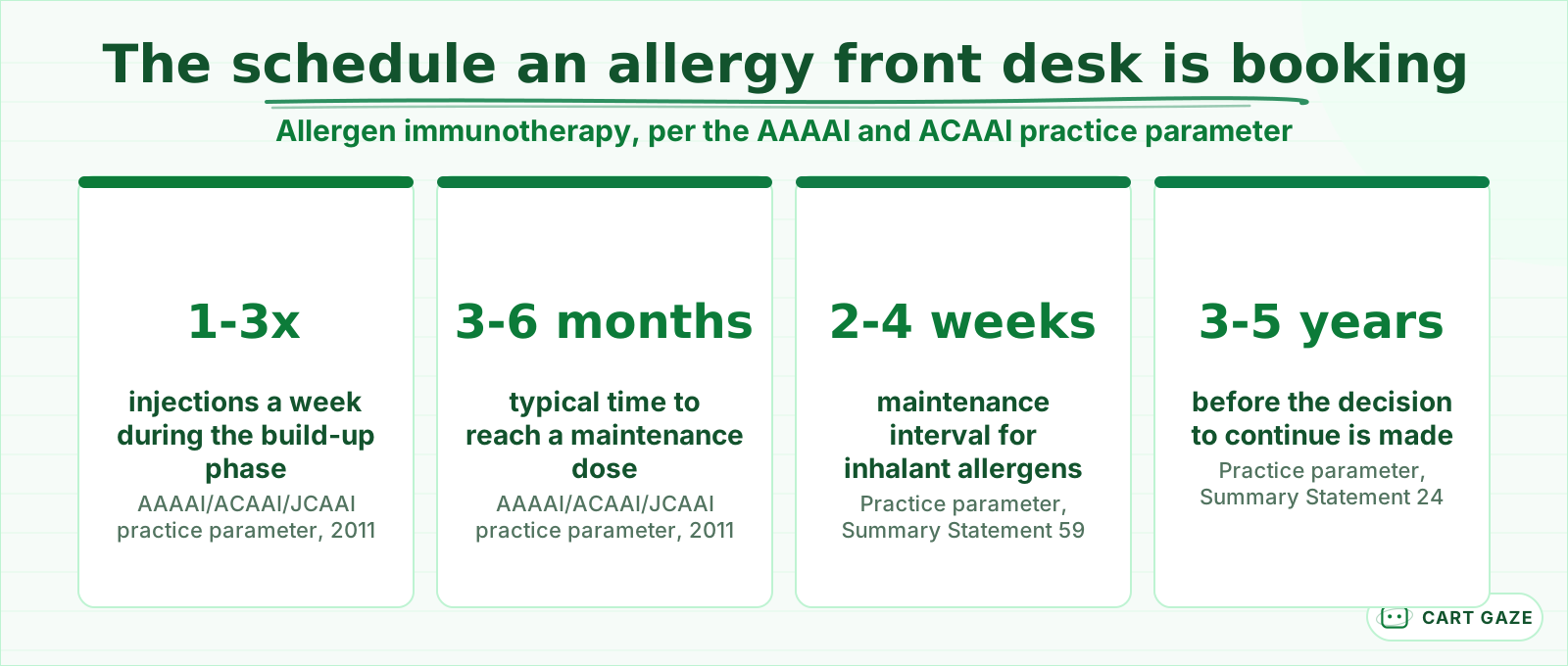 Every figure comes from the AAAAI and ACAAI practice parameter. One patient, dozens of booked visits.
Do the arithmetic once and the volume stops being abstract. A patient on a weekly build-up who reaches maintenance in 6 months books roughly 26 injection visits before the first maintenance appointment arrives. Run 50 patients through immunotherapy at the same time and you are booking, moving, and reminding well over 1,000 injection visits a year. That figure is modeled from the ranges in the practice parameter, so run it against your own panel, but the order of magnitude holds for any practice with a busy shot room.
Almost none of those visits needs a clinical conversation to schedule. The patient knows why they are coming. The slot type never changes. The same person calls every week for months, often about the same two things: moving Thursday to Friday, or asking whether they can come at lunch.
That combination, high frequency and low complexity, is the strongest automation candidate on a medical phone line. It is also the reason a generic AI receptionist demo looks great here and then falls over, because the exceptions in a shot room are not administrative.
The 30-minute wait after a shot is a scheduling constraint
The practice parameter tells patients to stay in the office for at least 30 minutes after an immunotherapy injection so that a reaction can be recognized and treated promptly. That turns a 2-minute injection into a half-hour of chair time, and it is the number your booking rules have to respect.
Higher-risk patients, including anyone with a previous systemic reaction, may be asked to wait longer at the physician's discretion. Cluster schedules push it further: 2 or more injections are given per visit, typically about 30 minutes apart, which can reach a maintenance dose in as little as 4 weeks but stretches one visit past an hour.
Important
Your constraint is chairs, not needles. If the booking rules count the injection and not the observation period, the schedule looks fine on screen and the waiting room is full by 11 a.m. Book the whole block, and have the agent say the wait out loud on the call so the patient plans for it.
This is also the most common thing your front desk explains all day. A new immunotherapy patient asks how long it takes, hears "about five minutes", and is annoyed at minute 20. An AI receptionist that quotes the full block on every booking removes an entire category of complaint before it starts.
A missed shot is a dosing question, not a rebooking question
When a patient misses an injection week, the visit is easy to move and the dose is not. The parameter is blunt: no published evidence supports a specific dose change for treatment gaps, but it is customary to reduce the dose when the interval runs long. Your clinical staff owns that call.
How long is too long depends on the extract concentration, whether the patient has reacted before, and how far off the prescribed interval they are. A pilot study of 16 different missed-dose adjustment protocols found wide variation between practices, and half of them counted the delay from the last dose actually received while the other half counted from the missed scheduled date. Your protocol is one of many, and no phone agent can infer it.
Warning
An AI receptionist may rebook a missed injection and flag the gap on the chart. It must never tell a patient what dose they will get, or that missing a week is fine. Those are clinical decisions, and a confident wrong answer on the phone becomes a dosing error in the shot room.
Missed weeks are also where courses quietly die. In a retrospective study across 7 Italian allergy centers, 26.8% of patients on a conventional 7-injection build-up were still in treatment at 3 years, against 63.4% of those on an abbreviated 4-injection schedule, and first-year dropout was 46.4% versus 9.1%. That is one non-US study of schedule design rather than a benchmark for your practice, but the direction is worth taking seriously: the build-up phase is where patients fall out, so a gap that nobody chases is often the end of the course.
Reaction calls, and the line an AI receptionist never crosses
Systemic reactions happen in roughly 0.2% of injections on conventional schedules, and 27% to 50% of them start after the 30-minute wait has ended. So your practice does take reaction calls from patients who are already home, and every one of them needs a person immediately, with no triage attempt in between.
| Call type | What an AI receptionist can do | What has to reach a person |
|---|---|---|
| Routine injection visit | Book or move the full slot, including the wait | Nothing, unless the patient mentions a past reaction |
| Missed build-up week | Rebook and flag the gap on the chart | The dose decision, every time |
| Reaction after leaving the office | Say to call 911, then connect a human | The entire call, immediately |
| Biologic or prior authorization status | Log the request and route it with a callback | The approval, the date, and any appeal |
| Question about holding a medication | Take the details and route to nursing | The instruction itself |
The reaction rule has to be absolute, because a phone script that asks "how severe is it?" has already started triaging. Epinephrine is the treatment of choice in anaphylaxis, and nothing about that decision belongs on a phone tree. The correct behavior is short: tell the caller to call 911, get a clinician on the line, ask nothing else.
That boundary is the same one every safe deployment draws, and it is worth understanding before you evaluate vendors. What an AI receptionist actually does and where it stops sets out the general version of it. The allergy-specific part is that your emergency call has a known clinical trigger, so you can test the routing against real scenarios instead of hoping.
Staffing to a pollen curve, and the biologics calls under it
Your call volume is seasonal in a way most specialties are not, and the curve is predictable. The base rates are large: 25.2% of US adults and 20.6% of children had a diagnosed seasonal allergy in 2024, per the National Health Interview Survey. When the pollen arrives, the phones follow.
The season is not fixed, either. EPA's ragweed indicator covers 11 North American monitoring sites and reports season length through 2015, with a statistically significant lengthening trend at 7 of them. Planning against last decade's calendar understates the shoulder weeks.
Tip
Forecast from your own allergen calendar, not from last year's staffing. You know roughly when tree, grass, and ragweed season start in your area, so the surge is schedulable. An AI receptionist absorbs the extra call volume without seasonal hiring, but it must respect chair capacity, or you have traded a phone queue for a full waiting room.
Underneath the seasonal noise sits a slower, heavier call type. Injectable biologics for asthma and chronic urticaria bring prior authorization and specialty pharmacy coordination, and those callers want status rather than a booking. Under the CMS Interoperability and Prior Authorization Final Rule, impacted payers must return decisions within 72 hours for expedited requests and 7 calendar days for standard ones, starting 1 January 2026. An agent can capture the request and route it. It cannot promise an approval or a date.
What to automate, and what to keep with the people who know your patients
The recurring injection booking is the right thing to automate and the shot room conversation is not. Volume and repetition make the booking a fit for an AI receptionist. Your staff know the weekly regulars by voice, and a change in one of them is often the first clinical signal anyone gets.
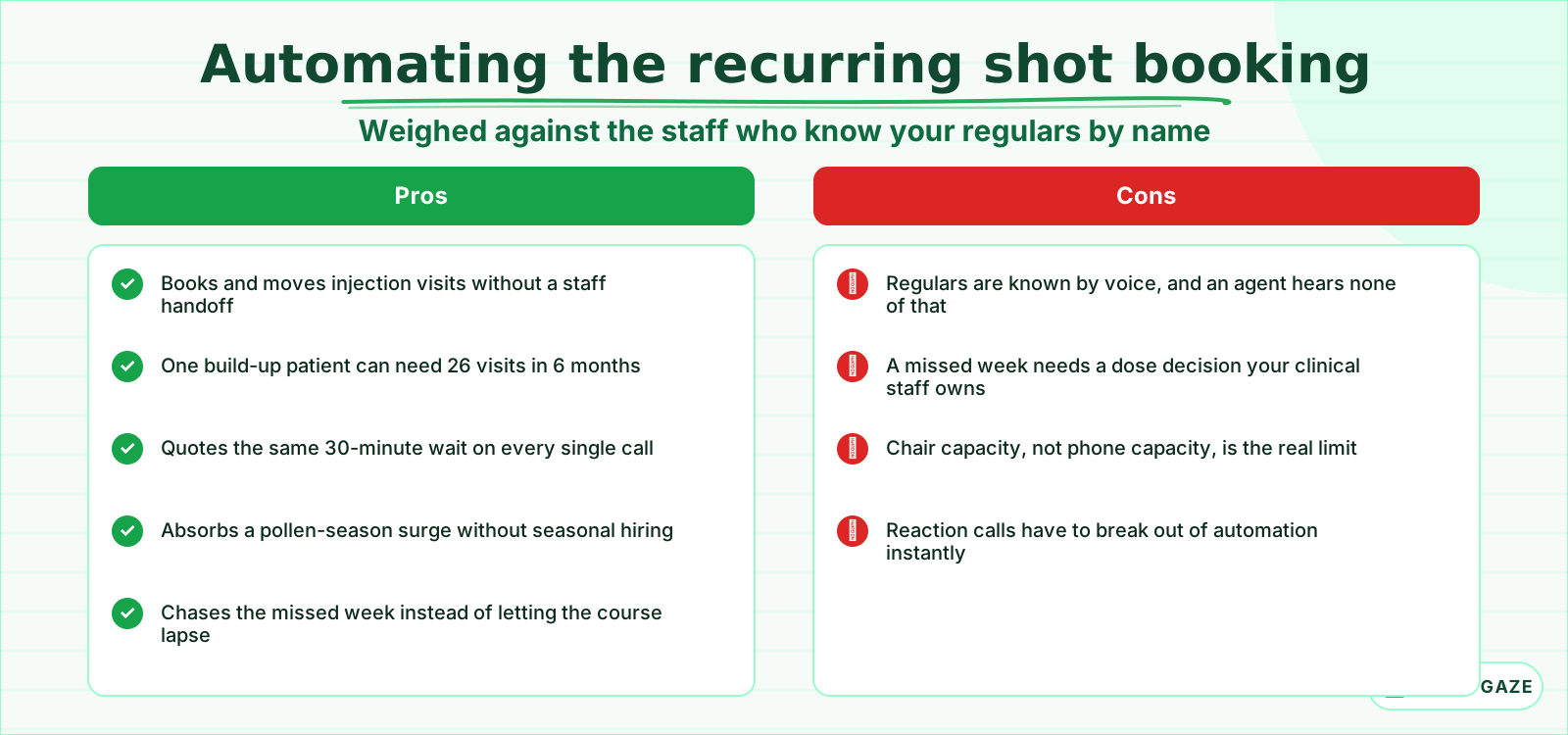 The volume argues for automation. The relationship argues against. Both are real.
A workable split looks like this. Automate the routine injection booking, the reschedule, the appointment reminder, the hours and location questions, and the new patient inquiry that ends in a testing appointment. Keep the dose, the reaction, the shot room conversation, and anything about holding a medication with your people.
The mechanics of the recurring booking and its reminders are worth getting right on their own, and we walk through them in AI appointment scheduling and reminders. One more thing to plan for: a large share of allergy patients are children, so the person on the phone is usually a parent booking for someone else, which changes both the verification and the tone. The pediatric version of this problem goes into that in detail.
Set it up against your own shot schedule
Configure against your real injection schedule rather than a demo script, then pilot narrowly. Start with routine injection rescheduling only, for 30 days, with the reaction path and the dose path hard-routed to staff from day one. Read the transcripts yourself in week one, and measure rebooked visits in your own schedule.
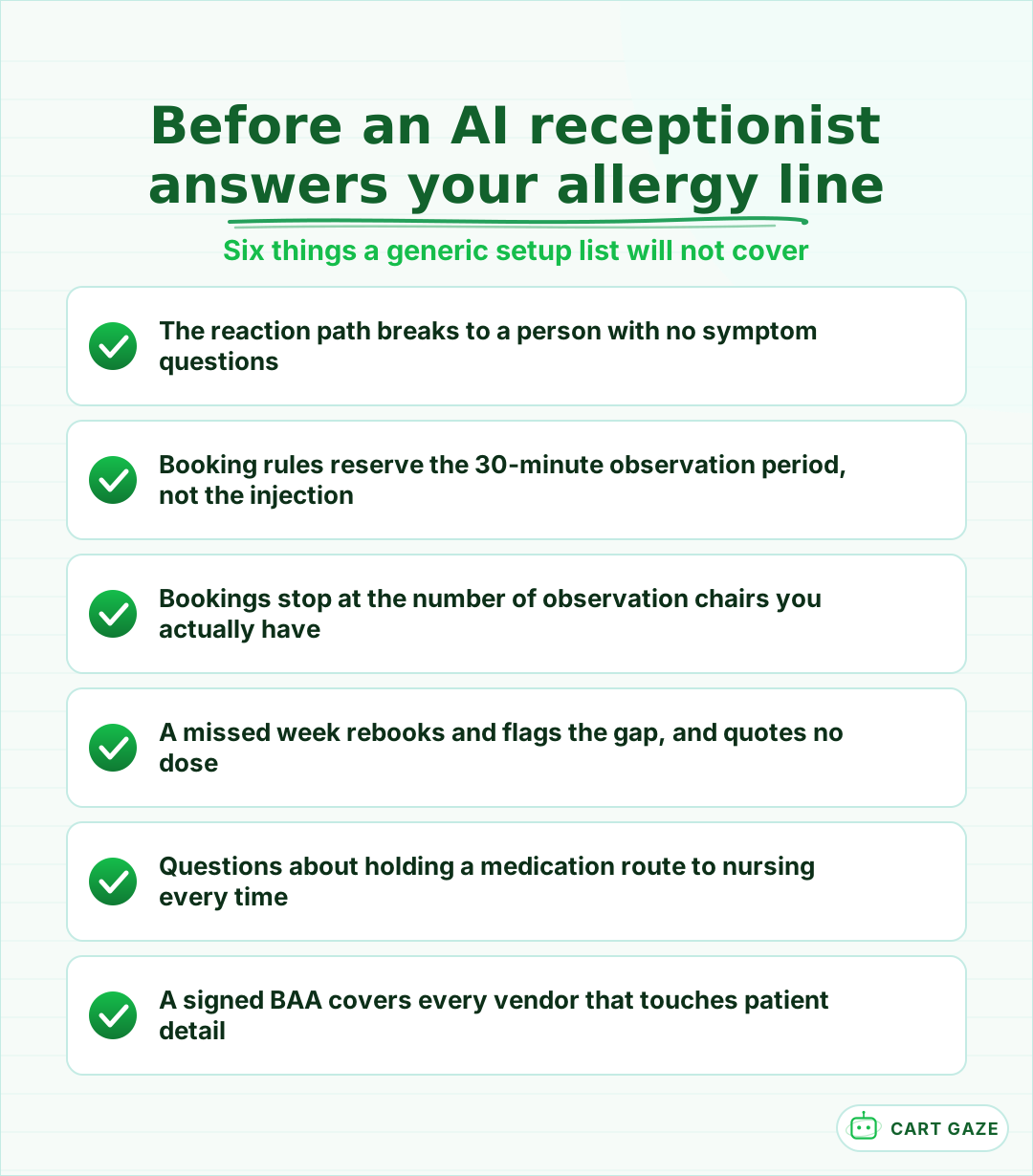 Six checks specific to an allergy line, not a generic go-live list.
The failure mode to watch for is not a rude agent. It is a helpful one. An agent trying to be useful will answer a dose question, reassure a patient about a missed week, or book past the number of observation chairs you have. Every one of those is a configuration choice you make before go-live, not a bug you find afterward.
Pre-flight for an allergy phone line
- A signed BAA is in place before any patient detail reaches the system.
- The reaction path is tested with real wording patients use, not clean sample scripts.
- Booking rules count the 30-minute observation period, and stop at your chair capacity.
- Someone reads a full week of transcripts before you widen the pilot.
On the compliance question, treat it as a contract and configuration matter. Any vendor touching patient details is a business associate and needs a signed Business Associate Agreement. Be skeptical of any page advertising itself as "HIPAA certified", because that certification does not exist.
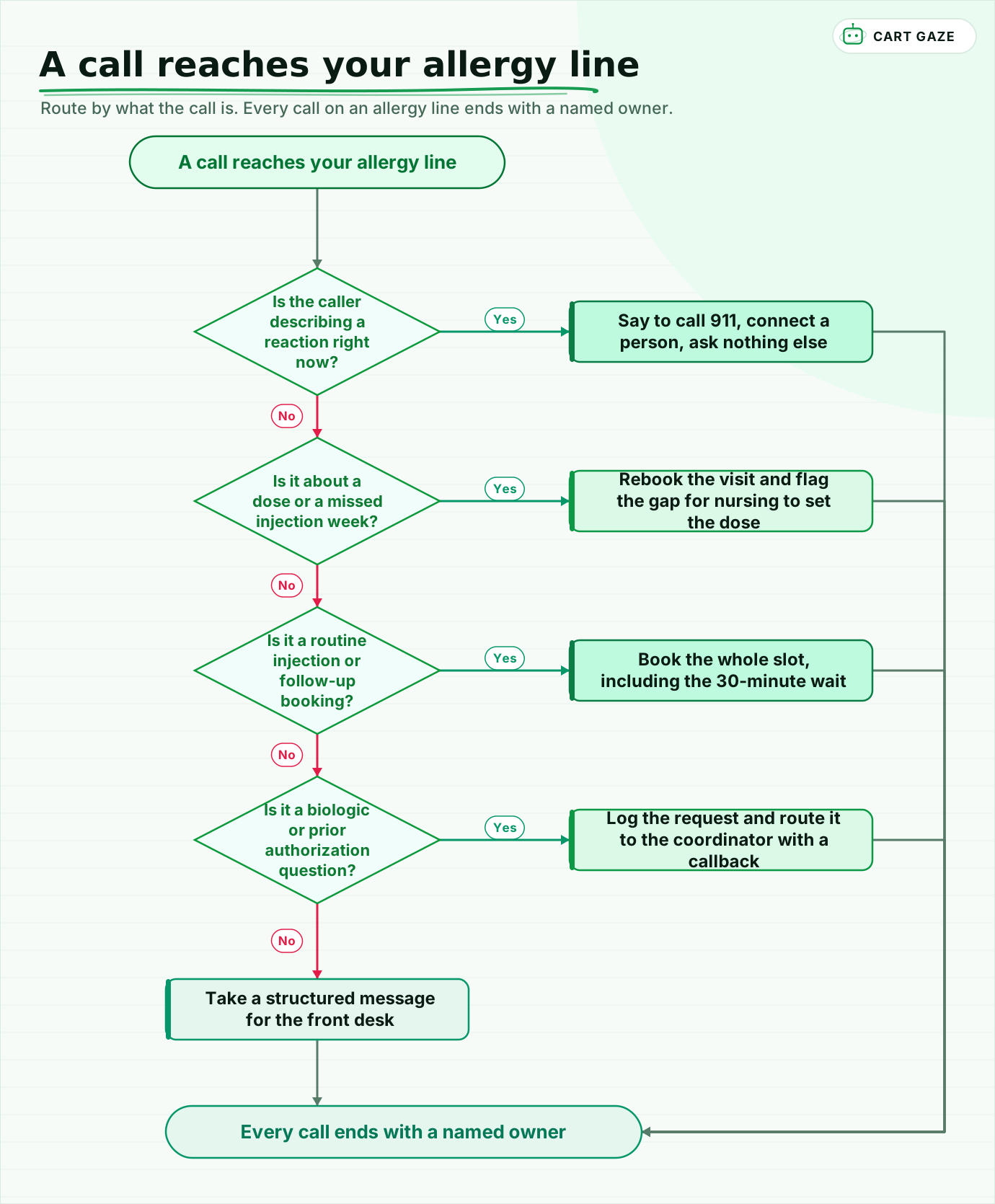 Route by what the call is. Every call on an allergy line ends with a named owner.
Walk the flow once against your own calls. A reaction goes to 911 and a human. A dose or missed-week question gets rebooked and flagged for nursing. A routine injection gets the whole slot booked, wait included. A biologics question gets logged and routed with a callback. Everything else becomes a structured message.
If you would rather see the size of the leak before you look at tools, the free Growth Leak Audit sizes it from your own numbers, including the injection visits that never got rebooked.
Fair questions.
Can an AI receptionist schedule allergy shots?
Yes, and recurring injection visits are the strongest fit on an allergy phone line. The slot type never changes, the patient knows why they are coming, and a build-up patient may book 1 to 3 visits a week for months. The agent should reserve the full block, including the 30-minute observation period, rather than the injection time alone.
What should happen when a patient misses an allergy injection week?
The visit gets rebooked and the gap gets flagged for clinical staff, who decide the dose. The AAAAI and ACAAI practice parameter notes there is no published evidence supporting a specific dose change for treatment gaps, and practices use widely different protocols. An automated agent cannot infer yours, so it must never state a dose or say a missed week is fine.
How does the 30-minute wait affect allergy appointment scheduling?
It turns a short injection into a half hour of chair time. The practice parameter asks patients to remain in the office at least 30 minutes so a reaction can be recognized and treated, and higher-risk patients may wait longer. Booking rules that count only the injection overfill the waiting room, so cap bookings at your real observation chair capacity.
Can an AI receptionist handle a call about an allergic reaction?
No, and it should not try. A caller describing a reaction gets told to call 911 and gets a person on the line, with no symptom questions and no severity scoring. Delayed systemic reactions account for 27% to 50% of reactions, so these calls arrive after the patient is home. Recognition and routing are the job, never assessment.
Is an AI receptionist for an allergy practice HIPAA compliant?
Compliance is a configuration and contract question rather than a product badge, and "HIPAA certified" does not exist. Any vendor handling patient details is a business associate and needs a signed Business Associate Agreement in place first. Ask what the system records, what it reads back on a call, how long it retains audio, and who can access it.
Sources.
- [1]Allergen immunotherapy: a practice parameter third update (AAAAI/ACAAI/JCAAI)
- [2]Adherence to allergen subcutaneous immunotherapy is increased by a shortened build-up phase
- [3]Diagnosed allergic conditions in adults: United States, 2024 (NCHS Data Brief 545)
- [4]Diagnosed allergic conditions in children ages 0-17: United States, 2024 (NCHS Data Brief 546)
- [5]EPA climate change indicators: ragweed pollen season, technical documentation
- [6]CMS interoperability and prior authorization final rule CMS-0057-F fact sheet
Written by

Muhammad Qasim Hammad
Founder, Cart Gaze
Qasim builds AI receptionists and front-office automation for medical and dental practices at Cart Gaze. Posts here start from published sources and real call data, not vendor claims, and every number links back to where it came from.
Keep reading.
 By Practice TypeAI Receptionist for Ambulatory Surgery Centers: Who Calls You11 min read
 By Practice TypeAI Receptionist for a Gastroenterology Practice: Prep Calls10 min read
 By Practice TypeAI Receptionist for an ENT Practice: The 14-Day Clock10 min read
 By Practice TypeAI Receptionist for Orthopedics: What It Fixes, What It Cannot10 min read
 By Practice TypeAI Receptionist for a Cardiology Practice: Safe Call Routing10 min read
 By Practice TypeAI Receptionist for Fertility Clinics: What It Must Never Do10 min read