
AI Receptionist for Ambulatory Surgery Centers: Who Calls You
A surgery center does not usually own the patient relationship, so a large share of its calls come from surgeons' offices posting cases and managing block time. Here is what that changes about automating the phone.
Key takeaways.
- A surgery center hosts other people's cases, so a large share of inbound calls come from surgeons' offices posting cases and managing block time rather than from patients.
- MedPAC counted 6,436 Medicare-certified surgery centers in 2024, growing over 2% a year since 2019, and about 68% of them run a single clinical specialty.
- At one academic hospital, day-of-surgery cancellations ran 2.02% with no structured pre-op contact and 0.60% after a preoperative nurse telephone screen.
- An automated line may read your written fasting, medication and escort instructions back verbatim, and must never adjust them: GLP-1 guidance reversed between 2023 and 2024.
- 42 CFR 416.52(c) requires discharge in the company of a responsible adult unless the attending physician exempts the patient, so the escort question is answerable from policy.
Table of Contents9 sections
- An ASC front desk answers other offices, not just patients
- What a surgeon's office needs when it calls to post a case
- The pre-op window is a clock with a case on it
- Fasting and medication questions are where automation stops
- Anesthesia, the ride home, and what is safe to confirm
- Three bills arrive and the patient calls the wrong one
- Count who actually calls you before you configure anything
- Match the phone to how a surgery center actually works
- Fair questions
The phone at an ambulatory surgery center rings, and the caller is not a patient. It is a scheduling coordinator at a surgeon's office, posting a case, changing a case, or asking whether Thursday's block is still held. An AI receptionist built to greet patients answers the wrong half of that phone.
There were 6,436 Medicare-certified surgery centers in 2024, and the sector grew by more than 2% a year between 2019 and 2024, according to MedPAC's March 2026 report to Congress. Almost none of them own the patient relationship. Cases arrive because somebody else's office decided to send them, which makes an ASC front desk a business-to-business line with a patient line attached.
This post covers what a surgeon's office actually needs when it calls, why the pre-op window is a clock with real money on it, and the boundary that matters more here than anywhere else in healthcare: an automated line may read out your written fasting and medication instructions, and it may never change them.
An ASC front desk answers other offices, not just patients
A surgery center hosts other people's cases. The surgeon's office finds the patient, posts the case, and owns the relationship, so a large share of inbound calls are office to office: coordinators posting cases, holding block time, chasing paperwork. Software built only to greet patients answers the wrong half.
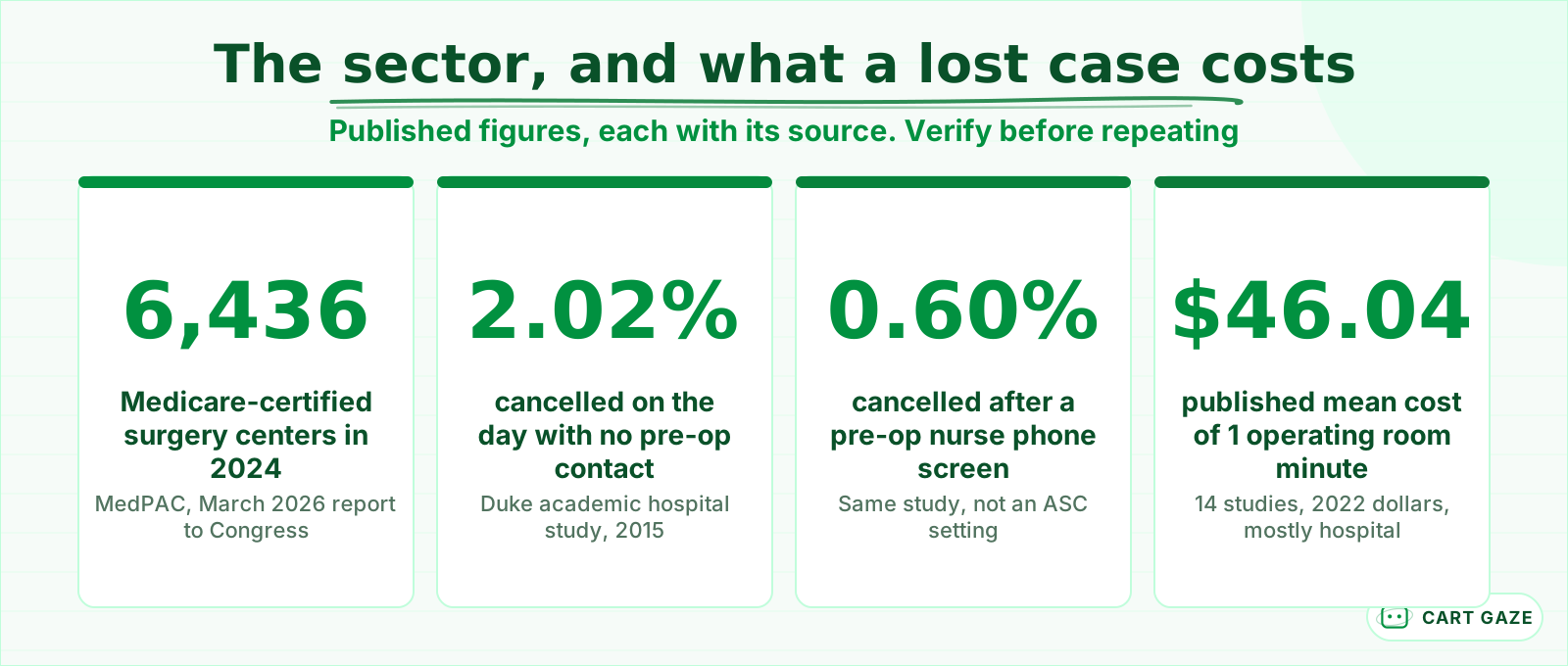 Published figures with their sources. Reasons to measure your own center, not your result.
The structural point is worth sitting with. A family practice that loses a call loses one patient. A surgery center that frustrates one scheduling coordinator loses a stream of cases from a surgeon it will never hear the complaint from, because the coordinator just posts the next case somewhere easier.
The risk concentrates further than most owners expect. MedPAC reports that about 68% of ASCs billing Medicare in 2024 specialized in a single clinical area. A single-specialty center draws from a narrow pool of referring surgeons, so the number of relationships holding up your schedule is small enough to count.
None of this shows up in a vendor demo, because the demo always plays a patient calling to book. Ask instead what happens when the caller opens with "I'm calling from Dr. Alvarez's office to post a case for the 14th."
What a surgeon's office needs when it calls to post a case
A scheduling coordinator calling your surgery center wants a case on the schedule, block time confirmed or released, and a named person reached without waiting. None of that is patient work, and none of it fits a phone tree that opens by asking whether this call is a medical emergency.
Look at how a real center writes it down. Sibley Ambulatory Surgery Center, part of Johns Hopkins, publishes physician instructions routing case posting through a dedicated Surgical Posting Department with its own phone and fax, alongside a named schedule coordinator and a posting supervisor. Three staffed contact points, none for patients.
The same document shows how governed block time is. Utilization is reviewed monthly, anything under 80% gets evaluated, unused block is automatically released 1 week before the block starts, and the surgeon's office is expected to release time at least 2 weeks out. Every one of those rules generates an office-to-office call.
So the honest split is narrow. An automated line can take structured case details, book a callback with your scheduler, confirm what is already on the schedule, and pass a release request through with the block, date and surgeon attached. It cannot accept a posting, approve a same-day change, or promise a room.
Important
A referring coordinator should never land in a queue or be asked to describe symptoms. If your system cannot recognize a professional caller in the first sentence, it will quietly train your best referrers to stop calling. The specialist practice at the other end of that relationship has its own version of this, covered in referrals in, post-op calls out.
The pre-op window is a clock with a case on it
Between the day a case is posted and the morning it runs, a fixed set of things has to happen, and every one of them is a phone contact that can fail. Coverage verified, authorization decided, written instructions delivered, receipt confirmed. Miss one and the case cancels on the day.
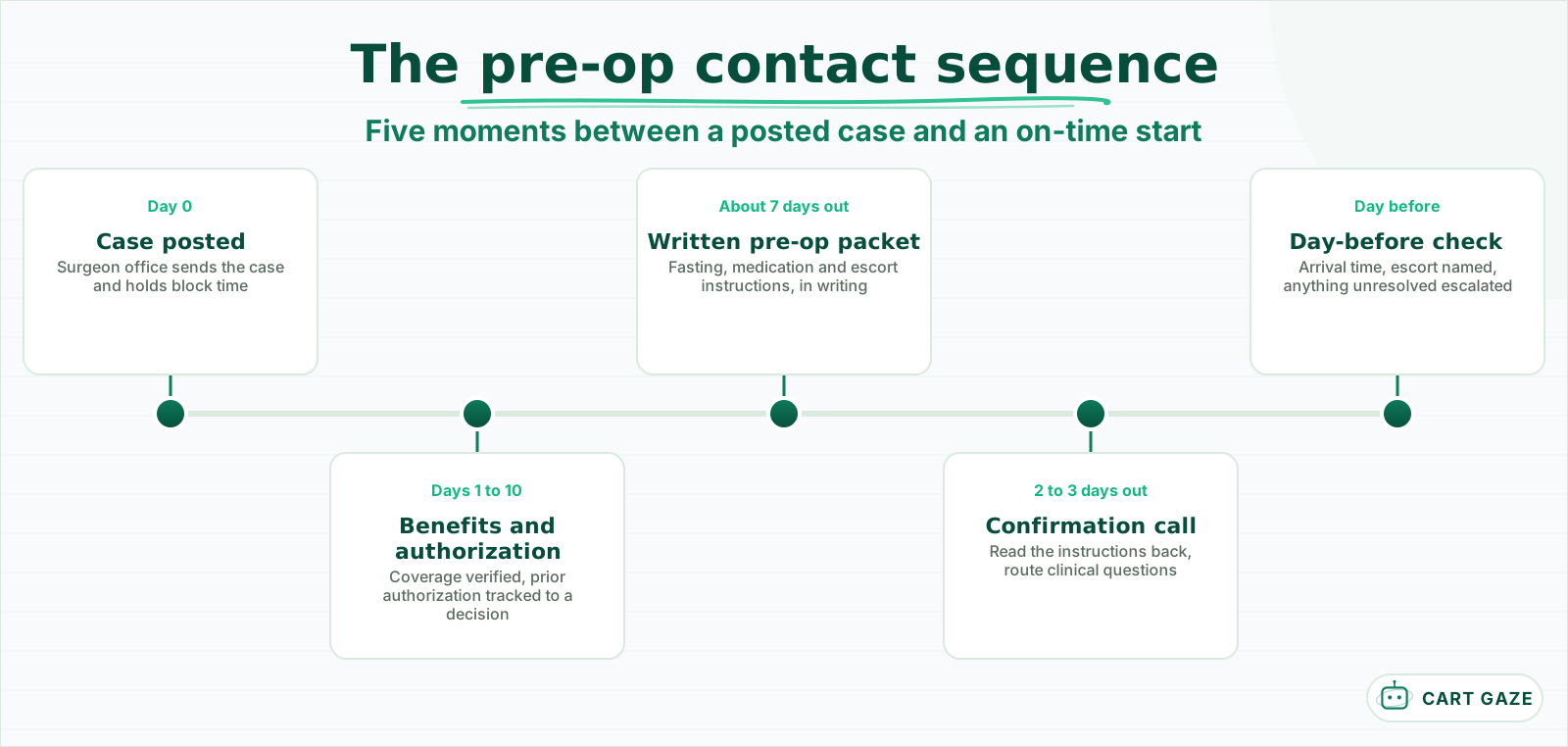 Every phase is a contact that can fail. A missed one shows up as a morning cancellation.
There is decent published evidence that the contact itself does the work. A Duke University Medical Center study of 14,893 elective cases found an overall day-of-surgery cancellation rate of 1.23%. Split by preparation, cancellations ran 2.02% with no structured preoperative assessment, 0.60% after a preoperative nurse telephone screen, and 0.48% after a comprehensive clinic visit. That was an academic hospital in 2013, not an ASC, so treat it as a reason to measure your own rate.
What the nurse screen consisted of is the interesting part: health history and current status, medication reconciliation, an explanation of the logistics of the day, and instruction on preoperative fluids. Most of that is delivery of written material and confirmation of receipt. The clinical review inside it is not.
A morning-of cancellation is expensive in a way an empty clinic slot is not, because the block minutes cannot be resold at that notice. A 2022 review of 14 published estimates put the mean cost of 1 minute of operating room time at $46.04, ranging from $14.50 to $131.65. Those are mostly hospital figures, so use them for order of magnitude.
The authorization leg deserves separate attention, because it is the step most likely to be sitting unresolved at day 10 while everyone assumes it cleared. The mechanics are in prior authorization automation.
Fasting and medication questions are where automation stops
An automated line may read your written, pre-approved pre-op instructions back to a caller and confirm they received them. It may not change a fasting window, advise on holding a medication, or decide whether a case can still proceed. Those are clinical judgments, and they route to a nurse.
This is not a cautious hedge. Recent history already tested the line. In 2023 the American Society of Anesthesiologists issued consensus guidance advising that GLP-1 receptor agonists be held before a procedure. In 2024, multisociety guidance approved by four surgical and gastroenterology societies moved to shared decision-making among the patient and the procedural, anesthesia and prescribing teams, with most patients continuing therapy.
Guidance that reversed direction inside 12 months is not something a script should answer at 9 p.m. The same goes for anticoagulants, insulin dosing on the morning of surgery, and the caller who took a sip of water at 6 a.m. and wants to know whether the case is off.
Warning
An automated line must never adjust a fasting interval, tell a caller to hold or continue a medication, or judge whether a patient is still a candidate. Your center's criteria for who can safely have surgery in an ambulatory setting, covering airway, sleep apnea, cardiac history and body mass index, are clinical determinations made by your anesthesia team.
The safe version is narrow and genuinely useful. The system states your written instruction verbatim, confirms the patient heard it, logs the confirmation, and hands everything else to a person. If you have not drawn that boundary before, what an AI receptionist does and where it stops is the general argument.
Anesthesia, the ride home, and what is safe to confirm
Escort rules, arrival times, and what to bring are policy questions with written answers, which makes them the safest work on a surgical line. Federal regulation already requires that a patient leaving your center after anesthesia goes with a responsible adult, unless the attending physician exempts them. That rule is quotable.
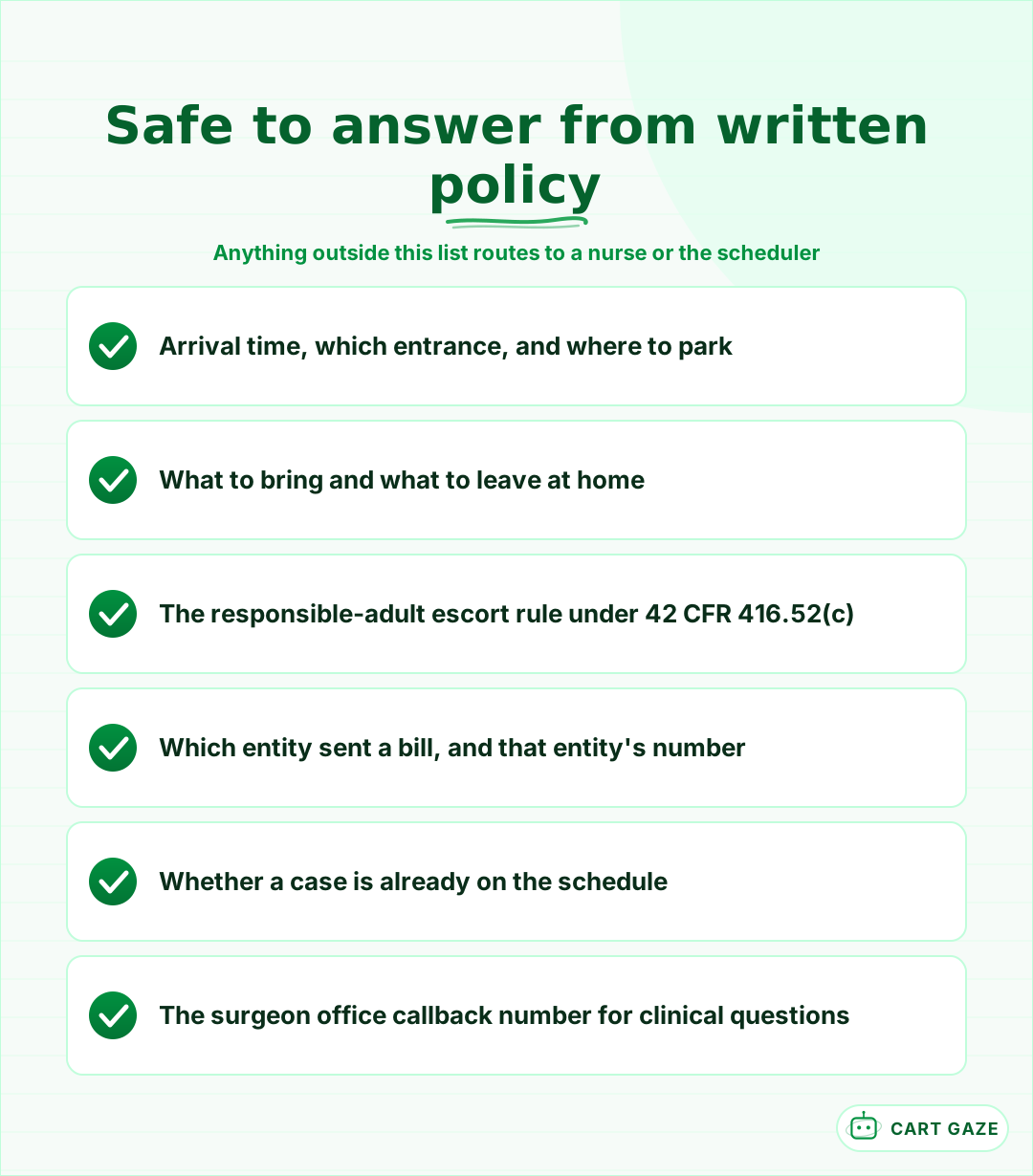 Written answers already exist for these. Anything outside the list routes to a person.
The regulation is 42 CFR 416.52(c), which also requires your center to give each patient written discharge instructions. Individual centers put it more plainly. Sibley's physician instructions state that a patient receiving anesthesia or sedation must be accompanied by a responsible adult at the time of discharge.
That phrasing matters because the escort question arrives in a dozen disguises. Can my husband drop me and come back. Can I take a rideshare home. Can my daughter wait in the parking lot. Each has one written answer your center already decided, and a busy desk at 4:45 p.m. gives a slightly different version every time.
Arrival time is the other underrated one. Patients confuse their arrival time with their surgery time, show up 90 minutes late for a 7:30 a.m. start, and turn an on-time case into a delayed one. Reading the time back and asking the caller to repeat it is work automation does consistently.
Three bills arrive and the patient calls the wrong one
A single case at your center generates bills from separate entities. Medicare pays the facility for room, nursing, recovery and supplies, and pays the surgeon and the anesthesia group under a different schedule. Patients see three envelopes and call whichever number they find first, which is usually yours.
| The bill came from | What it covers | Who can actually answer it |
|---|---|---|
| The surgery center | Facility services: room, nursing, recovery, drugs, supplies | Your billing office |
| The surgeon | The professional fee for performing the procedure | The surgeon's practice |
| The anesthesia group | Anesthesia professional services, billed separately | The anesthesia group's biller |
| An outside lab | Pathology on specimens sent out | The laboratory on the statement |
Under the structure described in MedPAC's payment basics, the ASC facility payment and the related physician services for surgery and anesthesia sit in different payment systems, and the beneficiary owes the Part B deductible plus 20% of the ASC rate. Several separate numbers land in one mailbox over several weeks.
Tip
Write one routing script per billing entity, with the callback number and one sentence on what that bill covers, and stop there. The moment your desk explains another organization's charge, a good-faith answer becomes a wrong one, and the patient repeats it to the surgeon.
Count who actually calls you before you configure anything
Three counts from data you already hold will tell you more than any vendor demo: what share of last month's inbound calls came from a physician office line, how many cases cancelled on the day and why, and how many pre-op callers asked a fasting or medication question.
Start with the first, because it decides whether any of this is worth doing. Pull last month's inbound numbers and mark the ones belonging to a physician practice rather than a mobile. If that share is meaningful, a system which cannot recognize a professional caller is disqualified regardless of how well it books patients.
The second count needs the reason attached, not just the total. Cancellations tracing to a missed contact, a fasting error, a missing escort or an unresolved authorization are the ones a better phone process touches. Cancellations from a real change in a patient's condition are not.
The third count is the one nobody runs. Every fasting or medication question that reached a nurse was an interruption on a clinical day, and the volume tells you what a routing rule is worth before you pay for one.
Before an automated line answers your center
- Referring offices reach a scheduler or a callback slot, never a hold queue.
- Your written pre-op and discharge instructions are loaded word for word.
- Fasting, medication and candidacy questions route to a nurse with no assessment.
- A signed BAA is in place before any patient detail reaches the vendor.
Match the phone to how a surgery center actually works
The routing rule is simpler than most vendors make it sound. Clinical questions go to a nurse. A surgeon's office reaches a scheduler without waiting. Anything your written policy already answers gets read back verbatim. Everything else gets handed to whichever entity actually owns it, with the number.
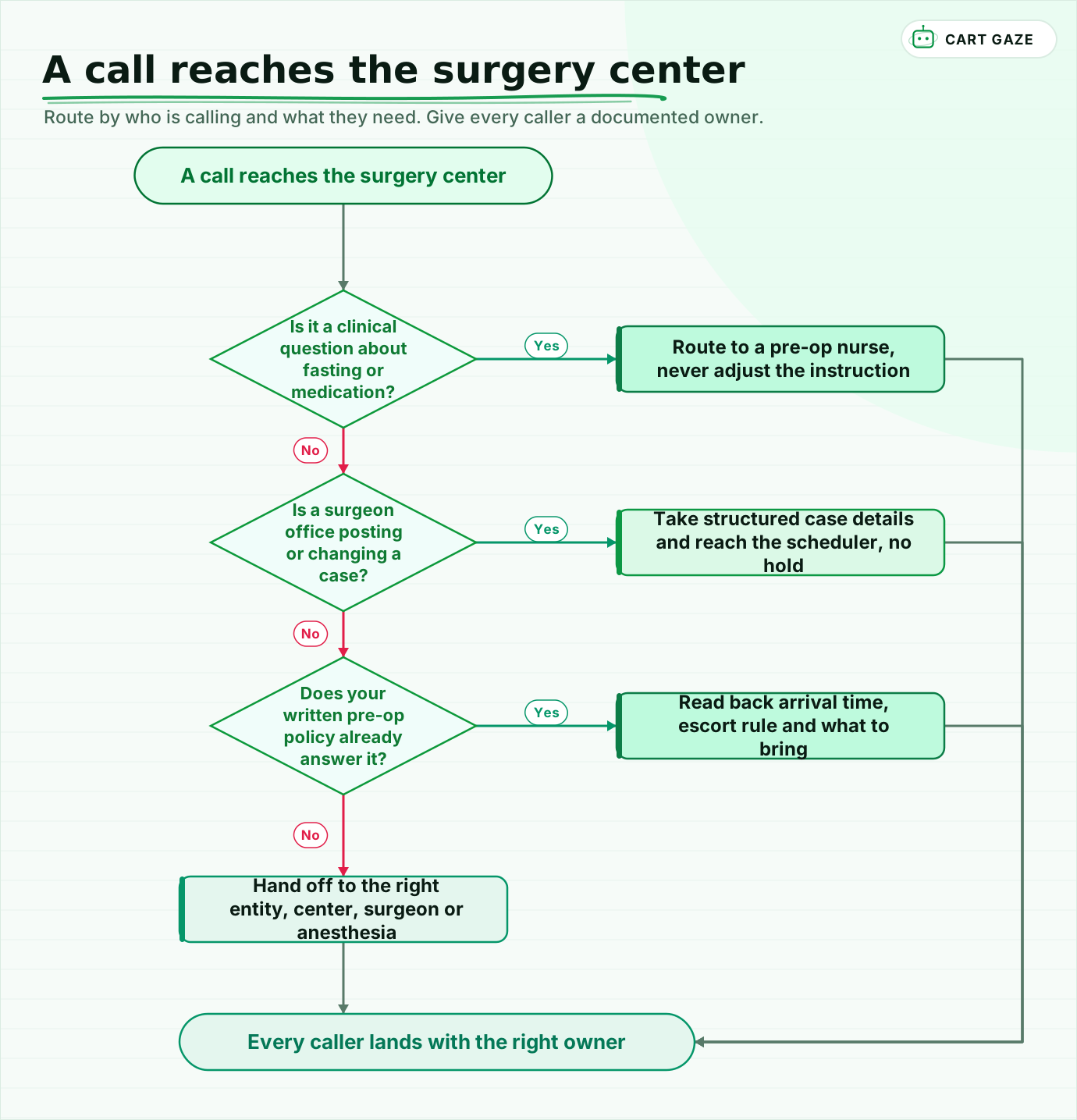 Route by who is calling and what they need. Give every caller a documented owner.
Walk it once. Fasting and medication go to a person every time, with no judgment applied on the way. A posting or change from a surgeon's office reaches your scheduler without a queue. A question your own policy answers gets the policy answer. Anything left is a handoff with a name and a number attached.
Pilot the office-to-office lane first. It carries the least clinical risk, the failure mode is a callback rather than a safety event, and it is the lane your competitors are ignoring. On compliance, "HIPAA compliant" describes a configuration plus a signed Business Associate Agreement, and "HIPAA certified" does not exist, whatever a sales page says.
Then re-measure. Day-of cancellations and block utilization are numbers your center already tracks, so read them again after 60 to 90 days and see whether anything moved. If you would rather size the phone-side loss first, the free Growth Leak Audit works from your own numbers.
Fair questions.
How is an AI receptionist for a surgery center different from one for a clinic?
A clinic owns its patient relationships. A surgery center hosts cases that other practices send, so a large share of its calls are office to office: a scheduling coordinator posting a case, releasing block time, or chasing paperwork. A system that only knows how to greet patients and offer appointment slots strands exactly the callers who bring the work.
Can an AI receptionist answer fasting or NPO questions before surgery?
It may read your written, pre-approved instructions back to the caller and confirm they were received. It may not shorten or extend a fasting window, advise on holding a medication, or decide whether a case can still proceed. Those are clinical judgments. GLP-1 perioperative guidance changed between 2023 and 2024, which is exactly why a script should not be answering.
Can an automated line post a case for a referring surgeon's office?
It can capture structured case details, confirm what is already on the schedule, book a callback with your scheduler, and pass a block release through with the date and surgeon attached. It should not accept a posting outright, approve a same-day case change, or promise a room, because those decisions depend on staff and equipment availability.
Will an AI receptionist reduce day-of-surgery cancellations?
No vendor can promise that. What is published is that structured preoperative contact helps: at Duke, cancellations ran 2.02% with no structured assessment against 0.60% after a nurse telephone screen. That was a hospital in 2013, not a surgery center, and the study measured a nurse call, not automation. Measure your own rate and reasons first.
Is an AI receptionist HIPAA compliant for an ambulatory surgery center?
HIPAA compliance is a configuration plus a signed Business Associate Agreement, not a product badge, and "HIPAA certified" does not exist. Any vendor touching patient details is a business associate and must sign a BAA. Ask what the system records, what it reads back on a call, how long it retains audio, and who can access it.
Sources.
- [1]MedPAC, Report to the Congress: Ambulatory surgical center services status report (March 2026)
- [2]Day of surgery cancellation rate after preoperative telephone nurse screening or comprehensive optimization visit
- [3]Cost of operating room time is $46.04 per minute (literature review)
- [4]42 CFR 416.52: Conditions for coverage, ASC patient admission, assessment and discharge
- [5]Sibley Ambulatory Surgery Center: General Information for Physicians (case posting and block time)
- [6]Multisociety clinical practice guidance for the safe use of GLP-1 receptor agonists in the perioperative period
- [7]MedPAC Payment Basics: Ambulatory surgical center services payment system
- [8]2023 ASA Practice Guidelines for Preoperative Fasting (modular update)
Written by

Muhammad Qasim Hammad
Founder, Cart Gaze
Qasim builds AI receptionists and front-office automation for medical and dental practices at Cart Gaze. Posts here start from published sources and real call data, not vendor claims, and every number links back to where it came from.
Keep reading.
 By Practice TypeAI Receptionist for Allergy and Immunology: Shots on Schedule11 min read
 By Practice TypeAI Receptionist for a Gastroenterology Practice: Prep Calls10 min read
 By Practice TypeAI Receptionist for an ENT Practice: The 14-Day Clock10 min read
 By Practice TypeAI Receptionist for Orthopedics: What It Fixes, What It Cannot10 min read
 By Practice TypeAI Receptionist for a Cardiology Practice: Safe Call Routing10 min read
 By Practice TypeAI Receptionist for Direct Primary Care: Protect the Promise10 min read