
Patient Callback Requests: How to Offer, Staff and Automate Them
A callback request swaps hold time for a promise. Here is when to offer one, what window to promise, how to staff the queue, and why the returned call so often goes unanswered.
Key takeaways.
- Offer a callback inside the queue once waits pass 30 to 60 seconds, and state a specific window such as within 2 hours rather than as soon as possible.
- Pew Research found 80% of US adults do not generally answer unknown numbers, so return calls from your main practice number and always leave a voicemail.
- Keep callback voicemails to the practice name and a callback number, as HHS OCR suggests, and close each request after 3 attempts with an outcome code.
- Clinical callbacks run on a faster clock: a triage vendor targets 5 minutes for emergent calls and 15 for urgent ones, so symptom calls skip the callback queue.
- Move routine requests to a text-back link or an AI receptionist that finishes them on the first call, and keep callbacks for requests that need judgment.
Table of Contents7 sections
"Press 1 and we will call you back" rescues a caller from hold, and it breaks the moment nobody calls back inside the window you promised, or the call comes from a number the patient will not answer. That second failure is more common than practices expect: Pew Research found 80% of US adults do not generally answer calls from numbers they do not recognize.
Most advice about callbacks stops at switching the feature on. This post covers the parts that decide whether it works: when to offer it, what window to promise, how to staff the queue so callbacks happen, how to get the patient to pick up, and which requests should never wait for a callback because a text-back or an AI receptionist can finish them on the first call.
When a callback request beats holding
A callback request beats holding when your wait is long enough that callers start giving up, usually past the first 30 to 60 seconds. The caller keeps their place in line and hangs up; your team returns the call in order. It moves the work to later, so it helps only if callbacks get made.
Vendor guidance puts the line in roughly the same place. virtualQ, which sells callback software, tells its customers that when waits run under 20 seconds a short hold does no harm, and that where waits are long, offering the callback after 30 seconds is reasonable. Mindful, another callback vendor, reports from its own customer data that callers who choose a callback tolerate about twice the wait, and that virtual queues cut offered calls by 20% on average because repeat dials and abandons drop out. Both are vendors describing their own products, so treat those figures as a starting setting rather than a promise.
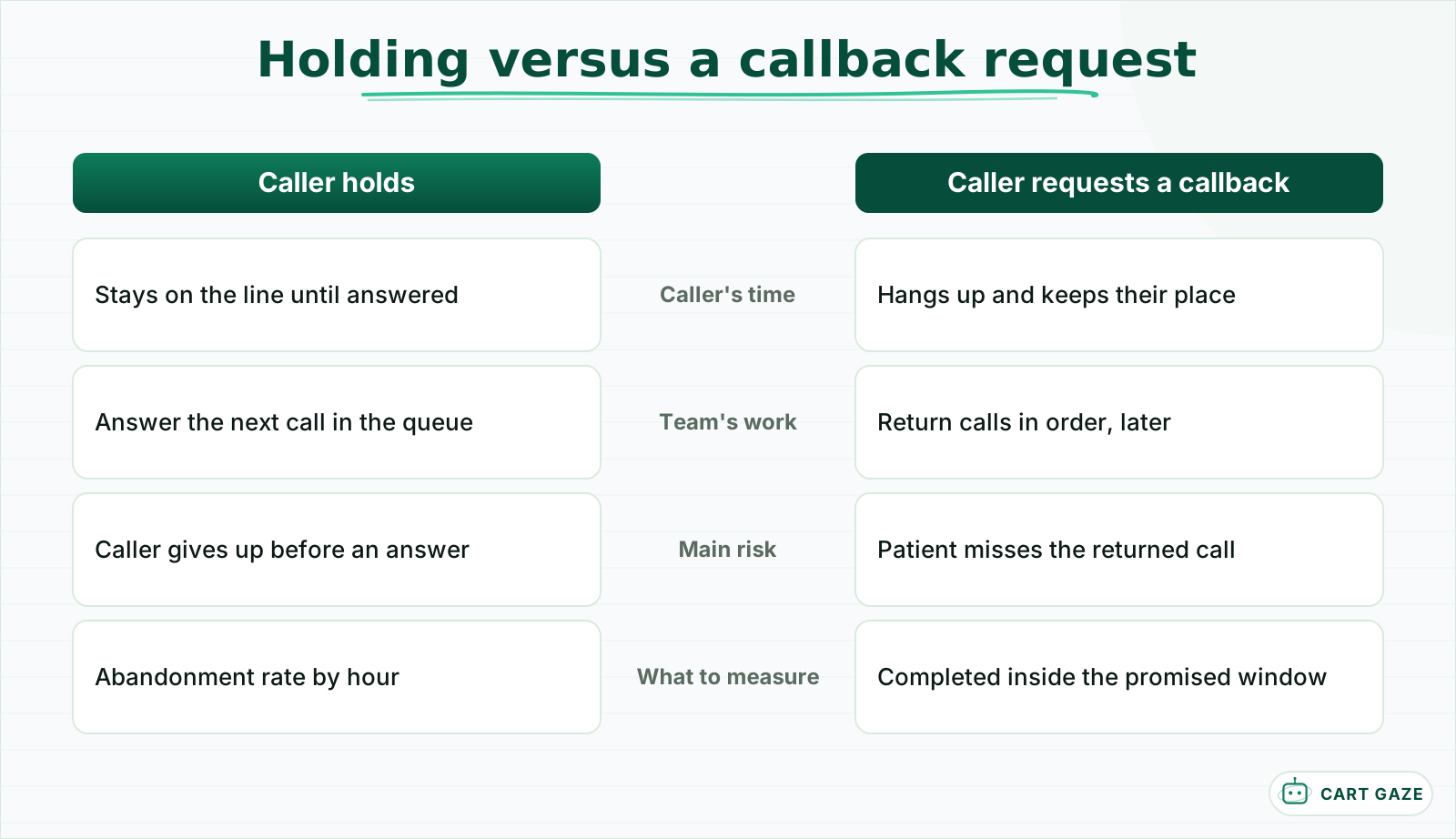 A callback trades an abandoned call for a returned one. It pays off only if the return happens.
The offer itself is simple. After a set wait, the queue plays something like "To keep your place in line, press 1 and we will call you back at this number." The system records the caller's number and position, and the call ends. Most cloud phone systems can do this, sometimes as a paid add-on, so check yours before buying anything new.
Put the offer inside the queue, after the wait has started, rather than as a menu option up front. An extra choice at the top of a phone tree is one more branch between the patient and a person, which is the problem covered in why medical office phone trees fail.
Phone access is not a niche worry. In MGMA's December 2025 Stat poll of 236 medical groups, 22% named phone access their top patient-access priority for 2026, behind no-shows at 27% and online scheduling at 24%, and MGMA lists callback options among the fixes practices are adopting.
What to promise: the callback window
Promise a window you can keep every day, and say it in the offer: "within 2 hours" or "before 5 p.m. today," not "as soon as possible." Administrative callbacks have no published standard, so set yours from staffing. Clinical callbacks are a different queue with far shorter windows.
A vague promise is worse than none. "As soon as possible" sets the patient's clock to the next 10 minutes, so a callback at 3 p.m. feels like a missed call even though your team did exactly what it planned. A specific window turns the same 3 p.m. call into a kept promise.
Clinical callbacks run on their own clock. Nurse triage services work to tiers: TriageLogic, a URAC-accredited triage vendor, publishes targets of 5 minutes or less for emergent calls, 15 minutes or less for urgent calls, and 30 to 60 minutes for non-urgent ones, and reports its own median callback at under 12 minutes. A 2-hour window is fine for a reschedule and unacceptable for a symptom.
The administrative windows below are starting points to adjust to your staffing, not published standards. The clinical rows follow the triage vendor's targets.
| Callback type | Example requests | Window to promise | Who returns it |
|---|---|---|---|
| Scheduling | Book, reschedule, cancel | Within 2 hours, same business day | Front desk callback owner |
| Billing and insurance | Balance question, coverage question | Same day or next morning | Billing staff |
| Records and forms | Records request, form status | 1 business day | Front desk or records |
| Clinical, non-urgent | Medication question, result question | 30 to 60 minutes | Nurse or clinical staff |
| Clinical, urgent | New or worsening symptoms | No callback: transfer now | Clinician on duty |
Warning
Never let a symptom call wait in the scheduling callback queue. If a caller mentions new or worsening symptoms, the call goes to clinical staff now, or follows your emergency instruction, however long the queue is.
Why callbacks fail when the patient does not pick up
Many callbacks fail at the patient's phone, not your desk. Pew Research found 80% of US adults do not generally answer calls from unknown numbers, and 67% let them ring and check voicemail instead. A callback from an unfamiliar number, with no voicemail left, often reaches nobody at all.
Pew's survey of 10,211 adults ran in July 2020, and younger adults were more likely than older ones to pick up an unknown number, which is the opposite of what most practices assume about their patients. A 2022 Kantar survey commissioned by TNS, a company that sells branded caller ID, put the share who never answer an unrecognized mobile call at 75%, and found 79% would answer a call from their healthcare provider if the practice name and logo were displayed. That second figure comes from a vendor with a product to sell, but the direction matches Pew.
The practical rules follow from those numbers. Return calls from the main practice number the patient dialed, never a staff mobile or a direct line they have not seen. Set the outbound caller name with your carrier; many phones will show it and some will not. Leave a voicemail every time, because that is where two-thirds of people look. HHS's Office for Civil Rights suggests leaving only the provider's name and number and asking the patient to call back, so keep results, diagnoses, and visit reasons out of the message.
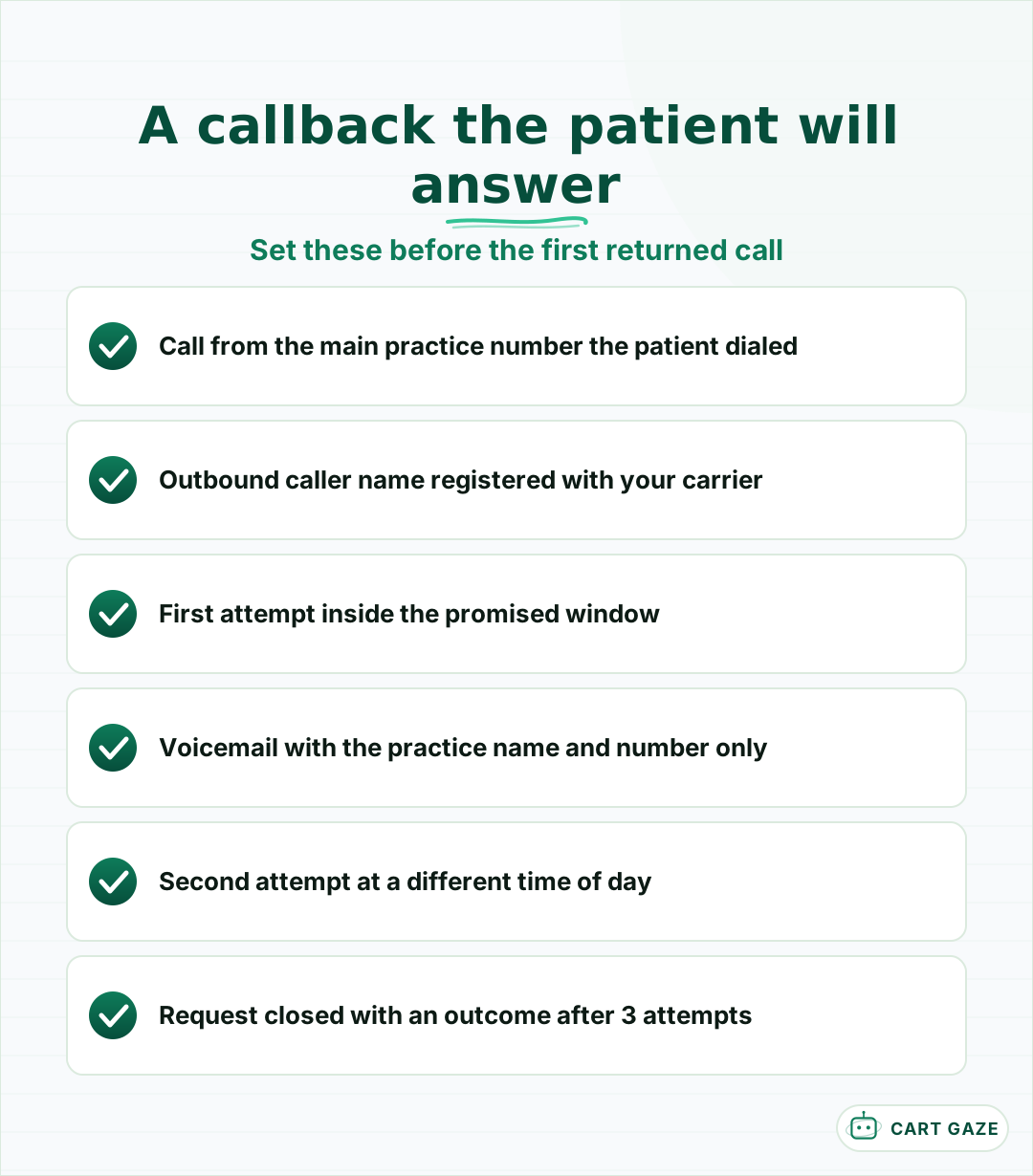 Most of these cost nothing. They decide whether the returned call reaches a person or a voicemail box.
Tip
If the patient has agreed to texts, one short message just before the call ("We are calling you back now from our main number") gives them a reason to pick up. Keep it free of any clinical detail.
The same patients who ignore an unknown number are the ones who hang up at your greeting rather than leave a message, which is the daytime gap covered in what voicemail costs a busy front desk.
How to staff the callback queue
Treat callbacks as scheduled work with one owner, not something staff fit in between rings. Give one person the queue for set blocks each day, work it in the order requests arrived, and close every request with an outcome. Without an owner, callbacks drift to the end of the day and miss the window.
Three short blocks usually beat one long one: after the morning rush, after lunch, and an hour before close, so no request waits more than a few hours. Size the blocks from your own volume. As an illustration, a queue that takes 20 callback requests a day at about 4 minutes each, voicemails included, is 80 minutes of work that has to sit somewhere on the schedule. If nobody's schedule shows it, it does not happen.
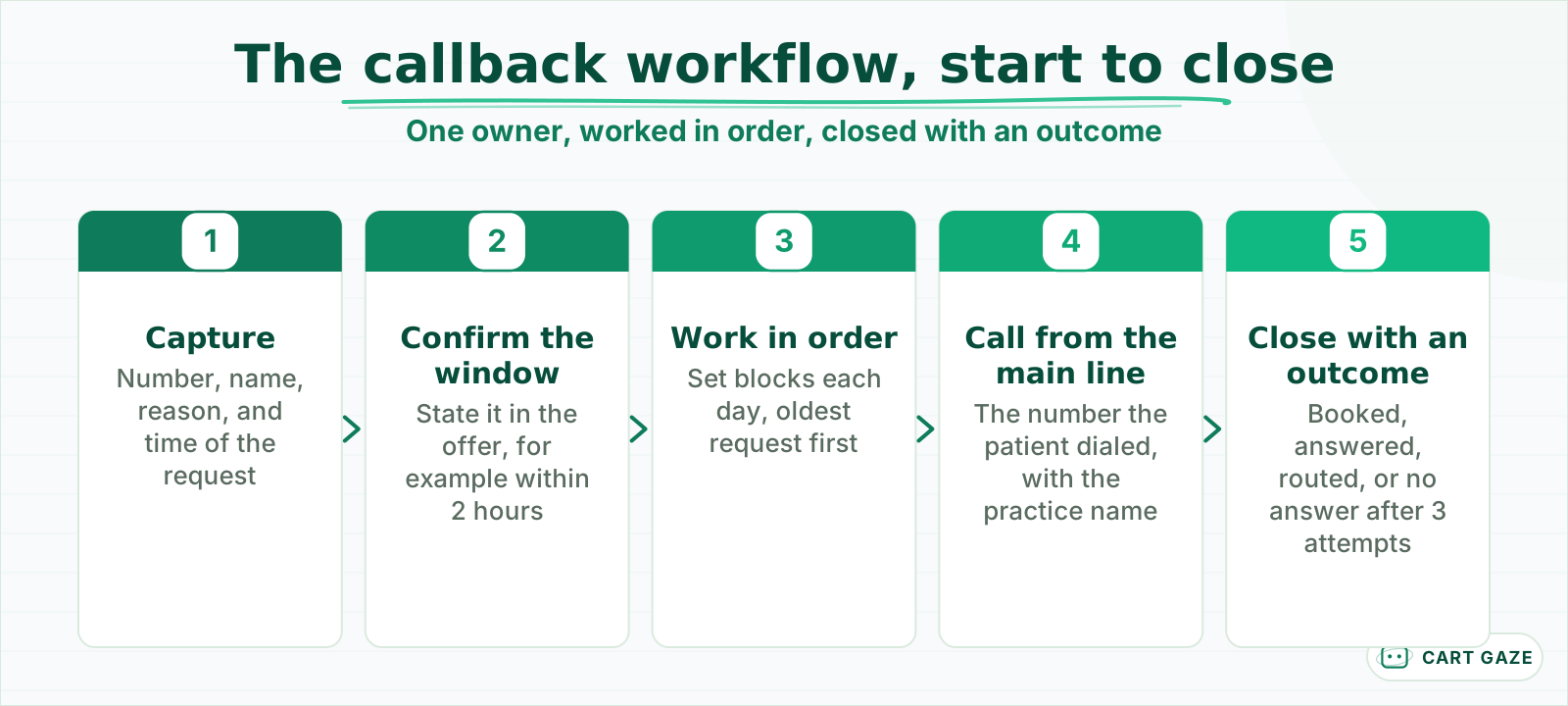 Every request ends with an outcome, so the queue never holds a promise nobody owns.
Work the queue oldest first, and make 3 attempts at different times of day before closing a request as unreached. Close each one with a code: booked, answered, routed to clinical staff, or no answer after 3 attempts. The codes are what let you measure the queue instead of guessing.
Four numbers tell you whether callbacks are working:
- Callback requests per day, divided by calls offered, to see how often waits trigger the offer.
- The share of callbacks completed inside the promised window.
- The share that reached the patient on the first attempt.
- The share that ended booked, answered, or routed, rather than closed unreached.
If completion inside the window falls below the level you are willing to defend to a patient, either shorten the promise to something you can keep or move routine requests out of the queue altogether.
Where a text-back or an AI receptionist replaces the callback
Many callback requests are routine: a reschedule, office hours, a refill status, a form. Those do not need a person at 3 p.m.; they need an answer now. A text-back link can finish some of them, and an AI receptionist can answer and complete them on the first call, leaving callbacks for complex requests.
Every callback is two touches and a second chance for the unknown-number problem. Removing the routine share from the queue shrinks the callback list to the calls that need judgment: a billing dispute, a referral question, a family juggling three appointments.
A text-back, sent only to patients who have agreed to texts, can carry a booking link or office hours when the call itself cannot be answered. An AI receptionist goes further. When it can read and write your schedule, it books, reschedules, and answers office questions while the caller is still on the line, and passes anything else to your desk with the caller's name and reason attached. What it does on a live call, and where it stops, is set out in what an AI receptionist does and where it hands off.
It must also know its limits. An AI receptionist routes every clinical, urgent, or distressed caller to a person and never assesses symptoms or gives medical advice.
Important
Anything that records or transcribes patient calls, including a callback feature that captures a spoken reason, handles PHI. Confirm the vendor will sign a BAA before it goes live on your patient line.
Before you switch on callback requests
- The promised window is in the recorded offer and on the owner's schedule.
- Callbacks go out from the main practice number.
- Symptom calls have a path that skips the callback queue.
- Voicemail wording names only the practice and a callback number.
Decide which calls get a callback offer
Offer callbacks only where a person must handle the call and the wait is long enough to lose callers. Route symptom calls to clinical staff now, finish routine requests on the first call where you can, and keep the callback for the complex middle. Then check completion inside the window monthly.
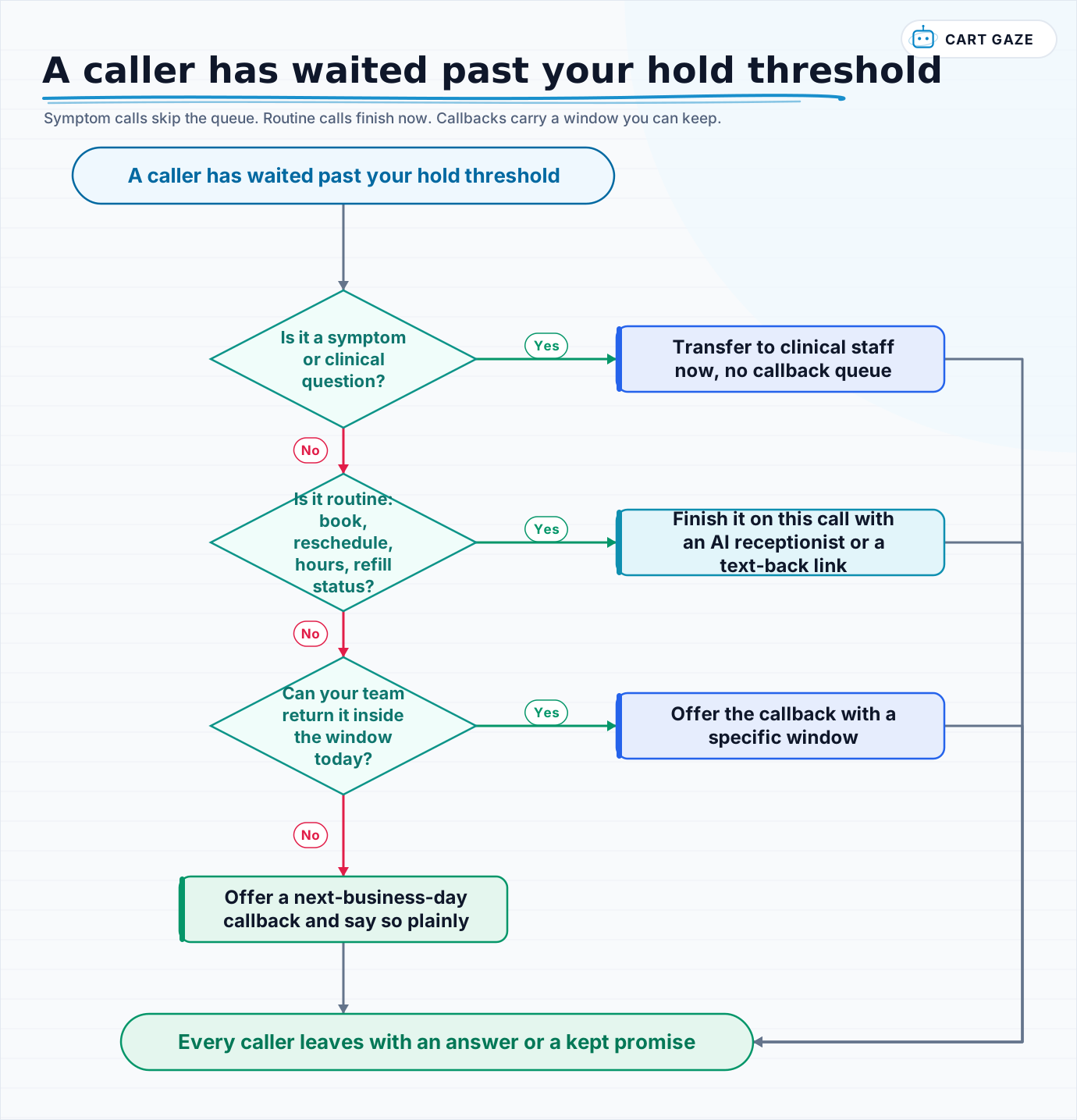 Symptom calls skip the queue. Routine calls finish now. Callbacks carry a window you can keep.
Walk the flow with your queue report open. Symptom calls never enter the callback queue. Routine requests get finished on the call. Everything else gets a callback with a specific window if your team can meet it today, and an honest next-business-day promise if it cannot. Re-check the four numbers each month, and tighten the window only when completion inside it holds.
To see how the routine share of a queue gets handled before it ever becomes a callback, what an AI receptionist does on a live call walks through a booking, a transfer to clinical staff, and a hand-off to your desk.
Fair questions.
What is a callback request on a medical office phone system?
It is an option offered to callers waiting in the queue: press a key, hang up, and keep your place in line while the practice calls you back. Most cloud phone systems include it, sometimes as an add-on. It replaces hold time with a returned call, so it only works when a named person returns those calls inside a promised window.
How soon should a practice return a patient callback?
For administrative calls there is no published standard, so promise a window you can keep every day, such as within 2 hours or before 5 p.m. and put it in the recorded offer. Clinical calls are different: nurse triage services target 5 minutes for emergent calls, 15 for urgent ones, and 30 to 60 minutes for non-urgent questions.
Why do patients miss callbacks from their doctor's office?
Most people screen unknown numbers. Pew Research found 80% of US adults do not generally answer them, and 67% check voicemail instead. A callback from a staff mobile or an unlisted line looks like spam. Return calls from the main number the patient dialed, set your outbound caller name, and always leave a short voicemail.
What can a practice say in a callback voicemail under HIPAA?
HHS guidance does not prohibit voicemails, but it asks practices to limit what they disclose. The Office for Civil Rights suggests leaving only the provider name and number and asking the patient to call back. Leave out results, diagnoses, and the reason for the visit, and say when you will try again if you do not hear back.
Can an AI receptionist replace callback requests?
For routine requests, often yes. An AI receptionist that can read and write your schedule can book, reschedule, and answer office questions on the first call, so those callers never enter the callback queue. It must route every clinical or urgent call to a person and never assess symptoms, and because it handles PHI, the vendor must sign a BAA.
Sources.
- [1]Pew Research Center: most Americans do not answer cellphone calls from unknown numbers (2020)
- [2]TNS survey (Kantar, 2022): 75% of Americans will never answer calls from unknown numbers
- [3]TriageLogic: nurse triage callback times for emergent, urgent, and non-urgent calls
- [4]virtualQ: how, when, and how often to offer callbacks
- [5]Mindful: the ultimate guide to customer callback
- [6]MGMA Stat: patient access priorities for 2026
- [7]AAFP Family Practice Management: HIPAA, answers to your frequently asked questions (2018)
- [8]HHS FAQ 198: may health care providers leave messages for patients at their homes
Written by

Muhammad Qasim Hammad
Founder, Cart Gaze
Qasim builds AI receptionists and front-office automation for medical and dental practices at Cart Gaze. Posts here start from published sources and real call data, not vendor claims, and every number links back to where it came from.
Keep reading.
 Missed Calls & Front DeskCall Hold Time Benchmarks for Medical Practices: When Callers Hang Up12 min read
 Missed Calls & Front DeskCall Volume Forecasting for Your Front Desk: Staff the Peak11 min read
 Missed Calls & Front DeskFront Desk Call Metrics Every Practice Should Track in 202610 min read
 Missed Calls & Front DeskPrescription Refill Automation That Keeps Providers in Control10 min read
 Missed Calls & Front DeskAfter-Hours Call Handling: Cover the 41% Nobody Answers11 min read
 Missed Calls & Front DeskMedical Office Phone Scripts That Book Patients: 6 Templates11 min read