
Running Late Text to Patients: When to Send It and What to Say
Patients wait about 13 minutes in the lobby and 10 more in the exam room, and satisfaction falls past 15. Here is when to send a running-late text, who gets it, and what it should say.
Key takeaways.
- Patients reported waiting 13.3 minutes in the waiting room and 9.6 in the exam room on average in PatientPoint 2024 survey of 11,009 patients.
- In a study of 4,216 orthopaedic visits, a wait over 15 minutes independently predicted a low Press Ganey score.
- Text patients due in the next 60 to 90 minutes who have not arrived once a provider runs 15 minutes behind, and offer rebooking at 30.
- Say the practice, the delay rounded up, that the visit is still on, and what the patient can do, in under 160 characters with no clinical reason.
- Running-late texts count toward the 3-a-week limit, and the rebooking path must work without a staff member picking up the phone.
Table of Contents8 sections
- How long patients wait, and how long they will tolerate
- Why telling patients early changes the wait
- The running-late workflow: trigger, threshold, text
- What the running-late text should say
- Offer a choice, not just an apology
- Where automation and an AI receptionist fit
- Decide your running-late rule
- Fair questions
A patient who leaves work early, finds parking, and then sits for 40 minutes does not remember the visit; they remember the wait. Most of that frustration is avoidable, not because the schedule never slips, but because nobody told them before they left home. PatientPoint's 2024 survey of 11,009 patients put the average waiting-room wait at 13.3 minutes, followed by another 9.6 minutes alone in the exam room.
A running late text to patients turns a surprise into a choice. This post covers how long patients actually wait and tolerate, why telling them early changes how the same wait feels, a running-late workflow with a trigger and a threshold, the wording that works, and where automation and an AI receptionist take the follow-up calls.
How long patients wait, and how long they will tolerate
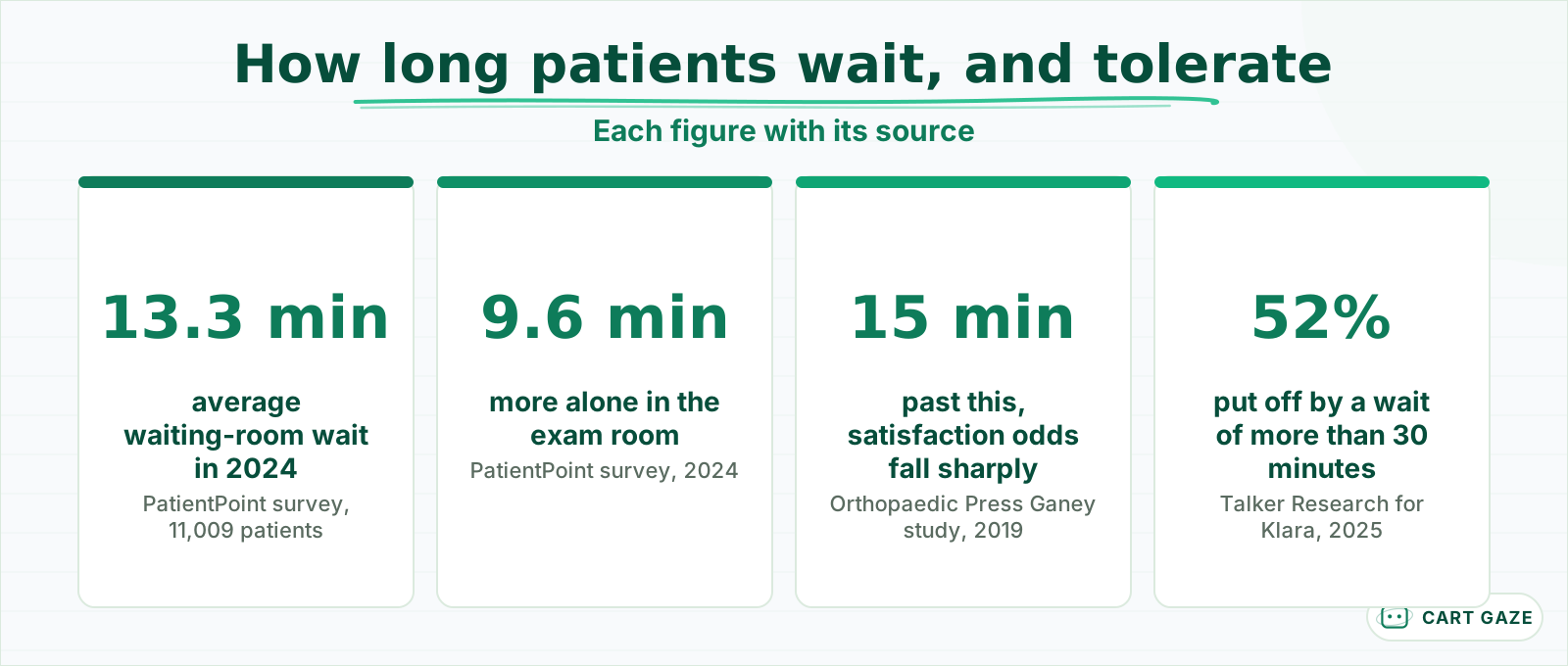
Patients wait about 13 minutes in the waiting room and another 10 in the exam room on an average visit. Satisfaction falls sharply once the total passes 15 minutes, and more than half of adults in one 2025 survey named a 30-minute wait as a reason to be put off a practice.
 Averages from surveys and one specialty study. Your worst afternoon is the one that counts.
PatientPoint's figures come from surveys of patients at physician offices using its waiting-room and exam-room programs: 13.3 minutes in the waiting room in 2024, up from 12.8 in 2023, and 9.6 minutes in the exam room, down from 11.4. Those are averages, and averages hide the afternoon that ran an hour behind.
The clearest link between waiting and satisfaction comes from a 2019 study of 4,216 new orthopaedic outpatient visits at one academic center, scored on the Press Ganey survey. The mean wait was 17.8 minutes. Compared with patients seen within 15 minutes, patients who waited 15 to 29 minutes had about a third of the odds of a satisfied score, and those who waited 30 to 59 minutes about a fifth. A wait over 15 minutes independently predicted a low score.
Tolerance shows up in consumer surveys too. In a May 2025 survey of 2,000 Americans run by Talker Research for Klara, 52% named sitting in the waiting room for more than 30 minutes as one of their top reasons to be instantly turned off a doctor's office.
Your own number is easy to find. Most practice management and EHR systems stamp when a patient checks in, when they are roomed, and when the provider opens the visit. Pull 4 weeks of those timestamps, subtract check-in from provider start, and look at the result by provider and by hour. The average will look fine; the late-afternoon sessions of one or two providers usually will not.
Important
The orthopaedic study measured one specialty at one academic institution. It shows the shape of the effect, not a threshold that will hold exactly for a family practice or a dental office. The 15-minute line is a sensible starting point, not a law.
Why telling patients early changes the wait
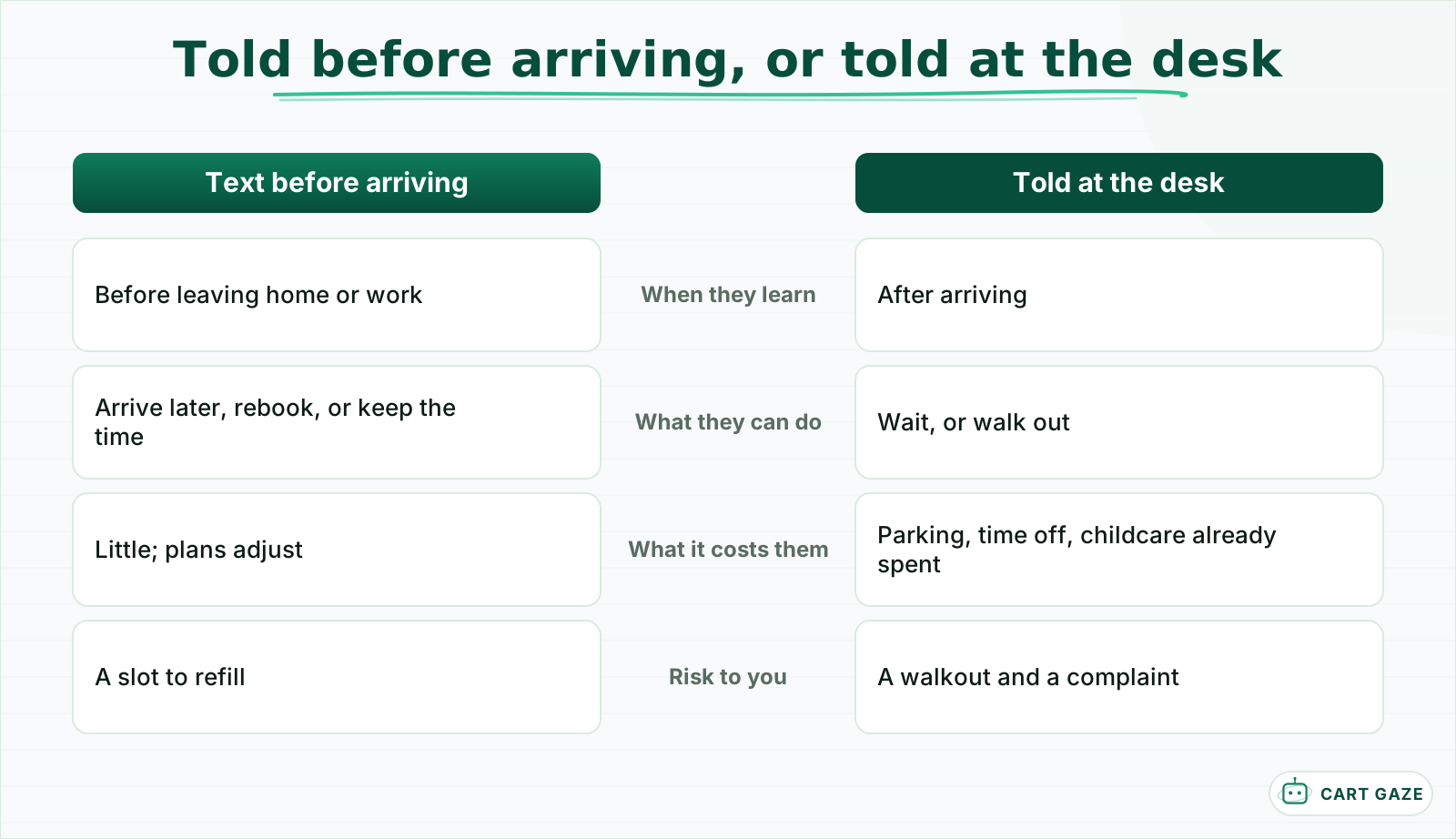
A wait the patient knew about before leaving home feels shorter and costs them less than one they discover in the lobby. A text sent early lets them arrive later, finish a task, or rebook. The same 30-minute delay, announced in advance, becomes 5 minutes in a chair instead of 35.
The orthopaedic study hints at this. It scored patients on whether they were "informed of any delays," and patients who waited under 15 minutes gave that item a perfect score 52.4% of the time, against 32.3% for those who waited longer. Long waits and poor communication about them arrived together.
 Same delay, different cost. The earlier the news, the more the patient can do about it.
There is a practical difference too. A patient who hears about a delay at the desk has already paid for parking, taken the time off, and arranged the childcare. A patient who hears about it by text an hour earlier can adjust all three. Arrival status matters here, and how practices capture it is covered in how patient check-in and arrival automation works.
The running-late workflow: trigger, threshold, text
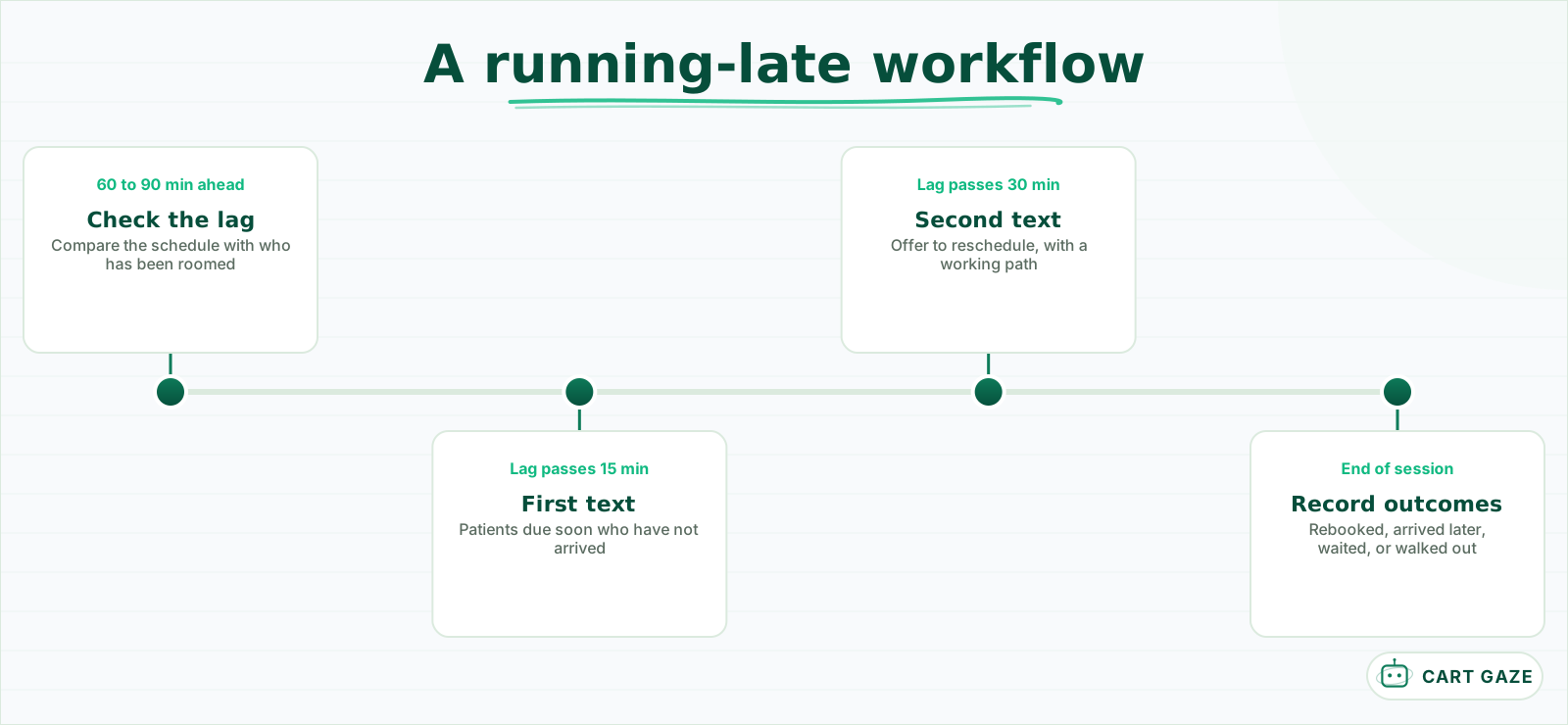
A running-late workflow needs three decisions: what triggers it, how late is late enough to text, and who gets the message. A workable default is to check each provider's lag an hour ahead, text when it passes 15 minutes, and send only to patients due in the next 60 to 90 minutes who have not arrived.
The trigger can be manual or automatic. Manual means the front desk or a medical assistant flags a provider as running behind and the system texts the next patients. Automatic means the scheduling or EHR system compares when the last patient was roomed with when they were booked, and flags the lag itself. Manual is easier to start and depends on someone remembering during the busiest hour.
Track the lag per provider, not per practice. One provider running 40 minutes behind while two others are on time is common, and a practice-wide text would alarm patients who have nothing to wait for. If the trigger is manual, give it one owner per session, usually the medical assistant working with that provider, since they know first when a visit is running long.
 Two texts at most per delay, each with a threshold behind it.
The threshold keeps the texts meaningful. A text for a 5-minute delay trains patients to ignore the next one. A 15-minute threshold matches where satisfaction starts to fall, and a second step at 30 minutes, with an offer to reschedule, covers the afternoon that really slips.
Who gets it matters as much as when. Patients already in the waiting room need a person to tell them, face to face. Patients due within the next hour who are still at home or at work are the ones a text can help. Patients booked later in the day usually do not need a text yet, because the lag may recover by then.
What the running-late text should say
The text should say who it is from, how late the provider is running, that the visit is still on, and what the patient can do: arrive later, keep the time, or reschedule. It stays under 160 characters, gives no clinical reason for the delay, and never promises a time you cannot keep.
| Delay | Message | Offer |
|---|---|---|
| 15 to 29 minutes | "[Practice]: Dr. [Name] is running about 20 min behind. Your visit is still on. Reply STOP to opt out." | Arrive a little later if you like |
| 30 minutes or more | "[Practice]: We are running about 40 min behind today. Call [phone] to reschedule, or come in as planned. Reply STOP to opt out." | Reschedule or keep the time |
| Back on schedule | "[Practice]: Good news, we are back on time. Please come in at your scheduled time. Reply STOP to opt out." | Keep the time |
Keep the reason generic. "Running behind" is enough; "an emergency with another patient" is true often enough to be tempting and says more about another patient than it should. Round the delay up, not down. A patient told 20 minutes who waits 15 is pleased; one told 10 who waits 25 feels misled twice.
The same wording discipline applies to the texts sent before a visit, and the full set of prep messages is covered in pre-visit patient prep automation.
Tip
Count running-late texts toward your weekly total. A confirmation, a reminder, and a running-late text in one week reach the 3-message weekly ceiling that the TCPA healthcare exemption allows per patient.
Offer a choice, not just an apology
The most useful running-late text offers the patient a real choice: keep the time, come later, or rebook without penalty. Patients who choose to rebook free a slot you could not use anyway, and patients who choose to wait do so knowingly. An apology alone asks them to absorb the delay.
The choice has to be real. If rebooking means calling a line that goes to voicemail, it is not a choice. The simplest version is a reply keyword or a link to an online rebooking page, with the reschedule written back into the schedule so the slot is not double-booked.
A walkout is the cost of not offering one. A patient who arrives, waits 45 minutes, and leaves without being seen has spent more than a patient who rebooked from home, and they are more likely to tell someone about it.
Two policies make the offer credible. First, never charge a late-cancellation or no-show fee for a visit the patient rebooked because you were running behind; the delay was yours. Second, put freed slots to work. A patient on your waitlist who wanted an earlier appointment can often take a slot that a running-late text just opened, especially later in the same week.
Where automation and an AI receptionist fit
Automation sends the text; an AI receptionist handles what happens next. When 6 patients get a running-late text at once, several call back at the same moment to ask or rebook. An AI receptionist can answer those calls together, reschedule into open slots, and pass anything clinical to staff.
The automatic trigger has a prerequisite: your scheduling system has to know when patients are roomed and seen, and your texting tool has to read that status. If the rooming timestamps are entered late or not at all, the lag the system calculates will be wrong, and a manual flag from the medical assistant will be more reliable until that is fixed.
That matters because the moment a provider runs behind is the moment the front desk is busiest. Patients in the lobby need attention, the phone is ringing, and the running-late texts produce their own wave of calls. An AI receptionist on those calls books the rebookings and answers "am I still on?" without pulling anyone from the desk. What it does on a live call, and where it stops, is set out in what an AI receptionist does and where it hands off.
It must route every clinical, urgent, or distressed caller to a person and never assess symptoms or give medical advice. A patient who asks whether they can safely wait until tomorrow is a clinical question, not a scheduling one.
Before you turn on running-late texts
- The trigger and the 15-minute threshold are written down.
- Only patients due soon, and not yet arrived, receive the text.
- The rebooking path works without a staff member picking up.
- Running-late texts are counted toward each patient's weekly total.
Decide your running-late rule
Start with a manual trigger, a 15-minute threshold, and a single text to patients due in the next hour who have not arrived. Add a second step at 30 minutes that offers rebooking. Measure how many patients rebooked, arrived later, or walked out, and adjust the threshold from your own numbers.
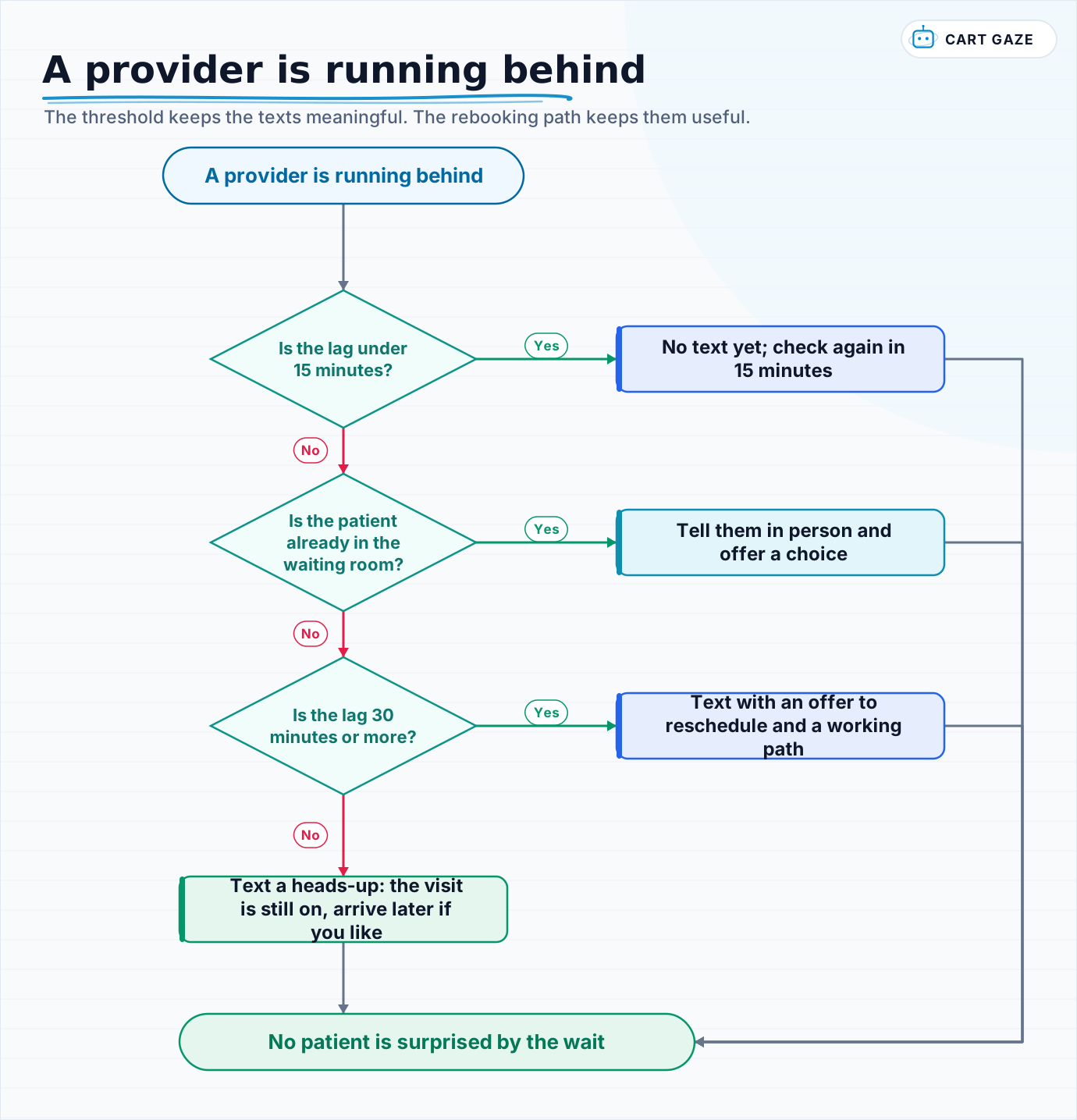 The threshold keeps the texts meaningful. The rebooking path keeps them useful.
Walk the flow with one provider's worst afternoon in mind. The rule should tell a patient something useful before they leave home, and never train them to ignore the next text.
How patient texting runs day to day, with opt-out enforced by the system, is set out in how patient texting works, and how opt-out is enforced.
Fair questions.
Should a medical practice text patients when running late?
Yes, once the delay is large enough to matter. A text sent before the patient leaves lets them arrive later, keep the time, or rebook, while the same news at the desk arrives after they have spent the time. A 15-minute threshold is a sensible start, because satisfaction falls sharply past that point in published data.
What should a running-late text to patients say?
Who it is from, roughly how late the provider is running, that the visit is still on, and what the patient can do. For example: "[Practice]: Dr. [Name] is running about 20 min behind. Your visit is still on. Reply STOP to opt out." Round the delay up, give no clinical reason, and keep it under 160 characters.
How long do patients wait at a doctor office on average?
PatientPoint 2024 survey of 11,009 patients at physician offices put the average at 13.3 minutes in the waiting room and another 9.6 minutes alone in the exam room. In a 2025 survey of 2,000 Americans, 52% named a waiting-room wait of more than 30 minutes as one of their top reasons to be put off a practice.
Who should receive a running-late text?
Patients due in the next 60 to 90 minutes who have not arrived yet. Patients already in the waiting room need to hear it in person, and patients booked later in the day usually do not need a text yet, because the delay may recover. Sending too many texts for small delays trains patients to ignore them.
Can an AI receptionist help when the schedule runs late?
It can handle the calls that running-late texts produce, answering several at once, rebooking patients into open slots, and confirming that visits are still on, so the front desk can look after patients in the lobby. It must route clinical or urgent questions to a person and never assess symptoms or give medical advice.
Sources.
- [1]PatientPoint: what is the average wait time for patients today (2024 survey)
- [2]Evaluating the impact of wait time on orthopaedic outpatient satisfaction using the Press Ganey survey (JBJS Open Access, 2019)
- [3]Talker Research: America's top 3 instant doctor's office turn-offs (for Klara, May 2025)
- [4]eCFR: 47 CFR 64.1200(a)(9)(iv), healthcare exemption conditions
Written by

Muhammad Qasim Hammad
Founder, Cart Gaze
Qasim builds AI receptionists and front-office automation for medical and dental practices at Cart Gaze. Posts here start from published sources and real call data, not vendor claims, and every number links back to where it came from.
Keep reading.
 No-Shows & Follow-UpAfter a No-Show: The Follow-Up Sequence That Brings Patients Back10 min read
 No-Shows & Follow-UpNo-Show Rate Benchmarks by Specialty: What the Studies Show10 min read
 No-Shows & Follow-UpPatient SMS Templates for Medical Practices, With Compliance Notes10 min read
 No-Shows & Follow-UpThe Intake Form Completion Chase: Paperwork Done Before Arrival11 min read
 No-Shows & Follow-UpHoliday Closure Communication: Keep Patients From a Locked Door10 min read
 No-Shows & Follow-UpAI Appointment Rescheduling: Make Cancelling Easy On Purpose12 min read