
After a No-Show: The Follow-Up Sequence That Brings Patients Back
In a 2024 trial, a letter alone brought back 11.6% of no-show patients within 30 days, and a next-day portal message nearly doubled it. Here is the full follow-up sequence, with fee rules by payer.
Key takeaways.
- In a 2024 trial of 362 no-show patients, 11.6% returned within 30 days after a letter alone and 22.2% when a portal message followed within 1 business day.
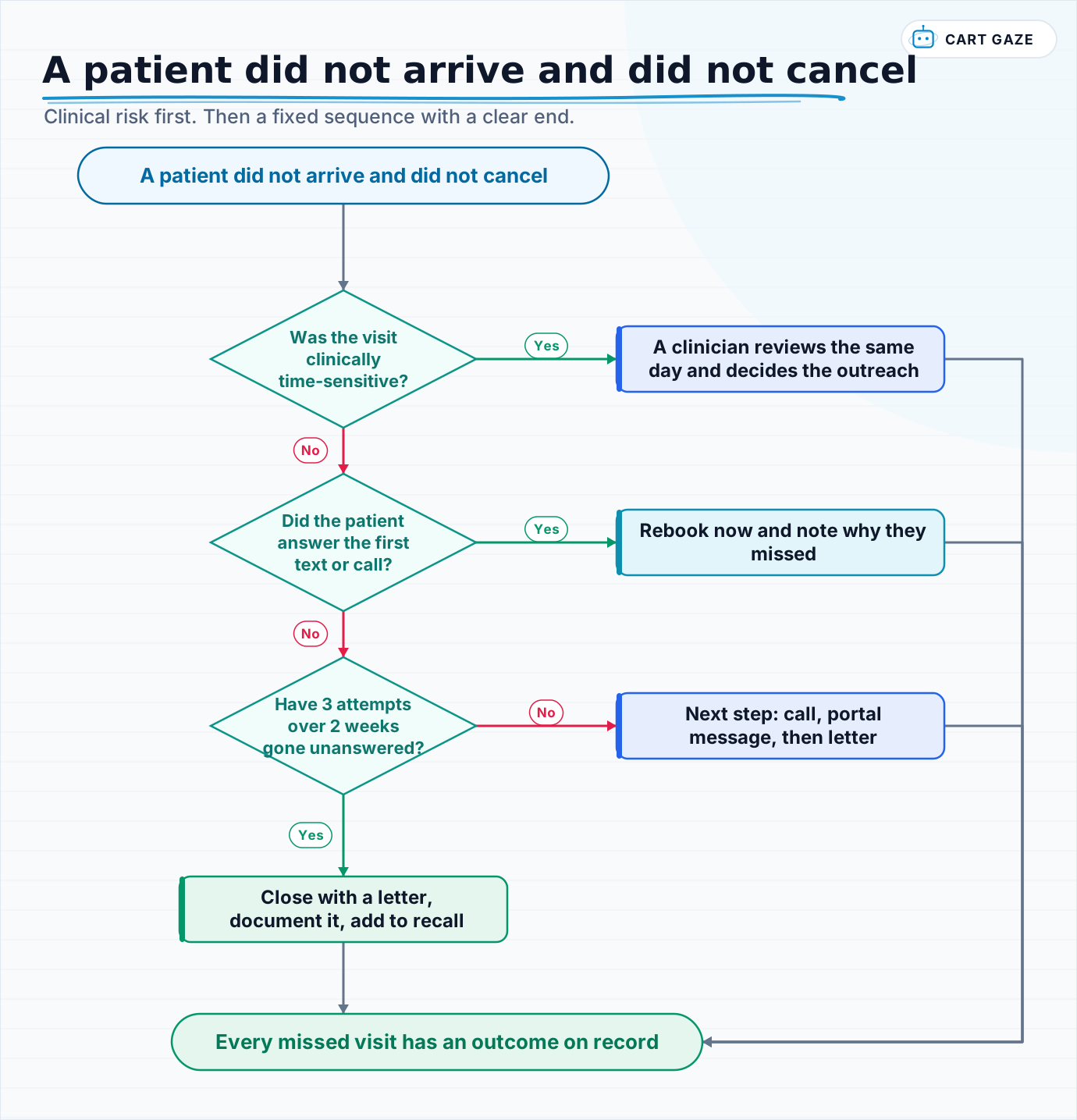
- Before any automated message, a clinician should review no-shows for time-sensitive visits and document every attempt to reach those patients.
- Run a short sequence: a same-day text, a next-day call and portal message, a second attempt at day 3 to 5, and a letter at about 2 weeks.
- Medicare patients may be charged a missed-appointment fee only if every patient is; Medicaid patients may not be charged at all.
- Stop after about 3 unanswered attempts over 2 weeks, close with a documented outcome, and move the patient to recall.
Table of Contents8 sections
When a patient misses an appointment, most practices mark the slot as a no-show and move on to the next patient. The patient still needs the visit, the practice still carries responsibility for their follow-up, and the longer nobody reaches out, the less likely they are to come back. In a 2024 randomized trial at an academic eye department, only 11.6% of no-show patients sent a standard mailed letter came back within 30 days.
No-show follow-up is a short, repeatable sequence. This post covers why the hours after a missed visit matter, the clinical check that comes before any automated message, a follow-up sequence of text, call, portal message, and letter, how to handle fees without breaking payer rules, when to stop, and where automation and an AI receptionist fit.
Why the hours after a no-show matter
The first business day after a missed visit is when a patient is most likely to rebook. A trial in an academic eye clinic found that adding a portal message within 1 business day nearly doubled the share of patients who came back within 30 days. Every day of silence lowers that share.
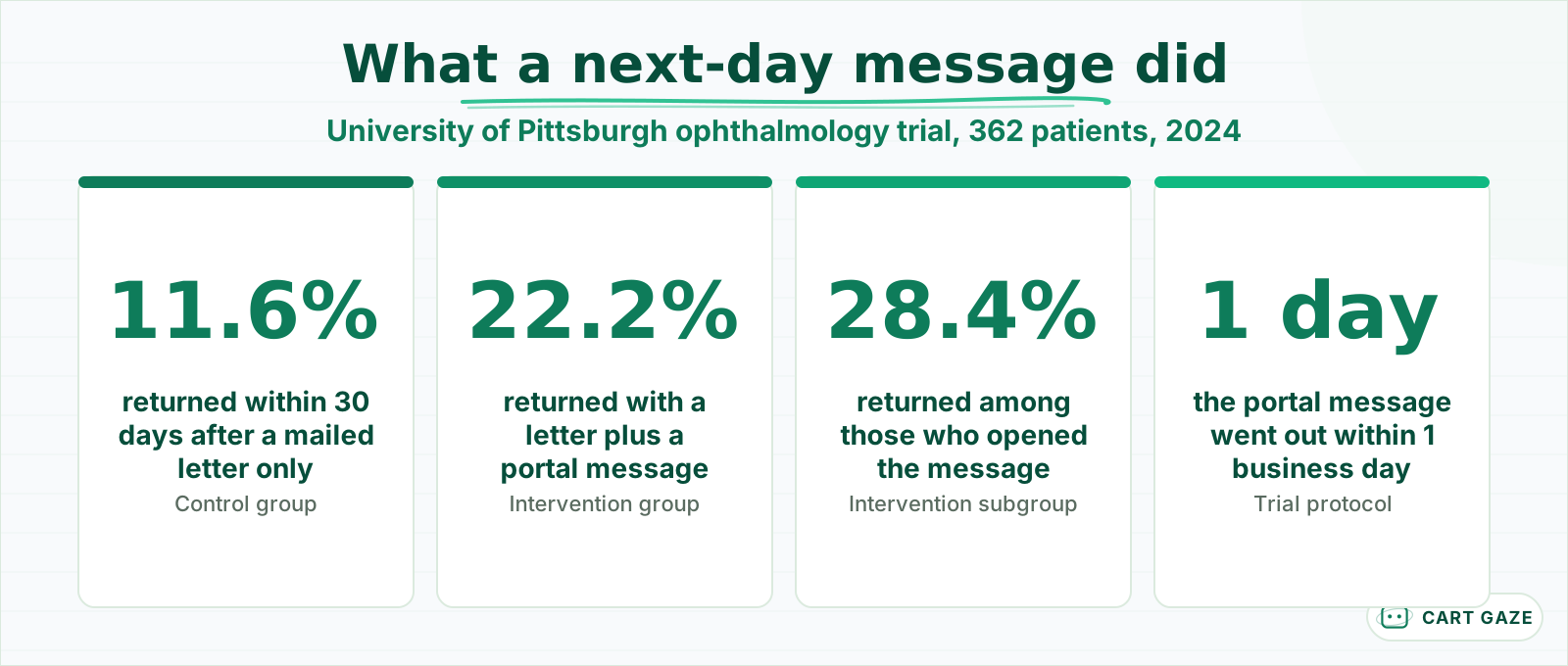 One academic eye clinic, return patients with portal accounts. Speed and channel both mattered.
The trial, published in 2024, enrolled 362 return patients who missed appointments at a University of Pittsburgh ophthalmology department. The control group got the standard mailed letter. The intervention group got the same letter plus a message through the patient portal within 1 business day. Within 30 days, 22.2% of the intervention group attended a follow-up visit, against 11.6% of the control group. Among patients who actually opened the portal message, 28.4% came back.
Two lessons carry beyond eye care. Speed matters, because a message the next day meets a patient who still remembers the appointment. And the channel matters, because a letter arrives days later and is easy to set aside. The trial also shows the ceiling: even the better arm brought back fewer than 1 in 4 patients within a month, which is why a single message is not a follow-up plan.
A missed visit is also a risk signal. A 2018 review of 105 studies found that a prior no-show was one of the most consistent predictors of the next one, so the patient who missed today is the patient most likely to miss again.
Check the clinical risk before any automated message
Before the automated sequence starts, someone clinical should look at the day's no-show list. A missed post-operative check, an abnormal result follow-up, or a high-risk medication review needs a clinician's decision and a documented attempt to reach the patient, not a friendly reschedule text in the morning.
Malpractice insurers treat this as a known weak spot. The Doctors Company's guidance on noncompliant patients tells practices to document their efforts to follow up and intervene when a patient does not keep to the plan of care, and to schedule the follow-up appointment before the patient leaves the office. A no-show on a time-sensitive visit with no documented follow-up is the pattern those recommendations exist to prevent.
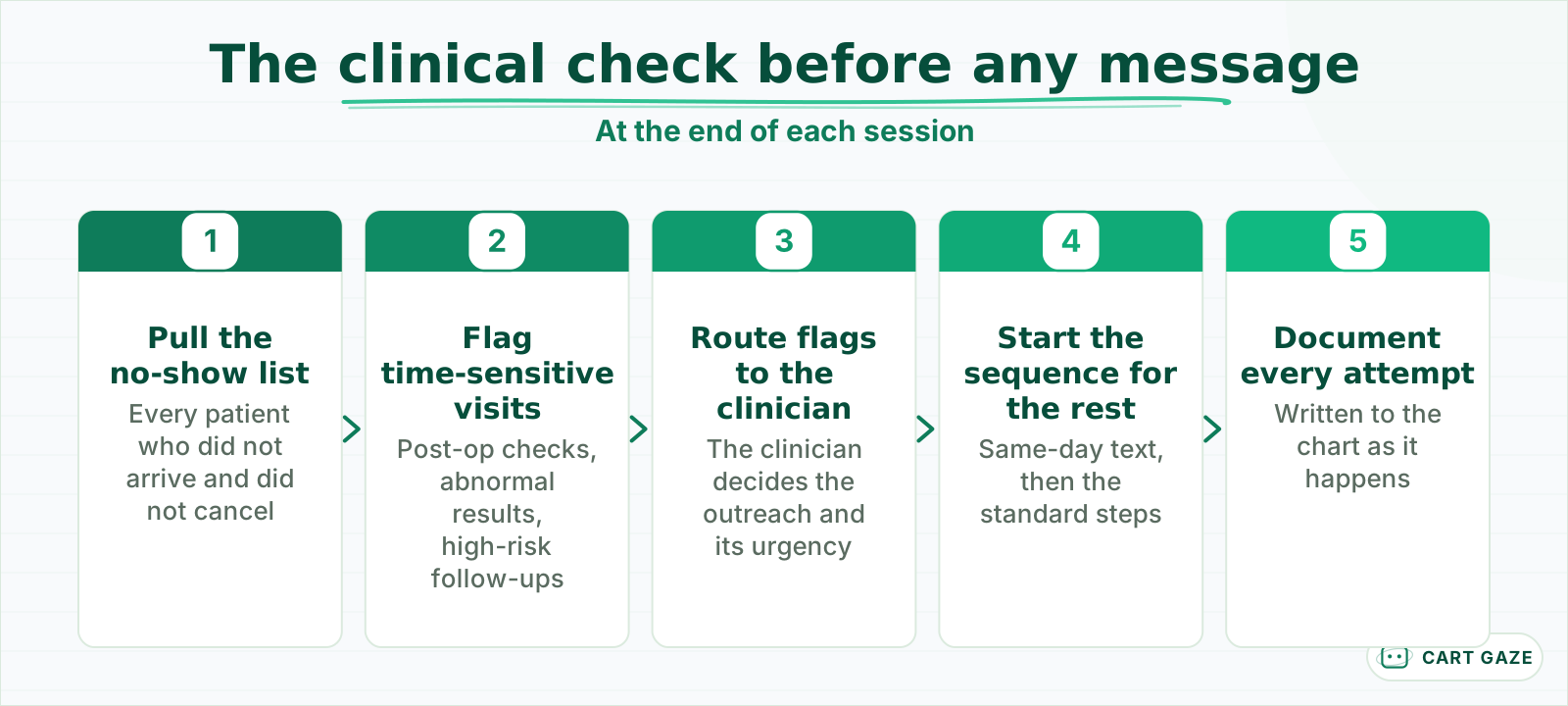 Ten minutes a session. The automated sequence starts only after this review.
In practice this is a 10-minute review at the end of each session. Pull the list, flag the visits that were clinically time-sensitive, and route those to the clinician who owns the patient. Everything else enters the standard sequence. Keep the flag rules written down so the review does not depend on who is working that day.
Some groups need their own rule. A missed visit for a child, for a patient in behavioral health treatment, or for someone on a medication that needs monitoring can carry a safety concern beyond the missed slot. Follow your clinical protocols for those patients, even when the automated sequence would otherwise handle the outreach.
The follow-up sequence: text, call, portal, letter
A good sequence starts the same day with a short text, adds a call and a portal message the next business day, makes a second attempt a few days later, and ends with a letter at about 2 weeks. Every step offers an easy way to rebook, and every attempt goes into the chart.
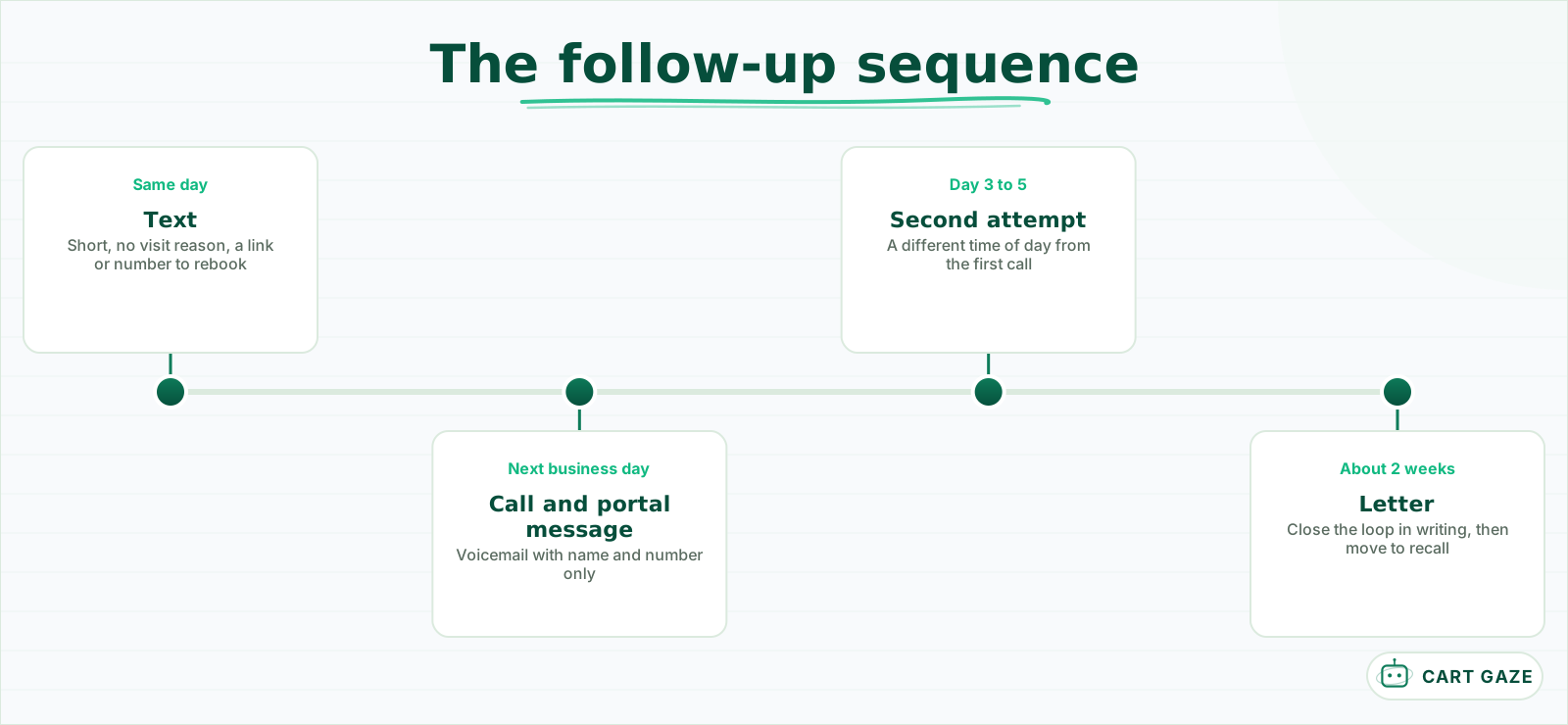 Four touches, then stop. Every step offers an easy way to rebook.
Same day, by text. "[Practice]: We missed you today. We would like to get you rescheduled. Call [phone] or book at [link]. Reply STOP to opt out." Send it to patients who have agreed to texts, and keep it free of the reason for the visit.
Next business day, by call and portal message. A call reaches patients who ignore texts, and the portal message is the step the Pittsburgh trial measured. Leave a voicemail with only the practice name and a callback number.
Day 3 to 5, a second attempt. Use a different time of day from the first call. Many patients who missed a morning visit work mornings.
About 2 weeks, a letter. The letter closes the loop in writing, repeats how to rebook, and gives the practice a record that it tried.
At each step, ask why they missed if they answer. Transport, childcare, cost, a work shift, and "I forgot" each point to a different fix, and the reasons are more useful than the no-show count itself.
Match the offer to the reason. A patient without a ride may be able to do the visit by telehealth, if the visit allows it. A patient worried about cost needs a billing conversation before a new slot. A patient who forgot may need a reminder closer to the visit, and a patient who works shifts needs an earlier or later time. Record the reason in a structured field, not only in free text, so you can count reasons across a quarter.
Handle fees and policy without losing the patient
A missed-appointment fee is allowed for Medicare patients only if your policy charges every patient the same way, and it may not be billed to a Medicaid patient at all. Commercial plans depend on your contract. Whatever the rules allow, the first message after a no-show should invite the patient back, not open with a charge.
| Payer | Can you charge a missed-appointment fee? | Condition | Source |
|---|---|---|---|
| Medicare | Yes | Same policy for all patients; bill the patient, not Medicare | CMS Transmittal 1279, 2007 |
| Medicaid | No | A missed visit is not a separate billable service | CMS policy, as quoted by NC Medicaid |
| Commercial | Depends | Check each payer contract | Your contracts |
| Self-pay | Yes, if disclosed | Written policy given before the visit | Your policy |
CMS set out the Medicare position in Transmittal 1279, effective October 1, 2007: a missed-appointment charge is a charge for a missed business opportunity, not for a service, so it is allowed if the practice's policy applies equally to Medicare and non-Medicare patients. For Medicaid, North Carolina's Medicaid agency, quoting CMS, puts it plainly: providers may not bill Medicaid beneficiaries for missed appointments, because a missed appointment is part of the cost of doing business.
Warning
A signed no-show policy does not make a missed-appointment fee billable to a Medicaid patient. Check how your billing system flags Medicaid accounts before any fee is applied automatically.
Tone matters more than the fee. A patient who missed a visit because a parent was taken to the hospital and then receives a fee notice as the first contact is unlikely to rebook. One common approach is to waive the first fee and apply the policy from the second missed visit.
Know when to stop
Stop the automated sequence after about 3 attempts over 2 weeks with no answer, close the request with a documented outcome, and put the patient on your recall list so they are contacted again at the next due date. Repeated no-shows need a policy decision by the physician, not a longer automated sequence.
More messages rarely change the outcome and can start to feel like pressure, especially for patients who missed because of cost or a hard week. The letter at 2 weeks is the natural end point for most patients.
Patients who miss repeatedly are a separate question. Some practices limit same-day or double-booked slots for them; some require a phone confirmation the day before. Ending the relationship over repeated no-shows is a clinical and legal decision with its own notice obligations, so it belongs with the physician and your malpractice carrier, not in an automated rule. Re-engaging patients who have drifted away entirely is covered in patient recall and reactivation automation.
Where automation and an AI receptionist fit
Automation runs the sequence on time and records every attempt; an AI receptionist handles the calls that come back. When a patient returns the call at 7 p.m. to rebook, an AI receptionist can book them into an open slot immediately and pass anything clinical to staff.
The sequence itself is well suited to automation: the trigger is a no-show status in the schedule, the steps and timing are fixed, and each attempt can write a note to the chart. The clinical review at the start is the one step that must stay with people.
If your texting tool cannot write to the chart, do not skip the documentation. Export the day's attempts and add a short note to each patient's record, or choose a tool that can. An attempt that happened but is not in the chart is, for risk purposes, an attempt that did not happen.
On the phone side, the calls a follow-up sequence produces arrive at all hours, and a patient who calls back and reaches voicemail may not call twice. An AI receptionist answers, rebooks, and notes the reason the patient gives. What it does and where it stops is set out in what an AI receptionist does and where it hands off. It routes every clinical, urgent, or distressed caller to a person and never assesses symptoms or gives medical advice.
The freed slot from the no-show is its own opportunity, and offering it to patients on a waitlist is covered in cancellation and rebooking automation.
Before you automate no-show follow-up
- A clinician reviews time-sensitive no-shows the same day.
- The first message goes out within 1 business day.
- Every attempt is written to the chart automatically.
- Fees are blocked on Medicaid accounts by the billing system.
Build your no-show follow-up
Start with the clinical review, then a same-day text, a next-day call and portal message, a second attempt, and a letter at 2 weeks. Measure the share of no-show patients who rebook within 30 days, and compare it with the 11.6% a letter alone achieved in the Pittsburgh trial.
 Clinical risk first. Then a fixed sequence with a clear end.
Walk a week of no-shows through the flow by hand before automating it, so the clinical flags and the stop rule match your patients. After that, the sequence can run on its own while staff handle the calls and the clinical review.
How the texts in this sequence run day to day, with opt-out enforced by the system, is set out in how patient texting works, and how opt-out is enforced.
Fair questions.
What should a practice do after a patient no-shows?
First, have a clinician review whether the visit was time-sensitive, such as a post-op check or abnormal result follow-up, and act on those directly. For everyone else, send a short text the same day, call and send a portal message the next business day, try again at day 3 to 5, and send a letter at about 2 weeks.
How quickly should you contact a patient after a missed appointment?
Within 1 business day. In a 2024 randomized trial at an academic eye clinic, patients who got a portal message within 1 business day of their no-show were nearly twice as likely to attend within 30 days as those who got only a mailed letter: 22.2% against 11.6%. A same-day text is a sensible first step.
Can a medical practice charge Medicare patients a no-show fee?
Yes, if the practice charges every patient the same way. Under CMS Transmittal 1279, effective October 1, 2007, a missed-appointment charge is for a missed business opportunity rather than a service, so it may be charged to a Medicare patient directly when the policy applies equally to all patients. It is never billed to Medicare.
Can you charge Medicaid patients for missed appointments?
No. CMS policy treats a missed appointment as part of the cost of doing business rather than a separate billable service, so providers may not bill Medicaid beneficiaries for it, whatever the patient signed. Make sure your billing system blocks automatic no-show fees on Medicaid accounts.
When should a practice stop following up on a no-show?
After about 3 unanswered attempts over 2 weeks, ending with a letter. Record the outcome in the chart and add the patient to your recall list for their next due date. For patients who miss repeatedly, any decision to change how they are scheduled or to end the relationship belongs with the physician and your malpractice carrier.
Sources.
- [1]Atta et al. Effect of a patient portal reminder message after no-show on appointment reattendance in ophthalmology (Am J Ophthalmol, 2024)
- [2]CMS Transmittal 1279: charges for missed appointments (June 29, 2007)
- [3]NC Medicaid: provider billing of Medicaid beneficiaries
- [4]The Doctors Company: noncompliant patients increase liability risks for practitioners (August 2023)
- [5]Dantas et al. No-shows in appointment scheduling: a systematic literature review (Health Policy, 2018)
Written by

Muhammad Qasim Hammad
Founder, Cart Gaze
Qasim builds AI receptionists and front-office automation for medical and dental practices at Cart Gaze. Posts here start from published sources and real call data, not vendor claims, and every number links back to where it came from.
Keep reading.
 No-Shows & Follow-UpNo-Show Rate Benchmarks by Specialty: What the Studies Show10 min read
 No-Shows & Follow-UpRunning Late Text to Patients: When to Send It and What to Say10 min read
 No-Shows & Follow-UpPatient SMS Templates for Medical Practices, With Compliance Notes10 min read
 No-Shows & Follow-UpAI Appointment Rescheduling: Make Cancelling Easy On Purpose12 min read
 No-Shows & Follow-UpThe New Patient Welcome Sequence That Gets Them Through9 min read
 No-Shows & Follow-UpAppointment Deposits and No-Show Fees: Who You May Charge10 min read