
Call Tracking Numbers for Medical Practice Marketing, Done Safely
Call tracking shows which ads ring the phone, but it can scramble your Google listing, recorded calls are PHI, and 11 states require all-party consent to record. Here is how to set it up safely.
Key takeaways.
- Call tracking labels each call with its marketing source; it only shows value once each call is connected to a booked or unbooked outcome.
- Keep your main local number on your Google Business Profile and citations, and use dynamic number insertion on your site for paid traffic only.
- A vendor that records or transcribes calls holds PHI and needs a BAA; turn recording off if you do not need it.
- The Digital Media Law Project counts 11 all-party consent states, so announce recording at the start of every recorded call.
- Judge sources by cost per booked patient: $2,000 for 12 bookings is about $167 each, while $500 for 5 bookings is $100.
Table of Contents8 sections
A practice spending on ads usually knows how many clicks it bought and has no idea how many of those clicks turned into phone calls, let alone booked patients. Call tracking numbers close that gap, and they come with three traps practices rarely hear about: they can scramble your Google Business Profile, recorded calls are PHI, and about a dozen states require every party's consent to record.
This post covers how call tracking numbers work for medical practice marketing, static numbers versus dynamic number insertion, how to set them up without breaking your listings, the BAA and recording-consent questions, what to measure, and where an AI receptionist fits once the calls start coming in.
What call tracking numbers actually tell you
Call tracking assigns a different phone number to each marketing source, so every call arrives labelled with where the caller found you: an ad, a directory, a mailer, or your website. It tells you which sources produce calls. On its own, it does not tell you which calls became booked patients.
That last point is where most setups stop short. A report showing 60 calls from paid search and 20 from a directory says nothing about which source brings patients who book, show up, and return. The value of call tracking depends on connecting each call to an outcome.
There are two kinds of tracking number. A static tracking number is one number printed on one thing: a mailer, a billboard, a directory listing. A dynamic number insertion (DNI) setup uses a script on your website to swap the displayed phone number based on how the visitor arrived, so a visitor from a paid search ad sees a different number from one who typed your address.
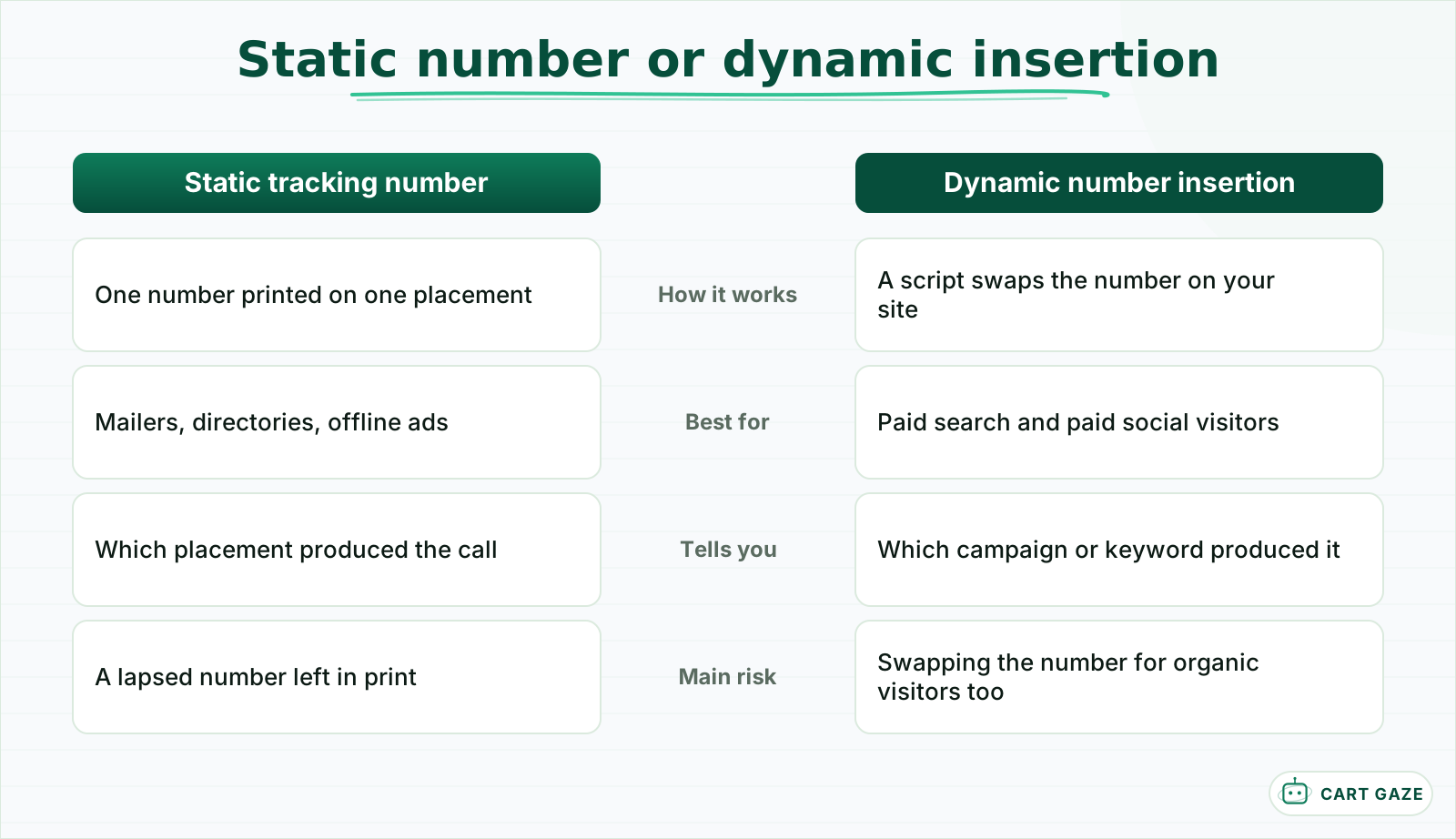 Most practices need both: static numbers offline, dynamic insertion on the website.
Most practices need both: static numbers for offline and third-party channels, and DNI for the website, where one page is seen by visitors from every source.
Calls are only one route in. Web forms, online booking, and texts arrive through other doors, and a call tracking report says nothing about them. Before judging a campaign, add its form submissions and online bookings to its tracked calls, or a source that mostly produces online bookings will look like a failure.
The listing trap: tracking numbers and your Google Business Profile
Your Google Business Profile needs a local number under your direct control that reaches your practice, and the same main number should appear consistently across the web. Putting tracking numbers on listings carelessly can split your identity across several numbers and confuse both patients and search engines.
Google's own guidelines for business listings say to use a local phone number instead of a central call center number whenever possible, that the number must be under the direct control of the business, and not to provide numbers that redirect or refer users to anyone other than the actual business. Google also allows additional phone numbers on a profile.
The wider risk is consistency. Local search relies on your name, address, and phone number matching across directories, review sites, and your own website. If each directory shows a different tracking number and those numbers later lapse, you leave a trail of dead numbers that still point at your practice. Keeping the profile itself accurate and current is covered in Google Business Profile automation.
Warning
When you cancel a tracking number, it can be reassigned to someone else. Before you let any number go, find every place it was printed or listed, and replace it with your main number first.
A safe default is to keep your main local number on your Business Profile and in directory citations, use DNI on your website so organic visitors still see the main number, and reserve static tracking numbers for paid placements and offline campaigns you control.
How to set up call tracking without breaking anything
Set up call tracking in five steps: decide which sources are worth tracking, give offline and paid listings static numbers, add DNI to the website for paid and campaign traffic only, keep your main number on your Business Profile and citations, and record outcomes against every call.
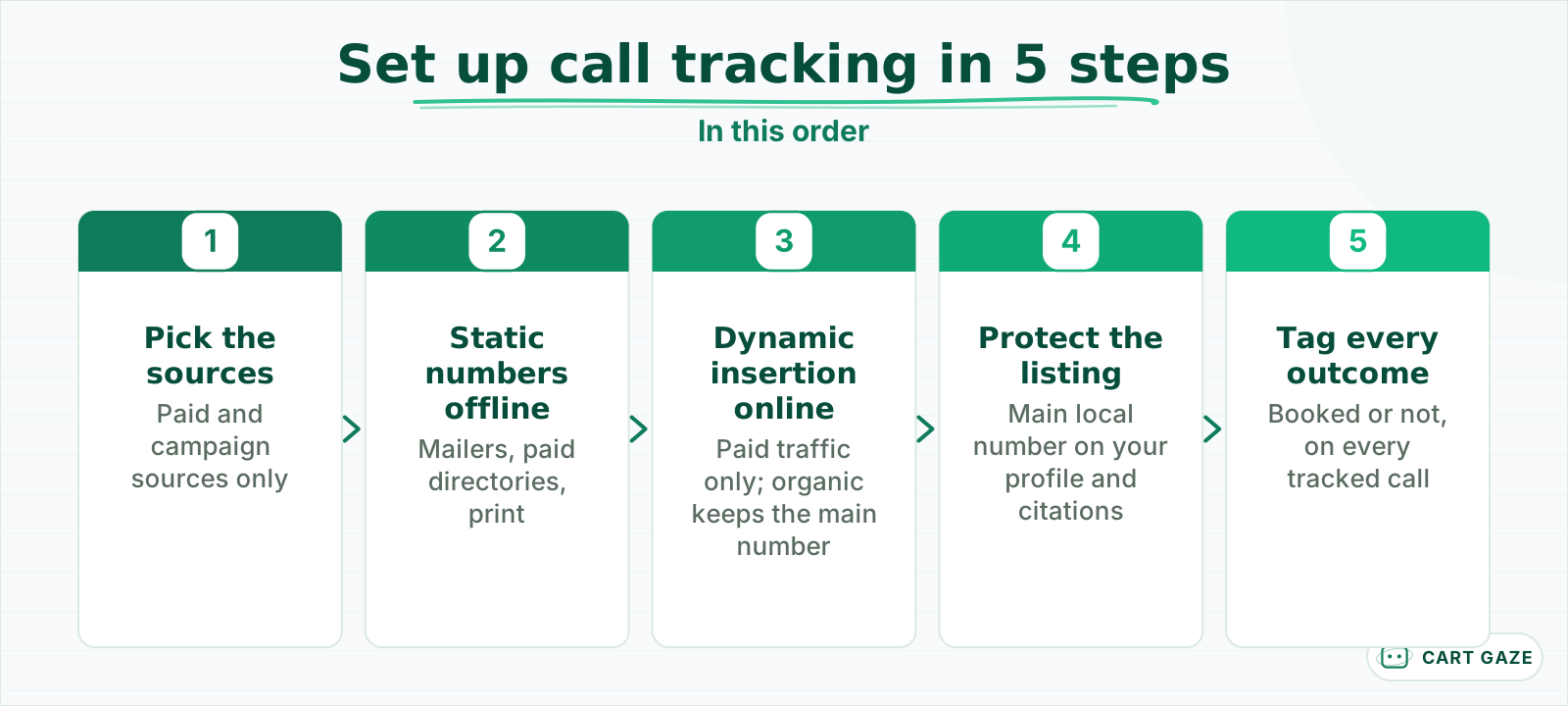 Track what you pay for. Leave the main number where patients and search engines expect it.
Not every source deserves a number. A campaign you spend real money on, a paid directory, and a mailer all do. A free listing you never touch usually does not, and giving it a tracking number only adds a number you must maintain.
Configure DNI to swap numbers only for the traffic you want to attribute, such as paid search and paid social, and leave organic and direct visitors on the main number. That keeps the number patients remember, and the one search engines see, stable.
Route every tracking number to the same place your main number goes, so a tracked call is answered exactly like any other. A tracking number that rings a different phone, or skips your after-hours rules, creates a worse experience for the very callers you paid to reach.
Multi-location practices need one more rule. Each location needs its own numbers, and each tracking number must ring the location it advertises. A patient who finds your north office in an ad and reaches the south office's front desk has been routed wrong, and the report will credit the wrong location with the booking.
Recording, BAAs, and consent
If a call tracking vendor records or transcribes calls, it holds PHI and needs a signed BAA before it touches a patient line. Recording also brings state consent law: the Digital Media Law Project counts 11 states that require every party's consent. Announce recording at the start of every recorded call.
Recorded patient calls contain names, dates of birth, symptoms, and insurance details. HHS treats a vendor that maintains PHI as a business associate, not a mere conduit, so the vendor must sign a BAA and meet HIPAA's safeguards. Not every call tracking product or plan tier offers one, and some offer tracking without recording to sidestep the issue.
On consent, the Digital Media Law Project reports that 38 states and the District of Columbia allow recording with one party's consent, while 11, including California, Florida, Pennsylvania, and Washington, require every party's consent. Patients call from across state lines, so the simple, safe rule is a short announcement at the start of every recorded call.
Important
If you do not need recordings, turn recording off. Source attribution works without them, and an unrecorded call has no transcript to protect.
Transcripts often feed keyword or AI "lead scoring" features, which read the content of the call. That is PHI processing too, and it belongs under the same BAA.
If you do keep recordings, decide how long, and who can listen. Set a retention period in the vendor's settings rather than keeping everything forever, limit playback to the people who need it, and make sure marketing staff or an outside agency reviewing campaign performance see source and outcome data, not patient recordings.
What to measure
Measure booked patients by source, not calls by source. Track calls, first-time callers, answered rate, and bookings for each tracked source, then divide spend by booked patients to get a cost per new patient. A source with fewer calls but more bookings is usually the better one.
| Metric | How to get it | Why it matters |
|---|---|---|
| Calls by source | Tracking report | Shows which sources ring the phone |
| First-time callers | Tracking report, deduplicated | Separates new patients from repeat calls |
| Answered rate by source | Tracking report | Unanswered paid calls are wasted spend |
| Booked calls by source | Outcome tag on each call | The number that matters |
| Cost per booked patient | Spend divided by booked calls | Compares sources fairly |
As an illustration: $2,000 a month on search ads producing 40 calls, of which 12 book, is about $167 per booked patient. A directory costing $500 that produces 10 calls, 5 of which book, is $100. The ad drives more calls; the directory brings cheaper patients.
Connecting calls to bookings is the step most setups skip. Either the person answering tags each tracked call as booked or not, or someone matches the caller's number against new-patient bookings made within 7 days of the call, once a week. The first is faster; the second catches patients who called, hung up, and booked online later.
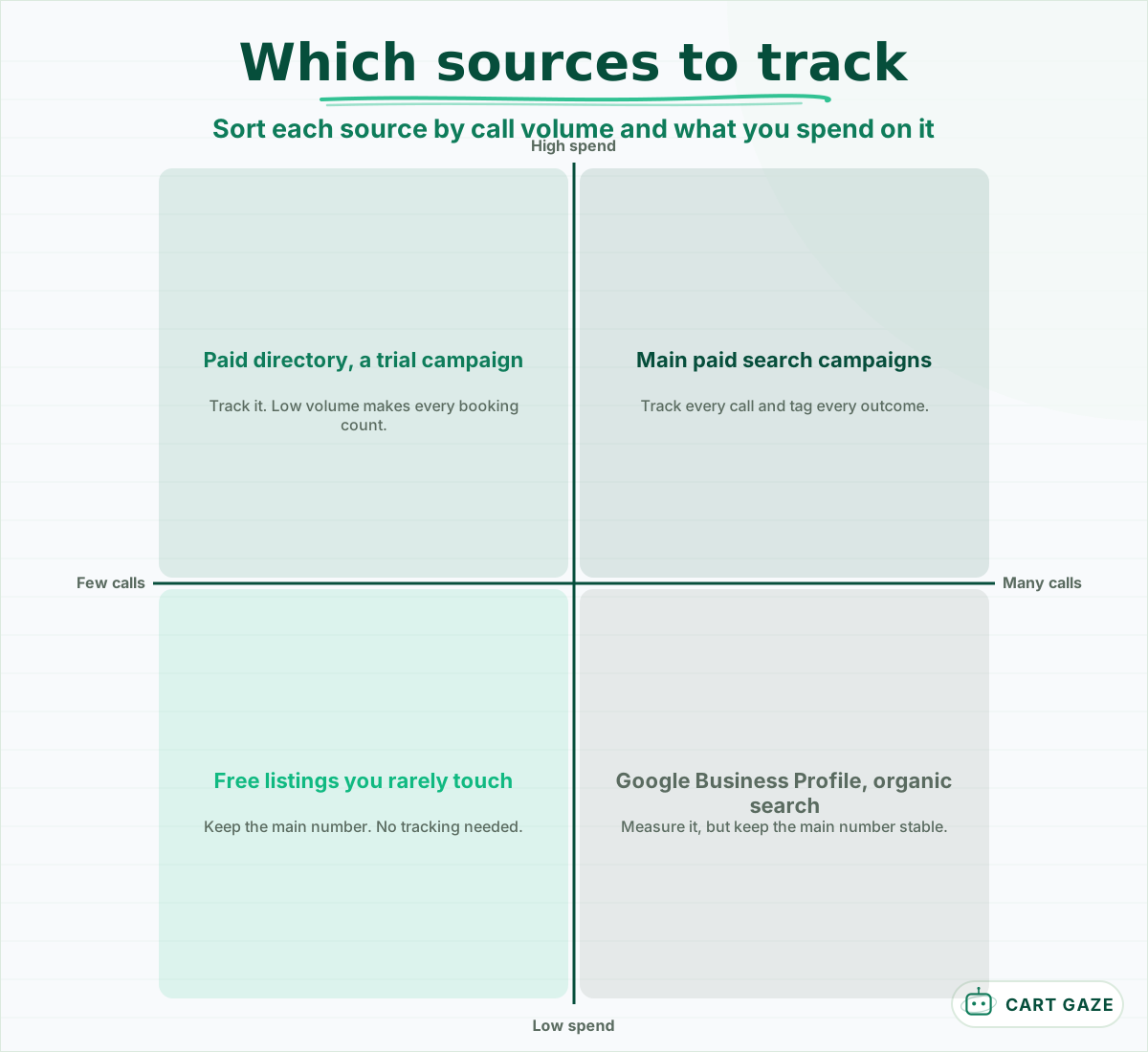 Spend decides whether a source gets a number. Volume decides how closely you watch it.
Answered rate deserves its own line. A paid call that rings out or reaches voicemail costs the same as one that books. If a source's calls arrive mostly at lunch or after hours, the fix may be coverage, not more budget. Scoring the leads those sources produce is covered in lead scoring for paid ads.
Where an AI receptionist fits
Call tracking tells you where calls come from; an AI receptionist makes sure the paid ones get answered. If tracked calls from ads arrive at peaks or after hours and go unanswered, an AI receptionist can answer them, book routine appointments, and tag the outcome so the tracking report shows bookings.
That pairing matters most for paid channels, where an unanswered call is money already spent. Make sure the tracking number forwards to the line the AI receptionist answers, so the call keeps its source label, and use one report as the record of outcomes so calls are not counted twice. The AI receptionist answers on the first ring, books into the schedule when the caller wants an appointment, and hands everything else to staff. What it does and where it stops is set out in what an AI receptionist does and where it hands off.
It sits under the same rules as the tracking vendor: a BAA, a recording announcement if it records, and routing every clinical, urgent, or distressed caller to a person. It never assesses symptoms or gives medical advice.
Before you turn on call tracking
- Your main local number stays on your Business Profile and citations.
- Every tracking number rings the same place as the main line.
- Any vendor that records or transcribes has signed a BAA.
- Recorded calls open with a recording announcement.
Choose your call tracking setup
Choose by what you spend and where. Paid channels get tracking; free listings keep the main number. Recording is off unless you need it, and on only with a BAA and an announcement. Then judge every source by cost per booked patient, not by calls, and fix unanswered paid calls first.
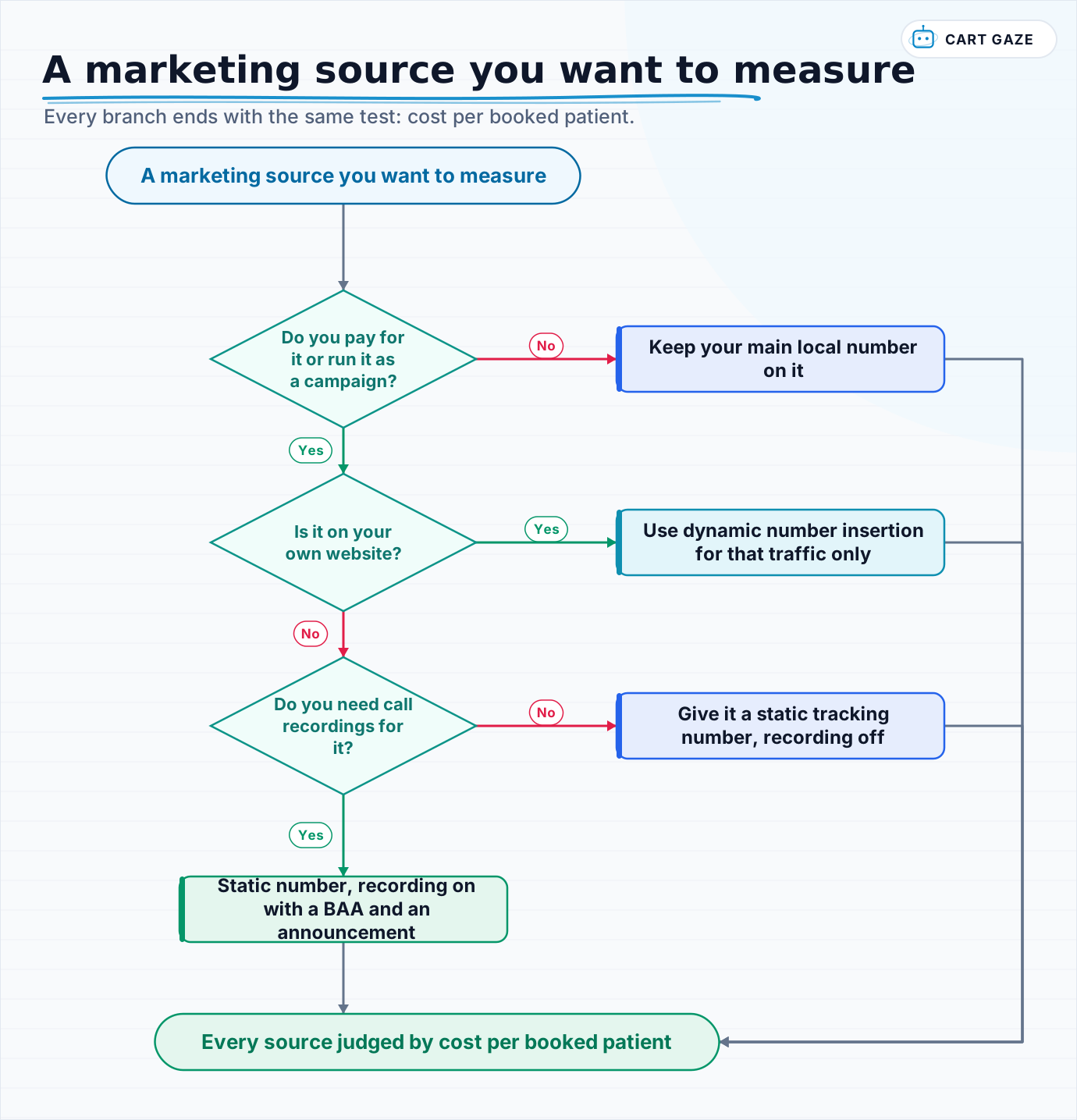 Every branch ends with the same test: cost per booked patient.
Walk each marketing source through the flow once, and write down which number it uses and why. That list is also what you will need when a number is retired.
If unanswered calls turn out to be your biggest leak, the choice is usually between more staff, an answering service, and an AI receptionist, and the booking difference between the last two is set out in how an AI receptionist compares with an answering service.
Fair questions.
What is a call tracking number for a medical practice?
A phone number assigned to one marketing source, such as an ad, a mailer, or a directory listing, that forwards to your main line and records which source produced the call. Static numbers go on one placement; dynamic number insertion swaps the number on your website based on how the visitor arrived. Both only pay off when each call is tied to a booking outcome.
Will call tracking numbers hurt my Google Business Profile?
They can if used carelessly. Google requires a number under the business direct control, prefers local numbers over call centers, and prohibits numbers that refer callers to anyone other than the business. Scattering different tracking numbers across listings also breaks name, address and phone consistency. Keep your main local number on your profile and citations.
Do call tracking vendors need a BAA with a medical practice?
Yes, if they record, transcribe, or otherwise store the content of patient calls, because those recordings contain PHI and the vendor becomes a business associate. Not every call tracking product or plan tier offers a BAA. If you only need source attribution, you can often turn recording off and avoid storing call content at all.
Is it legal to record patient phone calls for call tracking?
It depends on the states involved. The Digital Media Law Project reports 38 states and the District of Columbia allow recording with one party consent, while 11 states, including California, Florida, Pennsylvania and Washington, require every party consent. Because patients call across state lines, announce recording at the start of every recorded call.
What should a practice measure with call tracking?
Booked patients by source, not calls. Track calls, first-time callers, answered rate and booked calls for each source, then divide each source spend by its booked calls to get a cost per booked patient. Answered rate matters because a paid call that rings out costs the same as one that books.
Sources.
Written by

Muhammad Qasim Hammad
Founder, Cart Gaze
Qasim builds AI receptionists and front-office automation for medical and dental practices at Cart Gaze. Posts here start from published sources and real call data, not vendor claims, and every number links back to where it came from.
Keep reading.
 Patient Acquisition & GrowthNew Patient Call Conversion Rate: Benchmarks and the Five Leaks10 min read
 Patient Acquisition & GrowthGoogle Business Profile Automation Without a HIPAA Slip10 min read
 Patient Acquisition & GrowthAI Search Visibility for Medical Practices: A Practical Checklist10 min read
 Patient Acquisition & GrowthTurn Website Chat Into Booked Appointments the Compliant Way11 min read
 Patient Acquisition & GrowthPatient Satisfaction Survey Automation: Texts That Get Answers10 min read
 Patient Acquisition & GrowthConsultation Follow Up That Converts Without Pressure9 min read