
New Patient Call Conversion Rate: Benchmarks and the Five Leaks
Call-tracking data puts healthcare new-patient conversion between about 40% and 55%. Here is who measured it, how to measure your own rate, and the five places new-patient calls leak.
Key takeaways.
- Call-tracking vendors put healthcare new-patient conversion between about 40% and 55%, with top performers above 70%, measured on their own customers.
- Benchmarks disagree mostly over the denominator: Invoca found only 48% of healthcare calls from digital marketing were leads at all.
- Measure your own rate over 4 weeks or at least 50 new-patient calls, dividing bookings by new-patient calls and recording why each unbooked call failed.
- New-patient calls leak in 5 places: unanswered, not recognized as new, no ask to book, a stalled question, and no follow-up.
- Fix the largest leak first; one closing line that offers 2 specific times addresses the missing ask, which Invoca puts at a 43% figure.
Table of Contents8 sections
Most practices know roughly how many new patients they see each month, and almost none know how many new-patient calls it took to get them. That missing number, the new patient call conversion rate, is where marketing money quietly disappears. Invoca's 2025 healthcare benchmarks, drawn from its analysis of more than 60 million calls, found that 40% of healthcare phone leads converted on the call.
This post collects the published conversion benchmarks and says who measured them and how, explains why they disagree, shows you how to measure your own rate from a few weeks of calls, maps the five places a new-patient call leaks, and matches each leak to the fix that closes it.
What a good new patient call conversion rate looks like
Published benchmarks put healthcare new-patient conversion between about 40% and 55%, with top performers above 70%. The figures come from call-tracking vendors measuring their own customers, so they describe practices that already track calls. Treat the middle of the range as ordinary, not good.
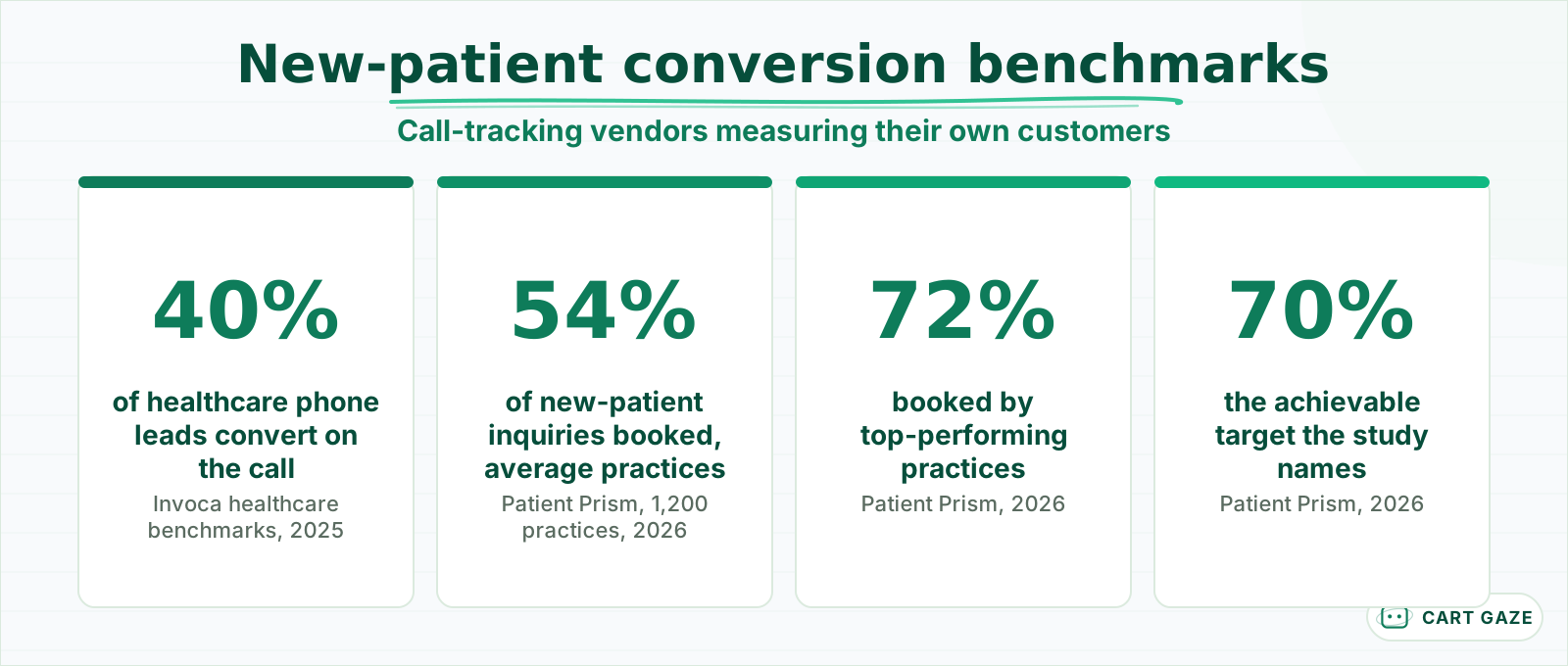 Vendor data from practices that already track calls. The middle is ordinary, not good.
The two most useful datasets come from vendors that record calls for a living. Invoca's 2025 healthcare report, based on its AI analysis of more than 60 million phone calls across industries, puts healthcare lead conversion on the call at 40%. Patient Prism's 2026 study, covering 1,200 dental and specialty medical practices and 12.5 million patient interactions from January to March 2026, puts the baseline at 55% of new-patient inquiries converting to a scheduled appointment, average performers at 54%, top performers at 72%, and an achievable target at 70%.
Those numbers do not contradict each other as much as they seem to. Invoca counts conversion during the call itself. Patient Prism counts inquiries across phone, text, email, forms, and chat, and credits a booking that happens later. A practice converting 45% of calls on the call and another 10% through follow-up would land near both.
Important
Both datasets describe practices that pay for call tracking, which skews toward larger and more marketing-heavy practices. No public benchmark covers the typical 2-provider office with no call recording, so your own baseline matters more than any published one.
Why published conversion benchmarks disagree
Conversion benchmarks disagree mainly because of the denominator. Some divide bookings by all calls, some by calls identified as leads, and some by every inquiry across channels. A rate built on all calls looks terrible because existing patients, vendors, and wrong numbers are in it. Always ask what was divided by what.
Invoca's own data shows how large that effect is: only 48% of healthcare calls from digital marketing were leads at all. A practice that divided bookings by every inbound call would roughly halve its apparent conversion rate before a single call went badly.
Three other differences move the numbers. The clock: "booked on the call" is stricter than "booked within 7 days." The detection method: AI-scored recordings, manual tagging, and front-desk self-reporting each miss different calls. And the population: dental practices, orthodontists, and specialty groups differ in how many callers are shopping versus ready to book.
Sample matters too. Invoca's 60 million calls span several industries, with healthcare as one slice, and Patient Prism's 12.5 million interactions include texts, emails, forms, and chat alongside calls. Neither is a random sample of US practices.
So a published benchmark tells you whether you are in the right neighborhood, not whether you are winning. The useful comparison is your own rate this month against your own rate last month, measured the same way.
How to measure your own conversion rate
Take 4 weeks of calls, pick out the new-patient calls, and mark whether each one booked on that call, booked later, or did not book. Divide calls that booked by new-patient calls. Then, for every call that did not book, write down why. The reasons matter more than the rate.
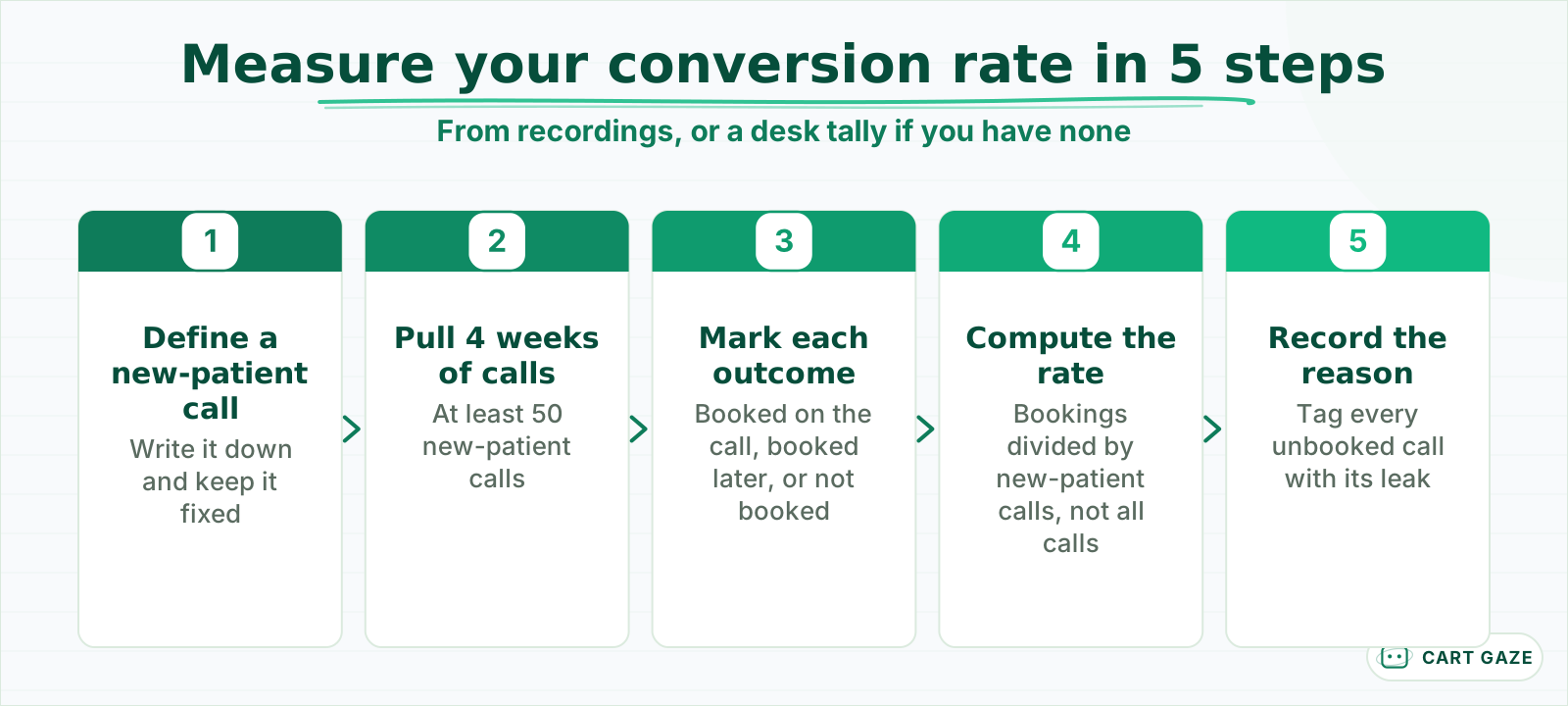 Fix the definition first. A rate you cannot repeat next month is not a baseline.
If your phone system records calls, the work is listening to them. If it does not, keep a simple tally at the desk for 2 weeks: a mark for each new-patient call, and a second mark when it books. It is less accurate than recordings, but it is a real number instead of a guess. Aim for at least 50 new-patient calls before you trust the rate.
Define "new-patient call" before you start and keep the definition fixed. A reasonable one: a caller who is not an established patient and is asking about an appointment, a service, a price, or insurance. Referral-office calls about a new patient count; a sales call does not.
Count people, not calls. A caller who rings three times in one morning before reaching someone is one new-patient inquiry, and counting all three makes your answering look worse and your conversion look better than either really is.
Keep two rates, not one. As an illustration, suppose 4 weeks produce 64 new-patient calls, 29 of which book on the call and 6 more of which book within a week after follow-up. Your on-call rate is 45% and your total rate is 55%. The gap between them is what your follow-up is worth, and it is the number most practices never see.
The five leaks in a new-patient call
New-patient calls leak in five places: the call is not answered, the caller is not recognized as new, nobody asks them to book, an insurance, price, or availability question goes unanswered, and nobody follows up when they hang up without booking. Most practices lose calls at two of these, not all five.
| Leak | What it sounds like | The fix |
|---|---|---|
| Not answered | Ringing, voicemail, a long hold | Overflow and peak coverage |
| Not recognized as new | "What's your date of birth?" to someone never seen | Ask "have you been here before?" first |
| No ask to book | Questions answered, call ends politely | Offer 2 specific times before hanging up |
| Stalls on a question | Insurance, price, first available date | Scripted answers and protected new-patient slots |
| No follow-up | Caller says "I'll call back" | Same-day text or call to unbooked callers |
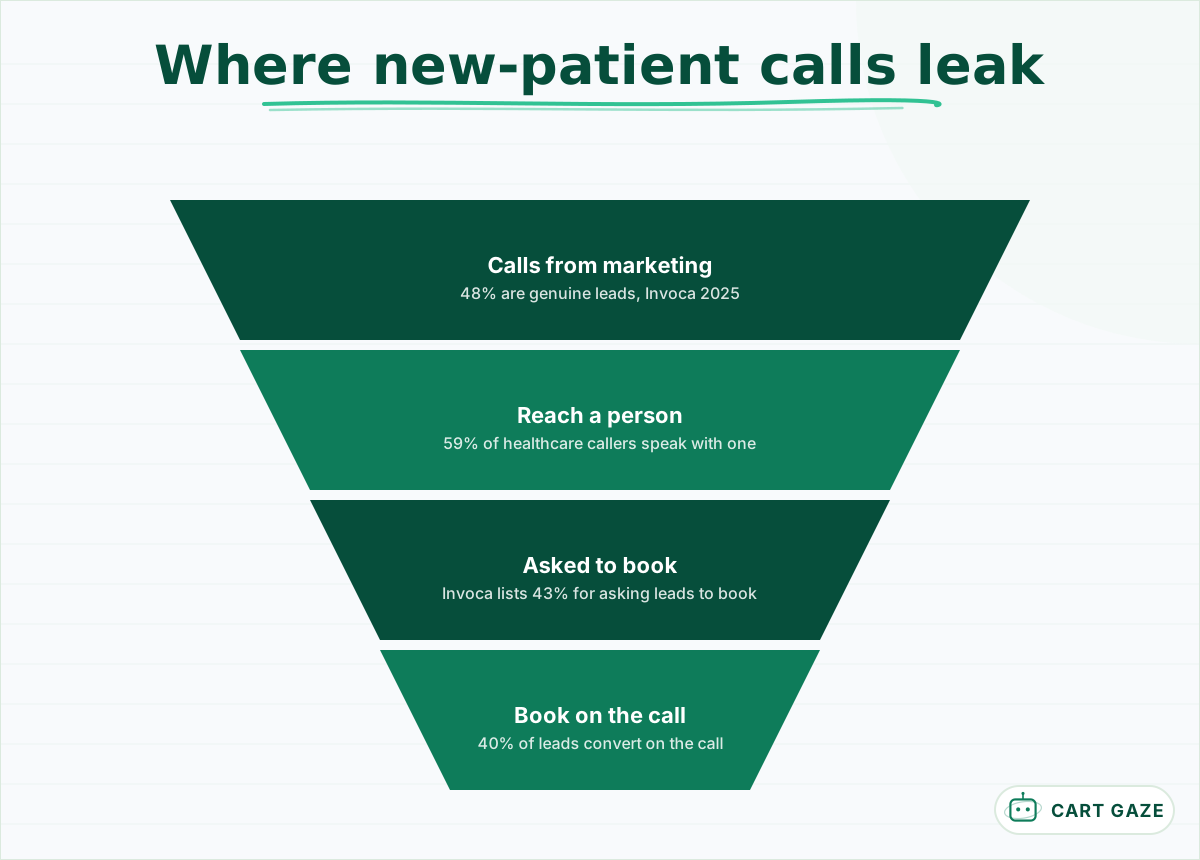 Each figure has its own denominator from the same report. They are not multiplied together.
The first leak is often the largest. Invoca found that 59% of healthcare callers spoke with a person, which leaves a large share who reached voicemail, a menu, or nothing. Every other leak only applies to calls somebody answered.
The second leak is quieter. A desk that opens every call with "date of birth?" treats a first-time caller like a patient who is already in the chart, and the new caller spends the first minute feeling like an intrusion. Asking "have you been with us before?" first routes the call to a different, warmer script.
The third leak is the most fixable. Invoca's healthcare benchmark lists 43% against staff asking leads to book appointments, which suggests many answered calls end with the caller's questions answered and no request for the booking. One closing line, "I have Tuesday at 10 or Thursday at 2, which works better?", changes that.
The fifth leak is follow-up, and it overlaps with response speed. A caller who says "I'll check my schedule and call back" is still a lead, and how fast you reach them is covered in what speed to lead means for new patient inquiries.
What lifts the conversion rate
The biggest lifts come from fixing the leak your own tally shows, not from training everything at once. Cover the phones at peaks if calls go unanswered. Teach one closing line if the ask is missing. Script the insurance and price answers if calls stall. Follow up the same day if callers leave unbooked.
Scripts help with the middle three leaks, and a set of tested ones lives in booking scripts for the medical front desk. The principle behind all of them is short: identify the caller as new, answer the question they called with, then offer specific times.
Availability deserves its own look. A new patient told the first opening is in 5 weeks often books elsewhere. Holding 2 or 3 new-patient slots per provider each week, released to existing patients 48 hours before if unused, converts calls that no script can save.
Give each fix an owner and a date to check it. Run the same tally for another 4 weeks after the change, with the same definition, and compare the leak you targeted before looking at the overall rate. If the missing ask drops from most unbooked calls to a few, the fix worked, even if a busy month hides it in the headline number.
Tip
Listen to 10 calls that did not book, all in one sitting, with the person who answered them. The pattern is usually obvious by the fifth call, and it lands better than any report.
Where an AI receptionist fits in new-patient conversion
An AI receptionist closes two leaks well: it answers every new-patient call, including peaks and after hours, and it always asks to book, offering real open times from your schedule. It does not replace a skilled person on a complex call, and it must hand clinical questions to staff.
On the other three leaks it is only as good as its setup. It recognizes a new patient if you tell it to ask. It answers insurance and price questions only from information you give it and keep current. It follows up only if the workflow sends a text to callers who did not book. What it can and cannot do on a live call is set out in what an AI receptionist does and where it stops.
Measure it the same way you measure your staff. Tag the new-patient calls it handled, use the same definition and the same two rates, and compare them with the calls your desk handled over the same weeks. A vendor's headline conversion figure describes its customers, not your patients.
Two conditions apply. It hears PHI, so the vendor must sign a BAA. And it routes every clinical, urgent, or distressed caller to a person and never assesses symptoms or gives medical advice, however the conversion numbers look.
Before you set a conversion target
- Your definition of a new-patient call is written down and fixed.
- The rate uses new-patient calls as the denominator, not all calls.
- Each unbooked call has a reason recorded against it.
- You know which of the five leaks is largest in your own calls.
Set your conversion target
Set a target from your own baseline and your largest leak, not from a vendor's top performers. If you convert 35% today, aim for the published middle, about 50%, by fixing one leak at a time. Re-measure monthly with the same definition, and raise the target only when the gain holds.
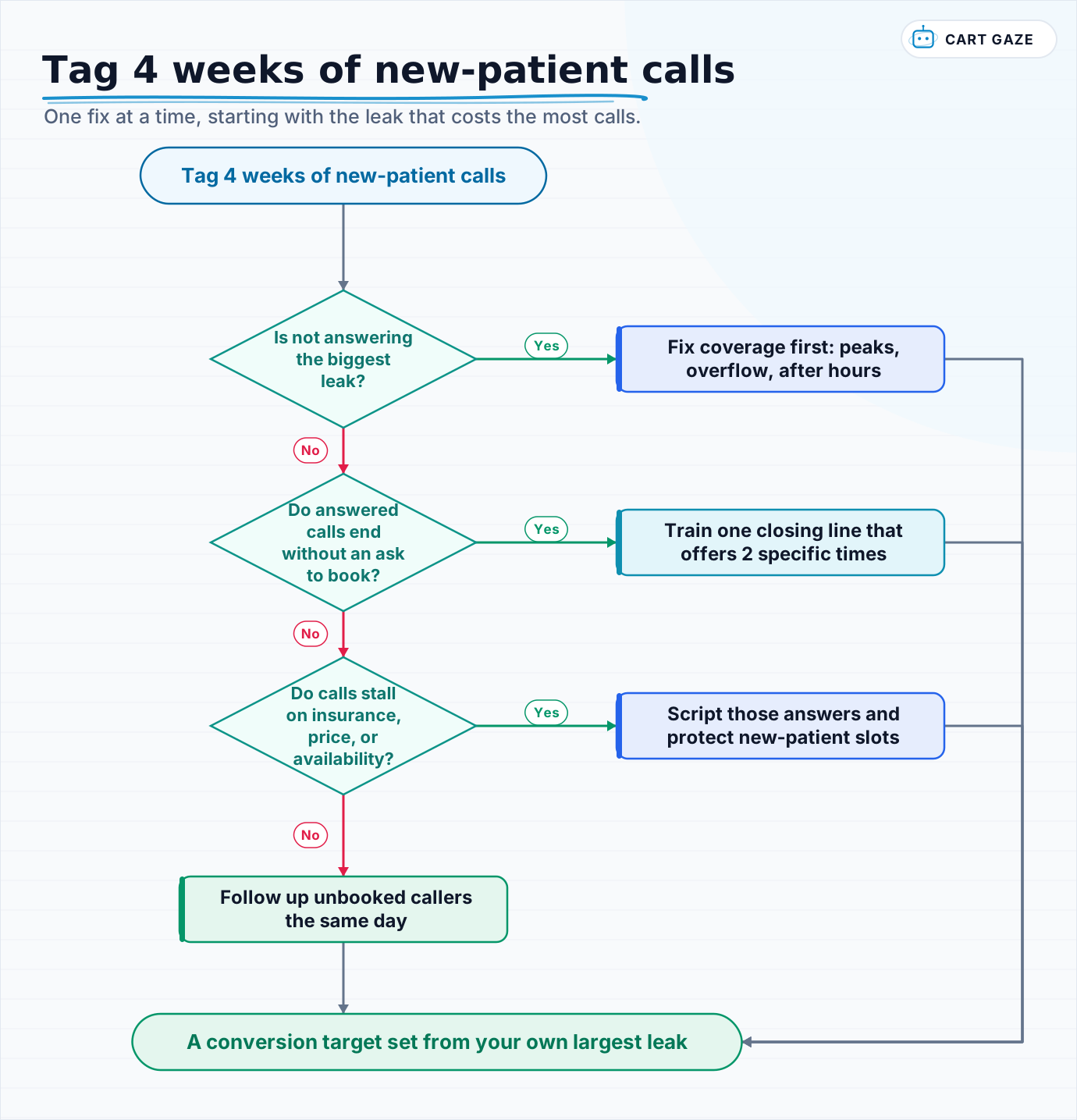 One fix at a time, starting with the leak that costs the most calls.
Walk the flow with your tally open. It sends you to one fix at a time, starting with whichever leak costs the most calls, because five simultaneous changes make it impossible to tell which one worked.
If answering is the largest leak, the choice is usually between more staff, an answering service, and an AI receptionist, and the booking difference between the last two is set out in how an AI receptionist compares with an answering service.
Fair questions.
What is a good new patient call conversion rate?
Published call-tracking data puts healthcare new-patient conversion between about 40% and 55%. Invoca found 40% of healthcare phone leads converted on the call in 2025, and Patient Prism put average practices at 54% and top performers at 72% in 2026. Both measure their own customers, so treat the middle as ordinary and set your target from your own baseline.
How do I calculate my new patient call conversion rate?
Take 4 weeks of calls, pick out the new-patient calls, and divide the number that booked by the number of new-patient calls. Do not divide by all calls, since existing patients, vendors, and wrong numbers will drag the rate down. Aim for at least 50 new-patient calls, and record why each unbooked call did not book.
Why do new-patient calls fail to book?
Usually at one of five points: the call is not answered, the caller is not recognized as new, nobody asks them to book, a question about insurance, price, or availability goes unanswered, or nobody follows up when they hang up unbooked. Most practices lose calls at two of these. Listening to 10 unbooked calls usually shows which.
Why do call conversion benchmarks disagree so much?
They divide different things. Some use all calls, some only calls identified as leads, and some every inquiry across phone, text, and web. They also differ on the clock, booked on the call versus within days, and on detection method. Invoca found only 48% of healthcare marketing calls were leads, so the denominator alone can halve a rate.
Can an AI receptionist improve new-patient call conversion?
It helps most with two leaks: it answers every call, including peaks and after hours, and it always offers specific open times. It answers insurance and price questions only from information you keep current. It must route clinical or urgent callers to a person and never assess symptoms, and because it hears PHI, the vendor must sign a BAA.
Sources.
Written by

Muhammad Qasim Hammad
Founder, Cart Gaze
Qasim builds AI receptionists and front-office automation for medical and dental practices at Cart Gaze. Posts here start from published sources and real call data, not vendor claims, and every number links back to where it came from.
Keep reading.
 Patient Acquisition & GrowthCall Tracking Numbers for Medical Practice Marketing, Done Safely10 min read
 Patient Acquisition & GrowthHow to Write a Lead Response SLA Your Practice Can Keep11 min read
 Patient Acquisition & GrowthHealthcare Directory Lead Response: One Queue and One Clock12 min read
 Patient Acquisition & GrowthSpeed to Lead Benchmarks Medical Practices Can Actually Measure12 min read
 Patient Acquisition & GrowthGoogle Business Profile Automation Without a HIPAA Slip10 min read
 Patient Acquisition & GrowthTurn Website Chat Into Booked Appointments the Compliant Way11 min read