
How to Write a Lead Response SLA Your Practice Can Keep
Most lead response SLAs promise a speed the front desk cannot deliver. Here is how to set different clocks by source and hour, name who owns each one, and build the escalation ladder behind them.
Key takeaways.
- The 21-times drop in qualify odds between 5 and 30 minutes comes from a 2007 B2B sales study, not a healthcare benchmark, so treat it as the shape of a curve rather than a target.
- Give each lead source its own clock: rings for a phone call or click-to-call, 15 minutes for a form or chat, and the business day for a referral email.
- After hours the promise has 2 parts, an instant automated acknowledgement and a human clock that starts at open, and they should be tracked separately.
- Build 3 escalation rungs with 3 different owners: a warning at roughly 75 to 80% of the window, a reassignment at the deadline, and the office manager a few hours later.
- Cap follow-up at 6 attempts across 2 channels over 5 business days, then close the inquiry with a written disposition instead of letting it rot.
Table of Contents8 sections
- Why most lead response SLAs fail in the first 2 weeks
- Set a different clock for each lead source and each hour
- Who owns the clock when the front desk is with a patient
- What escalates after the first, second and third failed attempt
- How many attempts is enough, and how to close a lead out honestly
- The reporting that makes an SLA real instead of aspirational
- Start with one clock you can actually hold
- Fair questions
Your practice already has a lead response rule even if nobody has written it down, and it is usually some version of "call them back when we get a chance." That rule loses new patients. The most quoted research on the subject, a 2007 study run by MIT's James Oldroyd with InsideSales across more than 15,000 web leads and 100,000 call attempts, found the odds of qualifying a lead fell about 21 times when the first call slipped from 5 minutes to 30 minutes.
That study is nearly 20 years old and it looked at B2B sales teams, not clinics, so do not treat 5 minutes as a healthcare benchmark. Treat it as a warning about the shape of the curve. The practical problem for a 2-provider practice is different anyway. You cannot promise a 5-minute callback when the one person at the front desk is checking a patient in, verifying benefits, and answering the phone at the same time.
A lead response SLA fixes that, but only if you write one you can keep. This post covers setting different clocks for different sources and hours, naming who owns the clock, the escalation ladder that fires after the first, second and third failed attempt, how many attempts is enough, and the two reports that make it real. There is a worked grid for a 2-provider practice you can copy.
Why most lead response SLAs fail in the first 2 weeks
Most practice SLAs fail because they promise a speed the staffing cannot deliver. A support-desk guide puts it plainly: committing to instant coverage when the team works 9 to 5 manufactures breaches you could have avoided. A rule that breaks twice a day stops being a rule and becomes background noise.
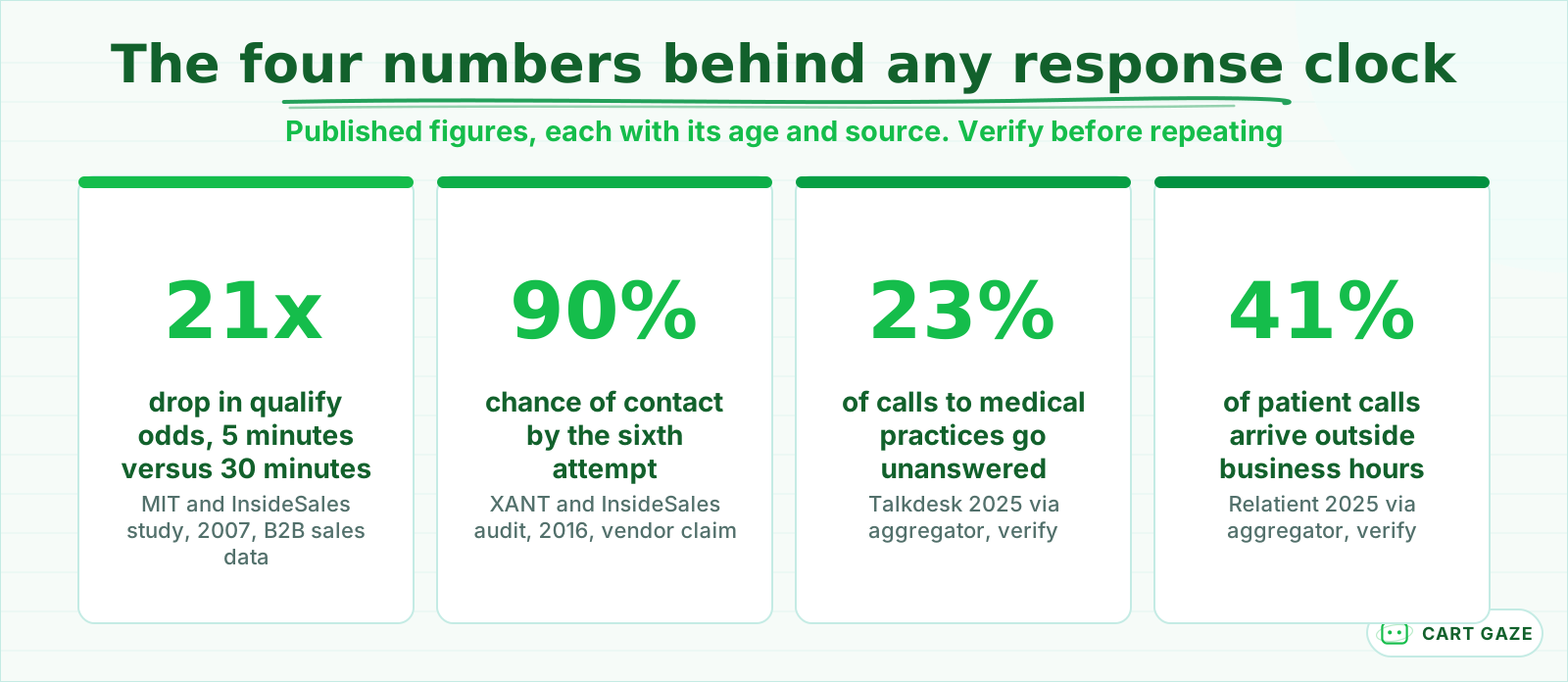 Published figures with their age and source. Set your clock against them, do not copy them.
The second failure is quieter. Contact centers settled this decades ago with a convention written 80/20, meaning 80% of calls answered within 20 seconds. It gets quoted everywhere, nobody agrees where it came from, and it says nothing about what happens to the other 20% of callers. Borrowing someone else's convention is not the same as writing one for your building.
Then there is the single-clock problem. Practices that do write something down usually write one number, and it has to cover a paid ad click-to-call at 9:15 a.m. and a referral email that arrived on Saturday. Those do not deserve the same deadline, and pretending they do guarantees you miss the one that mattered.
Set a different clock for each lead source and each hour
An inquiry's clock should follow its intent and its timing. Someone dialing after clicking an ad wants a voice now, so measure that in rings. A website form can wait minutes. A referral email can wait until end of day. After hours, the clock changes shape, not just length.
After hours the promise has two parts. An automated acknowledgement goes out immediately, and a separate human clock starts when the doors open. Track them separately, because they fail for different reasons. This is not a small slice either: one aggregator citing a 2025 Relatient study puts 41% of patient calls outside business hours.
Healthcare vendor guidance lands on under 10 minutes for a first response during staffed hours, with an instant auto-reply and next-day follow-up after them. General customer-service benchmarks are gentler, suggesting 4 to 8 business hours for email with under 4 hours as best in class. Neither is a law. Both mark the outer edge of what a patient will tolerate.
Here is a worked grid for a 2-provider practice with 2 people covering the front desk:
| Lead source | In-hours first response | After 6 p.m. and weekends | Who owns the clock | Escalates at |
|---|---|---|---|---|
| New patient phone call | Live, within 3 rings | Auto-answer, callback by 9:30 a.m. | Front desk lead | 10 minutes unreturned |
| Paid ad click-to-call | Live, within 3 rings | Auto-answer, callback by 9:30 a.m. | Front desk lead | 10 minutes unreturned |
| Website form | 15 minutes | Auto-reply, human by 9:30 a.m. | Holder of the shared inbox | 30 minutes |
| Text or website chat | 15 minutes | Auto-reply, human by 9:30 a.m. | Holder of the shared inbox | 30 minutes |
| Referral email or fax | Same business day | Next business day | Office manager | 1 business day |
Important
An SLA you break every day is worse than no SLA, because it teaches your team that the timer is decorative. Set the first version slower than you want it, hold it for 30 days, then tighten it.
Who owns the clock when the front desk is with a patient
A clock with no name attached does not run. "The front desk" is nobody, so every window needs a primary owner, a backup owner, and a system that answers when neither person is free. Write those names on the schedule the same way you write down who opens the building.
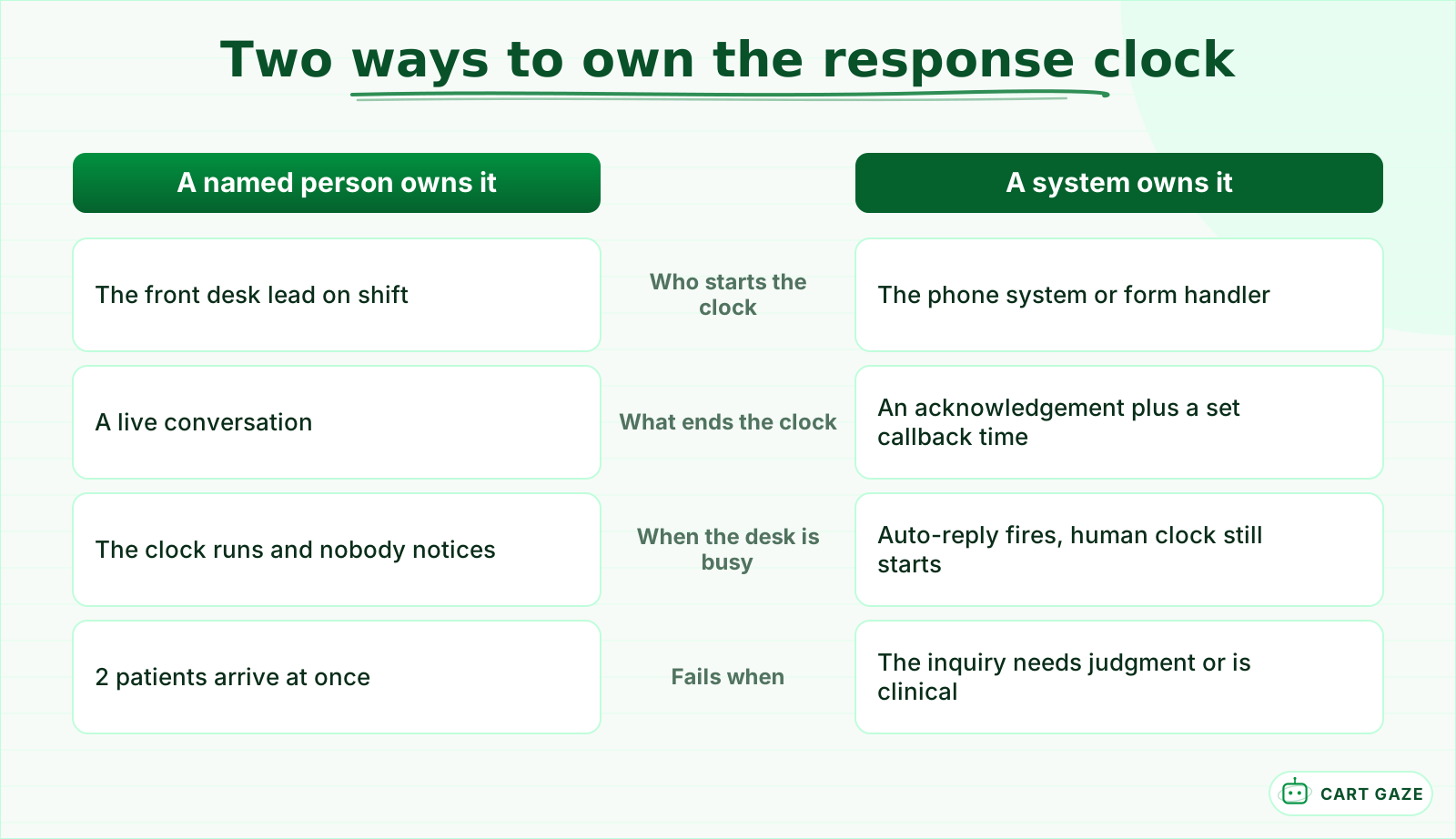 One is accountable and interruptible, the other reliable and limited. Most small practices need both.
The volume is what makes this necessary. An aggregator citing MGMA data puts inbound calls near 53 per physician per day, so a 2-provider practice can see close to 100 a day landing on one or two people who are also rooming patients and taking payments. Nobody in that role can also watch a timer.
Separating acknowledgement from response shrinks the problem. An automated text saying "we have your message, we will call you by 9:30" is not a response, but it buys the human clock a few hours without the patient assuming they were ignored. The response is the live conversation that follows, and only that ends the clock.
The system owner is where an AI receptionist earns its place, because it picks up on ring 1 at 8:47 p.m. and again at 12:10 p.m. when both humans are busy. It also has a hard boundary: it routes, it never diagnoses. If you have not evaluated one, start with what an AI receptionist does and where it stops so you know which parts of the clock it can honestly hold.
What escalates after the first, second and third failed attempt
Escalation is what makes the promise survive a busy morning. Three rungs are enough: a warning to the owner before the deadline, a handoff to a named backup at the deadline, and the office manager taking it personally a few hours later. Each rung gets a new owner and a new deadline.
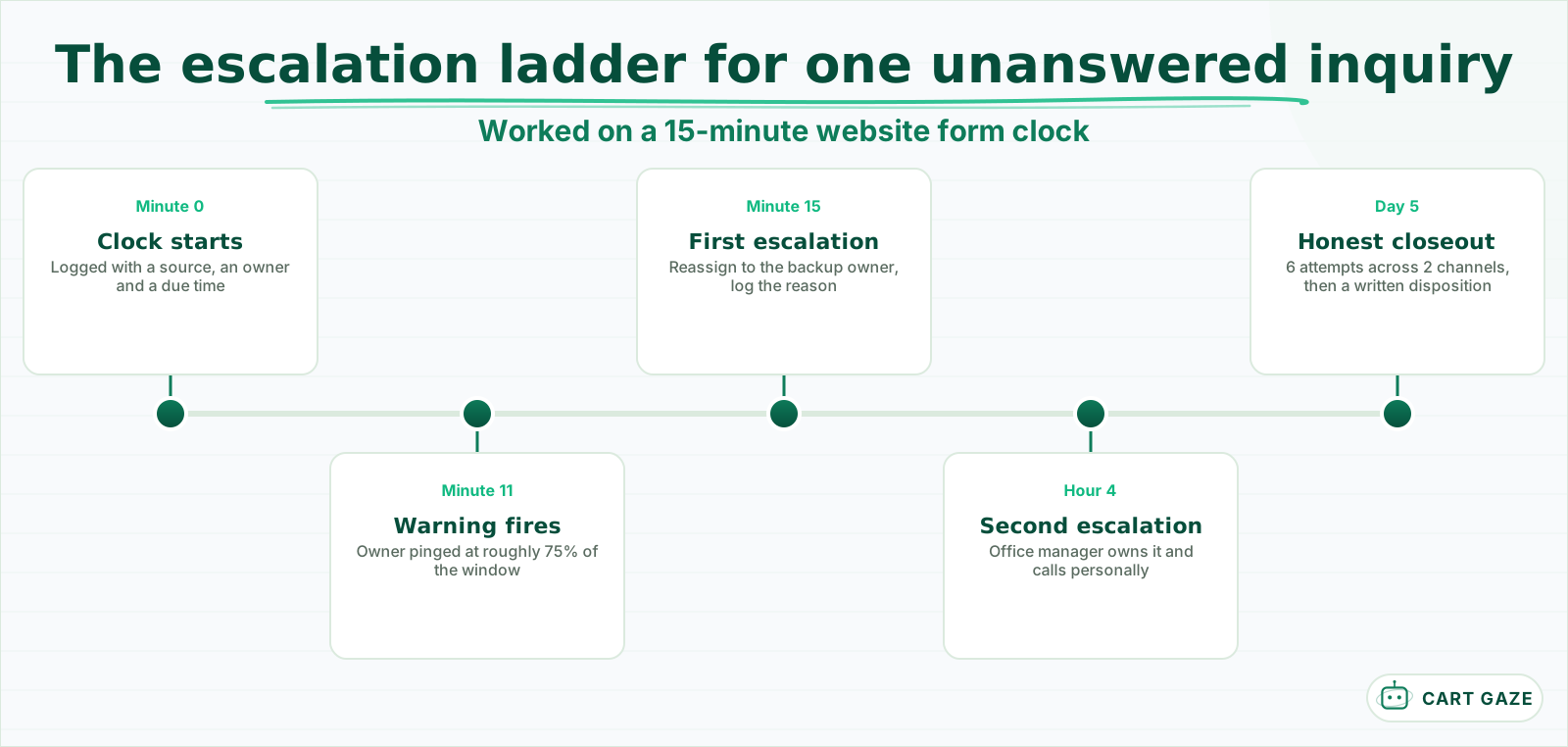 Each rung gets a new owner and a new deadline. Nothing loops back to whoever already missed it.
Fire the first rung before the breach, not after. Support tooling conventionally raises a warning at roughly 75 to 80% of the window, which on a 15-minute form clock is about 11 minutes in. That is still a save. An alert that arrives at minute 16 is a report, not a rescue.
The second rung is a reassignment, and it has to be a real one. Notifying the same person again is not escalation, it is nagging. Hand the inquiry to the backup owner and write down why the first attempt failed, because the reason code is worth more than the miss.
The third rung is somebody with authority, which at this size means the office manager or an owner. Sales templates put a manager at 1 hour and a VP at 4 hours; scale that to your building, but keep the principle that escalation only travels upward. It can skip a rung when urgent, and never moves back down.
Warning
A caller describing symptoms is not lead traffic and must never sit on a marketing clock. Route those calls to a clinician immediately, whatever the SLA says, and make sure any automated first touch is built to hand them off rather than answer them.
Getting that handoff right is its own design problem, with its own triggers and failure modes, and we work through them in escalation and fallback design.
How many attempts is enough, and how to close a lead out honestly
Six attempts across 2 channels over 5 business days is a defensible cap for a practice. The vendor audit behind the famous speed numbers claims the chance of making contact climbs to 90% by the sixth attempt, while real teams averaged 4.47 touches and quietly abandoned about 30% of leads early.
Treat that 90% as a vendor claim from a 2016 audit of 4,732 companies rather than a promise. The same audit reported that half the leads it examined got no response at all, and that the average response took over 40 hours. The usual problem is not too few attempts. It is zero attempts.
Persistence also has a ceiling. The 2007 study found that past roughly 20 hours, additional dials started working against the odds of ever qualifying that lead, because a call on day 4 reads as an afterthought rather than a response. The cap is not laziness. It is the point where more calling makes your outcome worse.
Closing a lead out honestly means writing a reason instead of going quiet. Every inquiry should end in one of a short list: booked, declined, unreachable after 6 attempts, wrong number, or went elsewhere. One with no disposition rots in a spreadsheet, gets re-called by somebody else next month, and lands in two different counts of how the practice is doing.
One caution about the sequence. If any attempts are automated texts, consent rules apply and they are stricter than most practices assume. No SLA document can wave that through.
The reporting that makes an SLA real instead of aspirational
Two reports are enough. The first is attainment: what share of inquiries got a response inside their own clock, cut by source and by hour. The second is a breach log where every missed line carries a reason. Without those, an SLA is a document nobody has ever checked.
Cutting attainment by hour is what turns a report into a decision. If 80% of your misses land between 11:30 a.m. and 1 p.m. that is a coverage gap with a scheduling answer. If they cluster on Monday mornings, it is a volume problem. If they are spread evenly across the week, your clock is simply too fast for the staff you have.
Sales-ops templates open at above 85% attainment and under 15% breach. Those are reasonable starting targets, though a small practice may need to begin nearer 70% and climb. The number matters far less than whether somebody actually reads it on a set day each week.
Reason codes beat blame every time. "Nobody was at the desk", "the form went to a mailbox nobody owns", and "the caller hung up after 12 seconds" point at three different remedies, and only one of them is about effort. Your phone system probably logs enough already, and the front desk call metrics worth tracking covers how to pull them without buying anything new.
Tip
Watch the warning state rather than the breach state. By the time an inquiry shows up on a breach report the patient has usually already called somewhere else, so the useful alert is the one that fires while there is still time to answer.
Before you switch the SLA on
- Every window on next month's schedule has a named primary and a named backup.
- The after-hours clock states both the automated acknowledgement and the human follow-up time.
- Symptom calls have a documented route to a clinician that ignores the marketing clock entirely.
- One person owns the weekly attainment report and has a standing time to read it.
Start with one clock you can actually hold
Pick one lead source, usually the highest-intent one, and hold its clock for 30 days before you add a second. A single kept promise is worth more than five written ones, and it gives you a real attainment number to argue with instead of a target somebody copied off a blog.
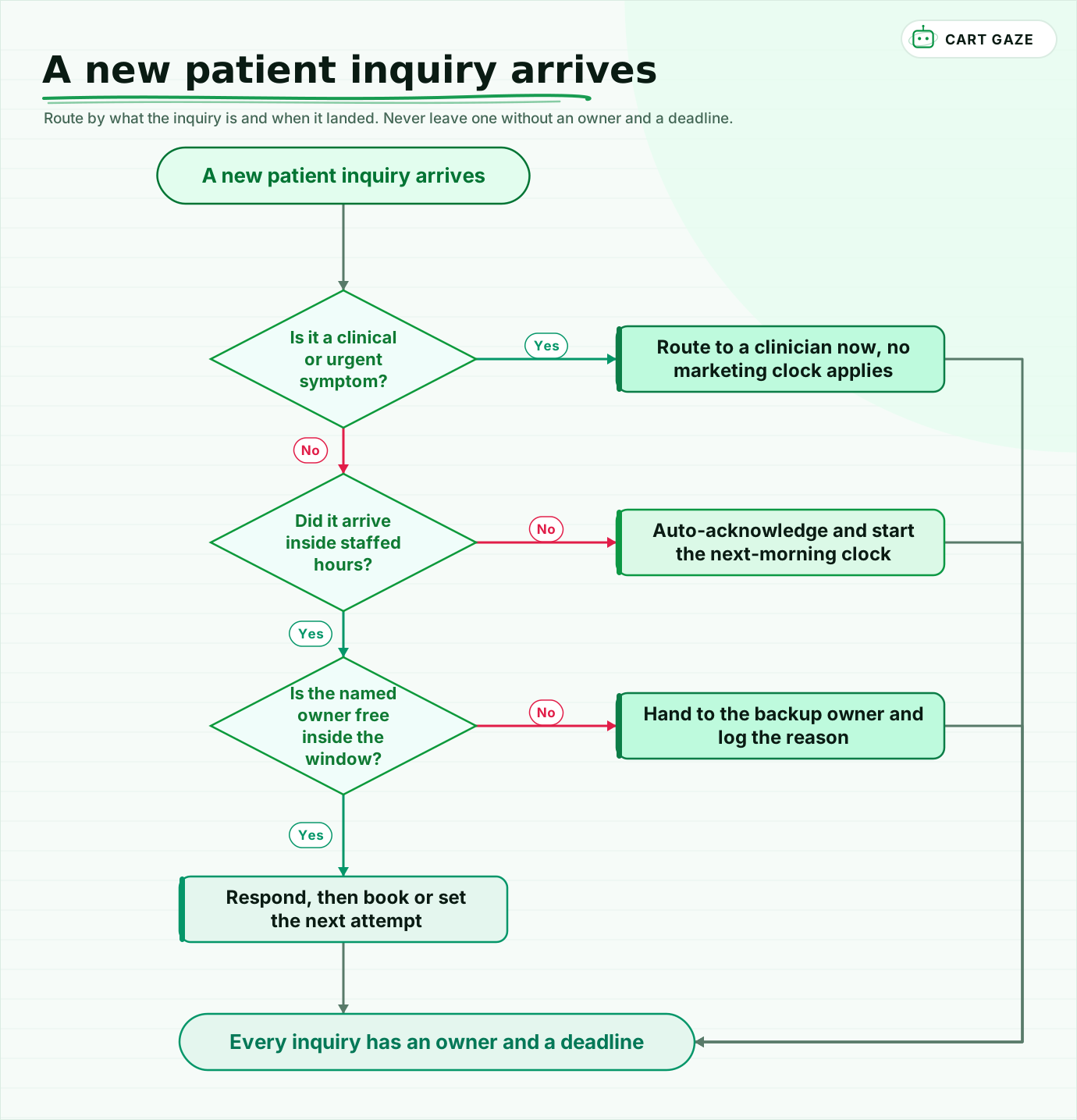 Route by what the inquiry is and when it landed. Never leave one without an owner and a deadline.
Walk the flow once. A symptom call leaves the SLA entirely and goes to a clinician. An after-hours inquiry gets an acknowledgement now and a human clock at open. An in-hours inquiry belongs to a named owner, and when that owner is not free it moves to the backup with the reason written down. Nothing sits without an owner and a deadline.
After 30 days, re-cut attainment and move the number. If you held 95%, tighten the clock. If you held 60%, the clock is wrong, not the staff. Adjusting a published SLA downward is a normal management decision, while quietly ignoring one is how the whole thing dies.
If you would rather size the inquiry volume first, the free Growth Leak Audit puts numbers on what is arriving and what goes unanswered, using your own figures rather than somebody else's benchmark.
Fair questions.
What is a lead response SLA for a medical practice?
It is a written promise about how fast a new patient inquiry gets a real response, who owns that clock, and what happens when the deadline passes. A usable one sets different targets by lead source and by hour, names a primary and a backup owner for every window, and defines the escalation that fires on a miss.
How fast should a practice respond to a new patient inquiry?
Healthcare vendor guidance lands on under 10 minutes during staffed hours, with an instant automated reply after hours and a human follow-up the next morning. The widely quoted 5-minute figure comes from a 2007 study of B2B sales teams, not from healthcare. Pick a target your staffing can hold for 30 days, then tighten it.
What should escalate after a missed lead response?
Three rungs, each with a different owner. A warning pings the owner at roughly 75 to 80% of the window, while there is still time to save it. At the deadline the inquiry moves to a named backup with a written reason. A few hours later the office manager owns it and calls personally.
How many times should you try to reach a new patient lead?
Six attempts across 2 channels over about 5 business days is a defensible cap. A 2016 vendor audit claims the chance of contact reaches 90% by the sixth attempt, while real teams averaged 4.47 touches. The same 2007 research found that past roughly 20 hours, extra dials started hurting the odds.
Do urgent or clinical calls belong on the lead response SLA?
No. A caller describing symptoms is not lead traffic and must never wait on a marketing clock. Those calls route to a clinician immediately, and any automated first touch has to hand them off rather than answer them. An AI receptionist routes and books appointments, it does not diagnose or judge how sick somebody is.
Sources.
- [1]Lead Response Management study executive summary (MIT / InsideSales, 2007)
- [2]Lead Response Audit: how many touches to make a sale (XANT / InsideSales, 2016)
- [3]Is 80/20 still a reasonable service level?
- [4]Lead SLA: definition, tiered response targets and escalation rules
- [5]SLA breach in customer support: states, warning thresholds and reporting
- [6]Medical practice phone statistics: call volume, unanswered calls, after-hours share
- [7]Dental practice phone statistics: missed calls and callers who try a competitor
- [8]Speed to lead: response time benchmarks for healthcare practices
- [9]Customer service email response time standards by industry
Written by

Muhammad Qasim Hammad
Founder, Cart Gaze
Qasim builds AI receptionists and front-office automation for medical and dental practices at Cart Gaze. Posts here start from published sources and real call data, not vendor claims, and every number links back to where it came from.
Keep reading.
 Patient Acquisition & GrowthSpeed to Lead: Why New Patients Book With Whoever Answers First11 min read
 Patient Acquisition & GrowthSpeed to Lead Benchmarks Medical Practices Can Actually Measure12 min read
 Patient Acquisition & GrowthHealthcare Directory Lead Response: One Queue and One Clock12 min read
 Patient Acquisition & GrowthPaid Social Lead Response Automation for Meta Instant Forms11 min read
 Patient Acquisition & GrowthWeb Form Lead Response Automation: Submit to First Touch11 min read
 Patient Acquisition & GrowthGoogle Business Profile Automation Without a HIPAA Slip10 min read