
Paid Social Lead Response Automation for Meta Instant Forms
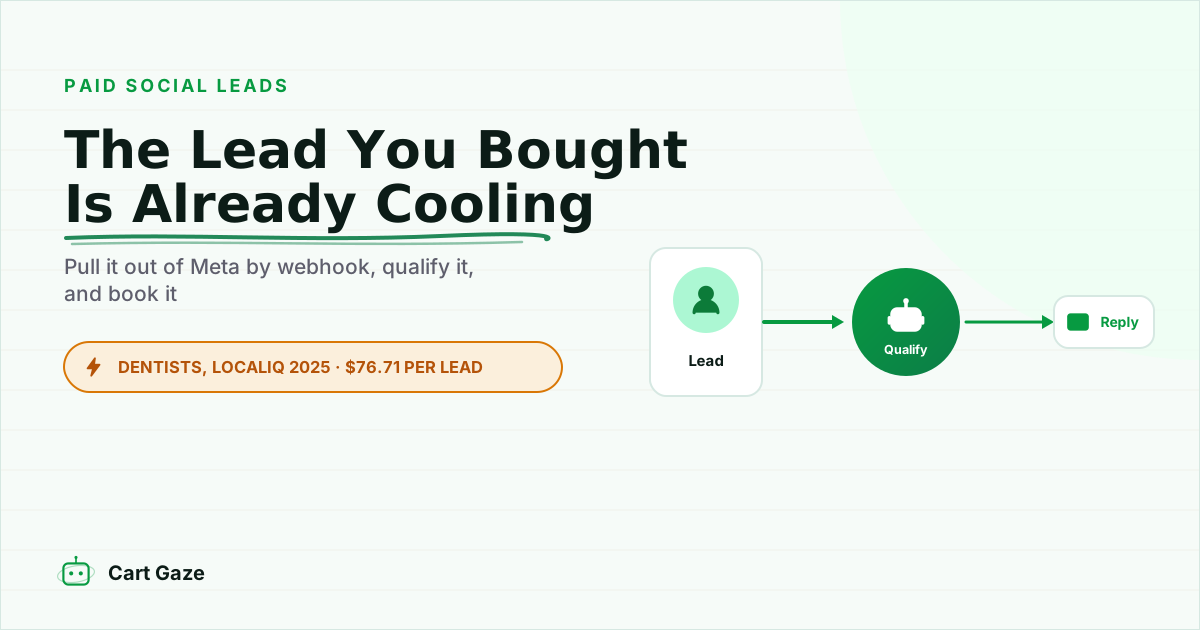
A Meta instant-form lead can cost $50 or more and starts decaying the second it is submitted. Here is how to pull it out of Meta in real time, qualify it before a human dials, and price the result honestly.
Key takeaways.
- A Meta instant form prefills name, email, and phone and submits in 1 or 2 taps, so it buys more leads per dollar and less intent inside each one.
- LocaliQ 2025 benchmarks put Facebook lead-ad cost per lead at $76.71 for dentists and $52.98 for health and fitness, against a $27.66 all-industry average.
- Meta lead webhooks carry ids only, so you need a second Graph API call to get the answers, and Meta states notifications can lag by up to a few minutes.
- Meta makes leads downloadable for 90 days after submission, so a manual CSV habit both slows response and eventually loses the record entirely.
- Modeled at $50 per lead and 100 leads a month, lifting the booking rate from 20% to 40% halves cost per booked consult from $250 to $125 on the same spend.
Table of Contents8 sections
- Why an instant-form lead is worth less than a website form lead
- What you are actually paying for one of these leads
- Pull the lead out of Meta in seconds, not overnight
- Qualify the lead before a human picks up the phone
- The honest math on cost per booked patient
- What breaks, and where the compliance line sits
- Put every paid social lead on a clock
- Fair questions
A lead from a Meta instant form arrives with the person's name, email, and phone already filled in, because they never typed any of it. They tapped an ad in the feed, glanced at a prefilled form, and tapped submit. Twenty seconds later they are watching something else. That lead cost you money, and it is already cooling.
The bill is real. LocaliQ's 2025 Facebook benchmarks put the leads-objective cost per lead at $76.71 for dentists and dental services and $52.98 for health and fitness, against an all-industry average of $27.66. A modest med spa or implant campaign is buying inventory at $50 or more a unit, and in most practices that inventory sits in a CSV file until somebody opens it tomorrow.
This post covers what makes an instant-form lead different from a website form lead, how to get one out of Meta in real time using the mechanics Meta actually documents, what to ask before a human is involved, and the honest arithmetic on cost per booked patient when response is measured in minutes rather than days.
Why an instant-form lead is worth less than a website form lead
Meta prefills name, email, and phone from the person's profile, so an instant form takes one or two taps and never sends anyone out of the feed. That is deliberate. Lower friction buys more leads per dollar and less commitment inside each one, and your front desk absorbs the difference.
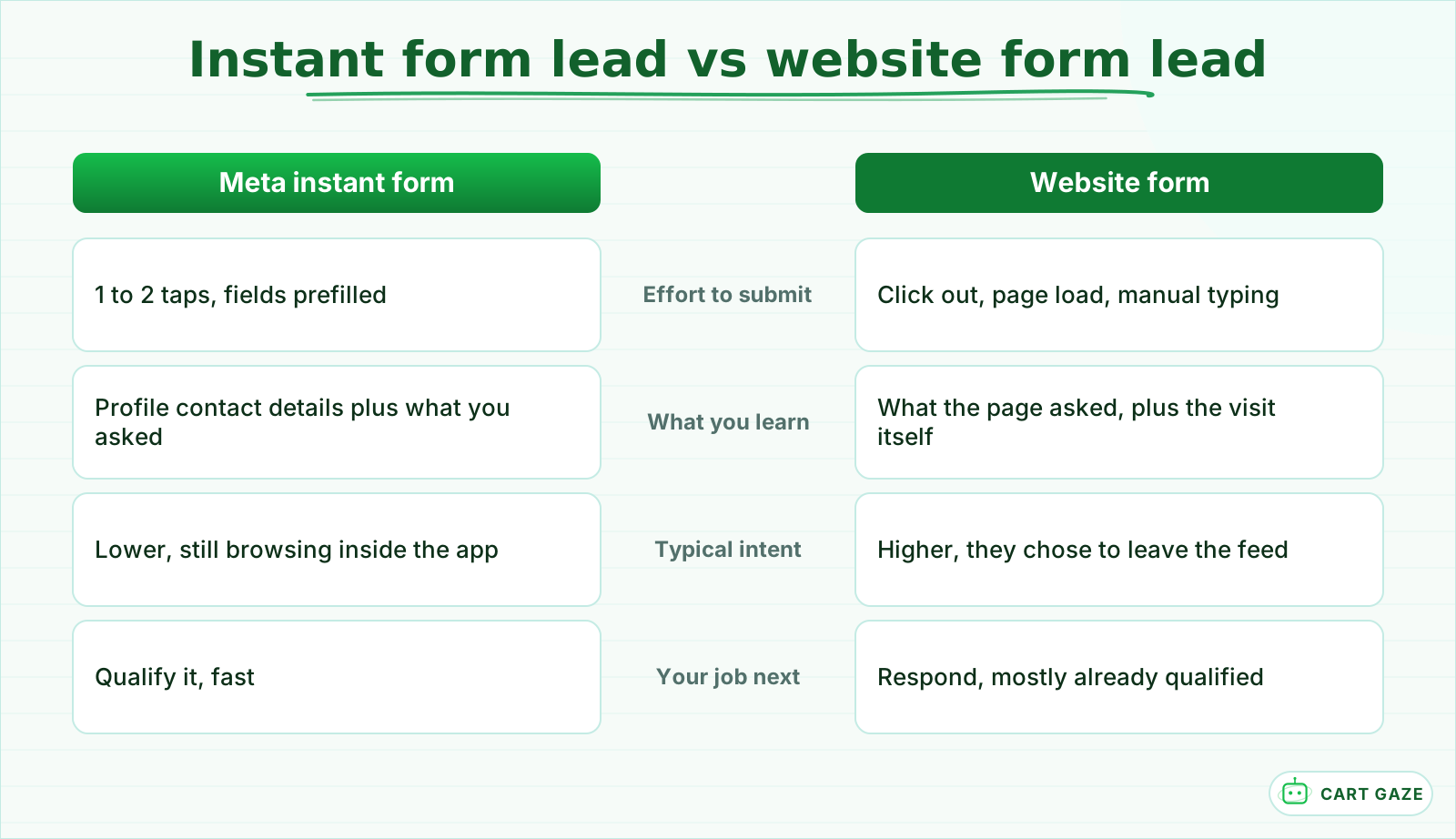 Same ad spend, two different leads. The instant form trades intent for volume by design.
Meta sells this trade openly. When you build an instant form you pick a type: one is described as quick to fill out and submit on a mobile device, and the other adds a review step so the person can confirm their information before it goes. The second type produces fewer leads that mean more. Neither is wrong. What is wrong is buying the first and then working the leads as though you bought the second.
The practical consequence is about timing, not attitude. A website form means someone left the feed, waited for a page to load, and typed their details in by hand. They already decided you were worth the detour. An instant-form submitter made none of those decisions, so their interest is at its highest point the moment they tap submit and falls from there. That is why response time carries more weight on paid social than on almost any other channel a practice buys.
None of this is an argument against instant forms. They are usually the cheapest way to buy a name and a phone number in aesthetics, implants, and weight loss. It is an argument that the lead arrives unfinished, and finishing it is your job, not Meta's.
What you are actually paying for one of these leads
LocaliQ's 2025 Facebook benchmarks put the leads-objective cost per lead at $76.71 for dentists, $52.98 for health and fitness, $51.42 for beauty and personal care, and $47.47 for physicians, against an all-industry average of $27.66. Healthcare buys some of the most expensive leads on the platform. That inventory has a shelf life.
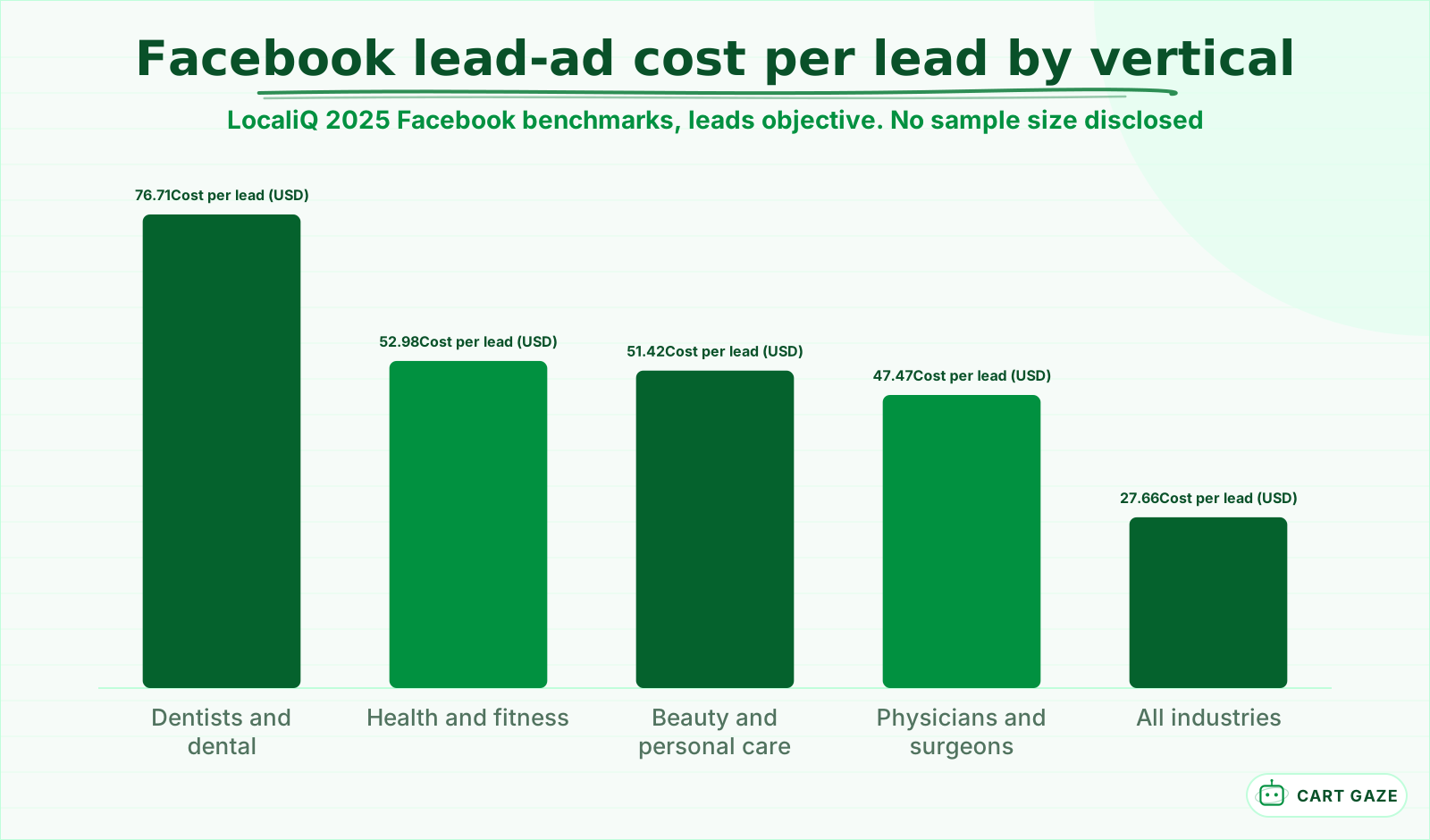 LocaliQ 2025 benchmarks, leads objective. Your account will differ, so treat these as a sanity check.
Those are aggregate benchmarks from one published dataset, last updated in October 2025, with no sample size disclosed. Treat them as a sanity check on your own account, not as a target. LocaliQ also reports that the all-industry average rose from $22.87 to $27.66 year over year, so the direction of travel is up.
Agency figures for med spas specifically run lower. Practice Growth Co publishes a Meta range of $15 to $30 a lead alongside a 30% to 40% lead-to-consult booking rate, and says outright that these are directional ranges from one agency's book rather than a controlled study. That is the correct way to read every number in this niche, including the ones on vendor landing pages.
Whatever your real figure is, the shape holds. At $50 a lead and 10 leads a week, you are spending roughly $2,000 a month on contacts that decay by the hour. The spend is already committed the moment the form is submitted. The only variable left is how much of it you recover.
Pull the lead out of Meta in seconds, not overnight
The default path in Ads Manager is a CSV someone downloads the next morning, which is why so many paid leads go cold before anyone dials. The real-time path is a webhook, and Meta's own documentation is specific about what it does and does not send you. Build for that gap.
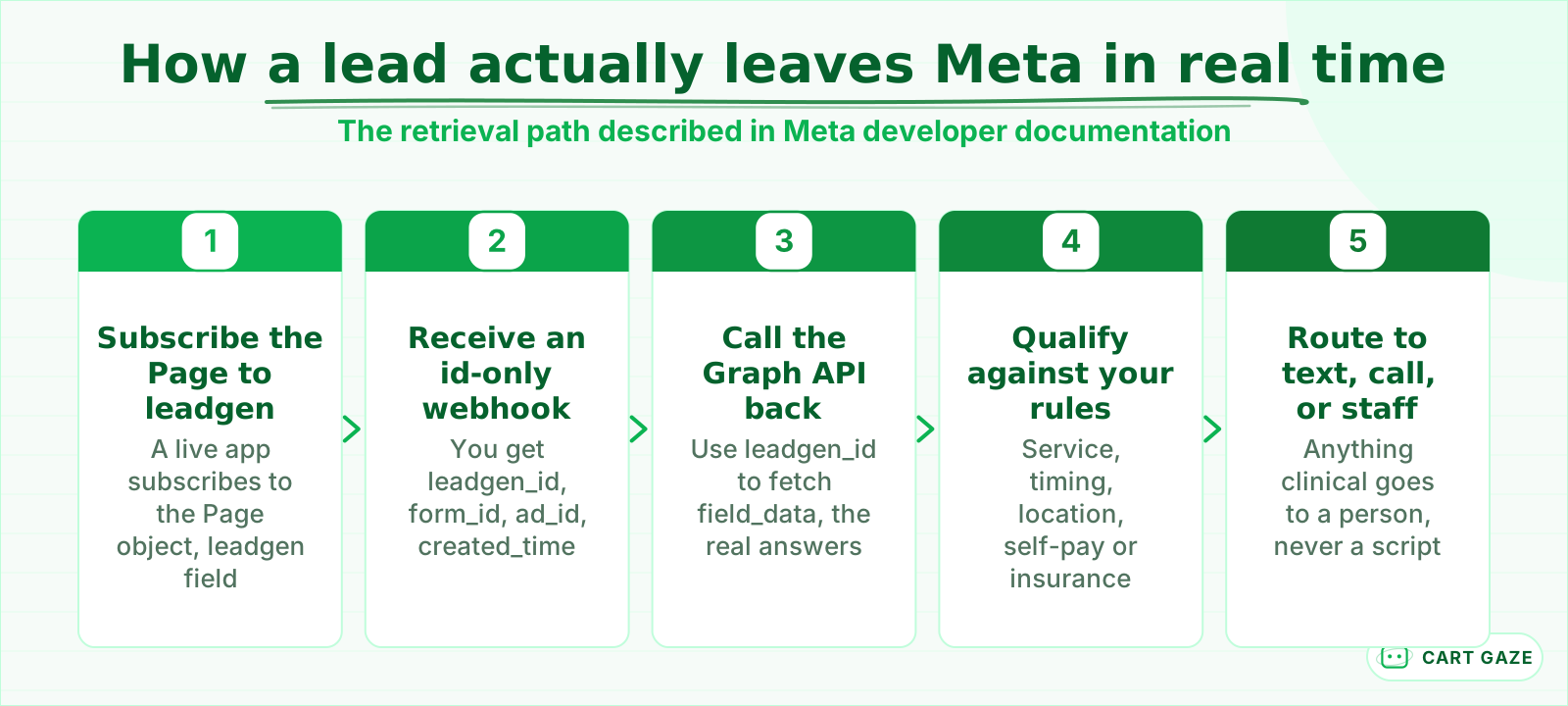 Meta sends ids, not answers. The second call is the one most setups forget to build.
Here is the part most integration guides skip. You subscribe your app to the Page object and the leadgen field. When a form is submitted, Meta posts a notification containing leadgen_id, page_id, form_id, adgroup_id, ad_id, and created_time. It does not contain the answers. You then call the Graph API back with that leadgen_id to retrieve field_data, which is where the person's actual responses live. One notification, two round trips.
Meta's documentation also sets expectations you should pass on to your team rather than oversell. Webhook notifications arrive with a delay of up to a few minutes. Leads cannot be retrieved at all while your app is in Development mode, which quietly breaks more first launches than anything else. And the retrieval rate limit is calculated as 200 multiplied by 24 multiplied by the number of leads created in that Page's last 90 days, so a brand new campaign has a smaller budget of API calls than a mature one.
Tip
Build a daily reconciliation pull alongside the webhook: query the Graph API for the day's leads and compare the count to Ads Manager. A webhook that stops firing throws no error and sends no alert, so a scheduled count is the only thing that tells you it went quiet.
The 90-day figure matters for a second reason. Meta's help center states that leads are only downloadable for 90 days after submission, so a practice running on manual CSV exports is not just slow, it is on a clock. Anything nobody exported in time is gone from the platform entirely.
Qualify the lead before a human picks up the phone
The form itself is your first qualifier. Meta lets you add custom questions to an instant form, and choosing the higher-intent type adds a review step where the person confirms what is about to be sent. Ask what changes your routing, not what flatters your reporting. Four answers usually do it.
Those four: which service they want, when they want to be seen, which location, and whether they expect to pay themselves or use insurance. Each one changes what happens next. A weight-loss inquiry asking about insurance coverage goes to a different queue than a Botox inquiry asking about Saturday availability, and knowing that before anyone dials is what makes a 3 minute response possible at all.
The automated first touch has a narrow, useful job: confirm the form arrived, repeat back what they asked for, and offer real times. It should not assess symptoms, interpret a photo, or answer a medical question, no matter how routine the question looks. If you are working out where that boundary sits, what an AI receptionist does and where it stops draws the same line for phone calls.
Warning
Med spa, implant, and weight-loss campaigns advertise cosmetic outcomes but attract clinical questions. Someone will reply to your automated text describing swelling, a medication, or a past procedure. That message needs a person, not a faster script.
Scoring belongs in the same pass. Rather than repeat the model here, the framework in scoring paid leads before you call them applies directly to instant-form answers, since the fields you added are exactly the inputs a score needs.
The honest math on cost per booked patient
Faster response does not change your ad spend. It changes the denominator. At $50 per lead and 100 leads a month, a 20% booking rate costs $250 per booked consult and a 40% rate costs $125, on identical spend. Everything below is modeled, so substitute your own numbers.
| Leads per month | Ad spend at $50 CPL | Booking rate | Booked consults | Cost per booked consult |
|---|---|---|---|---|
| 100 | $5,000 | 20% | 20 | $250 |
| 100 | $5,000 | 30% | 30 | $167 |
| 100 | $5,000 | 40% | 40 | $125 |
| 100 | $5,000 | 45% | 45 | $111 |
Chain one more step and you get to patients. Using Practice Growth Co's directional 30% to 40% booking rate and 50% to 60% consult-to-patient close, that same $5,000 produces roughly 15 to 24 first visits, or about $208 to $333 in acquisition cost per patient. Those are someone else's ranges run through arithmetic, not a forecast for your practice.
You will see a "21x" figure quoted constantly in aesthetics marketing, usually attached to a claim about clinics. It comes from the Lead Response Management study run by Professor James Oldroyd with InsideSales.com, which analyzed 3 years of data across 6 companies, more than 15,000 leads, and over 100,000 call attempts, and found a 21-fold drop in the odds of qualifying a prospect when response slipped from 5 to 30 minutes. It is business-to-business sales data, and it is roughly two decades old. The mechanism travels; the number is not a healthcare benchmark, and anyone presenting it as one has not read it. The response-window research is unpacked properly in speed to lead for new patient inquiries.
What breaks, and where the compliance line sits
Three things break in practice: junk leads that prefill made easy to submit, webhooks that go quiet without throwing an error, and consent language nobody has read since the form was built. None of them announce themselves, so each one needs a check you run on a schedule.
Junk is structural. Prefill means a mis-tap submits a genuine profile with a stale phone number attached. Meta added an SMS verification option because of this, and its own case study reports a 32% reduction in invalid phone numbers for one advertiser, which is a vendor case study rather than a benchmark you should plan around.
Important
The moment a form answer describes a condition, a medication, or a body area, you are holding patient information. Any vendor that touches it is a business associate and needs a signed Business Associate Agreement. There is no such thing as a "HIPAA certified" tool, so treat that phrase on a sales page as a warning sign.
Consent deserves five minutes of a lawyer's time. On 24 January 2025 the Eleventh Circuit vacated the FCC's one-to-one consent rule in Insurance Marketing Coalition v. FCC, which removed the requirement to name a single seller. Prior express written consent under the TCPA still requires the person to agree clearly and unmistakably before you text or call them, so the disclaimer wording sitting on your instant form is doing legal work. Have someone qualified read it.
Before you switch on automated lead response
- A signed BAA covers every vendor that will see a form answer.
- Your instant-form disclaimer wording has been reviewed by a lawyer, not copied from a competitor.
- A daily reconciliation pull compares Graph API lead counts against Ads Manager.
- One named person reads the first week of automated replies end to end.
Put every paid social lead on a clock
Pick one campaign and one form, put a stopwatch on the whole path from submission to first reply, and give every lead a logged outcome. Then measure booked visits per 100 leads in your own records, before and after, rather than trusting anyone's case study including this post.
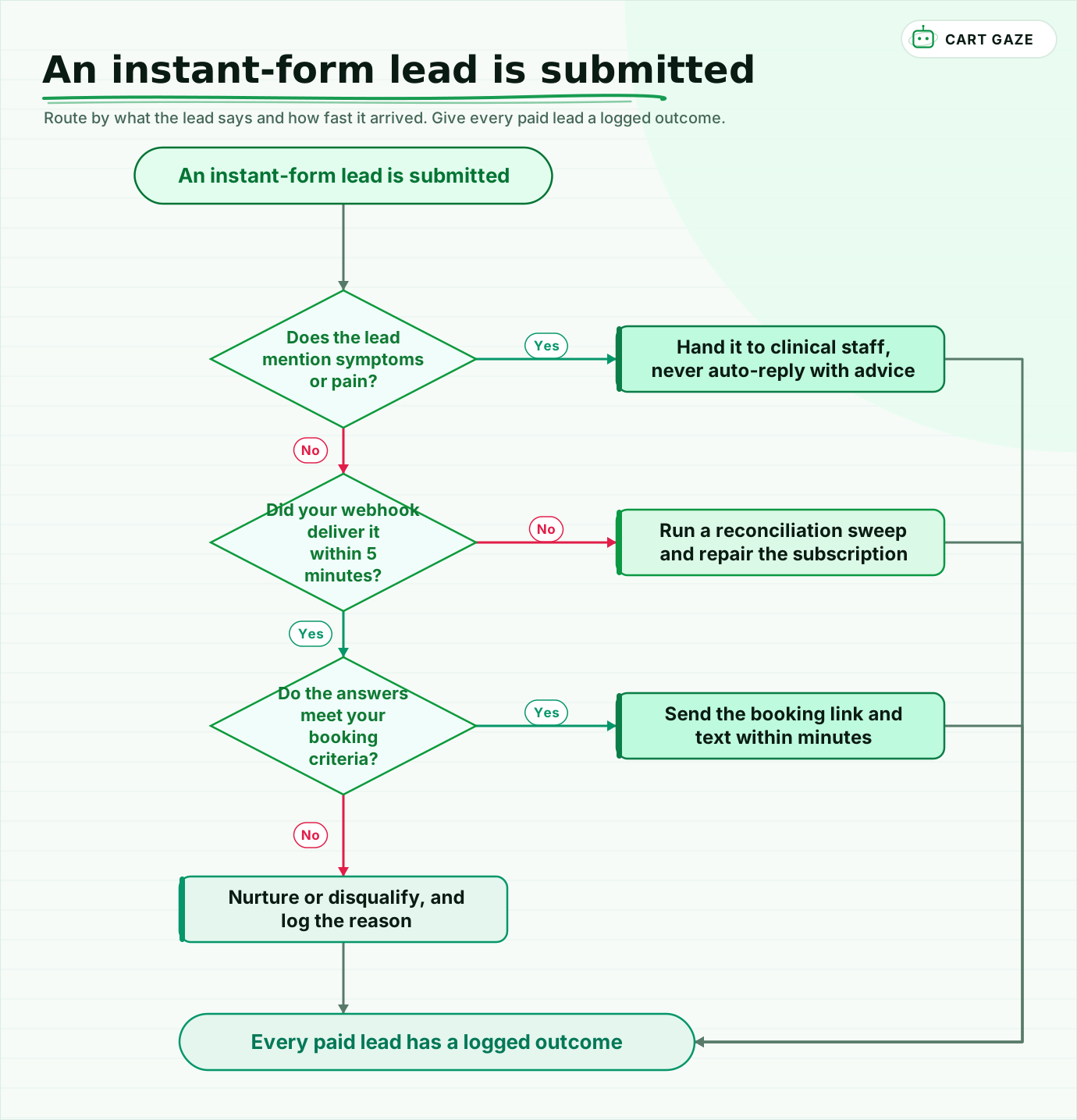 Route by what the lead says and how fast it arrived. Give every paid lead a logged outcome.
Walk the flow once. Anything mentioning symptoms or pain goes to clinical staff, always. If the webhook did not deliver inside 5 minutes, that is a plumbing problem to fix before you blame the leads. A qualified lead gets a booking link and a text while they are still holding the phone. A lead that misses your criteria gets nurtured or disqualified with the reason written down, because a paid lead with no recorded outcome is spend you can never explain.
Start with the slowest step, which in most practices is the overnight CSV. Closing that one gap moves your response from 14 hours to a few minutes without touching your ad account. If you would rather see the size of the leak before you build anything, the free Growth Leak Audit prices it from your own numbers.
Fair questions.
Why do Meta instant-form leads convert worse than website form leads?
Because the form is designed to be effortless. Meta prefills name, email, and phone from the profile, so submitting takes 1 or 2 taps with no page load and no exit from the feed. The person never chose to visit your site, so they made a much smaller commitment. You get more leads per dollar and less intent in each one.
How do I get Facebook lead ads into my system in real time?
Subscribe your live app to the Page object and the leadgen field. Meta then posts a notification carrying leadgen_id, form_id, ad_id, and created_time, but not the answers. Call the Graph API back with that leadgen_id to fetch field_data. Meta states notifications can arrive with a delay of up to a few minutes, so plan for minutes, not milliseconds.
How long does Meta keep my lead ad data?
Meta makes submitted leads downloadable for 90 days, after which they are no longer available from the platform. That matters most for practices exporting a CSV by hand, since a missed month is gone permanently. A webhook plus a daily reconciliation pull into your own records removes the deadline entirely.
What should an automated first reply to a paid social lead say?
Confirm the form arrived, repeat back the service they asked about, and offer real appointment times. It should never assess symptoms, interpret a photo, or answer a medical question. Cosmetic and weight-loss campaigns attract clinical replies, so build a clear path that hands those messages to a person immediately.
Do I need a BAA for a tool that responds to my Meta leads?
If a form answer describes a condition, a medication, or a body area, you are holding patient information, and any vendor that touches it is a business associate that needs a signed Business Associate Agreement. HIPAA compliance is a configuration and contract question. No product is "HIPAA certified", because that certification does not exist.
Sources.
- [1]Meta Webhooks for Lead Ads (subscribe the Page object to the leadgen field)
- [2]Retrieving Leads: Graph API field_data, rate limits, and webhook delay
- [3]Meta Lead Ads developer guide: bulk read, webhooks, and Leads Center
- [4]Download your leads data from Ads Manager (90-day download window)
- [5]About Instant Form types: more volume and higher intent
- [6]Facebook Advertising Benchmarks 2025: cost per lead by industry (LocaliQ)
- [7]Med spa marketing benchmarks: directional ranges from one agency book
- [8]Lead Response Management Study (Prof. James Oldroyd, MIT, with InsideSales.com)
- [9]Eleventh Circuit vacates the FCC one-to-one TCPA consent rule (Wiley)
- [10]Facebook Instant Form types, prefill, and Meta case-study numbers
Written by

Muhammad Qasim Hammad
Founder, Cart Gaze
Qasim builds AI receptionists and front-office automation for medical and dental practices at Cart Gaze. Posts here start from published sources and real call data, not vendor claims, and every number links back to where it came from.
Keep reading.
 Patient Acquisition & GrowthHow to Write a Lead Response SLA Your Practice Can Keep11 min read
 Patient Acquisition & GrowthWeb Form Lead Response Automation: Submit to First Touch11 min read
 Patient Acquisition & GrowthSpeed to Lead Benchmarks Medical Practices Can Actually Measure12 min read
 Patient Acquisition & GrowthSpeed to Lead: Why New Patients Book With Whoever Answers First11 min read
 Patient Acquisition & GrowthMultichannel Lead Response: One Thread Per Patient, Not Four11 min read
 Patient Acquisition & GrowthHealthcare Directory Lead Response: One Queue and One Clock12 min read