
Healthcare Directory Lead Response: One Queue and One Clock
Zocdoc, Yelp, Healthgrades, Google and insurer directories each deliver leads a different way, and patients compare about 21 profiles before booking. Here is how to answer them on one queue with one clock.
Key takeaways.
- Zocdoc's 2025 booking data puts the average patient at 21 provider profiles compared before booking, so your reply is always read next to a competitor's.
- Google removed Business Profile chat and call history on 31 July 2024, so a Google directory lead now arrives as a phone call or a website click, not a message.
- Yelp calculates a response rate and a median response time over a rolling 30 days and shows both, and a Zocdoc booking stays pending until your practice confirms it.
- CMS found 48.74% of Medicare Advantage directory locations had at least one error in its 2018 review, and a 2023 Senate study booked an appointment on only 18% of 120 calls.
- Audit listings first because it is free, then set one response target across every channel, then decide whether you need software to hold the queue together.
Table of Contents8 sections
- Where directory leads actually arrive, and who is watching each one
- Why a slow directory reply costs you twice
- Why a directory lead needs a different first message than a website lead
- Keep the listing accurate or the lead is dead before it arrives
- Put every directory inbox on one queue with one clock
- Where automation helps, and where a person still has to look
- Set your directory response clock this week
- Fair questions
A patient found you on Zocdoc at 8 p.m. sent a message, and then sent the same message to three other practices on the same screen. Zocdoc's own 2025 booking data puts the average patient at 21 distinct provider profiles compared before booking, so your reply is never read on its own. It gets read next to everyone else's.
Directory leads punish a slow practice twice. You lose the patient, who books with whoever answered. You also lose ground on the listing itself, because some directories measure your responsiveness in public. Yelp calculates a response rate and a median response time for business messages and shows both, and a Zocdoc booking arrives in a pending state that someone at your practice has to confirm before it counts as an appointment.
This post maps the channels a practice is actually reachable on and who is watching each one, explains why a directory lead needs a different first message than a website lead, covers the listing details that kill a lead before it arrives, and shows how to run all of it on one queue with one clock.
Where directory leads actually arrive, and who is watching each one
Directory leads do not land in one place. Zocdoc has its own inbox, Yelp has message threads with a published response rate, Healthgrades points patients at your phone or website, and most insurer find-a-doctor listings publish nothing but a number. Each channel has a different owner and a different clock.
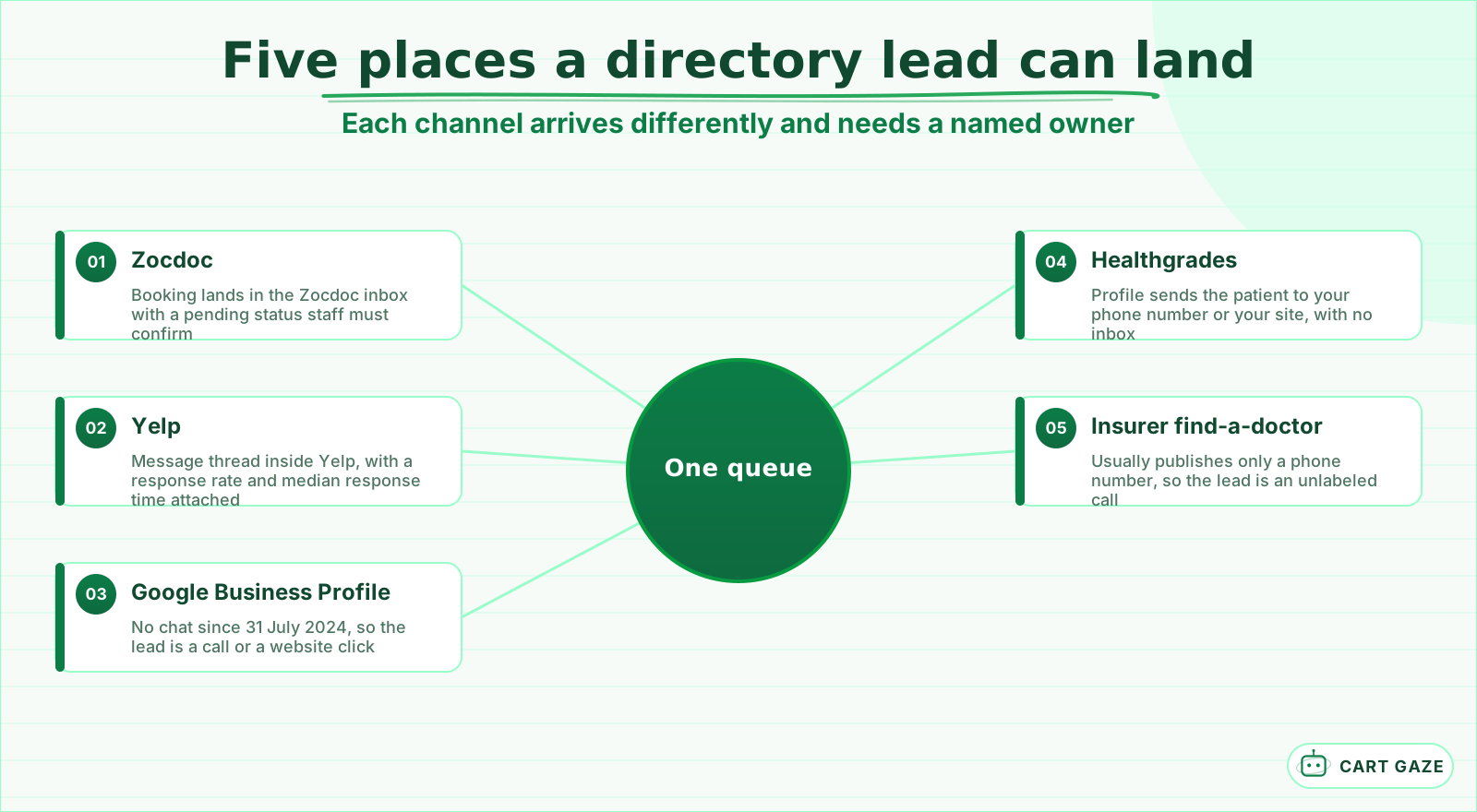 Five channels, five owners. Only two of them give you an inbox you can watch.
The roster changed in 2024 and a lot of advice has not caught up. Google removed chat and call history from Business Profile on 31 July 2024, after cutting off new chats on 15 July. Google's own notice says patients can still find and contact you through Search and Maps, which in practice means a phone call or a click through to your site. If a vendor's unified-inbox demo still shows Google messages, ask when that screenshot was taken.
Insurer find-a-doctor pages are the quiet one. Most publish your phone number and nothing else, so the lead arrives at the front desk as an ordinary call with no label on it. That hurts twice: nobody can watch an inbox that does not exist, and the call never shows up in the report you use to set next year's marketing spend.
Add it up and at least two of the five channels resolve to your phone line. Consolidating inboxes is half the job. The other half is making sure somebody answers, which is why what an AI receptionist does and where it stops belongs in this conversation before any messaging tool does.
Why a slow directory reply costs you twice
Slowness on a directory has two separate prices. The first is the patient, who is comparing your profile against roughly 20 others and books with whoever offers a time first. The second is the listing itself, because two of these platforms publicly document how they measure or gate your responsiveness.
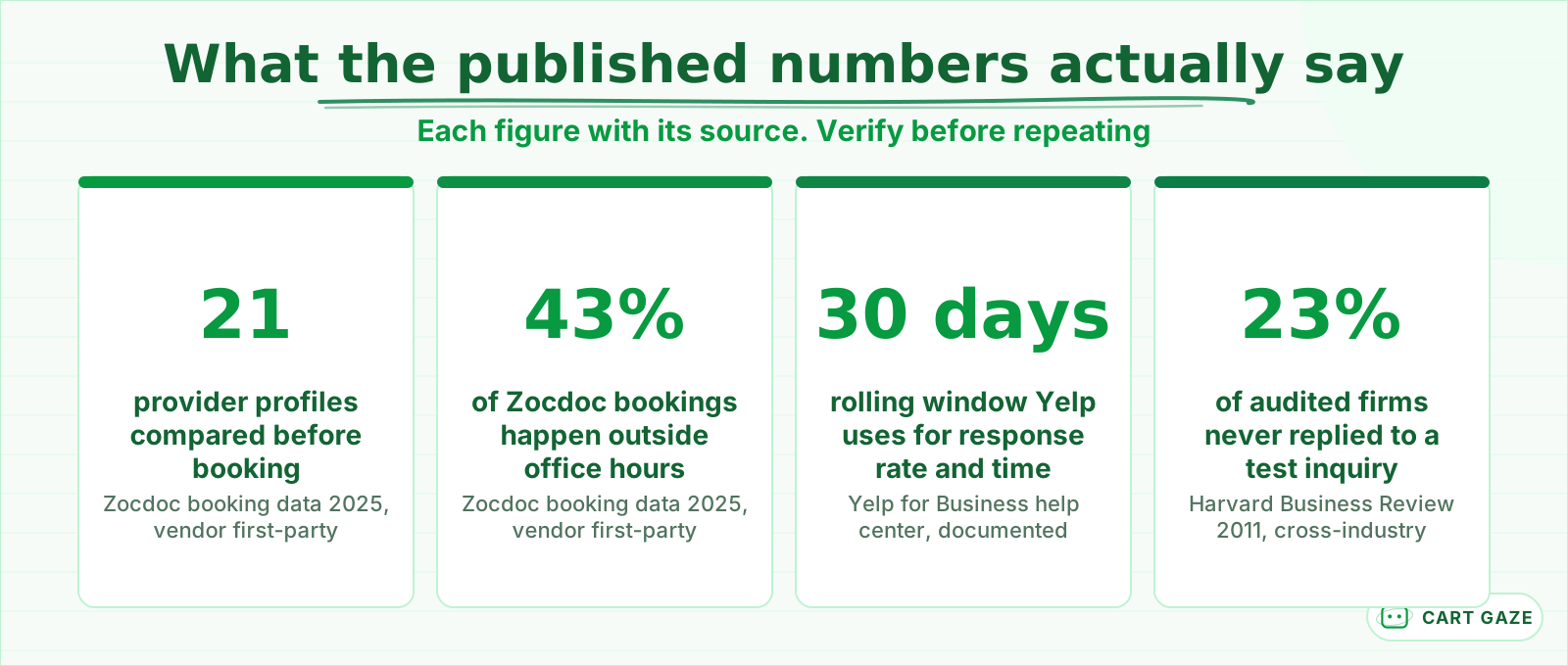 Published figures with their sources. Reasons to measure your own directory mix, not your result.
Take the patient side first. Zocdoc's booking data for 2025 puts the average at 21 provider profiles compared before a booking, and it runs higher in some specialties: about 31 profiles for psychology and about 25 for OB-GYN. Those are Zocdoc's own marketplace numbers, so treat them as directional for your practice rather than a law of nature.
The platform side is narrower but concrete. Yelp calculates a response rate, the share of new messages you answered in the last 30 days, and a response time, the median time you took to answer, excluding 6 p.m. to 8 a.m. but counting weekends. Yelp shows both so users can see how quickly and consistently you respond. On Zocdoc, a new booking arrives with a pending status and the practice has to confirm it, which means an unconfirmed booking is not yet an appointment.
Important
Those two mechanics are documented by the platforms themselves. The full ranking logic behind who appears first in a directory search is not published by Zocdoc, Healthgrades or Yelp. Be skeptical of any vendor who tells you exactly how much faster replies move you up a list.
You will see the old lead-response research quoted everywhere in this space, so here it is with its date attached. A March 2011 Harvard Business Review study audited 2,241 US companies and found 23% never replied to a test inquiry at all, while the average reply among those that did respond within 30 days took 42 hours. A companion study of 1.25 million leads found firms contacting within an hour were nearly 7 times as likely to qualify the lead as those that waited an extra hour. That work is 15 years old and covers insurance, lending and software, not medical practices. It tells you the shape of the problem, not your number.
Why a directory lead needs a different first message than a website lead
Someone who fills in your website form already chose you. Someone who messages you from a directory chose a filter, then a list, and is still deciding. The first reply has to close that gap: confirm the plan by name, offer a real time, and say which listing they came from.
Insurance is the biggest difference. 92% of appointments booked through Zocdoc in 2025 were in-network, so the patient reached you through an insurance filter and is assuming that filter is current. A reply that never names the plan sends them back to check, and going back means seeing the other 20 profiles again.
| What the reply has to do | Website form lead | Directory lead |
|---|---|---|
| What they already know | Your name, your site, your services | A filter matched you, plus a star rating |
| Who else they contacted | Often nobody | Frequently 2 or more practices at once |
| First message must include | A time and a next step | Plan confirmed, a specific time, the source |
| What loses the lead | Silence | A generic callback promise |
Tip
Write the first reply once per channel and save it as a template with two blanks: the plan name and the offered time. Improvising a first message at 6 p.m. on a Friday is how a lead becomes a callback that never happens.
Timing follows the same logic. 43% of Zocdoc bookings happen outside traditional office hours, so a real share of directory inquiries land when nobody is at the desk. An acknowledgment that arrives at 8 p.m. with a bookable time beats a perfect phone call at 10 a.m. the next day.
Keep the listing accurate or the lead is dead before it arrives
Some directory leads are lost before anyone was slow. If the phone number is wrong, the suite number is stale, the plan was dropped last year, or the accepting-new-patients flag is out of date, the patient hits a dead end and blames your practice. Directory accuracy is a documented, industry-wide failure.
The scale of it is not a guess. CMS reviewed Medicare Advantage online provider directories between November 2017 and July 2018, covering 52 organizations, 5,602 providers and 10,504 listed locations, and found 48.74% of those locations had at least one inaccuracy. The three problems it named were the provider not being at the listed location, a wrong phone number, and a listing claiming the provider was accepting new patients when they were not. That review is from 2018, so read it as evidence the problem is structural rather than as today's rate.
A Senate Finance Committee secret shopper study released in May 2023 is more recent and narrower. Staff called 120 listings drawn from 12 Medicare Advantage plans across 6 states. 33% were inaccurate, non-working numbers or unreturned calls, and an appointment could be booked only 18% of the time. That study covered behavioral health listings inside Medicare Advantage, so it is not a verdict on every directory, but it is the same failure mode.
There is also a clock on this that has nothing to do with marketing. Under the No Surprises Act, health plans have to verify provider directory information at least every 90 days and process your updates within 2 business days, and practices have to keep a process for submitting directory information when a contract starts, when it ends, when something material changes, and when the plan asks. A practice that ignores those verification requests can be pulled from the directory until it responds.
Check these before you blame response time
- Your main phone number and suite number are current on every listing you hold.
- Accepted plans match the contracts your practice actually holds this year.
- The accepting-new-patients flag matches reality for each provider.
- Someone owns the quarterly answer to plan verification requests.
Listing data also powers everything else patients see about you. Keeping name, address, phone and hours consistent is the same work that decides whether an answer engine describes your practice correctly, which we walk through in getting found by AI search.
Put every directory inbox on one queue with one clock
Consolidation is an ownership problem before it is a software problem. Name one person per channel, route every alert you can into a single place, and apply one response target to all of them. The channels that cannot be routed, Google and insurer directories, land on your phone line by default.
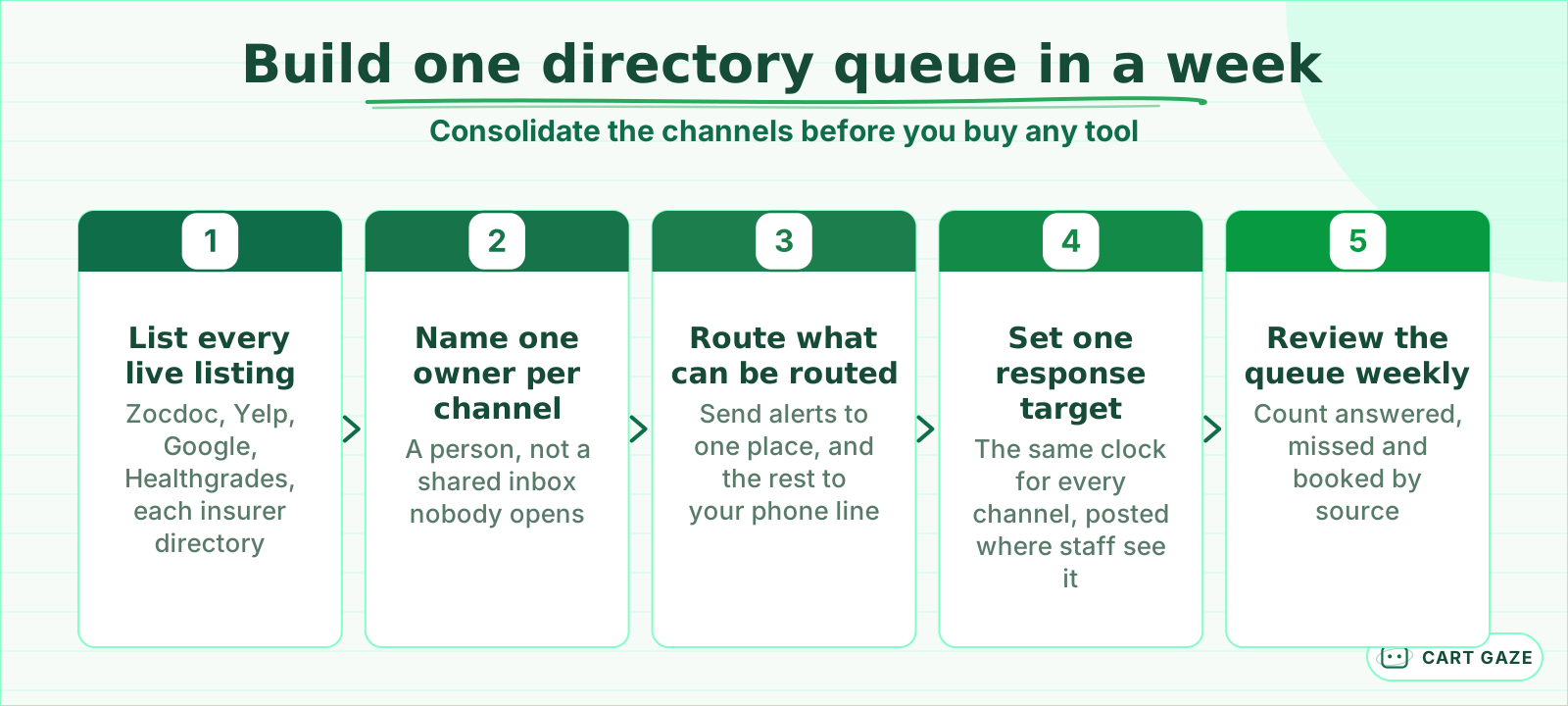 One queue, one owner, one clock. Everything after that is a preference, not a process.
Start with a list of every live listing, including the insurer directories you forgot you were in. Most practices turn up two or three they have not looked at since credentialing. Then put a name next to each one. A shared inbox that belongs to the team belongs to nobody at 5:15 p.m. on a Friday.
Route what the platform allows. Zocdoc and Yelp can both send email or mobile alerts to a named person. Google and the insurer directories cannot, so those inquiries arrive as calls and need the same clock as everything else. Whether that clock is held by a person, an overflow service or an AI receptionist, it has to be one number everyone knows.
Tag the source at first contact. An untagged directory call is invisible in the numbers that set next year's budget, and "we get some from Zocdoc, I think" is not a number. Count answered, missed and booked by source every week, and within a month the queue will tell you which two channels deserve your attention.
Where automation helps, and where a person still has to look
Automation is safe on the mechanical parts of this: an instant acknowledgment with a bookable link, source tagging, alerting the named owner, and answering the phone leg around the clock. It is not safe on anything clinical, and it is not safe on a public reply that reveals someone is a patient.
On the phone leg, an AI receptionist answers the insurer-directory call that would otherwise reach voicemail, finds out what the caller needs, and books the routine ones. It routes clinical and urgent calls to a human and never diagnoses. That boundary does not relax because the call came from a directory instead of a billboard.
Warning
A reply on a public listing that confirms someone is a patient is a disclosure, even when you are being helpful. Keep public replies generic and move the conversation to a private channel.
The same rule governs review responses, and the safe patterns transfer directly from review and reputation automation. Two more limits are worth writing down. A phone number typed into a directory form is not blanket consent to send marketing texts, so capture consent in your own first exchange and record when you got it. And if a vendor in this chain touches patient details, you need a signed Business Associate Agreement. "HIPAA compliant" describes a configuration plus that agreement, and "HIPAA certified" is not a thing that exists.
Set your directory response clock this week
Work in the order that costs least. Audit the listings first, because correcting a wrong number is free and recovers leads you never knew you had lost. Then set one response target that applies across every channel. Only after those two steps should you pay for software to hold the queue together.
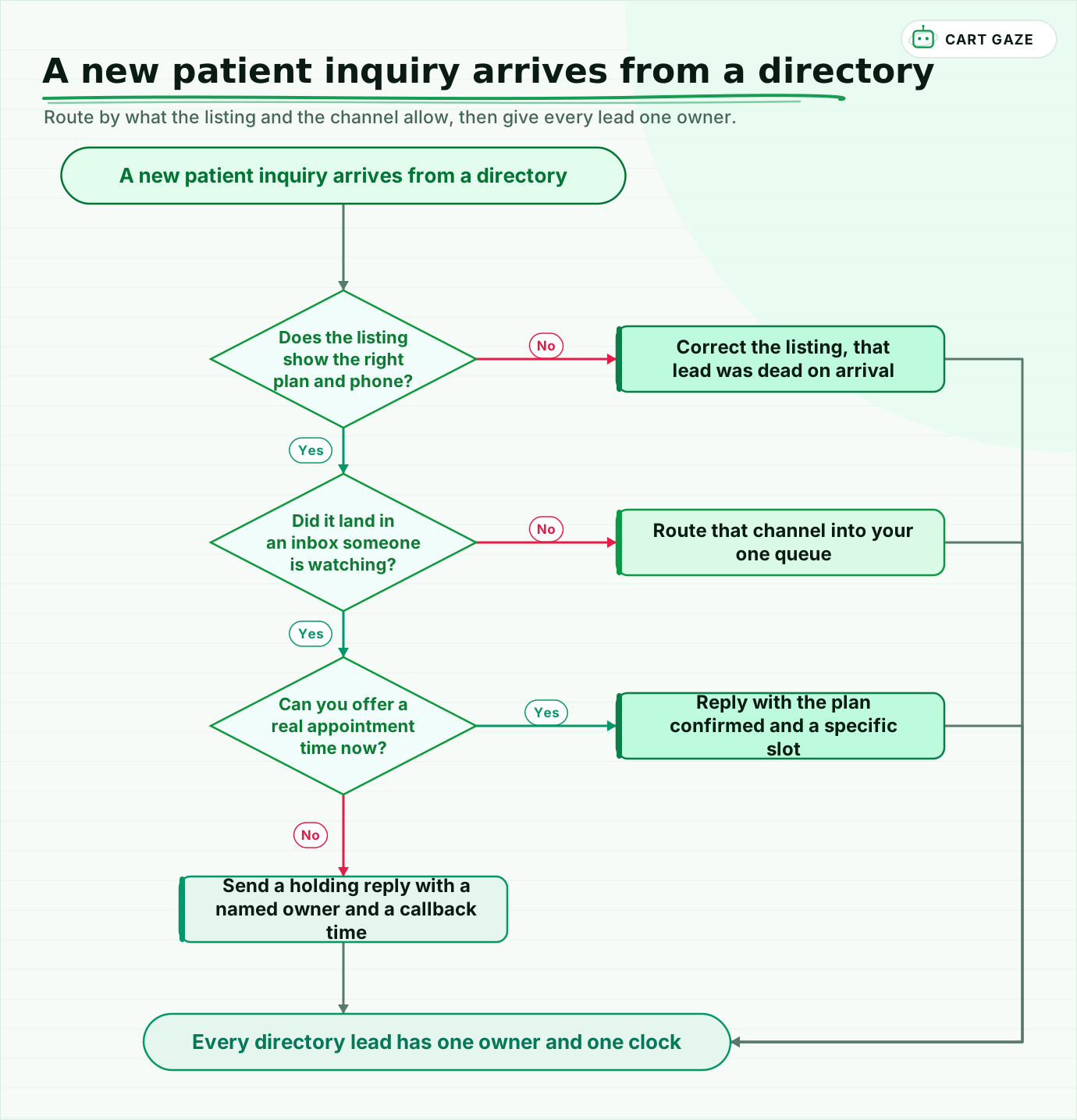 Route by what the listing and the channel allow, then give every lead one owner.
Walk the flow once. A listing with the wrong plan or phone number gets corrected before anything else, because no response time saves a lead that cannot reach you. A channel nobody is watching gets routed into the queue. An inquiry you can answer with a real time gets that time. Everything else gets a holding reply with a named owner and a callback window.
Pilot on the two channels that actually produce inquiries for you, not all five at once. Re-measure after 30 to 60 days using your own counts by source, because a vendor dashboard only counts what the vendor can see. If you would rather have the leak sized before you touch any of it, the free Growth Leak Audit works from your own numbers.
Fair questions.
How fast should a practice respond to a healthcare directory lead?
No healthcare-specific benchmark is published, so set one target that applies to every channel and hold it. The patient is comparing about 21 profiles at once, and on Yelp your median response time over the last 30 days is calculated and shown. A same-session reply with a real time beats a next-morning callback.
Does replying faster improve my ranking on Zocdoc or Healthgrades?
No directory publishes its full ranking logic, so treat any precise claim about that as a vendor claim. What is documented is narrower. Yelp calculates and displays a response rate and a response time, and a Zocdoc booking arrives with a pending status your practice has to confirm before it is a real appointment.
Can patients still message my practice through Google Business Profile?
No. Google removed chat and call history from Business Profile on 31 July 2024, after blocking new chats on 15 July that year. Google says patients can still find and contact a business through Search and Maps, which means your Google directory lead now arrives as a phone call or a click through to your website.
Why do directory leads hit a dead end even when we answer quickly?
Because the listing itself may be wrong. CMS found 48.74% of Medicare Advantage directory locations carried at least one inaccuracy in its 2017 to 2018 review, most often a wrong phone number, a wrong location, or an incorrect accepting-new-patients flag. Audit phone, address, hours, accepted plans and that flag every quarter.
Can an AI receptionist handle directory leads safely?
For the phone leg, yes. It answers the insurer-directory call that would otherwise reach voicemail, captures what the caller needs, and books routine visits around the clock. It routes clinical and urgent calls to a human and never diagnoses. Any vendor touching patient details needs a signed Business Associate Agreement first.
Sources.
- [1]What patients actually look for when choosing a doctor (Zocdoc booking data 2025)
- [2]Zocdoc developer documentation: appointment actions and confirmation
- [3]How Zocdoc shows real-time availability and instant booking
- [4]Yelp for Business: how response time and response rate are calculated
- [5]Changes to Google Business Profile chat and call history
- [6]CMS Online Provider Directory Review Report, round 3 (2018)
- [7]Senate Finance Committee secret shopper study on ghost networks (2023)
- [8]No Surprises Act provider directory requirements for practices and plans
- [9]The Short Life of Online Sales Leads, Harvard Business Review, March 2011
- [10]How patients find care today, Healthgrades Partner Solutions
Written by

Muhammad Qasim Hammad
Founder, Cart Gaze
Qasim builds AI receptionists and front-office automation for medical and dental practices at Cart Gaze. Posts here start from published sources and real call data, not vendor claims, and every number links back to where it came from.
Keep reading.
 Patient Acquisition & GrowthGoogle Business Profile Automation Without a HIPAA Slip10 min read
 Patient Acquisition & GrowthSpeed to Lead: Why New Patients Book With Whoever Answers First11 min read
 Patient Acquisition & GrowthMultichannel Lead Response: One Thread Per Patient, Not Four11 min read
 Patient Acquisition & GrowthHow to Write a Lead Response SLA Your Practice Can Keep11 min read
 Patient Acquisition & GrowthWeb Form Lead Response Automation: Submit to First Touch11 min read
 Patient Acquisition & GrowthSpeed to Lead Benchmarks Medical Practices Can Actually Measure12 min read