
Multichannel Lead Response: One Thread Per Patient, Not Four
A prospective patient calls, texts, fills in your form and opens chat. Most practices answer that as four leads and contact her four times. Here is how to keep one thread per person across every channel.
Key takeaways.
- One prospective patient touching 4 channels becomes 4 leads unless something matches her identity across them, and each lead follows up on its own.
- Match on a normalized phone number plus a second field such as a last name; about 35 million US numbers are reassigned each year and households share them.
- Give every lead source exactly one owner and a 15 minute escalation timer, so your front desk and your texting tool never both act on the same inquiry.
- Lead with a call when the inquiry came by phone and a text everywhere else, but 45 CFR 164.522(b) means a patient asking to be texted overrides your default.
- Suppress every sequence within minutes of a booking or an opt-out; from 31 January 2027 one revocation must stop all your unrelated automated calls and texts.
Table of Contents8 sections
- Why one prospective patient becomes four leads
- Match on the person, not on the channel that reached you
- One owner per lead, or two systems both follow up
- Channel order: call first, text first, or let the patient pick
- Consent travels per channel, and so does the opt-out
- Suppression: stop the nurture the moment they book
- Build the shared timeline before you buy another channel
- Fair questions
A prospective patient fills in your web form on Sunday night, calls the office on Monday morning, texts back the number that called her, then replies to the confirmation email. Four touches, one person. Most practices answer that as four separate leads and contact her four separate times, sometimes with four different answers about the same opening.
Patients do not read that as thoroughness. In a survey of 1,000 US patients fielded in December 2025, 90% said they prefer to be reached by text and 34% by phone, and 40% already worry a provider will send them too many messages. Contacting the same person on four channels is how you prove that worry right and lose a booking you had already won.
This post covers the plumbing that keeps one thread per person: how to match identity on a phone number and a name without merging the wrong two people, why one owner per lead matters, which channel to lead with, how to stop the nurture the moment someone books, and why consent and opt-outs travel differently on every channel.
Why one prospective patient becomes four leads
Four systems each catch a different touch, and none of them knows about the other three. Your phone system logs a call, the web form writes to a marketing tool, the texting platform opens a thread, and chat saves a transcript. Nothing joins them, so each one follows up alone.
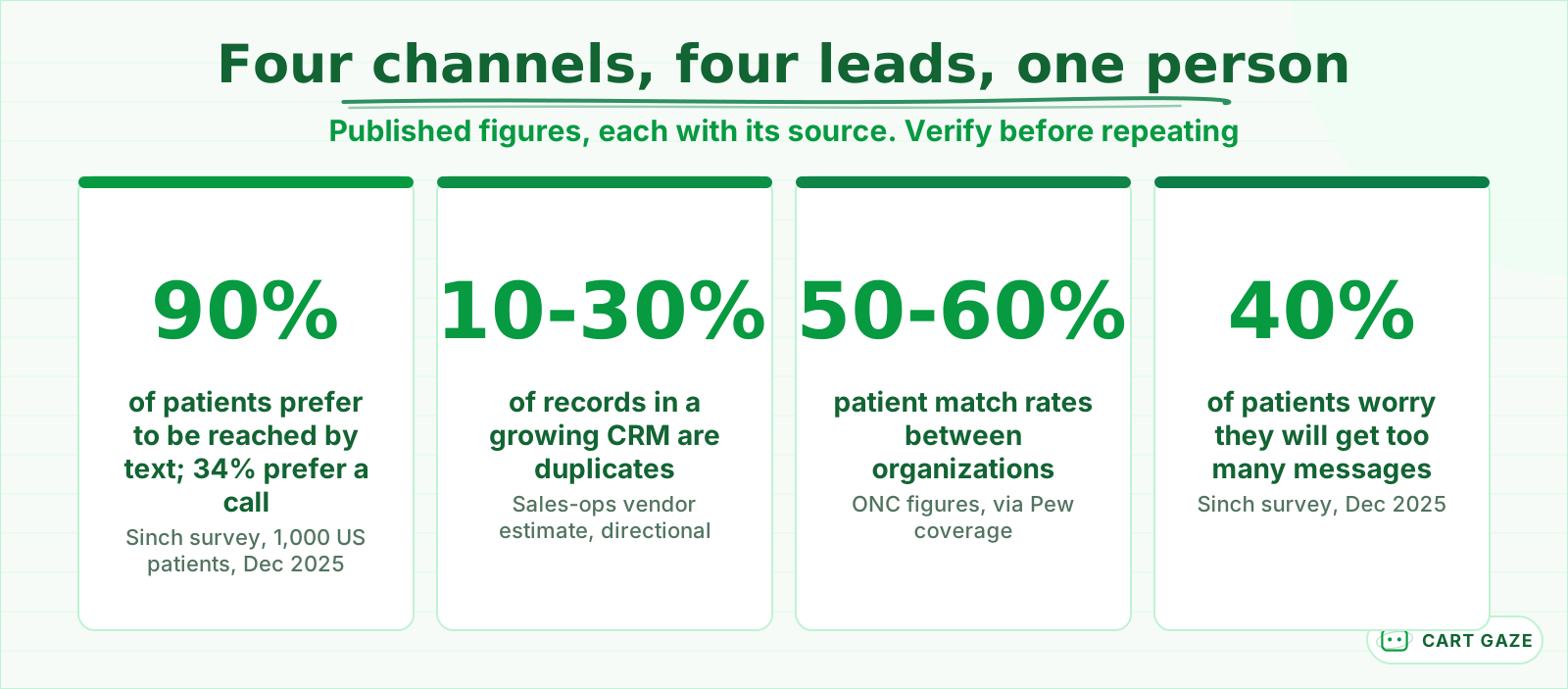 Published figures, each sourced. Reasons to measure your own duplicate rate, not benchmarks to repeat.
The numbers behind this are not healthcare-specific, but the mechanism is identical everywhere. Sales-operations vendors put the share of duplicate records in a growing CRM at 10% to 30%, and one vendor case study found 34% of what a team counted as new inquiries were existing contacts coming back through a different channel. Treat both as directional vendor estimates rather than benchmarks, then go count your own.
Healthcare has a harder version of the same problem. The Office of the National Coordinator has reported patient match rates between organizations as low as 50% to 60%, which means systems built specifically for patient identity get this wrong regularly. Your front office is attempting it with a phone log, a form inbox, and a texting app that share nothing.
The cost is not only wasted staff time. Every duplicate splits the history, so whoever picks up the fourth touch has none of the first three. She explains herself again, and the practice that made her repeat herself is not the one she books with.
Match on the person, not on the channel that reached you
Identity matching joins touches into one record using the fields you actually collect: a normalized phone number first, then a name, then date of birth or email as a tiebreaker. Match on one weak field alone and you merge two people. Match on nothing and you keep four.
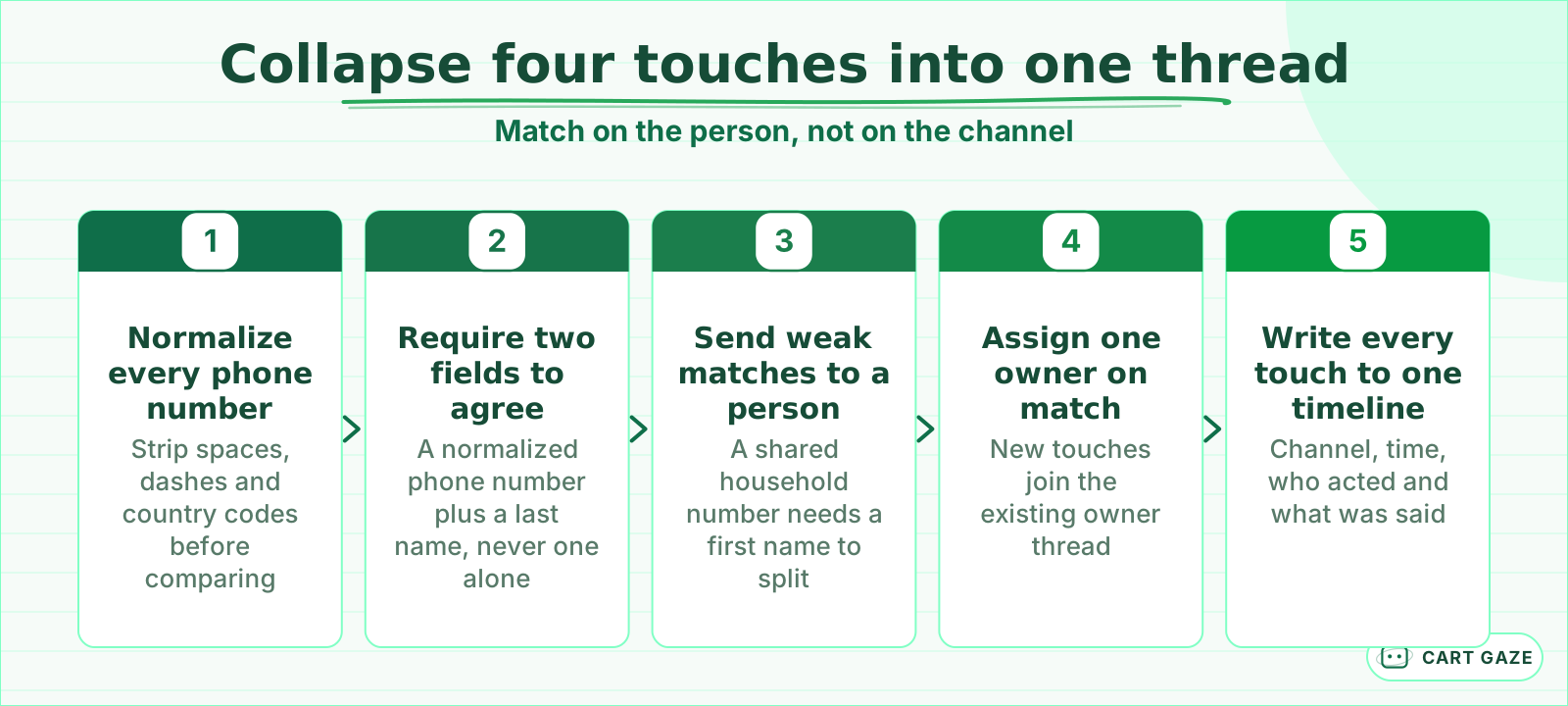 Normalize first, match on two fields, and send anything ambiguous to a person before it books.
Normalize before you compare. +1 (210) 555-0134, 210-555-0134, and 2105550134 are one number, and a system that stores them as three different strings will never join them. Names need the same treatment. Kate on the web form and Katherine on the insurance card are the same patient, and a strict character-for-character match says they are not.
Phone number alone is the fastest match and the riskiest. About 35 million US phone numbers are disconnected and reassigned to a new subscriber each year, close to 100,000 a day, which is why the FCC runs a Reassigned Numbers Database and grants a safe harbor only to callers who check it at least once every 30 days. A number that reached a patient two years ago may reach a stranger today.
Tip
Require two fields to agree before anything merges automatically, for example a normalized phone number plus a last name. Route single-field matches to a person. Un-merging two patients is far harder than clearing one duplicate.
Households share numbers too. Two children and a parent on one mobile is ordinary in a family practice, so a rule that stops at the phone number will happily book the wrong person. Add a first name, and send anything still ambiguous to a human before it becomes an appointment.
One owner per lead, or two systems both follow up
Ownership is the rule that says exactly one system or person is responsible for the next contact with this person. Without it, your texting platform and your front desk both act, because both see an unanswered inquiry and neither can see what the other already did or said.
The two-owner failure has a signature. A patient gets a voicemail from the front desk at 9:12 a.m. an automated text at 9:14 a.m. asking the same question, and a nurture email that evening offering an appointment she booked at lunchtime. Each system behaved correctly on its own data. Together they told her nobody here talks to each other.
Write the ownership rule down in one sentence per source. The web form goes to the coordinator on duty. A missed call goes to the automation that texts back, and that handoff has its own rules worth getting right, covered in missed-call text-back. Chat stays with chat until the visitor asks for a call. Then hold the rule: when a matched lead already has an owner, a new touch on a different channel joins that owner's thread instead of opening a new one.
Ownership also needs a timer. If the owner has not responded within 15 minutes during office hours, the lead should escalate to someone who can, not sit in a queue named after a person who is currently with a patient. Automation is one way to hold that timer without adding headcount, and what an AI receptionist actually does is worth reading before you assume it covers more than it does.
Channel order: call first, text first, or let the patient pick
Lead with a call when the inquiry came by phone or asked for a callback, and lead with a text everywhere else. Then drop your default the moment the patient signals one. Their stated channel beats your playbook, and in healthcare that preference is a right, not a courtesy.
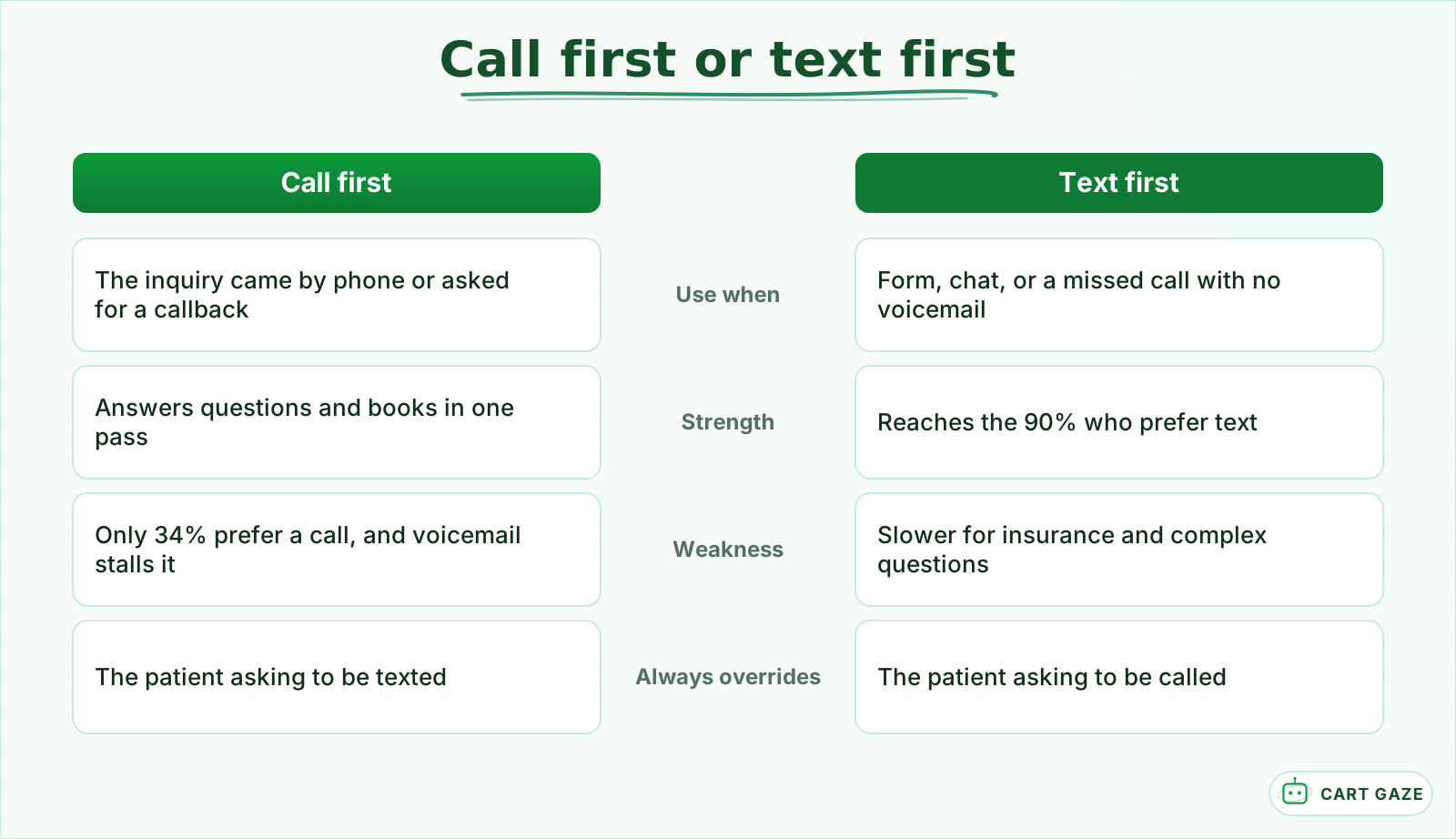 Pick a default per source, then drop it the moment the patient names a channel.
The speed-to-lead research everybody quotes is old, and it is not healthcare. The Lead Response Management study analyzed more than 15,000 leads and 100,000 call attempts across 6 companies over 3 years, and found the odds of qualifying a lead fell roughly 21-fold when the response stretched from 5 minutes to 30. It was published in 2007 on business-to-business sales data. Use it as a reason to answer quickly, not as a promise about your practice.
Channel preference does have current healthcare data behind it. In that 1,000-patient survey, 90% preferred text and 34% preferred a phone call, 68% wanted two-way texting rather than one-way reminders, and 78% expected a same-day response when they reached out. A voicemail nobody returns until tomorrow afternoon fails all three expectations at once.
The override matters most. Under 45 CFR 164.522(b) a patient may ask to be contacted by alternative means, and a covered entity has to agree where the request is reasonable, after warning the patient about the risks of that channel and documenting the warning. So "please just text me" is not a preference checkbox. It is a request you are expected to honor and record.
Consent travels per channel, and so does the opt-out
Consent is not one switch. Permission to call is not permission to text, and permission to text about appointments is not permission to email a promotion. Each channel carries its own rule set, its own opt-out signal, and its own record of when and how the patient agreed.
| Channel | What you need before contact | How they opt out | What that stops today |
|---|---|---|---|
| Automated call | Prior express consent for a healthcare message | A verbal request, or a do-not-call listing | Automated calls from you |
| SMS text | Prior express consent, written if it is promotional | STOP, QUIT, CANCEL, or any reasonable wording | Texts on that topic from you |
| A working address and a working unsubscribe | The unsubscribe link, or a reply asking to stop | That mailing list only | |
| Web chat | The visitor started the conversation | Closing the window | Nothing, unless you log it as a preference |
Two dates matter. Today an opt-out has to be honored through any reasonable means, including the words stop, quit, and cancel, and processed within 10 business days. From 31 January 2027, under FCC order DA-26-12A, a revocation given in response to one type of message must stop all future automated calls and texts from you on unrelated matters, not only the campaign it arrived in.
Warning
Build the broad opt-out now rather than in January 2027. If a patient replies STOP to a recall text and your review-request campaign keeps sending, that is exactly the failure the new rule is written to end, and the average TCPA settlement has been estimated at $6.6 million.
There are limits inside the permission you already have. The 2015 healthcare exemption for urgent, non-emergency messages allows no more than 1 message a day and 3 a week per provider, caps a text at 160 characters, and requires an easy opt-out honored immediately. The detail is worth reading in TCPA compliance for automated patient texting. Two more things belong in the same breath: meeting HIPAA does not mean you have met the TCPA, and any vendor that will see patient details needs a signed Business Associate Agreement. There is no HIPAA certification to buy instead, because no such certification exists.
Suppression: stop the nurture the moment they book
Suppression is the rule that removes a person from outreach once the outreach has done its job. The moment an appointment is booked, every sequence aimed at getting that appointment should stop within minutes, on every channel, including the ones that did not book it and never saw the booking.
Four events should suppress, and most practices wire only the first. A booked appointment stops the booking nurture. An opt-out stops that channel, and from 2027 it stops all of them. A live human conversation stops the automation for a set window so the software does not talk over your coordinator. A merged duplicate stops the second thread at the moment of the merge.
Important
Suppression only works if the booking writes back to the same record your outreach reads from. If the scheduler and the messaging tool never sync, the patient who books at 8 p.m. still gets the 9 a.m. message asking whether she is still interested.
Set the suppression window in minutes, not days. A nightly sync is fine for reporting and useless here, because the awkward message goes out in the hours before it runs. If live write-back is not available yet, shorten the sequence instead. Two touches over 48 hours is safer than seven over two weeks when you cannot see the booking.
Before you switch on multichannel follow-up
- Every channel writes to one record keyed on a normalized phone number and a name.
- Each lead source has one named owner and a written escalation timer.
- A booking or an opt-out suppresses outreach on every channel, not only the one it arrived on.
- A signed BAA covers every vendor that will see patient details.
Build the shared timeline before you buy another channel
One timeline per person, showing every touch on every channel in order, is the thing that makes the rest work. Ownership, suppression, and consent all read from it. Buy the timeline first, because a fifth channel bolted onto four disconnected systems just adds a fifth uncoordinated follow-up to the same person.
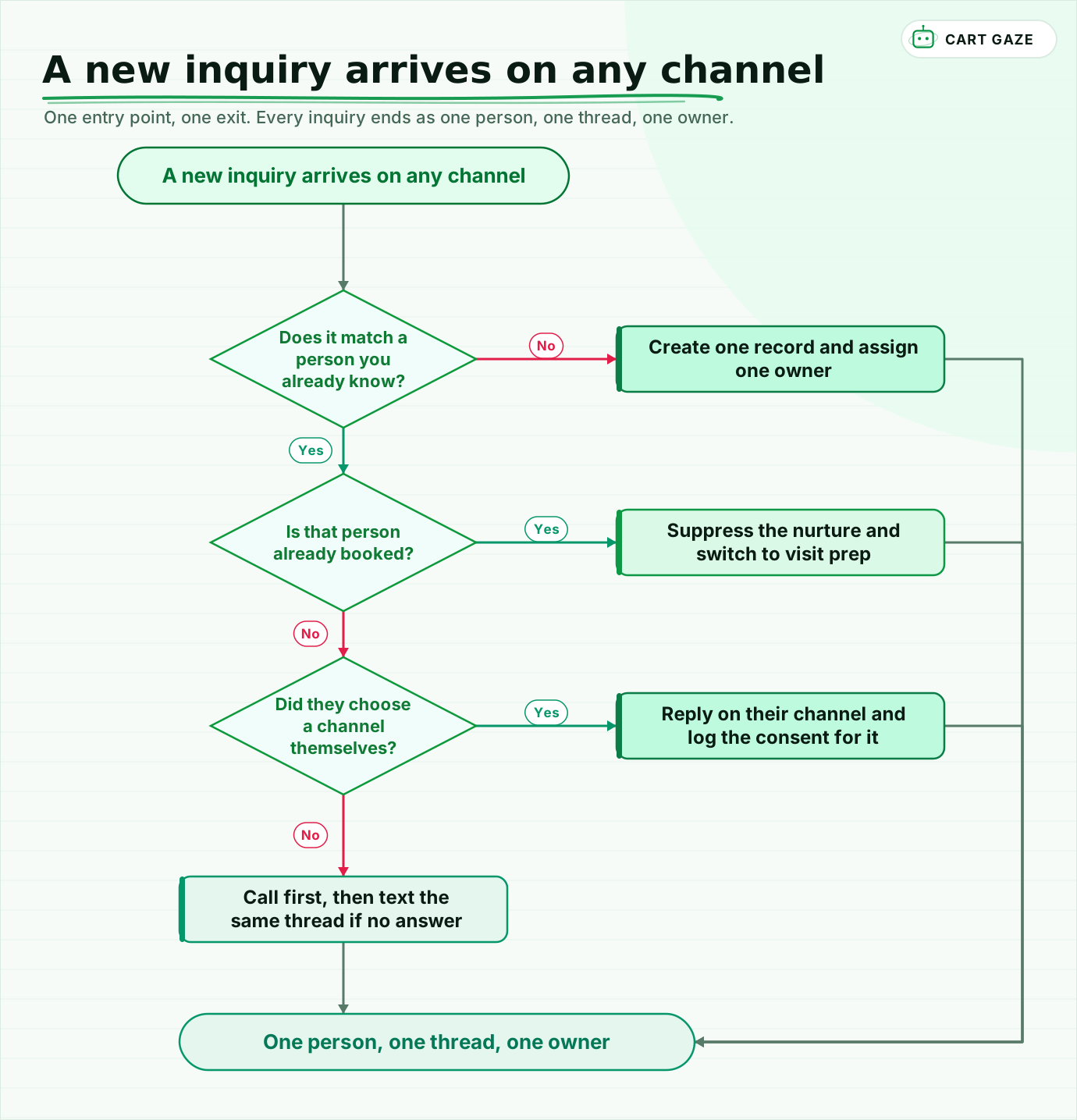 One entry point, one exit. Every inquiry ends as one person, one thread, one owner.
Walk the flow once. A new inquiry lands, and the first question is whether it matches someone you already know. If not, create one record and give it one owner. If it matches and that person is already booked, suppress the nurture and move her to visit preparation. If she named a channel, answer there and log the consent for it. Otherwise call first, then text the same thread when nobody picks up.
Run it on one source before you run it on all of them. Pick the channel that produces your most confusing leads, usually the web form, and give it a single owner, a 15 minute escalation timer, and a suppression rule tied to your scheduler. Then read two weeks of threads end to end. You will find the merges you got wrong, which is the entire point of starting small.
If you would rather see the size of the leak measured before anyone talks tools, the free Growth Leak Audit works from your own numbers.
Fair questions.
What is multichannel lead response for a medical practice?
It is the practice of treating every inquiry from one person as a single thread, whether it arrives by phone, text, email or web chat. One record, one owner, one shared history of every touch. Without it, each system answers separately, so the same prospective patient hears from you three or four times about one appointment.
How do you match a phone call and a web form to the same person?
Normalize the phone number to one format, then require a second field to agree before merging automatically, usually a last name, a date of birth or an email address. Single-field matches go to a person to confirm. Phone number alone is risky because households share numbers and about 35 million US numbers are reassigned every year.
Should you call a new patient inquiry first or text first?
Call first when the inquiry arrived by phone or asked for a callback, and text first for forms, chat and missed calls with no voicemail. In a December 2025 survey of 1,000 patients, 90% preferred text and 34% preferred a call. Whatever your default, honor it when the patient names a channel herself.
Does an opt-out on one channel stop messages on the others?
Not automatically today. An opt-out must be honored through any reasonable means and processed within 10 business days, but it applies to that type of message. From 31 January 2027, under FCC order DA-26-12A, a revocation on one message type must stop all unrelated automated calls and texts from you. Build the broad version now.
What should stop a patient nurture sequence?
Four events: a booked appointment, an opt-out, a live conversation already underway with a staff member, and a duplicate record being merged. Each should suppress outreach within minutes rather than overnight, because a nightly sync still lets the follow-up go out asking whether someone who booked last night is interested.
Sources.
- [1]The State of Healthcare Patient Communication in 2026 (survey of 1,000 US patients)
- [2]Provider demand for accurate patient matching is high, Pew says (ONC match rates)
- [3]Duplicate leads in your CRM: causes, types and how to fix them
- [4]FCC establishes reassigned phone number database
- [5]Lead Response Management study (2007, business-to-business sales data)
- [6]MGMA Stat: patient access priorities for 2026
- [7]Is texting in violation of HIPAA? 45 CFR 164.522(b) and BAA requirements
- [8]The TCPA and healthcare: consent, exemptions and risk mitigation
- [9]FCC pushes back TCPA consent revocation rule to January 31, 2027 (order DA-26-12A)
- [10]FCC grants limited waiver for part of the TCPA consent revocation rule
- [11]The hidden costs of fragmented patient data
Written by

Muhammad Qasim Hammad
Founder, Cart Gaze
Qasim builds AI receptionists and front-office automation for medical and dental practices at Cart Gaze. Posts here start from published sources and real call data, not vendor claims, and every number links back to where it came from.
Keep reading.
 Patient Acquisition & GrowthWeb Form Lead Response Automation: Submit to First Touch11 min read
 Patient Acquisition & GrowthMissed Call Text Back for Medical Practices: How It Works10 min read
 Patient Acquisition & GrowthHealthcare Directory Lead Response: One Queue and One Clock12 min read
 Patient Acquisition & GrowthSpeed to Lead Benchmarks Medical Practices Can Actually Measure12 min read
 Patient Acquisition & GrowthPatient Referral Programs: Ask More People, Reward Carefully10 min read
 Patient Acquisition & GrowthConsultation Follow Up That Converts Without Pressure9 min read