
Do You Take My Insurance? How to Answer Without Losing the Booking
The insurance question is a filter: a vague answer sends the caller elsewhere, a careless yes ends in an out-of-network bill. Here is what the desk can say before verifying, and a script that books.
Key takeaways.
- Answer network status for the exact plan product on the card, because one carrier can run a PPO, an HMO, a marketplace plan and Medicare Advantage with different networks.
- Never say "we accept" alone; say in network, out of network, or that you will confirm the product before the visit.
- Network status comes from your contract list; coverage needs an eligibility check, so the desk never promises a service is covered.
- Plan directories drift: a 2023 Senate secret-shopper study booked a mental health visit only 18% of the time from 12 Medicare Advantage directories.
- An AI receptionist can answer from the same product-level list, collect the member ID, and book with verification pending, under a signed BAA.
Table of Contents8 sections
- Why the insurance question decides the booking
- Accepts, in-network, out-of-network: say the one that is true
- What the desk can say before verifying
- The script, start to finish
- Keep your plan list current, because the directory will not
- Where an AI receptionist fits in the insurance question
- Turn the insurance question into a booking
- Fair questions
The first question many new patients ask is "do you take my insurance?", and a careless answer costs you either way. A hurried "no" loses a patient you could have seen. A hurried "yes" books a visit that ends in an out-of-network bill and an angry phone call. In KFF's 2023 survey of 3,605 insured adults, 14% said a doctor or hospital they needed was not covered by their insurance.
This post is about the phone call, not the eligibility check that comes later. It covers what "accepts," "in-network," and "out-of-network" actually mean, what the desk can safely say before anything is verified, a script that ends in a booking, how to keep your own plan list honest when insurer directories are not, and where an AI receptionist can take the question without promising what it cannot know.
Why the insurance question decides the booking
The insurance question is a filter. A caller asking it has not decided to book yet; they are deciding whether you are worth a visit at all. A fast, precise answer keeps them on the line, and a vague one sends them back to their plan's list to call someone else.
Patients ask because the lists they have are unreliable. The same KFF survey, fielded in February and March 2023, found that 58% of insured adults had some problem with their insurance in the past year, and 26% had needed an in-network doctor who had no appointments available. A caller who has been burned once calls to confirm before booking.
Insurer directories give them good reason to. In a secret-shopper study released by the Senate Finance Committee on May 3, 2023, staff using the directories of 12 Medicare Advantage plans managed to book a mental health appointment only 18% of the time. That was one specialty and one type of plan, but it is the clearest public measure of how far a directory can drift from reality.
So the patient arrives at your phone line holding a plan name, a hunch, and a little suspicion. What the desk says in the next 30 seconds decides whether that becomes an appointment.
Accepts, in-network, out-of-network: say the one that is true
In-network means your practice has a contract with that specific plan product, so the patient pays in-network cost sharing. Out-of-network means no contract: you may still see them, but they pay more and may get a balance bill. "We accept" blurs the two, so never use it alone.
The trap is that patients hear "we take Blue Cross" as "my visit is covered." One carrier can run a PPO, an HMO, a marketplace product, and a Medicare Advantage plan, each with its own network. Your contract covers some of those products and not others, so the carrier name alone answers nothing.
| Term | What it means | What the patient usually pays | A safe way to say it |
|---|---|---|---|
| In-network | A contract with that plan product | In-network copay, coinsurance, deductible | "We are in network with that plan's PPO." |
| Out-of-network, will see | No contract, but you will treat and bill | A higher share, possibly a balance bill | "We are out of network with that plan; here is what that usually means for cost." |
| Courtesy filing | You submit the claim; the patient may pay up front | Out-of-network share, reimbursed to the patient | "We can file the claim for you; your plan decides what it pays back." |
| Not accepted | No contract and no billing to that plan | Self-pay | "We are not in network with that plan. We do offer self-pay." |
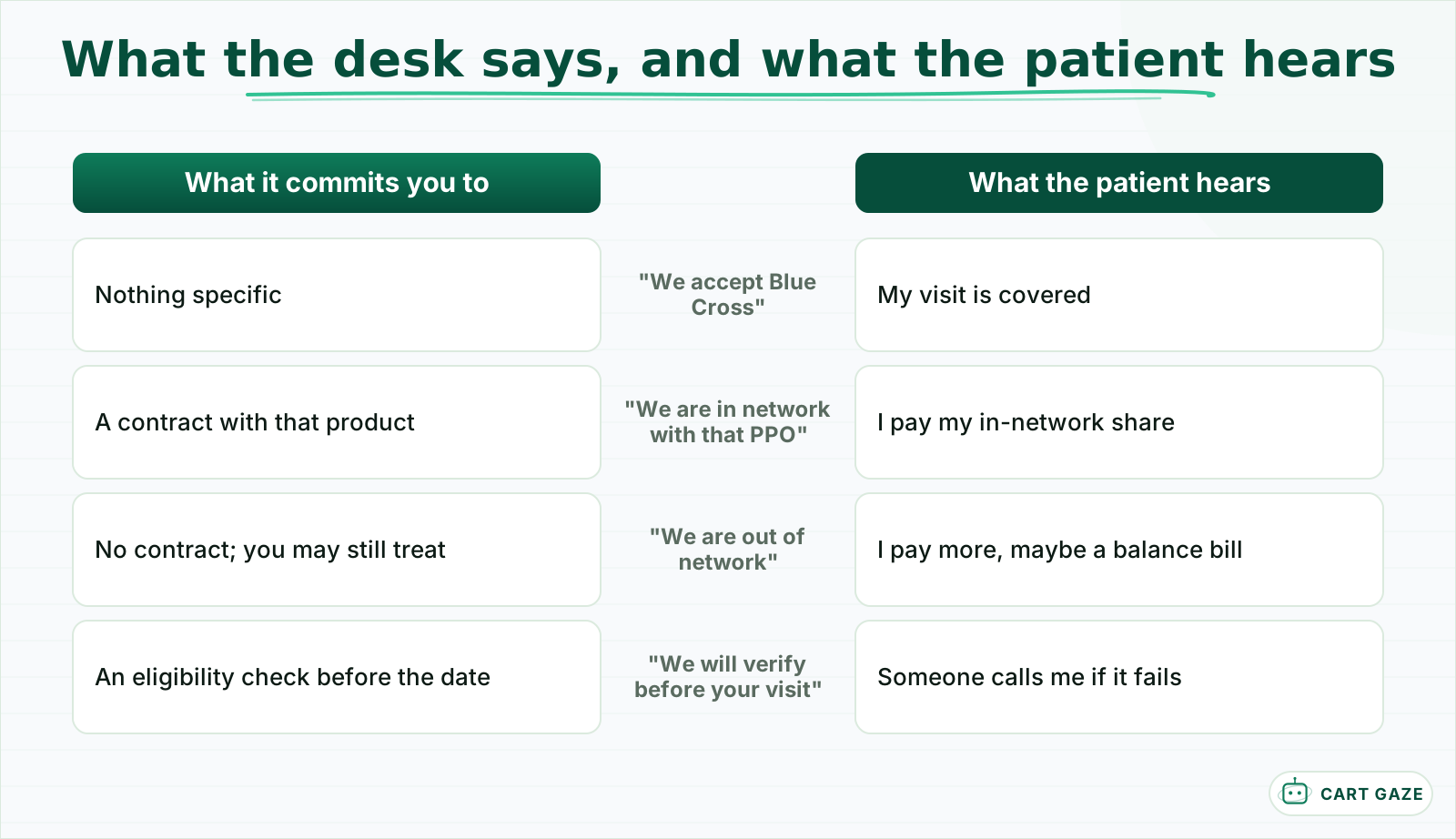 The patient hears coverage. Only say what your contract list actually confirms.
Each row is a different promise, and each one is true only for the product on the patient's card. That is why the first thing the desk asks for is the plan name printed on the card, not the carrier the patient remembers.
What the desk can say before verifying
Before verifying, the desk can say only what your contract list says about that plan product: in network, out of network, or unknown. It cannot promise that a visit or service is covered. Ask for the plan name printed on the card and the member ID, and verify before the visit.
Network status and coverage are different questions. Network status is about your contract, which you can know from your own records. Coverage depends on the patient's plan, deductible, and benefits, which you cannot know until an eligibility check runs, and sometimes not even then. Blending the two is how "yes, we take it" turns into a billing complaint.
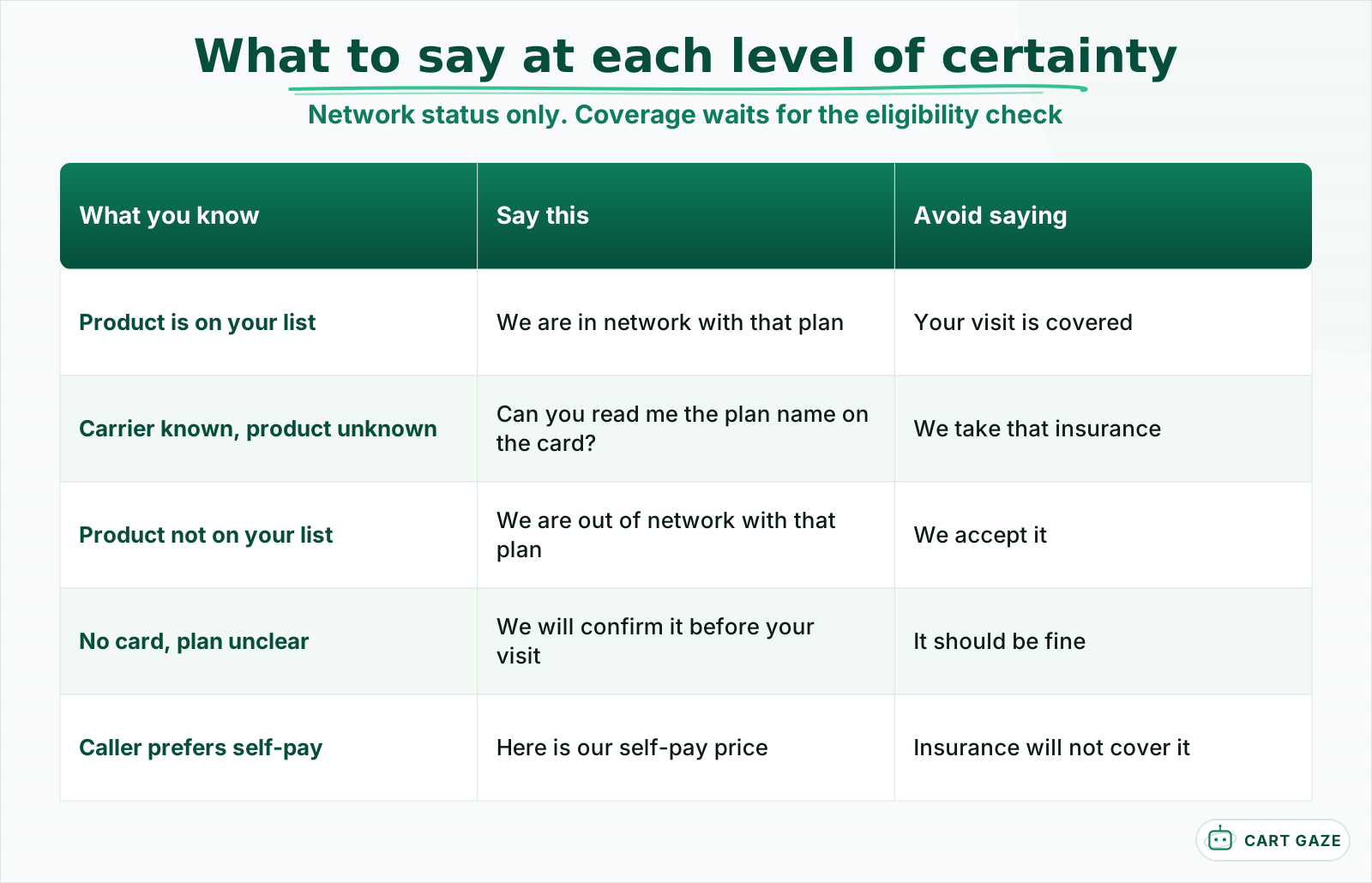 Unknown is a legitimate answer. A guess in either direction is not.
"Unknown" is a legitimate answer. If the patient cannot find the plan name, or the product is one you have never seen, say you will confirm it before the visit and book the appointment anyway, with a note to verify. That keeps the patient and the slot instead of losing both to a guess.
The check itself, from the member ID to a 270/271 eligibility response, is covered in how automated insurance verification works. This post stops at the promise the desk makes before that check runs.
The script, start to finish
A good insurance script takes under a minute and ends with a booking or a clear next step. Ask for the plan name on the card, check it against your list at the product level, say the true status in plain words, collect the member ID, and book with verification pending.
- "Could you read me the plan name exactly as it appears on the front of your card?" If they do not have the card, ask for the carrier and whether it came through an employer, the marketplace, Medicare, or Medicaid.
- Check the product against your list. Do not answer from memory.
- Say the status: "We are in network with that plan," "We are out of network with that plan," or "I need to confirm that product; I will do it before your visit."
- "Can I take your member ID so we can check your benefits before you come in?"
- Book the visit, and say what happens next: "We will confirm your coverage and call or text you if anything changes."
Tip
Ask the patient to photograph the front and back of the card and send it through your intake form before the visit. Card capture cuts retyping errors, and how card capture works explains why a clean scan still is not a coverage check.
For out-of-network callers, the script changes at step 3. Tell them plainly that they are out of network, that they will usually pay more, and that their plan decides what it reimburses. Some will still book. Callers who would rather self-pay should get your self-pay price, and self-pay patients are entitled to a Good Faith Estimate under the No Surprises Act.
Keep your plan list current, because the directory will not
Keep one product-level list of the plans you are in network with, owned by one person and reviewed at least quarterly. Plan directories are often wrong despite the No Surprises Act's 90-day verification rule, so your own list is the only one your desk should read.
Section 116 of the No Surprises Act, in force for plan years from January 1, 2022, requires plans to verify directory information at least every 90 days, update it within 2 business days of a change, answer a patient's network-status question within 1 business day, and keep a record of that answer for 2 years. A patient who relied on inaccurate directory information pays only in-network cost sharing.
Providers carry part of this. The American Optometric Association's summary of the law tells members to submit directory information to plans when they contract, when they terminate, and when their details materially change, and notes that the practice or the plan may have to refund what a patient paid above in-network cost sharing because of an inaccurate directory. A plan whose verification requests go unanswered is obliged to remove you from its directory.
Important
The law's protection is written around the plan's directory and the plan's answers, not your front desk's. Your staff should say only what your own list confirms, and write down the plan name the patient read out.
The list itself can be one page: carrier, product name, plan type, network status, effective date, and the date someone last confirmed it. When a contract changes, the list changes the same day, and so does anything that reads it.
Where an AI receptionist fits in the insurance question
An AI receptionist can answer the insurance question from the same contract list your staff reads, collect the plan name and member ID, and book with verification pending. It cannot confirm benefits or promise a service is covered, and anything it cannot match exactly should go to a person.
That combination is useful at 7 p.m. when a new patient is choosing between three practices and yours is the one that answers. It gives the same product-level answer your best staff member would, 24/7, and it never improvises a "yes" to keep a caller happy. What it does on a live call, and where it hands off, is set out in what an AI receptionist does and where it stops.
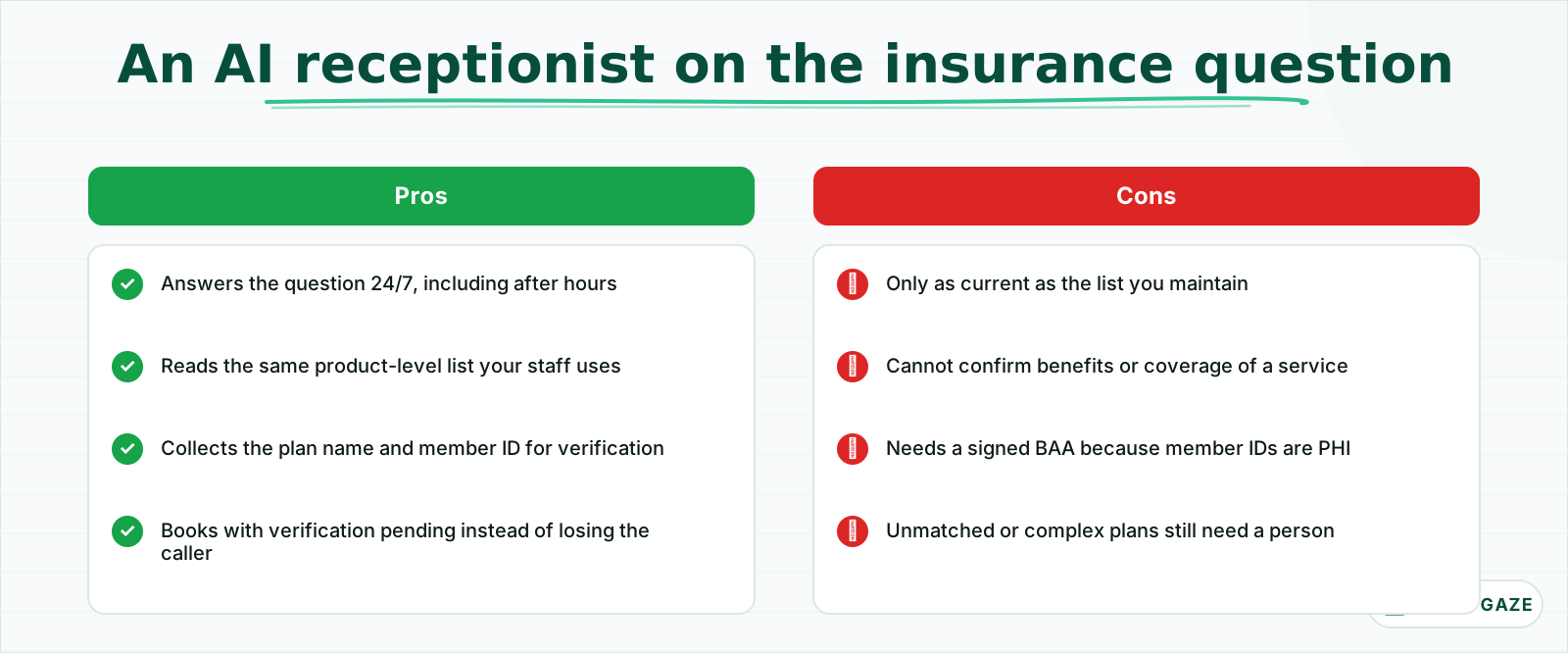 It is only as accurate as the list it reads, and it never promises coverage.
Two conditions come first. Member IDs, plan names, and the reason for a visit are PHI, so the vendor must sign a BAA. And the AI must route every clinical question, including "is this symptom worth coming in for," to a person; it never assesses symptoms or gives medical advice.
Before anyone answers the insurance question
- The contract list is product-level and has a last-confirmed date.
- The desk and the AI receptionist read the same list.
- Unknown products are booked with a verify-before-visit note.
- Nobody says a service is covered before an eligibility check.
Turn the insurance question into a booking
Every insurance call should end with the caller knowing where they stand: in network and booked, out of network with the cost explained, or not covered with a useful next step. The flow below turns the question into one of those outcomes in under a minute.
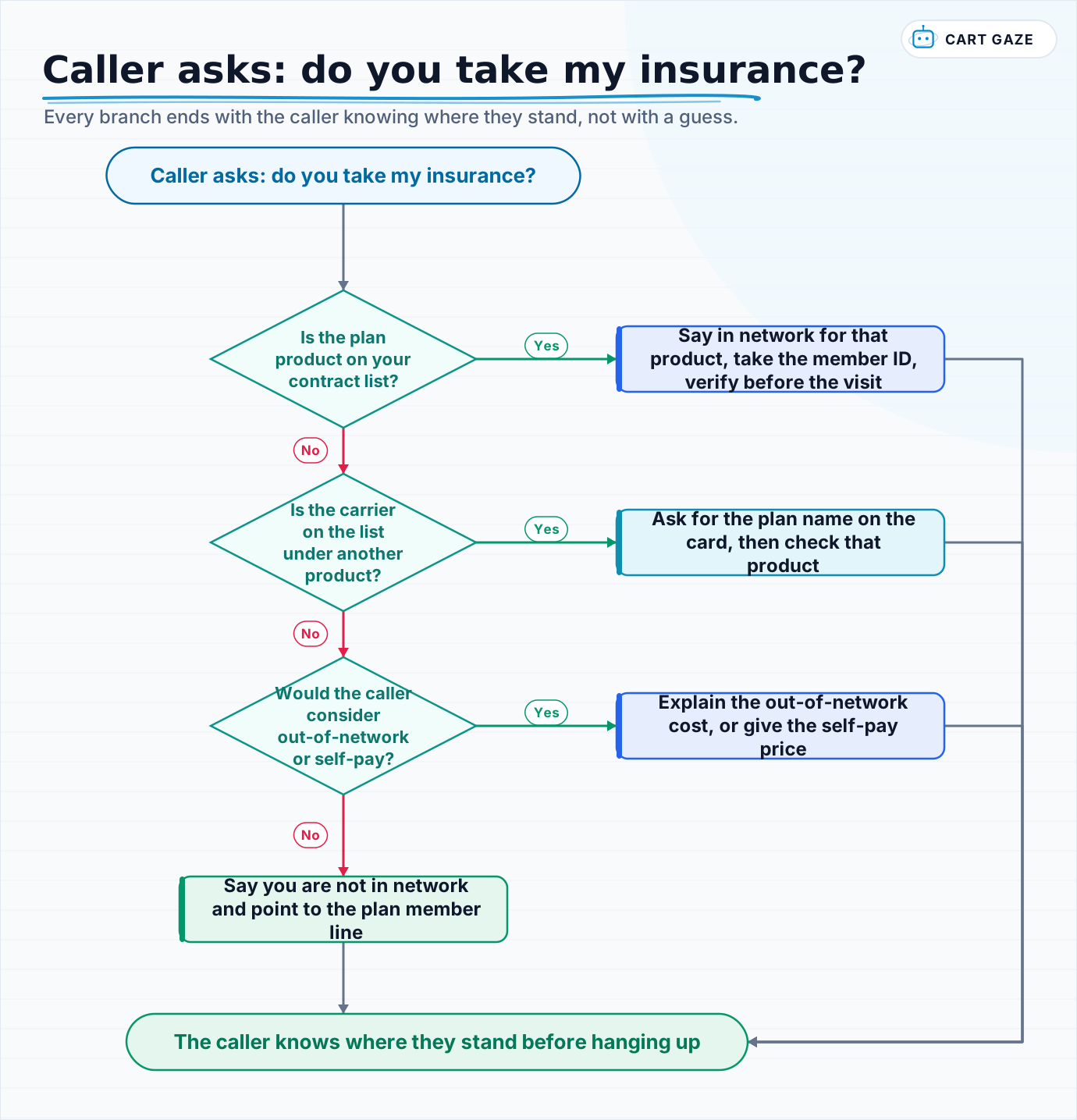 Every branch ends with the caller knowing where they stand, not with a guess.
Walk it with your contract list open. A product on the list gets a clear in-network answer and a booking. A carrier you know under a different product gets one more question, the plan name on the card. A plan you are not in network with gets an honest answer, the cost difference, and a self-pay option or a pointer to the plan's member line.
To hear how the insurance question gets answered and booked after hours, what an AI receptionist does on a live call walks through a booking, a hand-off to staff, and the questions it will not answer.
Fair questions.
What is the difference between "we accept your insurance" and "we are in network"?
In network means the practice has a contract with that specific plan product, so the patient pays in-network cost sharing. "We accept" can mean only that the practice will bill the plan as an out-of-network provider, which usually costs the patient more and can bring a balance bill. Say which one is true for the plan on the card.
What should the front desk say before insurance is verified?
Only what your contract list says about that plan product: in network, out of network, or not yet known. Ask for the plan name printed on the card and the member ID, book the visit with a note to verify, and tell the patient you will confirm coverage before the appointment. Never promise that a visit or a service is covered.
Why do patients call to ask if a practice takes their insurance?
Because the lists they have are unreliable. In KFF's 2023 survey of 3,605 insured adults, 14% said a doctor they needed was not covered and 26% said an in-network doctor had no appointments. A 2023 Senate secret-shopper study booked a mental health visit only 18% of the time using Medicare Advantage directories.
What does the No Surprises Act require about provider directories?
Plans must verify directory information at least every 90 days, update it within 2 business days of a change, and answer network-status questions within 1 business day. A patient who relied on an inaccurate directory pays only in-network cost sharing. Practices must send plans their directory information when they contract, terminate, or materially change.
Can an AI receptionist answer insurance questions for a medical practice?
It can answer network status from the same product-level list your staff uses, collect the plan name and member ID, and book with verification pending. It cannot confirm benefits or promise that a service is covered, and it should hand anything it cannot match to a person. Because member IDs are PHI, the vendor must sign a BAA.
Sources.
- [1]KFF Survey of Consumer Experiences with Health Insurance (2023)
- [2]AHA News: Senate hearing examines health plan barriers to behavioral health access (May 3, 2023)
- [3]AHA: detailed summary of the No Surprises Act, Sec. 116 provider directories (January 2021)
- [4]American Optometric Association: No Surprises Act provider directory FAQ
Written by

Muhammad Qasim Hammad
Founder, Cart Gaze
Qasim builds AI receptionists and front-office automation for medical and dental practices at Cart Gaze. Posts here start from published sources and real call data, not vendor claims, and every number links back to where it came from.
Keep reading.
 Missed Calls & Front DeskFront Desk Staffing Ratio per Provider: Benchmarks and a Worksheet10 min read
 Missed Calls & Front DeskMedical Office Voicemail Greeting Scripts for Every Closed Hour10 min read
 Missed Calls & Front DeskPatient Callback Requests: How to Offer, Staff and Automate Them10 min read
 Missed Calls & Front DeskCall Hold Time Benchmarks for Medical Practices: When Callers Hang Up12 min read
 Missed Calls & Front DeskCall Volume Forecasting for Your Front Desk: Staff the Peak11 min read
 Missed Calls & Front DeskCancellation Waitlist Automation: Fill the Empty Slot Fast10 min read