
Medical Office Voicemail Greeting Scripts for Every Closed Hour
Most medical office greetings bury the emergency line and promise a callback without a time. Here is what every greeting must say, five scripts to record today, and when to replace one.
Key takeaways.
- Every greeting needs the practice name, an emergency instruction, a callback time or reopening date, another way to get help, and what to leave.
- Put "hang up and call 911 or go to the nearest emergency room" right after the practice name, and add 988 where patients may be in crisis.
- Record 5 greetings, each 15 to 30 seconds: after hours, lunch, holiday, daytime overflow, and unplanned closure.
- Voicemail and its transcripts are PHI, so the phone vendor needs a BAA, and returned calls should leave only a name and a callback request.
- If most callers hang up or most messages are routine, answer those calls with a text-back or an AI receptionist instead of a better greeting.
Table of Contents8 sections
- What every medical voicemail greeting must say
- The five greetings, and when each should play
- Scripts you can record today
- Keep PHI out of the greeting, and protect what callers leave
- Switch greetings on a schedule, not from memory
- When a greeting should become an answer
- Choose the right greeting setup
- Fair questions
Your voicemail greeting is the only thing some patients hear from your practice all week, and most medical office greetings were recorded once, years ago, by whoever was free. They read out the address, skip the emergency instruction, and promise to "return your call as soon as possible" without saying when. A good greeting takes 15 to 30 seconds, which is Nextiva's guidance for business greetings, and it tells the caller exactly what to do next.
This post covers what every medical office voicemail greeting must say, the five greetings a practice needs and when each should play, scripts you can record today, how to keep PHI out of the greeting and protect what callers leave, how to switch greetings on a schedule, and when a greeting should be replaced by something that actually answers.
What every medical voicemail greeting must say
Every greeting needs five things: the practice name, what to do in an emergency, when the office reopens or will call back, another way to get help, and what to leave in a message. The emergency line comes first after the name, because the caller who needs it most will not wait for the end.
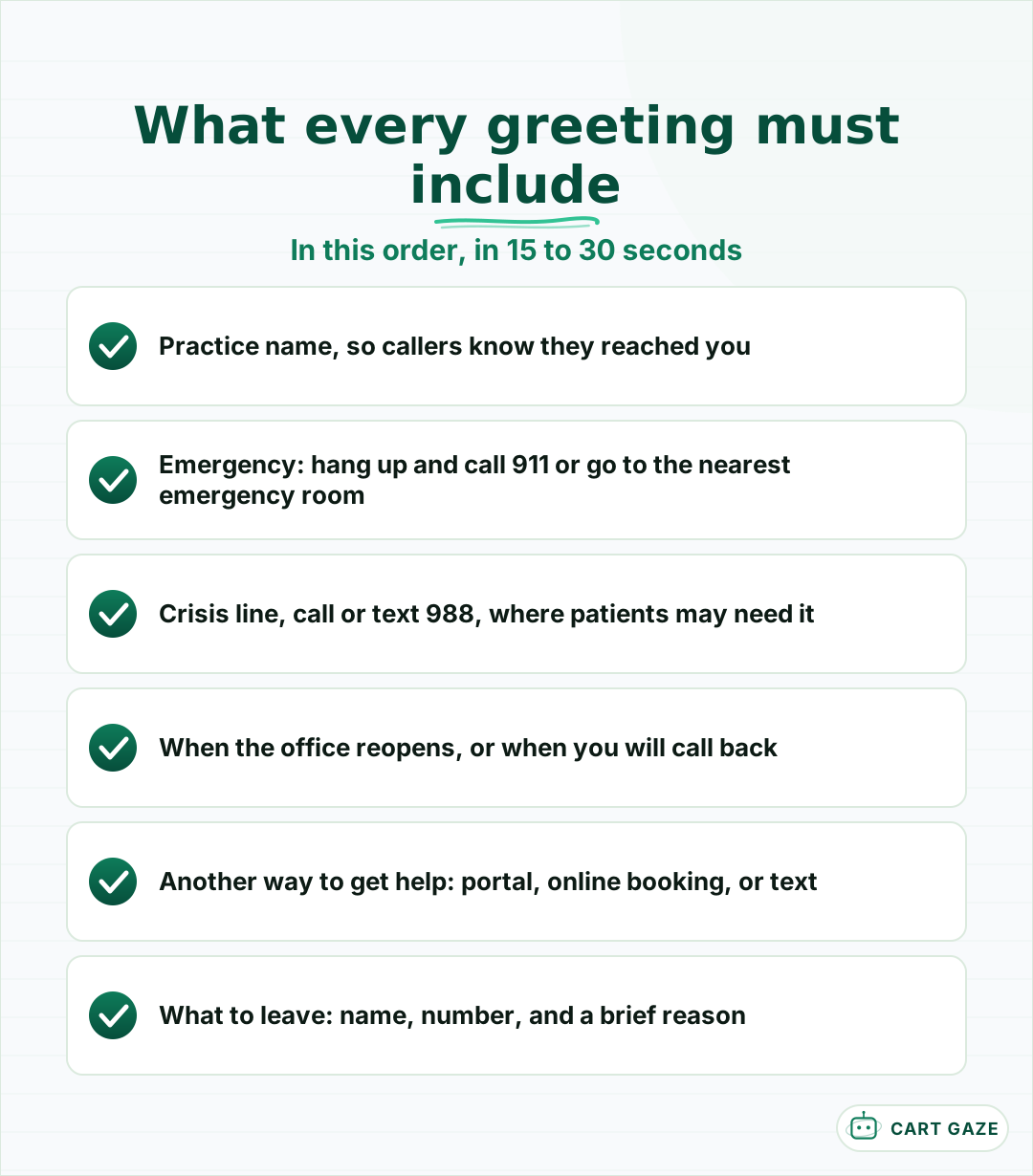 The emergency line comes right after the name. The caller who needs it will not wait.
The emergency instruction is the one that matters most and the one most often buried. Malpractice insurers are direct about the underlying rule: The Doctors Company's 2024 guidance on telephone triage says that when a situation is emergent, the patient should be directed to call 911 or go to the nearest emergency department. A greeting cannot assess anything, so it has to say that plainly to every caller.
If a clinician or nurse line is on call, the greeting should say exactly how to reach it: a menu option, a number, or an answering service. If nobody is on call, say that honestly and point to 911 or an urgent care, rather than implying a callback that will not come until morning.
The callback promise matters almost as much. MagMutual's risk guidance on telephone encounters tells practices to always tell patients when they can expect a return call, and to define a reasonable time frame for returning calls in their procedures. "As soon as possible" is not a time frame. "By 10 a.m. the next business day" is.
Practices that see patients in mental health crisis should add one more line. The 988 Suicide and Crisis Lifeline, live since July 2022, takes calls, texts, and chats, and has answered more than 13 million contacts. For a behavioral health, primary care, or pediatric practice, "call or text 988" belongs in every closed-hours greeting.
The five greetings, and when each should play
A practice needs five greetings, not one: after hours, lunch, holidays, daytime overflow when every line is busy, and unplanned closures such as weather or a power outage. Each plays at a different time, to a caller with different expectations, and each needs its own callback promise.
| Greeting | When it plays | What the caller needs most | Callback promise |
|---|---|---|---|
| After hours | Evenings, nights, weekends | Emergency and on-call route | Next business morning, with a time |
| Lunch | A fixed midday window | When you are back | Within the hour after reopening |
| Holiday | Planned closures | Reopening date, urgent route | The first business day back |
| Daytime overflow | All lines busy while open | A real person soon | The same day, with a window |
| Unplanned closure | Weather, outages, emergencies | What is happening, where to go | A specific date or "we will text you" |
The daytime overflow greeting is the one practices forget. It plays while the office is open and fully staffed, so the caller expects a person, and a greeting that sounds like after-hours tells them nobody is coming. Why that moment loses so many callers is covered in what voicemail costs a busy front desk.
Scripts you can record today
Each script below runs about 20 to 30 seconds read at a natural pace. Replace the bracketed parts, keep the order, and record in a quiet room. The emergency line always follows the practice name, and every script ends with what the caller should leave and when they will hear back.
Script 1: after hours. "You've reached [practice name]. If this is a medical emergency, hang up and call 911 or go to the nearest emergency room. If you are in crisis, call or text 988. Our office is closed and opens at [8 a.m.]. For [urgent questions after hours], [press 1 / call our on-call line at number]. Otherwise, leave your name, number, and a brief reason, and we will call you back by [10 a.m.] the next business day."
Script 2: lunch. "You've reached [practice name]. If this is a medical emergency, hang up and call 911. We are at lunch and back at [1 p.m.]. You can also [book online at website / message us through the patient portal]. Leave your name and number, and we will call you back within an hour of reopening."
Script 3: holiday. "You've reached [practice name]. If this is a medical emergency, hang up and call 911. Our office is closed for [holiday] and reopens on [day, date]. For [urgent questions], [route]. Leave your name, number, and a brief reason, and we will return your call on [reopening day]."
Script 4: daytime overflow. "Thanks for calling [practice name]. If this is a medical emergency, hang up and call 911. Every member of our team is on another call. Leave your name, number, and a brief reason, and we will call you back by [time window] today, or [book online / text us at number] right now."
Script 5: unplanned closure. "You've reached [practice name]. If this is a medical emergency, hang up and call 911. Our office is closed today because of [reason]. [Appointments today will be rescheduled / We will text you]. Leave your name and number, and we will call you back on [date]."
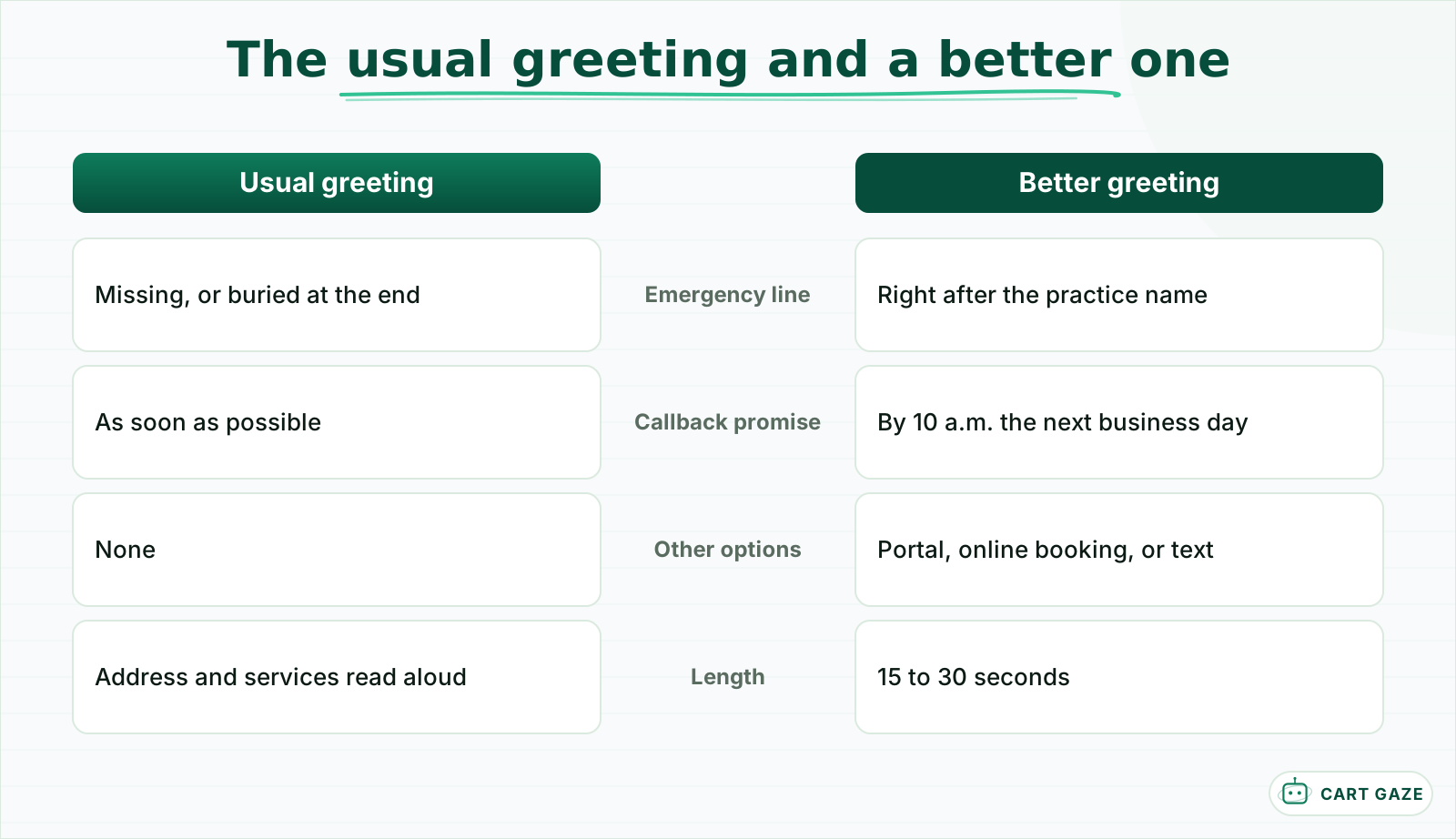 Same 30 seconds. One tells the caller what happens next.
A few recording habits make the difference between a greeting callers follow and one they replay. Speak a little slower than feels natural. Say any phone number twice. Give a short web address rather than spelling out a long one. If a large share of your patients speak Spanish or another language, record a second version and offer it with a single key press near the start, after the emergency line.
Tip
Record every greeting in one sitting, with the same voice. Callers notice a mismatched greeting as a sign that nobody is minding the phones.
Keep PHI out of the greeting, and protect what callers leave
The greeting itself should contain nothing about any patient, and it should ask for only a name, a number, and a brief reason. What callers leave is PHI, so the system storing it needs a BAA, and staff returning those calls should leave only a name and a callback request.
Callers will leave clinical detail whatever you ask, so plan for it. A cloud phone system or voicemail service that stores messages for you holds PHI, and HHS treats a vendor that maintains ePHI as a business associate rather than a mere conduit, which means a signed BAA. Check the voicemail-to-email feature in particular, because a transcription landing in an ordinary inbox is a copy of PHI outside the system you vetted.
Returning those calls has its own rule. MagMutual's guidance is that phone messages left by medical staff should include just a name and a request for a callback, and that clinical information or advice should not be left on a voicemail unless the patient has specifically authorized it.
Warning
A greeting that tells callers to "leave your symptoms and we will call back" invites a clinical message nobody will hear until morning. Put the emergency and on-call route first, and ask only for a brief reason.
Switch greetings on a schedule, not from memory
Set each greeting to switch automatically with your hours, and schedule holiday and lunch greetings in the phone system rather than relying on whoever closes up. After every change, call the line yourself to hear what plays. A holiday greeting still running in February is a common, avoidable mistake.
Most cloud phone systems let you attach a greeting to business hours, a lunch window, and dated holiday exceptions. Enter every planned closure for the year in one sitting, and give the phone settings one owner.
Test from outside the building. Call the main number from a mobile phone, not an internal extension, because internal calls often skip the routing a patient's call goes through. Do it after every change and once a month regardless, and listen all the way to the beep.
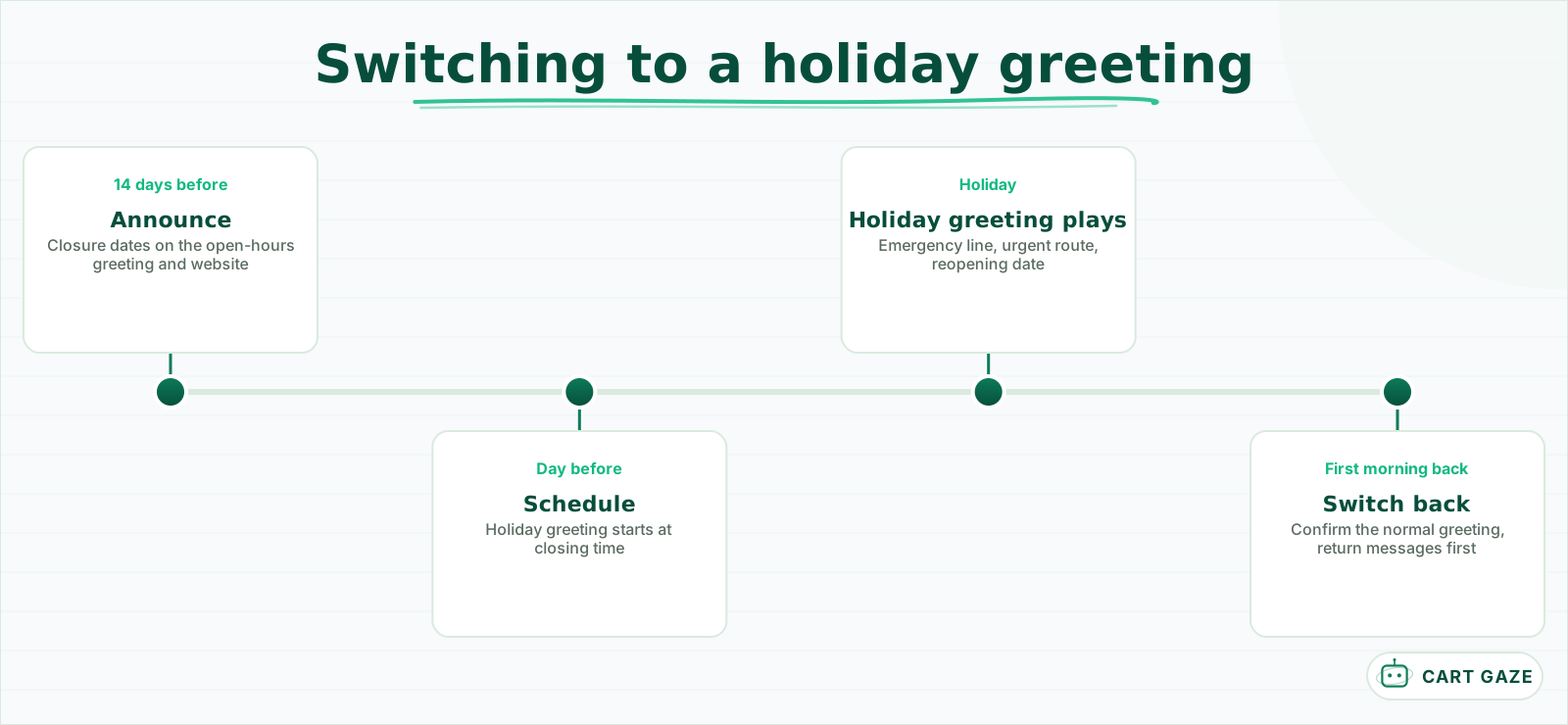 Schedule the switch in the phone system, then call the line to hear it.
Holidays are where the schedule slips. Put the closure dates into the open-hours greeting and on your website 14 days before, schedule the holiday greeting to start at closing time the day before, and on the first morning back, confirm the normal greeting is playing and return the holiday messages first.
When a greeting should become an answer
A greeting only defers the call. If most callers hang up without leaving a message, or most messages are routine requests like bookings and reschedules, a better greeting will not fix it. That is the point to answer those calls with a text-back or an AI receptionist, keeping the greeting for what remains.
After hours, the choice between a greeting, an answering service, and an AI receptionist depends on your call mix, which is covered in how to handle after-hours calls. During the day, overflow greetings are worth replacing first, because those callers expected a person.
An AI receptionist answers the call rather than recording it. It books and reschedules from your real schedule, answers office questions, and passes anything else to staff. What it does and where it stops is set out in what an AI receptionist does and where it hands off. It must route every clinical, urgent, or distressed caller to a person or to 911 guidance, and never assess symptoms or give medical advice.
Before you re-record your greetings
- The emergency instruction comes right after the practice name.
- Each greeting names a specific callback time or reopening date.
- Holiday and lunch greetings switch on a schedule, not by hand.
- The voicemail system and any transcripts are covered by a BAA.
Choose the right greeting setup
Choose your greeting setup by when calls go unanswered. Closed hours need an after-hours greeting with an on-call route. Planned closures need timed greetings that switch back on their own. Busy daytime hours need the most thought, because routine calls there are better answered than recorded.
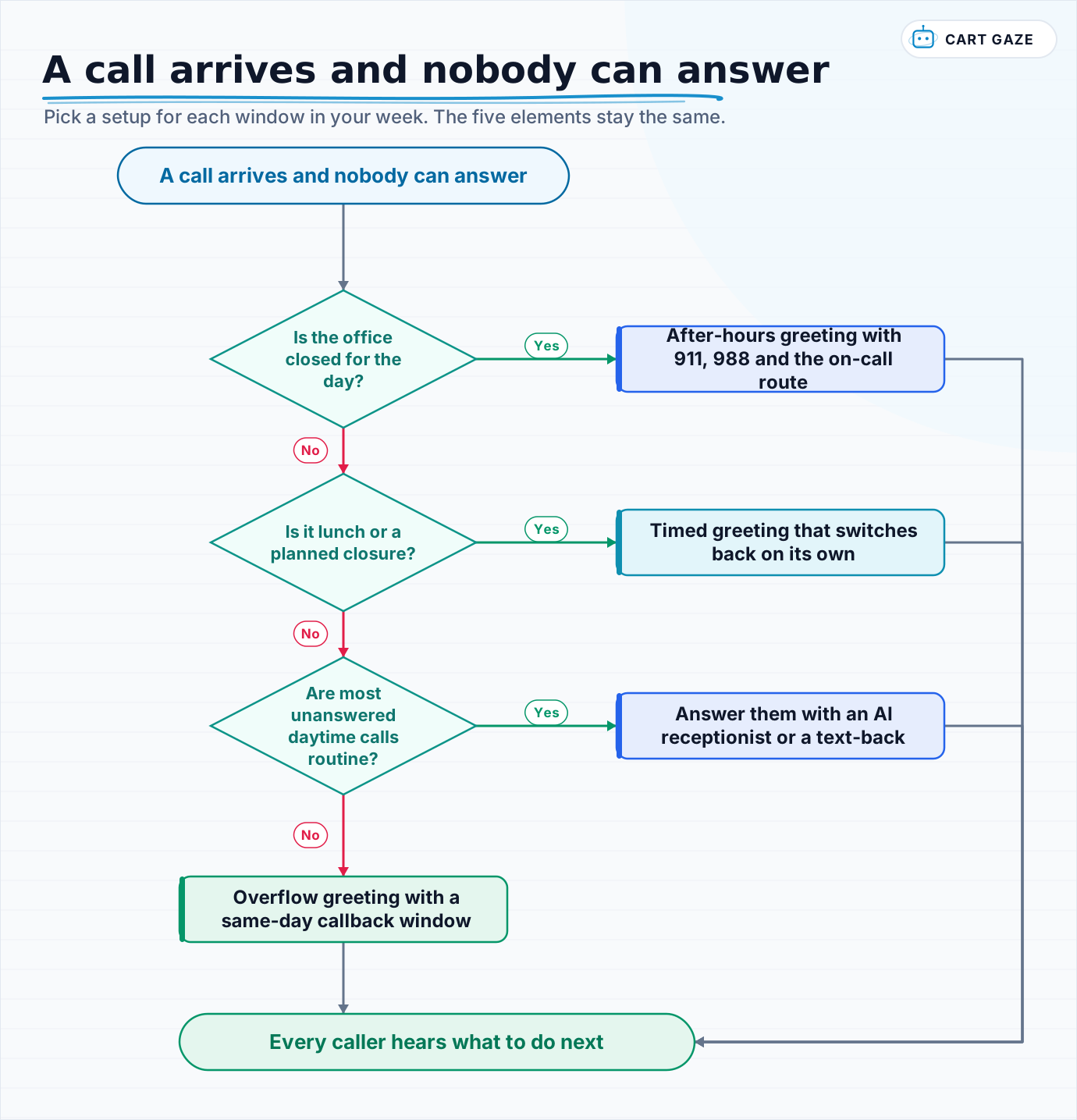 Pick a setup for each window in your week. The five elements stay the same.
Walk the flow for each window in your week. Whatever the answer, every greeting keeps the same five elements, and every one is tested by calling the line after it changes.
To hear how a routine call gets answered instead of recorded, what an AI receptionist does on a live call walks through a booking, a transfer to staff, and an after-hours hand-off.
Fair questions.
What should a medical office voicemail greeting say?
Five things, in this order: the practice name, what to do in an emergency (hang up and call 911 or go to the nearest emergency room), when the office reopens or will call back, another way to get help such as the portal or online booking, and what to leave: a name, a number, and a brief reason. Keep it to 15 to 30 seconds.
Does a medical practice voicemail need an emergency message?
Yes. A recording cannot assess anything, so it must tell every caller what to do if the situation is urgent. Malpractice insurer guidance says emergent callers should be directed to call 911 or go to the nearest emergency department. Put that line right after the practice name, and add "call or text 988" if your patients may be in crisis.
How long should a medical office voicemail greeting be?
About 15 to 30 seconds, which is the range phone-system vendors such as Nextiva recommend for business greetings. That is enough for the practice name, the emergency line, the callback promise, and one alternative channel. Leave out the street address and long lists of services; callers who need them can find them on your website.
Is it HIPAA compliant for patients to leave voicemails?
Patients may leave messages, but what they leave is PHI, so the phone or voicemail vendor storing it must sign a BAA, including any voicemail-to-email transcription. Keep patient information out of the greeting itself. When staff return calls, guidance from malpractice insurers is to leave only a name and a request to call back.
When should a practice replace voicemail with an AI receptionist?
When most callers hang up without leaving a message, or most messages are routine requests such as bookings and reschedules. A greeting only defers those calls. An AI receptionist can answer and complete them, but it must route every clinical or urgent caller to a person or to 911 guidance and never assess symptoms.
Sources.
- [1]The Doctors Company: telephone triage and advice, patient safety strategies (October 2024)
- [2]MagMutual: risk management guidelines for telephone encounters (September 2021)
- [3]988 Suicide and Crisis Lifeline: about 988
- [4]Nextiva: business voicemail greeting examples and templates (updated July 2026)
- [5]HHS FAQ 2077: can a cloud service provider be considered a conduit
Written by

Muhammad Qasim Hammad
Founder, Cart Gaze
Qasim builds AI receptionists and front-office automation for medical and dental practices at Cart Gaze. Posts here start from published sources and real call data, not vendor claims, and every number links back to where it came from.
Keep reading.
 Missed Calls & Front DeskDo You Take My Insurance? How to Answer Without Losing the Booking10 min read
 Missed Calls & Front DeskMedical Office Phone Scripts That Book Patients: 6 Templates11 min read
 Missed Calls & Front DeskFront Desk Staffing Ratio per Provider: Benchmarks and a Worksheet10 min read
 Missed Calls & Front DeskPatient Callback Requests: How to Offer, Staff and Automate Them10 min read
 Missed Calls & Front DeskCall Hold Time Benchmarks for Medical Practices: When Callers Hang Up12 min read
 Missed Calls & Front DeskCall Volume Forecasting for Your Front Desk: Staff the Peak11 min read