
AI Appointment Rescheduling: Make Cancelling Easy On Purpose
77% of patients still cancel by phone, so a hold queue quietly turns cancellations into no-shows. Here is how AI appointment rescheduling handles the change safely, and what should fire the moment a slot opens.
Key takeaways.
- A cancellation with notice is a slot you can still resell, while a no-show is not, and 16% of patients skip a visit without cancelling at all.
- 77% of patients still cancel by phone, so a hold queue at 8:40 a.m. is where a cancellation quietly turns into a no-show.
- Changing an existing appointment discloses PHI, so verify 2 identifiers before the agent says anything about the visit, per 45 CFR 164.514(h).
- Reschedule as one action: read live availability, hold the new slot, confirm the write, and release the old slot last.
- 68% of patients say they would join a waitlist, and UCSF published an 11% acceptance rate across 60,660 earlier-slot offers.
Table of Contents8 sections
- A no-show costs more than a cancellation ever will
- Why patients no-show instead of cancelling
- Verify the caller before you change anything
- Rescheduling is one action, not a cancel plus a hope
- Enforce your notice window and deposit the same way every time
- The waitlist is what should fire the second a slot opens
- Make cancelling easy on purpose
- Fair questions
Booking an appointment at your practice probably takes about 30 seconds online. Cancelling that same appointment takes a phone call, a hold, and a conversation nobody enjoys. In Tebra's 2026 survey of more than 3,100 patients, 77% still cancel by calling the practice, 15% use a patient portal, and 8% text or email.
That gap is where no-shows come from. Almost nobody wakes up planning to skip a visit. They plan to cancel, they hit a queue at 8:40 a.m. on the way to work, and then saying nothing becomes easier than trying again. The practice built a wide front door and a locked back door, then blamed the patient for climbing out a window.
This post treats making cancellation easy as the goal, not a concession. It covers what a no-show actually costs next to a cancellation, the identity check that has to happen before an AI agent touches an existing appointment, why rescheduling is one action rather than a cancel plus a hope, how to apply your notice window and deposit the same way every time, and what should fire the second a slot comes free.
A no-show costs more than a cancellation ever will
Both leave the same empty chair, but only one of them is recoverable. A cancellation with notice gives you hours to resell the slot and a patient who has already rebooked. A no-show gives you nothing: no warning, no waitlist trigger, and a patient too embarrassed to call back.
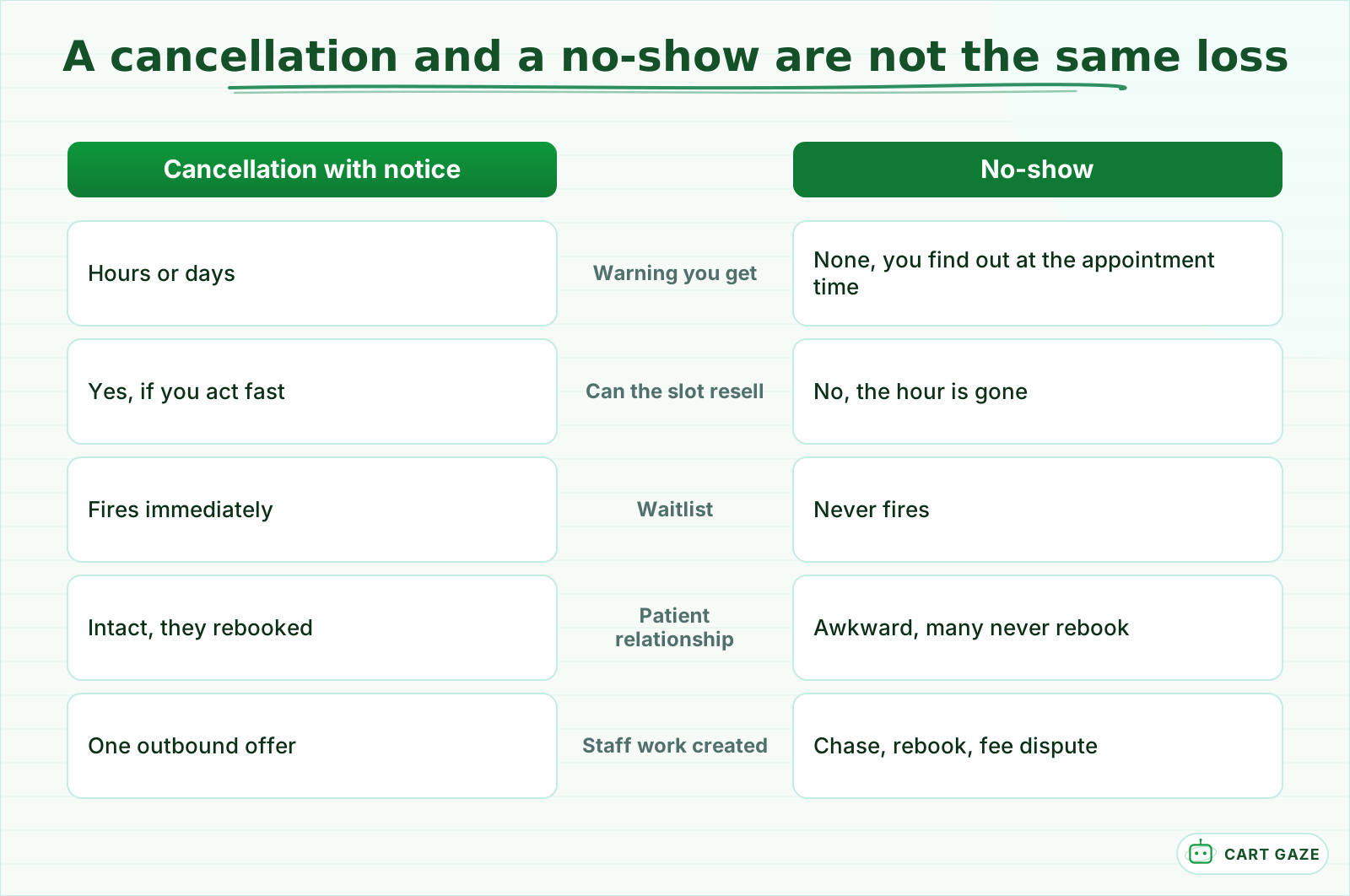 Same empty chair, completely different loss. Notice is the only thing that makes a slot recoverable.
The scale is not small. In that same Tebra survey, 47% of patients said they cancelled an appointment in the last 12 months, and 16% failed to show without cancelling at all. An MGMA Stat poll published on 11 August 2026, with 190 applicable responses, found 32% of medical groups reporting higher no-show rates year to date than in 2025, 58% about the same, and 10% lower.
Put a number on the chair. Roughly $200 in lost revenue per missed appointment is the figure most often quoted, originally from Curogram and repeated by Zocdoc. It is an aggregate across specialties, so treat it as directional and swap in your own average visit value. At 2 missed slots a day, even a directional number gets uncomfortable quickly.
A cancellation is not free either. Someone still has to notice it, find a patient who wants the slot, and reach them in time. But that work is possible. After a no-show there is nothing to work with. The broader tactics for pulling that rate down are worth a separate read in reducing patient no-shows.
Why patients no-show instead of cancelling
Because cancelling is harder than not cancelling. Most practices route it through the phone, which means hold time during the exact working hours the patient is busy. Add the small social discomfort of explaining yourself, and silence becomes the path of least resistance for an otherwise cooperative patient.
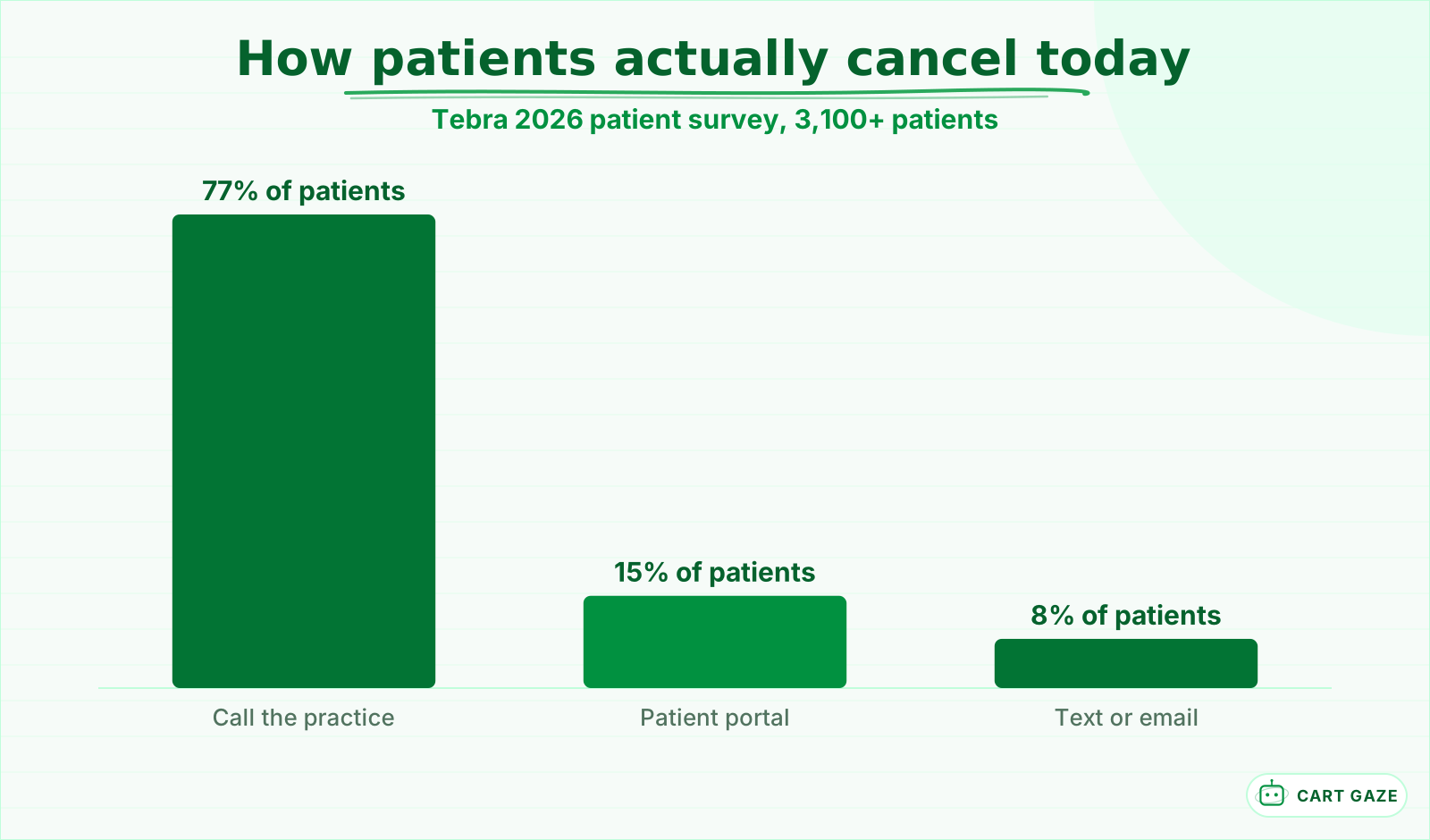 Cancelling is still a phone call for most patients, and a phone queue is where cancellations die.
The survey numbers point the same way. 69% of patients said they would be more likely to show up if they could reschedule online, and 40% said a one-tap reschedule option would make them move an appointment instead of no-showing. Those are stated preferences from a single vendor survey rather than measured behavior, so read them as direction, not as a forecast.
Fees make it worse in a way most policies never anticipate. In the same survey, 30% of patients said they attended an appointment they would have cancelled because they were worried about a fee. That is not attendance you want, and 54% said they would try a provider offering fee-free cancellation.
Tip
Time your own cancellation path this week. Call your main line at 8:40 a.m. and ask to cancel an appointment. However many minutes that takes is the friction every patient meets, and it is usually the cheapest thing on this list to fix.
An AI agent helps here by removing the queue, not by being clever. A patient calls at 9 p.m. says Thursday will not work, and the change happens inside that conversation. The same is true of a text reply. If you have not looked closely at where these systems fit and where they stop, start with what an AI receptionist actually does.
Verify the caller before you change anything
Reading an appointment back to a caller discloses protected health information. A phone number that matches your record is not proof of identity, since phones are shared, reassigned, and answered by other people. Verify two details you already hold before the agent says anything at all about a visit.
The rule is not folklore. 45 CFR 164.514(h) requires a covered entity to verify the identity of a person requesting protected health information, and that person's authority to have it, whenever they are not already known. A booked date, a provider name, and a visit reason all sit inside that definition.
In practice that means two identifiers asked up front: full name plus date of birth, or name plus the last 4 digits of the number on file. Ask first, not afterward. An agent that opens with "I see you're in Tuesday at 2 with Dr. Reyes, can I get your date of birth?" has already made the disclosure it was supposed to gate.
When verification fails, the agent should do less, not more. No hints, no partial confirmation, no negotiation. Offer a callback to the number on file or a portal link, log the attempt, and end it there. Voice-agent testing guidance treats matching the caller to an existing record as a prerequisite that runs before availability is even checked, which is the right order.
Warning
A rescheduling call can turn clinical without warning. "Should I even keep this appointment, or go to urgent care?" is a medical question, and the agent's job is to route it to a human rather than answer it. Note also that "HIPAA certified" does not exist: compliance is a configuration plus a signed Business Associate Agreement.
Rescheduling is one action, not a cancel plus a hope
The common failure is cancelling first and searching second. The old slot is gone, nothing suitable is free, and the patient now has no appointment at all. Do it in the other order: find the new time, hold it, confirm the write, and release the old slot last.
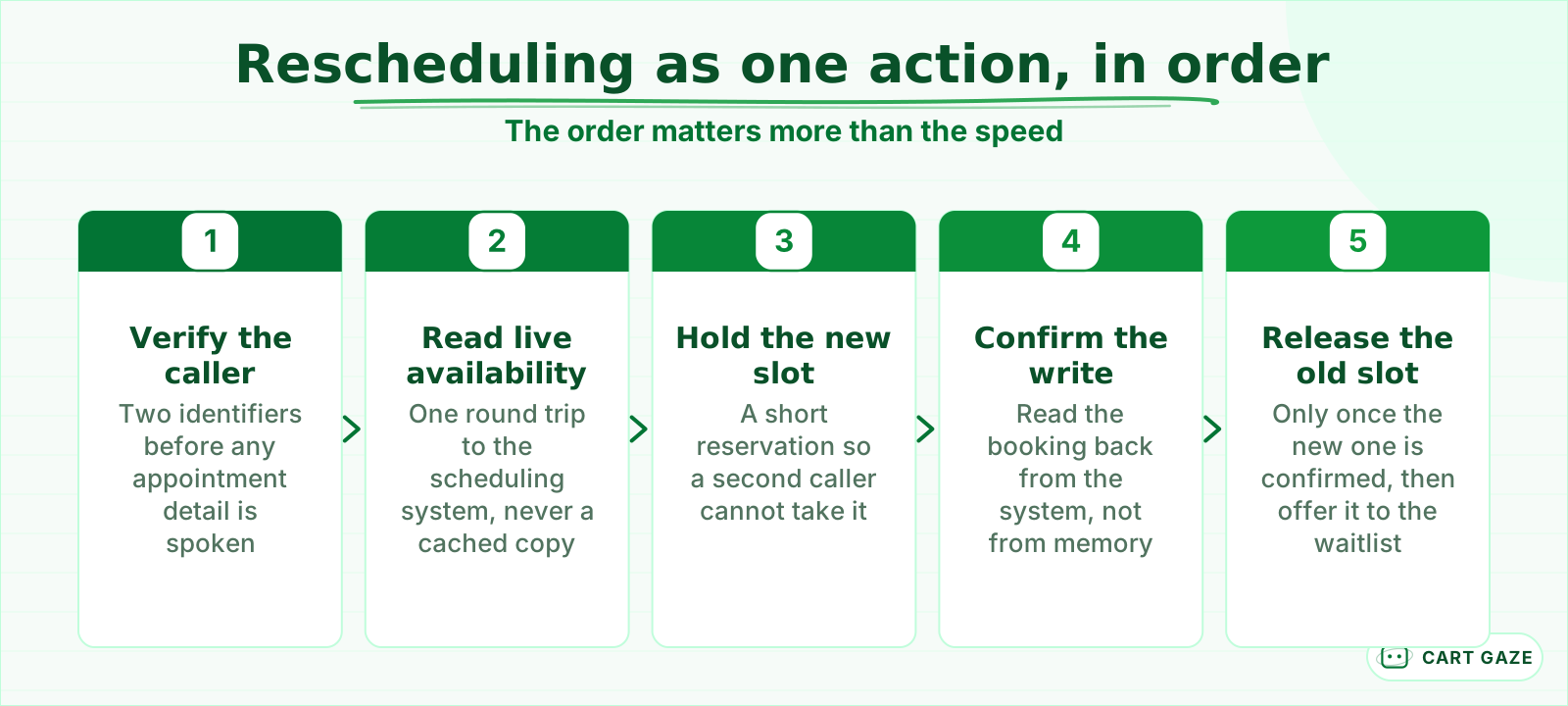 Release the old slot last. Reverse the order and a patient ends up with no appointment at all.
Every one of those steps is a live round trip to one scheduling system. A cached copy of availability is how a phone booking and a website booking end up disagreeing about what is free. If the availability read and the confirmation write are not atomic, two callers can both hear "confirmed" for the same 2 p.m. slot, which is a real race condition rather than a rare glitch.
The hold is the step vendors skip in demos, because it costs a second. It is also the step that prevents the apology call. A short reservation on the new slot, released automatically if the patient does not confirm, is cheap insurance.
Decide now what happens when the write fails, because it will. The correct behavior is to leave the original appointment untouched, tell the patient plainly that the change did not go through, and open a task for staff with a callback number. A silent failure is worse than a busy signal, because nobody knows to fix it. The mechanics of releasing and refilling slots deserve their own read in cancellation and rebooking automation.
Enforce your notice window and deposit the same way every time
A cancellation policy is only a policy if it applies identically at 2 a.m. on a Saturday, and to the patient who complains loudest. That consistency is the one thing automation is genuinely good at, provided you write the window and the fee down before you switch anything on.
Most practices draw the line at 24 to 48 hours of notice, and 65% of providers in the Tebra survey allow fee-free cancellation inside that window. Write the ladder out once, in the words the agent will actually speak.
| Notice the patient gives | What most policies say | What the agent should do | What it must never do |
|---|---|---|---|
| More than 48 hours | Free to cancel or move | Release the slot, offer a new time, trigger the waitlist | Mention a fee at all |
| 24 to 48 hours | Usually still free | Same, and flag the opening as short notice | Guess at an exception |
| Under 24 hours | Late cancellation, a fee may apply | State the policy as written, offer to move instead | Waive or charge on its own |
| Already missed | No-show, rebooking rules apply | Offer the next opening and log it for staff | Debate the fee with the patient |
The enforcement numbers are worth a look first. Only 27% of providers charge a no-show or cancellation fee at all, and among those, 49% charge between $1 and $40. 59% keep no card on file, which makes the fee a letter rather than a charge. Patients are split too: 41% think such fees are fair and 59% do not.
Important
Never let the agent invent a waiver. Practices that quietly bend the window for some patients end up with a policy that means nothing, and automation will expose that inconsistency within a week. Route every fee dispute to one named human who has the authority to decide.
The waitlist is what should fire the second a slot opens
A released slot has a short shelf life, and the only thing that reliably beats the clock is an automatic offer. In the Tebra survey, 68% of patients said they would opt into a waitlist for the next available opening, so the demand is usually already sitting there unasked.
The best published evidence comes from a health system rather than a vendor. A retrospective cohort study in JMIR (2024) examined Fast Pass at UCSF Health, a tool that messages patients when an earlier appointment opens. Across 220 departments it sent 60,660 offers for 21,978 open slots, 11% were accepted, and 84.2% of accepted offers became completed visits. Patients were seen a median of 14 days sooner.
That 11% acceptance rate is the honest headline. A waitlist offer is not a magic refill, it is a cheap ticket you can issue thousands of times. Volume and speed do the work, not persuasion.
Useful targets to steer by: a cancellation fill rate above 50% within 60 days of launch, above 70% once the program matures, and a median time-to-fill under 30 minutes for short-notice slots. Those are vendor benchmarks rather than published research, so treat them as a direction to move in. Offer to a few patients at a time with a real response window instead of texting the entire list, or you create a second race and a second apology call.
One finding from the UCSF study deserves more attention than it usually gets: older adults, non-White patients, and non-English speakers were all less likely to accept offers. Self-service is an additional door, never the only one. Keep a human answering the phone for the patients who need one.
Before you switch on self-service changes
- A signed Business Associate Agreement covers the vendor handling appointment details.
- Your notice window and fee sit in one document, in the exact words the agent will speak.
- Identity verification runs before any visit detail is spoken, and the failure path is a callback, not a hint.
- A named person reads the first week of change requests end to end.
Make cancelling easy on purpose
Start by measuring the ratio you actually care about, which is cancellations against no-shows rather than either number alone. If patients are cancelling more often and no-showing less, the change is working, even though your raw cancellation count went up and will look worse on a monthly report.
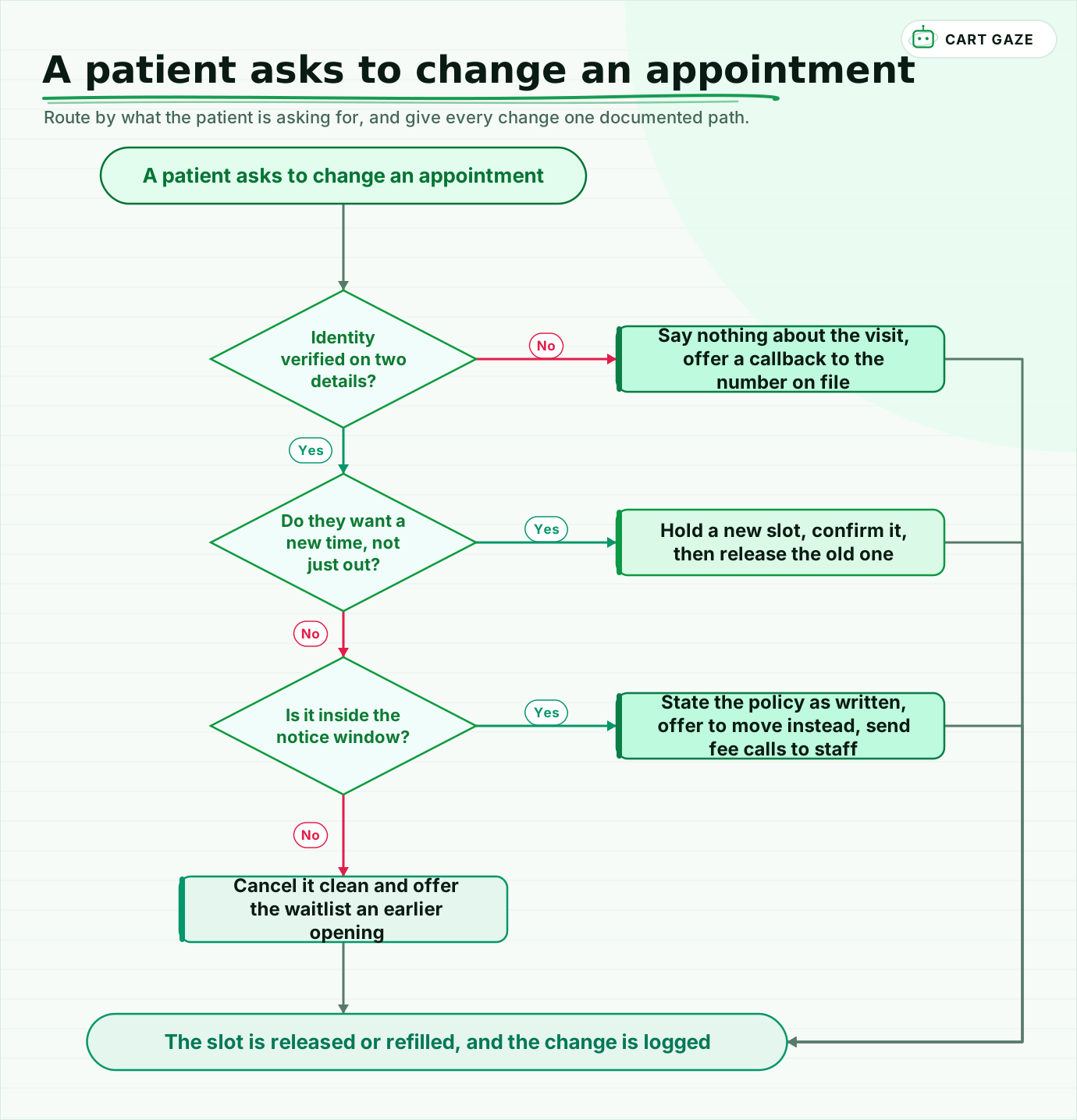 Route by what the patient is asking for, and give every change one documented path.
Walk the flow once. Verify identity before anything about the visit is spoken. If the patient wants a different time, hold the new slot and confirm it before the old one goes anywhere. If they simply want out, apply the window exactly as written and hand any fee conversation to a person. Either way the slot gets released or refilled, and the whole exchange is logged.
Pilot narrowly. One appointment type, one channel, 30 to 60 days, and somebody reading the transcripts in week one. Then compare your own numbers before and after, rather than a vendor's slide.
Making cancellation easy will feel like inviting people to leave. It is the opposite. A patient who can cancel in 20 seconds at 9 p.m. hands you a slot you can still sell, and comes back. A patient who cannot simply disappears. If you would rather have the size of that leak measured from your own numbers first, the free Growth Leak Audit does it before anyone talks tools.
Fair questions.
Why is a no-show worse than a cancellation?
A cancellation with notice leaves you a slot you can still sell and a patient who usually rebooks. A no-show leaves an unsellable hour, a waitlist that never fires, and a patient embarrassed enough to avoid calling back. Tebra's 2026 survey found 47% of patients cancelled in the past year, while 16% skipped without cancelling.
Can an AI agent cancel or reschedule an appointment on its own?
Yes for the scheduling action itself, provided it verifies identity first and writes to your live scheduling system rather than a cached copy. It should read availability, hold the new slot, confirm the booking, then release the old one. Any clinical question raised during the call goes to a human, and the agent never diagnoses.
What identity check should happen before an appointment is changed?
Two identifiers you already hold, asked before any visit detail is spoken: full name plus date of birth, or name plus the last 4 digits of the number on file. A matching caller ID is not verification. 45 CFR 164.514(h) requires verifying identity and authority before disclosing health information to someone not already known.
Should a practice charge a cancellation or no-show fee?
Treat it as a retention decision, not just a revenue one. Only 27% of providers charge a fee, 49% of those charge $1 to $40, and 59% keep no card on file, so many fees are uncollectable. 41% of patients think fees are fair and 54% would try a provider offering fee-free cancellation.
How fast should a released slot be offered to the waitlist?
Immediately, and to a few patients at a time rather than the entire list. Vendor benchmarks point to a median time-to-fill under 30 minutes for short-notice slots and a fill rate above 50% within 60 days. UCSF saw 11% of 60,660 offers accepted, with those patients seen a median 14 days sooner.
Sources.
- [1]Patient cancellation and no-show statistics, Tebra 2026 survey
- [2]MGMA Stat: about 1 in 3 medical groups see higher no-shows in 2026
- [3]Patient waitlist management and filling cancellations faster
- [4]An EHR-based automated self-rescheduling tool to improve patient access (JMIR, 2024)
- [5]Booking and reservation flow testing for voice agents: double-booking race conditions
- [6]45 CFR 164.514(h): verification requirements before disclosing health information
- [7]Average patient no-show rate: statistics and reduction strategies
Written by

Muhammad Qasim Hammad
Founder, Cart Gaze
Qasim builds AI receptionists and front-office automation for medical and dental practices at Cart Gaze. Posts here start from published sources and real call data, not vendor claims, and every number links back to where it came from.
Keep reading.
 No-Shows & Follow-UpHoliday Closure Communication: Keep Patients From a Locked Door10 min read
 No-Shows & Follow-UpThe New Patient Welcome Sequence That Gets Them Through9 min read
 No-Shows & Follow-UpNo-Show Prediction: Spot High-Risk Visits Before They Happen10 min read
 No-Shows & Follow-UpAI Appointment Scheduling That Books 24/7 and Cuts No-Shows10 min read
 No-Shows & Follow-UpPatient Review Automation: Automate the Ask, Not the Reply9 min read
 No-Shows & Follow-UpTelehealth Scheduling: Fewer No-Shows, a New Failure Mode9 min read