
Patient SMS Templates for Medical Practices, With Compliance Notes
Twelve patient text templates, each under 160 characters and each with the rule it sits under: the TCPA healthcare exemption, or the patient consent. Plus how to keep every text free of PHI.
Key takeaways.
- Texts under the TCPA healthcare exemption must stay at 160 characters or less, 1 a day and 3 a week, go to a patient-given number, and say Reply STOP.
- Appointment, checkup, pre-op, results, discharge and prescription texts can use the exemption; billing, reviews and promotions need documented consent.
- A results text says a result is ready in the portal and never names the test or the value.
- One emoji or curly quote switches encoding and cuts a text from 160 characters to 70, so draft templates in plain text.
- A single confirmation after STOP is allowed if it only confirms the opt-out, and sending it within 5 minutes is presumed consented.
Table of Contents8 sections
- The rules every patient text template follows
- Appointment texts: confirmation, reminder, running late, reschedule
- Recall, forms and results-ready texts
- Consent texts: the opt-in and the STOP confirmation
- Billing, closure and review texts need consent first
- Keep every text short, plain and PHI-free
- Put the templates to work
- Fair questions
Most practices write patient texts one at a time, under pressure, and the results drift: a reminder that names the procedure, a billing text sent under rules meant for appointment reminders, a review request that goes only to happy patients. Each is a small problem until a carrier blocks the number or a complaint arrives. The TCPA healthcare exemption, the rule most reminder texts rely on, allows 160 characters or less, 1 message a day, and 3 a week.
This post gives you 12 patient SMS templates, each under 160 characters, each with the rule it sits under: the healthcare exemption, or the patient's consent. It covers the rules every template follows, appointment, recall and results texts, the two consent texts, the texts that need consent first, and how to keep every message short, plain and free of clinical detail.
The rules every patient text template follows
Every patient text should name the practice, give a way to reach you, stay under 160 characters, and carry no clinical detail. Texts sent under the TCPA healthcare exemption must also say "Reply STOP," go only to a number the patient gave you, and stay within 1 a day and 3 a week.
The exemption lives in 47 CFR 64.1200(a)(9)(iv), and its conditions are specific. The text must go only to the wireless number the patient provided, state the provider's name and contact information, and be limited to appointment and exam confirmations and reminders, wellness checkups, hospital pre-registration, pre-operative instructions, lab results, post-discharge follow-up, prescription notifications, and home healthcare instructions. It may not include telemarketing, advertising, billing, debt collection, or other financial content, and it must comply with HIPAA.
Every exempt text must also tell recipients they can opt out by replying STOP, which is the exclusive opt-out method for these messages, and the practice must honor that request immediately. Anything outside the list, such as a statement notice or a review request, needs the patient's consent instead, and the exact consent needed depends on the content.
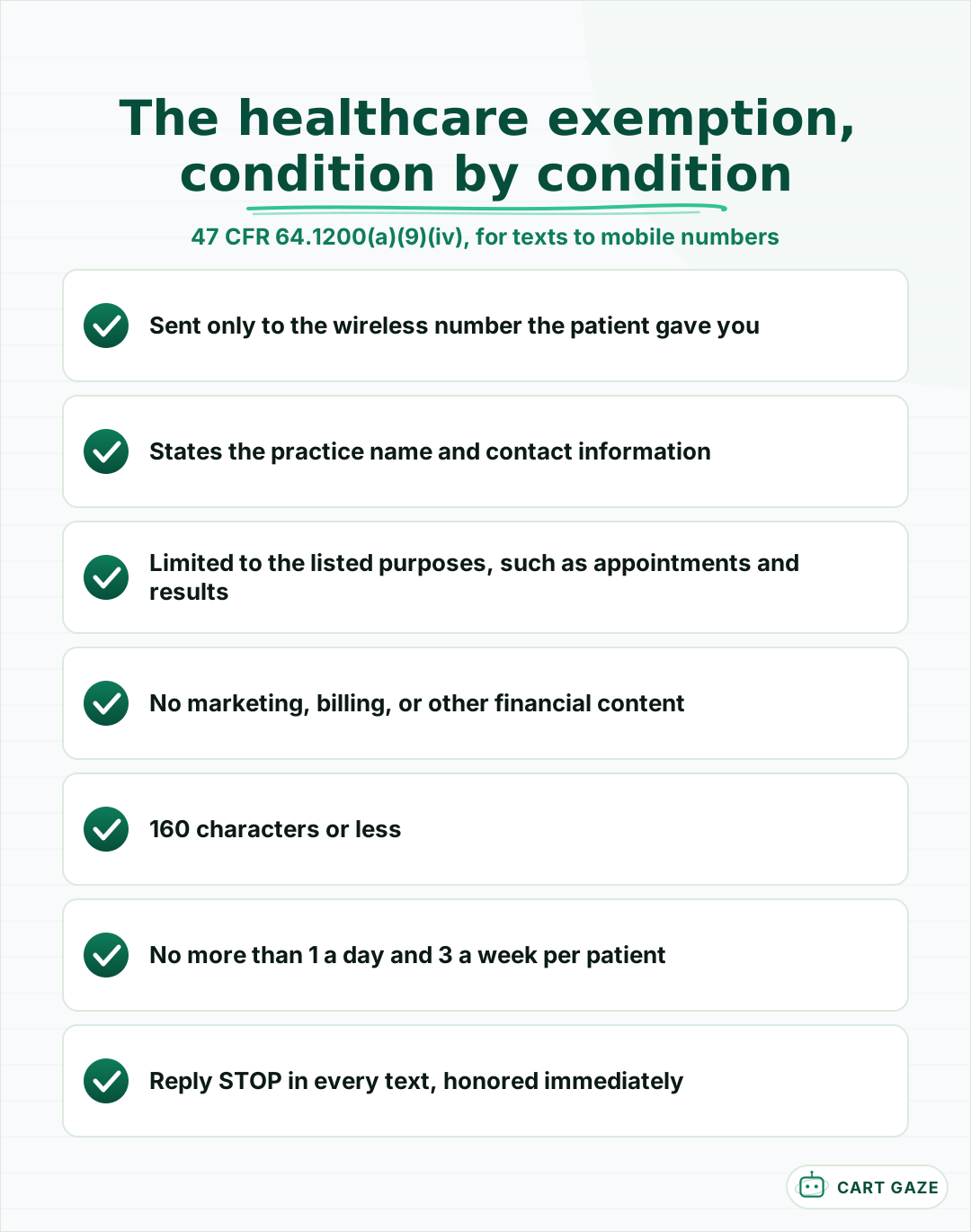 Miss one condition and the text needs consent instead of the exemption.
Here are the 12 templates at a glance. Character counts assume a 14-character practice name, a 12-character phone number, and a short link on your own domain.
| # | Template | Rule it sits under | Characters |
|---|---|---|---|
| 1 | Opt-in confirmation | Consent | 144 |
| 2 | Opt-out confirmation | One-time confirmation rule | 106 |
| 3 | Appointment confirmation | Healthcare exemption | 110 |
| 4 | Reminder | Healthcare exemption | 138 |
| 5 | Running late | Healthcare exemption | 137 |
| 6 | Reschedule confirmation | Healthcare exemption | 108 |
| 7 | Recall due | Healthcare exemption, wellness checkup | 120 |
| 8 | Pre-visit forms | Consent, or send with the confirmation | 130 |
| 9 | Results ready | Healthcare exemption, lab results | 132 |
| 10 | Office closure | Consent | 146 |
| 11 | Statement ready | Consent, financial content | 124 |
| 12 | Review request | Consent, solicitation | 127 |
Appointment texts: confirmation, reminder, running late, reschedule
Appointment texts are the core of the healthcare exemption, and they work best short: the practice name, the day and time, one action, and "Reply STOP." Leave out the reason for the visit and, for sensitive specialties, the provider's title. A patient's lock screen is not private, and a family member may read it first.
3. Appointment confirmation. "[Practice]: You are booked for [Tue Oct 7] at [10:00 AM]. Questions? Call [phone]. Reply STOP to opt out." Send it once, when the appointment is made.
4. Reminder. "[Practice]: Reminder of your visit [tomorrow] at [10:00 AM]. Reply C to confirm or call [phone] to reschedule. Reply STOP to opt out." A reply keyword like C lets your system mark the confirmation without a call. The timing of reminders is covered in how AI scheduling and reminders work.
5. Running late. "[Practice]: We are running about [20] min behind today. Your visit is still on. Call [phone] to reschedule. Reply STOP to opt out." Send it only when the delay is real and the number is honest.
6. Reschedule confirmation. "[Practice]: Your visit is now [Thu Oct 9] at [2:00 PM]. Questions? Call [phone]. Reply STOP to opt out." Confirm every change in writing, even one made on the phone.
Watch the count on busy weeks. A confirmation, a reminder, and a running-late text in 1 week is 3 messages, which is the exemption's weekly ceiling for that patient.
Recall, forms and results-ready texts
Recall and results texts sit inside the exemption as wellness checkups and lab results, but only if the text itself carries no clinical content. A results text says a result is ready and where to see it. It never says what the result is, and it never names the test.
7. Recall due. "[Practice]: You are due for your [annual checkup]. Book at [link] or call [phone]. Reply STOP to opt out." Keep the visit type generic. "Annual checkup" is fine; a named screening test tells the reader something about the patient.
8. Pre-visit forms. "[Practice]: Please complete your forms before your visit [Tue]: [link]. Questions? [phone]. Reply STOP to opt out." Intake forms are not named in the exemption's list, so send this to patients who agreed to texts, or fold the link into the appointment confirmation.
9. Results ready. "[Practice]: A new result is ready in your patient portal: [link]. Questions? Call [phone]. Reply STOP to opt out." The portal, behind a login, is where the result belongs.
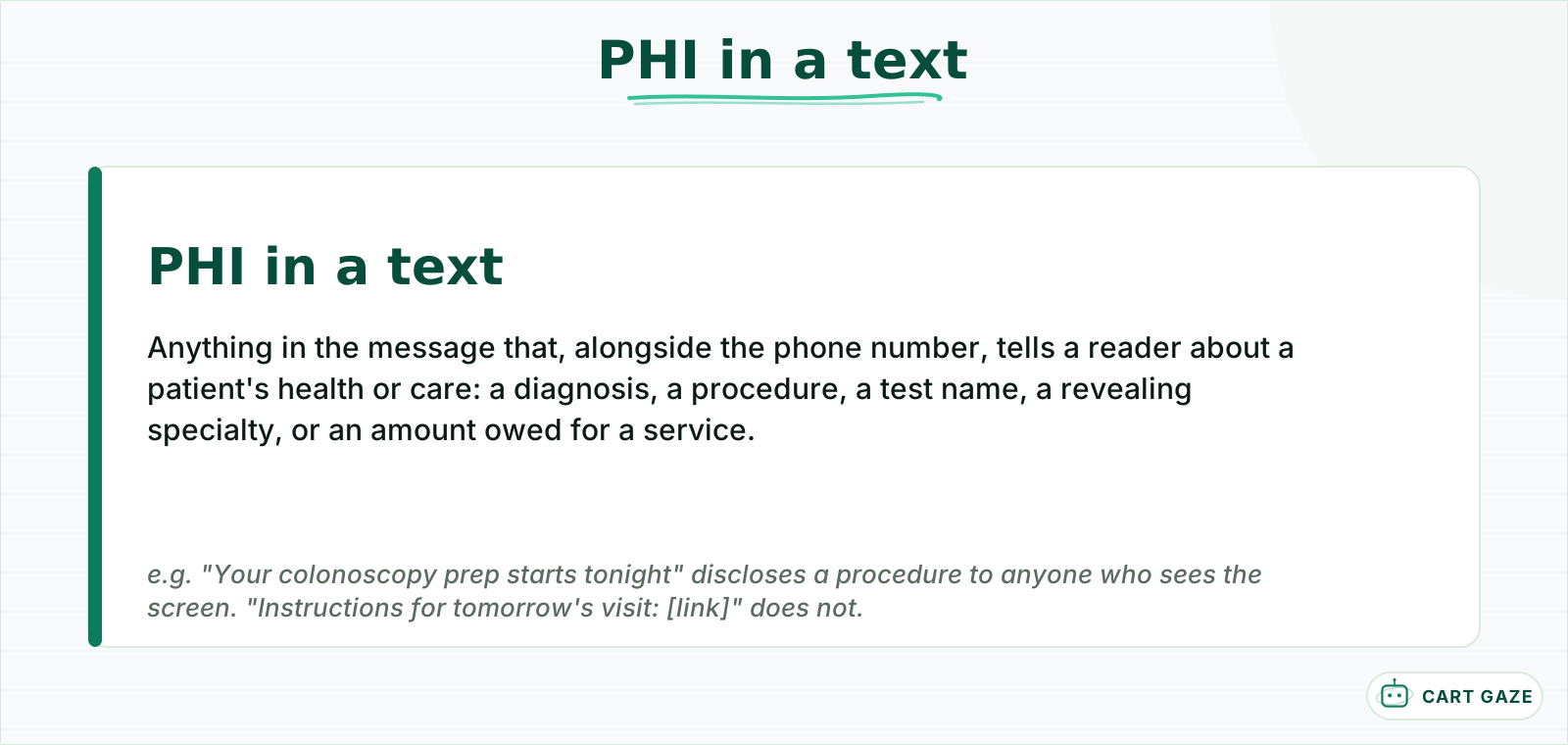 The lock screen is public. Write every text for whoever sees it first.
That same test applies to the practice name. A name like "Riverside Fertility" or "Downtown Oncology" discloses something in every text, so consider a neutral sender name, such as the group name, for message headers.
Consent texts: the opt-in and the STOP confirmation
Two templates handle consent itself: a confirmation when a patient opts in, and a single confirmation when they opt out. The opt-out text is allowed by rule, sent once, and must not sell anything. After it, nothing more goes to that number until the patient opts back in.
1. Opt-in confirmation. "[Practice]: You are signed up for appointment texts. Msg frequency varies. Msg & data rates may apply. Reply HELP for help, STOP to opt out." Send it as soon as a patient agrees, and keep a record of when and how they agreed.
2. Opt-out confirmation. "[Practice]: You are unsubscribed and will get no more texts from us. Call [phone] if you need us." Under 47 CFR 64.1200(a)(12), a one-time text that only confirms the revocation, with no marketing, is allowed, and one sent within 5 minutes is presumed to fall within the patient's consent.
Warning
Reply STOP to your own number from a test phone before you launch, and again after any change to your texting setup. Then send a reminder to that phone. If it arrives, your opt-out is not working, and that is the failure that ends in lawsuits.
What counts as a valid revocation, and why a HIPAA-compliant platform can still break the TCPA, is set out in what TCPA compliance means for patient texting.
Billing, closure and review texts need consent first
Statement, closure, and review texts fall outside the healthcare exemption: billing and financial content are excluded by name, review requests are solicitation, and closure notices are not on the list. Send them only to patients who agreed to receive texts from you, and keep each one informational and plain.
10. Office closure. "[Practice]: Our office is closed today due to weather. We will call to reschedule today's visits. Emergencies: call 911. Reply STOP to opt out." Useful and time-sensitive, but still outside the exemption.
11. Statement ready. "[Practice]: A new statement is ready. View or pay securely at [link] or call [phone]. Reply STOP to opt out." No amounts, no services, no dates of service in the text.
12. Review request. "[Practice]: Thanks for visiting today. If you would like to share your experience: [link]. Reply STOP to opt out." Send it to every patient on the same schedule. Google's review policy prohibits selectively soliciting positive reviews and offering incentives for any review, so no survey gate before the link and no discount for posting.
Keep every text short, plain and PHI-free
Write every text in plain characters and under 160 of them, because one emoji or curly quote switches the encoding and cuts the limit to 70. Name the practice, the time, and one action. Leave out diagnoses, procedures, test names, and amounts, which belong behind a login.
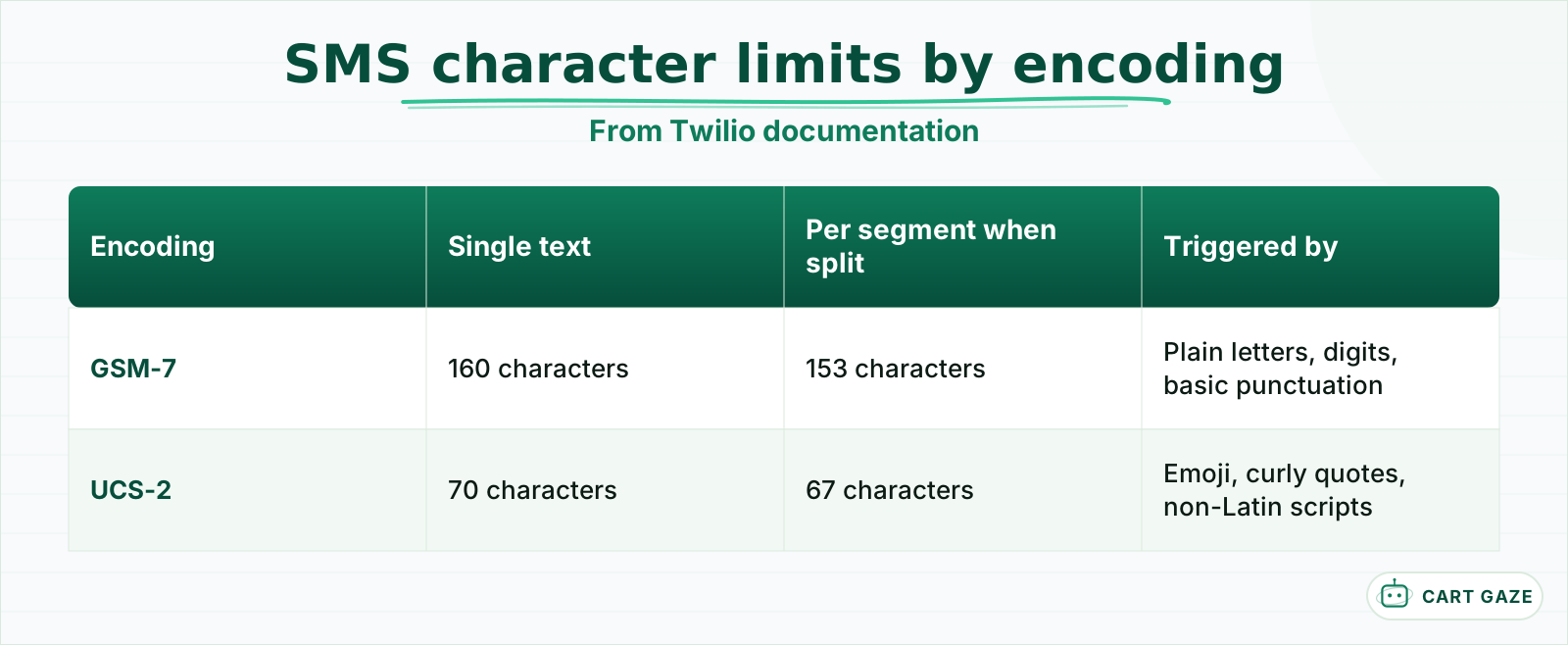 One curly quote is enough to switch encoding and more than halve the limit.
The encoding trap catches careful writers. Twilio's documentation notes that a text editor turning a straight quote into a curly one is enough to force UCS-2, which drops a single message from 160 characters to 70 and a split message from 153 to 67 per segment. Draft templates in a plain text editor, not a word processor, and paste them into your texting platform as plain text.
Tip
Keep a single shared file with all 12 templates, their character counts, and the rule each sits under. When someone edits a template, the count and the rule get checked in the same place.
Each template also passes through your texting vendor, which sees the phone number and message content. If a message can identify a patient and relates to their care, the vendor needs a BAA, and the sending number needs A2P 10DLC registration before carriers will deliver it at all.
Before a template goes live
- It is under 160 characters in plain text, with no emoji.
- It names the practice and gives a way to reach you.
- It includes Reply STOP, and your system honors it immediately.
- Its rule is recorded: healthcare exemption or documented consent.
Put the templates to work
Sort every text by the rule it sits under before it goes out. Exempt purposes follow the exemption's conditions. Billing, reviews, and anything promotional go only to patients who consented. Anything that fits neither should be a call or a portal message instead. Then send from one reviewed template set, not from memory.
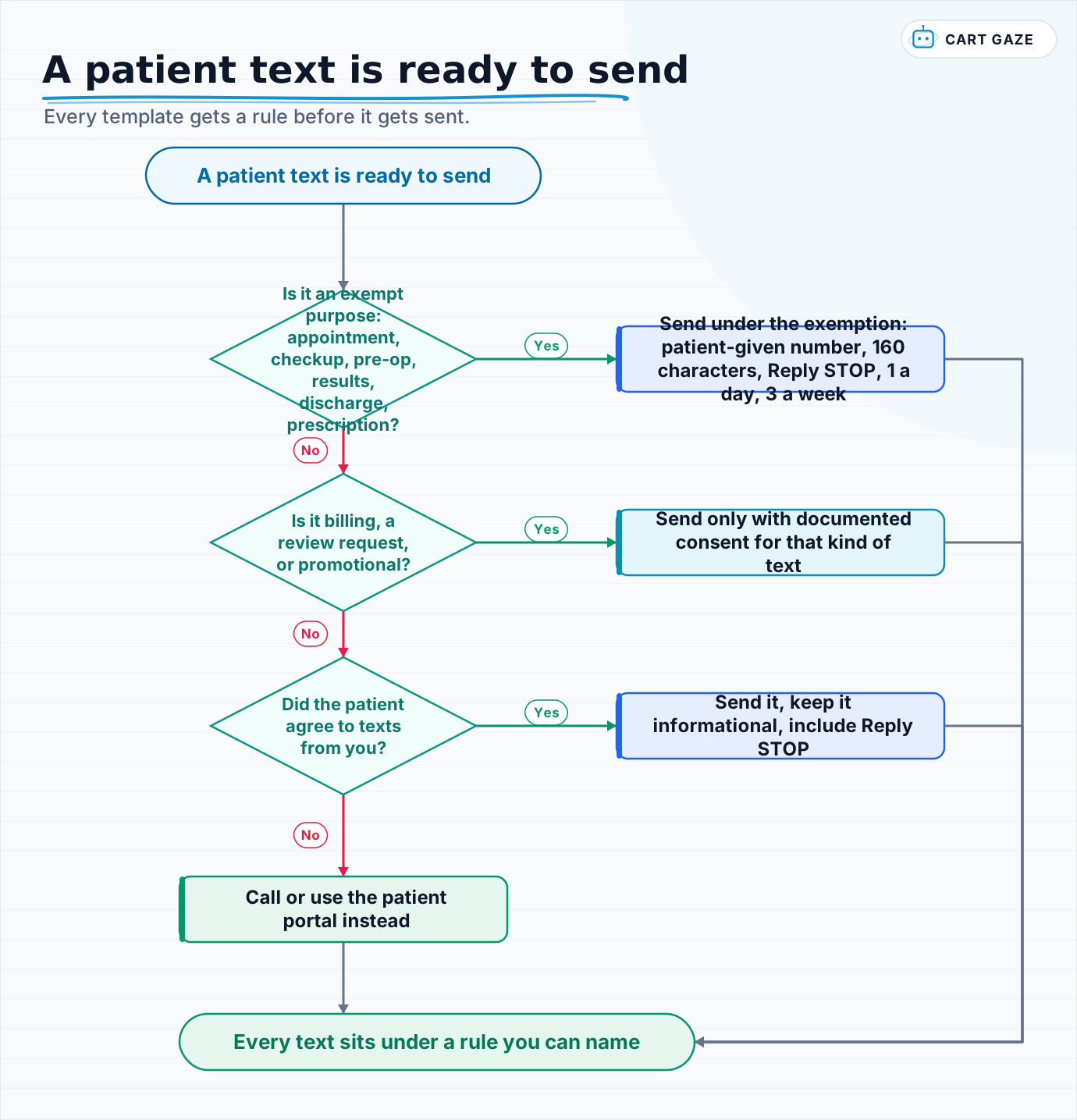 Every template gets a rule before it gets sent.
Walk each template through the flow once and write its rule next to it in the shared file. The work takes an hour, and it is the difference between a texting program you can defend and one you hope nobody asks about.
For how texting runs day to day, with the opt-out enforced by the system rather than by staff remembering, see how patient texting works, and how opt-out is enforced. What an automated assistant does on the phone side, and where it stops, is set out in what an AI receptionist does and where it hands off.
Fair questions.
What should a patient appointment reminder text say?
The practice name, the day and time, one action such as reply C to confirm or call to reschedule, and "Reply STOP to opt out." Keep it under 160 characters and leave out the reason for the visit. Under the TCPA healthcare exemption it must go to a number the patient gave you, no more than 1 a day and 3 a week.
Can a medical practice text patients about their bill?
Only with the patient's consent. The TCPA healthcare exemption excludes accounting, billing, debt-collection, and other financial content by name, so statement texts cannot rely on it. Keep the text plain: say a statement is ready and link to a secure page, with no amounts, services, or dates of service in the message itself.
Can we text patients that their lab results are ready?
Yes. Lab results are one of the purposes the TCPA healthcare exemption lists, but the text should only say that a new result is ready and link to the patient portal. Never put the result, the value, or the name of the test in the message, since a lock screen or a shared phone can expose it.
What should happen when a patient replies STOP?
Stop all texts to that number immediately. The rules allow one confirmation text that only confirms the opt-out and contains no marketing; sent within 5 minutes, it is presumed to fall within the patient's consent. After that, send nothing until the patient opts back in, and test your own STOP handling before every launch.
Is it OK to text patients asking for a Google review?
Only to patients who agreed to receive texts, since a review request falls outside the healthcare exemption. Send it to every patient on the same schedule. Google's policy prohibits selectively soliciting positive reviews and offering incentives for reviews, so do not gate the link behind a satisfaction survey or offer a discount for posting.
Sources.
Written by

Muhammad Qasim Hammad
Founder, Cart Gaze
Qasim builds AI receptionists and front-office automation for medical and dental practices at Cart Gaze. Posts here start from published sources and real call data, not vendor claims, and every number links back to where it came from.
Keep reading.
 No-Shows & Follow-UpAfter a No-Show: The Follow-Up Sequence That Brings Patients Back10 min read
 No-Shows & Follow-UpRunning Late Text to Patients: When to Send It and What to Say10 min read
 No-Shows & Follow-UpAI Appointment Scheduling That Books 24/7 and Cuts No-Shows10 min read
 No-Shows & Follow-UpReduce Patient No-Shows: The Reminder Playbook That Actually Works11 min read
 No-Shows & Follow-UpNo-Show Rate Benchmarks by Specialty: What the Studies Show10 min read
 Trust & CompliancePatient Consent Management Automation You Can Prove, Not Promise11 min read