
Patient Consent Management Automation You Can Prove, Not Promise
A consent rule written in application code never applied to the nightly job or the query someone runs by hand. Here is how to build patient consent records a practice can demonstrate rather than promise.
Key takeaways.
- A consent rule enforced in application code covers only the messages that pass through that code, so put it in the database where an import, a script, or a hand-run query meets it too.
- Scope consent by purpose: a number given at check-in for appointment reminders does not authorize a promotional text, and carrier policy limits consent to the subject matter the patient agreed to.
- Capture the moment rather than the answer: name, number, purpose, channel, source, and a versioned snapshot of the exact wording the patient saw.
- Keep consent append-only, because the sender carries the burden of proving consent existed and TCPA claims can arrive up to 4 years later; record revocation as a new row.
- Honor opt-outs within 10 business days, and build one opt-out that stops everything instead of waiting for the delayed cross-category rule now set for January 31, 2027.
Table of Contents8 sections
- Why a consent rule that lives in code is not a control
- Purpose-scoped consent: a reminder is not a marketing text
- What to record at the moment consent is captured
- Why a consent record must be append-only
- One opt-out that stops everything, or one per category
- What you should be able to produce when someone asks
- Make the rule structural, then try to break it
- Fair questions
Your texting system has a rule in it somewhere: do not message a patient who opted out. It probably works. The question worth asking is where that rule lives, because a rule written into application code only covers the messages that travel through that code. It does not cover the nightly job, the spreadsheet import, the automation node someone added last quarter, or the query a developer runs by hand at 6 p.m.
The gap has a price. Under the Telephone Consumer Protection Act a plaintiff can recover $500 for each message, and a court may increase that to as much as $1,500 per message where the violation was willful or knowing, with no cap on the total. A reactivation campaign that reaches 300 patients who already replied STOP is not one mistake. It is 300 of them.
This post is about building patient consent management automation as infrastructure instead of as a checkbox: consent scoped to a purpose, what to capture the moment a patient says yes, why the record has to be append-only, and how to turn "no message can exist without a consent record that covers it" into something you demonstrate rather than assert. None of this is legal advice, and your own program belongs in front of your own counsel.
Why a consent rule that lives in code is not a control
A rule enforced in application code protects only the messages that pass through that code. Every other writer to your patient database bypasses it: an import, a scheduled job, a vendor integration, a hand-run query. Move the rule into the data store and it applies to all of them, without exception.
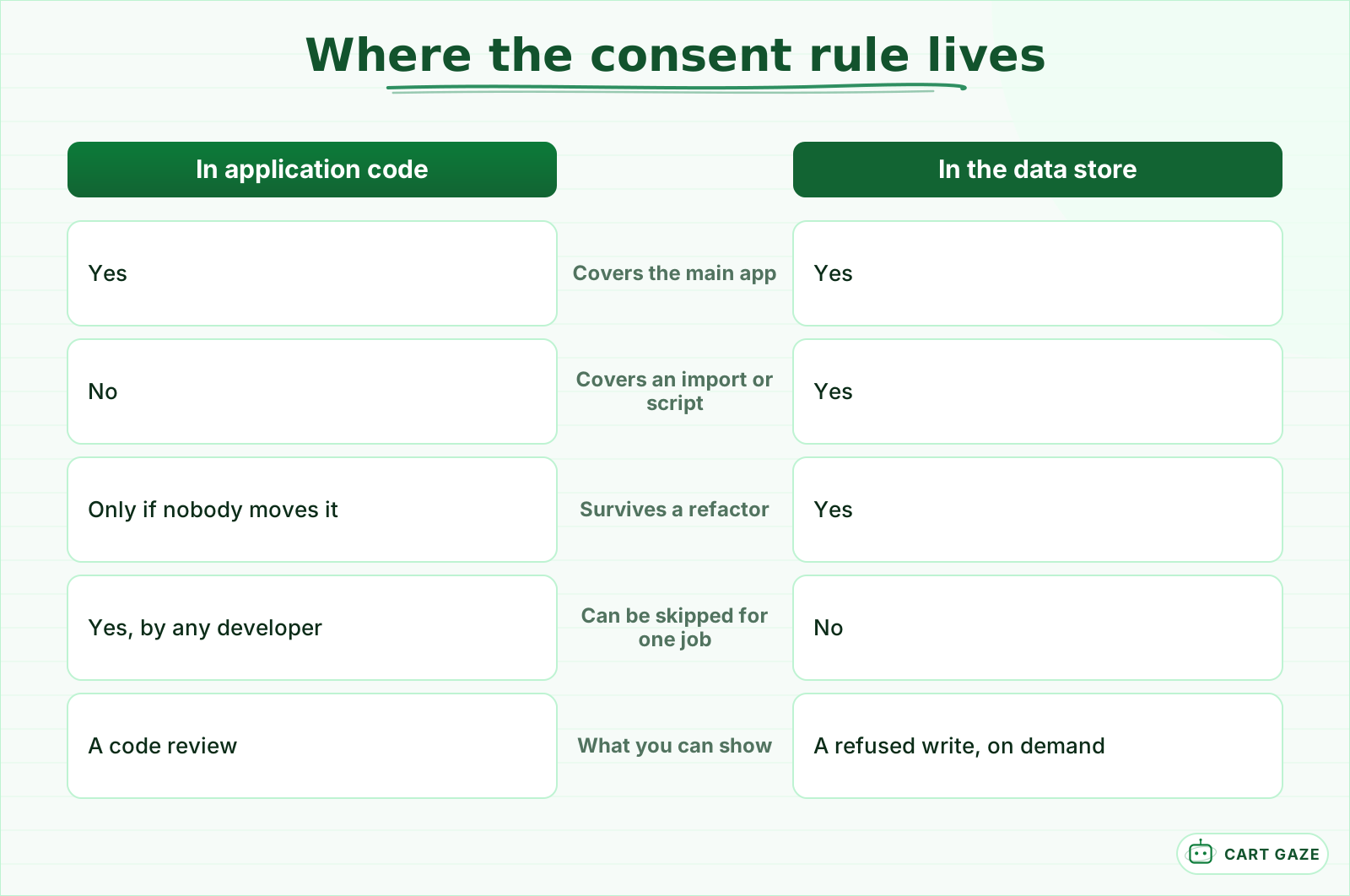 A rule only the application enforces is a rule every other writer can skip.
Count the writers your patient database actually has. The messaging platform is one. The practice management system syncing overnight is another. Then there is the marketing tool someone connected during a slow week, the CSV a front-desk lead cleaned up in a spreadsheet and re-uploaded, and the consultant who fixed a duplicate patient record directly in the database. A rule that lives in one of those paths governs one of those paths.
There are two claims a practice that texts patients should be able to make without flinching. First, no message row can exist without a consent row whose purpose covers that message. Second, no message row can exist for a number carrying an active opt-out. Both are ordinary database work: a foreign key from every send to the consent record that permitted it, and a trigger that refuses the insert when an opt-out is active, since a simple constraint cannot look at another table.
The difference shows up under pressure. A rule in code is one refactor from being lost, and any developer can skip it for a single job. A rule in the schema refuses the write and does the same thing at 2 a.m. for a script nobody remembers writing. The same instinct applies to voice, which what an AI receptionist does and where it stops covers for the phone side of the front desk.
Purpose-scoped consent: a reminder is not a marketing text
Consent is not a single yes. Twilio's messaging policy puts it plainly: consent is strictly for the subject matter the patient agreed to. A number given at check-in for appointment reminders does not authorize a promotional text about a whitening special, and the two are governed by different rules.
Carriers already assume this. Most practice databases do not, because they store one flag called something like sms_ok and let staff interpret it. The fix is unglamorous: purpose becomes a column with a controlled vocabulary, every send names its purpose, and the send is only allowed if a consent record with that purpose exists.
| Purpose | Example message | What it does not cover | Consent standard |
|---|---|---|---|
| Appointment reminder | "Your cleaning is Tuesday at 2 p.m." | Recall, review requests, promotions | Health care message to a patient-provided number |
| Recall and reactivation | "You are due for a checkup" | Anything with an offer in it | Treatment-related, confirm the framing with counsel |
| Billing and balance | "A balance of $180 is due" | Reminders or marketing | Outside the health care exemption, verify separately |
| Promotional | "20% off whitening in May" | Every clinical purpose above | Prior express written consent, plus HIPAA authorization if it is marketing |
The federal rules split along a similar line. The FCC exempts a health care message made by or on behalf of a covered entity or its business associate from the prior-express-written-consent requirement, and caps health care calls to a residential line at 1 per day and 3 per week. HIPAA runs on a separate axis: 45 CFR 164.501 defines marketing and excludes treatment communications, care coordination, and refill reminders where any payment received is reasonably related to the cost of sending. Marketing that falls inside that definition needs a written authorization.
Important
HIPAA and TCPA are separate obligations that both apply to the same message at the same time. A signed HIPAA authorization does not create TCPA consent, and TCPA consent does not permit a use of health information that HIPAA restricts. The rules themselves are covered in TCPA compliance for automated patient texting.
What to record at the moment consent is captured
Record enough to reconstruct the moment, not just the answer. The FTC's telemarketing rule sets the clearest published bar: the patient's name and number, a copy of the request exactly as presented, the response, the date, and the purpose. Copy that shape even where it does not apply.
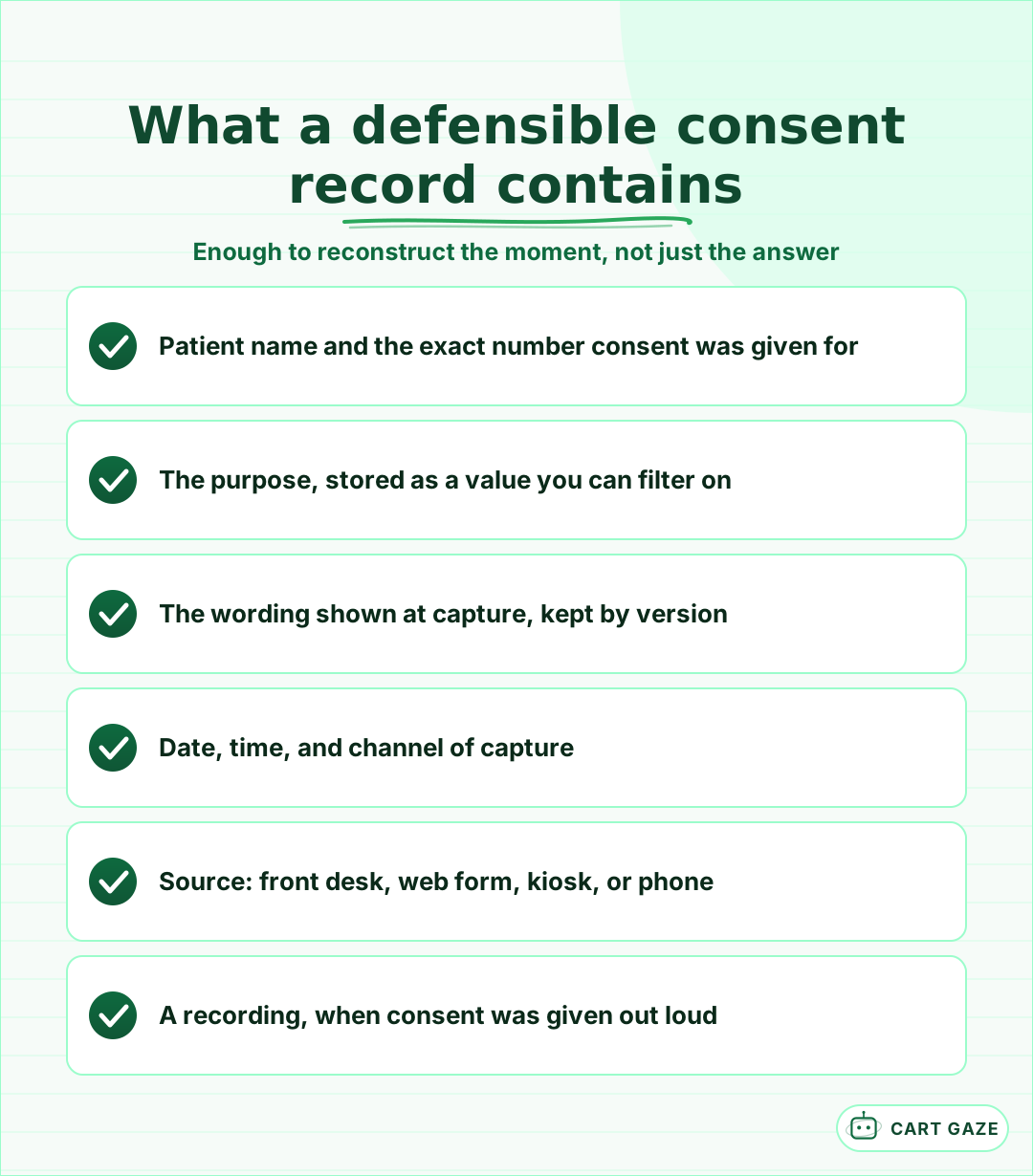 Modeled on the FTC recordkeeping list, which governs telemarketing rather than clinical reminders.
That rule governs telemarketing, not a dental appointment reminder, so it is not your legal standard. It is a good description of what a record has to contain before anyone believes it. The amended rule also requires a recording when consent is given out loud, and 5 years of retention.
Two fields matter more than practices expect. Channel, because HIPAA requires a provider to permit and accommodate reasonable requests to receive communications by alternative means or at alternative locations, so "how may we contact you" is a record, not a preference. And source, meaning front desk, web form, kiosk, or phone system, because the first question anyone asks about a number is where it came from.
Tip
Store the wording the patient saw as a versioned snapshot, not a link to the current form. Your intake form will be edited a dozen times in 4 years. A consent record that points at today's wording cannot show what someone agreed to in 2024, which is exactly the year a claim would be about.
Why a consent record must be append-only
If staff can edit a consent row, the row proves nothing. In a TCPA dispute the sender carries the burden of showing consent existed when the message went out, and claims can arrive up to 4 years later. An edited record cannot carry that weight. Revocation belongs in a new row.
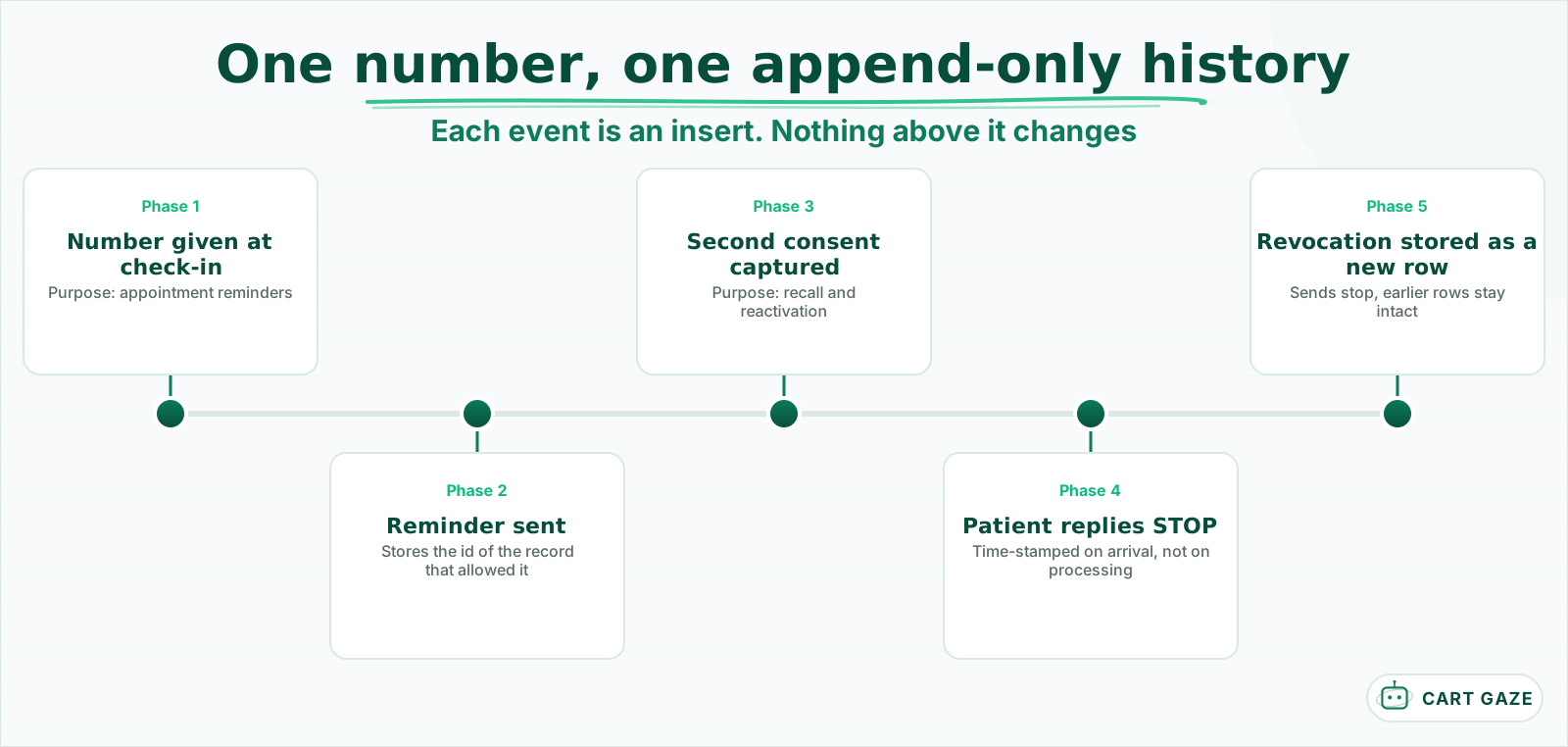 Every change is a new entry. Nothing already in the history is edited or deleted.
Think about what an edit actually destroys. A row that reads "consent: yes, updated last Tuesday" answers none of the questions that matter: yes to what, since when, and what did it say before. The same row written as a sequence of inserts answers all three, and the sequence is the evidence.
So revocation is recorded as a new fact rather than a change to an old one. The consent row stays exactly as captured. A revocation row lands next to it with its own timestamp, its own source, and the wording of the request if there was one. Reading the current state becomes a query over that history rather than a field someone maintains.
Warning
Append-only enforced by policy is not append-only. If the database role your application uses still holds UPDATE and DELETE on the consent table, the guarantee lasts exactly until someone has a reason to break it at 5 p.m. on a Friday. Revoke those privileges and let a trigger stamp revocations instead.
Derived state, like whether a number is currently opted out, is then computed from that history rather than stored as a flag someone can flip.
One opt-out that stops everything, or one per category
The FCC requires you to honor a revocation within 10 business days, and to accept any reasonable wording, including stop, quit, end, revoke, cancel and unsubscribe. The rule that makes one opt-out end every category of message from the same sender has been delayed to January 31, 2027. Build it now anyway.
Most of the revocation package took effect on April 11, 2025: the keyword list, the deadline, and the rule that you cannot force patients through one exclusive opt-out channel of your choosing. A single confirmation message back is permitted, and it is presumed to sit inside the patient's existing consent when it goes out within 5 minutes. Later than that and you are explaining the delay.
The delayed piece is the interesting one. That provision would make a revocation sent in response to one kind of message apply to all future messages from you on unrelated subjects. It was pushed to April 11, 2026, then pushed again by a January 6, 2026 order to January 31, 2027. Until then, a narrower reading is defensible.
Building to that narrower reading carries two costs. You rebuild when the waiver ends, on someone else's timetable. And in the meantime a patient who typed STOP once has to type it again to stop a different category of message from the same practice, which is not a conversation any front desk wants to have.
One opt-out ending everything is stricter than today's baseline requires, and it is a smaller system. There is one rule to implement, one to test, and one to explain to a patient who asks why the texts stopped completely.
What you should be able to produce when someone asks
Someone will eventually ask: a patient, an attorney, or a regulator. The answer should be a query, not a search. For any message you sent, name the consent record that allowed it, the wording the patient saw, the date and channel of capture, and any revocation since. Within minutes, not weeks.
That resolves to four artifacts, and a practice can check whether it has them this afternoon. The consent record itself, with purpose and wording version. The message log, carrying the id of the consent record that permitted each send. The opt-out log, showing when the request arrived and when it took effect. And the version history of the capture wording.
Keep them for at least 4 years to cover the TCPA limitations period. 5 years matches the retention bar the FTC set for telemarketing consent and is the easier policy to explain, because it has one number in it instead of two.
Then test the opt-out yourself, from a real phone, on a real number in your system. Reply STOP and confirm the messages stop, including the ones sent by whatever tool you did not think about. Vendor claims sit alongside the same BAA and configuration questions covered in what a HIPAA-aware setup requires, and "HIPAA compliant" describes a configuration plus a signed agreement, never a certification anyone can hold.
Before a consent system carries real patient messages
- Every send stores the id of the consent record that permitted it, and the purpose matches.
- An opted-out number is refused by the database, not only by the application.
- Consent rows can be inserted but not changed or removed by the account your app connects with.
- A healthcare attorney has reviewed your purpose categories and your capture wording.
Make the rule structural, then try to break it
Treat this like any other control: put the rule where every writer meets it, then attempt to violate it. Write a message with no covering consent record and confirm the database refuses it. Send to an opted-out number from a script outside the application and confirm that fails too.
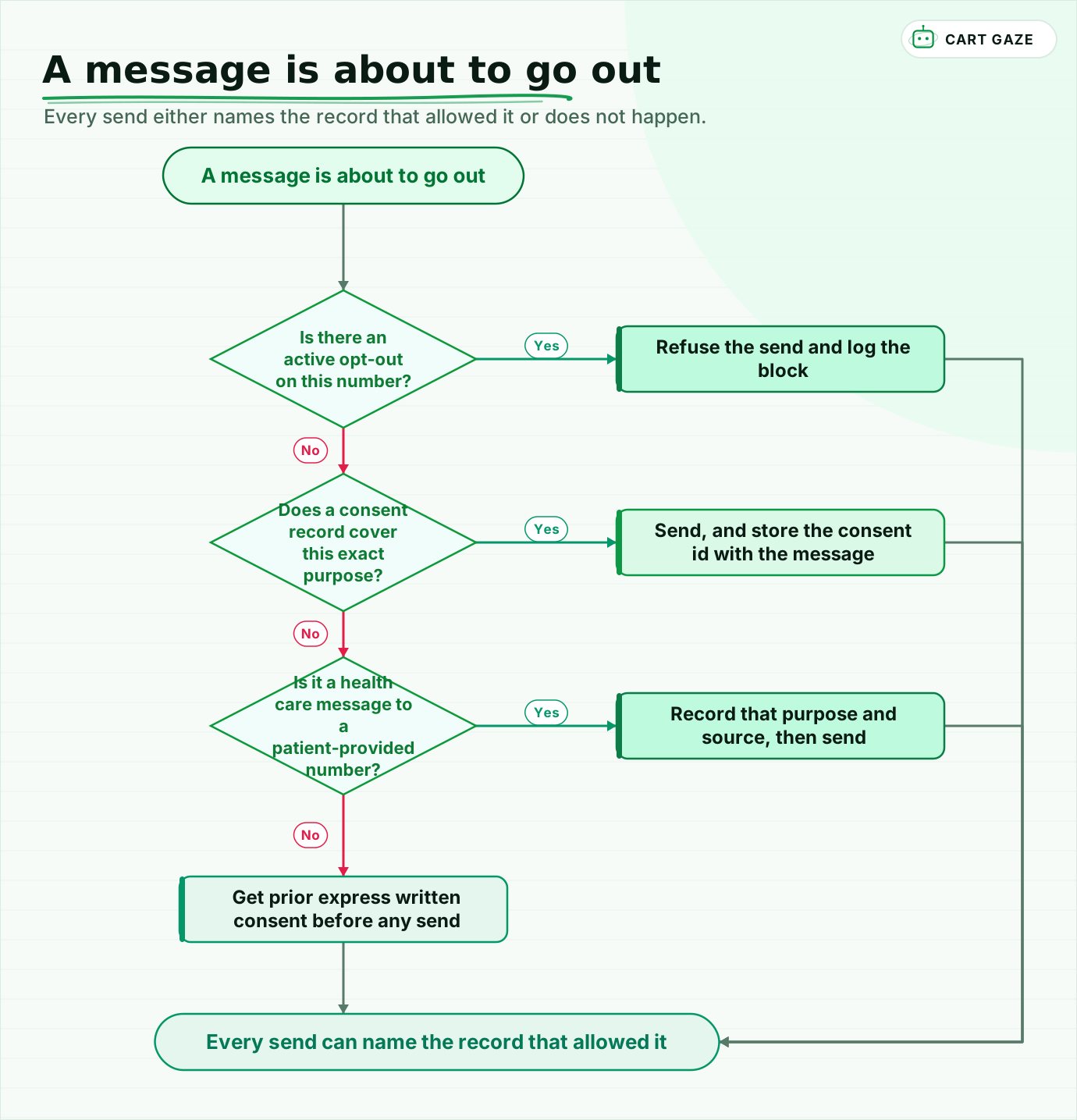 Every send either names the record that allowed it or does not happen.
Walk the flow once. An active opt-out refuses the send outright. A consent record whose purpose covers the message lets it through, and the send stores that record's id. A health care message to a number the patient provided gets its purpose and source recorded first. Anything else waits for prior express written consent, which is a decision for counsel and not for a queue.
This is general information rather than legal advice, and the parts most likely to be wrong in a specific practice are the purpose categories and the wording shown at capture. Have a healthcare attorney read both before you scale a texting program on top of them. If you would rather start with what your front-desk communication is currently costing you, the free Growth Leak Audit works from your own numbers before anyone talks tools.
Fair questions.
What is patient consent management automation?
It is the set of records and rules that decide whether a message may be sent to a patient. A working version stores consent by purpose, keeps the wording the patient saw, records revocations as new entries, and enforces both rules in the database so an import or a script cannot skip them.
Does consent to appointment reminders cover marketing texts?
No. Consent is limited to the subject matter the patient agreed to, and Twilio states this directly in its messaging policy for anyone sending through a carrier. A number given at check-in for reminders does not authorize a promotional message. Promotional texts generally need prior express written consent, and a HIPAA authorization if they meet the definition of marketing.
How fast do I have to honor a text opt-out?
The FCC requires revocation requests to be honored within a reasonable time not to exceed 10 business days, and you must accept any reasonable wording, including stop, quit, end, revoke, cancel and unsubscribe. One confirmation message back is allowed, and it is presumed to sit inside existing consent when sent within 5 minutes.
Should one opt-out stop every kind of message?
The FCC provision making a revocation apply to all future messages from the same sender on unrelated subjects has been delayed to January 31, 2027, so a narrower reading is currently defensible. Building the stricter version now avoids a rebuild later and spares a patient who typed STOP once from having to type it again.
How long should a practice keep consent records?
At least 4 years, which matches the federal statute of limitations for TCPA claims, since the sender carries the burden of showing consent existed when a message went out. 5 years is the simpler policy and matches the retention bar the FTC set for telemarketing consent records. Confirm your own schedule with counsel.
Sources.
- [1]47 U.S.C. 227(b)(3): private right of action and damages
- [2]47 CFR 64.1200: revocation of consent and the health care message exemption
- [3]FCC adopts revocation rules (FCC 24-24 summary)
- [4]FCC partially delays new TCPA consent revocation rules
- [5]FCC extends limited waiver for part of the TCPA consent revocation rule
- [6]45 CFR 164.501: definition of marketing and its exclusions
- [7]45 CFR 164.522(b): confidential communications requirements
- [8]Twilio Messaging Policy: consent scope and opt-out handling
- [9]Amended Telemarketing Sales Rule: consent recordkeeping requirements
- [10]TCPA consent: burden of proof and record retention
Written by

Muhammad Qasim Hammad
Founder, Cart Gaze
Qasim builds AI receptionists and front-office automation for medical and dental practices at Cart Gaze. Posts here start from published sources and real call data, not vendor claims, and every number links back to where it came from.
Keep reading.
 Trust & ComplianceTCPA Compliance for Patient Texting: The Rule HIPAA Misses10 min read
 Trust & ComplianceAI Outbound Calling TCPA Compliance: The Rules Before You Dial11 min read
 Trust & ComplianceMinor Consent and Guardian Verification: Who Can Book a Visit12 min read
 Trust & ComplianceAI Agent Audit Trail in Healthcare: What You Must Log and Keep11 min read
 Trust & ComplianceA2P 10DLC Registration for Medical Practices: A 2026 Guide10 min read
 Trust & ComplianceCall Recording Consent Laws for Medical Practices in 202610 min read