
Minor Consent and Guardian Verification: Who Can Book a Visit
A parent is usually a minor's personal representative under HIPAA, but 45 CFR 164.502(g)(3) names 3 exceptions and state law decides the rest. Here is who may book, who may be told, and what a phone system verifies.
Key takeaways.
- Under 45 CFR 164.502(g)(3) a parent, guardian, or person acting in loco parentis is usually the minor's personal representative and may access the record.
- The Privacy Rule names 3 exceptions, and each covers a single service rather than the whole chart, as OCR restated in its 3 December 2025 letter to providers.
- State law decides which services qualify: 23 states and DC let all minors consent to contraceptive services, while all 50 states and DC allow STI care.
- 45 CFR 164.514(h) requires verifying identity and authority before any disclosure, and caller ID proves neither because it can be deliberately falsified.
- An automated system cannot adjudicate custody or a state confidentiality exception, so its default should be to confirm nothing and route the call to staff.
Table of Contents8 sections
- The default: a parent is the minor's personal representative
- The 3 exceptions, and why each one is scoped to a single service
- The callers your front desk actually gets
- What a phone system can verify, and what it cannot
- Design the call so the default is to confirm nothing
- Set the policy before you configure the phones
- Match the call flow to your own state and policy
- Fair questions
A grandmother calls to move a 9-year-old's cleaning. A father calls asking why his 16-year-old came in last week. A 17-year-old calls to book her own visit and asks that nobody phone the house. Your front desk decides in the moment what it is allowed to say to each of them, and an automated phone system has to decide faster, with less to go on.
Under the HIPAA Privacy Rule a parent, guardian, or other person acting in loco parentis is usually the minor's personal representative, so the answer is usually yes. But 45 CFR 164.502(g)(3) names 3 exceptions, and the Office for Civil Rights restated them in a letter to providers on 3 December 2025. Those exceptions follow state law, which varies enormously: 23 states and DC let all minors consent to contraceptive services, while 2 states prohibit it without a parent.
This post covers who may book, who may reschedule, who may be told anything at all about a minor's visit, what a phone system has to verify before it speaks, and why the safe default for an automated caller is to confirm nothing and route. It is not legal advice, and your policy has to be set with counsel for the states you practice in.
The default: a parent is the minor's personal representative
Under the HIPAA Privacy Rule, a parent, guardian, or other person acting in loco parentis is the minor's personal representative when applicable law gives them authority to make health care decisions. They stand in the child's shoes: they may access the record, book care, and receive information about it.
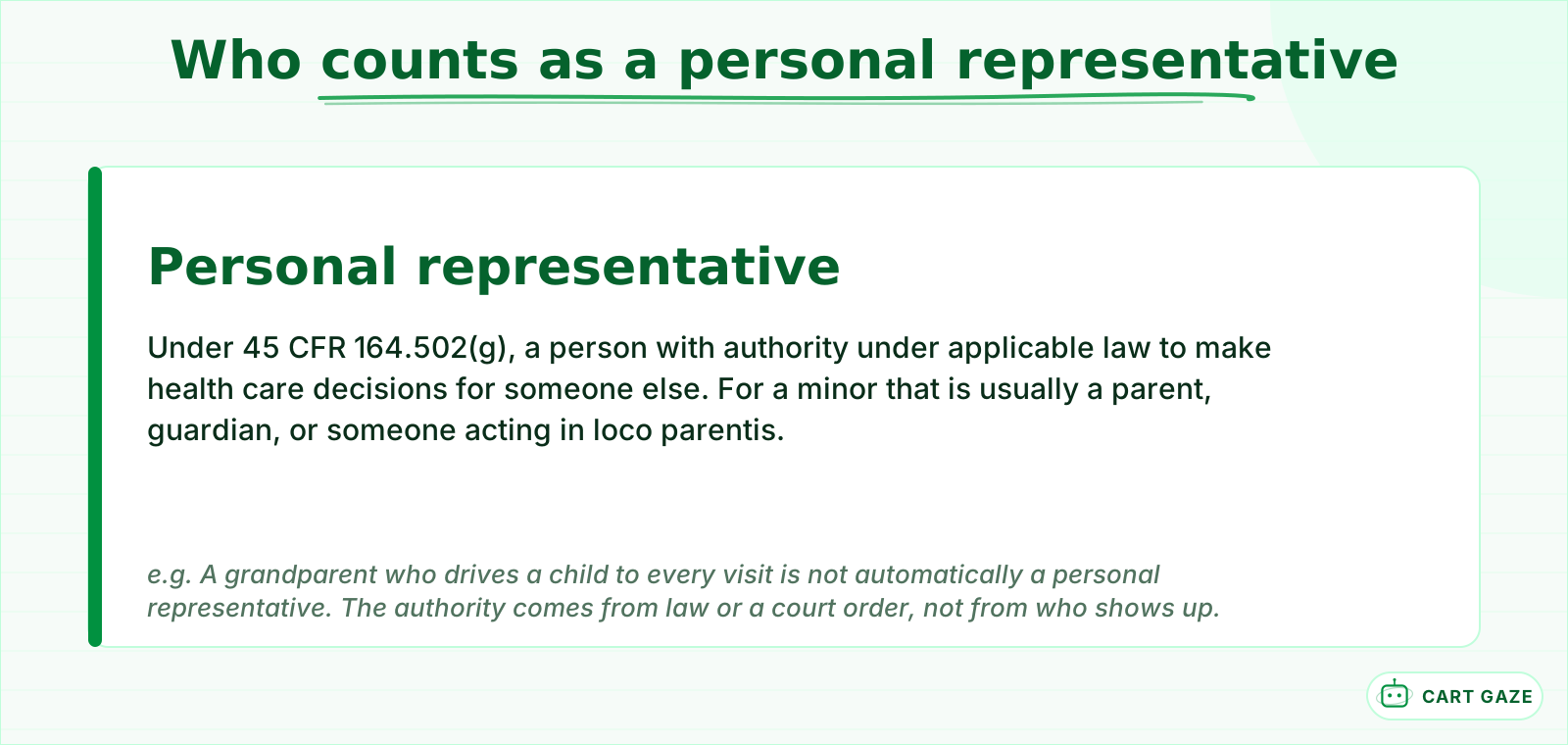 Authority comes from applicable law or a court order, not from who brings the child in.
That default runs in both directions, and practices tend to only worry about one of them. Saying too much to the wrong caller is a disclosure problem. Refusing a parent who is genuinely the personal representative is a right-of-access problem, and it is the one federal regulators wrote to providers about most recently.
In its 3 December 2025 letter, the Office for Civil Rights said parents are sometimes denied access to their children's records, or are told the child must authorize access first when no law requires it. Its own example is blunt: a practice cannot demand authorization from a 13-year-old before releasing that child's records to a parent in a state where parental consent is required for all care under 15. OCR also said a covered entity may not place limits on a parent's access beyond what applicable law already imposes.
Important
OCR named parental access to children's records an enforcement priority in that letter and said it will use all civil remedies available, including civil money penalties. An over-cautious phone script that refuses every caller is not a safe harbor. It is the other half of the same risk.
The 3 exceptions, and why each one is scoped to a single service
The Privacy Rule names 3 situations where a parent is not the personal representative: the minor consented to the care alone, a court or a person the court appointed directed it, or the parent agreed to a confidential relationship with the provider. Each exception covers one service, not the whole chart.
That scoping is the part front desks get wrong. OCR's own worked example is a 16-year-old treated for a sexually transmitted infection in a state that permits it without parental consent. Depending on that state's law, the provider may withhold information about that care from the parent. The provider may not use it as a reason to withhold the rest of the child's record.
Which services fall inside the exceptions is a state question, and the spread is wide. Guttmacher's state-policy tracking, updated 1 August 2026, counts 23 states and DC that explicitly allow all minors to consent to contraceptive services, 16 states that allow it only in specific circumstances such as marriage or an existing pregnancy, and 2 states that prohibit it without parental consent. Sexually transmitted infection services are the outlier: all 50 states and DC allow minors to consent, though 8 states set an age minimum and 16 have provisions letting or requiring a provider to notify a parent.
| Care category | Who typically consents | Who typically controls the information | What your phones should do |
|---|---|---|---|
| Routine visits, most care | Parent or guardian | Parent, as personal representative | Confirm narrow facts to a verified caller |
| STI testing and treatment | The minor, in all 50 states and DC | Often the minor, by state law | Never describe the visit reason |
| Contraceptive services | The minor in 23 states and DC | Varies by state | Route to staff |
| Outpatient mental health | Varies by state and by age | Varies by state | Route to staff |
| Substance use treatment | Varies by state, plus federal rules | Varies, and often the minor | Route to staff |
Warning
Nothing here is legal advice, and none of it is a 50-state answer. Minor consent rules change, differ by service, and differ by the patient's age within the same state. Your practice has to write its own policy with its own counsel for every state it operates in, then configure the phones to follow that policy.
The callers your front desk actually gets
Real calls about a child rarely come from a tidy list. You get a separated parent, a grandparent doing the school run, a nanny, a step-parent, a foster parent, and the teenager herself. Each one needs a different answer, and none of that is visible from the phone number.
Separated parents are the most common trap because the everyday language is misleading. Physical custody means the child lives with that parent. Legal custody carries the authority to make health care decisions, and the two do not have to sit with the same person. Malpractice-carrier guidance for physicians is direct on the consequence: one parent cannot be denied access to a child's records merely because they are not the physical custodial parent.
The fix practices are told to use is documentary rather than conversational. Capture the custody order at intake, note who holds decision-making authority, and record it where the front desk and the phone system can both see it. A caller asserting authority on a call is not evidence of it, and no script can turn it into evidence.
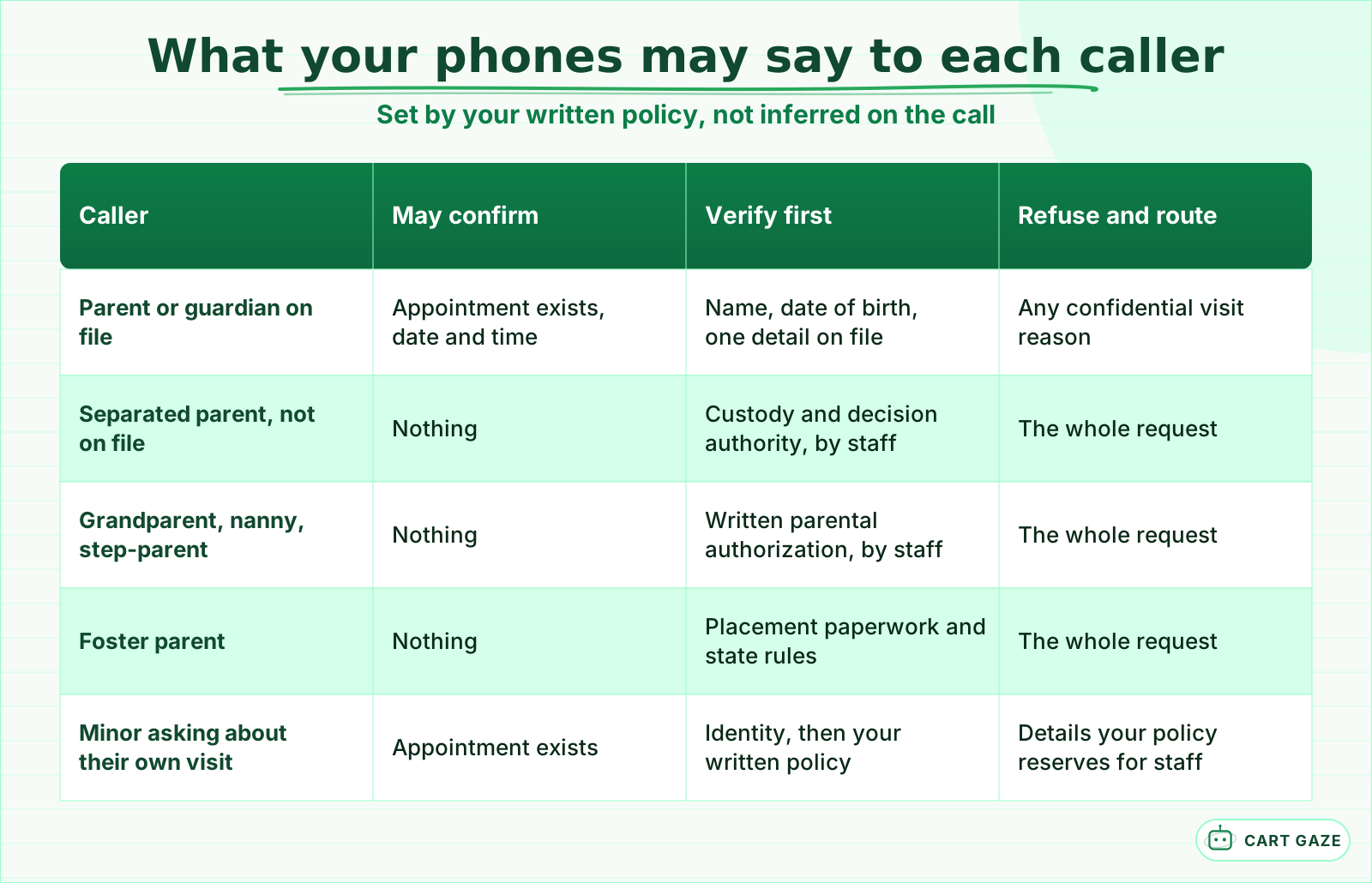 Conservative by design. An unverified caller gets nothing confirmed and the call goes to your staff.
The table is deliberately conservative in the middle rows. A grandparent who brings a child to every visit may well be the right person to talk to, and your practice can make that true by recording a written parental authorization. What it cannot be is a judgment the system makes on the strength of a familiar voice.
What a phone system can verify, and what it cannot
The Privacy Rule requires you to verify both the identity of a person asking for protected health information and their authority to have it, whenever either is unknown. A voice system can check a caller against a list your staff maintains. It cannot read a custody order or weigh professional judgment.
Start with what the system genuinely knows. It has a calling number, which the FCC describes as trivially falsifiable: spoofing is a caller deliberately falsifying the information sent to your caller ID display to disguise their identity. It has whatever the caller says, which is an assertion. And it has the practice record, which is the only one of the three that anybody verified.
So the honest capability list is short. A phone system can match a caller to authorized contacts already stored on a record, and it can confirm a fact the caller already supplied. It cannot decide who is acting in loco parentis, cannot interpret a custody order, and cannot apply a state confidentiality exception to a specific visit.
The regulator draws that line explicitly. Where state law is silent on parental access and the parent is not the personal representative, HHS says the decision to grant or deny must be made by a licensed health care professional exercising professional judgment. The abuse, neglect and endangerment provision at 164.502(g)(5) is stricter still: OCR calls it an individualized, patient-specific professional determination by the provider.
Warning
The failure mode is not a rude bot. It is a helpful one. A system that reads back "we have her down for an IUD consult Thursday at 2" to whoever called has disclosed a minor's confidential service to an unverified caller, and it did it while sounding competent.
Design the call so the default is to confirm nothing
Build the flow so an unverified caller learns nothing. The system greets, identifies the patient the caller names, checks that caller against the authorized contacts already in the record, and either confirms a narrow fact or hands the call to staff. Every other path ends in a warm transfer.
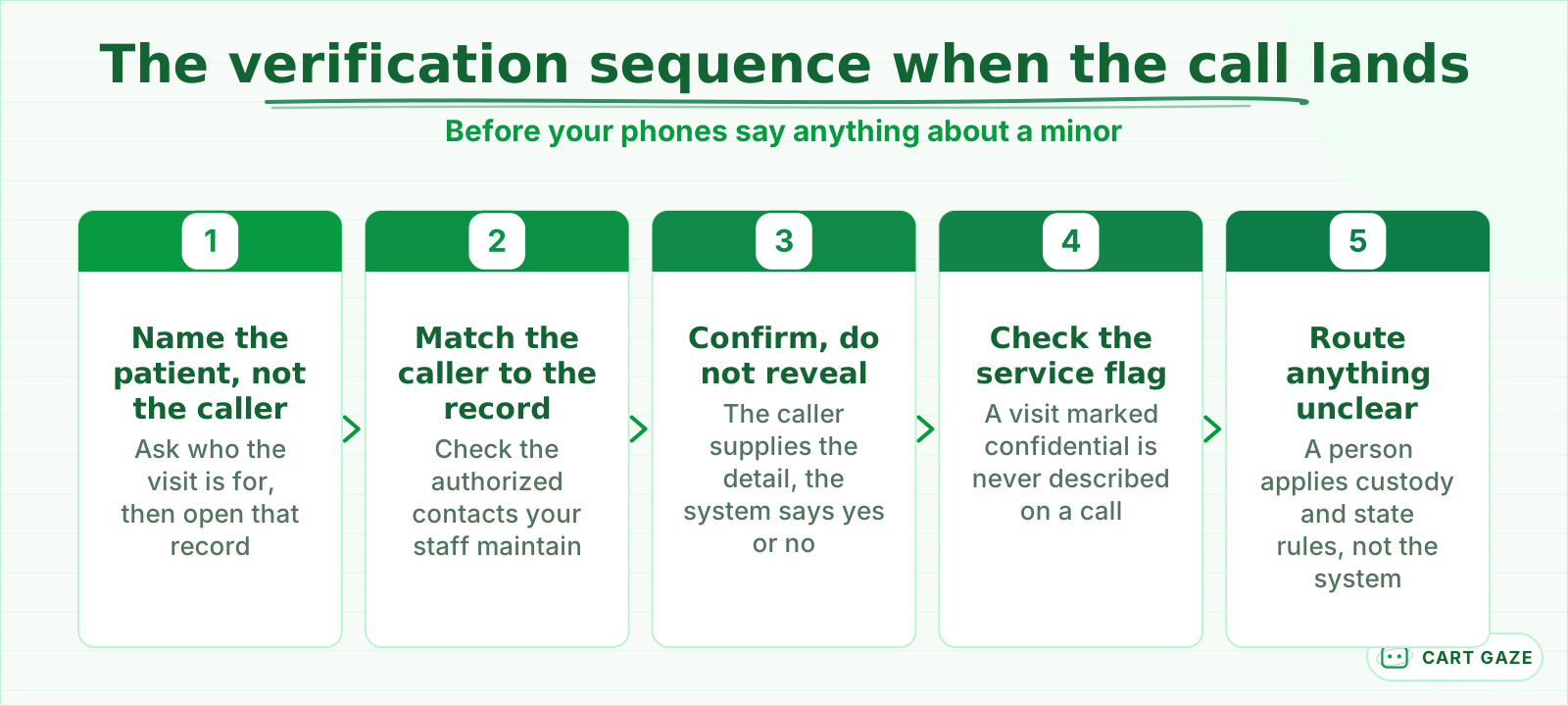 Identify the patient first, the caller second, and route every case the flow cannot settle.
Three design rules carry most of the weight. First, confirm rather than reveal: the caller supplies the detail and the system says yes or no, so a caller who does not already know the appointment time never learns it. Second, treat booking authority and information access as 2 separate permissions, because a system that grants them together will eventually hand over the second by accident. Third, flag the service, not the patient: a visit your policy marks confidential is never described on a call, whoever is asking.
The record is where all of this lives. Guardian status, custody authority, authorized contacts, and confidential-service flags are set by your staff during intake or a records request, with the paperwork in front of them. They are never inferred mid-call. If you are still working out where an automated line belongs in a practice at all, what an AI receptionist does and where it stops is the wider version of that boundary, and the parent-as-caller problem in pediatrics covers the clinical half of it.
Before an automated line handles calls about minors
- Your written policy on who may book and who may be told exists, reviewed by counsel for each state you operate in.
- Authorized contacts and custody authority are recorded per patient by staff, never inferred on a call.
- Confidential-service flags suppress the visit reason on every outbound and inbound interaction.
- Someone reads a week of minor-related transcripts end to end before you widen what the system may confirm.
Set the policy before you configure the phones
Your practice sets this policy with its own counsel, for every state it operates in, and then the phone system follows it. Reverse that order and you have a vendor default deciding a legal question. Write down who may book, who may be told what, and how staff record it.
The vendor is a business associate the moment it touches patient details, so a signed Business Associate Agreement comes before any real call. That contract plus a correct configuration is what people mean by "HIPAA compliant"; there is no such thing as a "HIPAA certified" product, and a vendor page claiming otherwise tells you something about the vendor. The honest version of that compliance question goes through what a BAA does and does not buy you.
OCR's December letter told covered entities to work with business associates so that default electronic-access configurations do not improperly block parents who are personal representatives. Read that instruction in both directions. A default too tight blocks a parent who has a legal right of access. A default too loose discloses a 17-year-old's confidential visit to a caller nobody verified. Only your written policy tells the vendor which way to lean, and only your staff can put the facts in the record that let the system apply it.
Match the call flow to your own state and policy
Start from the patient, not the caller. Identify the minor's record, check whether the caller is on the authorized list, then check whether the visit falls under a service the minor consented to alone. If any answer is unclear, the call goes to a person who can decide.
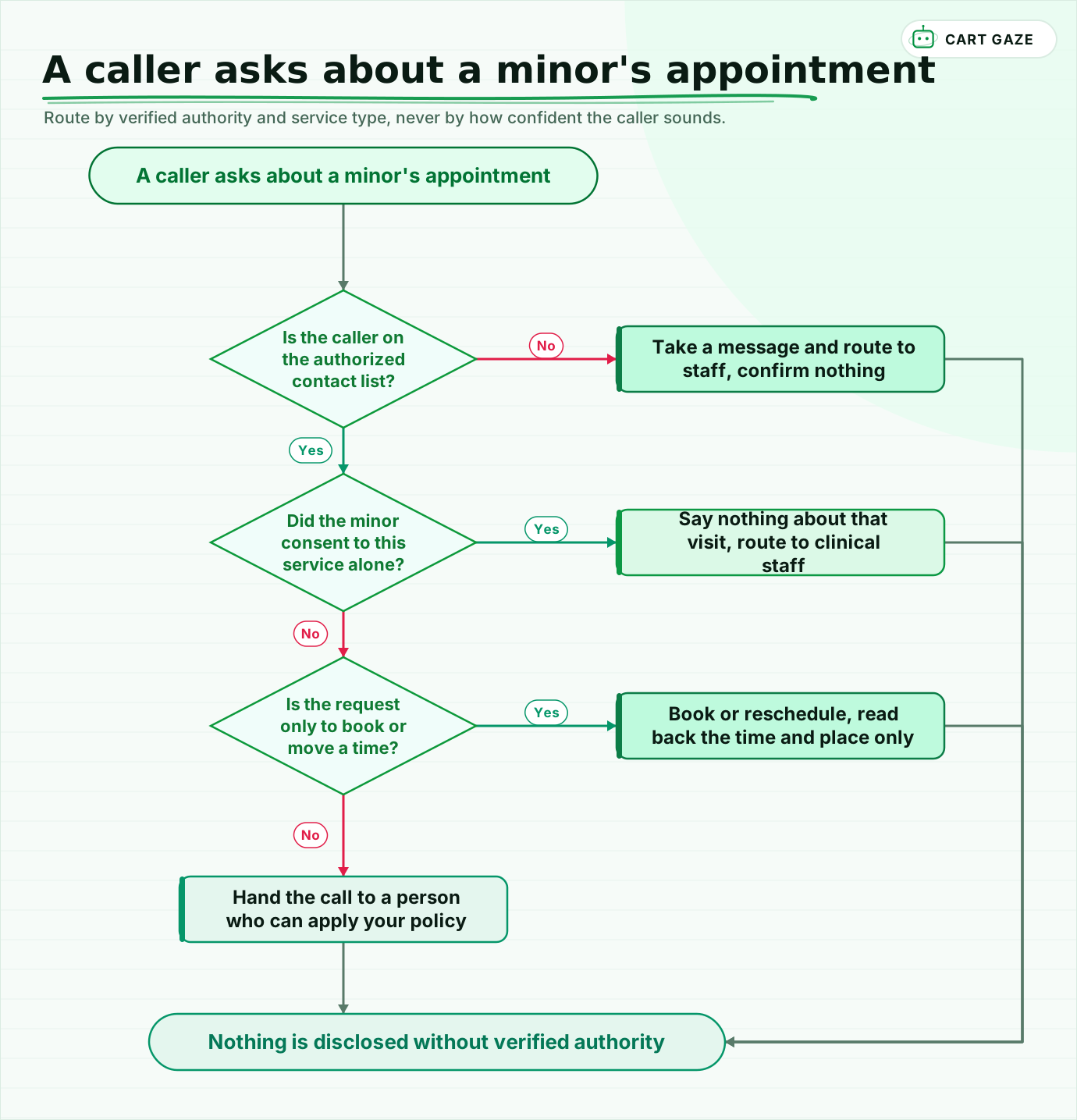 Route by verified authority and service type, never by how confident the caller sounds.
Walk it once. An unrecognized caller gets a message taken and nothing confirmed. A recognized caller asking about a service the minor consented to alone gets routed to clinical staff without a description of the visit. A recognized caller who only wants to move an appointment gets it moved, with the time and place read back and nothing else. Everything left over goes to a person.
Pilot it narrowly. Let the system book and reschedule for verified callers first, keep every other minor-related request on a transfer, and read the first week of those calls end to end before you widen what it may confirm. If you would rather see where your phones are losing patients before you touch any of this, the free Growth Leak Audit sizes that from your own numbers first.
Fair questions.
Can a grandparent or nanny book a child's appointment?
Only if your practice has already recorded them as an authorized contact, usually through a written parental authorization. Under HIPAA the personal representative is whoever applicable law gives health care decision authority, and bringing a child to visits does not create it. An automated phone system should book for a caller already on that list and route everyone else to staff.
Can a parent see their teenager's medical records?
Usually yes. HHS says a parent is generally the minor's personal representative and can exercise the child's right of access. The Office for Civil Rights made parental access an enforcement priority on 3 December 2025 and warned against demanding a minor's authorization where no law requires it. The exceptions are narrow, set by state law, and cover only the service involved.
What are the 3 HIPAA exceptions for minors?
A parent is not the personal representative when the minor consented to the care and state law did not require parental consent, when a court or a court-appointed person directed the care, or when the parent agreed to a confidential relationship between the minor and the provider. Each exception applies to that service only, not the whole record.
How should an AI receptionist verify a caller asking about a minor?
It should identify the patient first, match the caller against authorized contacts your staff already stored on that record, and confirm details the caller supplied rather than reading information out. Anything touching custody, in loco parentis status, or a confidential service goes to a person. Caller ID is not identity and cannot stand in for verification.
Is an AI receptionist HIPAA compliant for pediatric calls?
Compliance is a configuration plus a signed Business Associate Agreement, not a product badge, and no HIPAA certification exists for any vendor to hold. For minors you also need a written policy per state, authorized contacts recorded per patient, and confidential-service flags that suppress the visit reason on every call.
Sources.
- [1]HHS: Personal Representatives (45 CFR 164.502(g))
- [2]OCR letter: The HIPAA Privacy Rule and Parental Access to Minor Children's Medical Records (3 December 2025)
- [3]45 CFR 164.502: Uses and disclosures of protected health information, general rules
- [4]45 CFR 164.514(h): Verification requirements before disclosure
- [5]Guttmacher Institute: Minors' Access to Contraceptive Services
- [6]Guttmacher Institute: Minors' Access to STI Services
- [7]FCC consumer guide: Caller ID Spoofing
- [8]Cooperative of American Physicians: Treating Children of Divorced Parents
Written by

Muhammad Qasim Hammad
Founder, Cart Gaze
Qasim builds AI receptionists and front-office automation for medical and dental practices at Cart Gaze. Posts here start from published sources and real call data, not vendor claims, and every number links back to where it came from.
Keep reading.
 Trust & ComplianceAI Agent Audit Trail in Healthcare: What You Must Log and Keep11 min read
 Trust & CompliancePatient Consent Management Automation You Can Prove, Not Promise11 min read
 Trust & ComplianceCall Recording Consent Laws for Medical Practices in 202610 min read
 Trust & ComplianceTCPA Compliance for Patient Texting: The Rule HIPAA Misses10 min read
 Trust & ComplianceAI Outbound Calling TCPA Compliance: The Rules Before You Dial11 min read
 Trust & Compliance42 CFR Part 2 Compliance: What Your Phone System Must Change11 min read