
The Intake Form Completion Chase: Paperwork Done Before Arrival
Most practices send the intake link once and hope. An intake form completion chase anchored to the appointment, chasing only the sections still missing, gets the paperwork finished before the patient arrives.
Key takeaways.
- Chasing works on the people who ignored the first ask: in a randomized orthopedic study, completion among day-7 non-responders was 51.2% with text reminders against 35.2% without.
- Time the ladder off the appointment, not the send date: at booking, 72 hours out, 24 hours out, and the morning of, collapsed for short-notice visits.
- Partial completion is the normal case, so link back into the missing section by name instead of resending a form the patient has already half finished.
- Split missing fields into blocking ones (insurance, consent signature, medication list) and everything else, and escalate only the first group.
- Stop the automated chase on an opt-out, after 3 ignored touches, or inside 24 hours with a blocking field still empty, and hand those to a person.
Table of Contents8 sections
- Why sending the intake link once is not a process
- Time the chase off the appointment, not the send date
- Partial completion is the normal case, so chase only what is missing
- Sort the missing fields into blocking and not blocking
- When the chase should stop and a person should take over
- What the front desk should see on the morning of
- Start with one visit type and read the completion curve
- Fair questions
You send the intake link the moment the appointment is booked, and then you hope. Some patients finish it that evening. Some open it, type their name and address, reach the insurance section, and put the phone down. The rest arrive on Thursday morning with a tablet in their hands and a 15-minute delay already baked into your schedule.
The form itself is not the problem any more. Vendors have spent years fixing the form, and most of that advice is right: send it by text, keep it short, make it work on a phone. What almost nobody designs is the part that comes after the link. In a randomized study of orthopedic patients who had not returned a questionnaire by day 7, adding text reminders lifted completion to 51.2% against 35.2% for email reminders alone. The people who ignore the first ask are not lost. They are just not chased.
This post is about that chase, run as an agent with exactly one job. You will get the ladder timed off the appointment instead of the send date, how to follow up on a half-finished form without resending the whole thing, which missing fields actually stop a visit, when to stop messaging and hand it to a person, and the short list your front desk should be looking at before the first patient walks in.
Why sending the intake link once is not a process
One link at booking with no follow-up is not a workflow, it is a hope. Most patients do finish, eventually, and the ones who do not are the ones carrying your missing insurance details and unsigned consents. The chase exists to convert that remainder before it becomes a check-in problem.
Vendor completion claims cluster high. One widely circulated roundup reports 86% of patients completing digital intake in total, 68% of them within an hour of receiving the link, and 75% to 90% finishing before arrival. Those are vendor and aggregator figures rather than a benchmark you can plan against, and they all describe the same shape: a fast majority, then a stubborn tail.
The tail is the whole business case. General form research puts non-completion at roughly 34% of everyone who starts a form, with mobile completion running well below desktop, and the two most common stated reasons are length and discomfort about handing over sensitive information. Nothing about a medical intake form makes those pressures smaller.
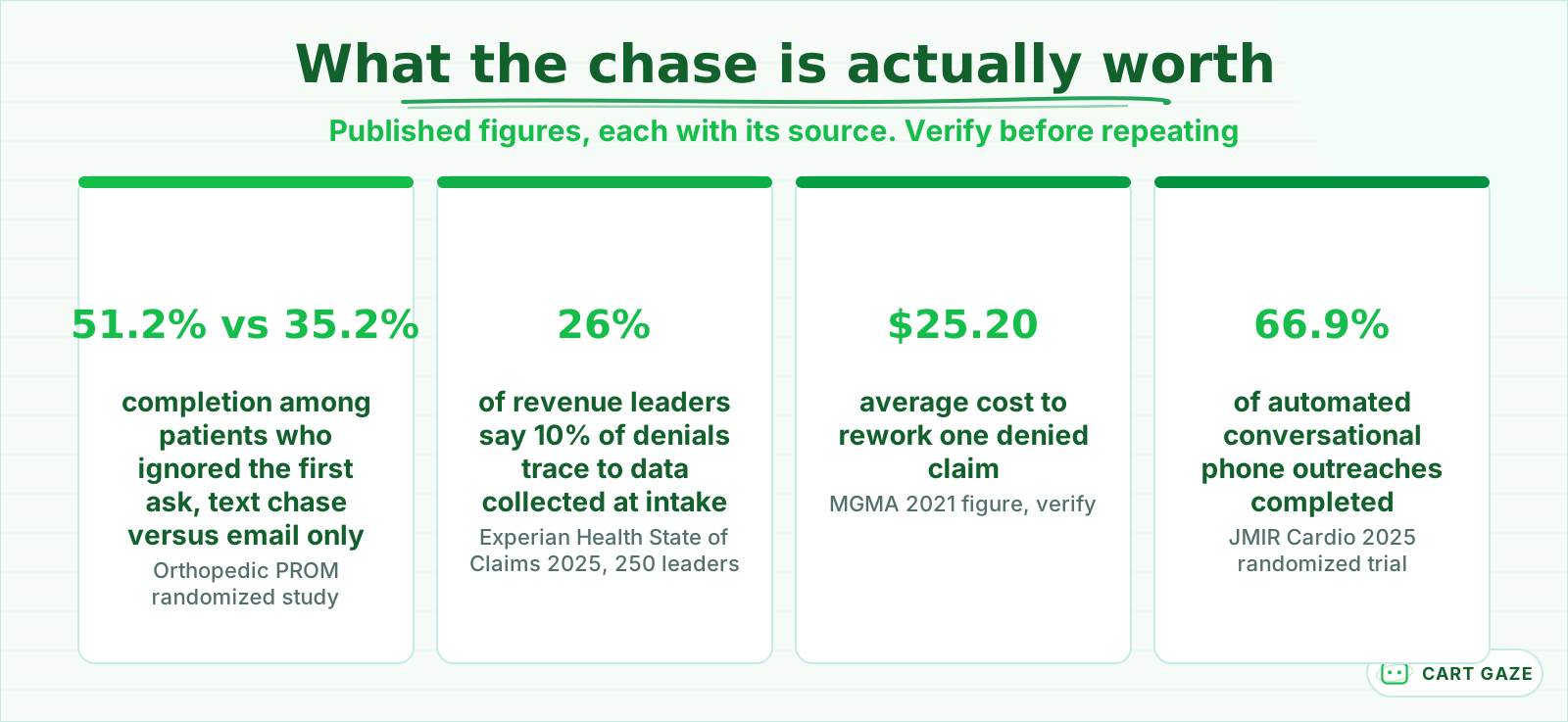 Published figures, each sourced. Reasons to build a chase, not a promise about your own practice.
That orthopedic trial is the cleanest evidence available for what chasing is worth, because it isolates the non-responders. Across 3,700 patients and 6,050 survey invitations, overall completion was 81.2% with a text chase against 76.4% without: a modest headline gap. Among the 1,707 patients who had ignored the first ask by day 7, the gap widened to 51.2% against 35.2%. Chasing does not move the people who were always going to comply. It moves the people who were not.
If your forms themselves are still long, portal-gated, or desktop-shaped, start there. Digital intake form design is a separate problem with its own payoff, and no amount of chasing rescues a form patients cannot finish on a phone in a parking lot.
Time the chase off the appointment, not the send date
Most reminder tools count forward from the moment you send the link, which is the wrong clock. A form sent at booking for a visit 5 weeks out does not need a nudge tomorrow. Anchor every touch to the appointment instead, so the last chance to fix something still leaves time.
| Touch | When it fires | Channel | What it asks for |
|---|---|---|---|
| 1. At booking | Immediately on confirmation | Text, email as backup | The full form, once |
| 2. 72 hours out | Only if anything is incomplete | Text | The missing sections by name |
| 3. 24 hours out | Only if a blocking field is empty | Text, then a staff call | Insurance, consent, medications |
| 4. Morning of | 2 hours before the visit | Text | A last link, plus a note that check-in can finish it |
The 72-hour rung earns its place for a reason beyond politeness. Eligibility guidance from compliance bodies is to verify coverage at least 48 hours before the visit, and many billing teams re-verify inside a 48 to 72 hour window so there is room to resolve a problem. If the patient's insurance details only land the night before, that verification happens under time pressure or at the counter, which is where errors get made.
Tip
Collapse the ladder for short-notice bookings instead of running it. A visit booked for tomorrow gets touch 1 and touch 4, not four messages in 26 hours. The cadence should scale with the lead time, not fire on a fixed schedule.
Vendor workflow guides converge on the same shape, with a primary send at confirmation, a reminder at 72 hours, and another at 24 hours for anyone still incomplete. Treat that as a sensible starting configuration rather than a proven optimum, because the underlying numbers are vendor models rather than measured results. The chase is one strand inside a wider pre-visit message sequence, and the two need to be planned together so a patient does not get a prep reminder and a paperwork reminder 10 minutes apart.
Partial completion is the normal case, so chase only what is missing
The usual state of an intake form is not empty. It is 70% done: name, address and date of birth in, insurance blank, consent unsigned. Resending the whole form to that patient reads as though you lost their work. Name the missing section and link straight back into it.
This is a platform requirement more than a messaging one. To chase a section rather than a form, the system has to save partial state as the patient goes, track completion per section rather than per document, and issue a resumable link that survives until the appointment. If your current tool only knows "submitted" and "not submitted," the chase you can build on top of it is limited to nagging.
The message changes shape too. "Please complete your forms" is a request to start again. "We still need your insurance ID and a signature on the financial policy, about 2 minutes" is a request to finish, and it tells the patient exactly what the cost of complying is.
Warning
A chase agent asks a patient to complete a form. It does not interview them. An agent that starts collecting symptoms, medication histories, or reasons for the visit conversationally has stopped chasing paperwork and started practicing intake, and anything it infers from those answers is a clinical judgment nobody authorized it to make.
That line is the same one that governs every other automated patient touchpoint. The safe pattern is capture, never interpret, and it is worth reading what an AI receptionist does and where it stops before you let any automated system talk to patients about their care.
Sort the missing fields into blocking and not blocking
Not everything missing is equally missing. Insurance identifiers, a signed consent and a current medication list can delay a visit or turn it into a denied claim. A preferred pharmacy cannot. Chase the first group hard and up to the morning of, and give the second group exactly one ask.
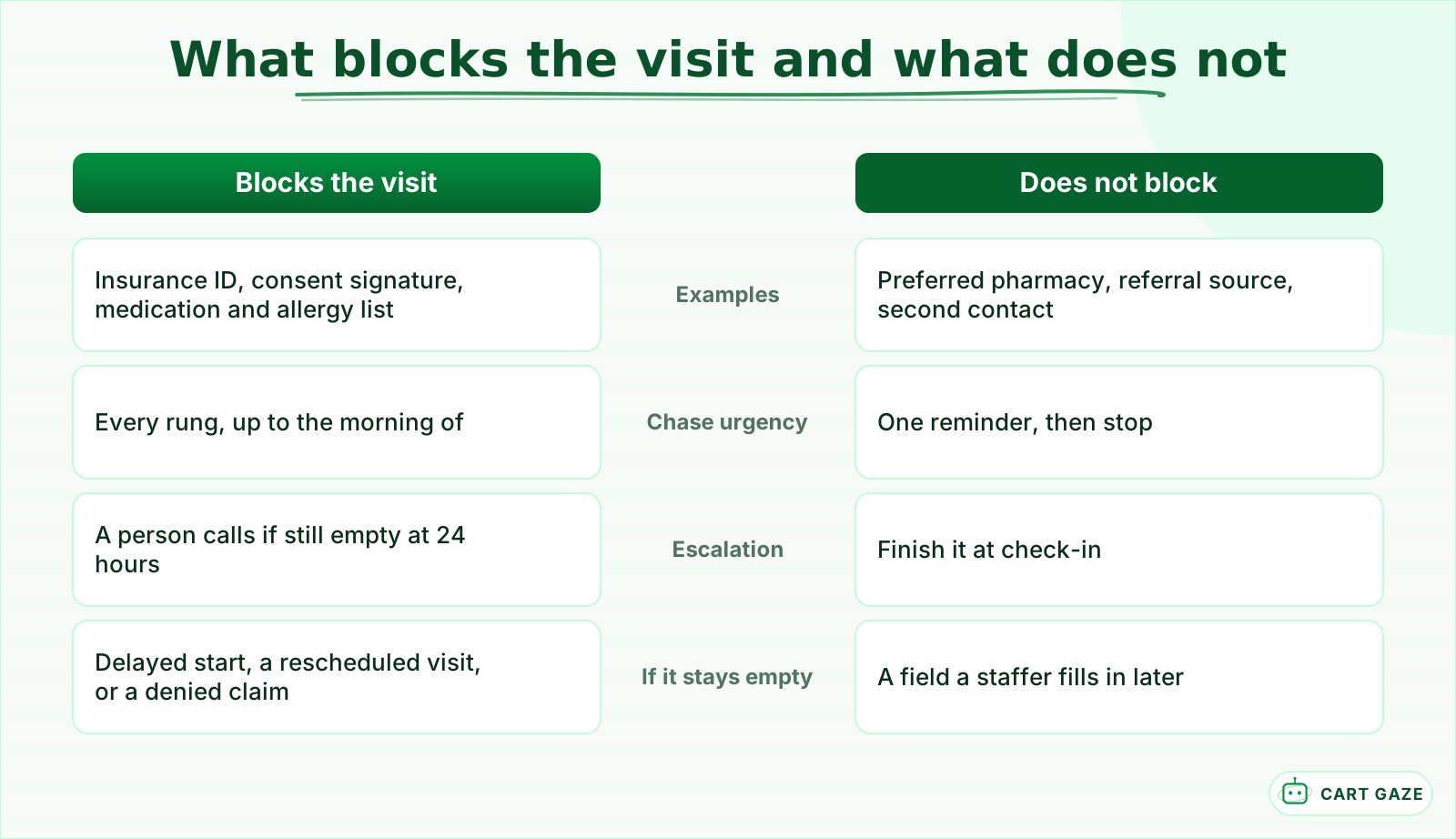 Chase the fields that stop the visit. Let the rest wait for check-in.
The denial side of this is measurable. In Experian Health's 2025 State of Claims survey of 250 revenue cycle leaders, 41% said at least 1 in 10 of their claims is denied, and 26% said that 10% of denials trace back to inaccurate or incomplete data collected at patient intake. Rework is not free either: a figure MGMA published in 2021 put the average cost of touching a denied claim again at $25.20, and that is an old number worth re-checking against your own billing data.
A consent signature is a different kind of blocker. It is not a data-quality issue, it is a permission issue, and no amount of good intent at the front desk substitutes for it. Medication and allergy lists sit in a third category: the visit can technically proceed without them, but the provider is then working blind on something that matters, so most practices treat them as blocking in practice.
Everything else can wait. A missing emergency contact or referral source is a field a staff member fills in later, and burning a fourth message on it trains patients to ignore the messages that were about insurance.
When the chase should stop and a person should take over
Three conditions end the automated chase: the patient opted out, 3 touches produced nothing, or a blocking field is still empty inside 24 hours of the visit. At that point a staff member calls. The agent's job was never to remove the call list, only to make it short.
Automated outreach has a real ceiling. In a 2025 randomized trial published in JMIR Cardio, 226 of 338 automated conversational phone outreaches to cardiology patients were completed, which is 66.9%. That was a different job from chasing a form, but the shape holds: roughly a third of automated contact attempts do not land, and pretending otherwise just means those patients arrive unprepared.
Important
Consent to text is a separate question from HIPAA. Ask at booking, log the answer, and honor a stop request on the first message, not after the next one is already queued. A common rule of thumb treats a reminder opt-out rate above 2% to 3% as a sign the cadence is too aggressive. Intake data is protected health information, so whatever platform stores it and sends the reminders is a business associate and needs a signed agreement in place. There is no such thing as a HIPAA certified vendor.
Handing off is the design, not the failure state. If the chase takes a 40-name call list down to 6, the front desk gets its morning back and the 6 calls that remain are the ones worth a human voice.
What the front desk should see on the morning of
Not a dashboard, and not a wall of green ticks. The front desk needs one short list of the patients who are not ready, ordered by appointment time, with the missing section named. A finished patient never appears on it, which keeps it short enough to act on.
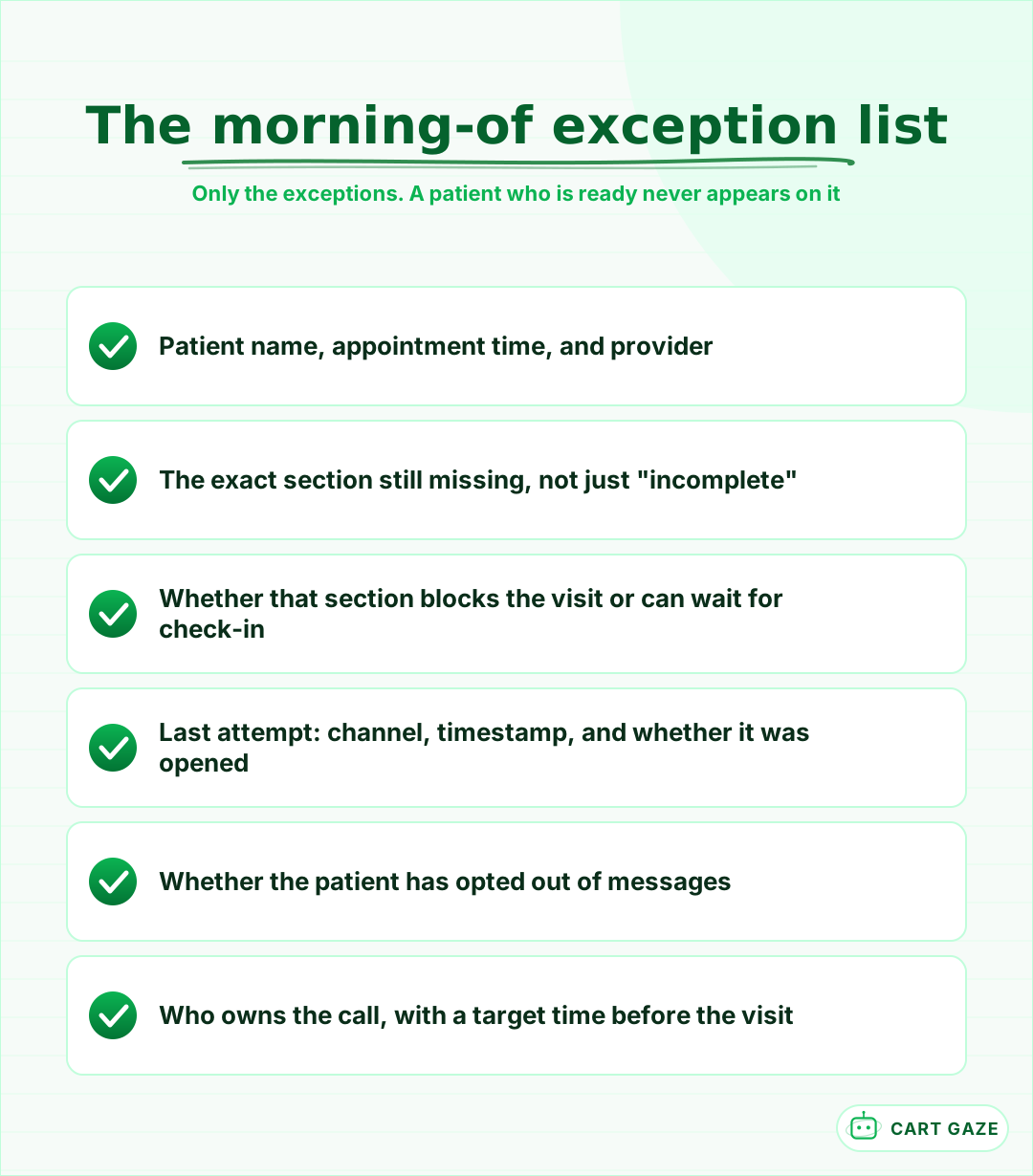 Six lines a front desk can act on before the first patient arrives.
Two of those lines do more work than the rest. "Whether it was opened" separates a patient who never saw the message from one who saw it and stalled, and those two need different calls. Opt-out status prevents the most avoidable mistake in the whole workflow, which is a staff member sending a manual text to someone who already asked you to stop.
The list should also shrink over time, and that is your read on whether the chase is working. A morning list that is still 12 names deep after 3 months means the ladder timing, the message copy, or the form itself needs another pass, not that patients are uncooperative.
Before a chase agent starts messaging patients
- A signed BAA covers whatever platform stores the intake data and sends the reminders.
- Consent to text is captured at booking and logged, with stop requests honored immediately.
- Blocking and non-blocking sections are defined in writing, so escalation is not a judgment call.
- A named person owns the morning list and the calls that come off it.
Start with one visit type and read the completion curve
Pilot the chase on new-patient visits for one provider, because that is where missing data and denial risk both concentrate. Then watch 3 numbers for 60 to 90 days: completion at 24 hours out, blocking fields still empty on the morning of, and how many chase calls staff make.
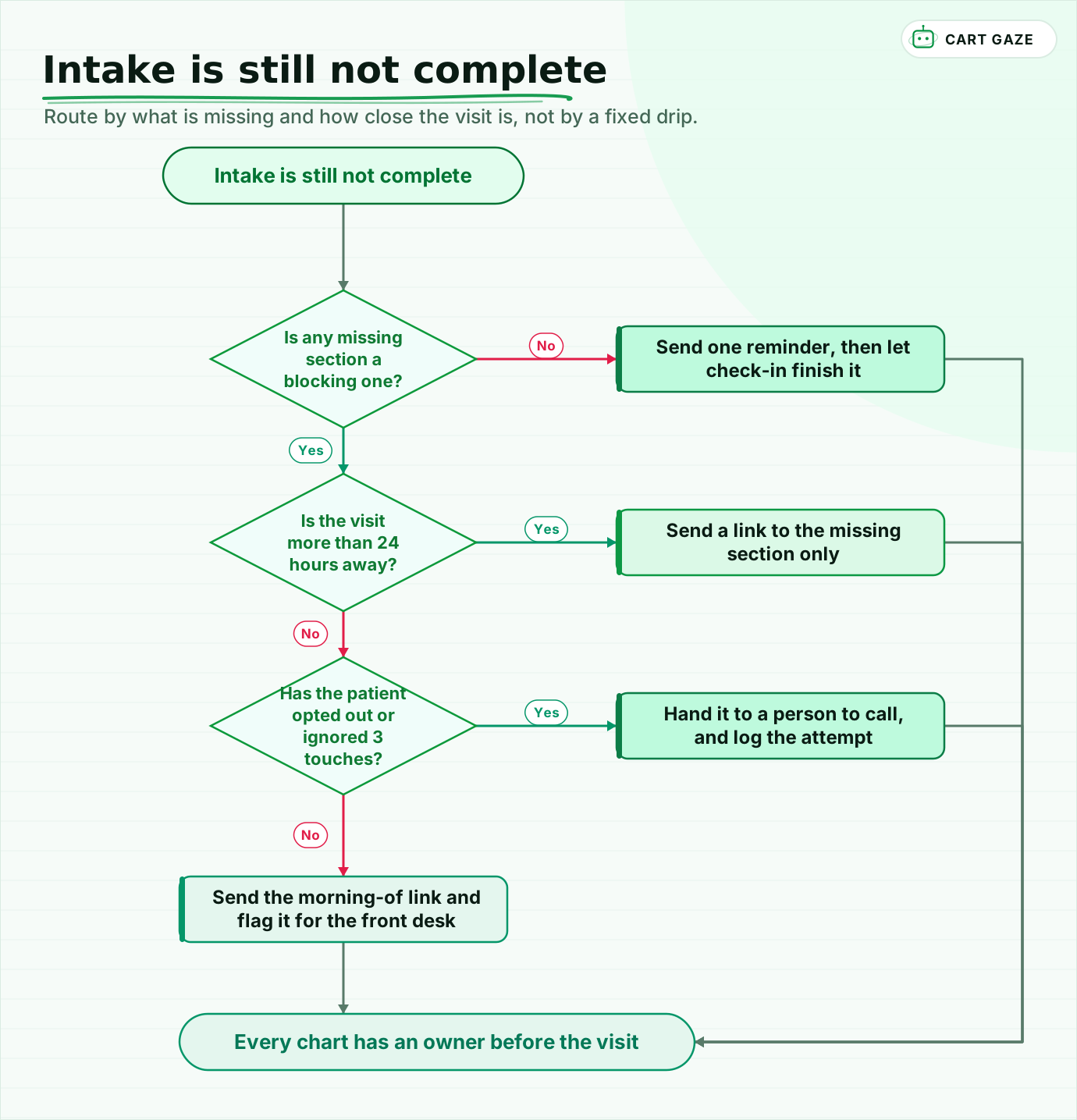 Route by what is missing and how close the visit is, not by a fixed drip.
Walk the flow once. A non-blocking gap gets one reminder and then waits for check-in. A blocking gap more than 24 hours out gets a link to that section only. Inside 24 hours, or after 3 ignored touches, or on any opt-out, it becomes a phone call with a named owner and a logged attempt.
Expect the curve to move slowly. Vendor guidance puts pre-registration completion at 40% to 60% in the first 30 days, climbing to 70% to 85% by 90 days once the timing and the wording have been tuned. That is a vendor model rather than measured data, but the trajectory is the honest part: the first configuration you ship will not be the one that works.
If you would rather see what incomplete paperwork and the calls around it are costing before you change anything, the free Growth Leak Audit sizes it from your own numbers.
Fair questions.
How many times should you remind a patient to complete intake forms?
Three automated touches after the initial send is a reasonable ceiling: 72 hours before the visit, 24 hours before, and the morning of. Anchor each one to the appointment rather than the send date, and collapse the ladder for short-notice bookings. After 3 ignored touches, or on any opt-out, hand the chase to a staff member instead of sending a fourth message.
What should you do when a patient only partially completes an intake form?
Chase the section, not the form. Send a resumable link that opens on the part still missing and name it in the message, so the patient sees a 2-minute task rather than a fresh start. That needs a platform which saves partial state and tracks completion per section, which many portal-based intake tools do not.
Which intake fields actually block a visit?
Insurance identifiers, a signed consent or financial policy, and a current medication and allergy list. Those either stop the visit, slow it down at the counter, or turn into a denied claim later. Preferred pharmacy, referral source and secondary contacts block nothing and can be finished at check-in, so they deserve one reminder at most.
Can an AI agent collect intake information over the phone instead?
It can ask a patient to complete a form and answer questions about where to find it. It should not conversationally collect a medical history or interpret what an answer means clinically. The safe boundary is capture, never interpret, and any system touching patient information needs a signed Business Associate Agreement. HIPAA certified vendors do not exist.
Is texting patients about incomplete intake forms allowed?
Capture consent to text at booking, log it, and honor a stop request immediately rather than after the next queued message. Reminders about an existing appointment are treated differently from marketing, but the safe posture is to ask first and keep the record. Watch the opt-out rate: above 2% to 3% usually means the cadence is too heavy.
Sources.
- [1]Text messaging to promote PROM completion in orthopedic practice: randomized controlled study
- [2]Experian Health State of Claims 2025: healthcare claim denial statistics
- [3]What one denial costs a small practice (MGMA rework figure)
- [4]Conversational AI phone calls to support patients with atrial fibrillation: randomized controlled trial
- [5]Digital patient intake forms statistics and completion figures
- [6]Online form statistics: abandonment, completion and mobile usage
- [7]Healthcare patient intake automation workflow guide: reminder cadence and completion ramp
- [8]Best practices in patient eligibility and benefits verification
- [9]Medical appointment text reminders: what is allowed and what the evidence says
Written by

Muhammad Qasim Hammad
Founder, Cart Gaze
Qasim builds AI receptionists and front-office automation for medical and dental practices at Cart Gaze. Posts here start from published sources and real call data, not vendor claims, and every number links back to where it came from.
Keep reading.
 No-Shows & Follow-UpHoliday Closure Communication: Keep Patients From a Locked Door10 min read
 No-Shows & Follow-UpThe New Patient Welcome Sequence That Gets Them Through9 min read
 No-Shows & Follow-UpNo-Show Prediction: Spot High-Risk Visits Before They Happen10 min read
 No-Shows & Follow-UpPatient Reactivation Automation: The List You Already Own10 min read
 No-Shows & Follow-UpReduce Patient No-Shows: The Reminder Playbook That Actually Works11 min read
 Practice Automation PlaybooksAI Agent Orchestration Rules That Stop Automations Colliding12 min read