
AI Agent Orchestration Rules That Stop Automations Colliding
Six automations that each work fine can still send a patient four messages in one week. Here is the orchestration layer that prevents it: one contact record, one suppression gate, a shared cap, and a single opt-out.
Key takeaways.
- Six automations that are each correct can still collide, because none of them can see the others and nobody is counting the total.
- Kaiser Permanente Colorado followed 428,242 adults and found 3.58 times the adjusted odds of opting out at 20 or more texts a year versus under 2.
- Suppression and quiet hours belong in one gate in front of every sender, not as a setting inside each workflow that a seventh workflow can skip.
- The FCC healthcare exemption caps treatment messages at 1 per day and 3 per week, but patient tolerance runs out well before that legal ceiling does.
- One opt-out should stop every category at once, and booking should end the speed-to-lead chase so a scheduled patient is not still treated as a lead.
Table of Contents8 sections
- Why six automations behave worse than one
- The shared contact record every agent writes to
- Suppression and quiet hours enforced in one place
- Precedence when two agents both have something to say
- A weekly contact cap, and the state that ends an agent's job
- The single opt-out that stops everything at once
- Build the orchestration layer before agent number seven
- Fair questions
Your patient got an appointment reminder on Monday, a hygiene recall on Tuesday, a review request on Wednesday, and a "we miss you" reactivation offer on Friday. Four automations, each working exactly as built, and one patient who now thinks your practice has lost track of them.
That is not a small annoyance. In the largest study of automated patient outreach, Kaiser Permanente Colorado followed 428,242 adults for a year and found that patients receiving 20 or more texts had 3.58 times the adjusted odds of opting out compared with patients receiving under 2. An opt-out is a door that closes in one direction.
This post covers the layer that prevents the collision: one shared contact record, one place where suppression and quiet hours are enforced, a weekly contact cap the whole practice shares, precedence when two agents both want to speak, a state that ends an agent's job once the patient books, and a single opt-out that stops everything at once. Most practices build this layer after a patient complains. It is much cheaper before.
Why six automations behave worse than one
Each automation is correct on its own. The collision is emergent, because none of them can see the others, so nobody is counting the total. Your reminder agent, recall agent and review agent each send one message a week and the patient receives three. Nothing in the stack is broken.
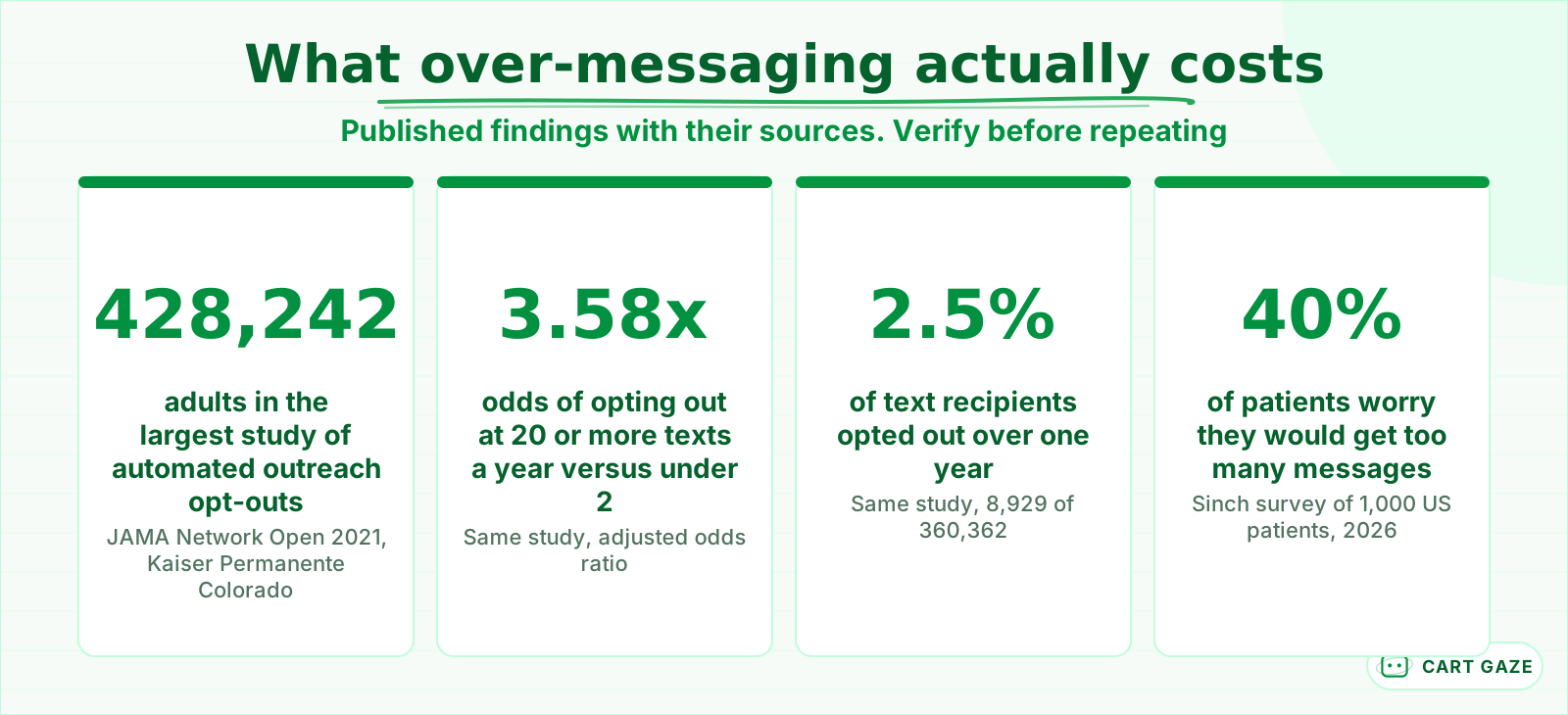 Published findings, each sourced. Reasons to cap your own volume, not a prediction of your numbers.
The Kaiser Permanente Colorado study is worth reading closely, because it measures the cost of the pile-up rather than guessing at it. Over one year, 2.5% of text recipients opted out entirely. The effect scaled with volume: patients getting 10 to 19.9 texts a year had 1.27 times the adjusted odds of opting out, and those getting 20 or more had 3.58 times. For automated voice calls the same threshold produced an adjusted odds ratio of 49.84. It is a single integrated system and a 2018 to 2019 dataset, so treat it as one large measurement rather than a law.
The damage also crosses channels. Patients who opted out of texts were 4.07 times more likely to opt out of the automated calls as well. Annoy someone on one channel and you can lose them on the other, which means your appointment reminders pay for your marketing agent's enthusiasm.
Patients arrive already braced for this. In a Sinch survey of 1,000 US patients published in 2026, 93% had opted in to texts from their providers and 97% wanted appointment reminders by text, but 40% worried they would receive too many messages or that texts would feel like spam. The appetite is there. The tolerance is thin.
None of this shows up with your first automation, or your second. It appears around the fourth or fifth, which is where most practices have assembled a working front office automation stack and stopped thinking about it.
The shared contact record every agent writes to
Orchestration starts with one row per contact event: which patient, which channel, which purpose, when, which agent sent it, and what came back. Every agent reads that record before sending and writes to it after. Without it, a frequency cap is not something you can even compute, let alone enforce.
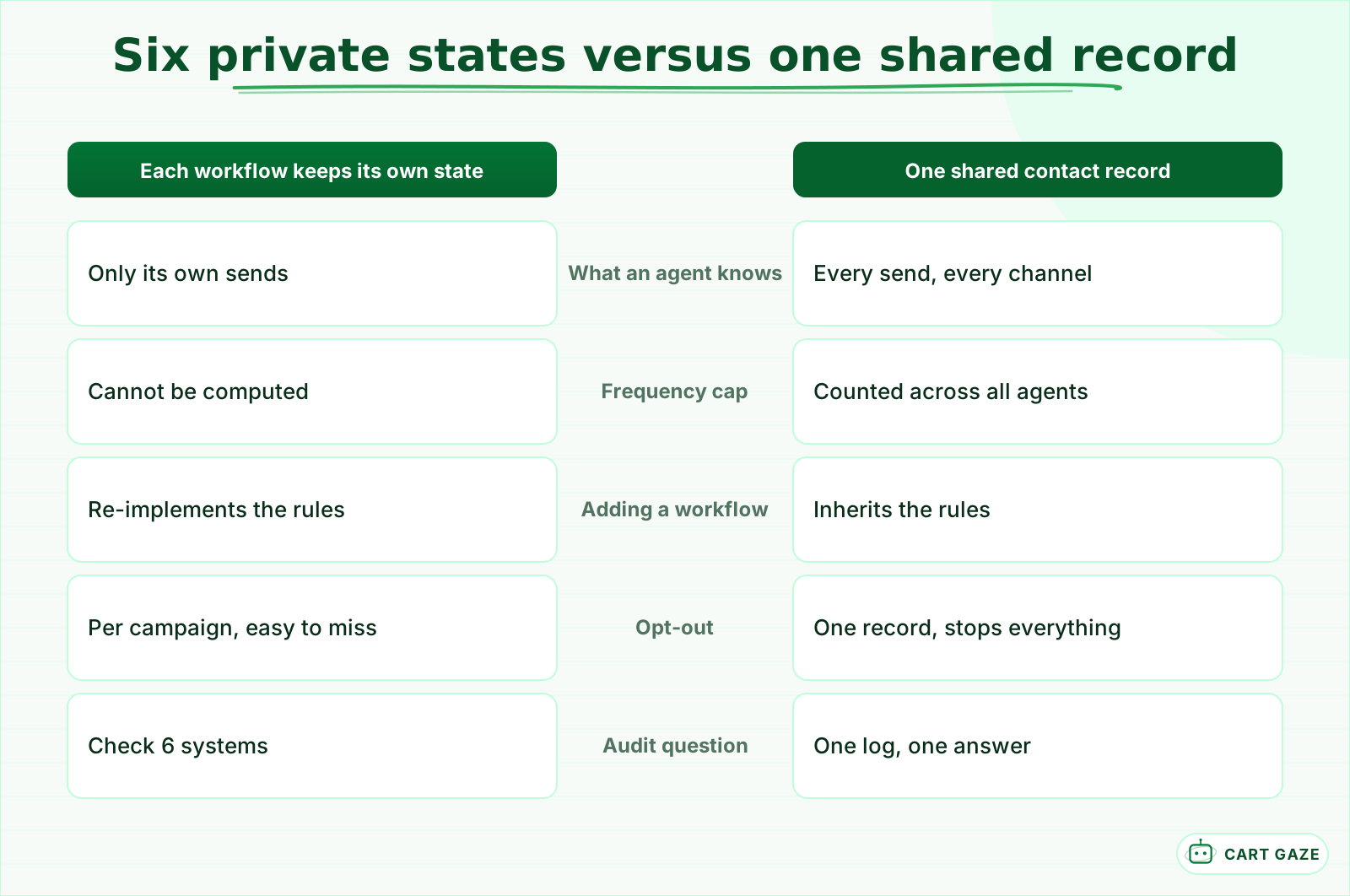 The rules are the same. Only one of these arrangements can actually enforce them.
Consent belongs on that record too, and specifically on the patient identity, not inside whichever tool happens to send the message. Consent trapped in one system is consent that gets missed at send time by every other system. The same goes for opt-out state, preferred channel, and preferred language.
The record also has to be honest about purpose. A patient who consented to appointment messages has not consented to promotions, and a send that cannot name which consent authorizes it should not go out. Federal rules treat treatment messages and marketing messages differently, and they are not interchangeable.
Your AI receptionist is one of these agents, not an exception to them. It books, it confirms, it follows up, and every one of those actions has to land in the same record as everything else. If you are still deciding what that agent should and should not do, what an AI receptionist actually handles sets the boundary. Whoever holds this record is handling patient data, so they are a business associate and need a signed BAA before a single patient detail arrives. "HIPAA certified" does not exist, so treat any vendor claiming it accordingly.
Suppression and quiet hours enforced in one place
A constraint that lives inside each workflow is a constraint the seventh workflow will not have. Put suppression and quiet hours in a gate that sits in front of every sender, so a new agent has to pass through them to reach a patient at all, with no setting to switch off.
Quiet hours are law rather than etiquette. 47 C.F.R. 64.1200 puts the federal window at 8 a.m. to 9 p.m. local time at the called party's location, and it is the patient's time zone that governs, not the one your server runs in. A number of states narrow it further, commonly to 8 a.m. to 8 p.m. and some bar Sunday calls outright, so confirm the rule for every state you actually text into.
Warning
A multi-state practice that computes quiet hours from the practice's own time zone will eventually send at 6:30 a.m. to somebody. Statutory damages under 47 U.S.C. 227(b)(3) run to $500 per violation and up to $1,500 for a willful one, assessed per message, so a single misconfigured batch is not a rounding error.
Enforcement location matters more than enforcement logic. A suppression check written into application code is one refactor from disappearing, and it does nothing for a hand-run export, a stray workflow node, or the CSV somebody uploads at 4 p.m. on a Friday. Enforce it closer to the data, where the send record is written, and no agent can route around it, including agents that do not exist yet.
Precedence when two agents both have something to say
When two agents qualify the same patient in the same window, one has to yield. Rank the message classes once and apply the ranking everywhere: clinical and appointment messages outrank marketing, always. A post-op instruction never waits behind a review request, and the yielding agent requeues rather than dropping silently.
| Message class | Example | Rank | Counts against the cap | Effect of an opt-out |
|---|---|---|---|---|
| Clinical and safety | Post-op instruction, abnormal result callback | 1 | No | Switch to a phone call |
| Appointment | Reminder, confirmation, cancellation notice | 2 | Yes | Stops |
| Billing and admin | Balance due, outstanding intake form | 3 | Yes | Stops |
| Recall and preventive | 6-month hygiene, annual physical | 4 | Yes | Stops |
| Marketing | Reactivation offer, review request, promotion | 5 | Yes | Stops |
Ranking has to be a property of the message, not of whichever workflow happened to run first. Marketing platforms have handled this for years by exempting transactional and operational sends from the cap while holding promotional volume to a tighter limit. The healthcare version is the same shape with higher stakes, because rank 1 is a clinical instruction and rank 5 is a coupon.
The yield behavior deserves a decision rather than a default. A recall message that loses to an appointment reminder should come back next week, not vanish. A marketing message that loses three weeks running is telling you the patient is saturated, which is information the marketing agent should act on. Silent drops are how practices end up believing a campaign ran when it did not, one of the failure modes covered in where practice automation breaks down.
A weekly contact cap, and the state that ends an agent's job
Two limits do most of the work. A weekly cap counted across every agent and channel stops the pile-up, and a terminal state ends an agent's job when its goal is met. Booking is the terminal state practices forget, which is why a scheduled patient keeps getting chased as a lead.
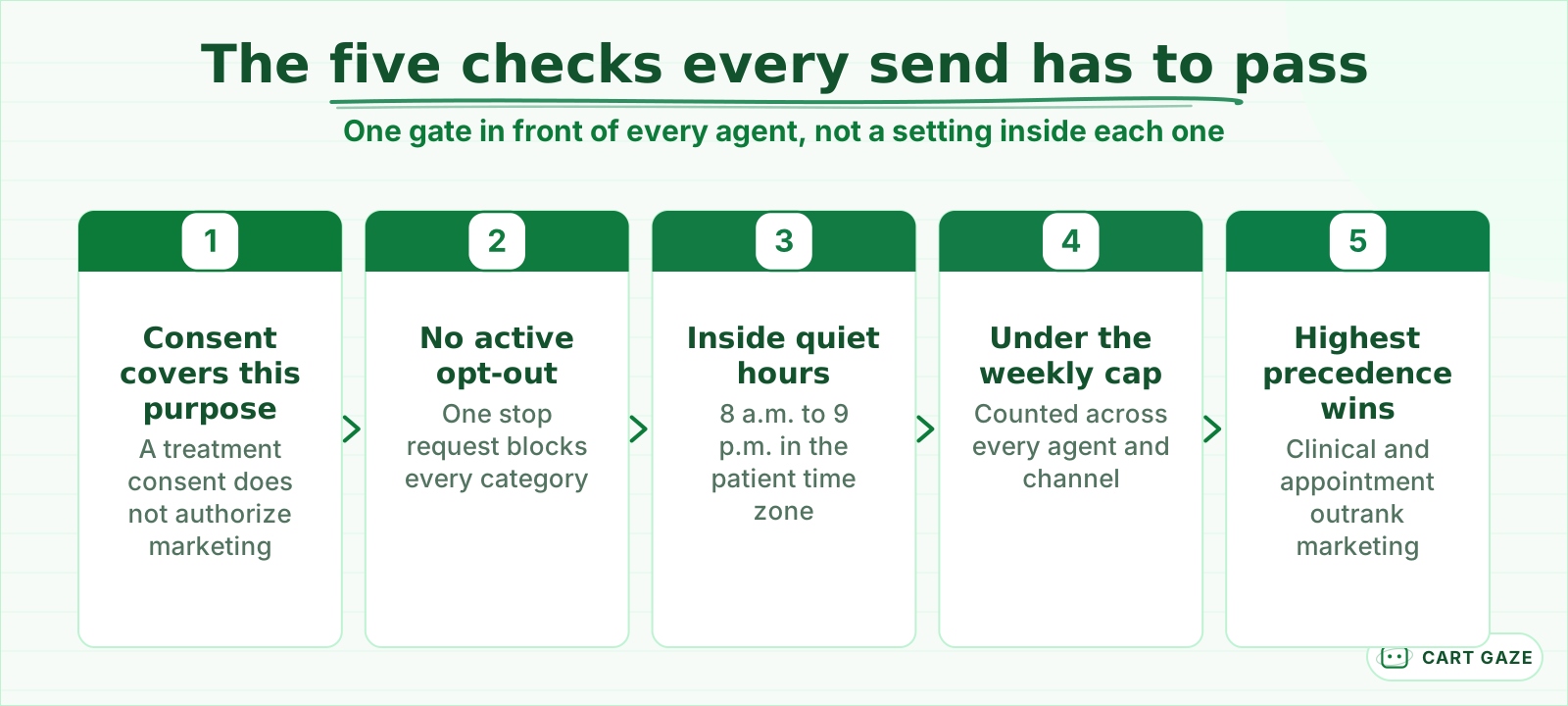 One gate, applied in order. A new workflow cannot route around a check it never implemented.
The federal ceiling for treatment-related messages is already written down. The FCC's healthcare exemption permits one call or text per day and a maximum of three combined per week, with calls of about a minute or less and texts of 160 characters or fewer, an easy opt-out on every message, and no marketing, solicitation, billing or debt-collection content inside an exempted send.
Important
That ceiling is a legal maximum, not a target. The Kaiser numbers put meaningful opt-out risk at 20 texts a year, which is well under 3 a week, so patient tolerance runs out long before the regulation does. Pick your cap from the tolerance number.
Terminal state is the half that gets skipped. Every agent needs an end condition written down, and the important ones are cheap to define: booking closes the speed-to-lead chase, a returned form closes the intake nudge, a posted payment closes the balance reminder, and an opt-out closes all of them. If the appointment write does not close the chase, your practice spends the week pursuing somebody who is already on the schedule, which reads to that patient as an office that does not talk to itself.
This is where many "the automation is broken" reports come from. The automation is fine. It never learned its job was finished, because the system that booked the appointment and the system running the chase were never introduced.
The single opt-out that stops everything at once
One stop request has to end every category of message, not just the campaign it arrived on. Federal rules already require a practice to accept revocation by any reasonable means and to process it within 10 business days, and the cross-category version of that rule already has a date.
Since April 11, 2025, 47 C.F.R. 64.1200 has required a practice to accept revocation through any reasonable method that clearly expresses the request, with no single exclusive method permitted, and the FCC named stop, quit, revoke, opt out, cancel, unsubscribe and end as recognized wording. The processing window dropped from 30 days to 10 business days.
The piece still not in force is the one that matters most here. The requirement that a revocation given in response to one message type applies to every other message type from the same sender was waived, first to April 11, 2026 and then to January 31, 2027. That date is current as of September 2026 and has already slipped twice, so check it rather than trusting this paragraph.
Tip
Build to the strict version anyway. Per-campaign opt-out means a patient who asked once has to ask again, and it means rebuilding your suppression logic the week the waiver lapses. One opt-out stopping everything is both the simpler system and the one that ages well.
One nuance worth keeping straight: a texting opt-out is a channel decision, not a withdrawal from care. If a patient who stopped texts needs a post-op callback, that call still happens, by phone, from a person. Encode that, or your safest message class becomes the one your suppression list silently deletes.
Before you switch on agent number two
- Every agent reads and writes the same contact record, including the AI receptionist.
- Suppression, quiet hours and the weekly cap sit in one gate rather than as a setting inside each workflow.
- A stop reply on any message removes the patient from every category, and the removal is logged.
- Booking, a returned form and a posted payment each end the agent job that was chasing them.
Build the orchestration layer before agent number seven
The layer is cheapest to add when you have two agents and most expensive at six, because by then the rules are copied into six places. Instrument first, restrict second: log every send from every system into one place for 30 days, then put the gate in front.
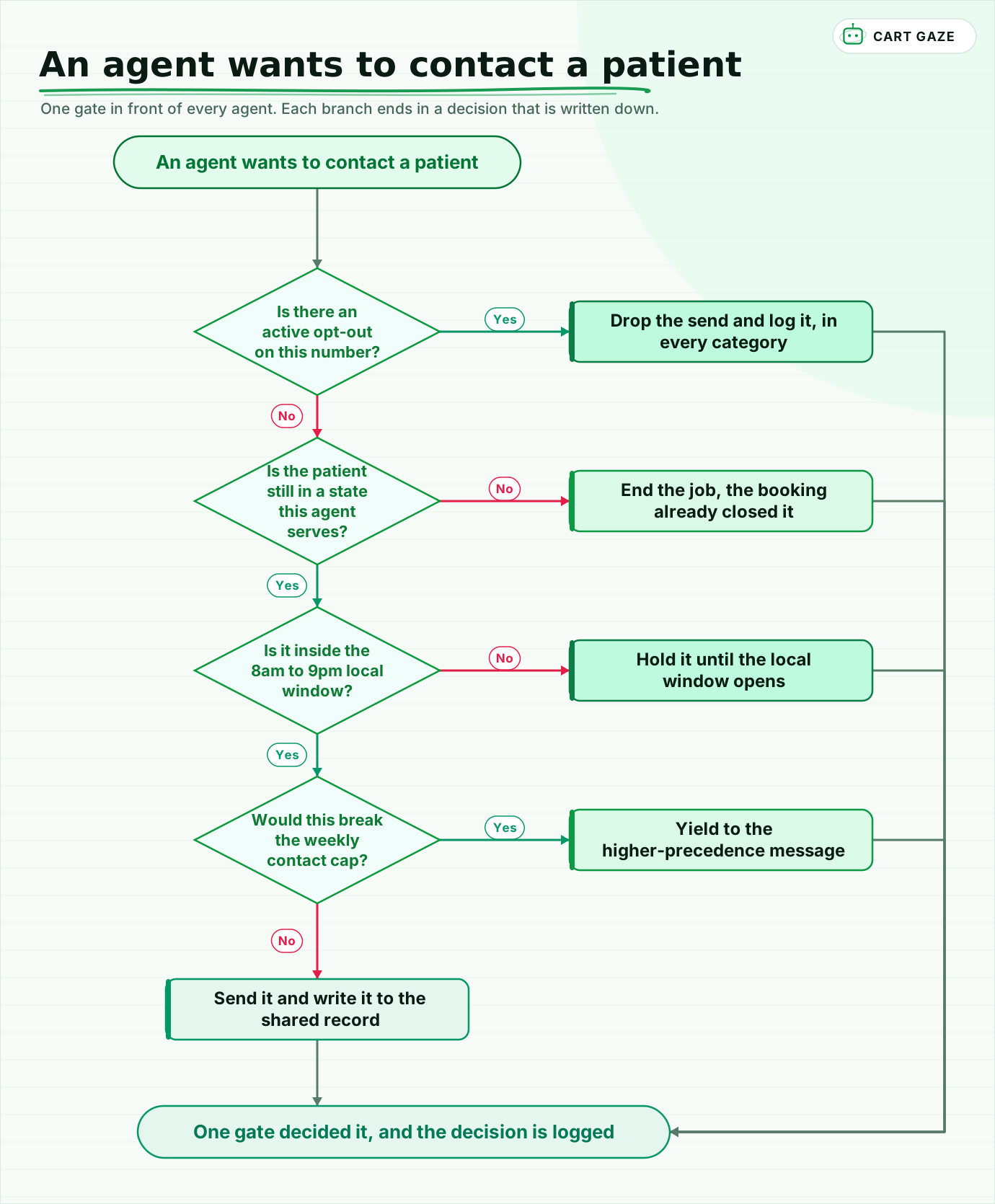 One gate in front of every agent. Each branch ends in a decision that is written down.
Reading 30 days of a real patient week is usually enough to end the argument. You will find the patient who got 5 messages in 9 days, the reactivation campaign still messaging people who booked, and at least one workflow nobody remembers turning on. That inventory tells you which rule to enforce first.
Then add the gate in the order the flowchart runs: opt-out, terminal state, quiet hours, cap, precedence. Once it holds, retire the per-workflow copies of those rules, because two places to change a quiet-hours window is one place too many. The goal is that adding agent number seven is a configuration change rather than a compliance review.
If you would rather see the collisions before you build anything, the free Growth Leak Audit maps what your current stack is sending and where the overlaps are, using your own numbers rather than somebody else's case study.
Fair questions.
What is AI agent orchestration for a medical practice?
It is the layer that coordinates several automations so they behave like one system. In practice it means a shared contact record every agent reads and writes, one place where suppression and quiet hours are enforced, a contact cap counted across all agents, a precedence order between message classes, and a single opt-out that stops everything at once.
How many messages a week is too many for a patient?
The legal ceiling for treatment-related messages under the FCC healthcare exemption is 1 per day and 3 per week combined. Patient tolerance is lower. Kaiser Permanente Colorado found meaningful opt-out risk starting around 10 texts a year and 3.58 times the odds at 20 or more, so most practices should cap well below the regulation.
Does an opt-out have to stop every type of message?
Not yet, but it is coming. Since April 11, 2025 a patient may revoke consent by any reasonable means and the request must be processed within 10 business days. The rule requiring a revocation on one message type to stop all other types is waived until January 31, 2027. That date has already slipped twice, so verify it before relying on it.
Why does a booked patient keep getting follow-up messages?
Because the agent chasing them has no end condition. Speed-to-lead follow-up runs on a schedule and stops only when something tells it to stop. If the appointment write does not close that job, the chase continues against a patient who is already scheduled. Define booking as the terminal state and the problem disappears.
What are the quiet hours for texting patients?
Federal rules under 47 C.F.R. 64.1200 set the window at 8 a.m. to 9 p.m. in the patient time zone, not yours. Several states narrow it further, commonly to 8 a.m. to 8 p.m. and some bar Sunday calls, so check every state you text into. Statutory damages under 47 U.S.C. 227(b)(3) reach $500 per violation and $1,500 if willful.
Sources.
- [1]Factors associated with opting out of automated text and telephone messages among adult members of an integrated health care system
- [2]Research warns against too many automated patient outreach messages
- [3]The state of healthcare patient communication in 2026 (survey of 1,000 US patients)
- [4]TCPA exemptions for healthcare companies: message limits and opt-out requirements
- [5]FCC partially delays new TCPA consent revocation rules
- [6]FCC extends limited waiver for part of the TCPA consent revocation rule
- [7]FCC delays effective date of TCPA revoke-all rule until January 31, 2027
- [8]47 C.F.R. 64.1200: restrictions on telephone solicitation, calling hours, and revocation of consent
- [9]FCC 20-186: limits on exempted calls under the TCPA (healthcare message caps)
- [10]TCPA calling hours: federal window, stricter states, and statutory damages
- [11]Frequency capping: global and per-channel caps, priority, and protected sends
Written by

Muhammad Qasim Hammad
Founder, Cart Gaze
Qasim builds AI receptionists and front-office automation for medical and dental practices at Cart Gaze. Posts here start from published sources and real call data, not vendor claims, and every number links back to where it came from.
Keep reading.
 Practice Automation PlaybooksHuman in the Loop AI Approvals: What to Gate and What to Let Run11 min read
 Practice Automation PlaybooksFront Desk AI Training: The Conversation Practices Skip10 min read
 Practice Automation PlaybooksPractice Phone System Migration: Move Lines Without Losing Calls10 min read
 Practice Automation PlaybooksThe Practice Daily Digest That Owners Actually Read10 min read
 Practice Automation PlaybooksAI Receptionist Implementation: A Realistic Week-by-Week Guide10 min read
 Practice Automation PlaybooksPractice Merger Call Continuity: Keep the Phones Answered12 min read