
Patient Email vs Text: Which Message Goes by Which Channel
Reminders, intake links, statements, recall and newsletters each belong on a different channel. Here is which goes by email, which by text, and the sender, consent and cost rules behind each choice.
Key takeaways.
- In a UCLA Health trial of 262,085 patients, text and portal flu shot reminders each reached about 47%, no better than usual care, so swapping channels alone moves little.
- Adding text reminders to emailed surveys lifted model-estimated response from 34.5% to 51.1% for joint replacement patients, with no difference by age group.
- Text reminders, confirmations and same-day changes; email statements, visit packets and newsletters; send intake links and results-ready notices both ways.
- Gmail and Yahoo require SPF or DKIM from every sender, and at about 5,000 emails a day to Gmail a domain must add DMARC, one-click unsubscribe and a spam rate under 0.3%.
- On list prices a text costs over 100 times more than an email, but 800 paper statements cost $656 in postage, so statements are where the channel choice saves money.
Table of Contents9 sections
- Does the channel change whether patients act?
- Open rates will not tell you which channel works
- Which channel each patient message should use
- What fits in a text, and what needs an email
- Getting delivered: email authentication and text registration
- Consent and opt-out rules differ by channel
- What each message costs on each channel
- Set one channel rule per message type
- Fair questions
Reminder texts, statement emails, recall letters, a quarterly newsletter: each goes out on a channel, and the channel is often whatever the sending software defaulted to. When one channel carries everything, a statement arrives as a text nobody can read on a phone, a reminder lands in a Promotions tab, and the texting program carries messages the rules never meant it to carry.
The research on channels is more modest than vendor pages suggest. In a UCLA Health trial of 262,085 primary care patients during the 2022 to 2023 flu season, text reminders did no better than patient portal reminders, and neither beat usual care: every arm vaccinated about 47% of patients. In a HealthPartners trial of joint replacement patients, adding text reminders to emailed surveys lifted the model-estimated response from 34.5% to 51.1%. Swapping one channel for another did little. Pairing them by message did a lot.
This post routes 8 common patient messages to a channel, with the reason for each, then covers open rates, text length and links, sender rules at Gmail, Yahoo and the carriers, consent law and cost.
Does the channel change whether patients act?
Less than most vendors claim. In 2 recent US trials, swapping one digital channel for another barely moved behavior, while adding a second channel to the first did. Choose the channel by what the message asks the patient to do, how soon, and how much they must read.
The UCLA trial is the cleanest test of channel alone. Researchers randomized 262,085 primary care patients into 3 groups: usual care, flu vaccine reminders through the patient portal, and the same reminders by text. Vaccination landed at 47.1%, 47.3% and 47.2%. The authors, writing in JAMA Internal Medicine in 2024, concluded that the text reminders did not outperform the portal reminders across the population.
The HealthPartners trial asked a different question. Adults who had a hip or knee replaced received outcome surveys by email, and those who had not answered were randomized either to text reminders on days 7 and 12 or to nothing more. With the texts, the model-estimated response was 51.1%. Without them, it was 34.5%. The study ran from November 2018 to January 2021 and was published in the American Journal of Medical Quality in 2024.
The effect did not differ by age group, sex, race or Medicaid status, which cuts against the habit of reserving texts for younger patients. Read together, the 2 trials point the same way: a reminder moved to another inbox is the same reminder, while a short text pointing at an unopened email is a second chance.
Patients do not agree on one channel either. In a 2017 national survey of 251 US adults by University of North Carolina researchers, the type of reminder was the feature respondents weighted most, and the preferred reminder could arrive by email, phone call or text. It is small and older, but the point holds: patients care how a reminder arrives, and they do not all want the same one.
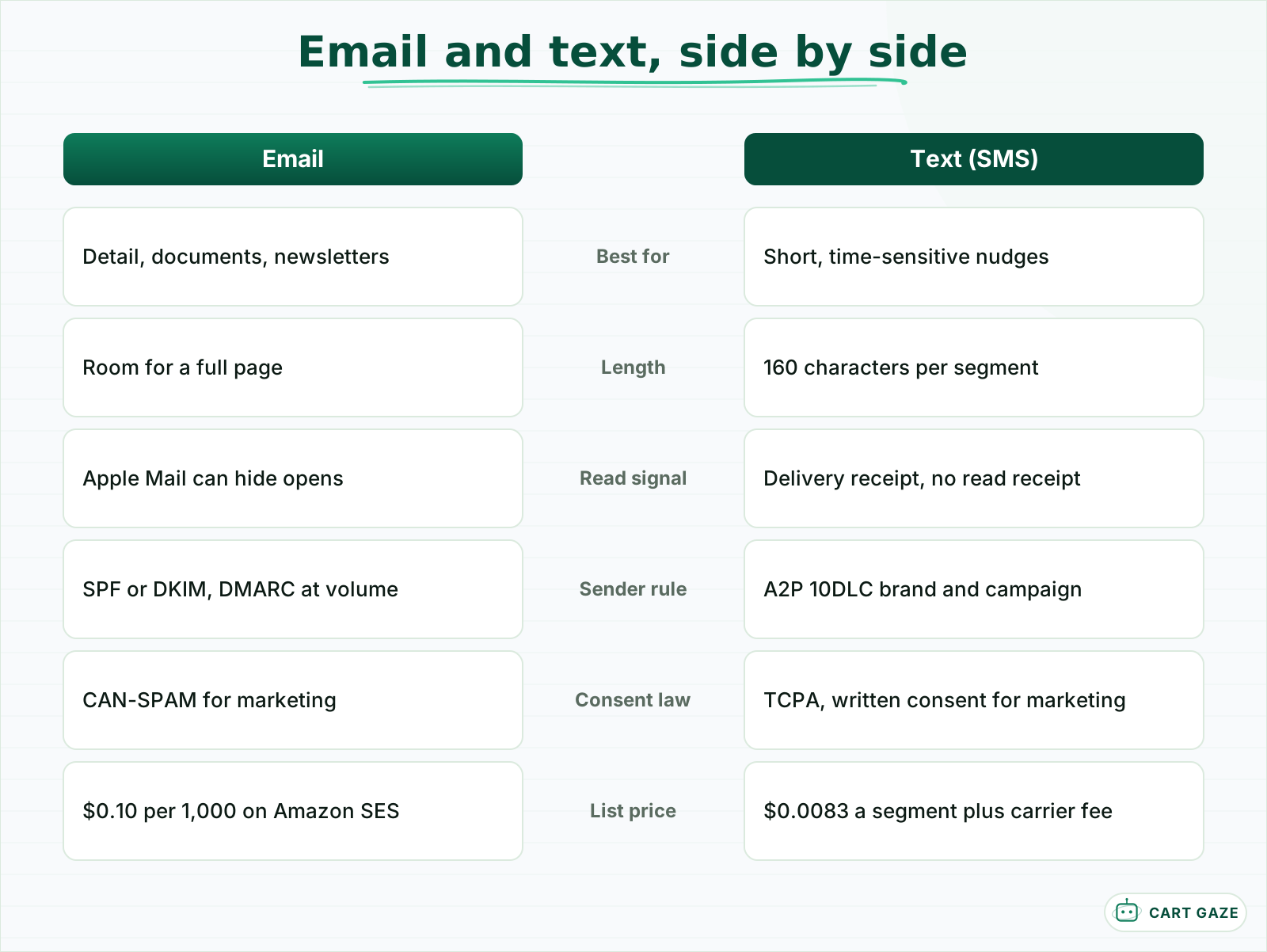 Neither channel wins outright. Each is strong where the other is weak.
Open rates will not tell you which channel works
Neither channel can tell you reliably whether a patient read a message. Apple's Mail Privacy Protection can hide email opens from senders, and a standard text returns a delivery receipt but no read receipt. Measure what the patient did instead: confirmed, completed a form, paid, booked, or replied STOP.
Apple's support page says the feature, once turned on in the Mail app, prevents senders from seeing whether you opened their email, so any open rate your platform reports is partly an estimate. Mailchimp, publishing benchmarks from its own customers' marketing email, put the average open rate at 35.63% and the click rate at 2.62% across all users, in data last updated December 2023, and its page warns that Mail Privacy Protection may affect open-rate accuracy. Even when an open is real, it is a weak signal next to a click.
Text has the opposite gap. Twilio's API documentation lists a "read" status only for RCS and WhatsApp, and only when the recipient has read receipts turned on. A plain SMS can be confirmed as delivered and nothing more. The SMS open rate of 98% repeated across vendor pages usually comes without a source or method, so treat it as an unsourced vendor claim. This post does not rely on it.
What you can measure is the action each message asks for:
- A reminder: confirmations and no-shows.
- An intake link: forms completed before arrival.
- A statement: payments within 30 days.
- A recall notice: visits booked.
- A newsletter: clicks and unsubscribes.
Compare channels on that action, for the same message type, over the same weeks. A channel that wins on opens and loses on completed forms is losing.
Which channel each patient message should use
Text the short, time-sensitive messages a patient must act on within a day: reminders, confirmation requests and same-day changes. Email anything long, documented or promotional: statements, visit packets and newsletters. Send intake forms and results-ready notices both ways, with a short text pointing to the detail in email or the portal.
| Message | Default channel | Backup | Why |
|---|---|---|---|
| Appointment reminder | Text | Short, time-sensitive, inside the TCPA healthcare exemption | |
| Confirmation request | Text | Email with a confirm link | A one-word reply is the fastest action a patient can take |
| Same-day change or running late | Text | Phone call | Useful only if read within the hour |
| Intake form link | Text the same link 2 to 3 days out | Long forms are easier on a computer; the text is the nudge | |
| Statement ready | Text, only with consent | Billing content falls outside the healthcare exemption | |
| Recall due | The patient's stated preference | The other channel | Weeks of lead time, so speed matters less than reach |
| Results-ready notice | Text or email, by preference | Portal notification | Say a result is ready, never what it is |
| Newsletter | None | Marketing by text needs prior express written consent |
Behind the table are 2 tests. Urgency decides whether text is worth its limits, and length decides whether email is worth its delay.
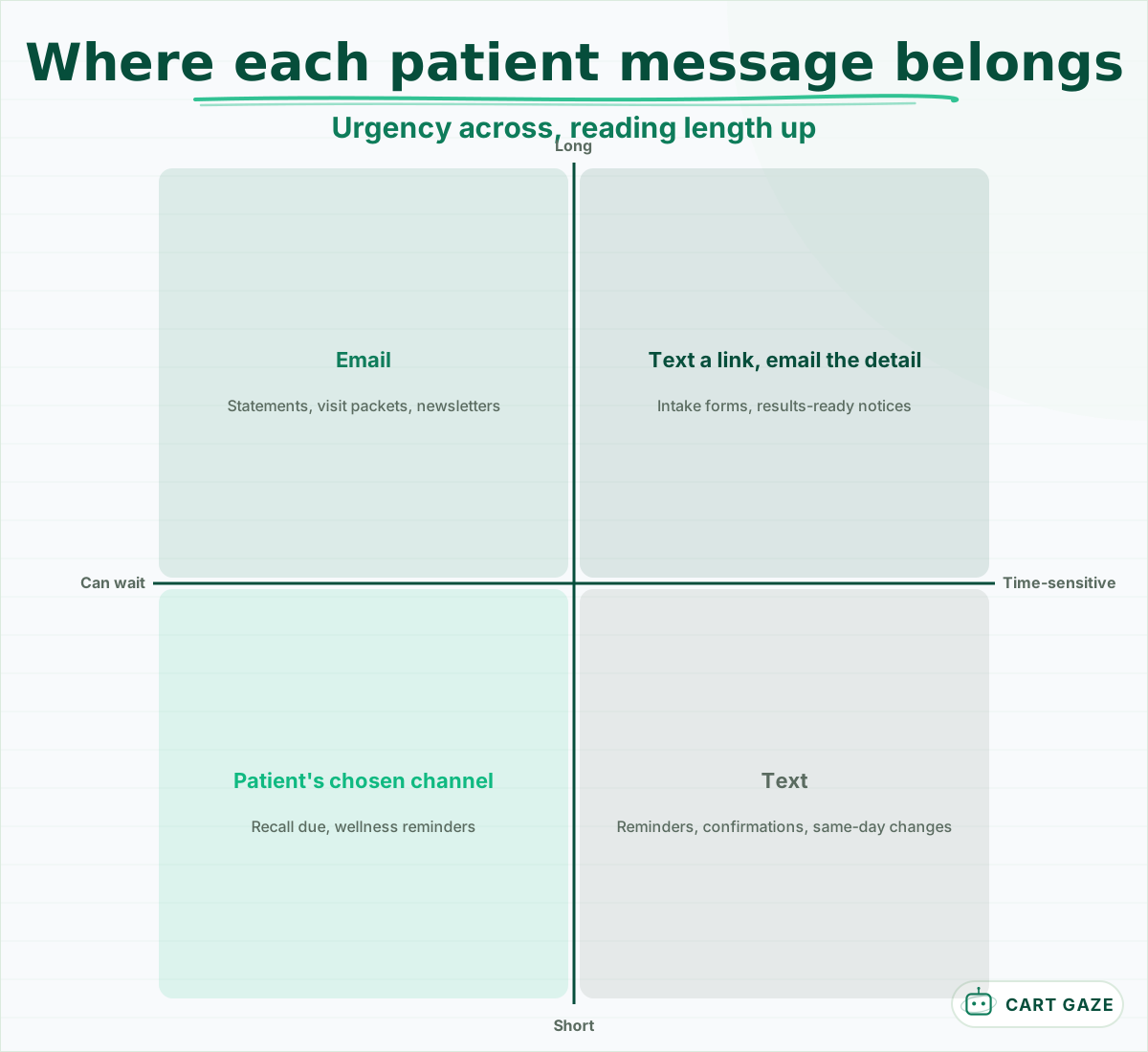 Urgency decides whether text is worth its limits. Length decides whether email is worth its delay.
Intake forms run several pages, and a phone is a hard place to finish them. Send the link by email, where it opens on a computer, then text the same link as the nudge a few days before the visit.
Watch the daily cap on reminders. The TCPA healthcare exemption allows 1 message a day and 3 a week per patient, counting automated voice calls and texts together. If your phone system also places automated reminder calls, those calls use up the same allowance as your texts.
New patients need their own sequence, because the first 3 weeks after booking carry more than a reminder. The new-patient welcome sequence sets out what each of those first messages should say. The table above decides which channel carries each one.
Record the patient's preference per message type, not once per chart. HHS's own example in its guidance on emailing patients is a provider accommodating a request for appointment reminders by email instead of on a postcard. A patient may want reminders by text and statements by email, and your systems should hold both answers.
What fits in a text, and what needs an email
A text should carry one fact and one action in 160 characters or fewer, the length of a single segment. Anything that needs a table, an attachment, more than one link or a paragraph of explanation belongs in an email, with a short text pointing to it when timing matters.
Twilio's documentation sets out the arithmetic. A standard text holds 160 characters in GSM-7 encoding, or 153 per segment once a message is split. A single emoji or curly quotation mark switches the whole message to UCS-2, which holds 70 characters, or 67 per segment. Twilio recommends keeping texts under 320 characters, and each segment is billed.
Tip
A 150-character reminder with one curly apostrophe pasted from a word processor is sent as UCS-2 and splits into 3 segments of up to 67 characters. It bills as 3 messages. Set your template editor to straight quotes and count characters after the merge fields fill in.
Links need the same care. CTIA's Messaging Principles and Best Practices, the carrier industry's guidelines, say a link shortener should have a web address and IP addresses dedicated to the sender, and links should clearly identify the website owner. Use your own domain or your vendor's dedicated one, one link per text, never a free public shortener.
Email has room, but room is not permission. HHS guidance on emailing patients says the Privacy Rule allows unencrypted email for treatment-related messages when reasonable safeguards are applied. Its examples are checking the address before sending and limiting the amount or type of information in the email.
Important
Put the fact that something is ready in the message and the thing itself behind a login. A statement email says a statement is ready and links to the payment page. A results-ready notice says to log in or call. Neither carries the balance details or the result.
Getting delivered: email authentication and text registration
Email from your practice domain must be authenticated with SPF or DKIM under Gmail's and Yahoo's sender rules, and a domain sending about 5,000 messages a day to Gmail must also publish DMARC and offer one-click unsubscribe on marketing. Texts from a 10-digit number need a registered brand and campaign, or carriers filter more.
The 3 email records do different jobs. SPF lists the servers allowed to send mail for your domain. DKIM signs each message so the receiving server can check it came from your domain unaltered. DMARC tells receiving servers what to do with mail that fails those checks and sends you reports about it.
The trap is that several systems send as your practice. The reminder platform, the billing company and the newsletter tool may each use your domain, and each must be covered by your SPF and DKIM setup. Google counts mail from the same primary domain together toward its bulk threshold, and its FAQ says bulk sender status does not expire once assigned. A practice will rarely send 5,000 reminders to Gmail in a day, but a newsletter to 6,000 Gmail addresses crosses the line in one send.
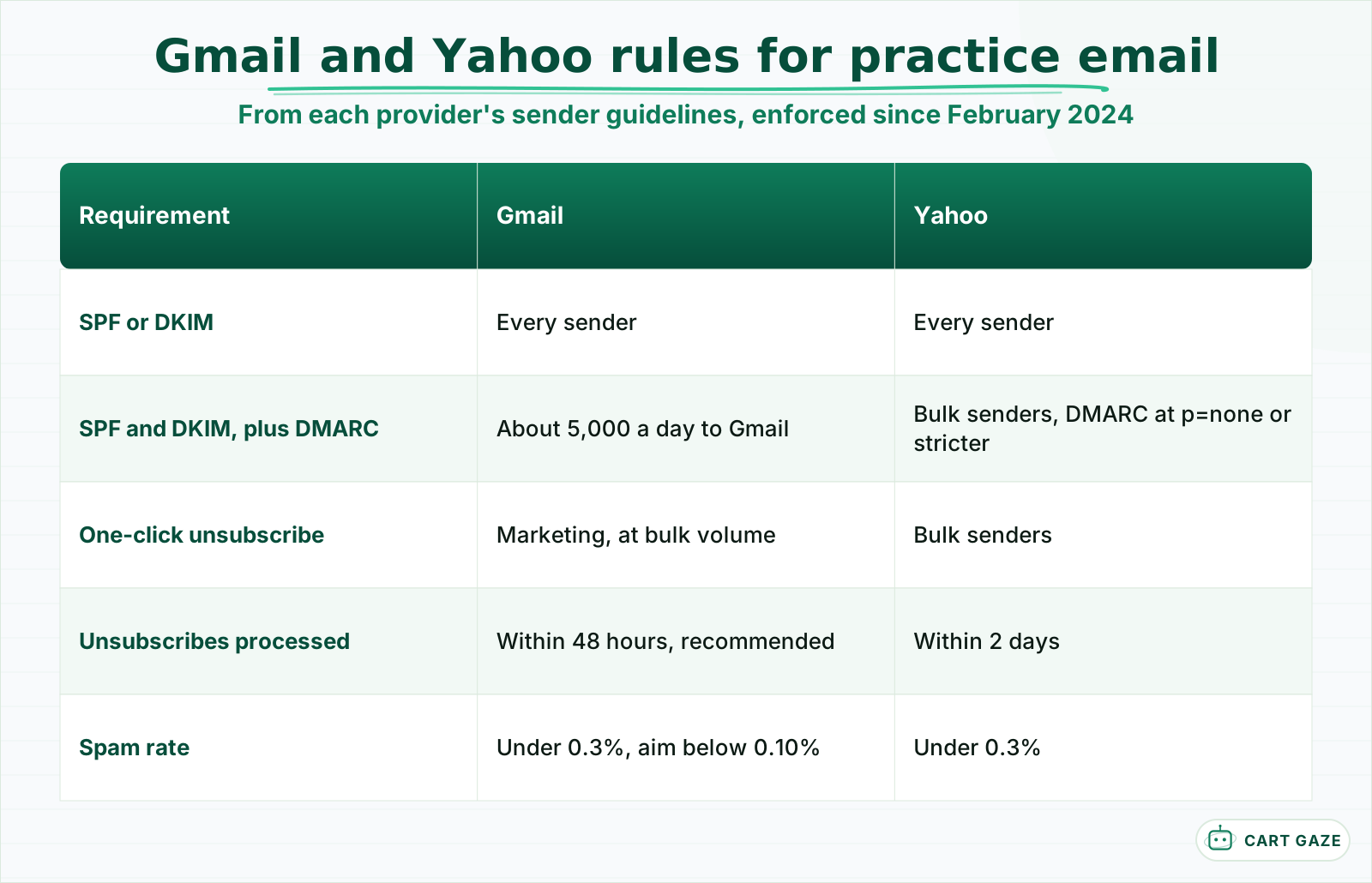 Most rules bite at volume, but every sender needs SPF or DKIM.
Both providers began enforcing these rules in February 2024, and both want your spam complaint rate under 0.3%, with Google recommending below 0.10%. Google's FAQ excludes transactional messages, such as reservation confirmations, from the one-click requirement. An appointment reminder is likely the practice equivalent, unless it adds a promotion. Google recommends processing unsubscribes within 48 hours, and Yahoo requires them to be honored within 2 days. Gmail said it began ramping up enforcement in November 2025, which can mean rejected messages.
On the text side, US carriers require anyone sending application-to-person texts from a 10-digit long code to register a brand and a campaign under the A2P 10DLC standard, and Twilio says unregistered traffic pays extra carrier fees and gets filtered more.
Consent and opt-out rules differ by channel
Texts fall under the TCPA, which exempts certain healthcare texts sent to the number a patient gave you and requires prior express written consent for marketing. Marketing email falls under CAN-SPAM, which requires a working opt-out and a postal address. Both channels need privacy safeguards and one shared opt-out record.
On the text side, 47 CFR 64.1200(a)(9)(iv) exempts a provider's text only when it goes to the wireless number the patient provided, names the provider with contact details, sticks to purposes such as appointment reminders, wellness checkups, lab results and prescription notifications, carries no marketing or billing content, generally stays at 160 characters or fewer, keeps within the daily and weekly cap, and offers Reply STOP, which must be honored immediately. Texts sent on consent instead must honor a revocation made by any reasonable method within 10 business days under paragraph (a)(10). What the TCPA requires of automated patient texting covers the exemption, the penalties and a 30-minute audit.
Email has its own law. The FTC's CAN-SPAM compliance guide applies the main rules to commercial messages, judged by their primary purpose. A commercial email must include a valid physical postal address and an opt-out that works for at least 30 days after sending, and opt-outs must be honored within 10 business days. Each email in violation can draw penalties of up to $53,088. Messages that facilitate or confirm a transaction the recipient already agreed to are treated as transactional, so a plain appointment reminder likely falls outside most of these rules, while a newsletter promoting a new service is commercial.
HIPAA applies to both channels: HHS guidance lets providers communicate electronically with patients, by email for example, when reasonable safeguards are in place, and HHS treats any vendor that stores the messages as a business associate that must sign a BAA.
Warning
An unsubscribe from your newsletter is not a request to stop appointment reminders. A patient who emails "stop texting me," though, may have revoked consent for texts. Log every opt-out with the channel and message types it covers, and make every sending tool check that log.
None of this is legal advice. Confirm your message types and consent records with counsel before you change what goes out.
What each message costs on each channel
On published list prices, a text costs more than 100 times as much as an email, and both cost a fraction of a stamp. Twilio lists $0.0083 per text segment plus carrier fees, Amazon SES lists $0.10 per 1,000 emails, and USPS charges $0.82 for a 1-ounce letter. Platform fees come on top.
These are each provider's own published prices, read in October 2026:
- Twilio, US text messages: $0.0083 per outbound segment from a 10-digit number, plus a carrier fee of $0.0035 at AT&T up to $0.005 at Verizon, and $1.15 a month for the number.
- Amazon SES, email: $0.10 per 1,000 emails, plus $0.12 per GB of attachments.
- USPS, paper: $0.82 for a 1-ounce First-Class letter, before paper, printing and the envelope.
Run a modeled month on those prices. Sending 2,000 single-segment reminders costs $23.60 to $26.60 by text, or $0.20 by email. Mailing 800 paper statements costs $656 in postage alone, against $0.08 to email them. That is our arithmetic on list prices, not a quote, and most practices also pay a platform subscription that outweighs the raw message cost.
Price barely matters for reminders, since texting 2,000 of them costs under $30. It matters for statements, where paper is by far the expensive channel. Moving statements to email, with a text nudge for patients who consented, is where the channel decision saves money.
The cost no price page shows is the reply. A text asking a patient to confirm invites "Can I move this to Thursday?" by return text or by phone, often after hours. An AI receptionist can take that callback, move the visit and pass anything clinical to staff, within the limits set out in what an AI receptionist does and where it hands off.
Set one channel rule per message type
Write down, for each message type, its default channel, its backup, the consent it relies on and the action you will measure. Load the same rules into every tool that sends, so the reminder platform, the billing system and the newsletter tool cannot each decide for themselves.
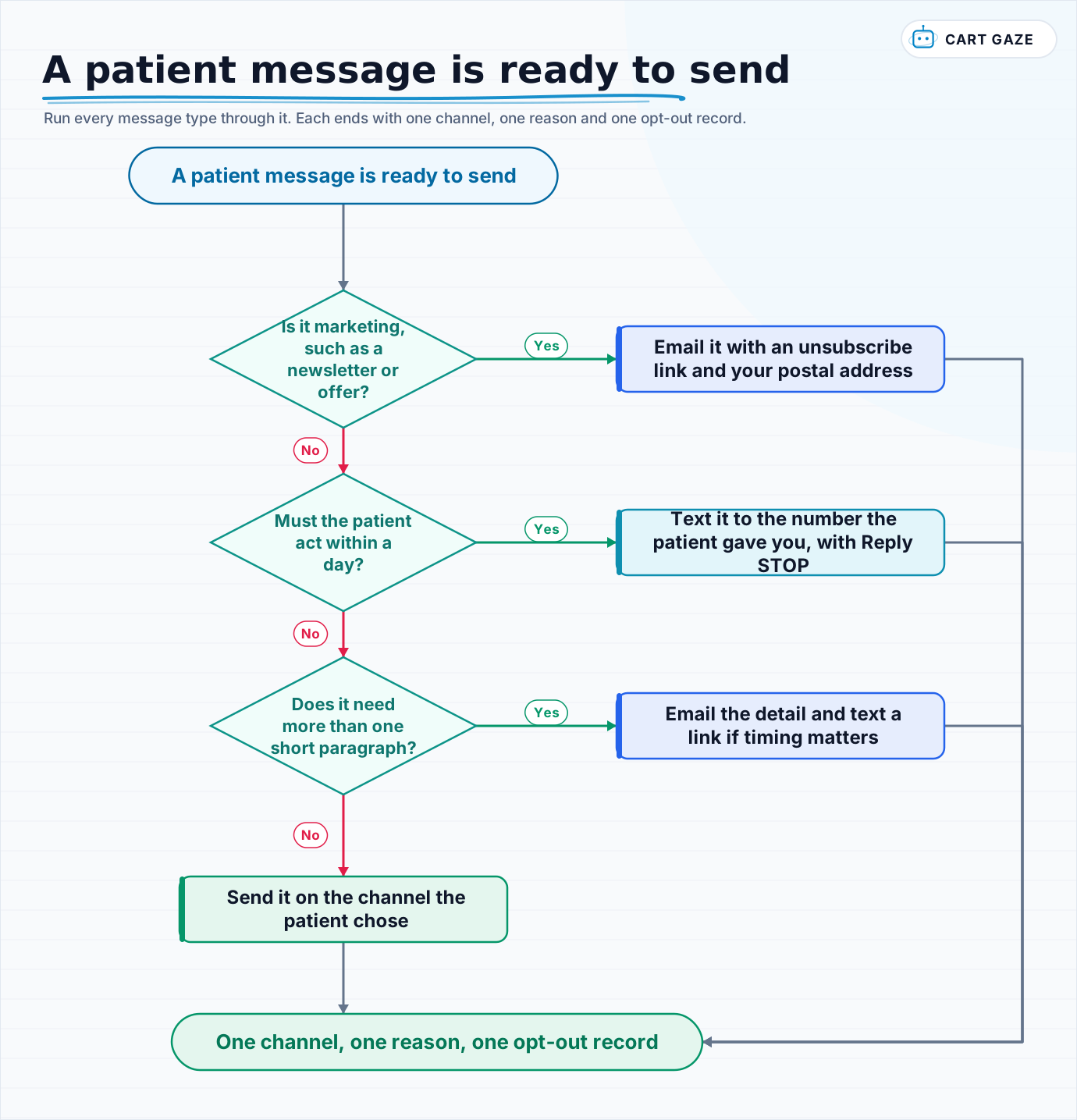 Run every message type through it. Each ends with one channel, one reason and one opt-out record.
Walk each message type through the flow: marketing by email with an unsubscribe link and your postal address, anything due within a day by text, anything longer by email with a text link when timing matters, and the rest by the patient's stated preference.
Then hold the rule for a quarter. Measure each message type's action, such as confirmations, completed forms or payments, before the change and 90 days after. One month at one practice is too noisy to call.
Before you route a message type to a new channel
- Your sending domain passes SPF and DKIM, and DMARC is published.
- The texting number's brand and campaign are registered.
- Each message type has one default channel, one backup and a named owner.
- Opt-outs from either channel land in one log that every sending tool checks.
For how texting runs on the numbers we operate, from opt-in to STOP, see our SMS program page, covering consent, message types and how to stop texts.
Fair questions.
Should a medical practice send appointment reminders by text or email?
Text is the default for reminders and confirmation requests because they are short and time-sensitive, and the TCPA healthcare exemption covers reminders sent to the number a patient provided, within 1 message a day and 3 a week. Email works as the backup and for patients who ask for it. Judge the channel by confirmations and no-shows, not opens.
Are SMS open rates really 98%?
That figure is repeated across vendor pages, usually without a source or method, and it cannot be measured directly: Twilio documents a read status only for RCS and WhatsApp, not SMS. Email opens are unreliable too, because Apple Mail Privacy Protection can hide them. Compare channels on what patients did, such as confirming, paying or completing a form.
Do Gmail and Yahoo's sender rules apply to a small practice?
Partly. Every sender must set up SPF or DKIM and keep its spam rate under 0.3%. The stricter rules, DMARC and one-click unsubscribe on marketing, apply at about 5,000 messages a day to Gmail, and Google counts mail from the same primary domain together. A single newsletter to a large patient list can cross that line in one send.
Does CAN-SPAM apply to appointment reminder emails?
CAN-SPAM's main rules apply to commercial email, judged by the message's primary purpose. The FTC treats messages that facilitate or confirm a transaction the recipient already agreed to as transactional, so a plain appointment reminder likely falls outside most of the rules. A newsletter or offer is commercial and needs an opt-out and a postal address. Confirm specifics with counsel.
Is it cheaper to text or email patients?
On published list prices, email is far cheaper. Amazon SES lists $0.10 per 1,000 emails, while Twilio lists $0.0083 per text segment plus a carrier fee of $0.0035 to $0.005. Both are tiny next to a $0.82 stamp, which is why statements gain the most from moving off paper. Most practices also pay a platform subscription that outweighs per-message costs.
Sources.
- [1]Szilagyi PG et al. Text vs Patient Portal Messaging to Improve Influenza Vaccination Coverage: A Health System-Wide Randomized Clinical Trial. JAMA Intern Med, 2024
- [2]Ziegenfuss JY et al. The Impact of Text Messaging to Promote PROMs Completion in Orthopedic Practice: a randomized controlled study. Am J Med Qual, 2024
- [3]Crutchfield TM, Kistler CE. Getting patients in the door: medical appointment reminder preferences. Patient Prefer Adherence, 2017
- [4]Apple: Use Mail Privacy Protection on iPhone
- [5]Mailchimp: Email marketing benchmarks and statistics by industry
- [6]Twilio: Message resource, status values
- [7]Twilio: What the SMS character limit is
- [8]CTIA Messaging Principles and Best Practices (May 2023)
- [9]Google: Email sender guidelines
- [10]Google: Email sender guidelines FAQ
- [11]Yahoo: Sender best practices
- [12]Twilio: A2P 10DLC overview
- [13]47 CFR 64.1200: Delivery restrictions (TCPA rules)
- [14]FTC: CAN-SPAM Act, a compliance guide for business
- [15]HHS: Does the HIPAA Privacy Rule permit health care providers to use e-mail to discuss health issues and treatment with their patients?
- [16]HHS: Guidance on HIPAA and cloud computing (business associates)
- [17]Twilio: SMS pricing in the United States
- [18]Amazon SES pricing
- [19]USPS: First-Class Mail prices
Written by

Muhammad Qasim Hammad
Founder, Cart Gaze
Qasim builds AI receptionists and front-office automation for medical and dental practices at Cart Gaze. Posts here start from published sources and real call data, not vendor claims, and every number links back to where it came from.
Keep reading.
 No-Shows & Follow-UpLeaving an Insurance Network: What to Tell Patients, and When15 min read
 No-Shows & Follow-UpThe Intake Form Completion Chase: Paperwork Done Before Arrival11 min read
 No-Shows & Follow-UpHoliday Closure Communication: Keep Patients From a Locked Door10 min read
 No-Shows & Follow-UpNo-Show Rate Benchmarks by Specialty: What the Studies Show10 min read
 No-Shows & Follow-UpPatient SMS Templates for Medical Practices, With Compliance Notes10 min read
 No-Shows & Follow-UpRunning Late Text to Patients: When to Send It and What to Say10 min read