
Provider Leaving a Practice? The Patient Notice, Phase by Phase
When a provider leaves a practice, patients need notice, a named clinician and a way to follow or move their records. A phased plan for the letter, results inbox, schedule, phones and desk script.

Key takeaways.
- Annual turnover among physicians billing traditional Medicare rose from 5.3% in 2010 to 7.6% in 2018, so a group needs a departure plan before it needs one.
- AMA ethics opinions, state board rules and the departure agreement set what patients are owed; Texas requires notice to patients seen in 2 years, posted 30 days ahead.
- The notice names the last day and the new clinician, says patients may follow the provider, explains records, and leaves out the contract and the reason for leaving.
- Before the last day, give every patient a named clinician and move the results inbox, refills, open orders and recall lists to someone who stays.
- In the last week, change every phone path, voicemail box and AI receptionist list that names the provider, then keep one desk script live for at least 6 months.
Table of Contents8 sections
- What you owe patients when a provider leaves
- When notice is given: confirm the date and name one owner
- The first 2 weeks: write the notice and settle records custody
- 30 days before the last day: send the notice and reassign the panel
- The last week: move the schedule and change the phones
- After the provider leaves: the script for "Is Dr. Reyes still here?"
- Run the departure from one dated plan
- Fair questions
Within a day of a provider giving notice, the front desk starts fielding the same call: is Dr. Reyes leaving, and where is she going? What the desk says then, and what the letter says a few weeks later, decides whether her patients follow her, stay with you, or drift out of care because nobody told them who to call.
Departures are routine. A 2023 study in the Annals of Internal Medicine, covering physicians who bill traditional Medicare, found annual turnover rose from 5.3% in 2010 to 7.6% in 2018, counting both physicians who stopped practicing and those who moved to another practice. At that rate, a 12-physician group should expect roughly 1 departure a year (our arithmetic, not the study's).
This guide runs a departure in 5 phases: when notice is given, the first 2 weeks, 30 days before the last day, the last week, and the months after. It covers what the notice may say, who keeps the records, the panel and its pending results, the schedule and phones, and the desk script.
What you owe patients when a provider leaves
No single federal law sets a departure notice for a private practice. The duty comes from the AMA Code of Medical Ethics, which asks for enough notice and help finding another clinician, from your state licensing board, which may set dates and content, and from the departure agreement, which names the sender.
The AMA's opinions are the closest thing to a national standard, and they center the patient, not the practice. Opinion 1.1.3 lists continuity of care among patients' rights: care that is still needed should not stop without "sufficient notice and reasonable assistance" in arranging more. The table sets out the 4 opinions that apply and 1 state rule.
| Source | What it says | What it means for your notice |
|---|---|---|
| AMA Opinion 1.1.3, Patient Rights | Continuity of care is a patient right; care ends only with notice and help arranging more | Tell patients early and name who will see them now |
| AMA Opinion 1.1.5, Terminating a relationship | Notice long enough to find another physician; help transfer care | The date matters as much as the wording |
| AMA Opinion 3.3.1, Medical records | Transfer records on the patient's request when a physician leaves; a reasonable fee, if any | Every notice explains how to get or move records |
| AMA Opinion 11.2.3.1, Restrictive covenants | Covenants should reasonably accommodate patients' choice of physician | The patient decides who they see next |
| Texas, 22 TAC 163.4 (2025) | Letter or email to patients seen in 2 years; notice posted 30 days before; set content | One state's floor; check your own board |
State rules are where dates and content get specific, and Texas is a clear example. Since January 9, 2025, a Texas physician who retires, ends employment or leaves a practice must notify every patient seen in the last 2 years by letter or email, and post a notice in the office and on the practice website at least 30 days before leaving. The notice must give the departure date, how to obtain or transfer records, the name and location of the new practice if there is one, and the new records custodian if ownership changes.
The same rule speaks directly to groups. The practice must hand over a list of the patients the departing physician saw in the last 2 years. It does not have to send the notice itself, but if it agrees to, it must follow the rule, and no physician who stays may interfere with the departing physician's notice. Locum tenens physicians at a location under 6 months are exempt, as are physicians who saw the patient only in hospital-type settings or only for anesthesia, radiology or pathology. Other states differ, and dentists, NPs and PAs answer to their own boards.
The stakes go beyond complaints. A 2021 study in JAMA Internal Medicine followed 359,470 Medicare fee-for-service beneficiaries from 2008 to 2017. In the year after their primary care physician left practice, patients had 18.4% fewer primary care visits and 17.8% more urgent care visits than matched patients whose physician stayed. The study covers physicians who stopped practicing entirely, not ones who moved, but it shows how sharply care patterns shift when a primary care relationship ends.
Departure agreements often carry non-solicitation or noncompete clauses that limit how the departing provider may contact patients. Those are contract matters governed by state law, and the front desk should never interpret them. This is general information, not legal advice: have counsel confirm your notice plan against the agreement and your state's rules before anything goes out.
When notice is given: confirm the date and name one owner
The day a provider gives notice, confirm the last clinical day in writing and name one owner for the departure. Then settle who sends the patient notice under the agreement, and pull the panel so a clinician can flag who needs a call first. Every later date counts from that day.
The last clinical day is not always the last day of employment. Unused leave, a garden-leave period or a negotiated wind-down can put weeks between the two, and patients care about the day the provider stops seeing them. Get that date in writing before anyone books around it.
Pair the administrator who owns the plan with a clinician who makes the clinical calls: which patients hear by phone first, and who inherits which results.
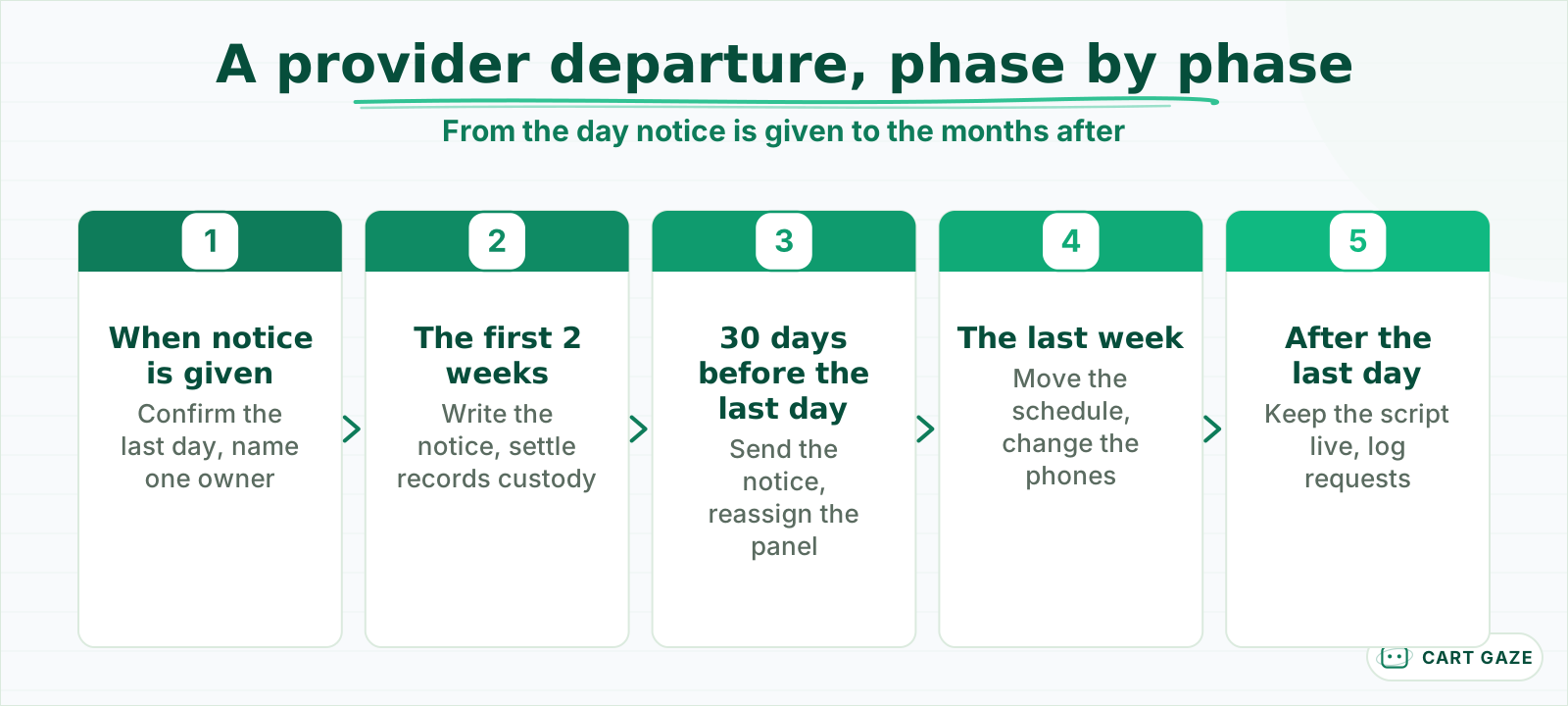 One owner and one last day. Each phase hands the next one a finished piece.
Decide who sends the notice: the practice, the departing provider, or both in one joint letter. The agreement may already answer it. A joint letter is common because patients get one consistent message instead of two competing ones, but it only works if both sides approve the wording.
Then pull the panel: every patient the provider saw in a lookback you choose. Texas uses 2 years, a reasonable reference elsewhere. Have a clinician review the list for patients who should hear by phone before a letter reaches them: anyone mid-treatment, pregnant, recently discharged, waiting on results, or on a medication the departing provider was adjusting.
Patients will hear the news before the letter arrives, so give the desk a holding line once the date is confirmed: "Dr. Reyes will be with us through [date]. Every patient will get a letter with the details and who will be caring for you, and you can still book with her until then."
The first 2 weeks: write the notice and settle records custody
Use the first 2 weeks to draft the notice and decide who keeps the charts. The notice gives the last day, the new clinician, how to book, the patient's right to follow the provider, and how to get or move records. The employment agreement and state law decide records custody.
What the notice says, in plain terms:
- The provider's last day seeing patients
- The clinician who will take over their care, and how to book
- That the patient chooses who they see next, including following the departing provider
- The new practice's name and location, where the agreement or your state's rule calls for it
- How to get a copy of their records or have them sent elsewhere
- Who handles refills, results and forms from now on
What it leaves out: the contract dispute, the reason for leaving unless the provider agreed to share it, anything that reads like clinical advice, and pressure to stay. A patient who reads "we strongly encourage you to remain with our practice" hears a sales letter about their own doctor.
A notice that covers all of this fits in 6 sentences:
"Dr. Reyes will leave [practice] on [date], and she will see patients until then. Dr. Kim, who has worked alongside her, will take over her patients' care, and you can book with Dr. Kim at [number] or through the portal. You are free to choose your next clinician, here or elsewhere, including following Dr. Reyes to [new practice and address, if included]. Your records stay with us, and we will send a copy to you or to the doctor you choose when you ask. Dr. Kim's team now handles refills, test results and forms. Call us at [number] with your questions."
Records custody is the other job for these 2 weeks. Where the practice owns the charts, it stays their custodian after the provider leaves, but the employment agreement and state law decide ownership, so read both rather than assume. Whoever keeps them, the AMA's records opinion says a patient's transfer request should never be refused and any fee should be reasonable.
HIPAA lets a covered entity disclose patient information for another provider's treatment (45 CFR 164.506(c)(2)), so a request from the provider's new practice to continue a patient's care can be a treatment disclosure, though state law may require the patient's signed authorization first. A patient's own request for a copy runs on HIPAA's 30-day access clock. If the notice sets off a wave of requests, run them through the records release workflow, from request to release, with a due date logged the day each one arrives.
Important
Never hold records hostage to the departure terms. A dispute over the contract, the patient list or money is between the practice and the provider, and the AMA's records opinion says the patient's transfer request goes ahead regardless.
30 days before the last day: send the notice and reassign the panel
Send the notice at least 30 days before the last day, by mail or email and on the portal, and post it in the office and online. The same week, give every patient on the panel a named clinician, and move the results inbox, refills and open orders to someone who stays.
Texas sets 30 days as its floor; elsewhere it is a sensible minimum, and more time helps patients mid-treatment. Call the patients your clinician flagged first, then mail or email everyone else, publish the same text on the portal and website, and post it at the desk. Text a link only to patients who have agreed to texts from you.
The default name is the most useful line in the notice. A patient told to "choose a new provider" has a task to put off; a patient given a name has an appointment to book. For a large panel, split patients across 2 or 3 clinicians by condition, location or visit type rather than loading one schedule, and say in the notice that a single call changes the assignment.
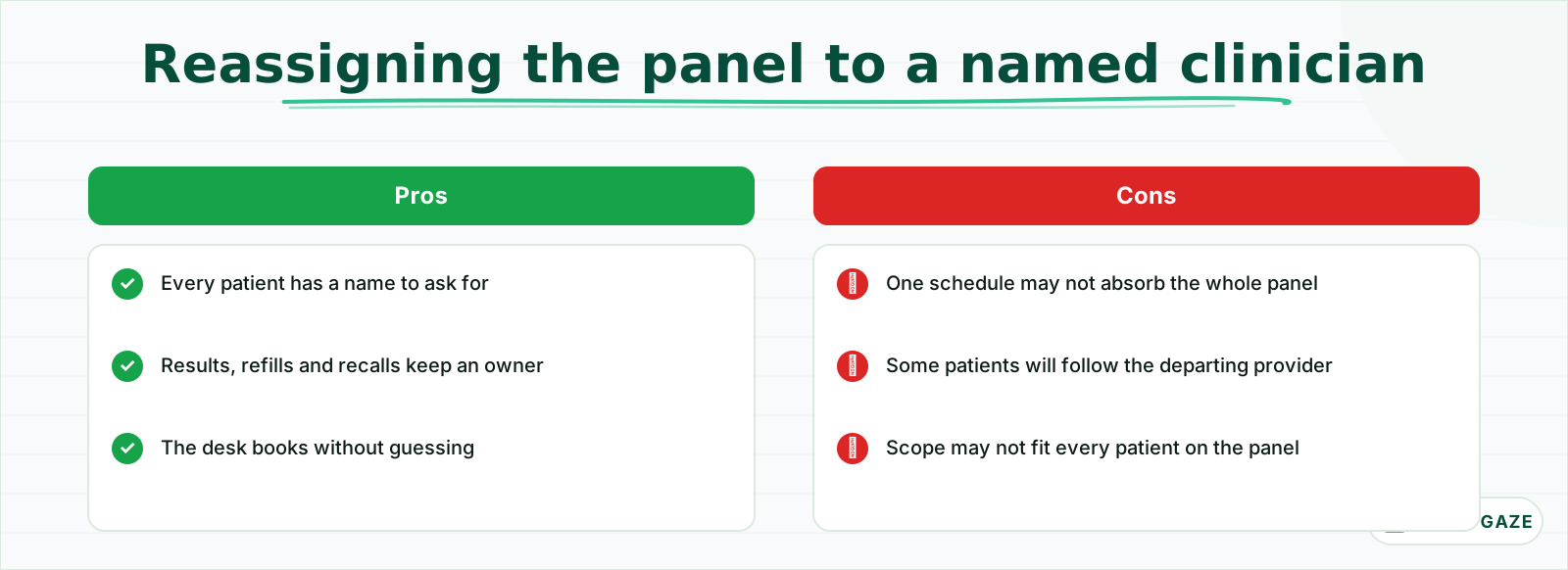 A default name keeps results and refills owned. The patient's choice still overrides it.
Patient choice still overrides the default. Some patients will follow the departing provider, and the notice should make that as easy as staying: one call or one signed form to move their records.
Then move everything still open. Results, refills, prior authorizations, referral letters, disability and school forms, care plans and recall lists can all carry the departing provider's name past the last day. Each needs an owner who stays, and the results inbox needs one before the last day, not after it.
Warning
An unowned results inbox is the riskiest item on this list. A lab or imaging result that lands in the queue of a clinician who has left can sit unread. Reassign the inbox, and the orders still waiting on results, to a covering clinician before the last day.
The last week: move the schedule and change the phones
In the last week, close the departing provider's scheduling template past the last day, move every booked and recurring visit to a named clinician, and change every phone path that still offers the provider by name: the phone tree, direct extensions, voicemail boxes, the after-hours rotation and any automated booking tool.
Close the template in order. Bookings past the last day should be blocked from the day the notice goes out. This week, move what was booked before then: follow-ups, recurring series such as injections or therapy, and procedures. Call those patients rather than texting, because a new clinician on a booked visit raises questions a text cannot answer.
Recall and reminder lists are the quiet leak. A 6-month recall generated under the departing provider's name still fires after the last day unless someone reassigns it.
Every place the phone system names the provider needs a change: the menu option ("press 3 for Dr. Reyes's office"), a direct extension, her voicemail box, the after-hours on-call rotation, and the provider list in any AI receptionist or online booking tool. Forward the voicemail box to a monitored queue rather than deleting it, because messages keep arriving.
If your routing matches callers to their usual provider, her patients now need a new match: the named successor first, then the patient's stated preference. The logic is laid out in how multi-provider call routing decides who takes a call, and the departure is the time to update it, not the month after.
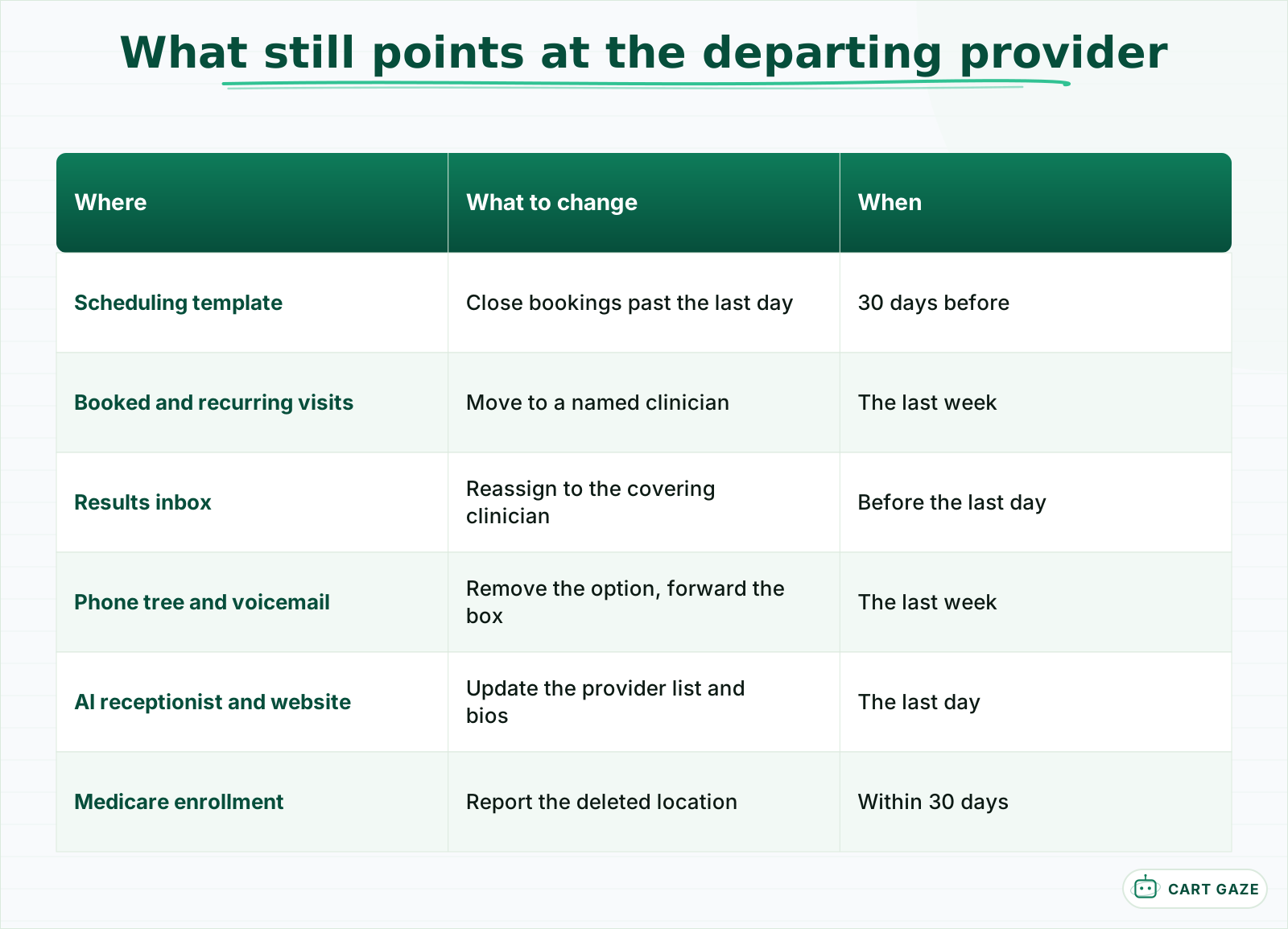 Each row is a place a patient or a result can still land on someone who left.
Tell every payer the provider has left so their directories stop listing them at your address, and report the change to Medicare, which expects a deleted practice location within 30 days (42 CFR 424.516).
After the provider leaves: the script for "Is Dr. Reyes still here?"
Calls asking for a departed provider keep coming for months, so give the desk one script and keep it live. Callers hear that the provider has left, who cares for them now, that they may follow, and how records move. Nobody improvises the reason for leaving, contract terms or clinical advice.
A script the whole desk can read:
- "Dr. Reyes left the practice on [date]."
- "Dr. Kim is now caring for her patients, and I can book you with Dr. Kim or another of our clinicians."
- "If you would like to keep seeing Dr. Reyes, [her new practice details from the notice], and we can send your records once you sign a request."
- "Are you waiting on a result, refill or form? Dr. Kim's team has those now."
- "Can I book that visit for you today?"
What the desk never says: why the provider left, anything about the contract, or "she wasn't allowed to tell you." Staff read the new location from the approved notice, so every caller hears the same thing.
Clinical calls are the exception to the script. A patient describing symptoms, or calling about a result that worried them, goes to the covering clinician or your triage path, never into a booking conversation.
Log every follow-the-provider and records-transfer request with a date. The log answers later questions from the departing provider, from counsel, or from a patient who says nobody told them.
An AI receptionist can carry most of these calls, since they follow a script. Loaded with the approved notice, it can tell callers the provider has left, book with the successor, take a records-transfer request for staff to verify, and send anything clinical to a person. It never judges whether a symptom is urgent and never says more than the notice does. That boundary is the same one set out in what an AI receptionist does and where it hands off.
Tip
Keep the departure script in the phone system and the AI receptionist's knowledge base for at least 6 months, then check call logs before you retire it. Patients who visit once a year will not call until their next visit is due.
Run the departure from one dated plan
A departure goes well when one owner runs it from one date: the notice reaches patients at least 30 days out, every open result has a new owner before the last day, and every phone path changes in the final week. Then the desk answers one question the same way for months.
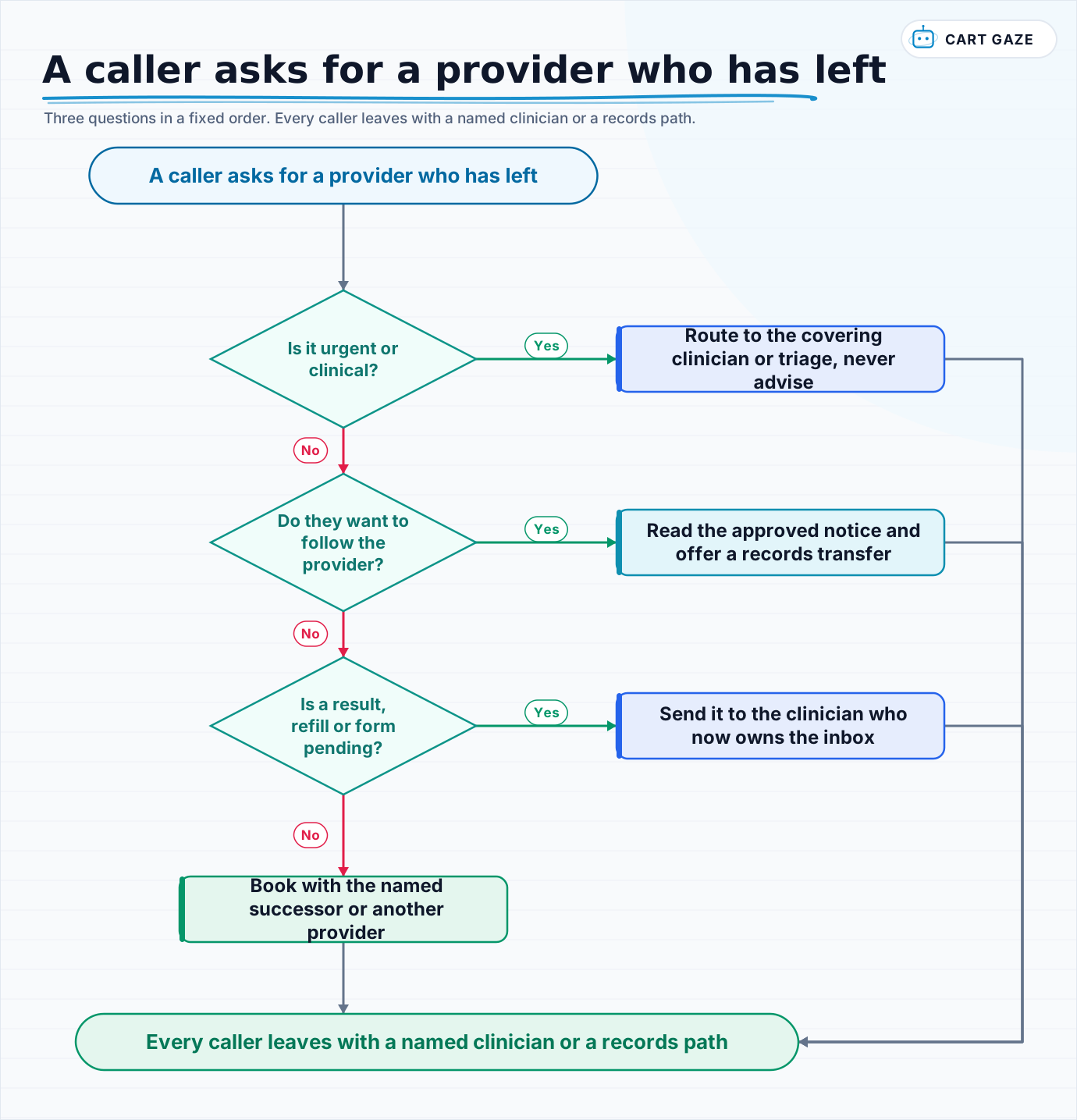 Three questions in a fixed order. Every caller leaves with a named clinician or a records path.
Walk the flow once with your desk. An urgent or clinical call goes to the covering clinician or triage, every time. A patient who wants to follow the provider hears the approved notice and gets a records-transfer path. A pending result, refill or form goes to the clinician who now owns the inbox. Everyone else books with the named successor or another provider.
Before the notice goes out
- The last clinical day is confirmed in writing, and one owner runs the plan.
- Counsel has checked the notice against the departure agreement and state rules.
- A clinician has reviewed the panel for patients who need a call first.
- The results inbox has a named owner who stays after the last day.
To see how a change like this lands in working phones and booking, the builds on our work page, and what each one handles, show finished setups at practices.
Fair questions.
Do we have to notify patients when a provider leaves the practice?
You should, and some states require it. No single federal law sets the notice, but the AMA Code of Medical Ethics asks for notice early enough that patients can find another clinician, and state boards can add rules. Texas, for example, requires a letter or email to every patient seen in the last 2 years. Confirm your own state's rule with counsel.
Can a practice stop a departing provider from telling patients where they are going?
That depends on the departure agreement and state law, so it is a question for counsel, not the front desk. Non-solicitation and noncompete clauses are contract matters. The AMA says covenants should reasonably accommodate patients' choice of physician, and Texas bars remaining physicians from interfering with a departing physician's required notice, which includes the new practice's name and location, if any.
Who keeps the medical records when a doctor leaves a group practice?
Where the practice owns the charts, it usually stays the custodian, but the employment agreement and state law decide ownership. Either way, a patient can ask for a copy or a transfer. The AMA says a transfer the patient requests should never be refused and any fee should be reasonable, and HIPAA gives the practice 30 days to act on a patient's access request.
How far in advance should patients be told a provider is leaving?
Texas sets a floor of at least 30 days for its posted notice, and that is a sensible minimum elsewhere. The AMA asks for notice long enough for a patient to find another physician, so patients mid-treatment, pregnant or waiting on results deserve a phone call before the letters go out, and more time wherever the departure date allows it.
What should the front desk say when a patient asks for a provider who has left?
Use one approved script: the provider left on a given date, who is caring for their patients now, that the patient may follow the provider, and how records move. Staff never explain why the provider left or discuss the contract. Clinical questions go to the covering clinician or triage, and every follow or transfer request is logged with a date.
Sources.
- [1]AMA Code of Medical Ethics, Opinion 1.1.3 Patient Rights
- [2]AMA Code of Medical Ethics, Opinion 1.1.5 Terminating a Patient-Physician Relationship
- [3]AMA Code of Medical Ethics, Opinion 3.3.1 Management of Medical Records
- [4]AMA Code of Medical Ethics, Opinion 11.2.3.1 Restrictive Covenants
- [5]22 Tex. Admin. Code 163.4, Physician Responsibilities when Leaving a Practice (Texas Medical Board, eff. Jan. 9, 2025)
- [6]Physician Turnover in the United States (Annals of Internal Medicine, 2023)
- [7]Changes in Health Care Use and Outcomes After Turnover in Primary Care (JAMA Internal Medicine, 2021)
- [8]45 CFR 164.506, Uses and disclosures to carry out treatment, payment, or health care operations (eCFR)
- [9]45 CFR 164.524, Access of individuals to protected health information (eCFR)
- [10]42 CFR 424.516, Additional provider and supplier requirements for enrolling and maintaining active enrollment status (eCFR)
Written by

Muhammad Qasim Hammad
Founder, Cart Gaze
Qasim builds AI receptionists and front-office automation for medical and dental practices at Cart Gaze. Posts here start from published sources and real call data, not vendor claims, and every number links back to where it came from.
Keep reading.
 Practice Automation PlaybooksMedical Practice Phone System Audit: A 30-Day Guide10 min read
 Practice Automation PlaybooksClinic Phone Coverage Plan: A Five-Phase Playbook for Practices10 min read
 Practice Automation PlaybooksFront Desk SOP Template: A Five-Step Guide for Medical Practices10 min read
 Practice Automation PlaybooksReduce Call Abandonment in 30 Days: A Week-by-Week Plan10 min read
 Practice Automation PlaybooksHuman in the Loop AI Approvals: What to Gate and What to Let Run11 min read
 Practice Automation PlaybooksAI Agent Orchestration Rules That Stop Automations Colliding12 min read