
Leaving an Insurance Network: What to Tell Patients, and When
When a practice leaves a payer network, the plan must notify patients in active treatment, who can keep in-network terms for up to 90 days. The rest is yours: the date, the letter and the phone script.
Key takeaways.
- Your participation agreement sets the notice you owe a commercial payer; Medicare Advantage contracts add a federal floor of 60 days for termination without cause.
- Under the No Surprises Act the plan must notify continuing care patients, who can elect up to 90 days of in-network terms counted from the plan's notice.
- During that window your practice accepts plan payment plus in-network cost sharing as payment in full; federal regulations were still pending as of June 2026.
- Medicare Advantage plans notify members 45 days ahead for primary care and behavioral health and 30 days for other specialties; Medicaid managed care uses a 30 or 15-day rule.
- Send a one-page letter and give the desk a script that states the plan, the date and the options, and never decides who qualifies for continuity of care.
Table of Contents9 sections
- Who has to tell patients when you leave a network?
- Your contract sets the date, so start with the termination clause
- Which patients keep in-network terms, and for how long
- Medicare Advantage, Medicaid and Marketplace plans run on different clocks
- What the patient letter should say
- The phone script for "Do you still take my plan?"
- Options for patients who want to stay with you
- Run the network exit as a dated checklist
- Fair questions
Your contract with a payer ends on a date you chose, or one the payer chose for you, and every patient on that plan finds out eventually. The good version is a letter from you, weeks ahead, with their options spelled out. The bad version is a patient learning at check-in, or from an explanation of benefits, that last week's visit was out of network.
Network exits are routine. A Health Affairs study of Medicaid managed care plans in 14 states from 2010 to 2015 found an average 12% annual turnover in primary care physician networks, with 34% of those physicians gone within five years. In KFF's 2023 survey of insured adults, 20% of Marketplace enrollees and 19% of Medicaid enrollees said a doctor or hospital they needed was not covered by their plan in the past year.
This post covers who has to notify whom, the federal continuity-of-care rule for patients mid-treatment, the separate clocks for Medicare Advantage, Medicaid and Marketplace plans, and the letter and phone script your front desk can use. It is general information, not legal advice, and state law adds rules of its own, so have counsel confirm your approach before the letters go out.
Who has to tell patients when you leave a network?
The plan carries the formal duty. Under the No Surprises Act, the plan must tell each continuing care patient about the termination and their right to ask for transitional care. The provider-side duties a network exit triggers cover payment terms and directory updates, not a patient letter. Send one anyway, because your patients call you first.
The statute, 42 U.S.C. 300gg-113, gives the plan 3 jobs when a provider's contract ends: notify each continuing care patient "on a timely basis" of the termination and their right to transitional care, give them a way to tell the plan they need it, and let them elect to keep their benefits with you on the same terms for that course of treatment. It sets no day count for that notice. It applies to employer group plans and individual policies for plan years starting on or after January 1, 2022.
Your own duties start with the directory. Under 42 U.S.C. 300gg-139, a provider must submit directory information to the plan when it terminates a network agreement, and CMS says plans must update their directories within 2 business days of receiving changes. The same section lets you require, in the terms of the contract termination, that the plan remove you from its directory when the contract ends.
A stale directory can also cost you money. If a patient relied on a plan directory that still listed you, was billed more than in-network cost sharing, and paid it, the law requires the provider to refund the excess plus interest. Send the directory update the day you give notice.
The plan's letter also reaches only some of your patients. The No Surprises Act requires it only for continuing care patients. Others on that plan with a visit booked after the end date may hear nothing until a claim processes out of network. That gap is why your own letter matters.
Your contract sets the date, so start with the termination clause
For a commercial payer, the notice you owe is whatever your participation agreement's termination clause says, including whether it must be written and where it goes. There is no standard period to assume. Medicare Advantage contracts carry a federal floor: 60 days' written notice either way for a termination without cause.
Read the clause before you pick a date. Look for the notice period, the delivery method, whether termination needs a stated reason, and whether it ends every product with that carrier or only one. A carrier can run a commercial PPO, a Marketplace plan and a Medicare Advantage plan under separate agreements or amendments, and each may need its own notice.
Then get the effective date confirmed in writing. Every other date in this process, the plan's notice, your letter, the last in-network visit, counts from that one. An assumed date is how patients end up with denied claims for visits you called covered.
The Medicare Advantage floor is in 42 CFR 422.202(d)(4): the plan and a contracting provider "must provide at least 60 days written notice to each other before terminating the contract without cause." That is a minimum; your agreement can require more.
When the payer ends the relationship, the reason matters. The No Surprises Act counts the expiration or nonrenewal of a contract as a termination, so a payer that simply declines to renew still triggers continuity of care for qualifying patients. A termination for failure to meet quality standards or for fraud does not.
Which patients keep in-network terms, and for how long
Under the No Surprises Act, a continuing care patient can elect up to 90 days of in-network terms with you, counted from the plan's notice. Five groups qualify: a serious and complex condition, inpatient or institutional care, scheduled nonelective surgery, pregnancy, and terminal illness. Other patients usually go out of network on the termination date.
The definitions are narrower than they sound. A serious and complex condition is an acute illness serious enough to need specialized treatment to avoid the reasonable possibility of death or permanent harm, or a chronic condition that is life-threatening, degenerative, potentially disabling or congenital and needs specialized care over a prolonged period. Surgery must be nonelective, and postoperative care counts. Pregnancy means pregnant and being treated for the pregnancy by you.
The clock starts when the plan sends its notice, not when the contract ends. The window runs for 90 days from that notice, or until the patient no longer qualifies, whichever comes first. Read literally, an early notice uses up part of the window while you are still in network anyway.
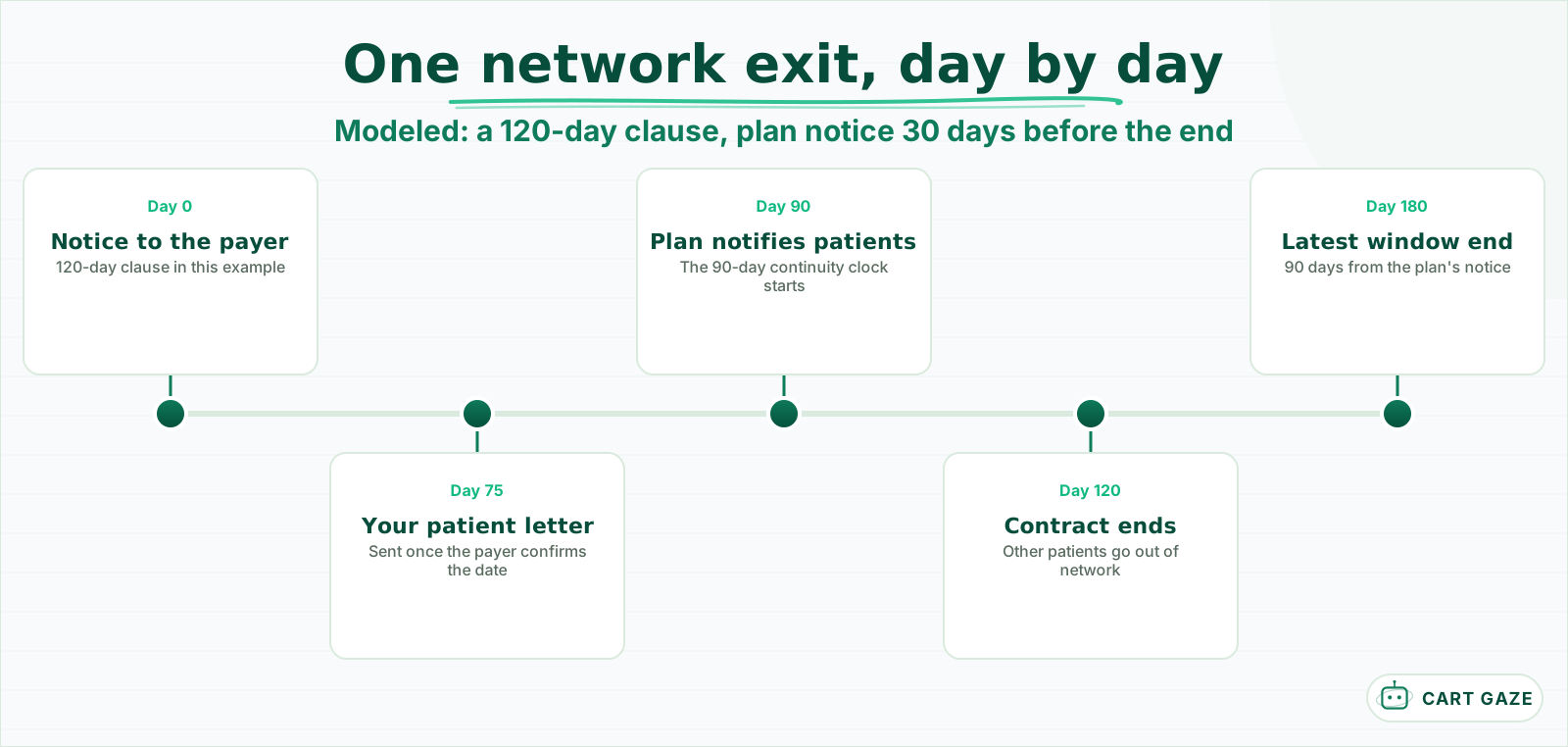 Modeled example. Your contract sets the first date; the plan's notice starts the 90-day clock.
In the modeled example above, the contract clause requires 120 days, the plan notifies on day 90, and the contract ends on day 120. The window can run to day 180, so at most 60 days of it fall after the contract ends. Your clause and your plan set the real dates.
During the window you have obligations too. Under 42 U.S.C. 300gg-138, you accept the plan's payment plus the patient's in-network cost sharing as payment in full, and you keep following the plan's policies, procedures and quality standards as if the contract had not ended. Keep your claims and prior authorization access to that payer working until the last window closes.
None of this has final regulations. In August 2021 the federal departments said they would write continuity-of-care rules after January 1, 2022, and CMS's June 2026 consumer advocate toolkit still says regulations "will be issued" in the future. Until then, plans and providers work from a good faith, reasonable interpretation of the statute.
Warning
The front desk never tells a patient they qualify for continuity of care, or that they do not. The plan decides. Staff say who to call and that the treating clinician can supply records if the plan asks.
State law can go further. California's Knox-Keene Act, at Health and Safety Code 1373.96, requires plans, at the enrollee's request, to let them finish covered services with a terminated provider: up to 12 months for a serious chronic condition, and a surgery the provider has documented to take place within 180 days of the termination date. Check your own state's rules with its insurance department.
Medicare Advantage, Medicaid and Marketplace plans run on different clocks
The No Surprises Act protections do not reach patients covered only by Medicare Advantage or Medicaid, which run their own rules. Medicare Advantage plans must notify affected members 30 or 45 days before the termination date, and Medicaid managed care plans have a 30-day or 15-day rule. Marketplace plans add another layer.
| Coverage | Who notifies the patient | Notice timing | Continuity rule | Rule |
|---|---|---|---|---|
| Employer or individual plan | The plan or issuer | "On a timely basis" | Up to 90 days for continuing care patients | 42 U.S.C. 300gg-113 |
| Marketplace plan, federally facilitated Exchange | The issuer | 30 days before, or as soon as practicable | Up to 90 days in active treatment, if terminated without cause | 45 CFR 156.230(d) |
| Medicare Advantage | The MA plan | 45 days (primary care, behavioral health), 30 days (others) | Special enrollment period if the change is significant | 42 CFR 422.111(e), 422.62(b)(23) |
| Medicaid managed care | The managed care plan | Later of 30 days before, or 15 days after the termination notice | Not set by this rule; ask the plan | 42 CFR 438.10(f)(1) |
| California Knox-Keene plan | Not set by this section | Not set by this section | Up to 12 months for a serious chronic condition, on request | Health and Safety Code 1373.96 |
The Medicare Advantage rule is the most specific. For a primary care or behavioral health provider, the plan sends written notice and makes one phone attempt at least 45 calendar days before the termination, to members assigned to that provider and anyone who was a patient in the past 3 years. For other specialties it is written notice at least 30 days ahead, to members in current care or seen in the past 3 months. It applies whether the termination was for cause or not.
Do the arithmetic on the 60-day floor. If a primary care practice gives a Medicare Advantage plan exactly 60 days' notice, the plan has about 15 days to get its letters out on time. Giving more notice than the minimum is the easiest way to make sure members hear before they book.
Members affected by a significant network change can also get a special enrollment period to move to another Medicare Advantage plan or to original Medicare, starting the month they are notified and running 2 more calendar months.
Important
Patients whose only coverage is Medicare Advantage or Medicaid fall under program billing rules, not commercial self-pay. Do not quote them a cash price until your billing lead or counsel confirms what applies.
What the patient letter should say
The letter names the plan, the exact date, and what changes on it. It says visits before that date stay in network, tells patients in active treatment to ask their plan about continuity of care, and lists their options: out-of-network benefits, self-pay, or a records transfer. Keep it under one page.
Name the plan product, not just the carrier. A patient with the carrier's Medicare Advantage plan who reads "we are leaving Carrier X" may cancel a visit that is still in network.
Send it after the payer confirms the date in writing, ideally before the plan's own letter arrives, and check that the dates match. For the patient list, pull everyone on that plan product seen in a lookback you choose. The Medicare Advantage rule's own windows, 3 years for primary care and 3 months for other specialties, are a sensible reference. Then call, rather than mail, anyone already booked after the end date.
A letter that covers the essentials can be 6 sentences:
"Our contract with [plan name and product] ends on [date]. Visits before [date] are billed to your plan as in network, and after that date we will be out of network with [plan]. If you are pregnant, scheduled for surgery, in inpatient care, or being treated for a serious and complex or terminal condition, call the member number on your insurance card and ask about continuity of care. Your plan decides who qualifies and for how long. You can keep seeing us using your plan's out-of-network benefits or our self-pay prices, or we can send your records to a new in-network practice. Call us at [number] with any questions."
Leave out the contract dispute. Patients do not need the rate history, and blaming the payer starts an argument the front desk then has to finish.
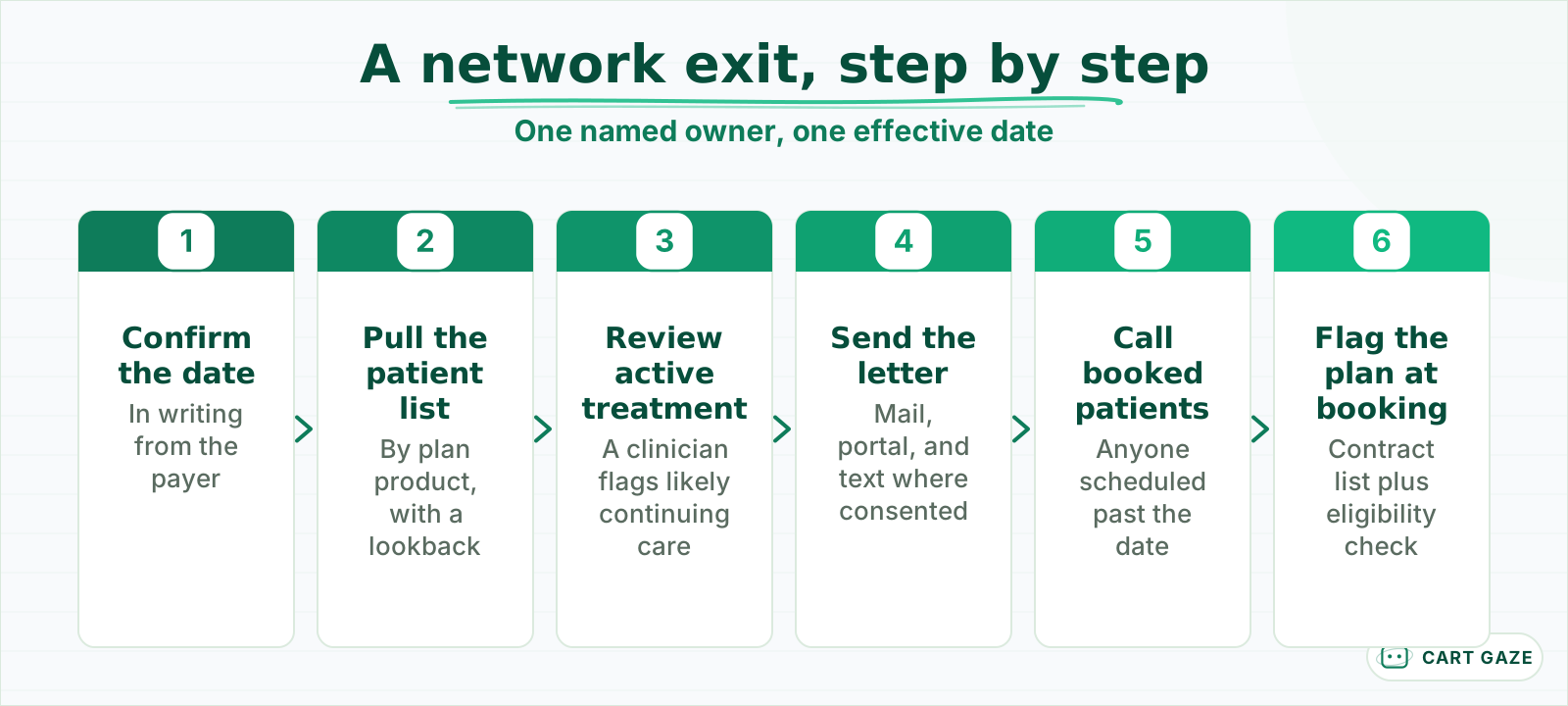 One owner, one effective date. The clinical review of active treatment happens before any letter goes out.
Send it the ways patients actually read: mail, the portal, and a text with a link for patients who have agreed to receive texts from you. Translate it for the languages your patients use.
The phone script for "Do you still take my plan?"
Every caller on that plan gets the same 4 facts: the plan name, the end date, that visits before it stay in network, and their options after it. The desk never decides who qualifies for continuity of care or estimates what the plan will pay. Those questions go to the plan.
A script your whole team can use:
- "Our contract with [plan] ends on [date]. Visits before then are in network."
- "After [date], we will be out of network with that plan."
- "If you are in the middle of treatment, like a pregnancy or a scheduled surgery, call the number on your card and ask about continuity of care. Your plan decides who qualifies."
- "If you want to keep seeing us, we can go over our self-pay prices, or your plan can tell you what it pays out of network. If you would rather move, we will send your records."
- "Would you like to book before [date], or shall I note what you decide?"
What staff should not say matters as much. "You qualify," "you will be covered," and "your plan will pay most of it" are all promises the practice cannot keep.
An AI receptionist can carry most of this call. It can answer "do you still take my plan?" from a dated contract list, book visits before the end date, and text the letter link to patients who have opted in. Questions about eligibility, disputed bills or continuity of care go to a named person. That is the split described in what an AI receptionist does and where it hands off.
Bookings after the date need a second check. The eligibility check confirms the plan is active; your own contract list is what says you are out of its network. Run both on every booking for that plan, as set out in how an eligibility check runs at booking.
Tip
Schedule the contract-list change for the effective date the day the payer confirms it, so the website, the phone script and the booking flow all switch together.
Options for patients who want to stay with you
Patients who want to keep seeing you after the date have 3 routes: use out-of-network benefits if their plan has them, pay as self-pay, or ask the plan for continuity of care if they qualify. Patients who want to leave need their records sent promptly to the new in-network practice.
Out-of-network benefits are the plan's question to answer. Whether a plan pays anything for out-of-network care depends on the plan, so send the patient to their member services line rather than guessing.
A patient with commercial coverage who chooses not to submit a claim counts as self-pay and is owed a good faith estimate on set deadlines, for example within 3 business days of asking for one, while Medicare and Medicaid enrollees cannot be treated as self-pay for that rule. If you already sort cash and insurance callers at intake, the same branch applies here, covered in routing cash-pay and insurance patients at intake.
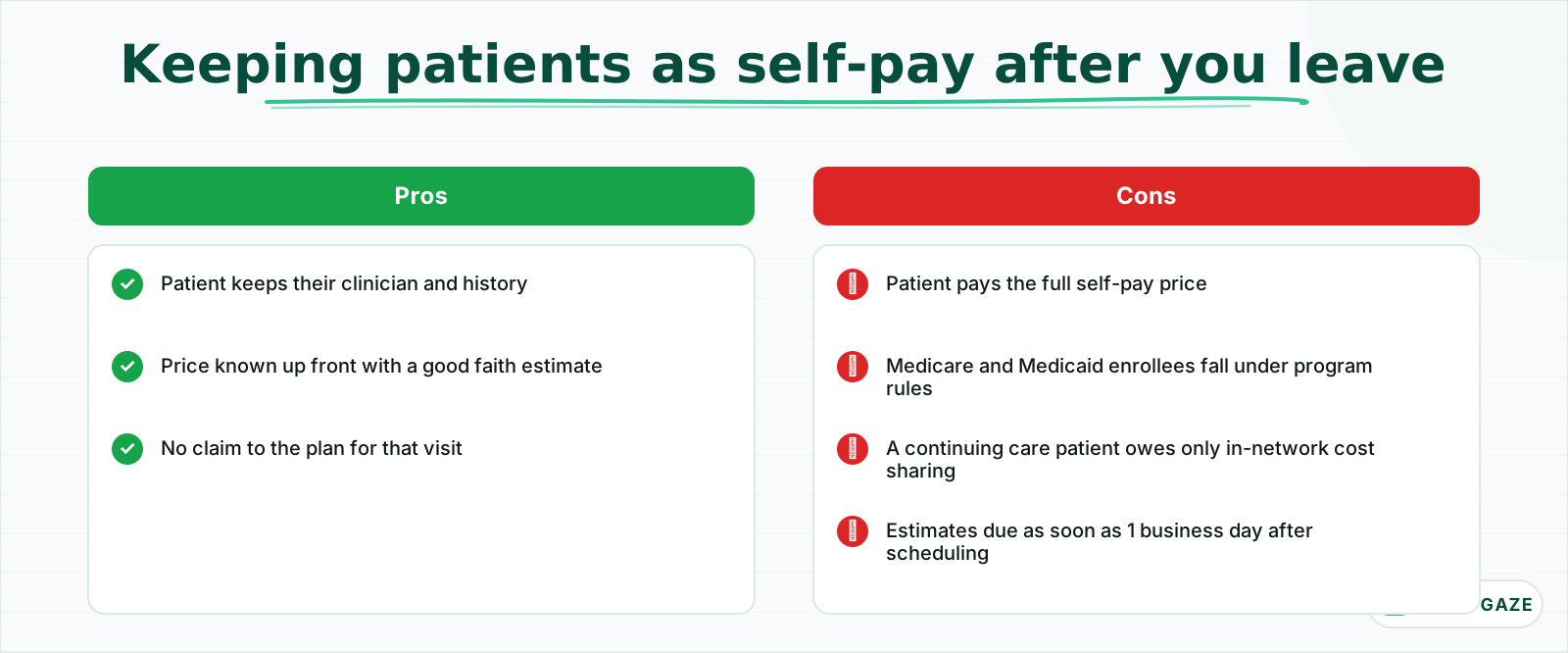 Self-pay keeps the relationship, at a price. Patients in a continuity window are billed under plan terms instead.
Self-pay is the wrong answer for a patient in a continuity window. Once a qualifying patient elects transitional care, you bill the plan, and they owe only in-network cost sharing until the window closes.
For patients who move, the records request is the last impression you leave. Send what the patient or the new practice asks for, without delay, and log it.
Run the network exit as a dated checklist
Treat a network exit as a project with one owner and one date. Confirm the date with the payer, update the directories, identify patients in active treatment, send the letter, script the phones, and flag the plan at booking. Then review the first weeks of calls after the date to catch what slipped.
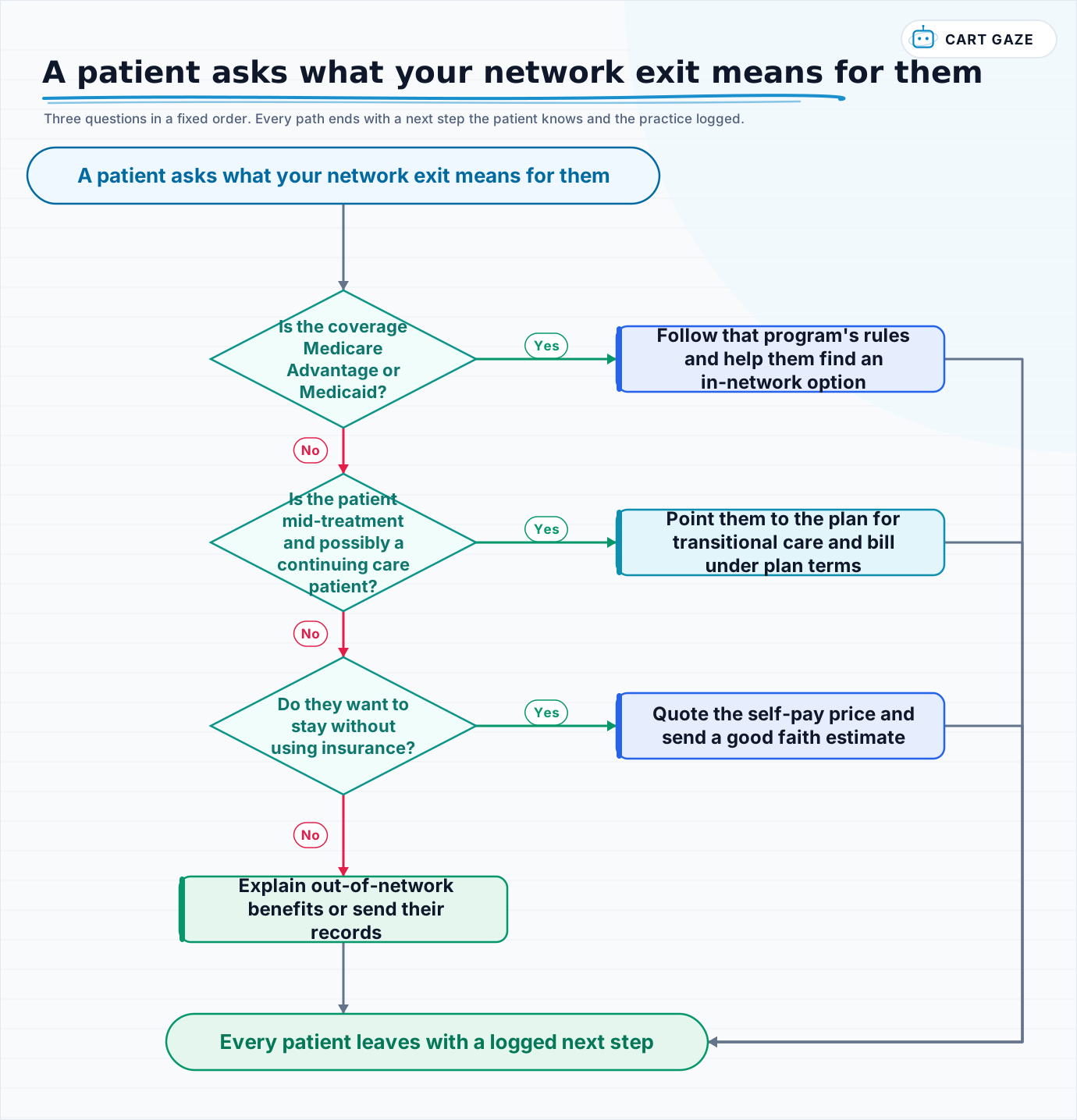 Three questions in a fixed order. Every path ends with a next step the patient knows and the practice logged.
Walk the flow once. A Medicare Advantage or Medicaid patient follows that program's rules, with help finding an in-network option. A patient mid-treatment goes to the plan for transitional care and is billed under plan terms. A patient who wants to stay without insurance gets the self-pay price and an estimate. Everyone else hears their out-of-network options or gets their records sent.
Before the first letter goes out
- The payer has confirmed the effective date in writing, for every plan product affected.
- Directory updates have gone to the plan, with removal on the end date.
- A clinician has reviewed the list of patients in active treatment.
- The letter, the phone script and the self-pay price list are final.
The texts that carry the letter link still need the patient's consent and a working opt-out. For how that runs on the numbers we operate, see how our patient texting works, from opt-in to STOP.
Fair questions.
Do I have to notify patients when my practice leaves an insurance network?
Under the No Surprises Act, the formal duty sits with the plan, which must tell continuing care patients about the termination and their right to transitional care. Medicare Advantage, Medicaid managed care and Marketplace plans have their own notice rules. Your contract or state law may add duties, so confirm with counsel, and send your own letter either way.
What is a continuing care patient under the No Surprises Act?
A patient who, with your practice, is being treated for a serious and complex condition, is in a course of inpatient or institutional care, is scheduled for nonelective surgery or postoperative care, is pregnant and being treated for the pregnancy, or is terminally ill and being treated for it. The plan decides who qualifies, not the front desk.
How long can a patient keep in-network terms after we leave their plan?
Up to 90 days under the No Surprises Act, counted from the date the plan sends its notice, or until the patient no longer meets the continuing care definition, whichever comes first. During that window you accept the plan payment plus in-network cost sharing as payment in full. Federal regulations are still pending, and some state laws allow longer.
Can patients keep seeing us as self-pay after we leave their plan?
Yes, if they choose not to submit a claim, though a patient who elects continuity of care is billed under plan terms during that window. Self-pay patients with commercial coverage are owed a good faith estimate on set deadlines. Medicare and Medicaid enrollees fall under program rules, so confirm what applies before quoting them a cash price.
Do Medicare Advantage plans follow different notice rules?
Yes. A Medicare Advantage plan must send written notice at least 45 days before the termination date for primary care and behavioral health providers, with one phone attempt, and at least 30 days before for other specialties. Contracts between Medicare Advantage plans and providers also require at least 60 days of written notice for a termination without cause.
Sources.
- [1]42 U.S.C. 300gg-113, Continuity of care (U.S. Code, govinfo)
- [2]42 U.S.C. 300gg-138, Continuity of care: provider requirements (govinfo)
- [3]42 U.S.C. 300gg-139, Provider directory information requirements (govinfo)
- [4]FAQs about ACA and Consolidated Appropriations Act, 2021 Implementation Part 49 (CMS, Aug. 20, 2021)
- [5]No Surprises Act Toolkit for Consumer Advocates (CMS, June 2026)
- [6]42 CFR 422.111, Disclosure requirements, (e) changes to provider network (eCFR)
- [7]42 CFR 422.202, Participation procedures, (d)(4) termination timeframes (eCFR)
- [8]42 CFR 422.62, Election of coverage under an MA plan, (b)(23) network change SEP (eCFR)
- [9]42 CFR 438.10, Information requirements, (f)(1) provider termination notice (eCFR)
- [10]45 CFR 156.230, Network adequacy standards, (d) provider transitions (eCFR)
- [11]45 CFR 149.610, Good faith estimates for uninsured (or self-pay) individuals (eCFR)
- [12]California Health and Safety Code 1373.96, completion of covered services
- [13]Network Optimization And The Continuity Of Physicians In Medicaid Managed Care (Health Affairs, 2018)
- [14]KFF Survey of Consumer Experiences with Health Insurance (2023)
- [15]KFF Survey of Consumer Experiences with Health Insurance, topline (June 2023)
Written by

Muhammad Qasim Hammad
Founder, Cart Gaze
Qasim builds AI receptionists and front-office automation for medical and dental practices at Cart Gaze. Posts here start from published sources and real call data, not vendor claims, and every number links back to where it came from.
Keep reading.
 No-Shows & Follow-UpPatient Email vs Text: Which Message Goes by Which Channel15 min read
 No-Shows & Follow-UpThe Intake Form Completion Chase: Paperwork Done Before Arrival11 min read
 No-Shows & Follow-UpHoliday Closure Communication: Keep Patients From a Locked Door10 min read
 No-Shows & Follow-UpNo-Show Rate Benchmarks by Specialty: What the Studies Show10 min read
 No-Shows & Follow-UpRunning Late Text to Patients: When to Send It and What to Say10 min read
 No-Shows & Follow-UpAppointment Deposits and No-Show Fees: Who You May Charge10 min read