
Personal Injury Patient Intake: Confirm Who Pays Before You Treat
An auto-accident patient brings a payer question nobody can answer on day one. Who pays first by state, the Medicare rules, letters of protection, and the fields to capture on the first call.
Key takeaways.
- In the 12 no-fault states and Puerto Rico, the patient's own PIP pays first; in at-fault states, the other driver's insurer pays a settlement, not bills as they arrive.
- Florida PIP pays 80% of reasonable expenses up to $10,000 only if initial care comes within 14 days; New York health service bills are due within 45 days of service.
- For a Medicare patient, no-fault or liability insurance pays first; Medicare may pay conditionally when that insurer will not pay within 120 days, then recovers from any settlement.
- With a liability claim, a practice either bills Medicare and withdraws its lien or keeps the lien, and a Medicare claim must be filed within 1 calendar year of service.
- A letter of protection is paid only if the case resolves, and state law sets how it works, so capture every possible payer on the first call before relying on one.
Table of Contents9 sections
- Why an accident patient is a different intake
- Who pays first: no-fault, at-fault and add-on states
- MedPay, health insurance and the gap between them
- When the patient has Medicare, federal rules set the order
- Letters of protection and liens: state law, not a form
- What to capture on the first call
- What treating before a payer is confirmed can cost
- Build the intake around who pays
- Fair questions
A patient calls on Monday. She was rear-ended on Friday, her neck has been stiff since Saturday, and she wants to be seen this week. Your front desk books her like any other new patient. Three months later her auto insurer says her personal injury protection is used up, her attorney says the bill will be paid when the case settles, and nobody can say when that will be.
That pattern repeats at scale. NHTSA estimates that about 2.42 million people were injured in police-reported US crashes in 2024, and the chiropractic, physical therapy, orthopedic and urgent care practices that see them inherit a payer question no other new patient brings.
Below: who pays first in each kind of state, the Medicare rules, letters of protection, the first-call fields, and the cost of treating before any of that is settled.
Why an accident patient is a different intake
A car accident patient arrives with a payer question nobody can answer on day one. Depending on the state, the patient's own auto policy, the other driver's insurer, a health plan and Medicare can all stand in line, and the payer that ends up responsible may not be known until a claim settles.
Every other new patient answers the payer question with a card. An accident patient answers it with a story, and each part of the story changes who gets the bill. A front desk that books first and asks later finds out from a denial.
The population is not small. NHTSA estimates that 279,225 people 65 and older were injured in crashes in 2023, 11% of everyone injured that year. That figure matters here, because a patient on Medicare brings federal payer rules that override the usual order, covered below.
The same logic reaches past cars. A fall in a store can bring a liability claim, and Medicare's definition of no-fault insurance includes homeowners and commercial plans that pay medical expenses regardless of fault.
If the patient was working when it happened, including driving for work, ask about workers' compensation first; Florida's PIP statute, for example, credits workers' comp benefits against PIP. That intake has its own fields and state rules, set out in what a workers' comp intake has to capture on the first call.
Who pays first: no-fault, at-fault and add-on states
In the 12 no-fault states and Puerto Rico, the patient's own personal injury protection pays first, whoever caused the crash, up to a limit set by state law. In at-fault states, the other driver's liability insurer is responsible, but it pays a settlement, not your bills as they arrive.
The Insurance Information Institute lists the no-fault states as Florida, Hawaii, Kansas, Kentucky, Massachusetts, Michigan, Minnesota, New Jersey, New York, North Dakota, Pennsylvania and Utah. In New Jersey, Pennsylvania and Kentucky, drivers may reject the limit on lawsuits and keep their full right to sue, so the state's label does not settle a patient's coverage. Ask what their own policy carries.
Florida shows how much a statute decides. PIP there pays 80% of reasonable medical expenses up to a $10,000 limit, but only if the patient receives initial care within 14 days of the accident. If a treating provider determines there was no emergency medical condition, reimbursement is limited to $2,500. That determination is clinical and belongs to a licensed provider, never to the front desk. A 2026 Senate bill to repeal Florida's no-fault law died in committee on March 13, 2026, so PIP still applies there.
New York's limits and clocks differ. Basic economic loss is capped at $50,000 per person, the patient must give written notice within 30 days of the accident, and claims for health services are due within 45 days of the date of service, whether the patient or a provider holding the patient's assignment submits them. Michigan lets drivers choose among 6 PIP medical levels, unlimited by default, and a named insured with Medicare Parts A and B may opt out of PIP medical entirely.
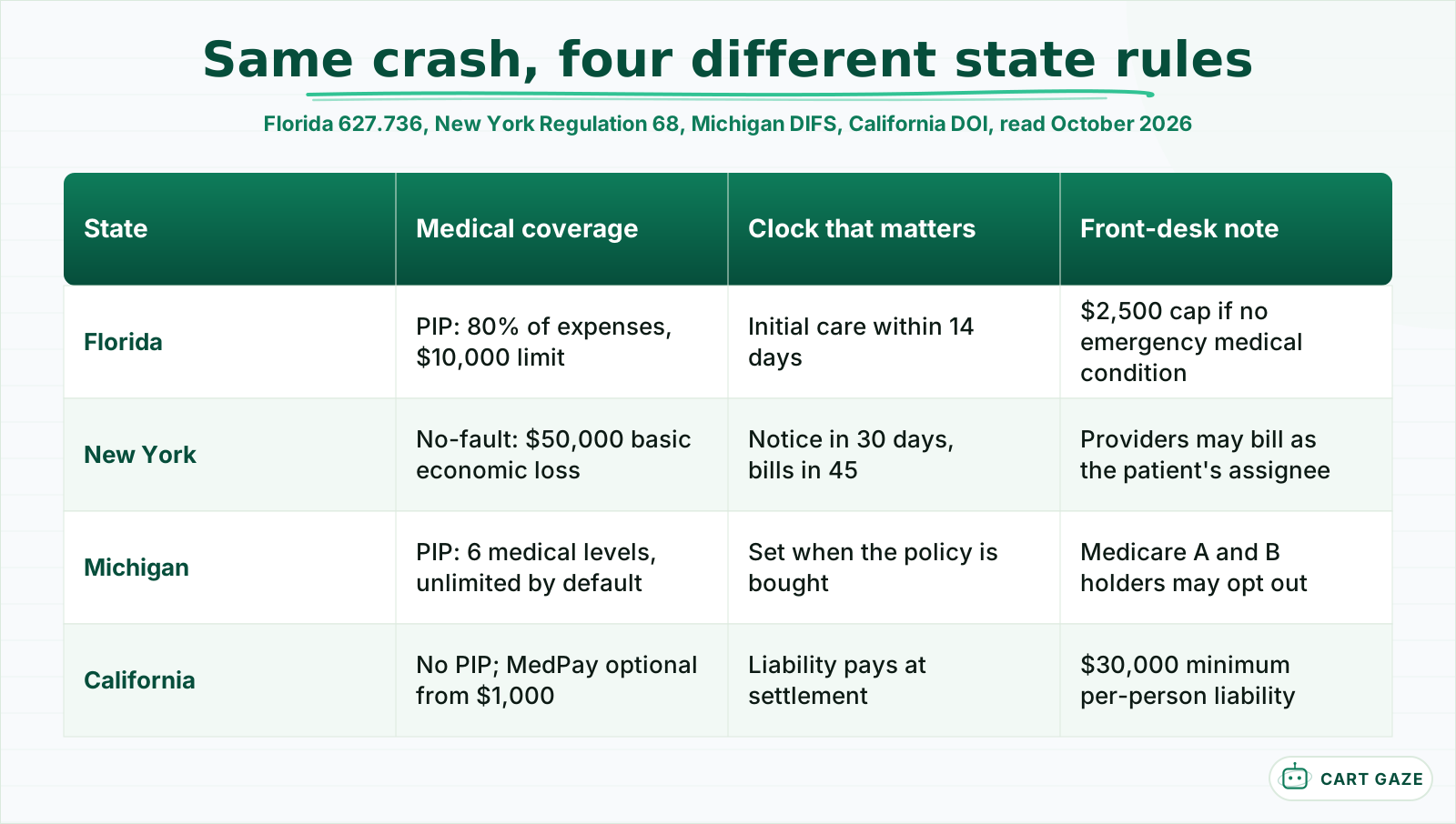 Four states, four sets of rules for the same crash. Check your own state's statute before you build the intake.
In at-fault states, the other driver's bodily injury liability coverage is the main source of money. CMS's Medicare Secondary Payer manual draws the line: no-fault insurance and health plans are obligated to pay for medical services, while liability insurance covers the damages the at-fault party owes, usually as one payment when the claim ends.
Add-on states sit between the two: first-party benefits from the patient's own insurer and no limit on suing, though the III notes those benefits may not be mandatory. Everywhere, ask what the patient's own policy pays, then who else might.
MedPay, health insurance and the gap between them
MedPay is optional coverage on the patient's own auto policy that pays medical bills regardless of fault, with limits as low as $1,000 in California. Health insurance can pay accident care too, but plan terms decide how it coordinates with auto coverage. A settlement may or may not fill the gap.
California's Department of Insurance puts it plainly: MedPay covers medical expenses for the policyholder and passengers no matter who is at fault, and the minimum limit is $1,000 per person. Because it is the patient's own coverage, it can pay early, even in an at-fault state.
Medicare treats MedPay like PIP: federal rules name "medical payments coverage" and "personal injury protection" as examples of no-fault insurance, which matters in the next section.
The other driver's policy is a different kind of money. California's minimum bodily injury liability limit is $30,000 for one person and $60,000 per accident. If the at-fault driver carried only the minimum, $30,000 may be all there is for the patient's lost wages, pain and suffering, and every provider's bill. A practice waiting on that pool is one creditor among several.
Health insurance is the least predictable source for an accident. New York's Department of Financial Services tells consumers they may claim on their health insurance once no-fault benefits are used up. Elsewhere, whether a plan pays first, pays after auto coverage, or seeks repayment from a settlement depends on its terms and state law, so ask the plan and note the answer with a reference number.
If your practice is in network with the patient's plan and you are thinking of billing auto coverage or a settlement instead, read your participation agreement first.
When the patient has Medicare, federal rules set the order
For a Medicare patient hurt in a crash, Medicare pays second. No-fault or liability insurance must be billed first, and Medicare may pay conditionally when that insurer will not pay promptly, then recovers its money from any settlement. With a liability claim, the practice chooses between billing Medicare and keeping a lien.
CMS's provider booklet on the Medicare Secondary Payer rules, updated July 2025, is direct: in an accident, including a car accident, no-fault or liability insurance pays accident-related care first. Practices are expected to ask about other coverage that could be primary at each visit, before services, and to keep the answers for 10 years after the date of service.
"Promptly" has a number. Under 42 CFR 411.21 and 411.50 it means payment within 120 days, counted for liability insurance from the earlier of the date the claim or lien was filed and the date of service. For no-fault coverage, CMS tells providers to bill the no-fault insurer first and get the denial before billing Medicare for a conditional payment. Any conditional payment is made on the condition that Medicare is repaid.
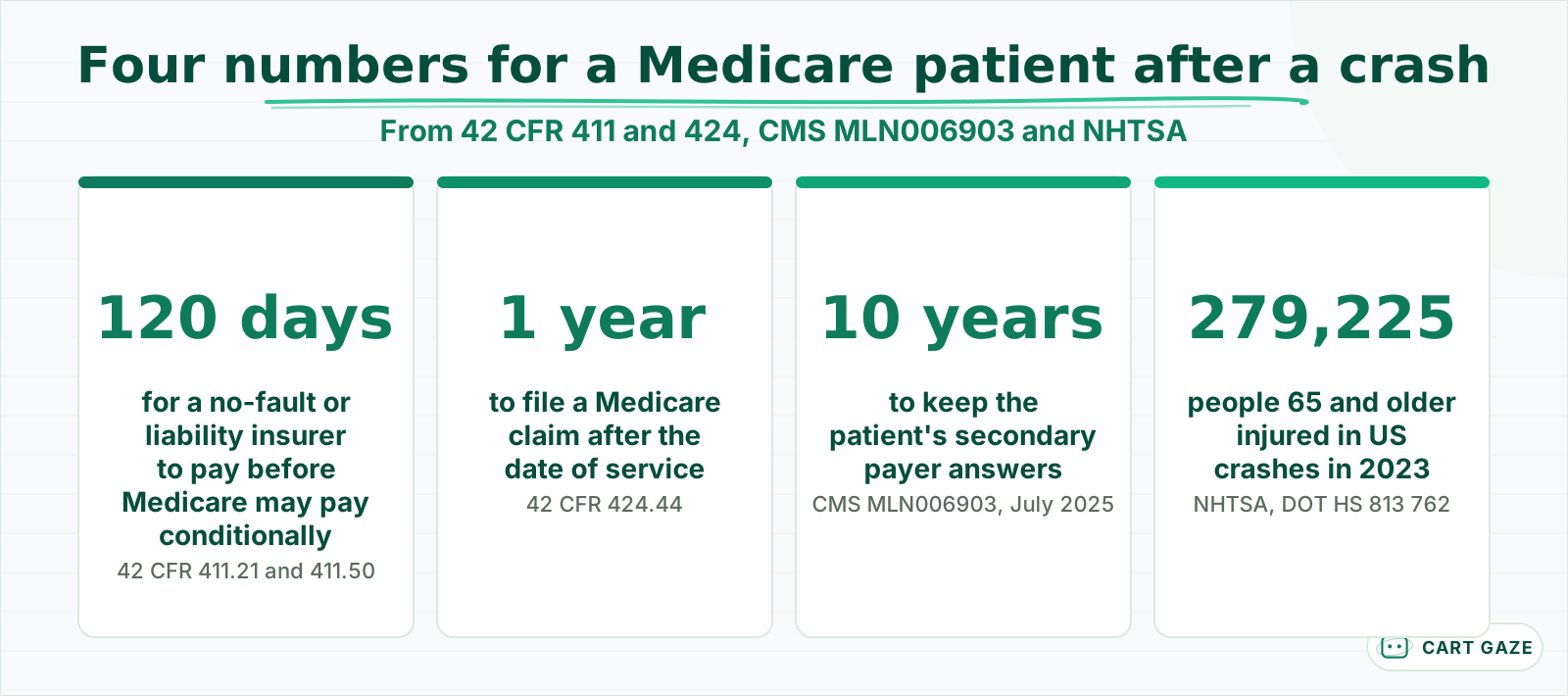 Federal rules and NHTSA data. The first three numbers set the deadlines for a Medicare accident patient.
Liability claims add a choice. CMS's manual says providers generally must bill the liability insurer, or file a lien against the settlement, before the 120-day period runs out. After it, a practice may either bill Medicare and withdraw its claims and liens, keeping only those for services Medicare does not cover and for deductibles and coinsurance, or keep its claims and liens and not bill Medicare. Billing Medicare limits the practice to the Medicare-approved amount, even if it later refunds Medicare's payment.
The clock that catches practices is Medicare's own filing limit: a claim must be filed within 1 calendar year after the date of service. CMS's 2025 booklet confirms a practice may keep pursuing a lien after that year passes, but the Medicare option is gone. A practice that waits on a slow settlement without deciding has decided by default.
Important
Decide the path for each Medicare accident patient in writing before day 120: bill Medicare and withdraw the lien, or keep the lien and accept the wait. Record the date, who decided and why, because the two paths cannot be combined later.
In Michigan, a driver with Medicare Parts A and B may have opted out of PIP medical, so there may be no PIP medical coverage to bill first. Keep the auto policy's declarations page with the patient's secondary payer answers.
Letters of protection and liens: state law, not a form
A letter of protection is a promise, usually from the patient's attorney, that your bill will be paid from any judgment or settlement. It is not insurance. Whether it is enforceable, how a lien attaches, and what a court will let a jury hear about your charges are all set by state law.
Florida's 2023 law, chapter 2023-15, shows how specific those rules get. The statute defines a letter of protection as any arrangement in which a provider treats in exchange for a promise of payment from a personal injury judgment or settlement, whatever the document is called. A claimant seeking medical expenses for care under one must disclose the letter, itemized bills coded with CPT or HCPCS, any sale of the receivable to a factoring company and its price, the patient's health coverage, and who made the referral, including the patient's own attorney.
The same law changes the evidence a jury hears about what the bill is worth. When a patient who has health coverage treats under a letter of protection instead, the evidence includes what that coverage would have paid. For patients with no coverage, or with Medicare or Medicaid, it includes 120% of the Medicare rate. A practice charging well above those figures should expect the gap to be argued.
Other states handle this through lien statutes, case law or not at all, and the rules can differ by type of provider as well as by state. This post is general information, not legal advice: before you accept letters of protection or file liens, confirm your state's rules with counsel and put the practice's terms in writing.
Warning
A letter of protection is not a payer verification. Ask about PIP, MedPay, health insurance and Medicare first. For a Medicare patient, treating under a letter means pursuing the liability claim, so the 120-day and lien rules above still apply.
Even sound paperwork carries risk: a case can settle for less than the bills, settle late, or not settle. Set a written ceiling for the balance you will carry on a letter, ask for status updates at fixed intervals, and state in your financial policy what happens if the case does not pay.
What to capture on the first call
Capture the injury facts and every possible payer before the first visit: date and state of the accident, whether it happened at work, the patient's own auto carrier and claim number, the adjuster, the other driver's insurer, health insurance, Medicare status, and the attorney, if one is involved.
| Field | Why it matters | Ask it this way |
|---|---|---|
| Date of injury and state | Sets the state rules and clocks, such as Florida's 14 days | "What day did it happen, and in which state?" |
| How it happened, and whether at work | A work injury goes to workers' comp | "Were you working or driving for work at the time?" |
| Own auto carrier, claim number, PIP or MedPay limit | First-party coverage can pay early | "Has your own insurer given you a claim number?" |
| Adjuster name and direct line | Confirms the claim is open and the limit left | "Who is your adjuster, and what is their number?" |
| Other driver's insurer and claim number | The liability claim that may settle later | "Do you know the other driver's insurance company?" |
| Health plan and Medicare | Secondary payer, or the payer once auto coverage runs out | "Do you have health insurance or Medicare?" |
| Attorney and any letter of protection | Lien rules, disclosures, status calls | "Is an attorney handling your claim?" |
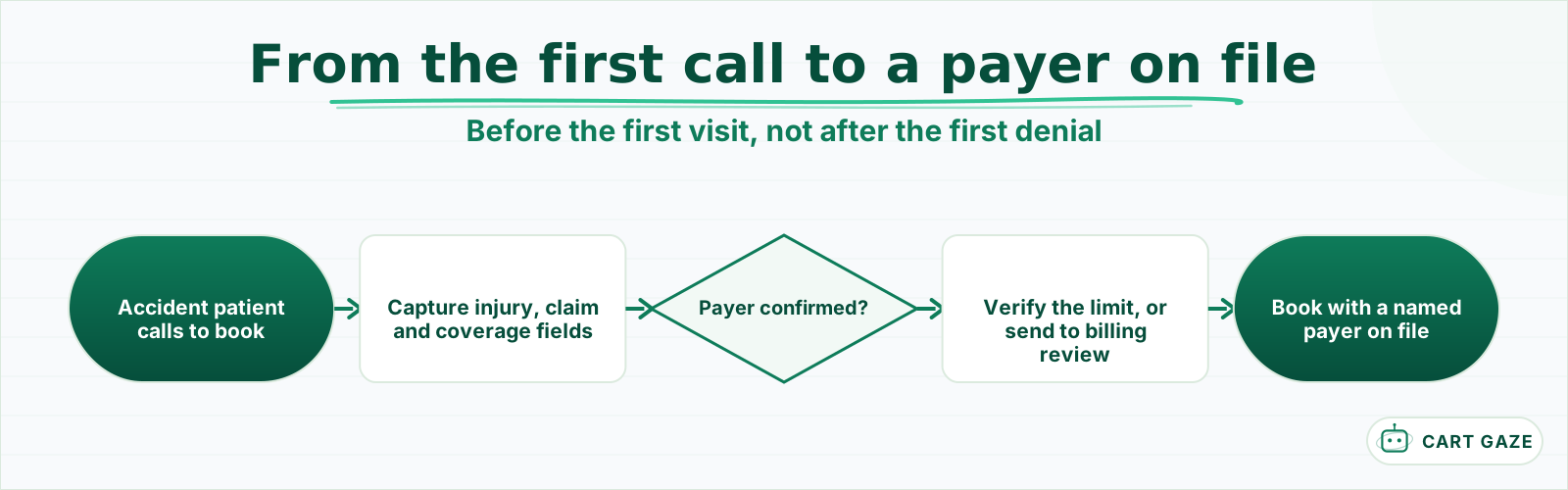 The front desk captures and routes. Billing confirms the payer. The visit is booked with a named payer on file.
Read every claim number and phone number back to the caller; auto claim numbers mix letters and digits, and one transposed character sends the first bill nowhere. Ask the patient to photograph both the auto and health insurance cards before the visit. Why a clean scan still does not prove coverage is covered in how insurance card capture works and where it stops.
Then verify: call the adjuster to confirm the claim is open, which coverage applies and how much of the limit is left, and record who said it and when. Ask a health plan how it handles accident-related claims. Mark any field the patient could not answer as pending, with a follow-up date.
Tip
Ask for the remaining limit, not the policy limit. A $10,000 Florida PIP policy that the emergency department has already billed against is not a $10,000 policy for your practice.
Privacy rules cover the people who call about the patient. Sending a claim to the auto insurer is a payment disclosure, which HIPAA lets a provider make for its own payment activities. A records request from an attorney generally needs the patient's signed authorization, and staff should verify the identity and authority of any adjuster or law-firm caller they do not already know.
Automation helps with the repetitive half. A scripted intake, read by a person or run by software, asks the same questions in the same order on every call, sends a secure link for card photos, and puts the dates that matter on a task list: Florida's 14 days, New York's 45, day 120 and the 1-year Medicare limit. It must not decide coverage, judge whether there was an emergency medical condition, or give legal advice.
What treating before a payer is confirmed can cost
Treating an accident patient before a payer is confirmed turns each visit into credit you extend. The balance can outrun a shared PIP limit, miss a state filing clock, lose the Medicare option after a year, or wait on a settlement that arrives late, arrives short, or never arrives.
Start with the shared limit. Florida's $10,000 PIP limit is one pool for every provider who treats the patient, and for disability benefits too. Modeled: if the emergency department and imaging center have already used $8,000 of it, at most $2,000 is left for every provider after them. A 12-visit therapy plan at $150 a visit is $1,800 in charges, and PIP at 80% of that is $1,440, most of what remains. These are our numbers, not a published case; the adjuster can tell you the real remaining amount.
Then the clocks: a Florida patient whose initial care came after day 14 has no PIP medical benefit to bill, New York health service bills are due within 45 days of service, and Medicare's 1-year limit runs whether or not anyone watches it. A letter of protection pays only if the case resolves.
None of this argues for turning accident patients away. Decide before the first visit which payer the visit is billed to and what happens if that payer says no, and tell the patient the same.
Before an accident patient's first visit
- The state, the date of injury and the work question are on file.
- Each payer has a claim number, a contact and a remaining limit, or a pending date.
- A Medicare patient has secondary payer answers and a written bill-or-lien decision.
- Billing has reviewed every letter of protection against your written terms.
Build the intake around who pays
Build the accident intake around one question: who pays for this visit, and how do we know? Put the work question first, the Medicare question second and coverage verification third, and send anything unconfirmed to billing review before the first appointment rather than discovering it on the first denial.
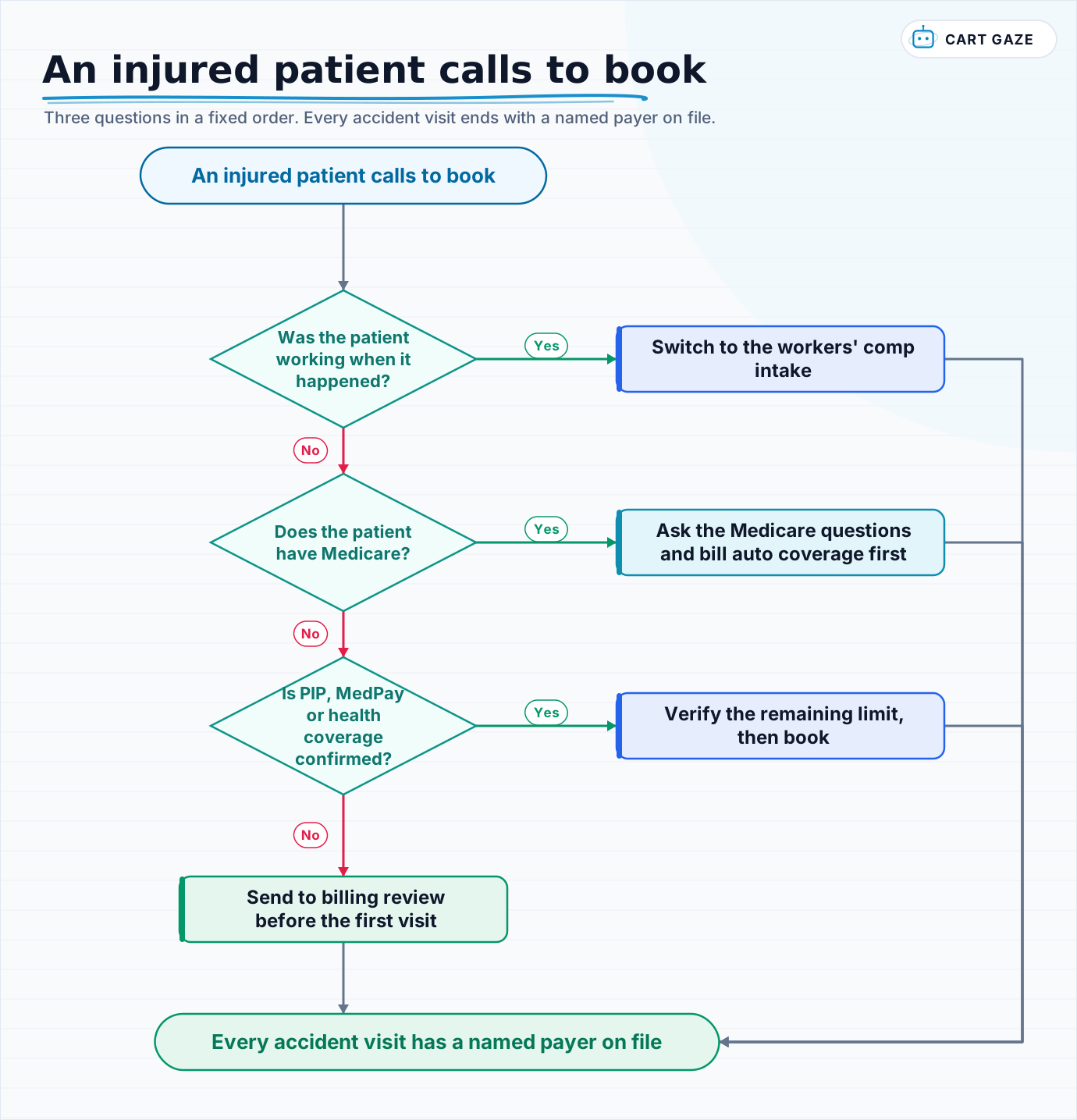 Three questions in a fixed order. Every accident visit ends with a named payer on file.
Walk a call through it: a work injury goes to the workers' comp intake, a Medicare patient gets the secondary payer questions with auto coverage billed first, and everyone else books once coverage is confirmed with a remaining limit. Anything unconfirmed goes to billing review.
Pilot it on new accident patients for 30 days, and track how many arrive with a confirmed payer and how many accident claims come back denied or pending the next quarter. If you are weighing an automated first call for this work, read what an AI receptionist does and where it stops so the questions it asks, and the decisions it leaves to staff, are settled before it answers a patient. To size the calls that never become visits at all, the growth leak calculator estimates what missed and after-hours calls cost each month from your own numbers.
Fair questions.
Who pays first for a car accident patient's treatment?
It depends on the state. In the 12 no-fault states and Puerto Rico, the patient's own personal injury protection pays first, up to a state limit, whoever caused the crash. In at-fault states, the other driver's liability insurer is responsible but pays a settlement when the claim ends, so MedPay or health insurance may cover care in the meantime.
What should the front desk collect when an auto accident patient calls?
The date and state of the accident, whether the patient was working, their own auto carrier and claim number, the PIP or MedPay limit and the adjuster, the other driver's insurer, health insurance and Medicare status, and any attorney or letter of protection. Read claim numbers back, and ask the adjuster for the remaining limit, not the policy limit.
Can we bill Medicare for a patient injured in a car accident?
Medicare pays second when no-fault or liability insurance applies. Bill the no-fault insurer first; Medicare may pay conditionally if that insurer will not pay within 120 days, and recovers from any settlement. With a liability claim, you either bill Medicare and withdraw your liens or keep the lien. Medicare claims must be filed within 1 calendar year of service.
What is a letter of protection?
A letter of protection is a promise, usually from the patient's attorney, that your bill will be paid from any judgment or settlement. It is not insurance, and state law sets how it works. Florida, for example, requires the claimant to disclose the letter, itemized coded bills and who made the referral. Ask about every insurance payer before relying on one.
Is MedPay the same as PIP?
Both pay medical bills from the patient's own auto policy regardless of fault, and Medicare treats both as no-fault insurance. PIP is mandatory in no-fault states and can also cover lost income. MedPay is optional and, in California, can be bought with limits as low as $1,000 per person. Ask which one the patient's policy carries, and the limit.
Sources.
- [1]Insurance Information Institute: Background on no-fault auto insurance
- [2]Florida Statutes 627.736, required personal injury protection benefits (2025)
- [3]Florida Senate Bill 522 (2026), Motor Vehicle Insurance, bill history
- [4]Florida Statutes 768.0427, letters of protection and medical expense evidence
- [5]New York DFS Regulation 68 (11 NYCRR 65), no-fault regulation text
- [6]New York DFS: consumer questions about no-fault insurance
- [7]Michigan DIFS: choosing PIP medical coverage
- [8]California Department of Insurance: automobile insurance guide
- [9]42 CFR 411.21, Medicare secondary payer definitions (eCFR)
- [10]42 CFR 411.50, no-fault and liability insurance general provisions (eCFR)
- [11]42 CFR 411.52, conditional Medicare payment in liability cases (eCFR)
- [12]42 CFR 424.44, time limits for filing Medicare claims (eCFR)
- [13]CMS Medicare Secondary Payer Manual, Chapter 2, MSP provisions
- [14]CMS MLN006903: Medicare Secondary Payer (July 2025)
- [15]NHTSA: Overview of Motor Vehicle Traffic Crashes in 2024 (DOT HS 813 791)
- [16]NHTSA: Summary of Motor Vehicle Traffic Crashes, 2023 Data (DOT HS 813 762)
- [17]45 CFR 164.506, uses and disclosures for treatment, payment and operations (eCFR)
- [18]45 CFR 164.508, uses and disclosures requiring an authorization (eCFR)
Written by

Muhammad Qasim Hammad
Founder, Cart Gaze
Qasim builds AI receptionists and front-office automation for medical and dental practices at Cart Gaze. Posts here start from published sources and real call data, not vendor claims, and every number links back to where it came from.
Keep reading.
 Billing & Revenue CycleWorkers Comp Intake Automation: Capture What Gets Paid10 min read
 Billing & Revenue CycleCash-Pay Patient Intake vs. Insurance: Branch the Call First10 min read
 Billing & Revenue CycleTime-of-Service Collections: Get Paid Before the Patient Leaves15 min read
 Billing & Revenue CycleCopay Waiver Rules: What a Medical Practice May Discount15 min read
 Billing & Revenue CyclePrice Shopper Calls: How to Quote Cash Prices by Phone and Book10 min read
 Billing & Revenue CycleBilling Question Call Deflection: Automate the Boring Half10 min read