
NEMT Ride Scheduling: Cut No-Shows When the Ride Is the Problem
Some no-shows are patients who never had a ride. Who qualifies for Medicaid non-emergency transportation, how state booking cutoffs work, what ride-share trials found, and what the front desk can automate.
Key takeaways.
- In 2017, 5.8 million people in the US delayed medical care because they had no transportation; 5.6% of adults on Medicaid did, against 1.9% of all adults.
- Every state must ensure rides for Medicaid enrollees with no other way to a covered service, under 42 CFR 431.53; the broker or plan, not your desk, decides who qualifies.
- Booking cutoffs vary by state: Georgia asks for 3 workdays and New York for 72 hours, so the ride prompt has to go out before the cutoff, not the day before the visit.
- Ride-share results are mixed: a 786-patient Penn trial found 36.5% vs 36.7% missed visits, and only 19.8% of the patients reached used the free ride.
- Automate 3 touches: a transportation question at booking, a ride prompt timed to the cutoff and a day-before ride check, then code ride failures apart from no-shows.
Table of Contents9 sections
- Why a missing ride looks like a no-show
- Who qualifies for a Medicaid ride
- How booking a Medicaid ride works, and why the cutoff matters
- What Medicare Advantage, PACE and Original Medicare cover
- What the ride-share trials actually found
- What the front desk can automate around a ride
- Count ride failures separately from no-shows
- Build the ride into the booking
- Fair questions
A patient who misses a visit because the ride never came looks the same in your no-show report as a patient who forgot. Reminders fix the second patient. They do nothing for the first, and for practices with a large Medicaid panel the first is common.
Using National Health Interview Survey data, a 2020 study in the American Journal of Public Health estimated that 5.8 million people in the United States, 1.8% of the population, delayed medical care in 2017 because they had no transportation. Medicaid is meant to close that gap: federal rules require every state to make sure enrollees with no other way to reach a covered visit can get a ride.
This post covers who qualifies, how booking works, what Medicare Advantage adds, what the ride-share trials found, and what your booking flow can automate.
Why a missing ride looks like a no-show
Transportation misses do not respond to reminders, because the patient knows the appointment and cannot reach it. In 2017, 5.6% of US adults on Medicaid delayed care because they had no transportation, against 1.9% of all adults. Your no-show report counts both kinds of miss the same way, which hides the fix.
The survey asked whether adults had delayed care in the past 12 months because they lacked transportation. The barrier climbs with disadvantage: 3.7% of adults with a functional limitation said yes, and about 7 in 100 adults below the poverty line. After the authors controlled for other factors, Medicaid recipients still had higher odds of reporting it.
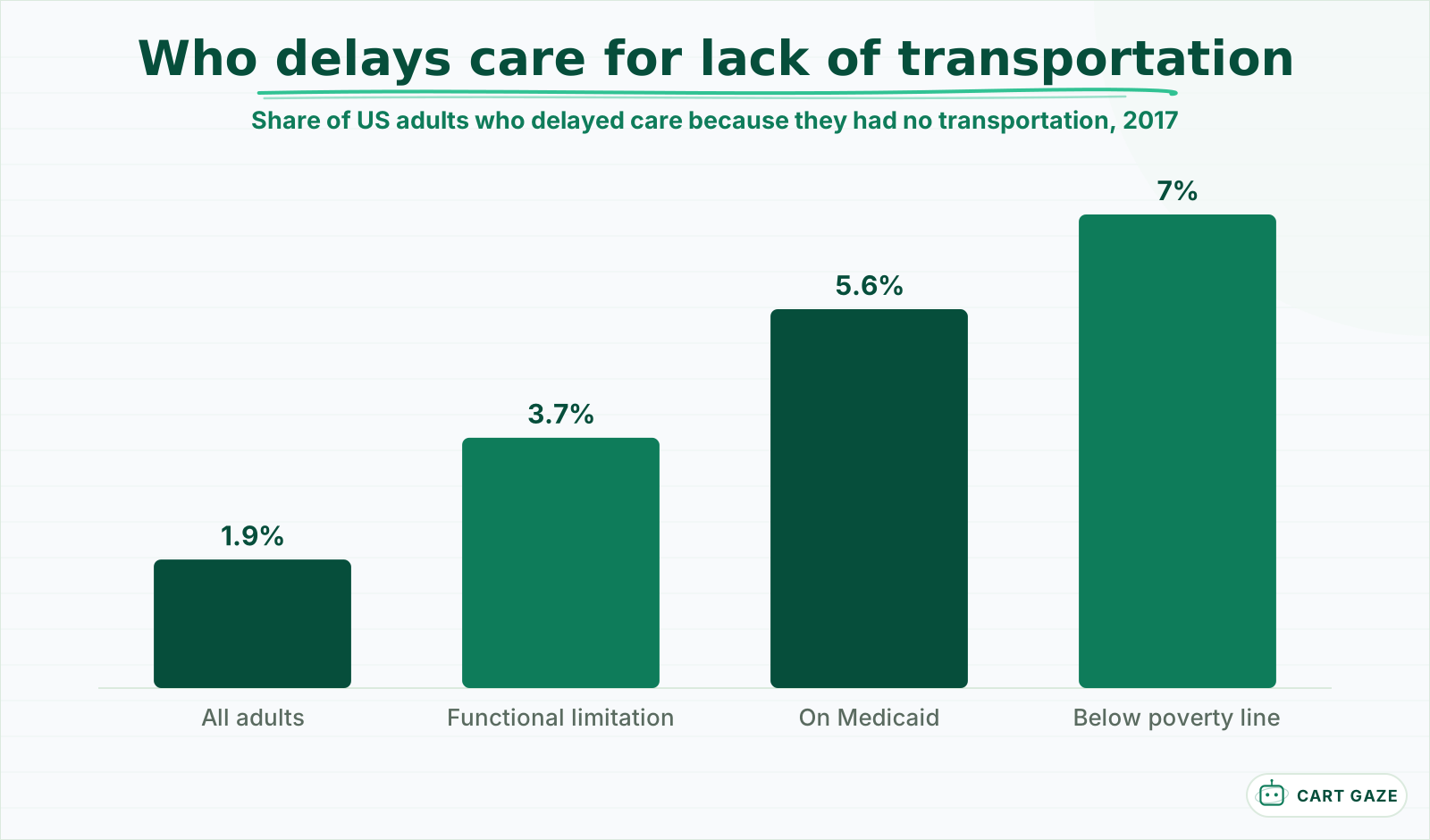 US adults, 2017 National Health Interview Survey, via Wolfe and colleagues, AJPH 2020. Delayed care, not missed visits.
Newer surveys connect delay to missed visits. In a 2022 survey of 2,181 adult Iowa Medicaid members, 11% of traditional members reported missing a health visit for transportation reasons in the past 6 months, as did 15% of expansion members who had the ride benefit. A North Carolina survey of 323 Medicaid and Medicare patients with at least 6 outpatient visits a year found about 1 in 3 had a transportation problem that made them late, delayed care, or caused a miss.
The Iowa authors flagged something a front desk can act on: the benefit's impact was limited by low awareness and use. Patients who could get a ride may not know it, or how to book one.
Reminders fix forgetting, and the reminder playbook for reducing no-shows covers that cadence. A patient whose car is in the shop needs a different message: the number to call for a ride and the last day to call it.
Who qualifies for a Medicaid ride
Every state Medicaid program must ensure necessary transportation for enrollees to and from providers, under 42 CFR 431.53 and, since 2021, the Social Security Act itself. CMS reads that as a duty to reach enrollees with no other way to a covered service, not a promise to pay for every trip.
The regulation is 2 sentences long. A state plan must "specify that the Medicaid agency will ensure necessary transportation for beneficiaries to and from providers" and "describe the methods that the agency will use to meet this requirement." Section 209 of the Consolidated Appropriations Act, 2021 wrote the same assurance into section 1902(a)(4) of the Act.
CMS's Medicaid Transportation Coverage Guide (SMD 23-006, September 28, 2023) spells out what that means:
- It is "not a requirement for states to pay for a ride." It covers enrollees with no other means of transportation.
- The trip must be to a covered service with a Medicaid provider.
- The ride is the least costly mode that meets the patient's medical needs. Under 42 CFR 440.170(a), that can be a bus pass, a taxi, a wheelchair van or a stretcher car.
- Rides generally go to the nearest qualified provider unless there is a medical need to go farther, though CMS warns a rigid reading can breach the patient's freedom of choice.
- Emergency ambulance trips are covered too, need no pre-approval, and are not booked through the ride line.
Two edge cases come up at the desk. For patients with both Medicare and full Medicaid, the state must still ensure a ride to a Medicaid-coverable service when Medicare pays first. And a few states are exempt for some groups: Iowa need not provide rides to adults in its Medicaid expansion program unless they are medically exempt or under 21.
Important
The broker or plan decides who qualifies and what kind of ride they get, not your staff. Give patients the right number and the date to call by, but never tell a patient a ride is approved until the broker has confirmed it.
How booking a Medicaid ride works, and why the cutoff matters
States arrange rides through a transportation broker, a Medicaid managed care plan, or both, and the patient or someone acting for them calls ahead to book. The advance notice varies: Georgia asks for 3 workdays and New York for 72 hours. Miss that cutoff and a routine ride may not happen.
Federal rules let a state hire a broker, chosen by competitive bid and barred from steering trips to transport companies it has a stake in. In managed care, the plan's customer service line can explain the ride benefit. On the booking call, CMS's consumer fact sheet says, the contact confirms enrollment, checks the appointment is with a Medicaid provider, confirms there is no other reasonable way there, and picks the type of ride.
Georgia shows how specific the rules get. Members, or a person acting on their behalf, call the broker between 7 a.m. and 6 p.m. Monday through Friday, at least 3 workdays before a non-urgent appointment. The count includes the day of the call and excludes the day of the appointment:
- A Thursday visit needs a call by Monday.
- A Monday visit needs a call by the Wednesday before.
- An urgent trip, where the patient must be seen that day and there is no threat to life or limb, is honored within 3 hours.
Since April 1, 2026, one broker, Verida, has covered all 5 Georgia regions, with a 24/7 "Where's My Ride" line.
New York contracts with one broker, Medical Answering Services, and asks members to call at least 72 hours before the appointment, with every trip approved in advance. A Monday 9 a.m. visit means calling by Friday at 9 a.m. which a patient booked on Friday afternoon has already missed.
Other states, and managed care plans, set their own windows, so write down the number and cutoff for each plan your patients carry. The cutoff is where these visits are lost: a Georgia patient booked on Tuesday for Thursday is already inside the window. Raising the ride while booking keeps the cutoff from deciding the visit.
Rescheduling has a second step. CMS tells enrollees to call the ride service as soon as an appointment changes, so a reschedule message should say so.
What Medicare Advantage, PACE and Original Medicare cover
Original Medicare's non-emergency transport benefit is limited to ambulance, so it does not cover a ride to a routine visit. Medicare Advantage plans may add rides as a supplemental benefit that the plan itself arranges, and details vary plan by plan. PACE includes transportation to its center and to medical appointments.
CMS's Medicare Managed Care Manual is direct: a Medicare Advantage plan "is not obligated to provide transportation to obtain non-emergent, covered Part A and Part B services," but may offer it as a supplemental benefit. The plan must arrange or provide the rides, physician office visits being the manual's example, and trip limits and booking rules live in each plan's benefit documents.
So ask Medicare Advantage patients who say getting to you is hard whether their plan includes rides; the member services number on the plan card answers it.
PACE, the Program of All-Inclusive Care for the Elderly, covers "transportation to and from the PACE center and medical appointments," so those questions go to the PACE organization.
| Coverage | Routine rides to visits? | Who arranges | What the desk tells the patient |
|---|---|---|---|
| Medicaid, fee-for-service | Yes, with no other means of transportation | State broker or agency | Broker number and the booking cutoff |
| Medicaid managed care plan | Yes, where the state puts rides in the plan | The plan or its vendor | The plan's ride line |
| Full Medicare and Medicaid | Yes, to a Medicaid-coverable service | State broker or plan | Same as Medicaid |
| Medicare Advantage | Only if the plan offers it | The plan | Check the plan's benefits first |
| Original Medicare | Limited non-emergency ambulance only | Not applicable | Talk through other options |
| PACE | Yes, to the center and appointments | The PACE organization | The PACE organization's number |
What the ride-share trials actually found
Free ride-share rides have a mixed record. A small Philadelphia pilot raised primary care show rates, but a larger trial at the same practices found no change in missed visits, and few patients used the rides. A 2022 meta-analysis found fewer missed appointments overall, though its controlled trials alone were inconclusive.
In a 2018 pilot at 2 Penn primary care practices in one building, Medicaid patients at the practice offering free rides went from a 54% show rate to 68%, while the comparison practice fell from 60% to 51%. The adjusted odds of showing up rose 2.57 times more at the ride-share practice, but the intervention period counted only 60 visits there.
The larger trial, published in JAMA Internal Medicine the same year, enrolled 786 Medicaid patients. Patients whose reminder call fell on an even-numbered weekday were offered a free ride on a call 2 days before the visit. The missed appointment rate was 36.5% in the ride arm and 36.7% under usual care, a null result. The authors pointed to low uptake: after a published correction, 57 of the 288 ride-arm patients who answered the call, 19.8%, used a ride.
At Massachusetts General Hospital, 151 of 7,707 patients scheduled for MRI, 1.95%, used a new ride service. Missed appointments did not change significantly, though riders arrived on time more often.
Pooled evidence leans positive but soft. A 2022 systematic review in BMC Public Health combined 7 studies of transport help (van rides, bus or taxi vouchers and ride-share) and found an odds ratio for missed appointments of 0.63, favoring the interventions. The 3 controlled trials alone gave 0.71, with a confidence interval crossing 1, so not statistically significant, and every study carried some risk of bias. Humana, a health insurer, funded it. An earlier Medical Care review rated most studies low quality, with low uptake in the more rigorous ones.
A 2019 pilot at Boston Medical Center's pediatric hematology clinic offered rides only to families who reported transportation trouble and saw an 8.5% drop in the no-show rate, at a cost of $2,175 over 3 months. It was not randomized, so read it as a signal, not proof.
Tip
Ask before you offer. The Penn trial offered rides broadly, few patients took them, and its authors suggested targeting patients with stronger transportation needs. One question at booking does that targeting at no cost.
What the front desk can automate around a ride
Three touches cover most of the gap: a transportation question at booking, a ride prompt timed to the state's cutoff, and a day-before confirmation that asks about the ride as well as the visit. Each can run by text or voice, and none requires your practice to decide who qualifies.
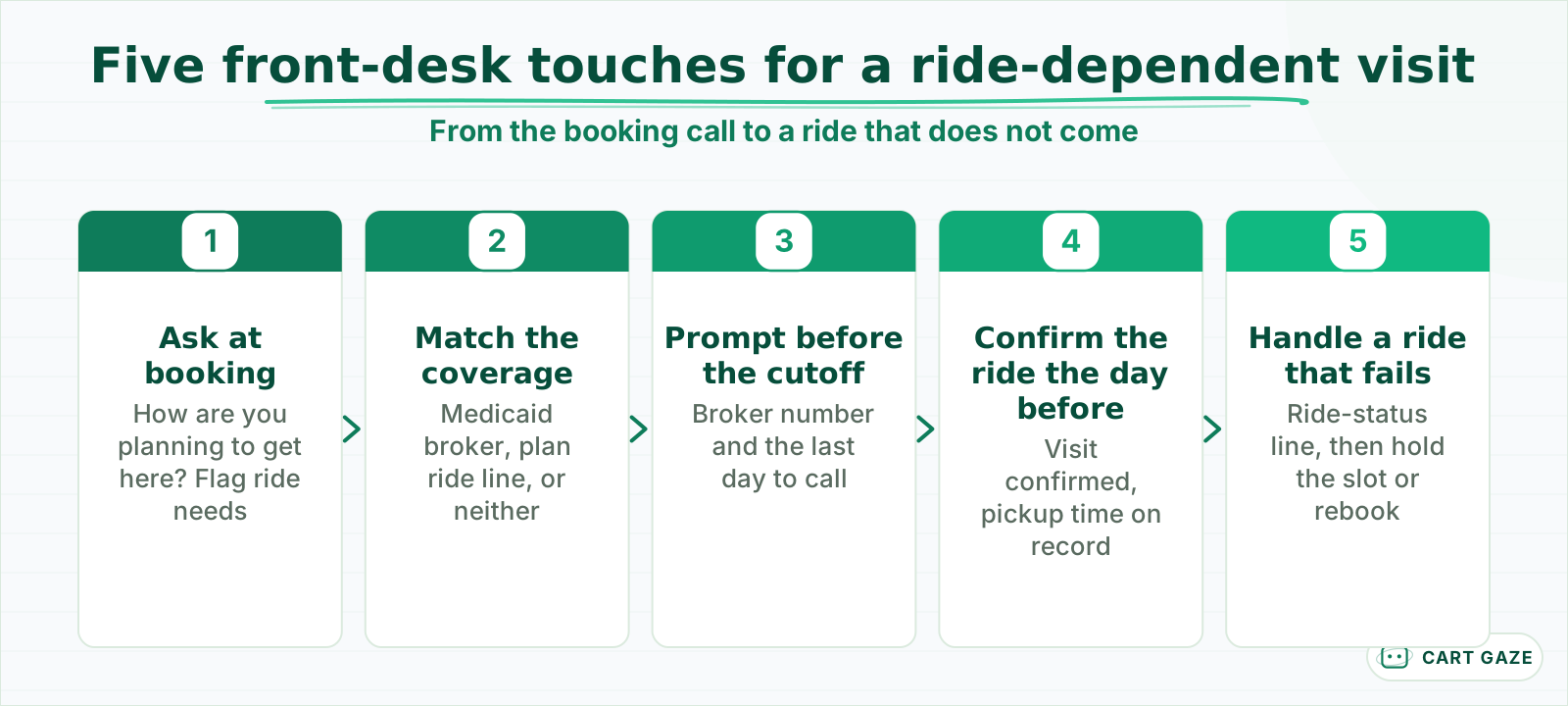 None of these steps decides eligibility. They make sure the patient calls the right line in time.
At booking, ask one question. "How are you planning to get here?" If the patient needs help, flag the appointment and note mobility needs such as a wheelchair. If they are on Medicaid, give them the broker or plan number and the date to call by. Wording matters: "You may be able to get a ride through Medicaid" is accurate, while "We'll get you a ride" is a promise your desk cannot keep.
Before the cutoff, send the ride prompt. Send it a day or two before the last day to call, so a busy phone line does not cost the patient the ride. A Georgia version for a Thursday visit:
"Your visit at [practice] is Thursday, October 22 at 10:00 a.m. If you need a Medicaid ride, call [broker] at [number] by Monday, October 19. Reply 1 once your ride is booked, or 2 if you need help."
Route a reply of 2 to a person the same day.
The day before, confirm the ride with the visit. Fold the ride into your existing confirmation: "Reply C to confirm. If you have a ride booked, reply with your pickup time." A patient who confirms but has no ride gets a staff call that afternoon, while there is still time to move the visit. CMS's guide lets states require riders with repeated no-shows to confirm "the morning of or the night before," so your message can remind them to make that call.
When the ride does not come, use a script. CMS tells enrollees to call the number they booked with, then their provider. When they reach you, point them back to the broker's ride-status line, because states are expected to send replacement rides at short notice. Hold the slot as long as the schedule allows; otherwise rebook on the spot.
Warning
Keep ride texts to the date, time, place and phone number, and leave the reason for the visit out of every message. If staff call a broker for a patient, get the patient's okay first, share only what the booking needs, and confirm the approach with your privacy officer.
An AI receptionist can run most of this by voice or text: the booking question, the timed prompt, the day-before reply and the ride-status number for a stranded patient. It does not decide eligibility, promise a ride, or judge whether a symptom makes a visit urgent; those go to the broker or your staff, the boundary set out in what an AI receptionist does and where it hands off. For the reminder layer underneath, see how AI scheduling and appointment reminders work together.
Count ride failures separately from no-shows
Add a transportation reason to your missed-visit log, because a ride that never came and a patient who forgot need different fixes. Then follow each flagged visit through the 4 points where it can fall out: flag, ride request, ride confirmation and arrival. The narrowest stage shows what to automate first.
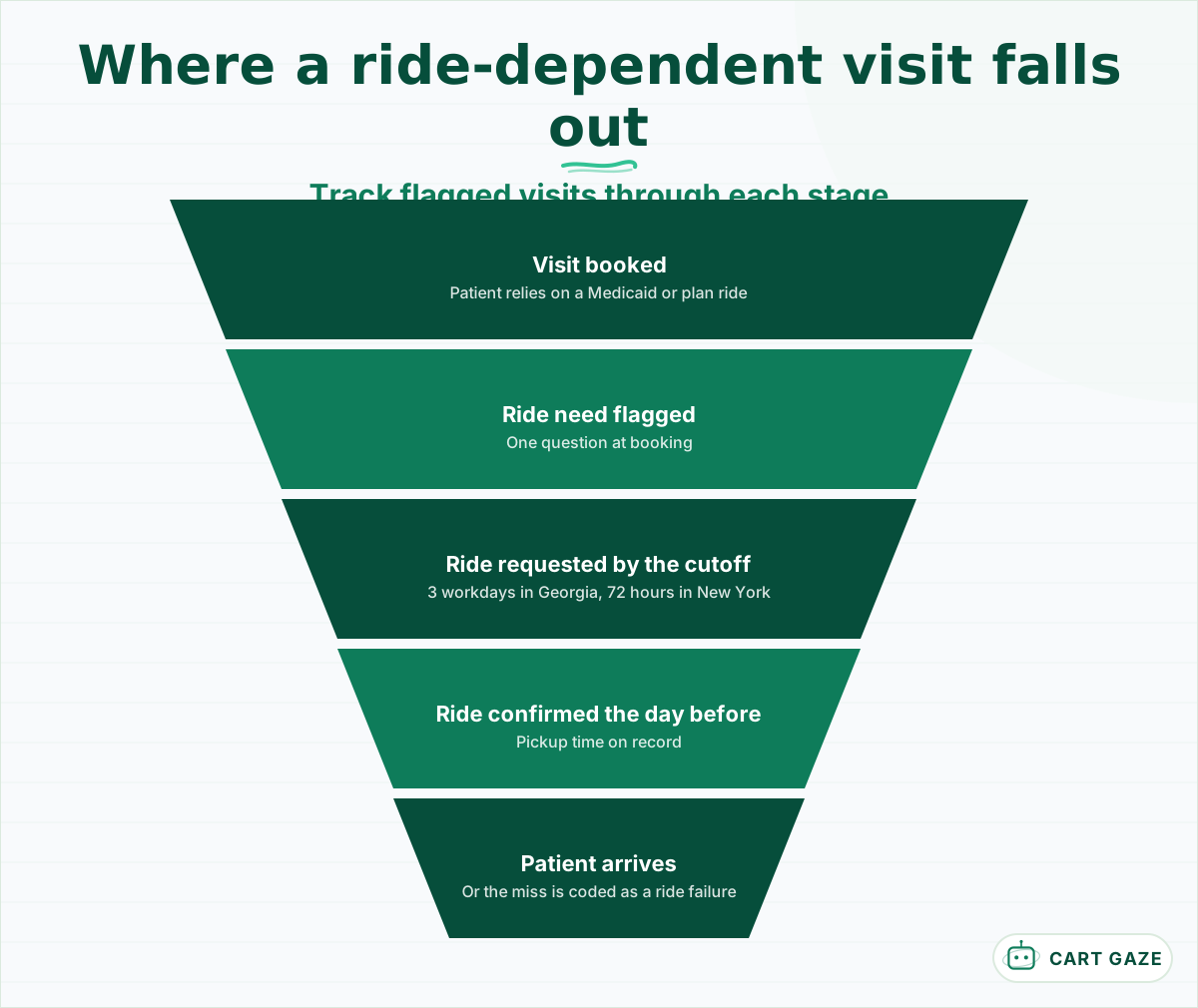 Code each miss by stage. The narrowest stage shows where to automate first.
Split the no-show outcome into at least 3 reasons the desk picks on the day: forgot or chose not to come, ride did not arrive, and no ride was booked. The last 2 have different owners. A ride that never came is the broker's performance problem, which CMS expects states to monitor. A ride never booked is a booking-flow problem you own.
The codes matter for policy too. CMS's 2023 guide says states may not deny rides because of past no-shows or lateness, "even if frequently occurring," and that "States and providers may also not impose a charge on a beneficiary for no-shows." That sentence sits in the guide's passage on ride no-shows. If your practice charges missed-appointment fees, confirm with your state Medicaid agency and counsel how they apply to Medicaid patients.
Run the codes for a month before changing anything, then read the funnel weekly. If flagged visits rarely reach a ride request, fix the booking prompt. If rides are requested but fail, take it to the broker or the state.
Before you add a ride step to booking
- You have the ride number and booking cutoff for each plan your patients carry.
- Staff say "you may be able to get a ride," never "we will get you one."
- Ride texts carry only the date, time, place and phone number.
- Your missed-visit log has a transportation reason code.
Build the ride into the booking
Treat transportation as part of scheduling, not a problem the patient solves alone. Ask at booking, route each patient to the ride line their coverage provides, prompt the ride before the cutoff, and confirm it the day before. The broker decides eligibility; your job is making sure the call happens in time.
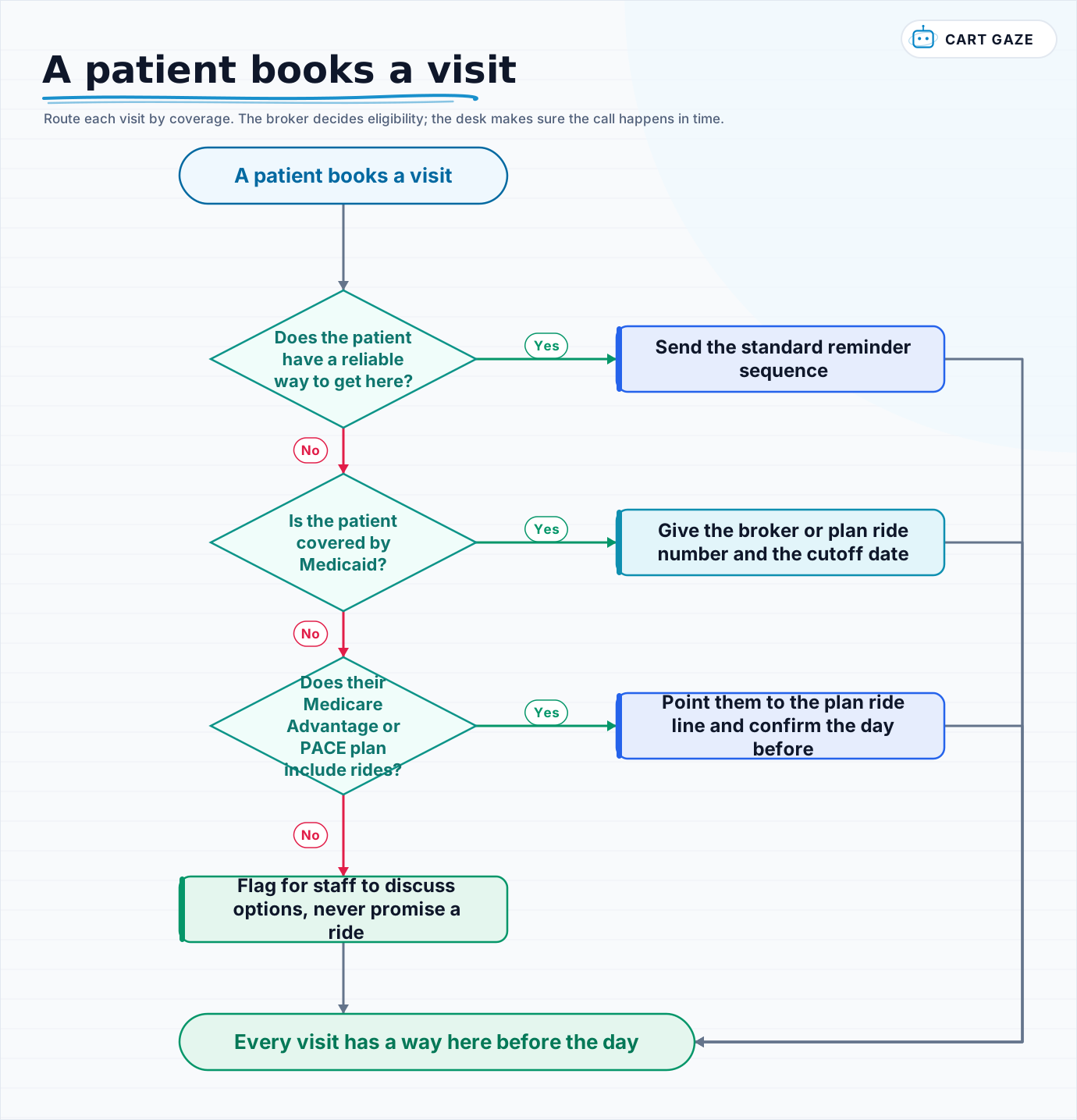 Route each visit by coverage. The broker decides eligibility; the desk makes sure the call happens in time.
Walk the flow once with your desk. A patient with a reliable ride gets the standard reminders. A Medicaid patient gets the broker number, the cutoff date and a ride check in the day-before confirmation. A Medicare Advantage or PACE patient whose plan includes rides gets pointed to the plan's line. Everyone else is flagged for a staff conversation about options, never a promise.
To see how the booking question, the timed prompt and the day-before ride check run by phone and text, our AI receptionist page shows how it answers calls and where it hands off to staff.
Fair questions.
Who qualifies for Medicaid non-emergency medical transportation?
Medicaid enrollees who have no other means of transportation to a covered service. Federal rules at 42 CFR 431.53 require every state to ensure necessary rides, and CMS says that is not a duty to pay for every trip. The state broker or managed care plan checks enrollment, the appointment and the patient's options, then picks the ride type. A few states exempt some groups.
How far in advance does a patient need to book a Medicaid ride?
It depends on the state and sometimes the plan. Georgia asks members to call at least 3 workdays before a non-urgent appointment, counting the day of the call but not the appointment day. New York asks for at least 72 hours, with every trip approved in advance. Urgent same-day needs can move faster, so check each plan's ride line and cutoff.
Does Medicare cover rides to doctor appointments?
Original Medicare's non-emergency transport benefit is limited to ambulance, so routine rides are not covered. Medicare Advantage plans may offer rides as a supplemental benefit that the plan arranges, and the details vary by plan. PACE covers transportation to its center and to medical appointments. Patients who also have full Medicaid can use the Medicaid ride to a Medicaid-coverable service.
Do free ride-share programs reduce no-shows?
The evidence is mixed. A small Penn pilot raised show rates, but a 786-patient trial found 36.5% versus 36.7% missed visits, with low uptake of the rides. A 2022 meta-analysis of 7 studies found fewer missed appointments overall, but its 3 controlled trials alone were not statistically significant. The trial authors suggested targeting patients with stronger transportation needs.
Can an AI receptionist book a Medicaid ride for a patient?
It can handle the steps around the ride: ask how the patient will get there, give the broker or plan number and the cutoff date, send a timed ride prompt, and check the ride in the day-before confirmation. The broker or plan books the ride and decides eligibility. An AI receptionist should never promise a ride or judge whether a visit is urgent.
Sources.
- [1]42 CFR 431.53, Assurance of transportation (eCFR)
- [2]42 CFR 440.170, transportation and NEMT brokerage programs (eCFR)
- [3]CMS SMD 23-006, Assurance of Transportation: A Medicaid Transportation Coverage Guide (2023)
- [4]CMS fact sheet: Let Medicaid Give You a Ride (2016)
- [5]Georgia Medicaid: Non-Emergency Medical Transportation FAQs
- [6]New York State Department of Health: Medicaid Transportation
- [7]Medicare Managed Care Manual, Chapter 4: Benefits and Beneficiary Protections
- [8]Medicare.gov: Programs of All-Inclusive Care for the Elderly (PACE)
- [9]Transportation barriers to health care in the United States: NHIS 1997-2017 (AJPH 2020)
- [10]Transportation barriers for Iowa Medicaid-enrolled adults with and without NEMT (Health Affairs Scholar 2025)
- [11]Transportation barriers to care among frequent health care users during COVID (BMC Public Health 2022)
- [12]Rideshare-based medical transportation for Medicaid patients and primary care show rates (JGIM 2018)
- [13]Association of rideshare-based transportation services and missed primary care appointments (JAMA Intern Med 2018)
- [14]Erratum: errors in abstract, results and Table 2 (JAMA Intern Med 2018)
- [15]Effects of a patient-centered rideshare program on missed MRI appointments (JACR 2021)
- [16]Effect of interventions for non-emergent medical transportation: systematic review and meta-analysis (BMC Public Health 2022)
- [17]Impact of transportation interventions on health care outcomes: a systematic review (Medical Care 2020)
- [18]Rethinking rideshares: a transportation assistance pilot for pediatric sickle cell patients (JHCPU 2020)
Written by

Muhammad Qasim Hammad
Founder, Cart Gaze
Qasim builds AI receptionists and front-office automation for medical and dental practices at Cart Gaze. Posts here start from published sources and real call data, not vendor claims, and every number links back to where it came from.
Keep reading.
 Clinical Documentation & Care CoordinationCall Summary to Chart: Documenting Phone Calls Safely9 min read
 Clinical Documentation & Care CoordinationFax Intake Automation: From Paper Tray to the Right Chart11 min read
 Clinical Documentation & Care CoordinationReferral Leakage: Close the Loop on Every Referral You Get11 min read
 Clinical Documentation & Care CoordinationImmunization Recall: Automate the Due List, Not the Advice15 min read
 Clinical Documentation & Care CoordinationCare Gap Closure: Triage the Payer List Before You Call12 min read
 Clinical Documentation & Care CoordinationRemote Patient Monitoring Enrollment: Get Devices Transmitting10 min read