
Care Gap Closure: Triage the Payer List Before You Call
CMS rates a Medicare Advantage contract on up to 43 quality measures for 2026, and no front desk can work every gap. Here is how to triage the payer list, reconcile what is already closed, and route the rest.
Key takeaways.
- CMS rates a Medicare Advantage prescription drug contract on up to 43 unique quality measures for 2026, so a payer gap list is always larger than any front desk can work.
- Reconcile before you call: a gap can sit open because the evidence never reached the payer, not because the care never happened.
- One payer publishes the lag plainly: billed services close a gap in 30 to 45 days, chart-based evidence in 60 to 90 days, and charts sent after December 1 are not counted.
- CMS weights intermediate outcome measures at 3 and process measures at 1 for 2026, but multiply the weight by your own denominator before choosing which gaps to work.
- Outreach naming a specific condition is protected health information, so an automated assistant may invite and book while every clinical question routes to a person.
Table of Contents8 sections
- Why the payer's care gap list is longer than your schedule
- The first automation win is reconciliation, not outreach
- Sort the gap list by effort and contract impact
- Which gaps a patient can close without a clinician
- What condition-specific outreach is allowed to say
- Build the reconcile-then-outreach loop
- Work the gaps your contract actually pays for
- Fair questions
Every month a payer sends you a list of patients who are missing something, and every month the list is longer than anything your staff could work. For 2026, CMS rates a Medicare Advantage prescription drug contract on up to 43 unique quality measures, and each one produces its own gap list against your panel.
The instinct is to start dialing. That is usually the wrong first move, because a meaningful share of those gaps are not clinical gaps at all. They are evidence gaps: the mammogram happened at a hospital across town, the A1c result sits in your chart with no code on the claim, the patient qualifies for an exclusion nobody filed. Calling those patients wastes staff time and annoys people who already did what you asked.
This post covers how to triage a payer gap list you cannot possibly work end to end: which gaps to reconcile instead of calling, how to rank the rest by effort against what your contract actually pays for, which ones a patient can close alone, and where an automated assistant has to hand the call to a person.
Why the payer's care gap list is longer than your schedule
A value-based contract scores you on measures you did not choose. CMS rates Medicare Advantage prescription drug contracts on up to 43 unique measures for 2026, and each one generates its own gap list. No front desk can work every open gap, so the real skill is deciding which ones to touch.
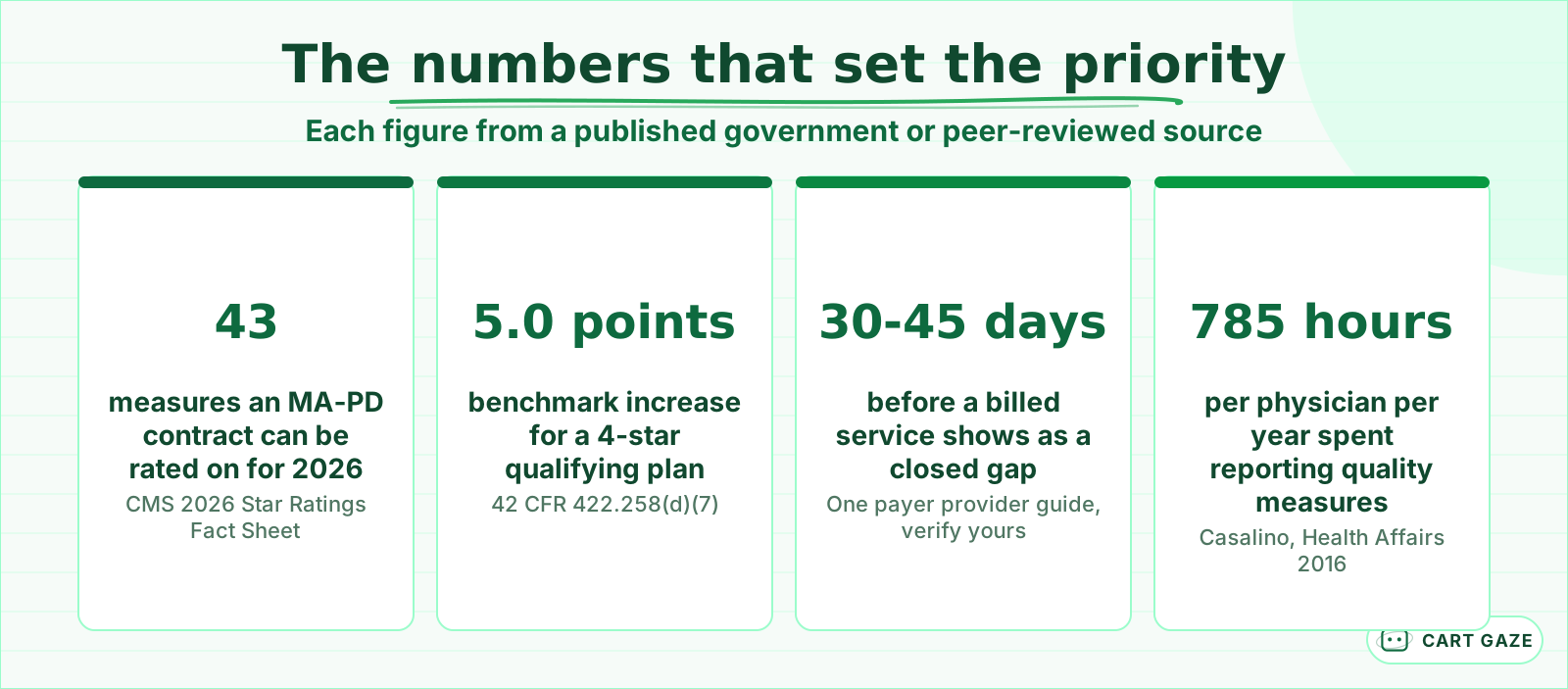 Published figures from CMS, the CFR and a peer-reviewed study. Verify each before repeating.
The money attached to that list is specific and dated. Under 42 CFR 422.258(d)(7), a qualifying plan is one rated 4 stars or higher, and for 2014 and subsequent years its benchmark percentage rises by 5.0 percentage points. CMS states that the 2026 Star Ratings will affect 2027 Medicare Advantage quality bonus payments, and that roughly 40% of these contracts, 207 of them, reached 4 stars or higher for 2026. Your plan partners are chasing that threshold, which is why their gap lists land in your inbox.
The workload is documented too. A 2016 Health Affairs study by Casalino and colleagues found that practices in four common specialties spent an average of 785 hours per physician each year, and more than $15.4 billion in total, dealing with quality measure reporting. That study is now 10 years old and predates most current specifications, so treat it as evidence that the burden is structural rather than as a current estimate of your own hours.
None of that means your clinical care is poor. It means the list was never sized for your staffing. Triage is the only honest response.
The first automation win is reconciliation, not outreach
Before you call anyone, find the gaps that are already clinically closed but not evidenced. A payer computes most measures from claims and encounters, so a screening done elsewhere, or a result that lives only in your chart, still reads as open. Fixing the record usually beats dialing the patient.
CMS is explicit about the mechanism. In the 2026 Adult Core Set, the administrative data collection method "uses transaction data (such as claims and encounters)" and applies where "the data are known to be complete, valid, and reliable." When that assumption does not hold, you get a gap that no phone call can close. The same document set spells out one specific trap: for the antibiotic avoidance measure, denied claims can be used to identify the eligible population, but denied claims cannot be used to identify numerator events. A denial can put a patient into the denominator while contributing nothing to the numerator.
There is also a lag, and it is published. One Medicaid plan's provider guide tells practices that billed services and standard supplemental files show as closed gaps in 30 to 45 days or less, while medical records count as non-standard supplemental data, appear 60 to 90 days after the chart is sent, are processed only from June through December, and are not ingested at all after December 1. Your payer's cutoffs will differ, but the shape holds: the list in front of you reflects data that arrived weeks ago.
Important
A gap list is a data artifact, not a clinical record. Before you buy outreach capacity, count what share of last month's list closed with a code, an exclusion or a file rather than a conversation. That number decides what you should automate.
This is the same closed-loop discipline that keeps results from going missing, and the same failure mode: an action happened, but nothing recorded that it happened. If your practice has not built that habit yet, closing the loop on lab results is the easier place to start.
Sort the gap list by effort and contract impact
Two things decide whether a gap is worth working: how much effort it takes to close, and how much your contract pays for closing it. CMS weights an intermediate outcome measure at 3 and a process measure at 1, so those two axes give you a workable first sort.
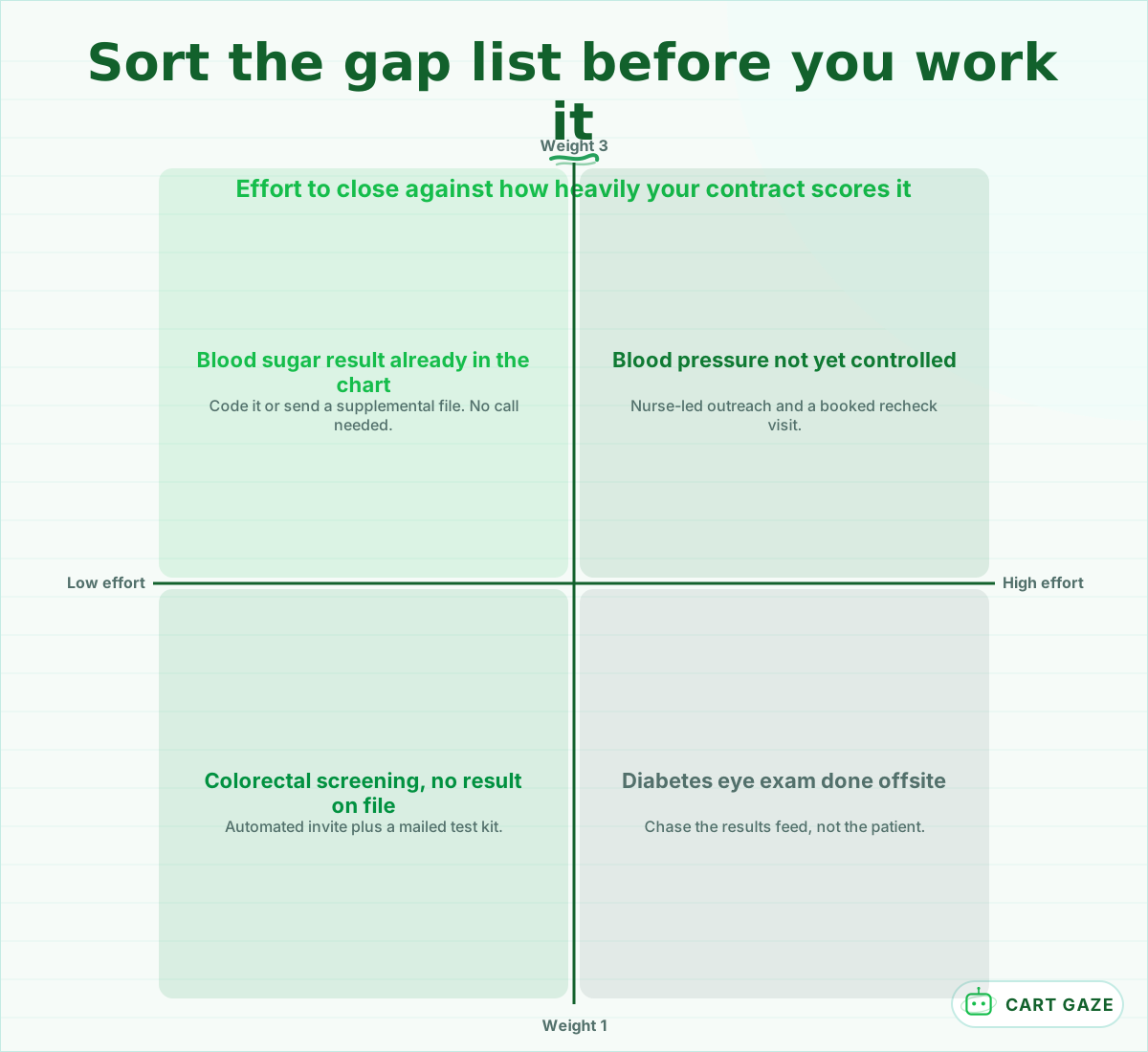 A first sort, not a verdict. Multiply the weight by your own denominator before committing staff.
The weights are published, not guessed. In the 2026 Star Ratings, Diabetes Care blood sugar controlled, Controlling Blood Pressure and Plan All-Cause Readmissions each carry a weight of 3. Breast Cancer Screening, Colorectal Cancer Screening and the Diabetes Care eye exam each carry a weight of 1. Patient experience, complaints and access measures dropped from 4 to 2 beginning with the 2026 Star Ratings, and Health Plan Quality Improvement carries a weight of 5.
Tip
Weight is per measure, not per patient. A weight-1 screening across 800 patients can be worth more to your contract than a weight-3 measure across 40. Multiply the weight by the size of your own denominator before you commit staff to either one.
Assume the weights will move. The Improving or Maintaining Physical Health and Improving or Maintaining Mental Health measures carry a weight of 1 for 2026 and a weight of 3 starting in 2027, and Kidney Health Evaluation for Patients with Diabetes was added for 2026. Specifications shift on the same cycle: the 2026 Medicaid Adult Core Set moved to HEDIS Measurement Year 2025 specifications, retired 4 measures outright, and dropped the administrative and hybrid options for Cervical Cancer Screening. Re-check the current year before you build anything around a weight.
Which gaps a patient can close without a clinician
Some measures close when a patient books a visit or returns a mailed kit. Colorectal cancer screening accepts an annual fecal immunochemical test, so it can close by mail. A mammogram needs an appointment. A controlled blood pressure reading needs a visit and a nurse. Route each gap accordingly.
| Measure example | 2026 Star Ratings weight | Can the patient close it alone? | Who should own it |
|---|---|---|---|
| Colorectal Cancer Screening | 1 | Yes, an annual FIT kit by mail | Automated invite plus a mailed kit |
| Breast Cancer Screening | 1 | Yes, with a self-booked mammogram | Automated invite plus a booking link |
| Diabetes Care eye exam | 1 | Partly, the exam is often offsite | Invite, then chase the results feed |
| Diabetes Care blood sugar controlled | 3 | No, needs a visit and a repeat test | Nurse-led outreach |
| Controlling Blood Pressure | 3 | No, needs a measured reading | Nurse or a booked recheck slot |
The mailed option is real, not a workaround. The USPSTF recommendation of 18 May 2021 lists an annual fecal immunochemical test among its accepted colorectal screening strategies, with a grade A recommendation for ages 50 to 75 and grade B for ages 45 to 49. A kit that arrives in the post can close that gap without anyone visiting your office.
Outreach itself has an evidence base worth knowing. The Community Preventive Services Task Force found that multicomponent interventions raised colorectal cancer screening by a median of 15.4 percentage points across 39 study arms, with fecal occult blood testing alone up a median of 7.7 points across 21 arms. That is a finding about a class of intervention, not a promise about any product.
One distinction worth holding: closing a scored measure is not the same job as enrolling someone into a program. If your goal is signing eligible patients into chronic care management, that is a separate enrollment workflow with its own consent and billing requirements.
What condition-specific outreach is allowed to say
Telling a patient they are due for a diabetic eye exam discloses that they have diabetes, so the message is protected health information and your channel, consent record and vendor agreement all apply. An automated assistant can invite and book. It never interprets a result or gives medical advice.
That distinction is the whole safety boundary. An assistant that answers the phone can confirm a patient is due for a screening, explain what the visit involves, and put it on the schedule. The moment a caller asks whether their last result was bad, or describes a symptom, the call belongs to a person. If you have not set that line before, what an AI receptionist does and where it stops is the place to draw it.
Warning
The measure name is the diagnosis. A detailed text about a diabetic eye exam or a colonoscopy can reach a shared phone, a family voicemail or a lock screen someone else reads. Keep condition detail out of the message body, hold a documented consent record for the channel you use, and have a signed Business Associate Agreement with any vendor that touches the list.
Two things get sold as compliance and are not. No vendor is "HIPAA certified," because no such certification exists. And "HIPAA compliant" describes a configuration plus a signed agreement, not a badge you can buy. Ask what a vendor stores, what it says out loud, and how long it keeps the recording.
Build the reconcile-then-outreach loop
Run the list in two passes. The first pass removes gaps that are already closed, already excluded, or missing only a code. The second pass sends outreach to whoever is genuinely due. Running them in that order keeps you from calling patients about care they already received this year.
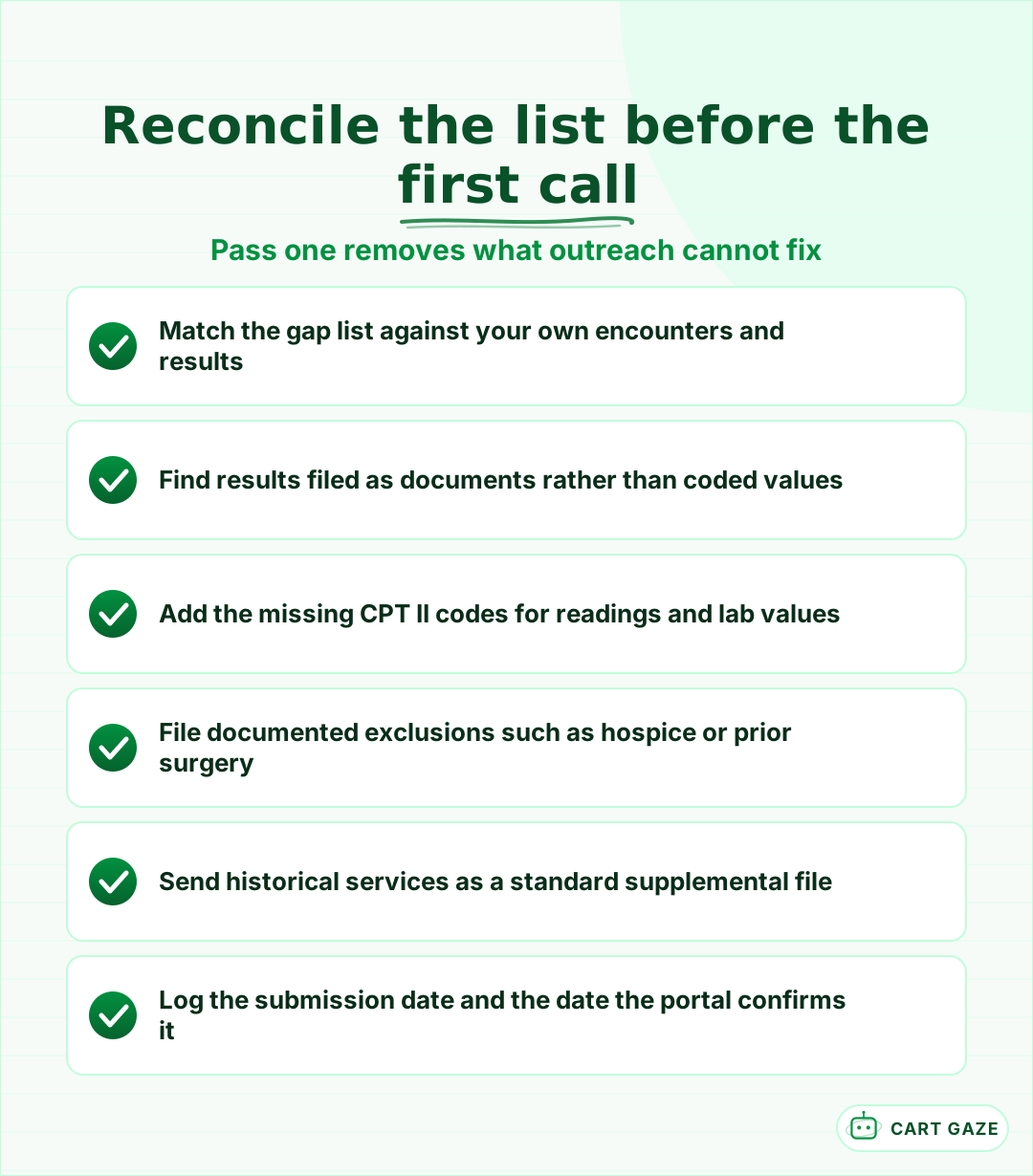 Pass one is a data job. It removes the gaps that no phone call could close.
Pass one is a data job, not a phone job. A coder and a query can handle most of it: match the gap list against your own encounters, look for results that arrived as documents rather than coded values, and check for documented exclusions such as hospice status or a prior surgery that makes the measure inapplicable. Each of those exits the list without anyone being contacted.
Pass two is the outreach, and it should log what pass one already proved. Record five fields per gap: the measure, the patient, the evidence path you used, the date you submitted it, and the date the payer portal confirmed it closed. Without that last field you cannot tell a submission that failed from a submission that is still inside the 30 to 90 day window.
Re-pull the list on the payer's refresh cadence rather than yours, and reconcile it against your own submission log. Anything you sent that did not land is the highest-value thing on your desk, because the work was already done once.
Before the first outreach run
- The gap list has been matched against your own encounter and results data.
- Documented exclusions have been filed for patients the measure does not apply to.
- Consent and channel are recorded for every patient you plan to contact.
- A signed Business Associate Agreement covers any vendor that receives the list.
Work the gaps your contract actually pays for
Start with the measures your contract weights heaviest and your data feeds worst. Reconcile those, automate the invitations that a patient can act on alone, and keep a nurse on the ones that need judgment. Measure the closed rate in your own payer portal, not in a demo.
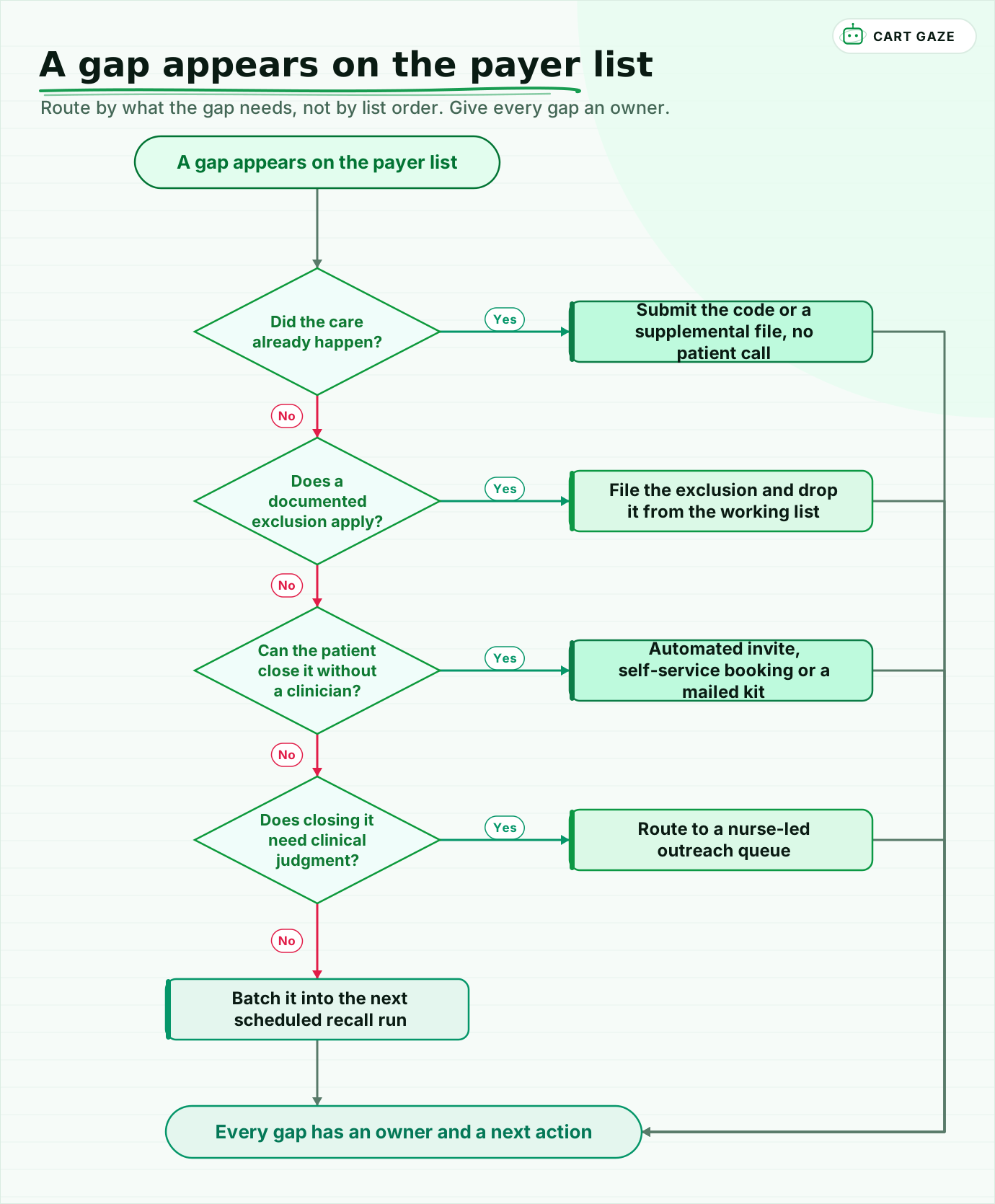 Route by what the gap needs, not by list order. Give every gap an owner.
Walk it once. Care that already happened needs a code or a file, not a call. A documented exclusion leaves the working list entirely. A screening a patient can self-serve gets an automated invite or a mailed kit. Anything needing clinical judgment goes to a nurse. Everything else waits for the next scheduled recall run.
Pick 2 or 3 measures rather than 43, and re-check the closed rate after one full refresh cycle, which may be anywhere from 30 to 90 days depending on the evidence path you used. Measure specifications, Star Ratings weights and your own contract terms all change by measurement year, so confirm the current ones with your payer representative before you build a workflow on them. Nothing here is clinical, coding or legal advice.
If you would rather see where the phone itself is leaking before you touch the gap list, the free Growth Leak Audit sizes that from your own numbers first.
Fair questions.
What is care gap closure in a value-based contract?
A care gap is a service a quality measure says a patient is due for and the payer has no record of. Closing it means either delivering that service or supplying the evidence that it already happened. Payers score practices on these measures because their own Medicare Advantage Star Ratings and quality bonus payments depend on the same numbers.
Why does a gap show as open when we already did the service?
Most measures are computed from claims and encounters, so evidence that never reached the payer in that form does not count. Common causes are a service performed at another practice, a result filed as a document rather than a coded value, and a denied claim, which can place a patient in the eligible population without contributing to the numerator.
Which care gaps should we work first?
Sort by effort to close against how heavily your contract scores the measure. For 2026, CMS weights intermediate outcome measures such as blood sugar control and blood pressure at 3, and process measures such as colorectal and breast cancer screening at 1. Then multiply by your denominator size, because a weight-1 measure across 800 patients can outweigh a weight-3 measure across 40.
Can a patient close a care gap without coming in?
Some can. The USPSTF recommendation of 18 May 2021 lists an annual fecal immunochemical test among accepted colorectal screening strategies, so a mailed kit can close that gap. A mammogram needs an appointment but no clinician conversation. A controlled blood pressure or glycemic result needs a visit, a measurement and often a treatment change.
Is automated care gap outreach allowed under HIPAA?
Outreach that names a measure names a condition, so it is protected health information and needs a documented consent record, an appropriate channel and a signed Business Associate Agreement with any vendor that touches the list. An automated assistant can invite and book, but it must never interpret a result or give medical advice. No vendor is HIPAA certified, because that certification does not exist.
Sources.
- [1]2026 Medicare Advantage and Part D Star Ratings Fact Sheet (CMS)
- [2]2026 Star Ratings Measures and Weights (CMS)
- [3]42 CFR 422.258: Calculation of benchmarks and quality bonus payment increases
- [4]2026 Core Set of Adult Health Care Quality Measures for Medicaid
- [5]Summary of Updates to the Adult Core Set Measures, 2026 Technical Specifications
- [6]Provider Guide: Closing Care Gaps (Carolina Complete Health)
- [7]US Physician Practices Spend More Than $15.4 Billion Annually To Report Quality Measures
- [8]USPSTF Final Recommendation Statement: Colorectal Cancer Screening
- [9]CPSTF: Multicomponent Interventions to Increase Colorectal Cancer Screening
Written by

Muhammad Qasim Hammad
Founder, Cart Gaze
Qasim builds AI receptionists and front-office automation for medical and dental practices at Cart Gaze. Posts here start from published sources and real call data, not vendor claims, and every number links back to where it came from.
Keep reading.
 Clinical Documentation & Care CoordinationRemote Patient Monitoring Enrollment: Get Devices Transmitting10 min read
 Clinical Documentation & Care CoordinationChronic Care Management Automation: Enroll More Eligible Patients10 min read
 Clinical Documentation & Care CoordinationTransitional Care Management Automation: Beat the 2-Day Clock11 min read
 Clinical Documentation & Care CoordinationPost-Visit Patient Check-In Automation That Routes, Not Triages11 min read
 Clinical Documentation & Care CoordinationCall Summary to Chart: Documenting Phone Calls Safely9 min read
 Clinical Documentation & Care CoordinationLab Result Follow-Up Automation That Closes Every Loop11 min read