
Post-Visit Patient Check-In Automation That Routes, Not Triages
The CDC puts unfilled prescriptions at 20% to 30% of scripts, and nobody at the practice knows which ones. A routine post-visit check-in catches that, plus the patient getting worse and the one about to write a review.
Key takeaways.
- A routine post-visit check-in does 3 jobs at once: catch the patient getting worse, catch the unfilled prescription or unbooked follow-up, and catch the unhappy patient before the review.
- The CDC puts primary nonadherence at 20% to 30% of all prescriptions, so a check-in at 3 to 7 days catches a script that was never picked up.
- The boundary is absolute: an automated check-in collects a response and routes it, never triages, never reassures, and never advises.
- Every concerning reply needs a named clinician, a named backup, and a written same-day response time, because a shared inbox is not an owner.
- A treatment check-in and a review request have different legal footing under the TCPA, where statutory damages run $500 per message, so the check-in always goes first.
Table of Contents8 sections
- What a routine post-visit check-in is actually for
- Timing: when the check-in should land, by visit type
- The clinical boundary: collect the answer, route it, never triage
- Keep it answerable in one tap, with a door to a real reply
- What belongs in the chart, and what stays in the messaging log
- Why the review request comes after the check-in, never instead of it
- Give every check-in reply a named owner
- Fair questions
A patient walks out of an ordinary appointment, and until they come back or something goes wrong, your practice hears nothing at all. The CDC puts it plainly: 20% to 30% of all medication prescriptions are never filled. The script you wrote on Tuesday may already be a dead letter by Friday, and nobody at the practice knows.
Most practices run some kind of follow-up after surgery. Almost none run one after a routine visit. That gap hides three separate problems: the patient whose symptoms are getting worse, the patient who never filled the prescription or booked the follow-up, and the patient who left annoyed and is about to say so in public.
This post covers what a routine post-visit check-in should ask, when it should land by visit type, and the one boundary that keeps it safe. An automated check-in collects a response and routes it. It never triages, never reassures, and never advises. Anything concerning goes to a named person the same day.
What a routine post-visit check-in is actually for
A routine check-in exists to surface three things a chart cannot: whether the patient is getting worse, whether they acted on the plan, and whether they left unhappy. It is a listening post, not a courtesy. Each answer belongs to a different person at your practice, and each has a deadline.
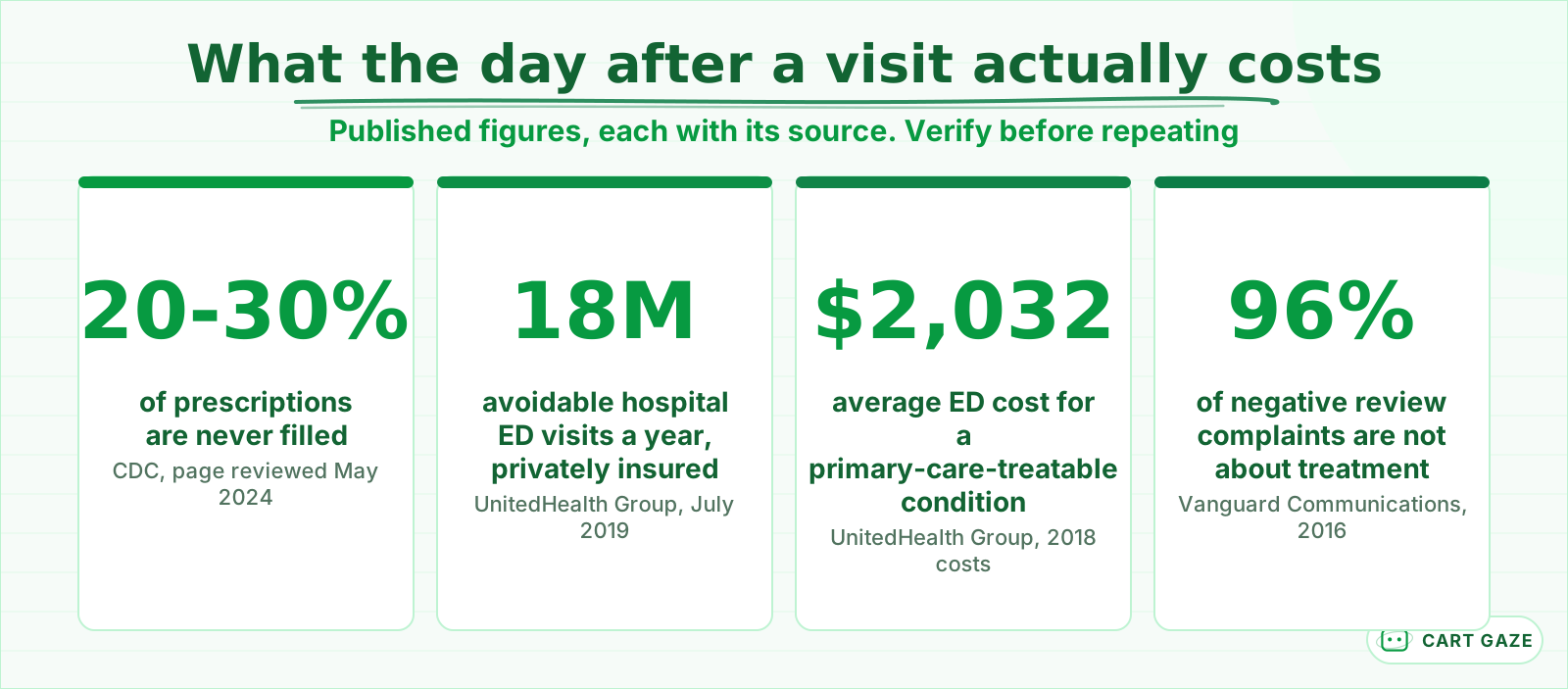 Published figures, each sourced. Reasons to measure your own gap, not a promised result.
The unfilled prescription is the biggest and quietest of the three. On top of the 20% to 30% that are never filled at all, the CDC notes that about 50% of chronic disease medications are not taken as prescribed. Nothing in your schedule tells you which patient that is, because the visit already happened and the next one is months out.
The "somewhere expensive" problem is easier to size. UnitedHealth Group counted 18 million avoidable hospital emergency department visits a year among privately insured patients, two-thirds of 27 million, adding $32 billion in cost. Treating a primary-care-treatable condition in a hospital ED averaged $2,032, against $167 at a physician office and $193 at urgent care. Those are 2018 costs published in 2019, so treat the ratio rather than the dollar figure as the durable part.
The third problem is reputational and almost entirely non-clinical. In a 2016 analysis of nearly 35,000 Google reviews of physicians, run by the healthcare marketing firm Vanguard Communications, only 4% of negative comments were about medical treatment. The other 96% were communication, wait times, staff and billing. Those are complaints a phone call in the same week could have absorbed.
Timing: when the check-in should land, by visit type
Timing is set by what could go wrong and when. A routine office visit gets a next-day check-in. A new prescription needs one at 3 to 7 days, while the first fill is still in play. A medication change or a chronic-care adjustment waits 7 to 14 days, once side effects show.
| Visit type | When it lands | What it asks | Who reads a flagged reply |
|---|---|---|---|
| Routine office visit | Next day | Better, worse, or the same, plus any question | Nurse or MA, same day |
| New prescription | 3 to 7 days | Did you pick it up, any side effects | Nurse or the prescriber, same day |
| Medication change or chronic care | 7 to 14 days | Tolerating it, plus readings if they track them | Care manager or prescriber |
| New patient, first visit | Next day | Was anything unclear, how did the visit go | Office manager, same day |
| Hygiene, PT, or a treatment plan | 24 to 48 hours | Comfort level, and whether the next visit is booked | Front desk, next business day |
The prescription row is the one practices get wrong most often. A check-in sent the morning after the visit is too early to know whether the script was ever picked up, so it collects a polite "all good" and misses the thing you were trying to catch.
None of this is surgical discharge follow-up, which is a different workflow with red-flag symptom screening and a second contact around day 7 to 10. If the patient had a procedure, use the post-procedure discharge follow-up workflow instead. This one is for the ordinary Tuesday appointment nobody follows up on.
Tip
Under the TCPA healthcare exemption, exempt treatment messages are limited to 1 per day and 3 per week. A reminder, a check-in and a review request in the same week uses that budget up, so decide which message you actually need before adding another.
The clinical boundary: collect the answer, route it, never triage
An automated check-in asks a fixed set of questions and moves the answers. It does not decide what a symptom means, does not tell anyone they are fine, and does not suggest a remedy. Every concerning reply goes to a named clinician, with a stated response time, the same day.
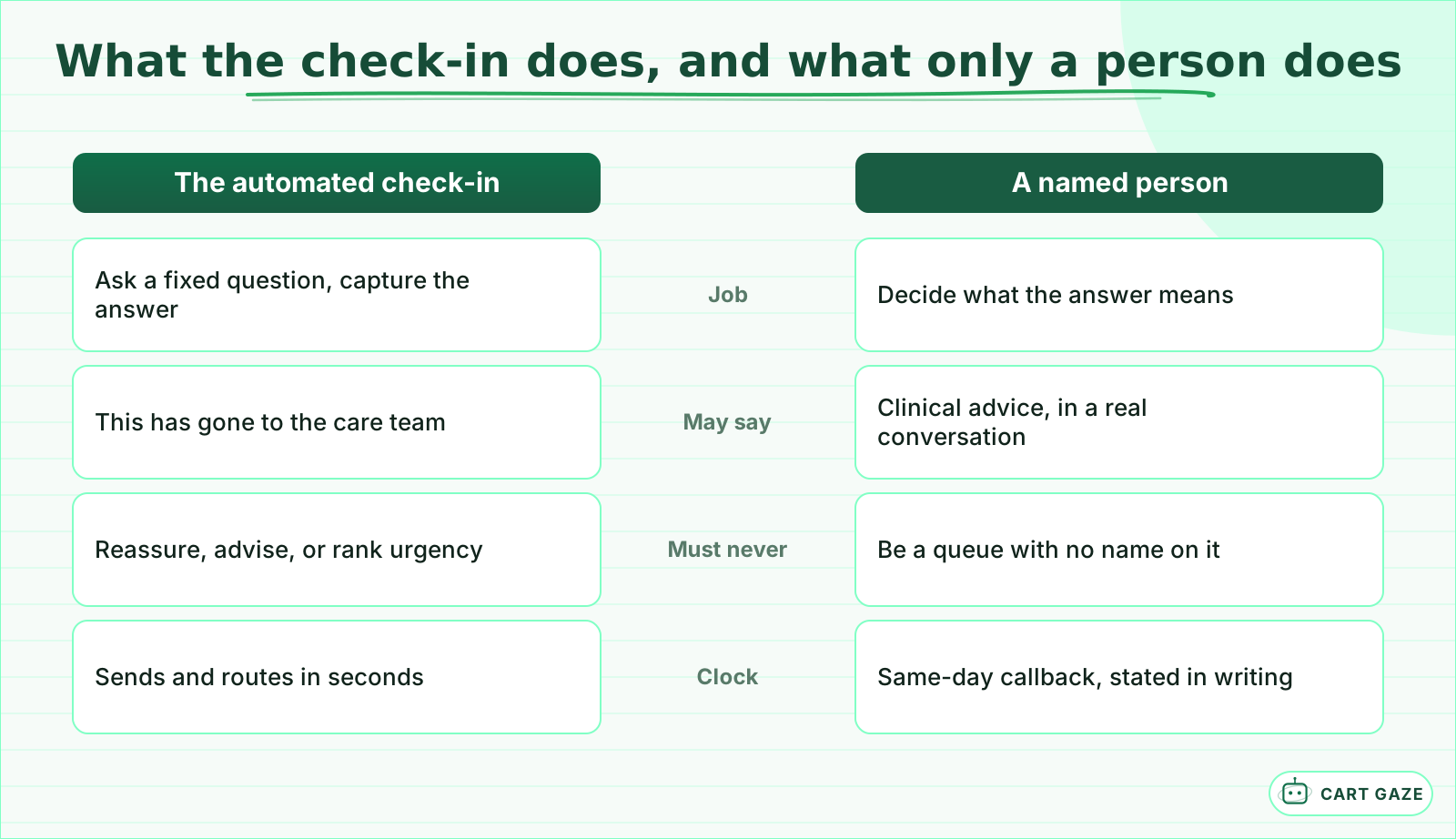 The automation asks and routes. Judgment stays with a person, every time.
"Routes it" has to mean something specific or it means nothing. A named clinician and a named backup, a response-time commitment you have written down, and a logged handoff. A shared inbox is not an owner. A queue with nobody's name on it is not an owner either.
The strongest evidence that routing is where the value sits comes from a symptom-monitoring trial at Memorial Sloan Kettering, published in JAMA in 2017. Across 766 patients, people self-reported their symptoms 73% of the time when prompted, and nurses acted on 77% of the automated alerts by calling, referring, or adjusting treatment. The group had 7% fewer emergency room visits and 4% fewer hospitalizations. That was oncology at health-system scale with enrollment running from 2007 to 2011, so it is the mechanism to copy, not an effect size a 3-provider clinic should expect. The asking did nothing on its own. The nurse who picked up the alert did.
Warning
An automated check-in must never tell a patient a symptom is nothing to worry about. Chest pain, uncontrolled bleeding, a fever above your practice's threshold, or a reply that reads as distress goes straight to a person, not to a script that guesses.
The same line applies wherever automation meets a patient. What an AI receptionist does and where it stops draws it on the phone: capture and route the routine, hand every clinical judgment to a human. A check-in message is the text version of exactly that boundary.
Keep it answerable in one tap, with a door to a real reply
The message that gets answered is short, asks one question, and can be finished with a single tap. Under the TCPA healthcare exemption a treatment text runs 160 characters or less, so there is no room for a paragraph anyway. Then leave one clear path to a person who can answer.
Channel decides whether you get an answer at all. A 2024 randomized trial in orthopedics, covering 1,707 patients and 2,238 survey invitations, lifted return rates from 35.2% to 51.2% by adding a text nudge. A March 2025 study across 695 practices, run internally by the survey vendor rater8 and reported as its own data, moved response from 22.40% to 37.52% when practices switched from email to text.
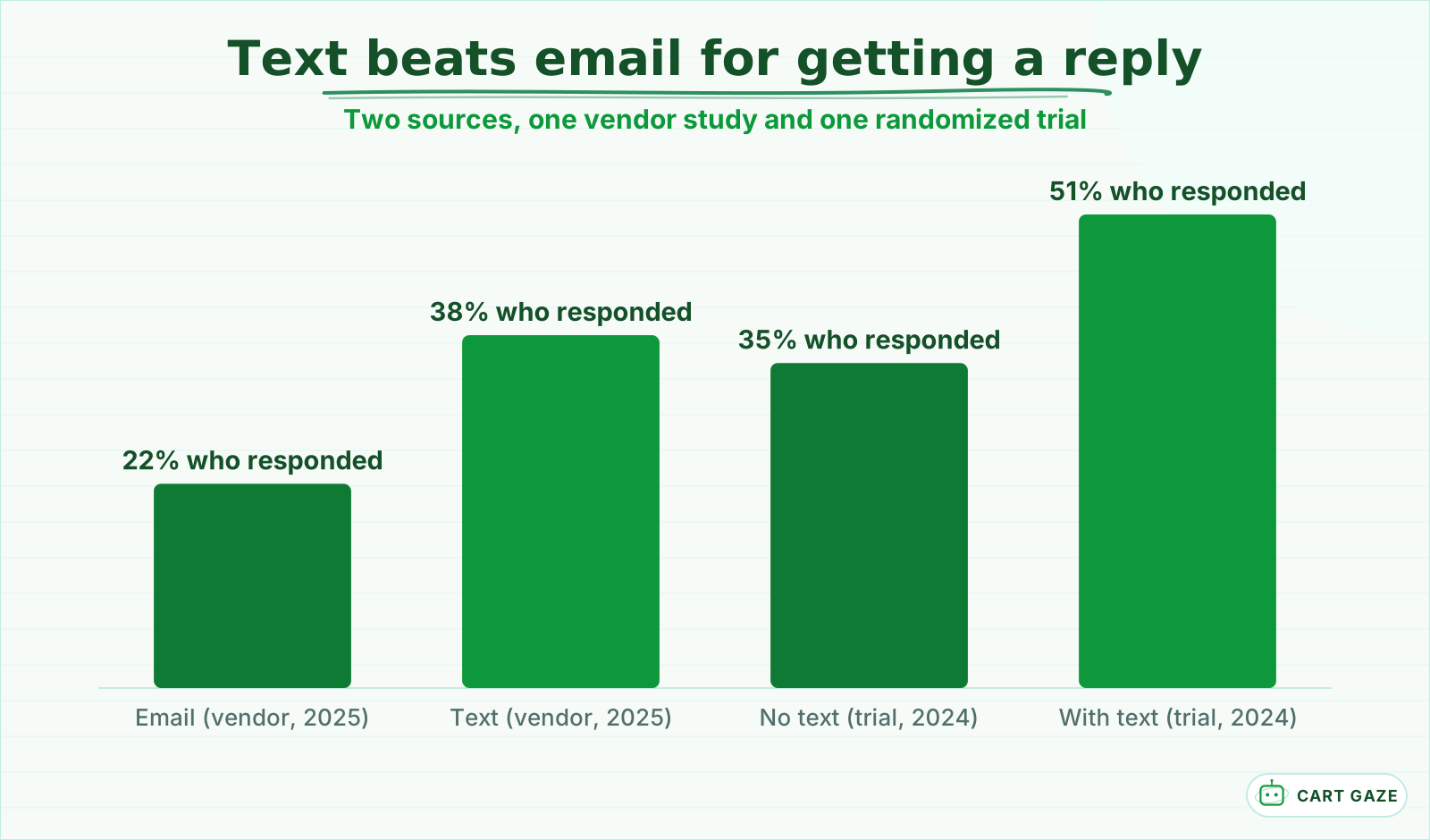 Two independent sources, one vendor study and one trial. Channel changes the reply rate.
Ask one thing per message. A satisfaction score and a clinical question in the same text produce one answer and no way to tell which question it belongs to. If you want both, send the clinical one first and let the experience question wait.
The free-text path matters more than the tap options. Most patients will pick a button, but the ones who type something are usually the ones with a real problem, and that reply needs to land somewhere a person reads within the window you promised.
What belongs in the chart, and what stays in the messaging log
Split the record in two. Anything clinical, the symptoms reported, the escalation, who was reached and what they did, belongs in the chart. Delivery details, consent, opt-outs and timestamps belong in the messaging log. Both are discoverable, so write each one as if it will be read later by someone else.
The practical test is whether a clinician making a decision would want to see it. A patient reporting dizziness on day 3 and the nurse's callback belong in the chart, in the patient's own words where possible. That the message was delivered at 9:04 a.m. that a reminder went out, that the patient opted out in June: messaging log.
Getting this wrong in either direction hurts. Clinical content stranded in a texting platform is invisible at the next visit. Every delivery receipt copied into the chart buries the two lines that mattered.
Important
Any vendor holding check-in content is a business associate and needs a signed Business Associate Agreement before the first message goes out. "HIPAA compliant" is a configuration and a contract, not a badge, and "HIPAA certified" does not exist as a credential.
Why the review request comes after the check-in, never instead of it
These are two different messages with two different legal footings. A check-in about a patient's care is treatment communication. A review request is marketing, and it needs prior express written consent under the TCPA. Sending the second in place of the first also skips the part that protects you.
The exposure is per message. TCPA statutory damages run $500 per violating message, tripled for knowing and willful violations, which is why "we texted our whole list" is an expensive sentence. Keep the two message types on separate consent records so nobody has to reconstruct later which patient agreed to what.
Sequence it in that order for a practical reason too. The check-in is where an unhappy patient tells you privately, and that reply should reach a person before any review request goes anywhere near them. Given that 96% of negative review content is non-clinical, most of those complaints are fixable by someone calling back. Ask for the review afterward, from patients whose experience is settled, with consent on file. Vendors converge on 24 to 48 hours after the visit for the ask, which is guidance rather than evidence. The mechanics of that half are covered in review and reputation automation.
Give every check-in reply a named owner
Before you switch anything on, decide who owns each kind of reply and how fast they must act. Assign the owner first, then the schedule. A check-in that collects answers nobody reads is worse than no check-in, because it creates a record that a patient told you something and nothing happened.
Before you turn on post-visit check-ins
- A signed Business Associate Agreement is in hand before any patient detail reaches the system.
- A named clinician and a backup own every flagged reply, with a written same-day response time.
- The questions have been tested against your ten most common post-visit calls, not a demo script.
- Someone reads the first two weeks of replies end to end before the program covers every visit.
Once the owners are assigned, the routing logic fits on one page.
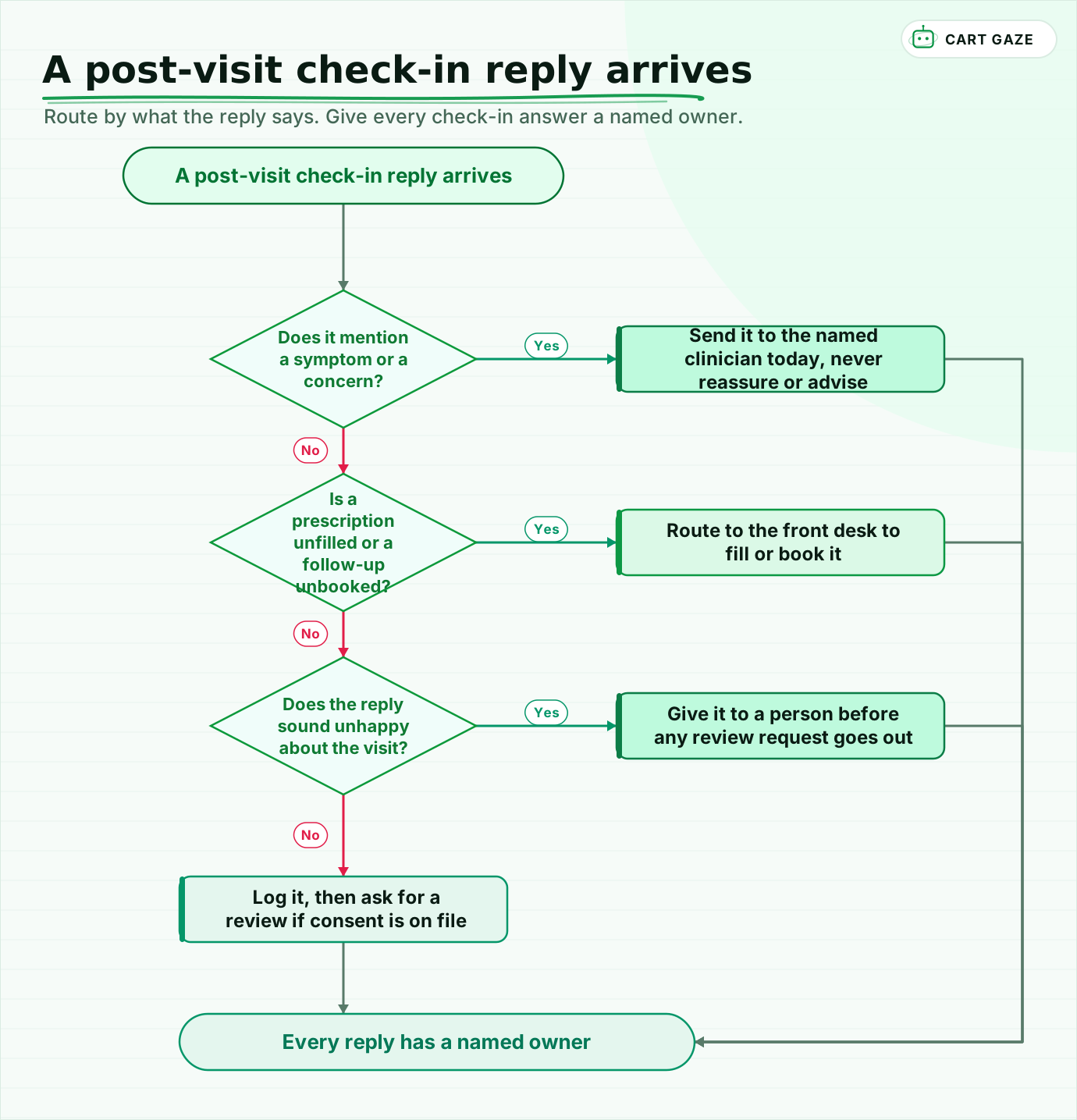 Route by what the reply says. Give every check-in answer a named owner.
Walk it once. A reply mentioning a symptom or a concern goes to the named clinician today, with no reassurance from the system on the way. An unfilled prescription or an unbooked follow-up goes to the front desk as work, not as a note. A reply that sounds unhappy goes to a person before any review request is sent. Everything else is logged, and only then is a review a reasonable ask.
Start with one visit type and one window, read the replies yourself for two weeks, and expand only after you know what patients actually send back. If you would rather size the gap first, the free Growth Leak Audit works from your own numbers before anyone talks tools.
Fair questions.
What is post-visit patient check-in automation?
It is a scheduled message sent after a routine appointment that asks a short, fixed set of questions and routes the answers to the right person. It catches worsening symptoms, prescriptions that were never filled, and follow-ups that were never booked. It collects and routes only. It does not assess symptoms or give any medical advice.
When should a post-visit check-in be sent?
Timing depends on what could go wrong. A routine office visit gets a next-day message. A new prescription is better checked at 3 to 7 days, once there has been time to fill it. A medication change or chronic-care adjustment waits 7 to 14 days. Hygiene, physical therapy and treatment plans sit at 24 to 48 hours.
Can an automated check-in triage a patient symptom?
No. An automated check-in should capture what the patient reports and hand it to a named clinician with a stated same-day response time. It must never rank urgency, reassure a patient that a symptom is minor, or suggest a remedy. Chest pain, uncontrolled bleeding, a fever above your threshold, or any sign of distress reaches a person immediately.
Is a post-visit check-in text allowed under the TCPA?
A message about the care a patient just received is treatment communication and sits inside the healthcare exemption when sent to the number the patient gave you. Exempt texts run 160 characters or less, carry an opt-out, and are capped at 1 per day and 3 per week. A review request is marketing and needs prior express written consent.
Should the check-in or the review request go first?
The check-in, always. It is where an unhappy patient tells you privately, and that reply should reach a person before any review ask goes out. In one analysis of physician reviews, 96% of negative comments were about non-clinical issues a callback could have resolved. Ask for the review afterward, with consent on file.
Sources.
- [1]Promoting Medication Management (CDC, 20% to 30% of prescriptions never filled)
- [2]18 Million Avoidable Hospital Emergency Department Visits Add $32 Billion in Costs Each Year (UnitedHealth Group)
- [3]Patients' top complaint? It isn't doctors or nurses, study finds (Vanguard analysis of ~35,000 reviews)
- [4]The impact of text messaging to promote patient reported outcome measures completion in orthopedic practice: a randomized controlled study
- [5]Why text messages outperform email for patient survey response rates (rater8 internal study, March 2025)
- [6]Online self-reporting of symptoms improves quality of life, extends survival (MSK symptom-monitoring trial, JAMA 2017)
- [7]The wrong patient communication plan could be costly (TCPA healthcare exemption, AOA)
- [8]Patient no-shows in 2025: what is changing and what to do about it (MGMA Stat)
Written by

Muhammad Qasim Hammad
Founder, Cart Gaze
Qasim builds AI receptionists and front-office automation for medical and dental practices at Cart Gaze. Posts here start from published sources and real call data, not vendor claims, and every number links back to where it came from.
Keep reading.
 Clinical Documentation & Care CoordinationLab Result Follow-Up Automation That Closes Every Loop11 min read
 Clinical Documentation & Care CoordinationPatient Portal Message Triage: Take Back the Clinician Inbox10 min read
 Clinical Documentation & Care CoordinationAI Medical Scribes: What Ambient Documentation Really Saves11 min read
 Clinical Documentation & Care CoordinationCare Gap Closure: Triage the Payer List Before You Call12 min read
 Clinical Documentation & Care CoordinationRemote Patient Monitoring Enrollment: Get Devices Transmitting10 min read
 Clinical Documentation & Care CoordinationTransitional Care Management Automation: Beat the 2-Day Clock11 min read