
Transitional Care Management Automation: Beat the 2-Day Clock
Only 10.9% of eligible Medicare discharges get billed as TCM, and the 2-business-day contact clock is why. Here is what transitional care management automation can honestly own, and where CMS says it stops.
Key takeaways.
- Only 10.9% of 1,556,347 eligible Medicare discharges from 2015 to 2019 were billed as TCM, and the usual cause is a missed discharge signal rather than bad coding.
- CMS gives you 2 business days from discharge to make interactive contact, and the 30-day TCM period starts on the discharge day and runs for 29 more days.
- CPT 99495 needs at least moderate medical decision making and a visit within 14 calendar days, while 99496 needs high complexity and a visit within 7.
- CMS lets you report TCM after 2 or more documented unsuccessful attempts, which makes a timestamped outreach log as valuable as the call that connects.
- Automation can detect the discharge, attempt outreach, log every try, and book the visit, but the interactive contact must be performed by clinical staff.
Table of Contents8 sections
- Why most eligible discharges never get billed as TCM
- What CMS requires before you can bill 99495 or 99496
- The visit window is what separates 99495 from 99496
- The deadline you cannot automate away
- What automation can honestly own in the TCM window
- Where an AI receptionist has to stop
- Build the clock before you build the script
- Fair questions
A patient leaves the hospital on a Friday afternoon. Your practice finds out the following Tuesday, when the discharge summary finally lands, and by then the window to bill Transitional Care Management has closed. This is not a rare accident. Of 1,556,347 eligible Medicare discharges between 2015 and 2019, only 10.9% were billed as TCM.
That gap is not a coding problem. The codes are well documented, and any billing company can recite them. The problem is operational. CMS gives you 2 business days from discharge to make interactive contact with the patient, and most practices spend those 2 days not knowing the discharge happened at all.
This post covers what CMS actually requires for CPT 99495 and 99496, why the 2-business-day clock decides whether you can bill anything, what a documented outreach attempt buys you when the patient will not pick up, and exactly where automation has to hand the call to a person.
Why most eligible discharges never get billed as TCM
Transitional Care Management has been payable since 2013, yet most eligible discharges never get billed. The reason is rarely the coding. Practices lose the episode because nobody inside the building knows the patient went home until the outreach deadline has already passed, and by then the claim is gone.
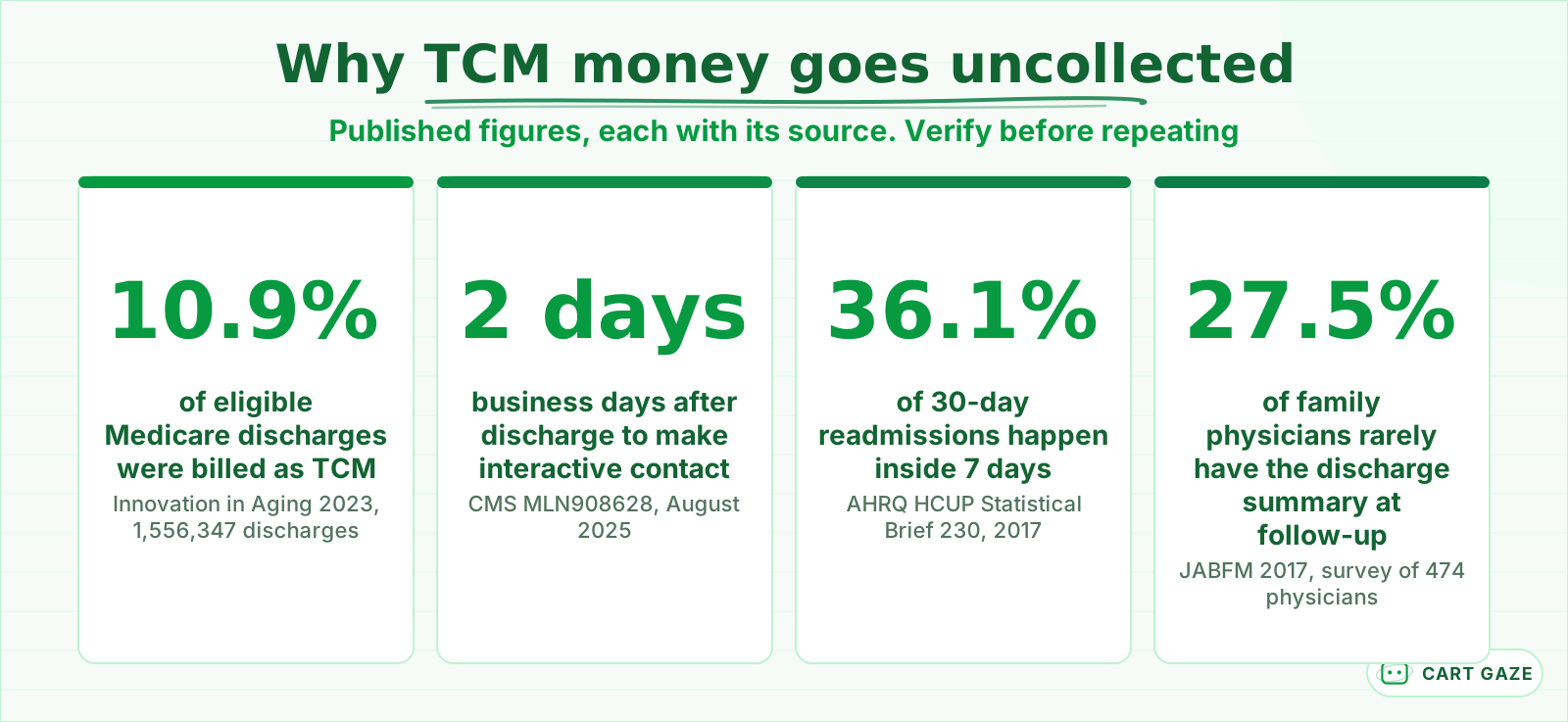 Published figures, each sourced. Reasons to audit your own discharge list, not your result.
The scale is documented. A 2023 study in Innovation in Aging examined 1,556,347 eligible Medicare fee-for-service discharges from 2015 to 2019 and found TCM was delivered in 169,536 of them, or 10.9%. Delivery was lowest for the patients at highest readmission risk: 9.0% for Black beneficiaries and 8.4% for Hispanic beneficiaries, against 11.3% for White beneficiaries.
The information lag is measurable too. In a 2017 survey of 474 family physicians published in the Journal of the American Board of Family Medicine, 27.5% said a hospital discharge summary was available at the post-hospital follow-up visit 40% of the time or less. If the paperwork arrives that unreliably, the phone call that has to happen first is not going to organize itself.
None of this means the codes are hard. It means the trigger is missing. A practice that cannot reliably detect a discharge within one business day cannot reliably bill TCM, however good its billers are.
What CMS requires before you can bill 99495 or 99496
Four conditions have to hold together. The patient must be discharged from a qualifying inpatient or observation setting, clinical staff must make interactive contact within 2 business days, the medical decision making must reach the required level, and a face-to-face visit must happen inside the window that code sets.
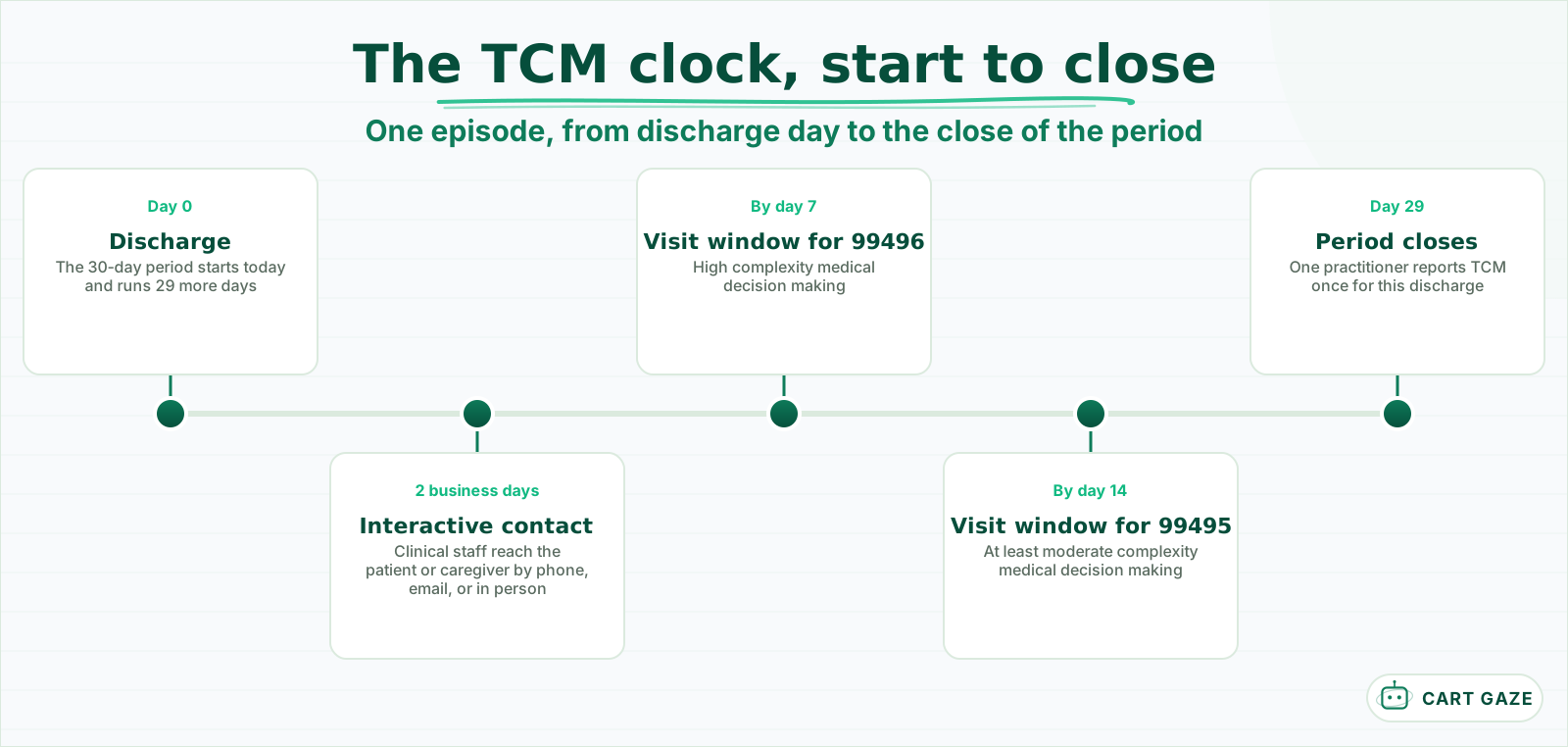 One discharge, five dated gates. Miss a gate and the episode stops being billable.
The 30-day TCM period begins the day the patient is discharged and continues for the next 29 days. Qualifying settings include an inpatient acute care hospital, an inpatient psychiatric hospital, an inpatient rehabilitation facility, a long-term care hospital, a skilled nursing facility, and hospital outpatient observation or partial hospitalization.
Two further rules catch practices out. Medication reconciliation and management has to be provided on or before the date of the face-to-face visit, not afterwards. And only 1 physician or non-physician practitioner may report TCM for a given discharge, once per period, so if the cardiology group across town gets there first, your claim is not the one that pays.
Tip
You cannot bill TCM if any part of the 30-day period falls inside a post-operative global surgery period for a procedure the same practitioner billed. If the patient just had surgery, the follow-up you owe them is a different job, and we walk through it in post-op discharge follow-up.
The visit window is what separates 99495 from 99496
Both codes demand the same interactive contact within 2 business days. What splits them is the level of medical decision making and how fast the patient has to be seen. 99495 needs at least moderate complexity and a visit inside 14 calendar days. 99496 needs high complexity and 7.
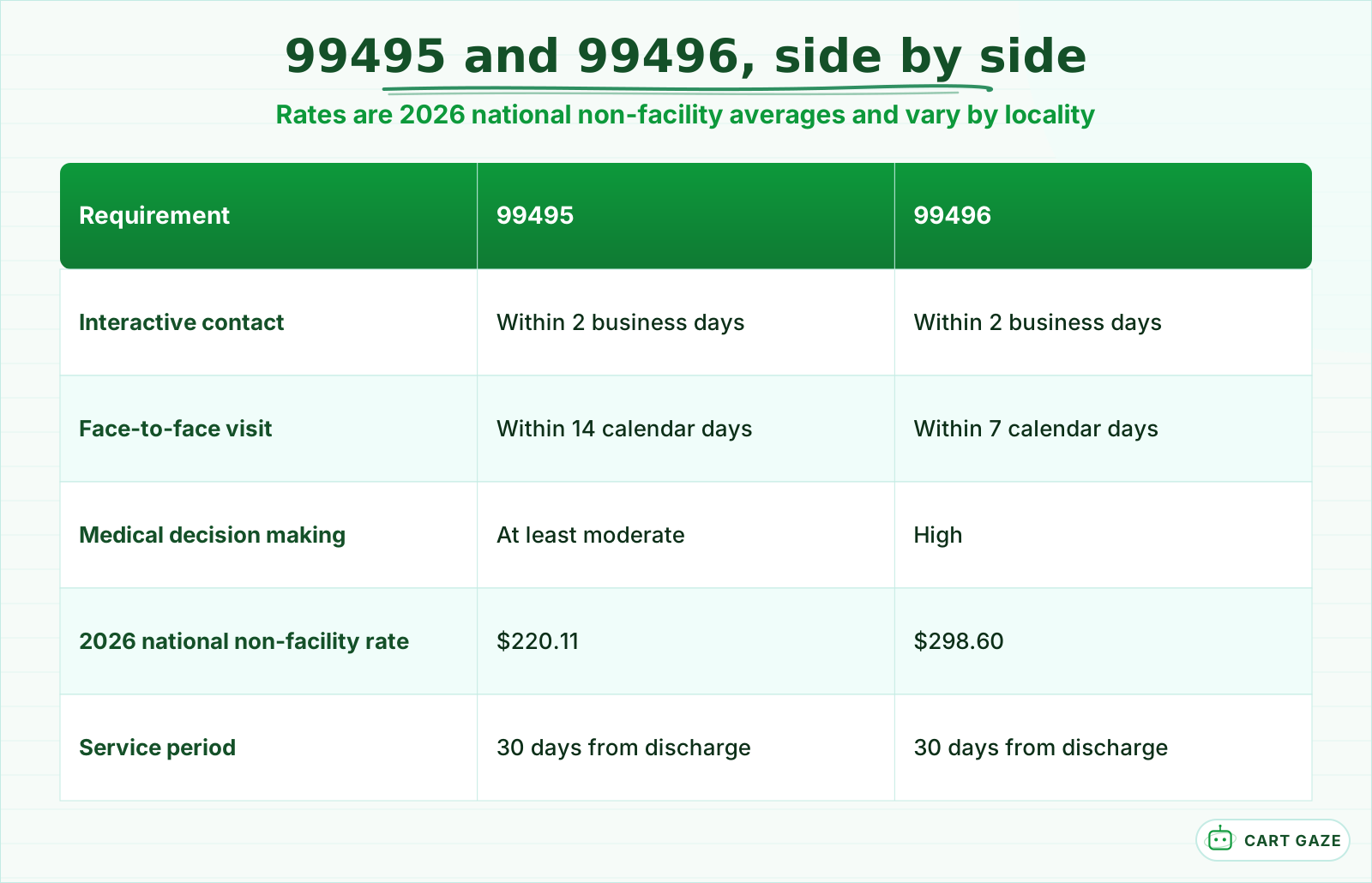 The visit window and the decision-making level separate the codes. Rates are locality adjusted.
The rates are worth knowing and worth distrusting. Published 2026 national non-facility figures put 99495 near $220.11 and 99496 near $298.60, but those are national averages from a third-party fee-schedule reference, and Medicare adjusts every rate by geographic practice cost index. Your actual payment depends on your locality. Confirm the current year's numbers in the Medicare Physician Fee Schedule before you build a projection on them, and treat any figure you read on a blog, this one included, as a starting point rather than a quote.
Both codes can be furnished by telehealth when Medicare's telehealth requirements are met, which matters most for the tighter window. A patient who cannot reach the office by day 7 may still be seen inside it.
The practical read: 99496 pays more and is harder to hit, because it compresses the visit into a single week. If your scheduling cannot reliably produce a slot within 7 calendar days of a discharge, you are a 99495 practice whether you meant to be or not.
The deadline you cannot automate away
CMS is specific about who makes the contact. The interactive contact must be performed by clinical staff who can address patient status and needs beyond scheduling follow-up care. A booking assistant that dials the patient and offers an appointment slot has not satisfied the requirement, no matter how quickly it dialed.
There is a real safety valve, though, and it is the reason your audit trail matters as much as the conversation.
Important
CMS lets you report the service after 2 or more unsuccessful separate contact attempts made in a timely manner, provided you meet the other requirements including a timely face-to-face visit, you document those attempts in the medical record, and you keep trying until you reach the patient.
Read that closely, because it changes what you are building. The billable artifact is not only a successful phone call. It is a dated, documented record of attempts. Software is very good at producing exactly that. Front desks are famously bad at it, because an attempt nobody logged did not happen as far as an auditor is concerned.
CMS also sets a documentation floor for every TCM claim: the discharge date, the date of first interactive contact with the patient or caregiver, the face-to-face visit date, and the medical decision making level. Four dates and a level. If your workflow cannot produce all of them on demand, the claim is exposed.
| TCM step | Can software own it | Who has to perform it |
|---|---|---|
| Detect the discharge | Yes | ADT feed, payer roster, fax, or the patient's own call |
| Launch the first outreach attempt | Yes | Automated call, text, or email, same day |
| Log time, channel, and outcome | Yes | Written to the chart with a timestamp |
| Conduct the interactive contact | No | Clinical staff who can address patient status |
| Reconcile medications | No | Clinical staff, on or before the visit date |
| Set the medical decision making level | No | The billing physician or practitioner |
| Book the face-to-face visit | Yes | Scheduling into the 7-day or 14-day window |
What automation can honestly own in the TCM window
Five jobs, and none of them involve talking a patient through their symptoms. Detect the discharge, launch a same-day outreach attempt, log every attempt with a timestamp and channel, escalate to clinical staff the moment someone answers or the window starts closing, and book the visit inside the deadline.
Detection is the hard part, and everything else depends on it. Since 2021, CMS has required conformant hospitals, psychiatric hospitals, and critical access hospitals to send electronic patient event notifications under a Condition of Participation at 42 CFR 482.24(d), delivered immediately prior to or at the time of discharge, to post-acute providers and to the patient's established primary care practitioner or practice group. If your practice is named and the feed reaches a system somebody actually watches, a discharge arrives as a machine-readable event instead of a fax in a tray.
Those feeds are not universal, so build for more than one signal. A payer or ACO roster, a hospital's discharge fax, a call from a family member, and the patient's own "I just got out of the hospital" phone call are all discharge signals. Any of them can start the clock.
Once the clock is running, the mechanical work is genuinely mechanical: place the attempt, record what happened, retry on a schedule, and raise a flag to a human when the second business day approaches with no contact made. That is a workflow, not a conversation.
Warning
Automation must never carry the clinical half of this. A recently discharged patient describing new pain, breathlessness, confusion, or a medication they stopped taking needs a person, immediately. Recognition and redirection, never diagnosis.
Where an AI receptionist has to stop
An AI receptionist routes TCM calls and never conducts them. It can recognize that a caller was recently discharged, capture the date, create the task, and put a clinical person on the line. It cannot assess symptoms, cannot give medical advice, and cannot stand in for the clinical staff CMS names.
That boundary is not a limitation the vendor should apologize for. It is what keeps the claim clean and the patient safe. If you have not evaluated one of these systems before, start with what an AI receptionist does and where it stops, because the boundary is the part sales decks skip.
Anything touching patient details brings a contract question with it. A vendor handling PHI is a business associate and needs a signed Business Associate Agreement before a single discharge record reaches it. Be wary of any vendor advertising itself as "HIPAA certified," because no such certification exists.
There is also a clean handoff at the end of the episode. The TCM period closes on day 29, and for a patient with two or more chronic conditions the next program often begins right there. That enrollment runs on different rules, and we cover it in chronic care management outreach.
Before you switch on TCM outreach
- Your discharge signal is named and tested: which feed, roster, or fax reaches you, and how fast.
- Every attempt writes a timestamp, a channel, and an outcome into the chart automatically.
- Clinical staff conduct the interactive contact, and the date lands in the record.
- Your biller has confirmed this year's requirements in the Medicare Physician Fee Schedule.
Build the clock before you build the script
Start by measuring, not buying. Pull last month's hospital and skilled nursing discharges for your Medicare panel, count how many met the requirements, and count how many you actually billed. The difference between those two numbers is your gap, and it tells you which part of the clock is broken.
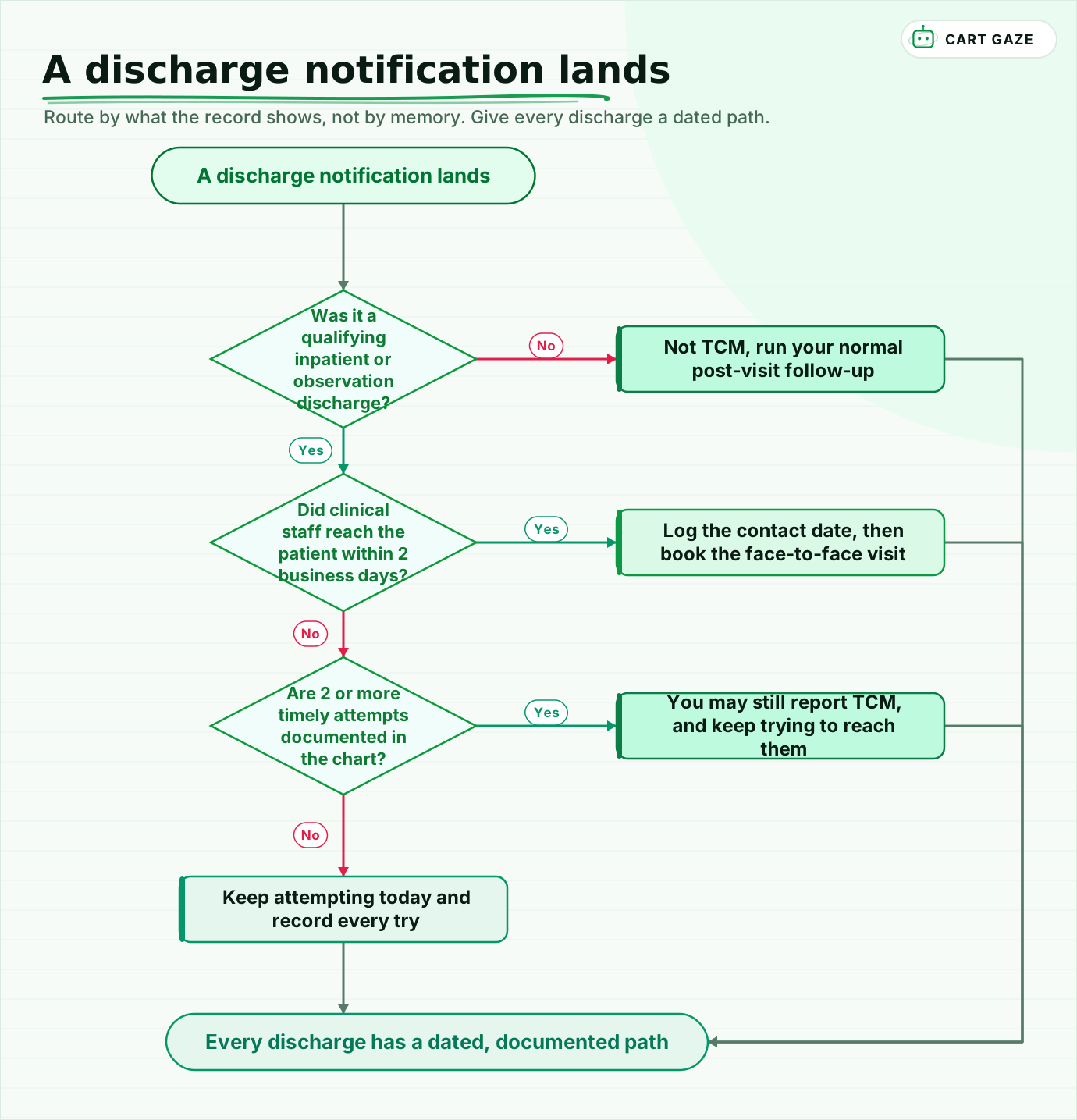 Route by what the record shows, not by memory. Give every discharge a dated path.
Walk the flow once. A discharge from a qualifying setting starts the clock. Contact inside 2 business days by clinical staff gets logged, and the visit gets booked. No contact, but 2 or more documented timely attempts, still leaves the episode reportable. Nothing documented leaves you with an attempt to make today and a record to write.
Pilot on one discharge source rather than all of them at once. A single hospital's notification feed, wired properly and watched for a month, teaches you more than five half-connected ones. Then measure the same two numbers again: eligible discharges, and discharges billed.
One caution worth repeating. Codes, payment rates, and program requirements change every year, and they vary by payer and by locality. Confirm the current year's rules in the Medicare Physician Fee Schedule, and run your workflow past your own biller or counsel. Nothing here is billing or legal advice, and a blog post is a poor substitute for the fee schedule.
If you would rather see the size of the gap before anyone talks tools, the free Growth Leak Audit works from your own numbers.
Fair questions.
What is the 2-business-day rule for transitional care management?
CMS requires interactive contact with the patient or caregiver within 2 business days of discharge, by phone, email, or face to face. It must be made by clinical staff who can address patient status, not only schedule a visit. If contact fails, 2 or more documented timely attempts can still support the claim.
What is the difference between CPT 99495 and 99496?
Both require interactive contact within 2 business days of discharge. 99495 needs at least moderate medical decision making and a face-to-face visit within 14 calendar days. 99496 needs high medical decision making and a visit within 7 calendar days. 99496 pays more, and the shorter visit window makes it harder to hit reliably.
Can an AI receptionist make the TCM interactive contact?
No. CMS requires the interactive contact to be performed by clinical staff who can address patient status and needs beyond scheduling follow-up care. Automation can detect the discharge, place and log outreach attempts, escalate to a person, and book the face-to-face visit. It should route the clinical conversation, never conduct it or assess symptoms.
Can you bill TCM if the patient never answers the phone?
Yes, in defined circumstances. CMS allows the service to be reported after 2 or more unsuccessful separate contact attempts made in a timely manner, as long as the other requirements are met including a timely face-to-face visit, the attempts are documented in the medical record, and the practice keeps trying until it reaches the patient.
How does a practice find out a patient was discharged in time?
Most practices rely on a mix of signals: an electronic ADT notification feed, a payer or ACO roster, a hospital discharge fax, or the patient calling in. Since 2021, CMS has required conformant hospitals to send electronic discharge notifications to a patient established primary care practitioner, though coverage is uneven. Build for several signals.
Sources.
- [1]Transitional Care Management Services (CMS MLN Booklet MLN908628, August 2025)
- [2]Underutilization of transitional care management among Medicare beneficiaries at high risk of readmission
- [3]A Comparison of All-Cause 7-Day and 30-Day Readmissions, 2014 (AHRQ HCUP Statistical Brief 230)
- [4]Information transfer and the hospital discharge summary: national primary care provider perspectives
- [5]Admission, Discharge, and Transfer Patient Event Notification Conditions of Participation (42 CFR 482.24(d))
- [6]CPT 99495 Medicare reimbursement rate, RVUs and fee schedule
- [7]CPT 99496 Medicare reimbursement rate, RVUs and fee schedule
Written by

Muhammad Qasim Hammad
Founder, Cart Gaze
Qasim builds AI receptionists and front-office automation for medical and dental practices at Cart Gaze. Posts here start from published sources and real call data, not vendor claims, and every number links back to where it came from.
Keep reading.
 Clinical Documentation & Care CoordinationRemote Patient Monitoring Enrollment: Get Devices Transmitting10 min read
 Clinical Documentation & Care CoordinationCall Summary to Chart: Documenting Phone Calls Safely9 min read
 Clinical Documentation & Care CoordinationChronic Care Management Automation: Enroll More Eligible Patients10 min read
 Clinical Documentation & Care CoordinationCare Gap Closure: Triage the Payer List Before You Call12 min read
 Clinical Documentation & Care CoordinationPost-Visit Patient Check-In Automation That Routes, Not Triages11 min read
 Clinical Documentation & Care CoordinationLab Result Follow-Up Automation That Closes Every Loop11 min read