
Remote Patient Monitoring Enrollment: Get Devices Transmitting
About 43% of Medicare patients on remote monitoring in 2022 never received all 3 components of it. Here is the enrollment funnel that breaks, from consent to a device that keeps transmitting, and what safely automates.
Key takeaways.
- About 43% of Medicare enrollees who received remote patient monitoring in 2022 did not get all 3 components of it, and most of those gaps are administrative.
- CMS pays device supply against a day count: 2 to 15, or 16 or more, days of transmission out of 30 days, depending on the code you report.
- For 2026 CMS finalized 99445 for 2 to 15 days of transmission, so the billing cliff moved down to 2 days rather than disappearing.
- A day 8 adherence nudge is the only step in the funnel that can still save the current cycle, because a denial on day 31 is a post-mortem.
- An assistant can chase consent, shipping and activation, but the 20 minutes of interactive time that 99457 pays for is clinical staff work.
Table of Contents8 sections
- Why remote patient monitoring enrollment stalls before the first reading
- What Medicare requires before a monitoring month is billable
- The transmission-day rule that quietly kills a billable month
- The enrollment funnel you can actually automate
- Where an AI receptionist helps, and the line it never crosses
- Automated enrollment outreach or a staff-led program
- Route each patient to the right enrollment path
- Fair questions
Your practice has the devices, the vendor contract, and a list of patients who qualify. What it does not have is a patient with a blood pressure cuff on the kitchen counter that sent a reading this morning. Remote patient monitoring rarely fails on technology. It fails somewhere between the eligible patient and the transmitting device, and federal audit data shows exactly where.
The HHS Office of Inspector General reviewed Medicare claims and found that about 43% of enrollees who received remote patient monitoring in 2022 did not receive all 3 components of it. Roughly 28% had no record of education and device setup, about 23% had none for a device, and 12% got no treatment management at all. The first two of those are logistics failures, and both happen before any clinical work starts.
This post walks the enrollment funnel stage by stage, names the transmission-day rule that quietly voids a billing month, and marks the exact line an automated assistant must not cross. Codes, day counts and rates are revised every year, so treat what follows as a map, not billing or legal advice.
Why remote patient monitoring enrollment stalls before the first reading
Remote patient monitoring enrollment breaks in operations, not in medicine. A patient qualifies, someone means to explain the program, the device ships, and then nothing arrives from it. Federal audit data puts numbers on that pattern, and most of the missing pieces sit on the administrative side of the practice.
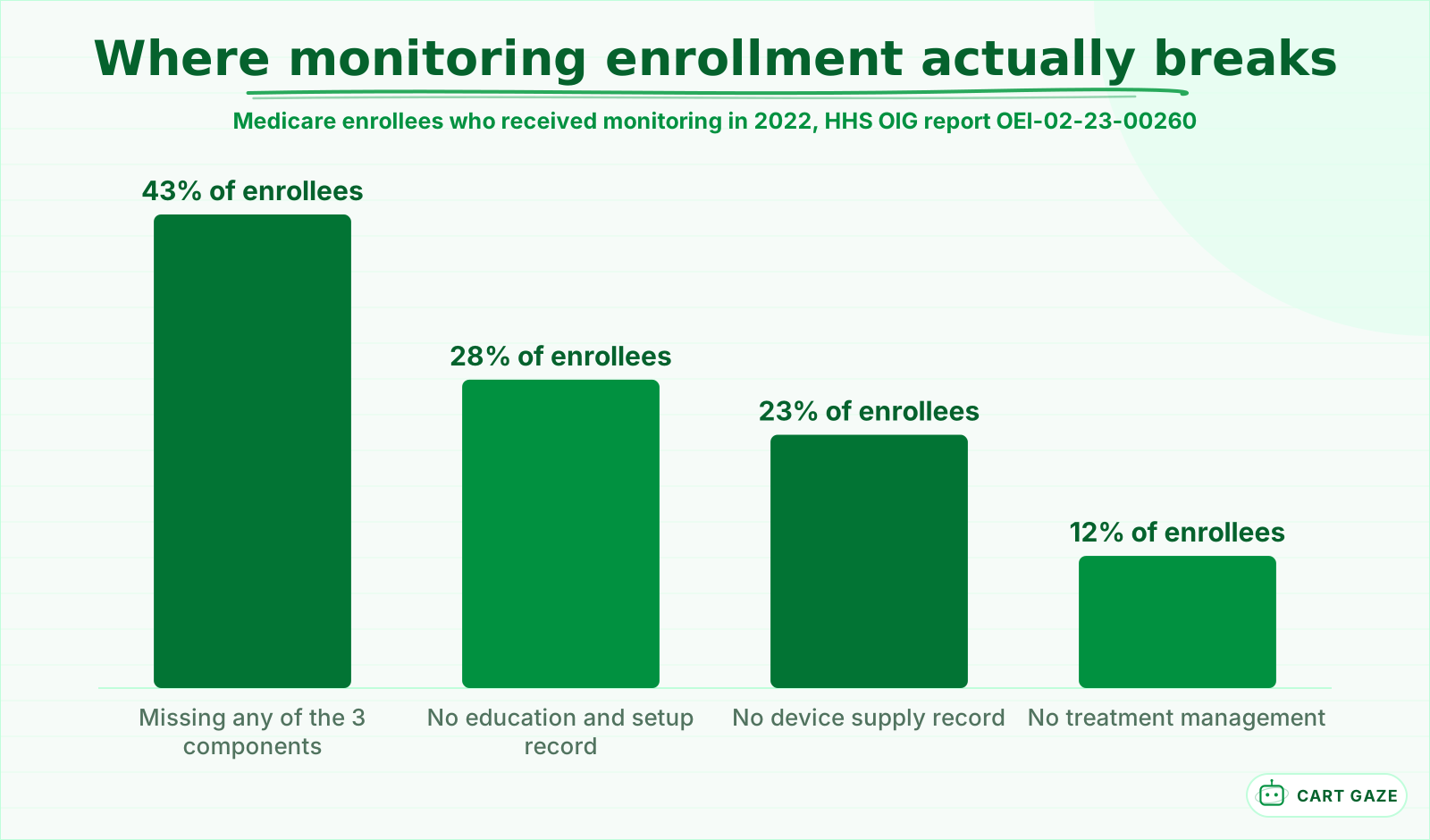 Government audit data, not a vendor claim. Setup and device supply are onboarding failures.
The program itself is neither small nor experimental. Slightly more than 570,000 Medicare enrollees received remote patient monitoring in 2022, compared with about 55,000 in 2019, and Medicare payments for it passed $500 million in 2024. Enrollment is the constraint on a service Medicare is already paying for at scale.
Eligibility is rarely the constraint either. Essential hypertension accounted for 55% of the conditions monitored in the OIG's 2022 data, and CDC survey data puts hypertension at 71.6% of adults aged 60 and over. Most primary care panels already hold more qualifying patients than the practice can onboard in a year.
Pulling that list is the same exercise as pulling any other overdue cohort out of your system, and the mechanics of working a list you already own carry over directly. What is different about monitoring is everything that has to happen after the patient says yes.
What Medicare requires before a monitoring month is billable
CMS describes remote monitoring as 3 components that build on each other: patient education and device setup, device supply, and treatment management. Around those sit conditions that decide whether a claim survives. Miss one and the month is not billable, no matter how good the clinical follow-up looked.
The CMS Medicare Learning Network booklet on telehealth and remote monitoring is blunt about those conditions. Remote physiologic monitoring requires an established patient relationship. Patient consent is required at the time you provide the service. The device has to meet the FDA definition of a medical device and upload data automatically. Only 1 practitioner can bill remote monitoring for a patient in a 30-day period.
One line in that booklet is what makes a staffed workflow possible at all: auxiliary personnel can provide remote monitoring services under the general supervision of the billing practitioner. A medical assistant can run setup and education. Automation can run the reminders around it.
| Code | What it covers | The threshold | What breaks it |
|---|---|---|---|
| 99453 | Setup and patient education | Billed once per device | Nobody documents the teaching |
| 99454 | Device supply and transmission | 16 or more days in 30 | The patient stops using it |
| 99445 | Device supply, shorter window | 2 to 15 days in 30 | The device never pairs |
| 99457 | First block of treatment time | 20 minutes in the month | No live contact with the patient |
| 99458 | Each additional block of time | Another 20 minutes | 99457 was never met |
| 99470 | Shorter treatment management | 10 to 19 minutes | The time is not documented |
Tip
CMS allows remote monitoring to be billed alongside chronic care management for the same patient, provided you do not count the same time and effort twice. If you already run a chronic care enrollment program, the eligible lists overlap heavily and the outreach can share a schedule.
The transmission-day rule that quietly kills a billable month
Device supply is paid against a day count, not a calendar month. CMS requires physiologic data collected for 2 to 15, or 16 or more, days out of 30 days depending on which code you report. A patient who stops wearing the cuff mid-cycle takes the month with them.
That two-tier structure is new. Through 2025, the device supply code 99454 needed 16 or more days of transmission in a 30-day period, and 15 days paid nothing. For 2026, CMS finalized 99445 for 2 to 15 days, effective 1 January 2026. Published summaries report it at the same rate as 99454, which is worth confirming against your own fee schedule before you plan around it.
So the cliff moved down. It did not disappear. The floor is now 2 days rather than zero, which means a device that never pairs still produces nothing, and the 20 minutes of interactive time that 99457 pays for still needs a patient engaged enough to take the call.
Lapsing is ordinary rather than exceptional. In a peer-reviewed study of remote monitoring among Medicaid patients with diabetes, 48.7% of the analyzed group met an 80% adherence bar and 51.3% did not. Of 2,099 patients in the wider sample, only 460, about 21.9%, stayed enrolled for 180 days or more.
The reason this hurts is that it fails silently. No alert goes off on day 9. The practice learns about it from a remittance advice weeks later, once the cycle is closed and the patient has already drifted.
Warning
Codes, day thresholds and payment rates are revised every year, and payment is adjusted by locality. Confirm the current-year rules with your billing team or your Medicare Administrative Contractor before you build a workflow or quote a number to anyone. Nothing here is billing or legal advice.
The enrollment funnel you can actually automate
Six stages sit between an eligible patient and a billable month, and only the last one has to be clinical. Flag the patient, explain the program and record consent, ship and track the device, confirm a first reading, watch adherence inside the cycle, then book the clinical time.
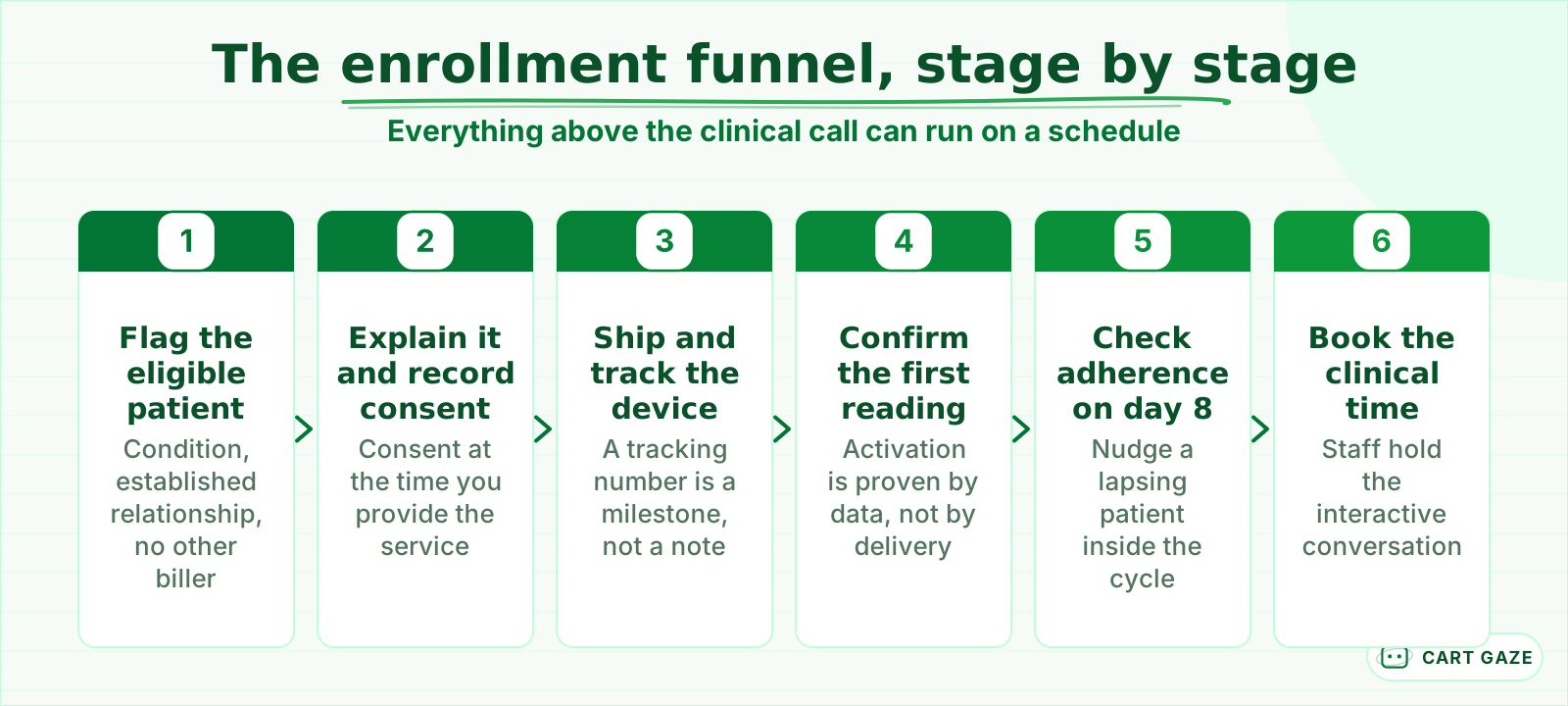 Each stage has its own drop-off. Only the last one has to be clinical.
Two of those stages are usually broken in practices that already run a program. The first is activation. Most shipping trackers mark a device delivered, and a delivered device still boxed on a counter reads as a success in every report the practice looks at. Activation should be proven by a first reading arriving, not by a delivery scan.
The second is the mid-cycle check. A day 8 adherence look is the only automation in this funnel that can still change the outcome of the current billing period. Anything after day 30 is a post-mortem on a month you already lost.
Consent is the stage to be most careful with. CMS requires patient consent at the time you provide the service, so a system can prompt for it, script it, and store the outcome, but a person still has the conversation and confirms the answer. A logged reply to a text message is not the same artifact as a documented consent.
Where an AI receptionist helps, and the line it never crosses
An automated assistant is useful on every logistics question in this program and on none of the clinical ones. It can chase an unreturned consent call, tell a patient when the cuff ships, explain what the program costs them, and put the clinical conversation on a real schedule.
What it must never do is read a number back to a patient and say anything about it. The interactive communication that 99457 pays for is clinical staff time under the billing practitioner. An assistant that interprets a blood pressure reading, judges whether a trend is dangerous, or coaches someone on medication is doing clinical work it is not licensed to do.
Important
The rule on a monitoring line is the same as on any patient line: recognition and redirection, never diagnosis. A caller describing symptoms goes to a human immediately, and a reading is data for a clinician to interpret, not something to comment on in the moment.
If you have not drawn that boundary before, what an AI receptionist does and where it stops is the shorter version of the same argument applied to your whole phone line.
The compliance side is short and not negotiable. Anything that touches patient health details needs a signed Business Associate Agreement with the vendor. Be suspicious of any page describing itself as HIPAA certified, because that certification does not exist. Compliance is a configuration plus a contract, and checking both is your job.
Automated enrollment outreach or a staff-led program
Neither approach wins outright, and the practices that scale usually run both. Staff get more first-time yes answers because the patient knows them. Automation reaches everybody the visit missed and keeps working after the yes, on the shipping, activation and adherence steps that nobody has time to chase.
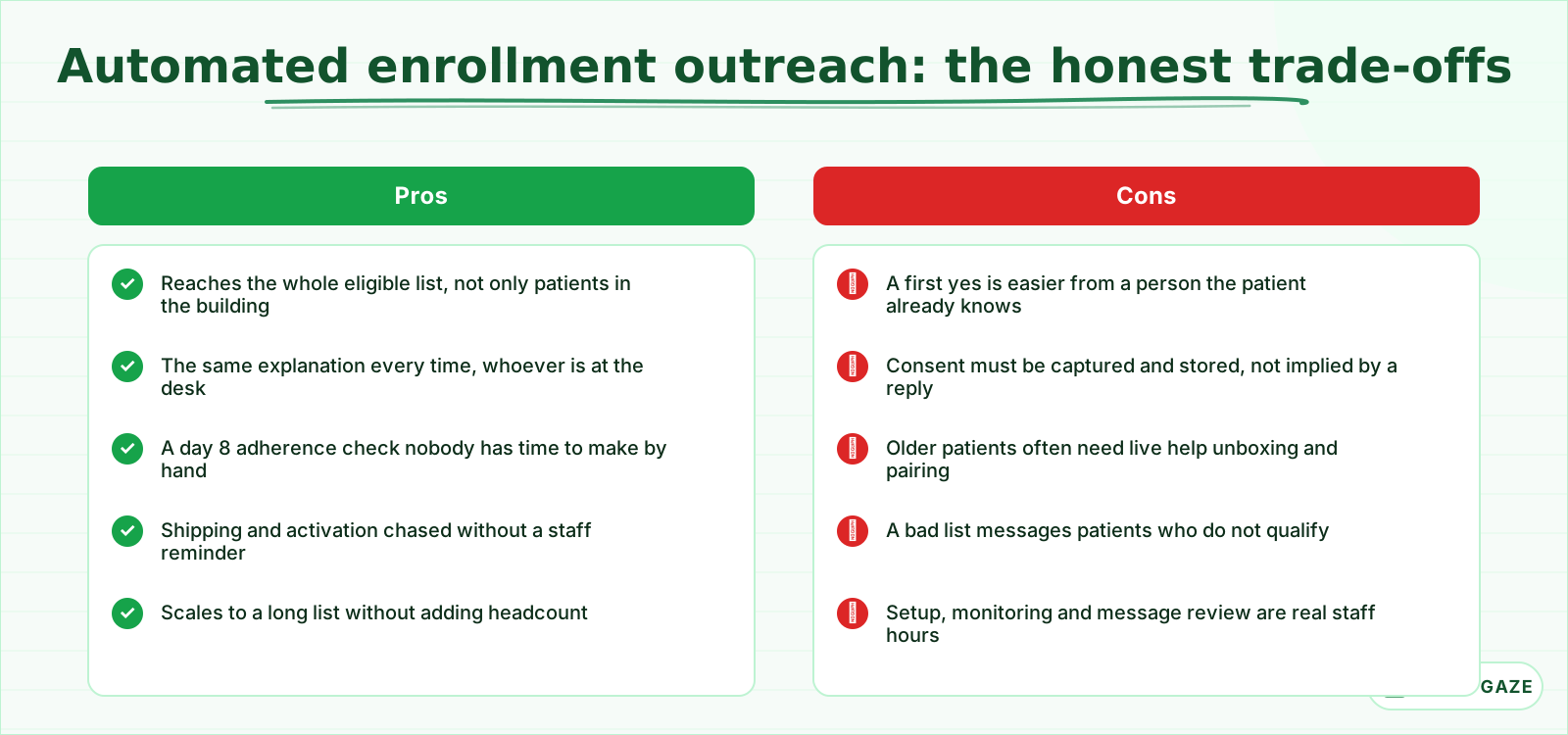 Automation wins on reach and timing. Staff win on the first yes and on trust.
The split most practices land on is plain. Staff make the first ask during a visit, when the patient is in front of them and can hold the device. Automation covers everyone the visit missed, and everything that happens after the yes.
One thing has to be right before either approach runs, and that is the list. Messaging a patient who does not qualify burns the ask and creates work at the front desk. A wrong list is worse than no outreach, and it is the cheapest thing on this page to correct.
Before you scale monitoring enrollment outreach
- Consent is captured and stored before the first billed minute of monitoring.
- A named clinical staff member owns the treatment management time each cycle.
- Device activation is measured by a first reading arriving, not by a delivery scan.
- Current-year codes and thresholds are confirmed with your billing team or your contractor.
Route each patient to the right enrollment path
Every eligible patient sits at one of 4 points: no consent, consent but no first reading, transmitting but behind on days, or on pace and ready for the clinical call. Each point has a different next action, and sorting patients by it is what keeps the program from stalling.
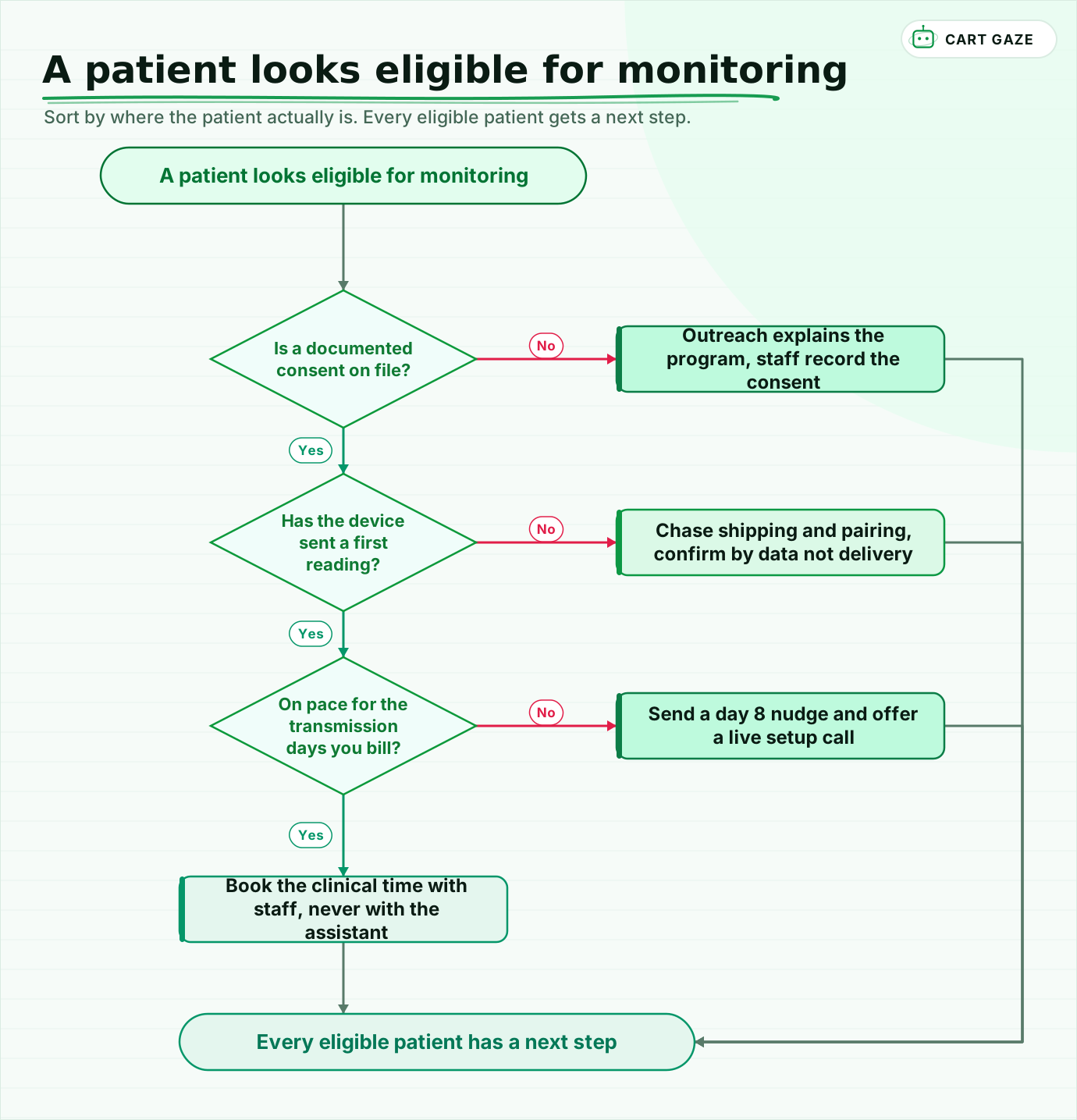 Sort by where the patient actually is. Every eligible patient gets a next step.
Walk it once. No consent on file means outreach explains the program and staff record the answer. Consent but no data means the device is stuck somewhere between the warehouse and the patient's hands, so chase shipping and pairing. Behind on transmission days means a nudge now, inside the cycle, with the offer of a live setup call. On pace means booking the clinical time with a person.
Start narrow. Pilot on one condition and one device type before you point this at the whole eligible list, and read the first two weeks of consent records and call transcripts yourself. Then re-measure in your own data after 60 to 90 days: consent rate, activation rate, and the share of enrolled patients hitting the transmission days you actually bill.
Somebody else's enrollment percentage is not your practice. If you would rather see the size of your own gap first, the free Growth Leak Audit sizes it from your numbers before anyone talks tools.
Fair questions.
How many days must a patient transmit data for remote patient monitoring to be billable?
CMS requires physiologic data collected for 2 to 15, or 16 or more, days out of a 30-day period, depending on which device supply code you report. The 16-day threshold applies to 99454, and CMS finalized 99445 for 2 to 15 days effective 1 January 2026. Confirm current-year rules with your billing team.
Why do so many remote patient monitoring enrollments never produce a claim?
Federal audit data points at onboarding rather than medicine. About 43% of Medicare enrollees who received monitoring in 2022 did not receive all 3 components: roughly 28% had no education and setup record, 23% none for a device, and 12% no treatment management. Those are logistics failures, visible long before a claim is filed.
Can an AI receptionist enroll patients in remote patient monitoring?
It can handle the logistics around enrollment: explain the program in plain language, chase an unreturned consent call, tell a patient when the device ships, confirm pairing, and book the clinical time. It should never conduct the interactive communication that 99457 pays for, interpret a reading, or advise on medication. That is clinical staff work.
Does patient consent for remote patient monitoring have to be documented?
Yes. CMS states that patient consent is required at the time you provide remote monitoring services, and it has to be recorded rather than implied. Automation can prompt for consent, script the explanation and store the outcome, but a person still holds the conversation and confirms the answer before the first billed minute.
Can you bill remote patient monitoring and chronic care management for the same patient?
CMS allows remote monitoring to be billed alongside chronic care management, transitional care management and several other care management services for the same patient, provided you do not count the same time and effort twice. Only 1 practitioner can bill remote monitoring for a patient in a 30-day period, so coordinate before enrolling.
Sources.
- [1]Additional Oversight of Remote Patient Monitoring in Medicare Is Needed (OEI-02-23-00260)
- [2]Some Billing for Remote Patient Monitoring Poses a Risk to Medicare (HHS OIG, 2025)
- [3]Telehealth & Remote Monitoring, MLN Booklet MLN901705 (CMS, December 2025)
- [4]Remote Patient Monitoring coverage and eligibility (CMS)
- [5]CMS finalizes 2026 remote monitoring reimbursement updates (Nixon Law Group)
- [6]Remote Patient Monitoring policy summary (Center for Connected Health Policy)
- [7]Real-World Adherence and Effectiveness of Remote Patient Monitoring Among Medicaid Patients With Diabetes
- [8]Hypertension Prevalence Among Adults: United States, August 2021 to August 2023 (NCHS Data Brief 511)
- [9]Uptake of Remote Physiologic Monitoring in the US Medicare Program
Written by

Muhammad Qasim Hammad
Founder, Cart Gaze
Qasim builds AI receptionists and front-office automation for medical and dental practices at Cart Gaze. Posts here start from published sources and real call data, not vendor claims, and every number links back to where it came from.
Keep reading.
 Clinical Documentation & Care CoordinationCare Gap Closure: Triage the Payer List Before You Call12 min read
 Clinical Documentation & Care CoordinationTransitional Care Management Automation: Beat the 2-Day Clock11 min read
 Clinical Documentation & Care CoordinationCall Summary to Chart: Documenting Phone Calls Safely9 min read
 Clinical Documentation & Care CoordinationChronic Care Management Automation: Enroll More Eligible Patients10 min read
 Clinical Documentation & Care CoordinationLab Result Follow-Up Automation That Closes Every Loop11 min read
 Clinical Documentation & Care CoordinationPost-Op Discharge Follow-Up Automation That Catches Problems Early10 min read