
Copay Waiver Rules: What a Medical Practice May Discount
Routine copay waivers have been on OIG's list of unlawful practices since 1991. The hardship exception, how to document financial need, which discounts hold up, and what staff should say.
Key takeaways.
- OIG has called routine copay waivers unlawful since its May 1991 Special Fraud Alert: they misstate the real charge and can work as a kickback to attract patients.
- A hardship waiver qualifies only if it is not advertised, not routine, and follows a good faith finding of financial need or failed reasonable collection efforts.
- Document need with one written test for everyone; OIG's 2004 guidance names income, assets, expenses, family size, medical bills and local cost of living.
- Prompt-pay discounts can be collection policy: OIG declined to sanction one in Advisory Opinion 08-03, but that opinion protects only the hospital system that asked.
- Florida treats billing a full charge while waiving copays as insurance fraud, and the 2025 federal maximum for an improper inducement is $25,595 per service.
Table of Contents9 sections
- Why can't a practice simply waive a copay?
- What does OIG treat as a routine waiver?
- When is a hardship waiver allowed?
- How do you document financial need?
- Are prompt-pay and self-pay discounts allowed?
- What do commercial payers and state law add?
- Is professional courtesy still allowed?
- Put the policy in writing before the next patient asks
- Fair questions
A patient at checkout asks whether you can skip the copay, just this once. Your front desk wants to say yes. For a Medicare or Medicaid patient, the federal answer turns on whether that yes is a decision about this patient's finances or a habit. The HHS Office of Inspector General (OIG) has called routine copay waivers unlawful since May 1991.
The amounts look small and the exposure does not. After the $283 Part B deductible in 2026, Original Medicare patients usually owe 20% of the cost of each covered service, per CMS and Medicare.gov. The civil penalty for an improper inducement to a Medicare or Medicaid patient reached $25,595 per item or service at its 2025 inflation-adjusted maximum.
Below: what OIG treats as routine, the hardship exception and its paperwork, discounts, commercial and state limits, professional courtesy, and the front-desk script.
Why can't a practice simply waive a copay?
Because the copay is part of the price. OIG's Special Fraud Alert, issued in May 1991 and republished in the Federal Register on December 19, 1994, says a routine waiver misstates your actual charge, can be an illegal kickback to attract patients, and invites overuse of services Medicare pays for.
OIG's own arithmetic shows the first problem. A supplier bills $100 and routinely waives the patient's share, so its real charge is $80. Medicare should pay 80% of $80, which is $64. It pays 80% of $100, which is $80, so every claim overpays $16 and misstates the charge.
The second problem is the kickback. The anti-kickback statute, 42 U.S.C. 1320a-7b(b), bars offering anything of value to generate business paid by Medicare or Medicaid. Forgiving a patient's share for reasons other than genuine financial hardship, the alert says, may unlawfully induce that patient to choose you.
A civil law reaches the same conduct on a lower knowledge standard. Under 42 U.S.C. 1320a-7a(a)(5), a practice can be penalized for remuneration offered to a Medicare or Medicaid patient that it knows or should know is likely to influence which provider the patient uses. The statute defines remuneration to include waiving coinsurance and deductible amounts, in whole or in part.
The statutory penalty is up to $20,000 for each item or service, plus an assessment of up to 3 times the amount claimed, and OIG may exclude the practice from federal programs. HHS adjusts the figure for inflation; the table in 45 CFR 102.3 put the maximum at $25,595 in 2025.
The 1991 alert addressed providers paid on the basis of their charges; OIG repeated the core position in its 2000 compliance guidance for physician practices and its 2004 guidance on hospital discounts.
What does OIG treat as a routine waiver?
A waiver is routine when it follows a pattern instead of a patient. OIG's alert lists warning signs: advertising "no out-of-pocket expense," hardship forms every patient signs, collecting only from patients with Medigap coverage, higher charges for Medicare patients, and waivers for everyone referred from one hospital.
The alert's full list, paraphrased:
- Ads saying "Medicare accepted as payment in full," "insurance accepted as payment in full" or "no out-of-pocket expense." Today that includes your website, your booking pages and your phone scripts.
- Ads promising discounts to Medicare patients.
- Routine use of financial hardship forms stating the patient cannot pay, with no good faith look at the patient's actual finances.
- Collecting copays and deductibles only from patients whose Medigap plan pays them, so the visit costs the patient nothing.
- Charging Medicare patients more than other patients, so the higher charge offsets the waived share.
- Skipping collection for a group of Medicare patients for reasons unrelated to need, such as every patient sent by a particular hospital.
- So-called insurance programs that cover copays only at the seller's own business, for premiums as low as $1 a month or $1 a year.
The third item is the one well-meaning practices trip over. A hardship form is the right tool, and OIG names it as a warning sign anyway, because a form every patient signs is a routine waiver with paperwork attached. The question is whether anyone looked at this patient's situation and decided.
Patterns also form quietly. A desk that waives for a few regulars, then for every patient over 80, then for anyone who complains, has built a group waiver nobody chose.
Warning
Your phone script counts as advertising. If staff or an automated system answer "Will I owe anything?" with "No, we'll take care of it," that is the "no out-of-pocket expense" promise OIG lists, made one caller at a time. Scripts should state what the plan says the patient owes.
When is a hardship waiver allowed?
When all three statutory conditions hold. Under 42 U.S.C. 1320a-7a(i)(6)(A), the waiver is not offered in any advertisement or solicitation, you do not routinely waive cost-sharing, and you either found in good faith that this patient is in financial need or failed to collect after reasonable collection efforts.
OIG's regulation at 42 CFR 1003.110 repeats the same three conditions; the eCFR text was current as of October 1, 2026.
Not advertised. Nothing on your website, intake packet, signage or phone script should offer a waiver. You can say financial assistance exists and how to apply; you should not promise a waived copay in advance.
Not routine. OIG's 2002 Special Advisory Bulletin on gifts and inducements describes the exception as covering "individualized determinations of financial need." It rejects categorical need: the law expressly covers Medicaid, a program open only to financially needy people, so membership in a needy group cannot by itself justify a waiver. "We waive copays for all our seniors on fixed incomes" fails.
Need, or a real collection effort. The second route needs no finding of need. If your normal collection steps have run their course on a balance, you may write it off. The statute does not define reasonable collection efforts, so write your own sequence, such as statements, a call and a final notice, and follow it for every account.
One protection is missing for most practices. The anti-kickback safe harbor for cost-sharing waivers, 42 CFR 1001.952(k), covers inpatient hospital services, federally qualified health centers and similar grant-funded facilities, pharmacies, and certain public ambulance services. An independent physician or dental office is not on that list, so its hardship waivers are protected only by being what they claim to be.
Medicaid adds a rule of its own. Under 42 CFR 447.52(e), the state plan must say that no provider may deny services to an eligible person who cannot pay the cost sharing, except where the state allows it for certain people with family income above 100% of the federal poverty level. The same section adds that nothing in it bars a provider from reducing or waiving cost sharing case by case.
How do you document financial need?
With a written test, applied the same way to every patient, and a record of each decision. OIG's 2004 guidance, written for hospitals, lists factors a good faith finding can weigh: local cost of living, income, assets and expenses, family size, and the size of the patient's medical bills.
It applies the same statutory exception a practice relies on, so it works as a model outside hospitals too:
- Financial need is not limited to indigence; any reasonable measure of hardship can count.
- Guidelines should rest on objective criteria suited to your locality and be applied uniformly in every case.
- OIG does not consider inflated income thresholds appropriate when they produce waivers for people not in genuine need.
- Finances change, so recheck at reasonable intervals; a patient seen several times a week needs no review at every visit.
- If a patient cannot or will not provide documents, a documented interview or questionnaire can serve.
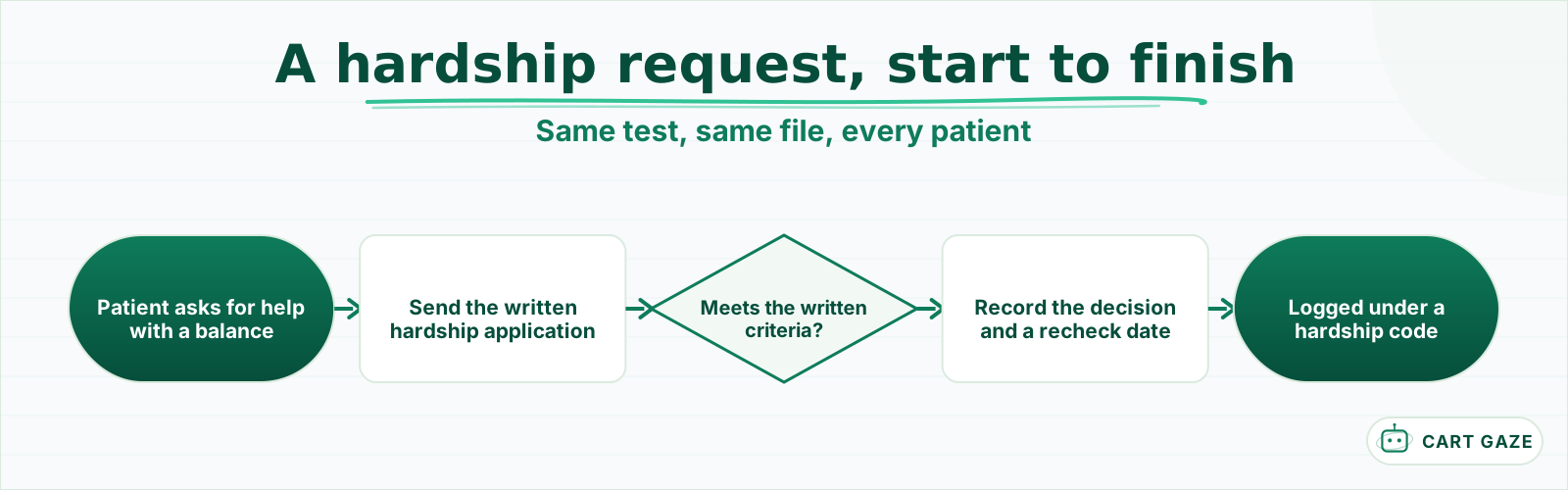 One written test for every patient. The file shows who decided, on what criteria, and when to recheck.
The file for each decision should make sense to someone who was not there:
- The application, or notes from the interview, dated.
- The criteria version used, for example a percentage of the HHS poverty guidelines, and how the patient measured against it.
- The decision, the amount waived, the dates of service covered and who approved it.
- The date the finding expires and must be rechecked.
Separate the person who hears the request from the person who decides it. A receptionist facing an upset patient bends toward whoever asks hardest; a billing manager applying the written test decides on finances.
Tip
Give hardship waivers their own adjustment code, separate from bad debt, small-balance write-offs and contractual adjustments. If you ever need to show that waivers were individual and not routine, a count by month and by approver is the evidence.
Are prompt-pay and self-pay discounts allowed?
Often, when they are built as collection policy rather than marketing. OIG wrote in 1991 that prompt-pay discounts are designed to induce prompt payment and do not appear to violate the anti-kickback statute, while warning it would watch for kickbacks under that label. Discounts for uninsured patients face fewer federal limits.
The clearest example is OIG Advisory Opinion 08-03, issued January 30, 2008. A health system with 2 acute care hospitals and 1 critical access hospital proposed discounting cost-sharing paid early: 10% on balances under $1,000 and 15% on $1,000 or more before discharge, or 5% and 10% within 30 days of the offer. OIG said it would not impose sanctions, citing the system's commitments:
- Patients would hear about the discount only during billing; it would not be advertised.
- Other payers would be told about it.
- Discounted amounts would not be claimed as bad debt or shifted to anyone else.
- The discount would bear a reasonable relationship to the collection costs it avoided.
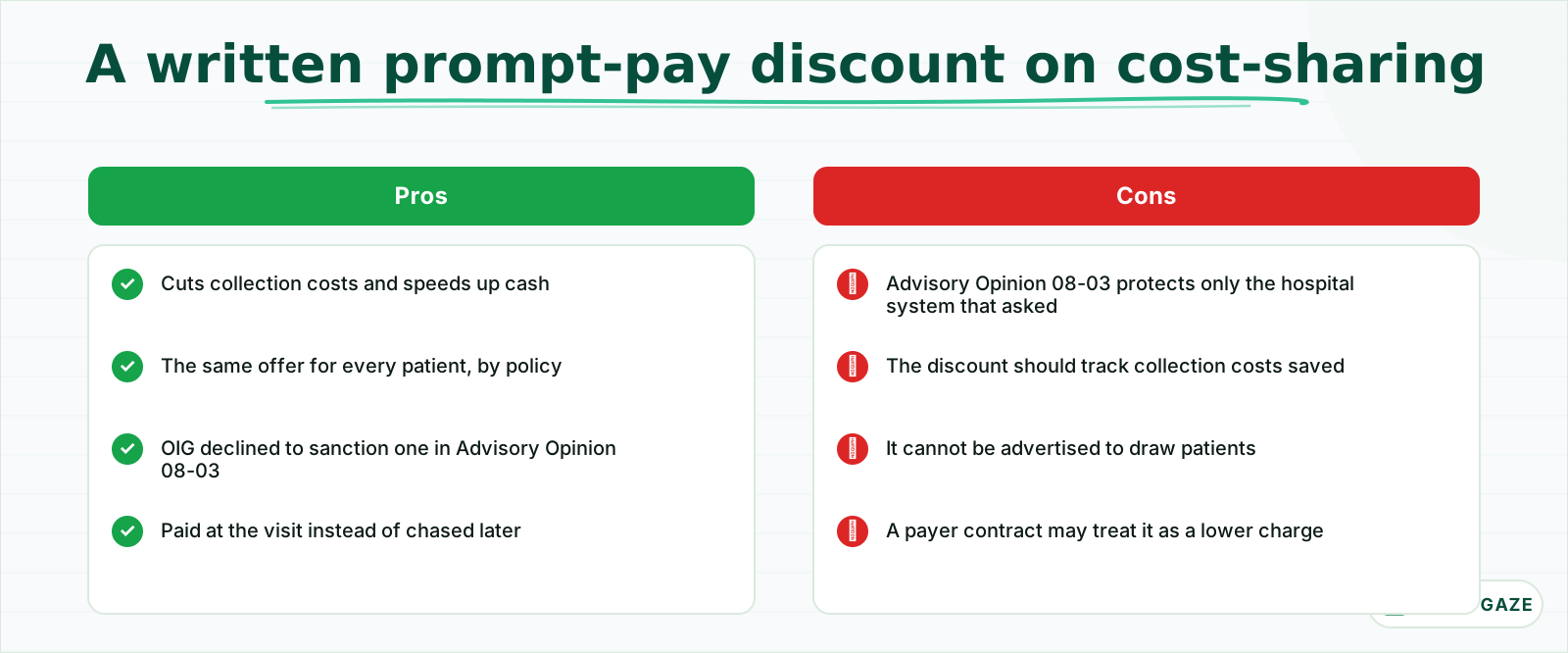 A prompt-pay discount is collection policy, not marketing. Advisory Opinion 08-03 shows the shape, not your protection.
Important
An advisory opinion protects only the party that requested it, and 08-03 went to a hospital system. A practice can borrow its structure but not its protection; OIG's advisory opinion process is open to a practice that wants its own.
Discounts for uninsured patients sit outside the beneficiary inducement law, which covers people eligible for Medicare or Medicaid. OIG's 2004 guidance says no OIG authority prohibits hospitals from discounting for uninsured patients who cannot pay, as long as the discount is not linked to generating federal program business.
It also addressed a quieter risk: an exclusion law, 42 U.S.C. 1320a-7(b)(6)(A), reaches providers that bill Medicare or Medicaid substantially more than their usual charges. The guidance states OIG's enforcement policy that free or substantially reduced charges to uninsured patients, or to underinsured patients paying for themselves, need not count when calculating usual charges.
How the self-pay path should run at intake, from price to deposit to Good Faith Estimate, is covered in routing cash-pay and insurance patients at intake.
What do commercial payers and state law add?
A second set of rules, in contracts and state statutes. The federal laws above protect Medicare and Medicaid. A commercial plan relies on its contract, and some states, Florida among them, treat billing a full charge you never meant to collect as insurance fraud. Other states differ.
A federal appeals court read plan language the way OIG reads Medicare. In Kennedy v. Connecticut General Life Insurance Co. decided February 7, 1991, the Seventh Circuit took up a $1,727 chiropractic bill. The chiropractor had agreed to accept whatever the insurer paid, and the plan excluded charges a patient is "not legally required to pay." Judge Easterbrook wrote that "80% of nothing is nothing," and the insurer owed nothing.
The opinion also describes the move plans worry about: announce a fee of $125, waive the patient's share, and collect $100 from the insurer instead of $80. Waiving commercial copays is a bet that the plan never asks.
Florida writes the rule into its criminal code. Section 817.234(7)(a) of the 2025 Florida Statutes makes it a material omission and insurance fraud for a service provider, other than a hospital, to make a general business practice of billing its usual and customary charge while agreeing or intending to waive deductibles or copayments. Whether the provider made a good faith attempt to collect is part of the test. Penalties depend on the value involved, from a third-degree felony below $20,000 to a first-degree felony at $100,000 or more.
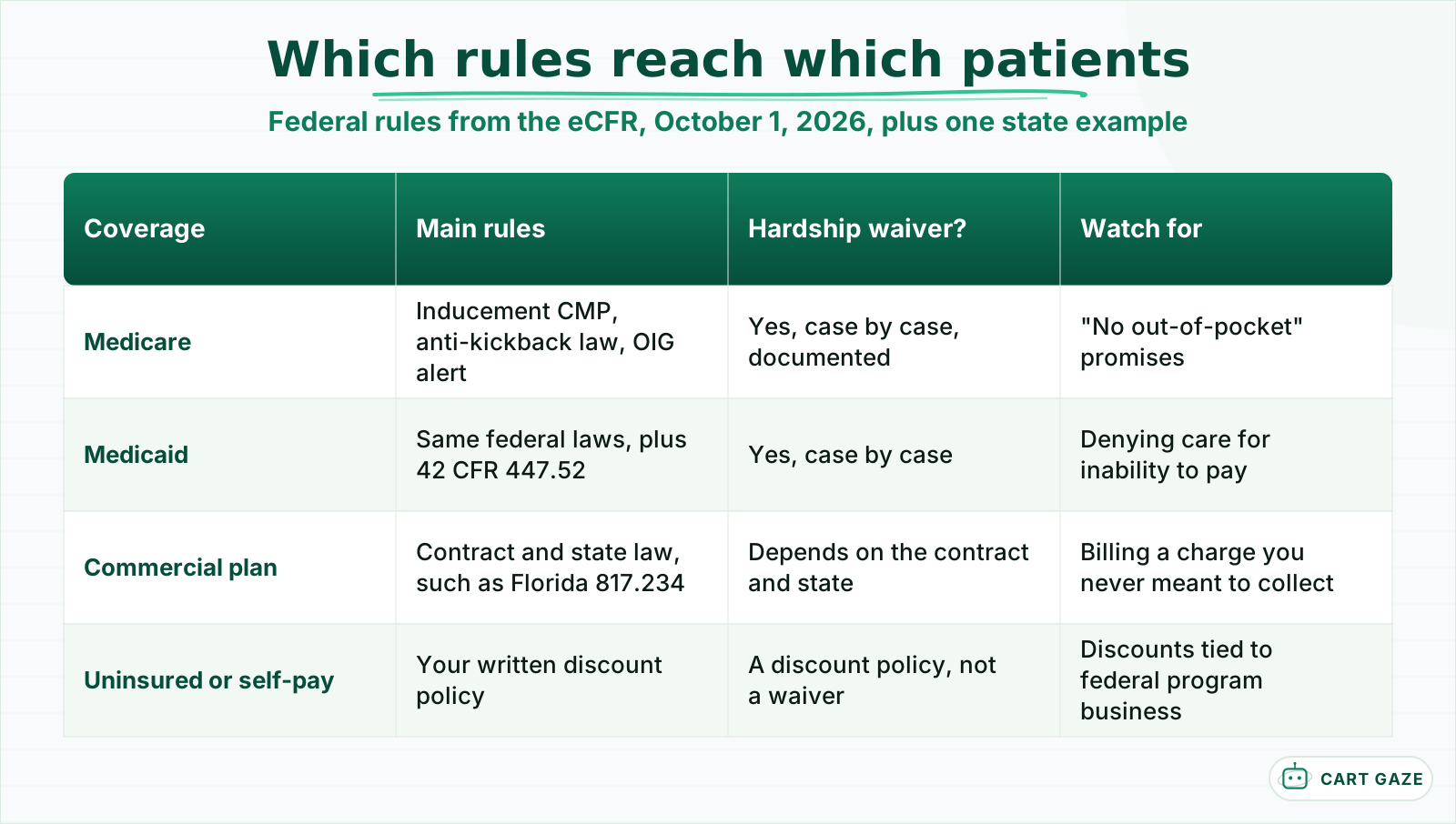 Federal rules first, then contracts and state law. Florida is one example; check your own state.
None of this is legal advice. Payer contracts, state insurance fraud laws and state anti-kickback laws vary, so have health care counsel review your written policy against your contracts and your state's law before staff use it.
Is professional courtesy still allowed?
Sometimes, depending on who receives it and how. OIG's 2000 compliance guidance for physician practices says the legal risk turns on two questions: how recipients are chosen and how the courtesy is given. Choosing recipients by their ability to refer is the anti-kickback problem; waiving only the copay is the inducement problem.
The guidance draws three lines:
- Regularly waiving the entire fee for a group, such as staff, physicians and their families, may not raise OIG concerns if membership does not depend on anyone's ability to refer.
- Waiving only the copay for that same group does not raise the anti-kickback issue under the same condition.
- Any copay waiver for a Medicare or Medicaid patient who is not financially needy does raise the beneficiary inducement issue, courtesy or not.
That middle practice, billing the plan and waiving the patient's share, is what OIG calls "insurance only" billing. On a commercial claim, it is the Kennedy problem again.
Hospitals and other entities with a formal medical staff follow the physician self-referral exception at 42 CFR 411.357(s). Its conditions include an offer to all staff physicians, or all in the local community, regardless of referrals; a written policy approved in advance by the governing body; and a good faith showing of financial need before courtesy reaches a federal program beneficiary.
Put the policy in writing before the next patient asks
Write one policy that covers hardship waivers, collection write-offs, any prompt-pay or self-pay discount and professional courtesy, then give staff the words for the moment a patient asks. The script matters as much as the policy, because the front desk is where routine waivers start.
| Patient says | Staff answer | What happens next |
|---|---|---|
| "Can you just waive my copay?" | "We can't waive copays as a general offer. If paying is hard right now, I can send you our financial assistance application." | Application sent; the balance stays open until a decision |
| "Will I owe anything today?" | "Your plan shows a copay of [amount]. I can take it now or set up a payment plan." | State the amount; never "no out-of-pocket" |
| "My last doctor never charged me a copay." | "We collect what your plan says you owe, and we review hardship requests one at a time." | No exception granted at the desk |
| "I lost my job and can't pay this." | "I'm sorry. I'll send the application now, and the billing manager will review it." | Hardship review with a recheck date |
| "Is there a discount if I pay today?" | Only if your written policy has one: "Every patient who pays at the visit gets [X]% off." | The same discount for every patient |
Automation can carry the repetitive parts: texting the application link when a patient asks, reminding the approver of recheck dates, and reporting hardship adjustments by month and approver. It should never decide a waiver or tell a patient a balance is waived; that stays with the person who owns the written test.
Before an automated phone line answers billing questions, settle what it says and when it hands the caller to staff; what an AI receptionist does and where it hands off to staff covers that boundary. For patients who can pay over time but not today, a plan usually beats a waiver, and how practices present payment plans and financing covers that conversation.
Before staff use the waiver policy
- The hardship criteria, application and approver are named in one written policy.
- Hardship waivers post under their own adjustment code.
- Your website, booking pages and phone scripts never promise "no out-of-pocket" costs.
- Your largest payer contracts have been read for cost-sharing and discount clauses.
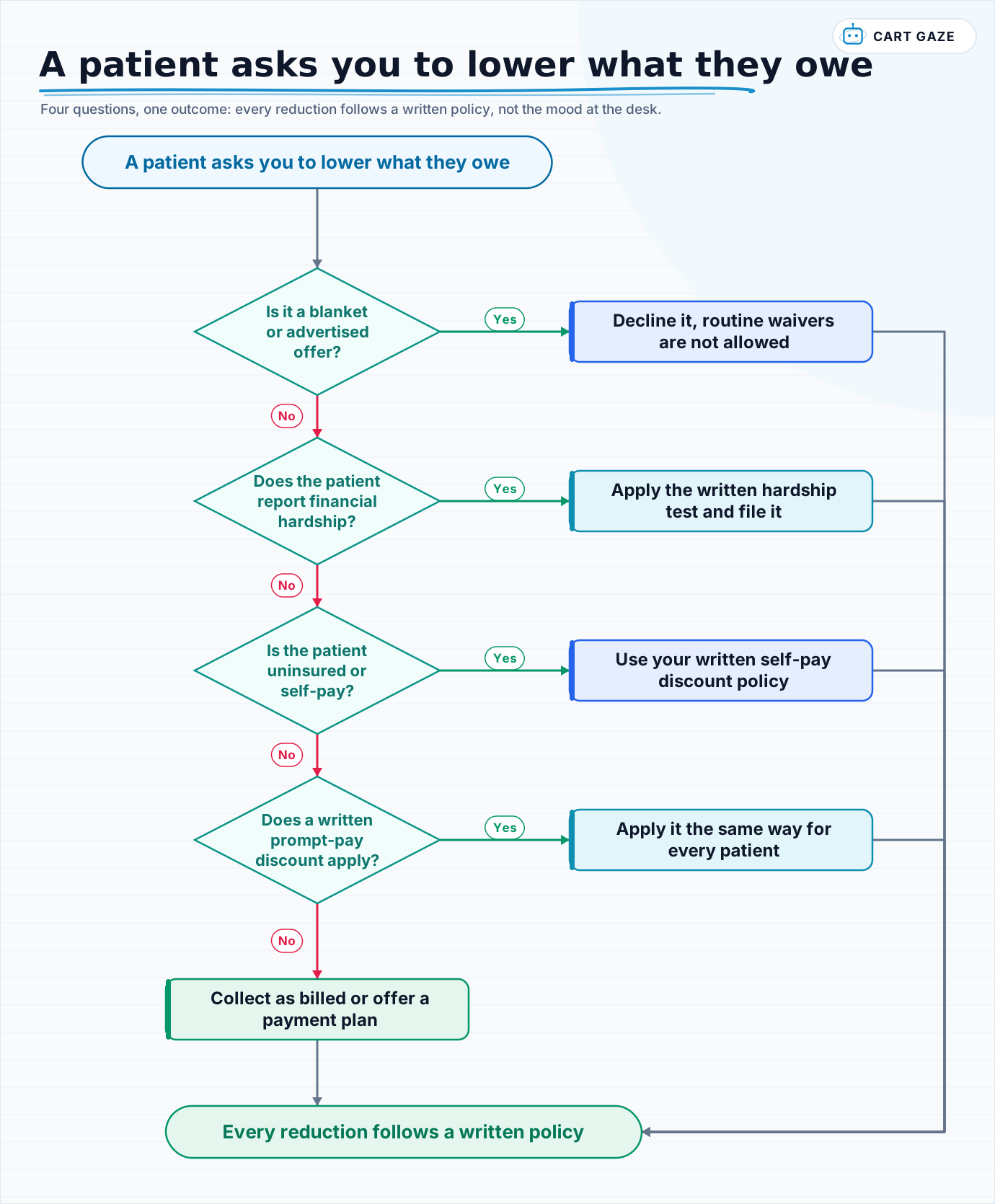 Four questions, one outcome: every reduction follows a written policy, not the mood at the desk.
Walk the ladder with your billing lead before staff use it: a blanket offer stops at the first question, and every other path ends in a written rule.
Waived copays are revenue a practice decides to give up, one patient at a time. Missed calls are revenue it never sees at all, and the growth leak calculator estimates what missed calls cost your practice each month from your own call numbers.
Fair questions.
Is it illegal for a medical practice to waive copays?
Routinely waiving copays for Medicare or Medicaid patients can violate federal law. OIG's Special Fraud Alert, issued in 1991, says routine waivers misstate the actual charge and can be an illegal inducement. Waiving a copay for one patient after a good faith finding of financial need, without advertising it, is allowed. Commercial plans and state laws can add their own limits.
How do you document financial hardship for a copay waiver?
Use one written test, applied the same way to every patient. OIG's 2004 guidance lists factors such as income, assets and expenses, family size, the size of the patient's medical bills and the local cost of living. Keep the application or interview notes, the criteria used, the amount waived, who approved it and the date to recheck.
Can a practice offer a prompt-pay discount to Medicare patients?
Possibly, if it is built as collection policy. OIG has said prompt-pay discounts do not appear to violate the anti-kickback statute, and in Advisory Opinion 08-03 it declined to sanction a hospital system's discount that was not advertised, was disclosed to payers and tracked avoided collection costs. That opinion protects only the system that requested it.
Can a practice waive copays for commercial insurance patients?
The federal inducement laws protect Medicare and Medicaid, but plan contracts and state laws cover commercial patients. In a 1991 case, a federal appeals court held that a plan owed nothing when the provider had agreed never to collect from the patient. Florida treats billing a usual charge while waiving copays as insurance fraud. Check each contract and your state.
Is professional courtesy for staff and physicians allowed?
It depends on who receives it and how. OIG's 2000 guidance says regularly waiving the whole fee for a group chosen without regard to referrals may not raise concerns, but waiving a copay for a Medicare or Medicaid patient who is not financially needy raises the beneficiary inducement issue. Hospitals have a separate written-policy exception at 42 CFR 411.357(s).
Sources.
- [1]Publication of OIG Special Fraud Alerts, including Routine Waiver of Copayments or Deductibles Under Medicare Part B (Federal Register, Dec 19, 1994)
- [2]42 U.S.C. 1320a-7a, Civil monetary penalties (United States Code, 2024 Edition, govinfo)
- [3]42 CFR 1003.110, Definitions, including remuneration (eCFR)
- [4]42 CFR 1003.1010, Amount of penalties and assessments (eCFR)
- [5]45 CFR 102.3, Penalty adjustment and table (eCFR)
- [6]42 CFR 1001.952, Exceptions (anti-kickback safe harbors), paragraph (k) (eCFR)
- [7]42 CFR 447.52, Cost sharing (Medicaid) (eCFR)
- [8]OIG Special Advisory Bulletin: Offering Gifts and Other Inducements to Beneficiaries (August 2002)
- [9]OIG: Hospital Discounts Offered to Patients Who Cannot Afford to Pay Their Hospital Bills (February 2, 2004)
- [10]OIG Advisory Opinion No. 08-03, prompt pay discounts (issued January 30, 2008)
- [11]OIG Compliance Program for Individual and Small Group Physician Practices (65 FR 59434, Oct 5, 2000)
- [12]42 CFR 411.357, Exceptions to the referral prohibition, paragraph (s) professional courtesy (eCFR)
- [13]Kennedy v. Connecticut General Life Insurance Co. 924 F.2d 698 (7th Cir. 1991)
- [14]Florida Statutes 817.234, False and fraudulent insurance claims (2025, Florida Senate)
- [15]2026 Medicare Parts A & B Premiums and Deductibles (CMS fact sheet, Nov 14, 2025)
- [16]Medicare costs: Part B coinsurance (Medicare.gov)
Written by

Muhammad Qasim Hammad
Founder, Cart Gaze
Qasim builds AI receptionists and front-office automation for medical and dental practices at Cart Gaze. Posts here start from published sources and real call data, not vendor claims, and every number links back to where it came from.
Keep reading.
 Billing & Revenue CycleWorkers Comp Intake Automation: Capture What Gets Paid10 min read
 Billing & Revenue CycleCash-Pay Patient Intake vs. Insurance: Branch the Call First10 min read
 Billing & Revenue CyclePrice Shopper Calls: How to Quote Cash Prices by Phone and Book10 min read
 Billing & Revenue CycleBilling Question Call Deflection: Automate the Boring Half10 min read
 Billing & Revenue CycleProvider Credentialing Automation: Never Miss a Deadline10 min read
 Billing & Revenue CycleYear-End Dental Benefits Reminder Automation for Practices11 min read