
Price Shopper Calls: How to Quote Cash Prices by Phone and Book
For a self-pay caller, asking what a visit costs counts as a Good Faith Estimate request. Here is how to quote honestly by phone, meet the 3-business-day rule, and still book the visit.
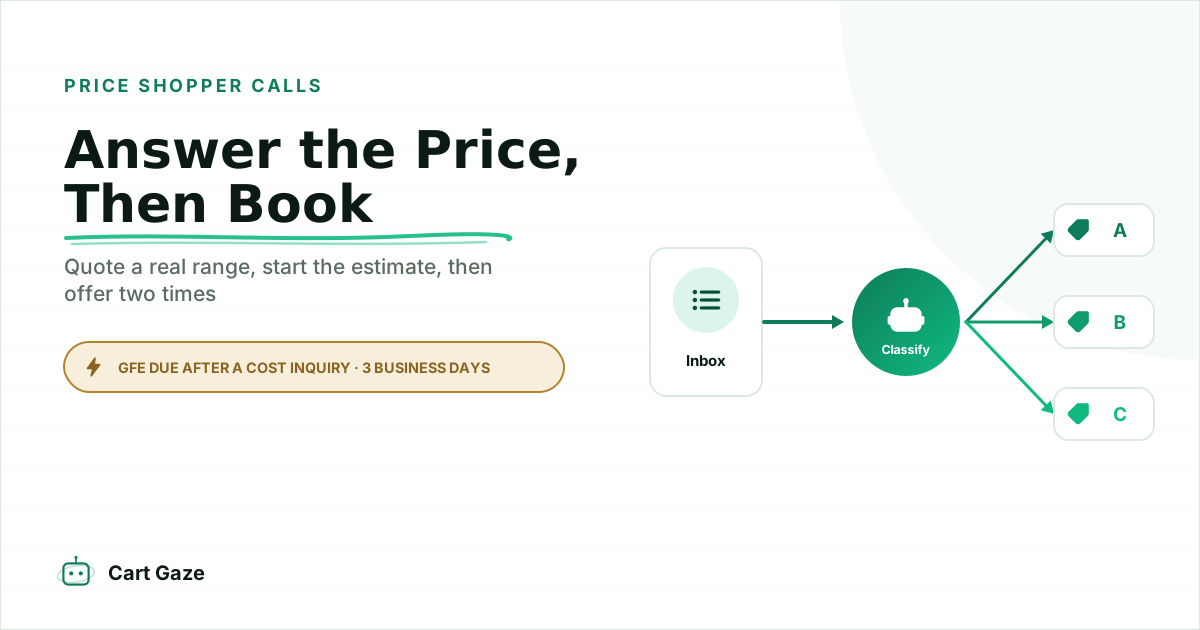
Key takeaways.
- For uninsured or self-pay callers, any question about cost counts as a Good Faith Estimate request under 45 CFR 149.610.
- The written estimate is due within 3 business days of a request, or within 1 business day of scheduling a visit 3 or more business days out.
- Quote from one approved price list: exact prices for fixed services, honest ranges with their drivers for variable ones.
- Do not guess an insured caller out-of-pocket cost; give the practice price and offer a benefits check instead.
- An AI receptionist may quote self-pay prices from the same list if it promises the estimate, logs the request, and routes clinical questions to staff.
Table of Contents8 sections
The call front desks dread most starts with "how much is it?" Give a bare number and the caller hangs up to compare it with the next practice. Refuse to give one and they hang up anyway. And since the No Surprises Act, that question from an uninsured or self-pay caller does something most desks do not realize: it counts as a request for a Good Faith Estimate, which starts a legal clock of 3 business days.
Price shopper calls can be answered honestly and still end in a booking. This post covers why the question matters more than the number, what the Good Faith Estimate rules mean for a phone quote, what the desk can quote and how, a quote-to-booking script, when an AI receptionist may quote, and how to keep the prices it quotes accurate.
Why "how much is it?" is really two questions
A price shopper is usually asking two things: what will this cost me, and can I trust you. A bare number answers the first and ignores the second. A range, what moves it, and a written estimate to follow answers both, and gives the caller a reason to book with you rather than keep dialing.
Most price calls come from people who are not only comparing numbers. They are uninsured, on a high-deductible plan, paying for something elective, or have been surprised by a bill before. A confident, specific answer signals that the practice is organized and honest about money, which is part of what the caller is shopping for.
The two failure modes are both common. The first is a bare number: "It's $185." The caller has nothing to compare except price, so they keep calling. The second is refusal: "We can't give prices over the phone." That sounds like a practice with something to hide, and after the No Surprises Act it is also the wrong answer for self-pay callers.
The better answer names the price or range, says what changes it, promises the written estimate, and moves to a time. That structure takes about a minute.
What the Good Faith Estimate rules mean for a phone quote
For an uninsured or self-pay caller, the regulation says any discussion or inquiry about the potential cost of a service counts as a request for a Good Faith Estimate. The practice must then provide a written estimate within 3 business days. A phone quote does not replace it; it starts it.
The rule is 45 CFR 149.610. It tells providers to treat "any discussion or inquiry regarding the potential costs of items or services under consideration as a request for a good faith estimate," and to tell people orally, when scheduling or when cost questions come up, that a Good Faith Estimate is available. When the estimate is requested, it is due no later than 3 business days after the request. When a service is scheduled at least 3 business days ahead, it is due within 1 business day of scheduling; at least 10 business days ahead, within 3 business days.
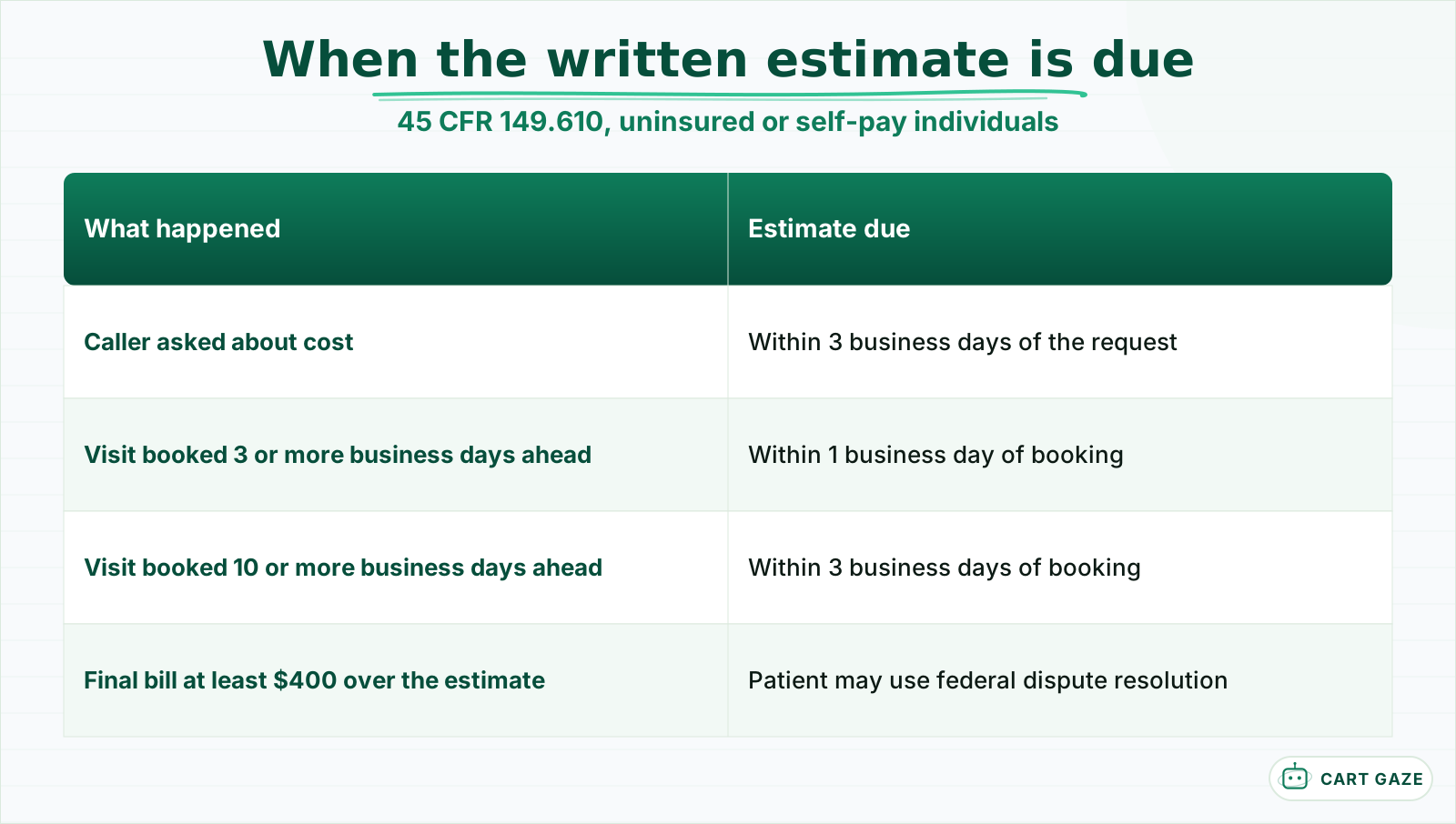 A price question from a self-pay caller starts the first row.
The estimate must be written, on paper or electronically, in a form the patient can save and print. If a caller asks for it by phone, the practice may tell them what it contains orally, but it still has to send the written version to meet the rule.
The stakes are real. If the final bill comes in at least $400 above the estimate, the patient can use the federal patient-provider dispute process. Who triggers an estimate, what it must contain, and how to automate it are covered in Good Faith Estimate automation.
Important
The rules apply to uninsured and self-pay patients. A patient using insurance is in a different position: their cost depends on their plan, so the desk should not quote an out-of-pocket amount before checking benefits.
What the desk can quote, and how
Quote from a published price list, never from memory. Give the exact price for fixed services, a range with its drivers for variable ones, and no out-of-pocket figure for insured callers until benefits are checked. Every self-pay quote ends with the written estimate promise.
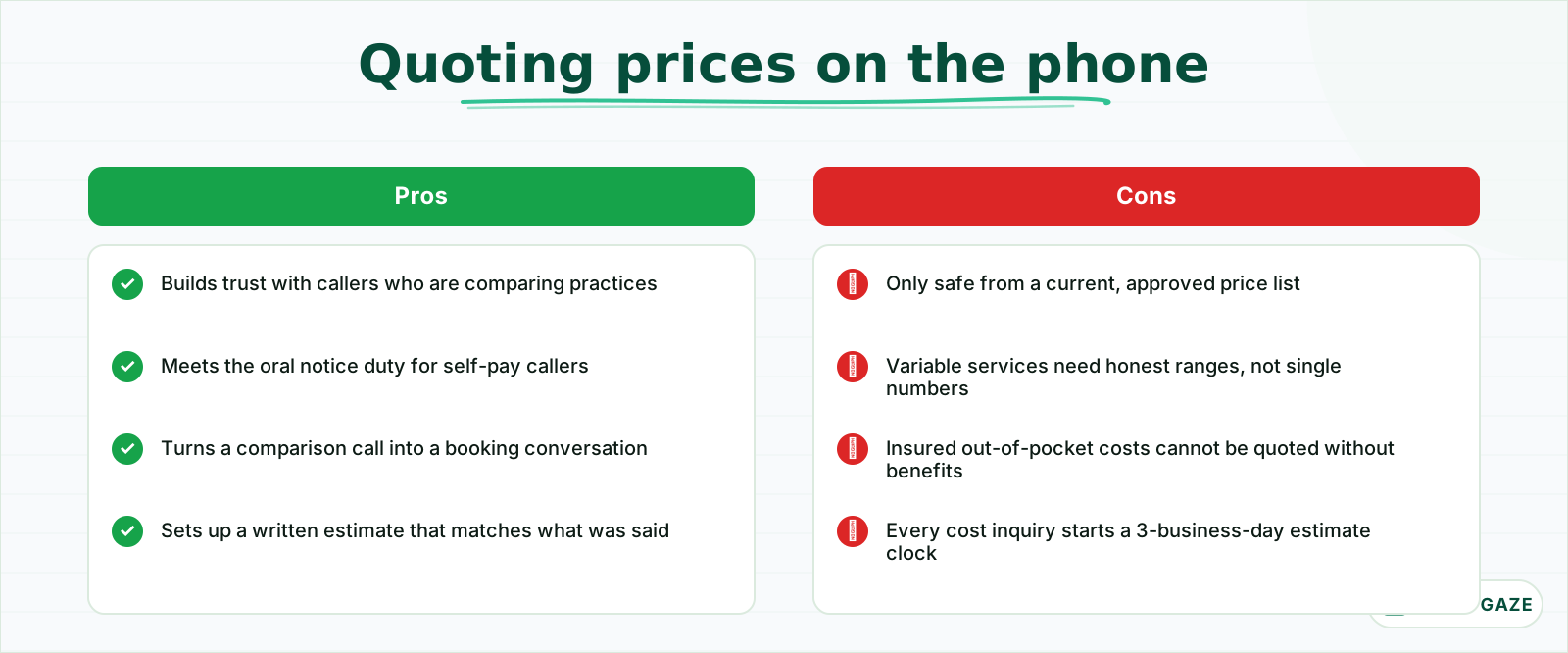 The list is what makes phone quoting safe. Without it, every call gets a different price.
A price list is the foundation. It should list each common self-pay service, its price or range, what is included, and what can add to it: imaging, lab work, a second provider, a facility fee. If the list lives only in one person's head, every call gets a slightly different answer, and the written estimates will not match what was said.
Ranges should be honest about what moves them. "A new-patient visit is $150 to $250, depending on whether you need X-rays" is useful. "It depends" is not. For services involving other providers, such as anesthesia or pathology, the estimate has to include the co-providers' expected charges, and the phone answer should say so.
Packages and payment options belong on the list too. If the practice offers a bundled price for a course of treatment, a deposit to hold a procedure date, or a payment plan, write down the exact terms. Callers often decide on whether they can spread the cost, not on the headline price, and an improvised answer about payment terms is a promise someone else will have to keep.
Insured callers asking "how much will I pay?" need a different answer. Their cost depends on the plan's deductible, copay, and coinsurance, so the honest phone answer is the practice's price and an offer to check their benefits. Sorting self-pay and insured callers from the first question is covered in cash-pay and insurance intake.
A quote-to-booking script
A good price call follows five moves: ask whether the caller will use insurance, give the price or range from the list, name what changes it, promise the written estimate, and offer two specific times. It takes about a minute and turns a comparison call into a booking conversation.
| Move | What to say | Why |
|---|---|---|
| 1. Sort | "Will you be using insurance, or paying yourself?" | Decides which answer is honest |
| 2. Price | "A new-patient visit is $150 to $250." | A real number builds trust |
| 3. Drivers | "It depends mostly on whether you need X-rays." | Explains the range |
| 4. Estimate | "I'll send you a written estimate within 3 business days." | Meets the rule, sets expectations |
| 5. Book | "I have Tuesday at 10 or Thursday at 2." | Moves the call forward |
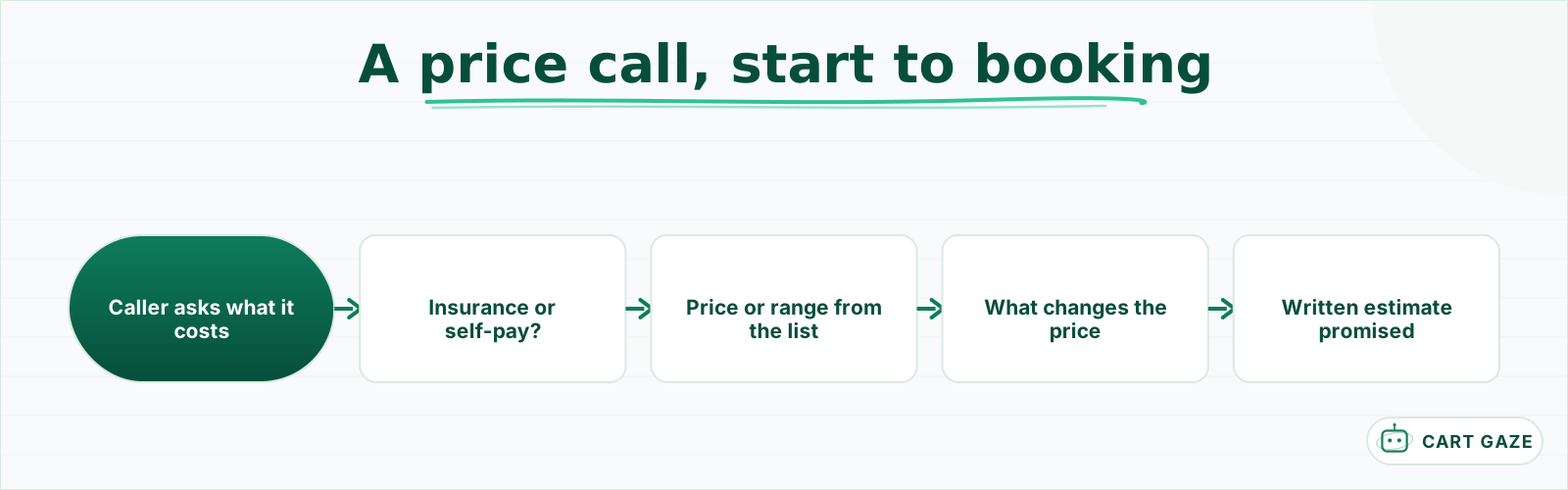 About a minute, start to finish. The estimate promise is the step people skip.
The fourth move matters more than it looks. Saying it out loud tells the caller they will have the price in writing, which removes much of the risk of booking, and it reminds staff that the estimate clock has started.
Some callers will still say they want to think about it. Take their name and a way to send the estimate, send it, and follow up once. A caller who has the practice's written estimate in hand is more likely to come back than one who has only a number from memory.
"Can you do it for less?" deserves a planned answer too. Do not negotiate on the phone. If the practice has a written prompt-pay discount or a sliding fee scale, state it exactly as written and apply it to everyone who qualifies. If it does not, say the listed price is the price, and point to the payment options instead. Ad hoc discounts create the inconsistency that makes written estimates hard to defend.
Tip
Put the five moves on a card at every phone. Price calls tend to arrive when the desk is busiest, which is exactly when people skip the estimate promise.
When an AI receptionist may quote prices
An AI receptionist can quote self-pay prices if it reads them from the same approved price list your staff uses, gives ranges with their drivers, promises the written estimate, and books. It should not estimate an insured patient's out-of-pocket cost, and anything outside the list goes to a person.
That setup fits the price call well. The questions repeat, the answers come from a list, and the calls often arrive after hours, when price shoppers have time to call around. An AI receptionist that answers "how much is a new-patient visit?" at 8 p.m. with a real range, the estimate promise, and two times has done the whole job.
It also needs to trigger the paperwork. If a caller asks about cost, the system should record the request so the written estimate goes out within the 3 business days, rather than relying on staff to notice the call the next morning. What an AI receptionist does and where it hands off is set out in what an AI receptionist does and where it stops.
Clinical limits apply here too. A caller asking "do I even need this procedure?" is asking a clinical question, and the AI must pass it to staff. It never assesses symptoms or gives medical advice, and because it hears PHI, the vendor must sign a BAA.
Keep the quoted prices accurate
A quote is only as good as the price list behind it. Review the list whenever fees change and at least quarterly, give it one owner, and make every quoting channel read the same version: staff, the website, and any AI receptionist. Then spot-check calls against it.
Mismatches are the usual failure. The website lists last year's price, the AI reads a spreadsheet updated this month, and a staff member quotes from memory. Each is defensible alone; together they give three prices for the same visit, and a written estimate that contradicts what the caller heard.
Spot checks catch it. Once a month, compare a handful of recent price calls, and the estimates that followed, with the list. If they differ, fix the source, not the call.
Consider publishing self-pay prices for common services on your website. A clear price page answers some questions before the phone rings, and callers who do ring already have a number in mind, which makes the conversation about fit and timing rather than price. The page has to read from the same list, or it becomes one more place for prices to drift.
Before your desk quotes a price
- There is one approved price list with a named owner.
- Every self-pay quote ends with the written estimate promise.
- Cost inquiries are logged so the estimate goes out within 3 business days.
- Insured callers get a benefits check, not a guessed out-of-pocket figure.
Answer the price question, then book
Answer every price call with a real number or range from your list, say what changes it, promise the written estimate for self-pay callers, and offer two times. Log the inquiry so the estimate goes out on time. Measure how many price calls end in a booking, and review the list quarterly.
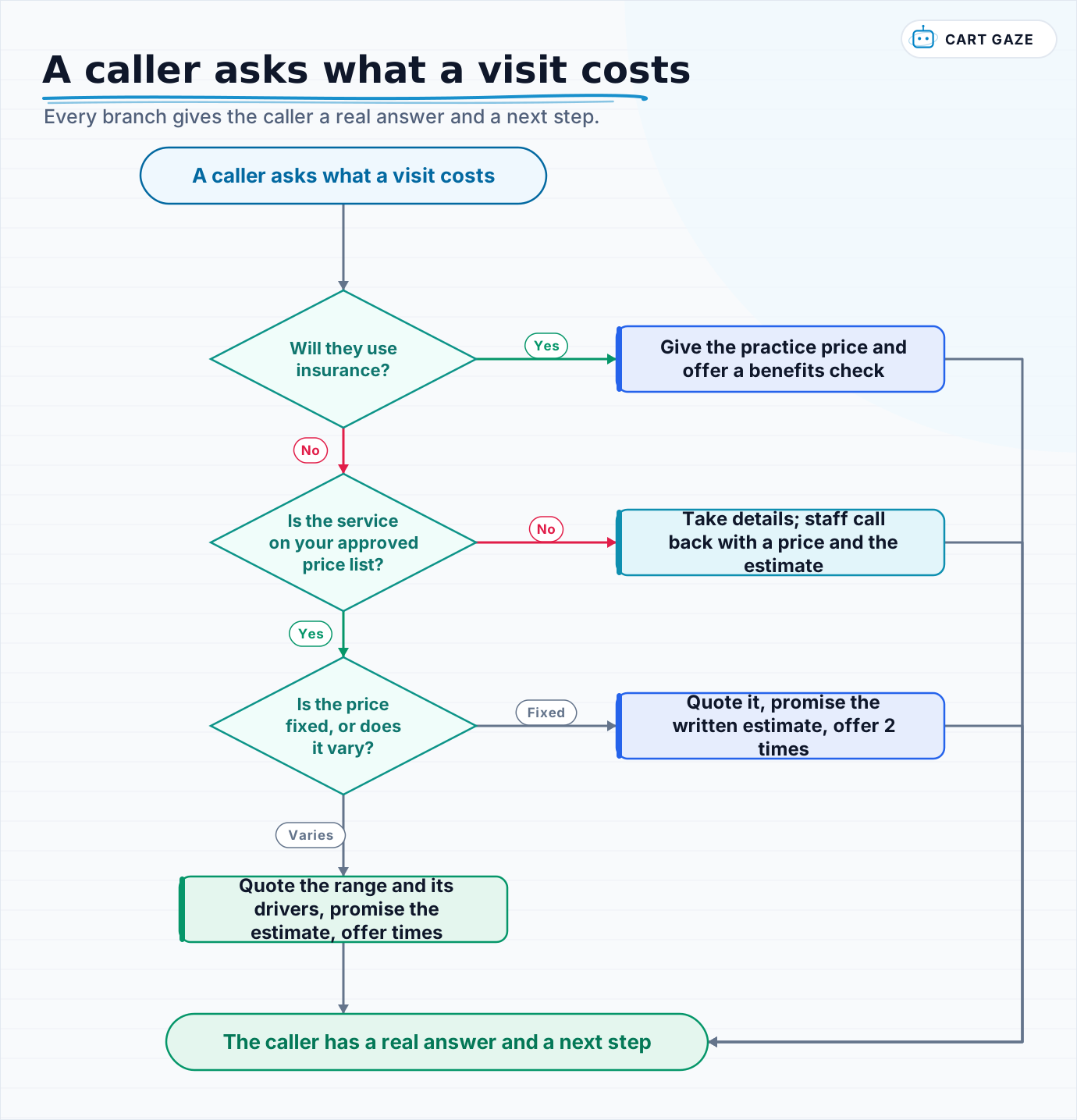 Every branch gives the caller a real answer and a next step.
Walk a week of price calls through the flow. Most practices find the biggest gains in two places: the calls that got no number at all, and the self-pay callers who were never sent a written estimate.
To see what unanswered and unconverted price calls cost your practice each month, try the growth leak calculator.
Fair questions.
Should a medical practice give prices over the phone?
Yes, from an approved price list. Refusing sounds like hiding something, and a bare number invites comparison on price alone. Give the price or an honest range, say what changes it, promise a written estimate for self-pay callers, and offer two appointment times. The whole answer takes about a minute.
Does a price question trigger a Good Faith Estimate?
For uninsured or self-pay individuals, yes. Under 45 CFR 149.610, providers must treat any discussion or inquiry about the potential cost of a service as a request for a Good Faith Estimate. The written estimate is then due no later than 3 business days after the request, even if the caller has not booked.
Can a practice give a Good Faith Estimate by phone?
It can tell the caller what the estimate contains by phone if they ask that way, but the rule still requires a written estimate on paper or electronically, in a form the patient can save and print. Treat the phone answer as the start of the process, and send the written version within the required timeframe.
How should the desk answer an insured patient asking what they will pay?
Give the practice price for the service and explain that the patient share depends on their plan deductible, copay and coinsurance. Offer to check their benefits before the visit. Do not guess an out-of-pocket figure, because a wrong number becomes a billing complaint when the claim is processed.
Can an AI receptionist quote prices to patients?
It can quote self-pay prices if it reads them from the same approved price list your staff uses, gives ranges with their drivers, promises the written estimate, and logs the request so the estimate goes out on time. It should not estimate insured costs, must pass clinical questions to staff, and needs a signed BAA.
Sources.
Written by

Muhammad Qasim Hammad
Founder, Cart Gaze
Qasim builds AI receptionists and front-office automation for medical and dental practices at Cart Gaze. Posts here start from published sources and real call data, not vendor claims, and every number links back to where it came from.
Keep reading.
 Billing & Revenue CycleWorkers Comp Intake Automation: Capture What Gets Paid10 min read
 Billing & Revenue CycleCash-Pay Patient Intake vs. Insurance: Branch the Call First10 min read
 Billing & Revenue CycleBilling Question Call Deflection: Automate the Boring Half10 min read
 Billing & Revenue CycleProvider Credentialing Automation: Never Miss a Deadline10 min read
 Billing & Revenue CycleDental Membership Plan Automation: Renewals Beat Signups10 min read
 Billing & Revenue CycleYear-End Dental Benefits Reminder Automation for Practices11 min read