
Billing Question Call Deflection: Automate the Boring Half
A patient calls saying they do not understand a bill. That is 4 different calls sharing one phone line: only 2 can be closed without a person, and your statement decides whether either one can.
Key takeaways.
- A billing call is really 4 calls: statement explanation, payment logistics, a coverage dispute, and hardship. Only the first 2 can be closed without a person.
- Deflection depends on the statement. If it does not carry a plain-language line item, the date of service, the payer allowed amount, and what is owed and why, no automation can explain it.
- Coverage disputes are claims investigations: KFF found ACA marketplace insurers denied 19% of in-network claims in 2024, and 36% of those denials carried no stated reason.
- The expensive part lands after the call: CAQH CORE prices a single manual claim status transaction at $15.96, with about 17 minutes of provider time at stake.
- Verify the caller before speaking a balance, route card payments to a compliant page rather than reading numbers aloud, and tag every billing call with a reason code.
Table of Contents8 sections
- Why the statement decides whether the call can be deflected at all
- The four kinds of billing call, and which two are safe to automate
- Why the coverage dispute and the hardship call need a person
- What a deflected billing call actually looks like
- The privacy and payment guardrails this needs
- Tag every billing call with a reason code
- Start with the two calls you can already answer
- Fair questions
A patient calls, reads out a number from a statement, and says they do not understand it. Your biller stops what they were doing, pulls the account, opens the ledger, and spends 4 minutes explaining a line item. Then the next one calls.
That call is deflectable, mostly. But only the boring half, and only if one thing is true first. J.P. Morgan's 15th annual Trends in Healthcare Payments report, published 21 May 2025, found that just 22% of consumers always know what they owe for a visit beforehand. The phone is where that gap gets settled, and the statement is what decides whether a machine can settle it.
This post splits the billing call into the 4 kinds it actually is, names the 2 you can automate end to end, explains why the other 2 need a person, and gives you the privacy and payment guardrails before any of it touches a patient line.
Why the statement decides whether the call can be deflected at all
Deflection is downstream of the statement. Automation can only read back what the record already holds, so if the bill does not carry a plain-language line item, the date of service, what the payer allowed, and what the patient owes and why, then nothing on the phone can explain it.
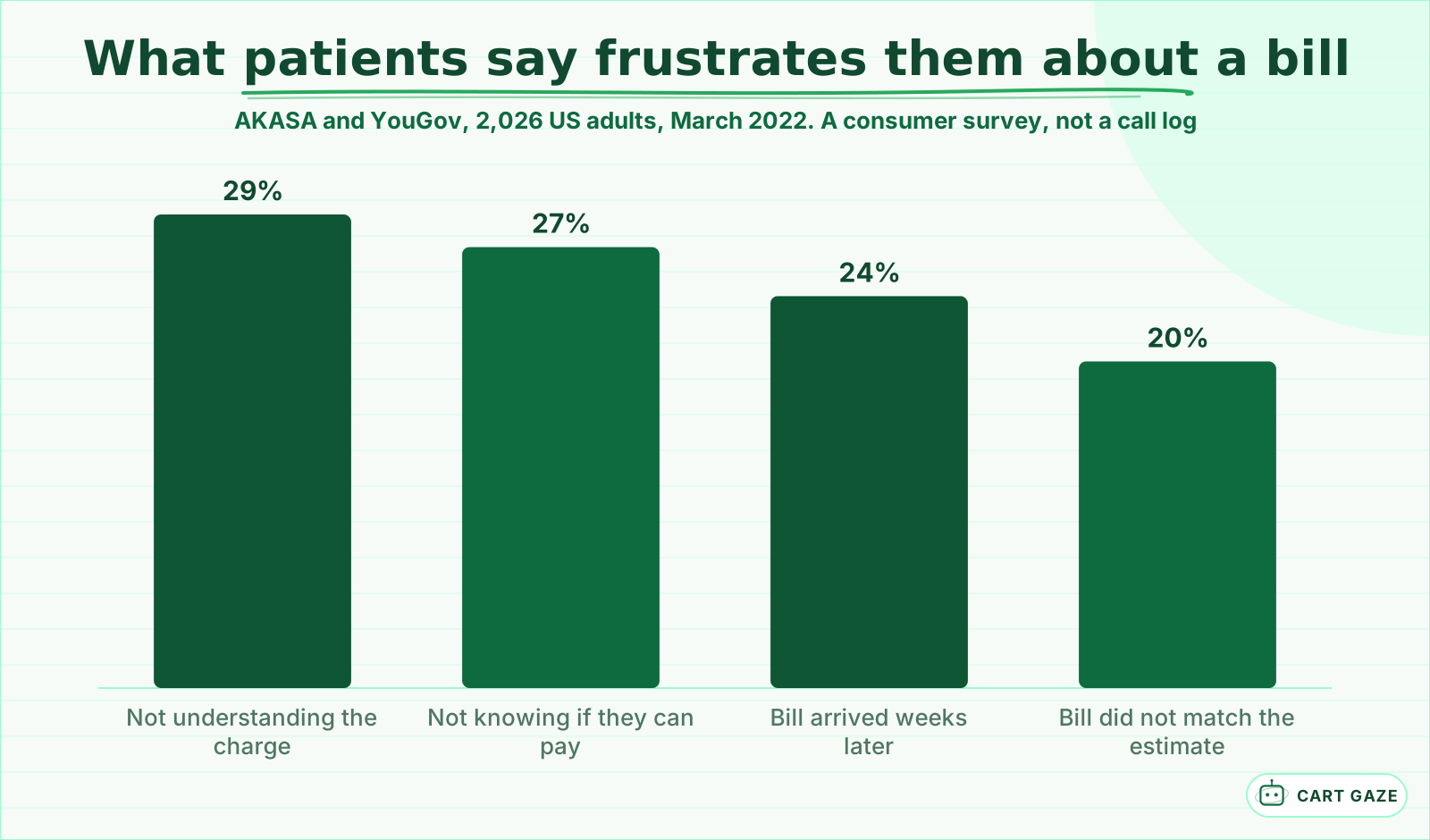 Consumer sentiment from 2022, not your call log. Each bar maps to a different kind of call.
HFMA's Patient Friendly Billing Project puts the standard plainly: statements should be clear, concise, correct, and written so an average reader can follow them. That is a design brief for the document, not a slogan for the website. Most practice statements fail the "concise" test and the "clear" test at the same time, by listing procedure codes and an insurance adjustment with no sentence attached.
The gap shows up in what patients say bothers them. In a 2022 survey of 2,026 US adults run by YouGov for AKASA, 38% called medical bills confusing, and the single biggest frustration, at 29%, was simply not understanding what they were being billed for. That is old, self-reported consumer sentiment rather than your call log, but it lines up with what billers hear every day.
There is a cheap test. Hand your own statement to somebody who does not work in healthcare and ask them to tell you what they owe and why. Whatever they cannot answer is a call you are going to take.
The four kinds of billing call, and which two are safe to automate
Billing calls are not one job. They are 4, and they split down the middle. Two are bounded: the answer already sits in the statement and the ledger, and the caller wants it read back or wants a way to pay. The other two need something automation does not have.
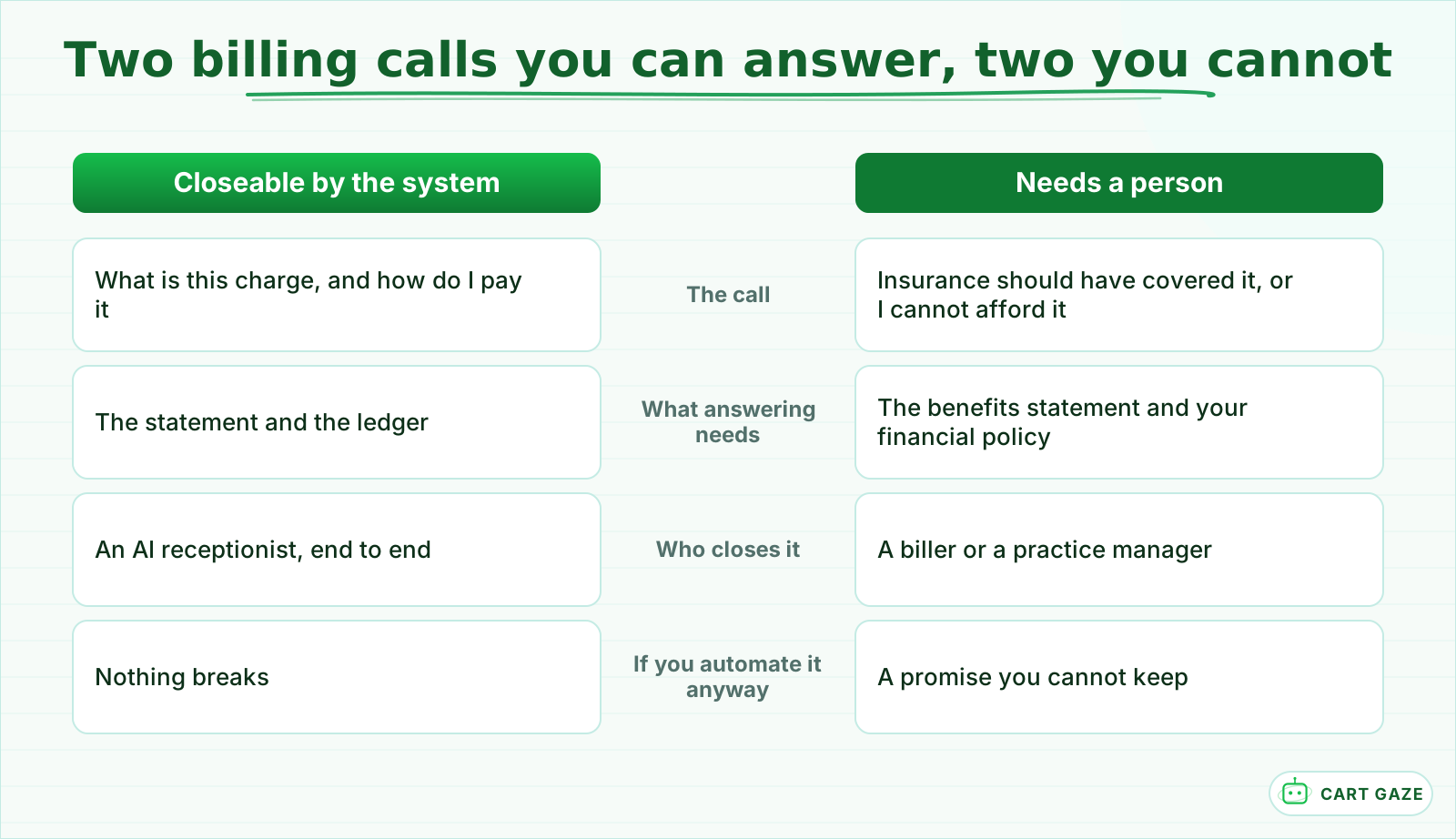 Two of the four billing calls are bounded. The other two need judgement or an investigation.
The first is statement explanation: "what is this charge?" The second is payment logistics: "how much, and where do I pay it?" Both are closeable without a person, assuming the caller is verified and the statement carries the answer.
The third is a coverage dispute: "my insurance should have covered this." That is a claims investigation, not a question. The fourth is hardship: "I cannot afford this." That is a judgement call with your financial policy attached, and the authority to make it does not sit with software.
Important
Never let the system negotiate a balance, waive a charge, or predict what a payer will cover. An estimate spoken in a confident voice becomes a promise the patient will hold you to, and a coverage prediction is one you have no standing to make.
Keep this separate from outbound work. Chasing money already owed runs on different timing and different consent rules, which we cover in AR follow-up and collections automation. If you have not scoped this kind of system before, start with what an AI receptionist does and where it stops.
Why the coverage dispute and the hardship call need a person
A denial call is not a billing question in disguise. The patient is asking you to explain a decision a third party made, for a reason often written down nowhere you can read. Answering it means opening the explanation of benefits, reading the payer's codes, and sometimes calling the payer.
The scale is real. KFF, publishing on 2024 data in March 2026, found that ACA marketplace insurers denied 19% of roughly 451 million in-network claims, with rates ranging from 3% to 36% across 157 insurers. Marketplace plans are not every payer, but the pattern travels.
The reason mix is what makes this undeflectable. Of those in-network denials, 36% were logged as "other" with no stated reason, 25% were administrative, 13% an excluded service, 9% a prior authorization or referral problem, and 5% medical necessity. More than a third carry no explanation at all, so nobody, human or machine, can answer that call from the statement alone.
It gets more expensive after the call ends. CAQH CORE priced a single manual claim status transaction at $15.96, drawing on the 2023 CAQH Index, and estimated that moving from a partly or fully manual process to a fully electronic one saves an average medical provider about 17 minutes per transaction. The patient's 4-minute call is the cheap part. The investigation it starts is not.
One more trap sits inside the estimate. Under the No Surprises Act, an uninsured or self-pay patient who schedules at least 3 business days ahead is entitled to a good faith estimate, and can start a dispute if the final bill is at least $400 above it. Thresholds and rules change, so confirm the current ones with your own counsel rather than treating any summary as advice.
What a deflected billing call actually looks like
The safe version of this call has a fixed shape, and the order matters more than the script. Verify the caller, confirm which statement they hold, explain only what the record says, then take payment through a compliant page or route with a structured handoff. Log a reason code every time.
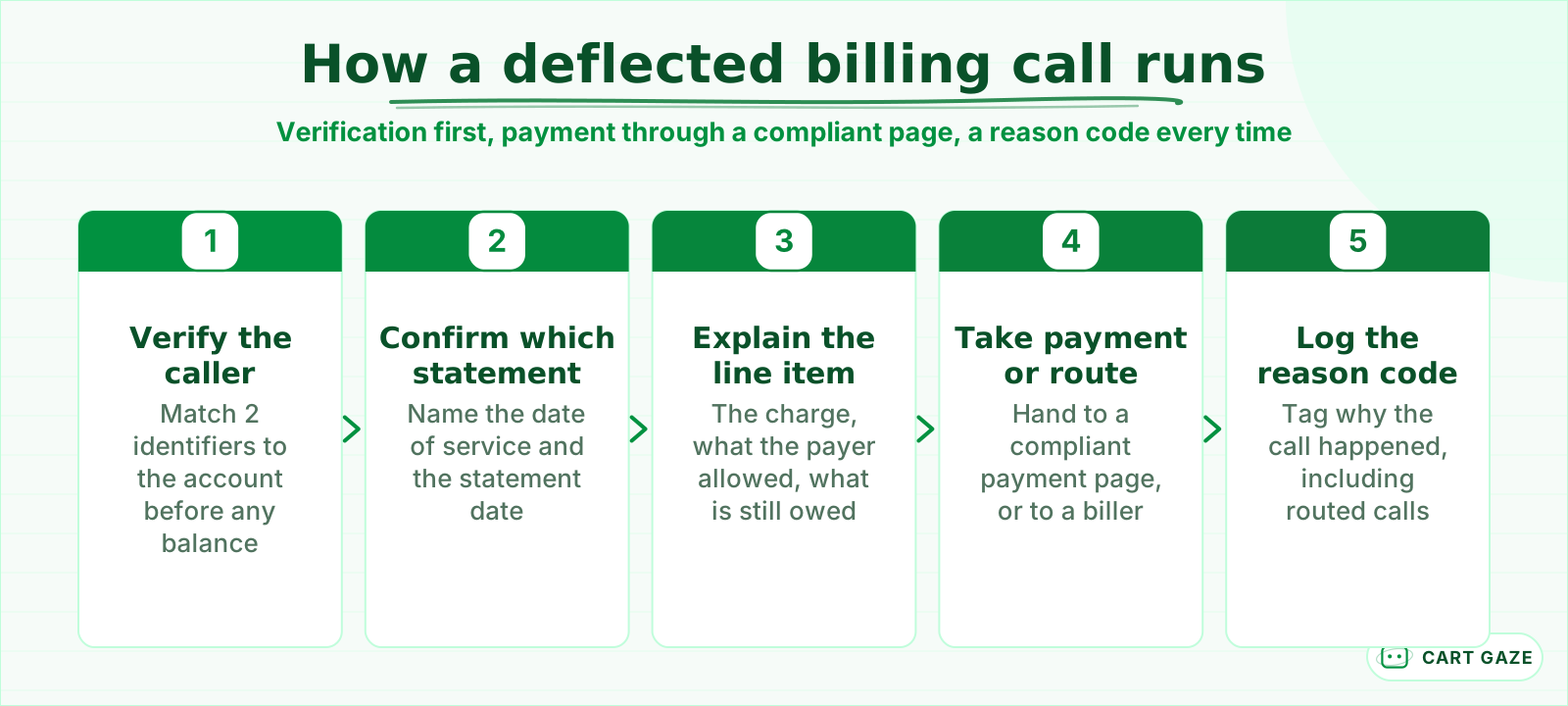 Verification first, payment through a compliant page, a reason code on every call.
Verification comes first because everything after it is protected information. Match at least 2 identifiers to the account before a balance is spoken aloud, and treat a failed match as a routing decision rather than a hurdle to talk the caller past.
Confirming the statement sounds trivial and is not. A patient with 2 dates of service and 1 envelope is the ordinary case, and answering about the wrong visit is worse than not answering at all. Name the date of service and the statement date back to them.
Then explain only what the record holds: the charge, what the payer allowed, and what remains. When the caller wants to pay, hand off rather than improvise. When the call turns into a dispute or a hardship conversation, route it with the account, the date of service, and what the caller actually said, so the biller does not start from zero.
The privacy and payment guardrails this needs
Two separate rulebooks apply to the same 4-minute call. Billing detail is protected health information, because a balance tied to a date of service and a procedure identifies both a person and their care. Card data sits under payment card rules instead, which are stricter about storage than most practices expect.
On the health side, any vendor that hears or stores billing detail is a business associate and needs a signed Business Associate Agreement before it touches a live line. "HIPAA compliant" describes a configuration plus that contract, and "HIPAA certified" is not a thing that exists, whatever a vendor page says.
Warning
If your system records calls and a caller reads a card number aloud, you have just put card data into your recordings. PCI Security Standards Council guidance from October 2023 is explicit that card verification codes cannot be retained once a transaction is authorized, regardless of encryption or the customer's permission.
The practical answer is to never have the number in the first place. Send a payment link by text, hand the caller to a hosted page, or use a masked capture that keeps the digits out of the transcript and the recording. An AI receptionist should route to payment, not take payment.
Pre-flight before a billing line goes live
- Confirm a signed BAA covers the vendor that hears balances and dates of service.
- Confirm card numbers never enter the transcript, the recording, or the call log.
- Test the flow against a failed identity match, and check where that call lands.
- Have someone outside the practice read your statement and say what they owe.
Tag every billing call with a reason code
Deflection saves minutes. Reason codes stop the call from happening. Tag every billing call with why it came in, including the ones that routed to a human, and you turn a phone log into a list of upstream defects. The same 5 tags will explain most of your volume within a month.
| Reason code | What the caller said | What it usually means upstream | Where the fix lives |
|---|---|---|---|
| Charge unclear | "What is this line for?" | The statement names a code, not a service | Statement wording |
| Balance surprise | "I thought this was covered" | Eligibility or estimate gap at check-in | Front desk process |
| Payment logistics | "Where do I even pay this?" | No link or method on the statement | Statement and text-back |
| Coverage dispute | "The insurer should have paid" | A denial nobody explained to the patient | Billing team |
| Affordability | "I cannot pay this right now" | No plan offered before the bill went out | Financial policy |
Tip
Tag from the first day rather than retrofitting later. Reason codes applied to calls you have already forgotten are guesses, and a month of guesses will point you at the wrong fix.
Read the tags monthly and act on the biggest column, not the loudest complaint. A spike in "charge unclear" is a statement wording job that a designer can fix in an afternoon. A spike in "balance surprise" is not a billing problem at all, it is an eligibility check that is not happening at the front desk. This one call type sits inside a wider phone picture, and the front desk call metrics worth tracking put it in context.
Start with the two calls you can already answer
Pilot on statement explanation and payment logistics only, and leave disputes and hardship on the human path from day one. Narrow scope is what makes this safe, and it is also what makes the first month readable, because you are testing 2 known call types rather than an open-ended promise.
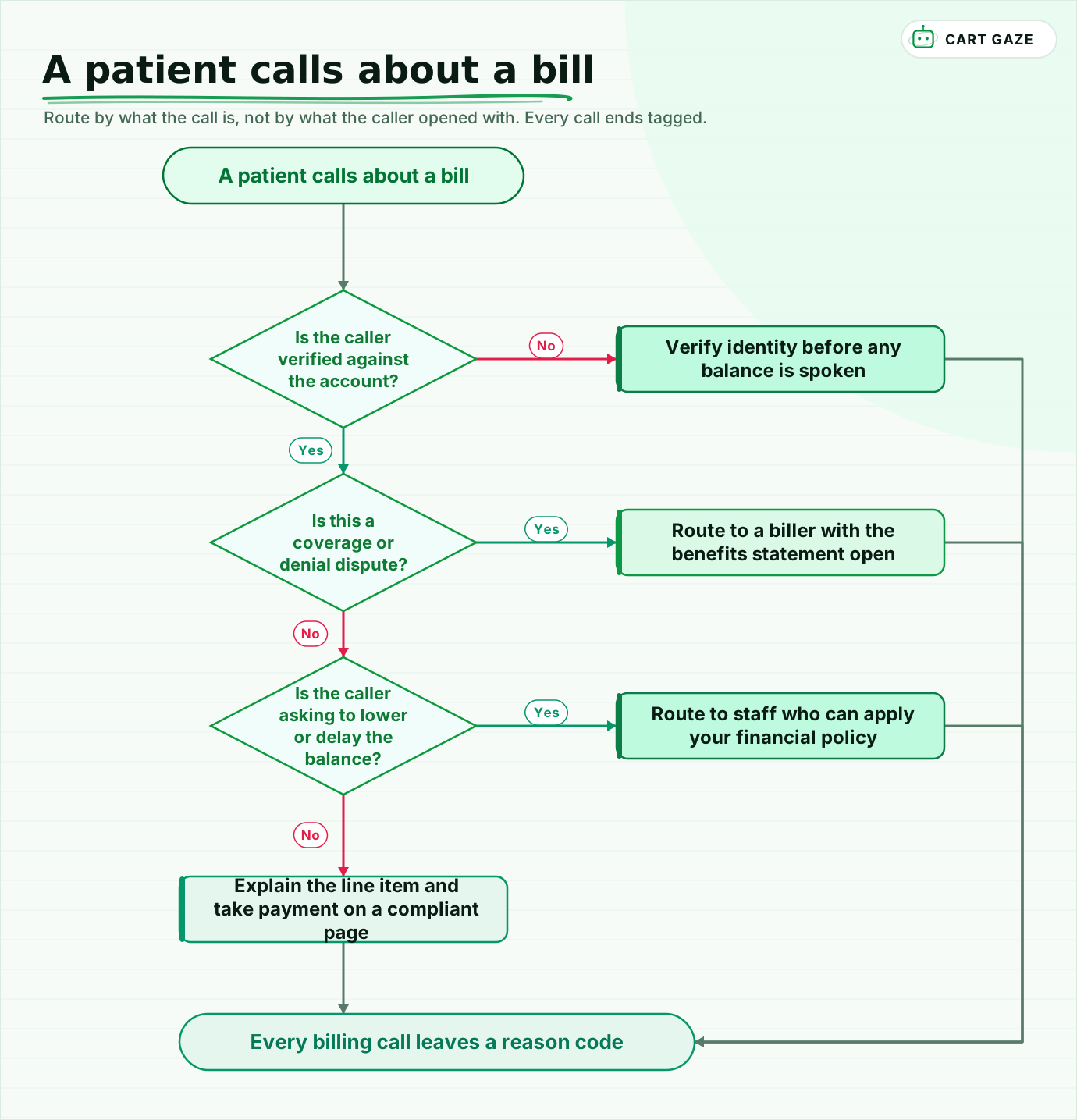 Route by what the call is, not by what the caller opened with. Every call ends tagged.
Walk the flow once. An unverified caller hears nothing about a balance. A coverage dispute goes to a biller with the benefits statement open. A hardship call goes to whoever can apply your financial policy. Everything else is a line item explained and a payment link sent.
Read the first 2 weeks of transcripts end to end, not a sample, because that is where you find the statement wording that confuses everyone and the question your knowledge base cannot answer. Then re-measure with your own reason codes after 30 to 60 days rather than a vendor's before-and-after slide. If you would rather see the size of this leak before anyone talks tools, the free Growth Leak Audit sizes it from your own numbers.
Fair questions.
Which patient billing calls can an AI receptionist actually handle?
Two of the four kinds. It can explain a statement line item and it can handle payment logistics, because both answers already sit in the statement and the ledger. It should not handle a coverage or denial dispute, which is a claims investigation, or a hardship request, which needs someone with authority over your financial policy.
Why can automation not answer "my insurance should have covered this"?
Because the answer is usually not in your system. KFF reported that ACA marketplace insurers denied 19% of in-network claims in 2024, and 36% of those denials were logged as "other" with no stated reason. Answering means opening the explanation of benefits, reading the payer codes, and often calling the payer directly.
Can an AI receptionist take a credit card payment over the phone?
It should route to payment rather than take it. PCI Security Standards Council guidance is explicit that card verification codes cannot be retained after a transaction is authorized, regardless of encryption. A system that records calls and hears a card number read aloud has put card data in its recordings. Send a payment link or use a masked capture instead.
Is a patient balance protected health information?
Yes. A balance tied to a date of service and a procedure identifies both a person and their care, so billing detail is PHI. Verify the caller against the account before any balance is spoken aloud, and make sure any vendor that hears it has signed a Business Associate Agreement. "HIPAA certified" does not exist.
What is a billing call reason code and why does it matter?
It is a tag applied to every billing call recording why it came in, such as charge unclear, balance surprise, payment logistics, coverage dispute, or affordability. Deflection saves minutes on the call. Reason codes point at the upstream defect, so a spike in one tag tells you whether to fix the statement or the front desk.
Sources.
- [1]Trends in Healthcare Payments, 15th annual report (J.P. Morgan)
- [2]Nearly 40% of Americans confused by medical bills (AKASA and YouGov survey)
- [3]Claims Denials and Appeals in ACA Marketplace Plans in 2024 (KFF)
- [4]The Claim Status Transaction: issue brief on provider burden (CAQH CORE)
- [5]Can card verification codes be stored for card-on-file transactions? (PCI SSC FAQ 1280)
- [6]Understanding costs in advance: good faith estimates and the dispute process (CMS)
- [7]Patient Friendly Billing Project: clear, concise, correct statements (HFMA)
Written by

Muhammad Qasim Hammad
Founder, Cart Gaze
Qasim builds AI receptionists and front-office automation for medical and dental practices at Cart Gaze. Posts here start from published sources and real call data, not vendor claims, and every number links back to where it came from.
Keep reading.
 Billing & Revenue CycleProvider Credentialing Automation: Never Miss a Deadline10 min read
 Billing & Revenue CycleWorkers Comp Intake Automation: Capture What Gets Paid10 min read
 Billing & Revenue CycleYear-End Dental Benefits Reminder Automation for Practices11 min read
 Billing & Revenue CycleCash-Pay Patient Intake vs. Insurance: Branch the Call First10 min read
 Billing & Revenue CyclePatient Payment Plan Automation: Sign Financing Before They Leave10 min read
 Billing & Revenue CycleUnscheduled Treatment Follow Up That Recovers Real Revenue10 min read