
Time-of-Service Collections: Get Paid Before the Patient Leaves
Practices collect 72% of copays at the visit but only about 27% of other patient balances. Here is how to estimate the balance, ask once at check-in and settle the rest with consent.
Key takeaways.
- In 2024 data from MGMA DataDive, practices collected 72% of copays at the time of service but only about 27% of other patient-due balances.
- Hospital data in JAMA Health Forum shows privately insured patients repaid 46.1% of what they owed on 2023 visits, and 92.2% of episodes were paid in full or not at all.
- Rerun eligibility no more than 3 days before the visit, build the estimate from the copay, deductible left and allowed amount, then ask once at check-in.
- Self-pay patients must get a written good faith estimate within 1 to 3 business days, and a final bill $400 above it opens federal dispute resolution.
- A card on file needs a signed authorization with a maximum amount, tokenized storage and a notice before each charge; card verification codes are never stored.
Table of Contents9 sections
- Why a balance gets harder to collect once the patient leaves
- What a patient will owe is mostly knowable before the visit
- Self-pay patients: the good faith estimate comes first
- The check-in conversation, word for word
- Card on file: consent, storage and when to charge
- What automation sends before and after the visit
- Measure what the front desk actually collects
- Decide what to collect at every visit
- Fair questions
A patient finishes a visit, walks past the front desk, and leaves owing $300 that nobody mentioned. From that moment the balance competes with rent, groceries and every other bill in the house, and your practice is reduced to mailing statements. In 2024 data from MGMA's DataDive, practices collected 72% of copayments at the time of service but only about 27% of other patient-due balances.
The copay is easy because everyone knows the number. The deductible and coinsurance are hard because, at most front desks, nobody works the number out before the patient arrives, so nobody asks for it. That gap is a preparation problem more than a willingness problem.
This post covers why balances get harder to collect after the visit, how to build an estimate, the federal rule for self-pay patients, a check-in script, card-on-file consent, what automation sends, and how to measure it. Every number we computed is labeled Modeled.
Why a balance gets harder to collect once the patient leaves
At the desk, a balance is one conversation with someone who just received care. After the visit it becomes a statement, then a reminder, then a call, each costing staff time while the patient's attention moves elsewhere. Published repayment data shows that many patients pay all of a bill or none of it.
The largest datasets come from hospital billing. A study in JAMA Health Forum in August 2025, by Ippolito and colleagues, followed 30.7 million patient episodes at 217 hospitals from 2018 to 2024, using data from FinThrive, a revenue cycle company. Before the pandemic, privately insured and Medicare Advantage patients repaid about 54% of what they owed. For privately insured visits in 2023, repayment fell to 46.1%, down from 53.8% in 2021.
Two findings matter at a front desk. In 92.2% of privately insured episodes, the patient paid either everything or nothing. And bills over $1,000 typically recovered under 35 cents on the dollar, against about 50 cents for bills near $100. These are hospital and hospital-billed professional services, and the data does not separate payments taken at the visit from later ones. Read it as the shape of the problem, not as your rate.
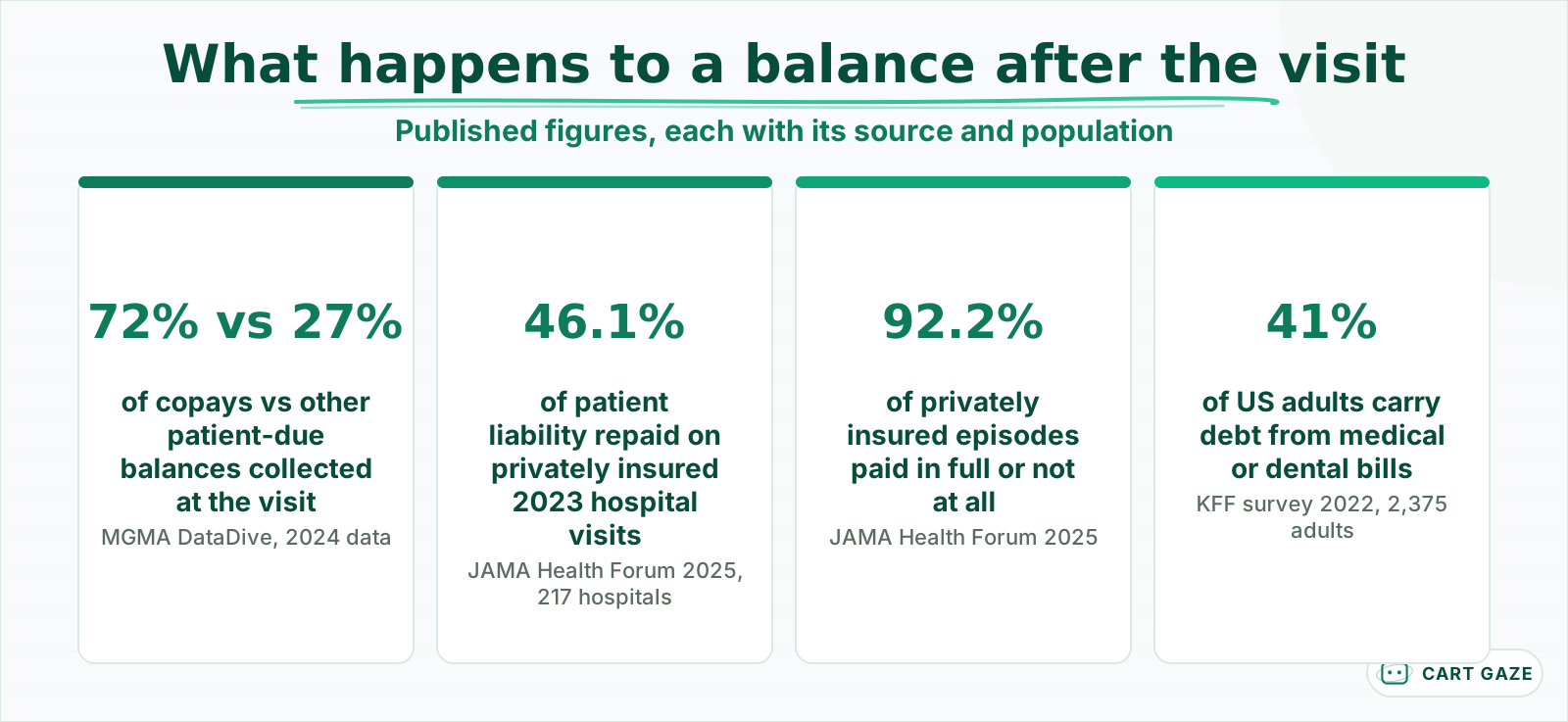 Published figures with their populations. Hospital data shows the shape of the problem, not your rate.
Patients feel the pressure from the other side. In KFF's Health Care Debt Survey of 2,375 adults, fielded in early 2022, 41% said they currently have debt from medical or dental bills, and 21% said they are paying off bills over time directly to a provider.
Unpaid balances also travel. In March 2022 the Consumer Financial Protection Bureau reported that, as of mid-2021, 58% of bills in collections on credit records were medical. A federal rule to keep medical debt off credit reports was issued in January 2025 and vacated by a federal court in Texas on July 11, 2025. The road from statement to agency is covered in AR follow-up and collections automation. This post is about the step before it.
Practices are split. In an October 2025 MGMA Stat poll with 247 responses, 26% of medical group leaders said patient balance collections had improved over the year and just under 3 in 10 said they had worsened. Those that improved most often credited the front end: time-of-service collection, clearer estimates and staff accountability.
What a patient will owe is mostly knowable before the visit
For an insured patient, the eligibility response usually tells you the copay, the deductible still unmet and the coinsurance rate. Combine those with the fee your contract allows for the scheduled service and you have an estimate. It will not be exact, but it is close enough to ask for at check-in.
Timing matters because deductibles move as other providers file claims. Writing for MGMA in 2022, senior industry advisor Cristy Good recommended confirming eligibility no more than 7 days before a visit, with no more than 3 days as best practice, and calling patients ahead when they carry an outstanding balance.
A worked example, Modeled. A patient is booked for a visit and a minor in-office procedure. Eligibility shows a $40 copay for the visit and $750 of deductible left, and the procedure's contracted allowed amount of $260 falls entirely under that deductible. The estimated share is $40 plus $260, or $300. Had the deductible been met, the plan's coinsurance rate would apply to the $260 instead.
| Item | Known before the visit? | Ask at check-in? | Watch for |
|---|---|---|---|
| Copay | Yes, from eligibility | Yes, in full | Plans with no copay until the deductible is met |
| Deductible on today's services | Mostly, from eligibility | Yes, as an estimate | Other providers' claims not yet posted |
| Coinsurance | Rate known, amount estimated | Yes, as an estimate | Services added during the visit |
| Prior balance | Yes, from your own ledger | Yes, as a separate line | Balances under appeal or dispute |
| Self-pay or uninsured | Yes, from your self-pay prices | After the written estimate | Federal good faith estimate rules |
| Medicaid cost sharing | Yes, usually small | Only as your state allows | Federal limits on denying care |
Some practices take the copay and known deductible at check-in and bill coinsurance after the claim. Others take the full estimate and refund any overpayment. Either can work. What does not work is an estimate nobody can explain, so store the inputs (allowed amount, copay, deductible left, coinsurance) beside the number where the person at check-in can see them.
Say the caveat every time. HFMA's time-of-service best practices tell staff to inform patients that actual costs may vary from estimates, depending on the services performed or the timing of other payments that affect the deductible. A patient who heard that is less likely to treat a later adjustment as a broken promise.
Self-pay patients: the good faith estimate comes first
If a patient is uninsured, or insured but choosing not to bill the plan, federal rules require a written good faith estimate when a service is scheduled ahead or the patient asks. It must arrive within 1 to 3 business days. A self-pay deposit should start from that document.
The rule is 45 CFR 149.610, part of the No Surprises Act. It covers a patient with no coverage and one who has coverage but does not want a claim submitted, so both questions belong in scheduling. The timing is fixed:
- Scheduled at least 3 business days ahead: the estimate goes out no later than 1 business day after scheduling.
- Scheduled at least 10 business days ahead: no later than 3 business days after scheduling.
- Requested by the patient: no later than 3 business days after the request.
The estimate must be written, on paper or electronically as the patient prefers, in a form they can save and print. Staff may explain it by phone, but the written copy is still required. It becomes part of the medical record, and patients can request copies of estimates issued in the last 6 years.
It also sets a line. Under 45 CFR 149.620, a final bill at least $400 above the expected charges on the estimate lets the patient start the federal patient-provider dispute resolution process. Estimate carefully, reissue the estimate when the plan of care changes, and keep any self-pay deposit within the estimated amount.
Insured patients are a different case. The No Surprises Act also calls for estimates sent to the patient's health plan and an advanced explanation of benefits from the plan, but CMS said in April 2024 that enforcement of both is deferred pending future rulemaking. Check cms.gov before you build around them.
In a January 2022 MGMA Stat poll with 634 responses, 44% of practices named workflow disruption as their greatest challenge with these estimates. The trigger is mechanical, which suits software: a self-pay flag on a booking can generate the estimate and send it.
The check-in conversation, word for word
A good check-in script states the amount, says what it covers, asks once and offers a way forward if the patient cannot pay today. Staff should not apologize for asking or argue about the estimate. Payment questions should never delay care, and anything complicated goes to one named person.
Using the Modeled example, the opening line sounds like this: "Your plan shows a $40 copay and $750 left on your deductible, so your estimated share for today is $300. I can take that by card now, or text you a secure link."
When the patient asks why: "That is what your insurance reported this week. The final amount comes from your plan after the claim. If you paid more than you owe, we refund it, and if you owe more, we tell you before anything is charged."
When the patient cannot pay today: "That is fine, and it does not change your visit. Would part of it today and a plan for the rest help, or should our billing coordinator call you?" How an in-house plan differs from third-party financing is covered in patient payment plan automation.
When the patient says insurance covers all of it: take the copay, note the objection on the account, and route it to billing for after the claim. The desk is not the place to settle a benefits dispute.
HFMA's guidance puts trained registration staff on routine cases and a financial counselor on complex ones, in a spot that does not hold up the line. Patients should hear that resolving a balance will not affect non-elective care.
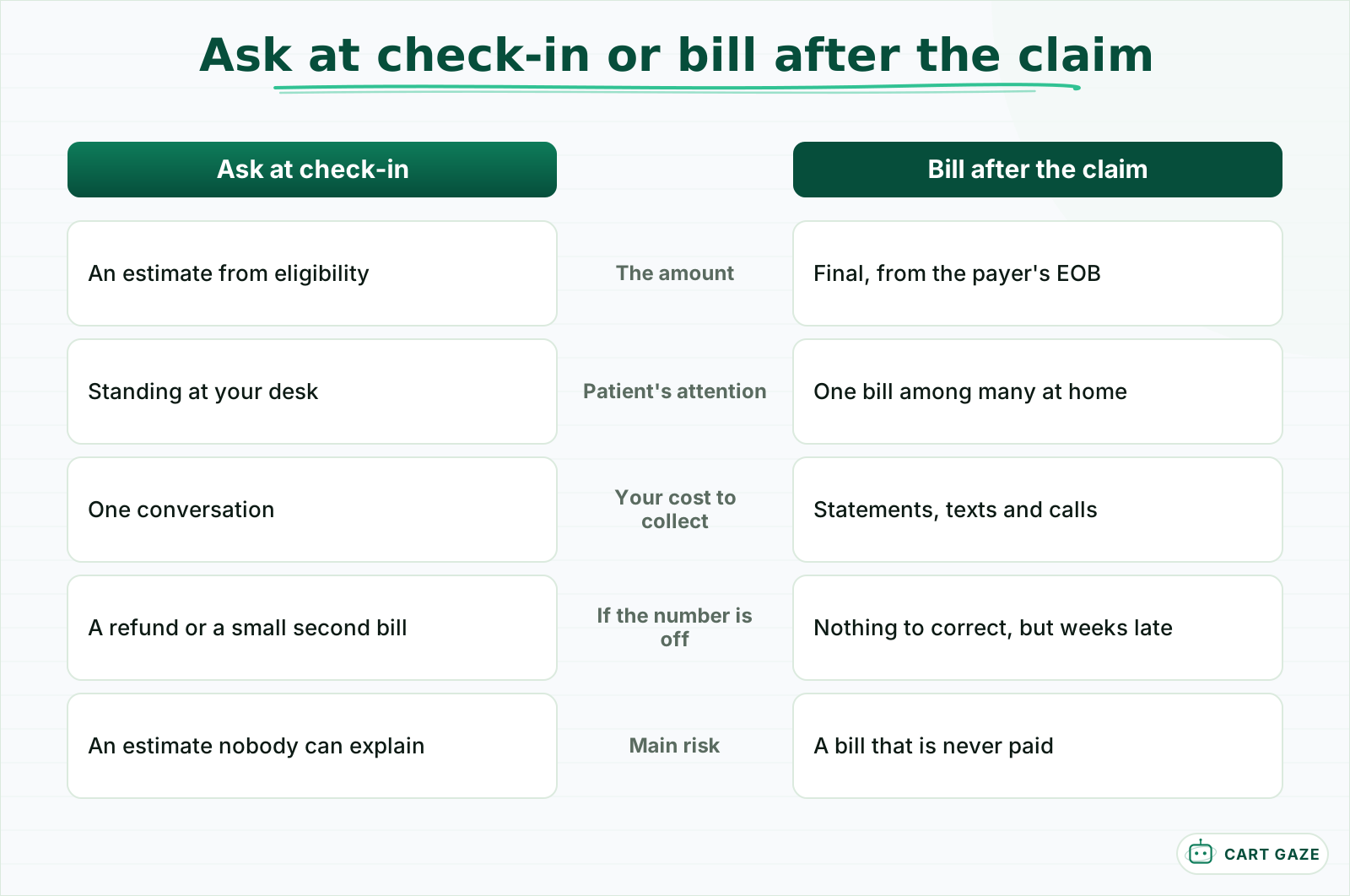 Neither option is free. One risks a refund, the other risks the whole balance.
Warning
Never make a non-elective visit wait on payment. For Medicaid patients, federal rules say a provider may not deny services for inability to pay cost sharing unless the state allows it for enrollees with income above 100% of the federal poverty level (42 CFR 447.52(e)).
State consumer-collection laws, Medicaid cost-sharing rules and card surcharge rules vary by state, so have counsel review your financial policy before staff use any script. Nothing here is legal advice.
Card on file: consent, storage and when to charge
Keeping a card on file lets you settle the balance after the claim without another statement. It only works with a signed authorization that names a maximum amount and how to revoke it, a processor that stores the card as a token, and a notice to the patient before each charge.
The authorization form should say, in plain words:
- Which balances it covers, such as your share of today's visit after insurance pays.
- The most you will charge without asking again.
- When you will charge: after the plan's explanation of benefits posts.
- How the patient is told first, and how many days they have to question it.
- How to withdraw consent.
Card networks have their own rules for stored cards, and your payment processor applies them. Ask the processor for its required consent wording before you print a form.
Storage is where practices get into trouble. The PCI Security Standards Council states that card verification codes, the 3 or 4 digits on the card, cannot be stored after authorization. Card-on-file charges do not need them, and neither encryption nor the patient's permission makes storing them acceptable.
Important
Never write a card number on a paper form, in a scheduling note or in the EHR. Have the patient enter the card into your processor's own payment page or terminal, so your practice holds a token instead of the card.
When the explanation of benefits arrives, compare the final patient responsibility with what was collected. If the patient owes more within the authorized maximum, send a notice, wait the stated days, charge and send a receipt. If they paid too much, refund it promptly. Charging stored cards without warning invites disputes that cost more than the balance.
What automation sends before and after the visit
Automation is good at the repetitive parts: running eligibility on schedule, building the estimate from the result, texting it with a payment link, reminding the patient before check-in, and posting the payment. People should keep the parts that need judgment: hardship, disputes, and anything that touches the patient's care.
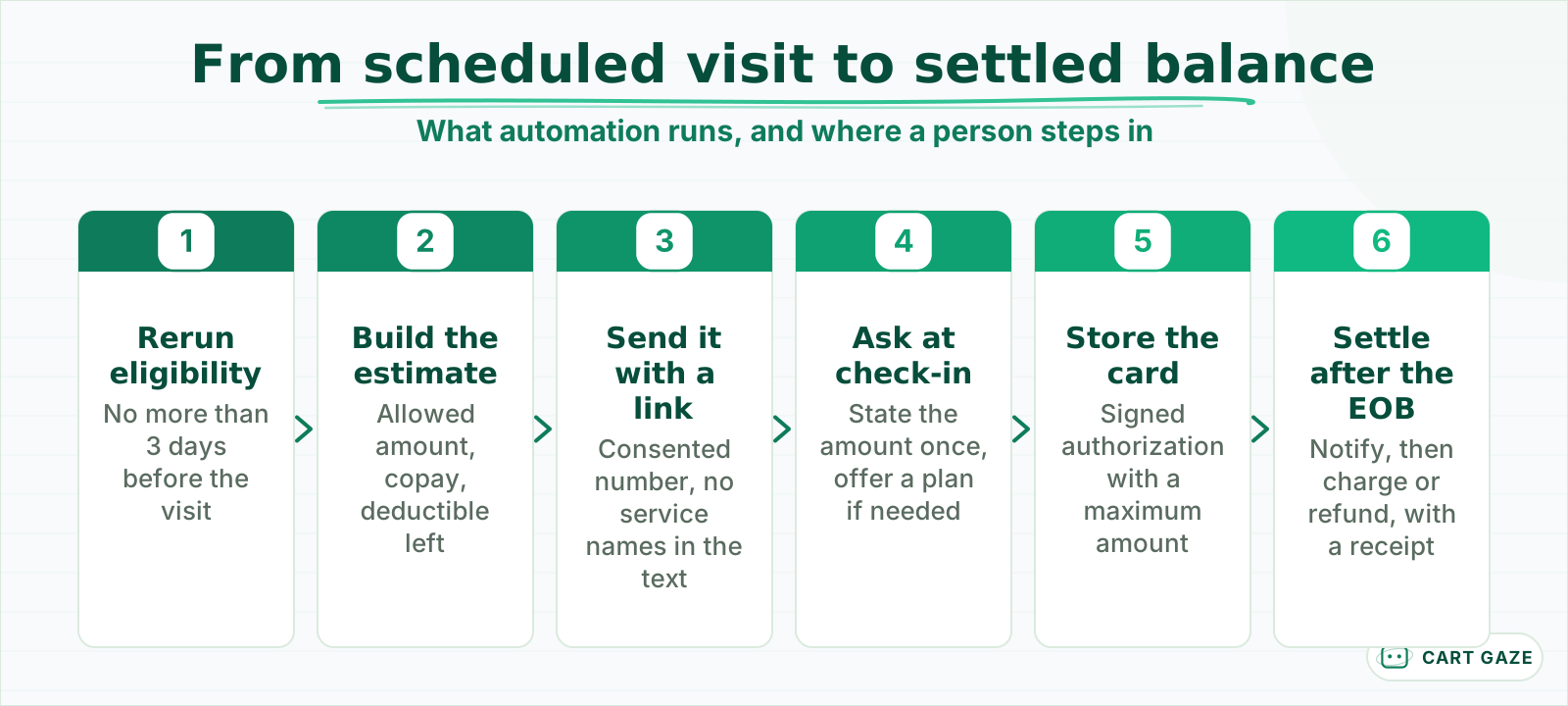 Software runs the clock and the math. A person handles hardship, disputes and anything clinical.
The sequence runs on the appointment clock. About 3 days out, the system reruns eligibility, builds the estimate and flags any visit with a missing input, such as inactive coverage. A person clears the flags. The patient gets the estimate with a secure link, so check-in confirms a number instead of springing one. After the claim, the system queues the notice, charge or refund.
A text about money is legally different from an appointment reminder. The FCC's 2015 order exempting certain healthcare calls and texts excluded any that include accounting, billing, debt-collection or other financial content. An estimate with a payment link is financial content, so it does not ride on that exemption. Capture consent for financial messages at intake, log it, and keep a working opt-out.
The estimate is tied to a scheduled visit, which makes it protected health information. Any vendor that builds, stores or sends it is a business associate and needs a signed business associate agreement first. Keep the text thin: practice name, amount and a secure link, with no service or diagnosis names.
Patients also call to ask what they will owe. An AI receptionist can answer from the estimate your staff prepared, resend the payment link and hand disputes and hardship requests to a person. It should never take card numbers by voice; a link keeps the card out of the call recording. It routes clinical questions to staff and never diagnoses. For the limits of these systems, see what an AI receptionist does and where it hands off.
Measure what the front desk actually collects
Track one rate every week: patient payments collected before or at the visit, divided by all patient payments. HFMA publishes this point-of-service measure as one of its MAP Keys, and it works for a practice. Pair it with how many visits had an estimate and how close estimates landed.
HFMA's definition counts patient cash for the current encounter collected before, at, or up to 7 days after the service, plus prior balances collected at a new visit, divided by all self-pay cash collected. The 7-day window fits a payment link sent the evening of the visit.
Four more numbers make the rate useful:
- Copay capture: copays collected at the visit divided by copays due. MGMA's 2024 figure is 72%.
- Other balances at the visit: deductible, coinsurance and prior balances collected at check-in, divided by what was due. MGMA's 2024 figure is about 27%.
- Estimate coverage: the share of scheduled visits with an estimate sent before arrival.
- Estimate accuracy: the share of estimates within a set dollar range of the final bill, plus refunds owed and how long they take.
A Modeled month shows the stakes. Say 400 visits a month carry a balance beyond the copay, averaging $120 each: $48,000 in patient responsibility. At 27% collected at the visit, the desk takes $12,960. At 45%, it takes $21,600, which is $8,640 a month that never needs a statement, a reminder or a call.
Tip
Each month, review the estimates that missed by the most and find the input behind each one: a deductible that moved after the eligibility check, a service added during the visit, or a wrong allowed amount. Fix the input that keeps repeating.
Before the front desk asks for balances
- Eligibility runs within 3 days of each visit, and every estimate shows its inputs.
- Patients get the estimate before arrival, on a channel they consented to.
- The card-on-file form names a maximum amount and how to revoke it.
- Staff know who handles hardship requests, and that care never waits on payment.
Decide what to collect at every visit
Write the policy down as a short decision path: self-pay patients get a written estimate first, insured patients get an eligibility-based estimate, a stored card covers the remainder up to a cap, and large balances go to a plan conversation. Then train the desk on the path, not on a quota.
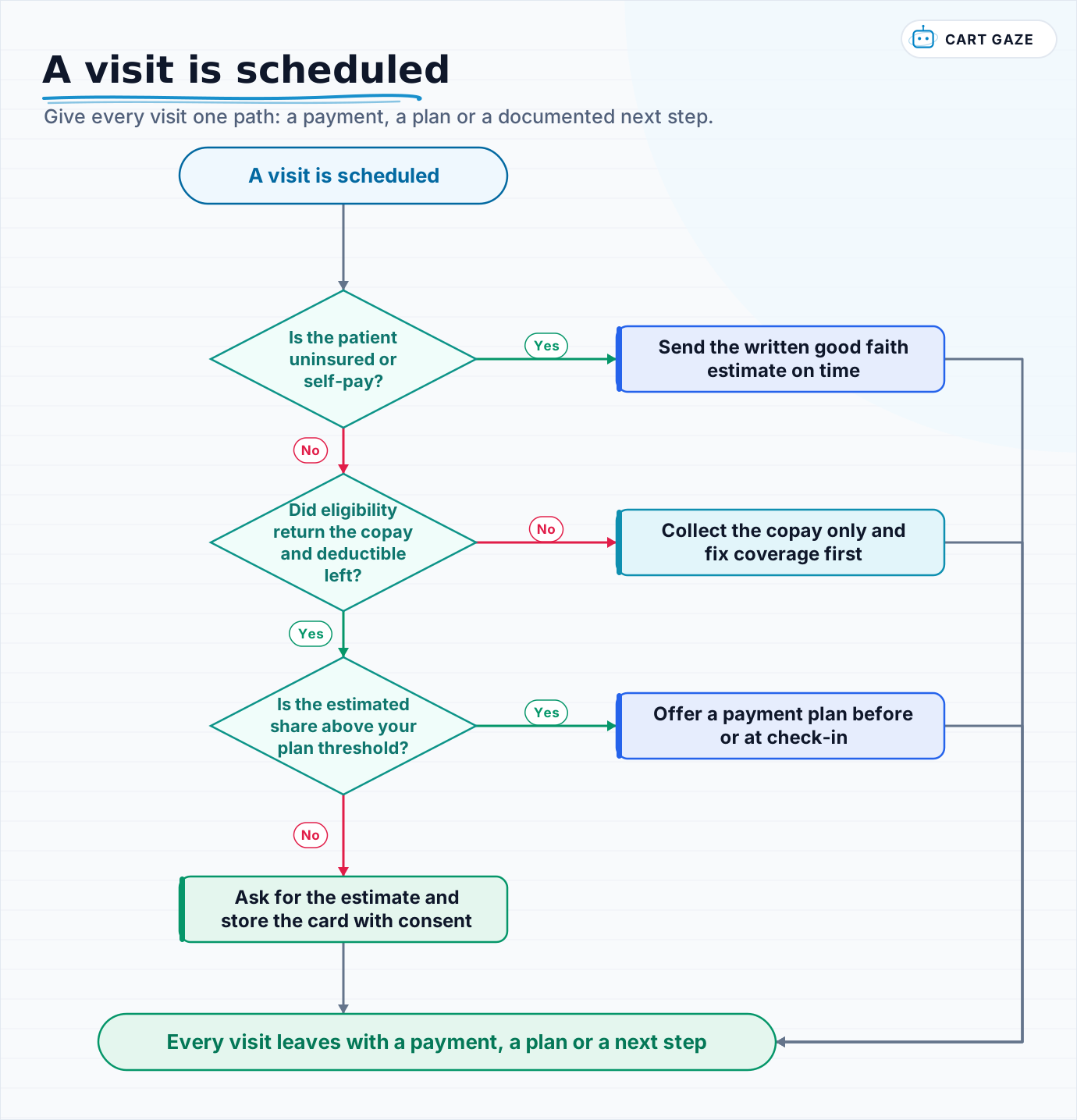 Give every visit one path: a payment, a plan or a documented next step.
Walk the flow once with your front desk. A self-pay patient gets the written estimate on the federal clock. An incomplete eligibility check means the copay only while someone fixes coverage. An estimate above your plan threshold opens a plan conversation. Everything else is a single ask, plus a stored card for whatever the claim shows later.
Pilot it on one provider's schedule for a month, then compare your point-of-service rate, estimate accuracy and refunds with the month before. To see what uncollected balances are costing your practice before you change anything, run your own numbers through the growth leak calculator.
Fair questions.
What are time-of-service collections?
Time-of-service collections are patient payments taken before or at the visit instead of billed afterward: the copay, the estimated deductible and coinsurance on that day's services, and any prior balance. In 2024 data from MGMA DataDive, practices collected 72% of copays this way but only about 27% of other patient-due balances, which is where most of the gap sits.
How do you estimate what a patient owes before the visit?
Rerun the eligibility check no more than 3 days before the visit, then combine the copay, the deductible still unmet and the coinsurance rate with your contracted allowed amount for the scheduled services. Store those inputs beside the estimate so staff can explain it, and tell the patient the final amount comes from the plan after the claim.
Do practices have to give self-pay patients a good faith estimate?
Yes. Under 45 CFR 149.610, a practice must give uninsured patients, and insured patients who choose not to bill their plan, a written good faith estimate within 1 to 3 business days of scheduling or a request. If the final bill is at least $400 higher than the estimate, the patient can use the federal patient-provider dispute resolution process.
Can a medical practice keep a patient's card on file?
Yes, with a signed authorization that names the balances it covers, a maximum amount, when you will charge and how to revoke consent. Store the card only as a token through your payment processor, and ask the processor for the card networks' required wording. PCI rules prohibit keeping card verification codes after authorization, even when encrypted.
Should a practice turn patients away if they cannot pay at check-in?
Not for non-elective care. HFMA guidance says patients should be told that resolving a balance will not affect non-elective care, and federal Medicaid rules bar providers from denying services for inability to pay cost sharing, apart from a narrow state option for higher-income enrollees. Offer a partial payment, a plan or a call from billing instead.
Sources.
- [1]MGMA Stat: Days in A/R holds steady for most practices, but payer pressure persists in 2026 (2024 time-of-service collection data)
- [2]MGMA Stat: Patient balance collection, what is moving the numbers (October 2025 poll)
- [3]MGMA Stat: Collection challenges growing for medical practices (eligibility timing guidance)
- [4]MGMA Stat: Medical groups report unintended consequences of good faith estimate requirements
- [5]Patient Repayment of US Hospital Bills From 2018 to 2024 (JAMA Health Forum, 2025)
- [6]KFF Health Care Debt Survey (2022)
- [7]CFPB estimates $88 billion in medical bills on credit reports (2022)
- [8]CFPB: Prohibition on Creditors and Consumer Reporting Agencies Concerning Medical Information (Regulation V), status
- [9]45 CFR 149.610: Good faith estimates for uninsured (or self-pay) individuals
- [10]45 CFR 149.620: Patient-provider dispute resolution
- [11]CMS: Progress Toward Advanced Explanation of Benefits (AEOB) Rulemaking and Implementation (April 2024)
- [12]HFMA: Best Practices for Communications at the Time of Service
- [13]HFMA MAP Keys: Point-of-Service Cash Collections
- [14]PCI SSC FAQ: Can card verification codes be stored for card-on-file or recurring transactions?
- [15]FCC 15-72: TCPA Omnibus Declaratory Ruling and Order (healthcare exemption conditions)
- [16]42 CFR 447.52: Medicaid cost sharing, denial of service for nonpayment
Written by

Muhammad Qasim Hammad
Founder, Cart Gaze
Qasim builds AI receptionists and front-office automation for medical and dental practices at Cart Gaze. Posts here start from published sources and real call data, not vendor claims, and every number links back to where it came from.
Keep reading.
 Billing & Revenue CycleCopay Waiver Rules: What a Medical Practice May Discount15 min read
 Billing & Revenue CyclePrice Shopper Calls: How to Quote Cash Prices by Phone and Book10 min read
 Billing & Revenue CycleWorkers Comp Intake Automation: Capture What Gets Paid10 min read
 Billing & Revenue CycleCash-Pay Patient Intake vs. Insurance: Branch the Call First10 min read
 Billing & Revenue CycleAR Follow-Up Automation That Collects Without Chasing Patients11 min read
 Billing & Revenue CyclePersonal Injury Patient Intake: Confirm Who Pays Before You Treat15 min read