
AI Receptionist for Sleep Medicine: The 90-Day PAP Clock
Sleep patients drop out between visits, not during them. Here is what an AI receptionist can carry across the six handoffs from referral to PAP adherence, and where it has to stop.
Key takeaways.
- Sleep care is a relay of 6 handoffs, from referral to the PAP adherence window, and patients drop out at whichever handoff nobody calls about.
- Medicare pays for a PAP device only with use of at least 4 hours a night on 70% of nights across a 30-day window inside the first 3 months.
- A face-to-face re-evaluation has to happen between day 31 and day 91 after therapy starts, so booking it at device setup protects the coverage.
- One published sleep clinic review found 21.2% no-shows across 2,532 appointments, and an overnight bed lost at 8 p.m. cannot be resold that night.
- Symptom calls, sleepiness at the wheel, study results, and pressure changes go to a person; automation books, confirms, and reads back written prep.
Table of Contents8 sections
- Why sleep patients drop out between visits, not during them
- The two testing paths your front desk has to keep straight
- An empty overnight bed is your most expensive no-show
- The 90-day adherence clock, and what automation can do about it
- The calls a sleep clinic must hand to a person
- Who owns the machine: routing between your clinic and the supplier
- Where to start in your own clinic
- Fair questions
A sleep patient does not leave your clinic in one moment. They leave in six: the referral nobody schedules, the consult they skip, the study they cancel, the results visit they never book, the device they never set up, and the therapy they abandon before day 90. Every one of those gaps is a phone call somebody did not make or did not answer.
That is what separates sleep medicine from almost every other outpatient specialty. A patient can complete four stages and still cost you a study you already ran and a device your supplier already shipped. Medicare pays for that device only when the record shows use of at least 4 hours a night on 70% of nights during a 30-day stretch inside the first 3 months, so a missed follow-up call is a billing event, not just an empty slot.
This post maps what an AI receptionist can honestly do across that path: which calls it can finish, which testing questions it has to get right, which calls it must hand to a clinician immediately, and how to keep the adherence clock from running out quietly.
Why sleep patients drop out between visits, not during them
Sleep care is a relay, not a visit. A patient moves through a referral, a consult, a study, a results visit, a device setup, and months of follow-up, and each pass between those steps is a phone call. Miss one handoff and the patient stops, usually without telling anyone.
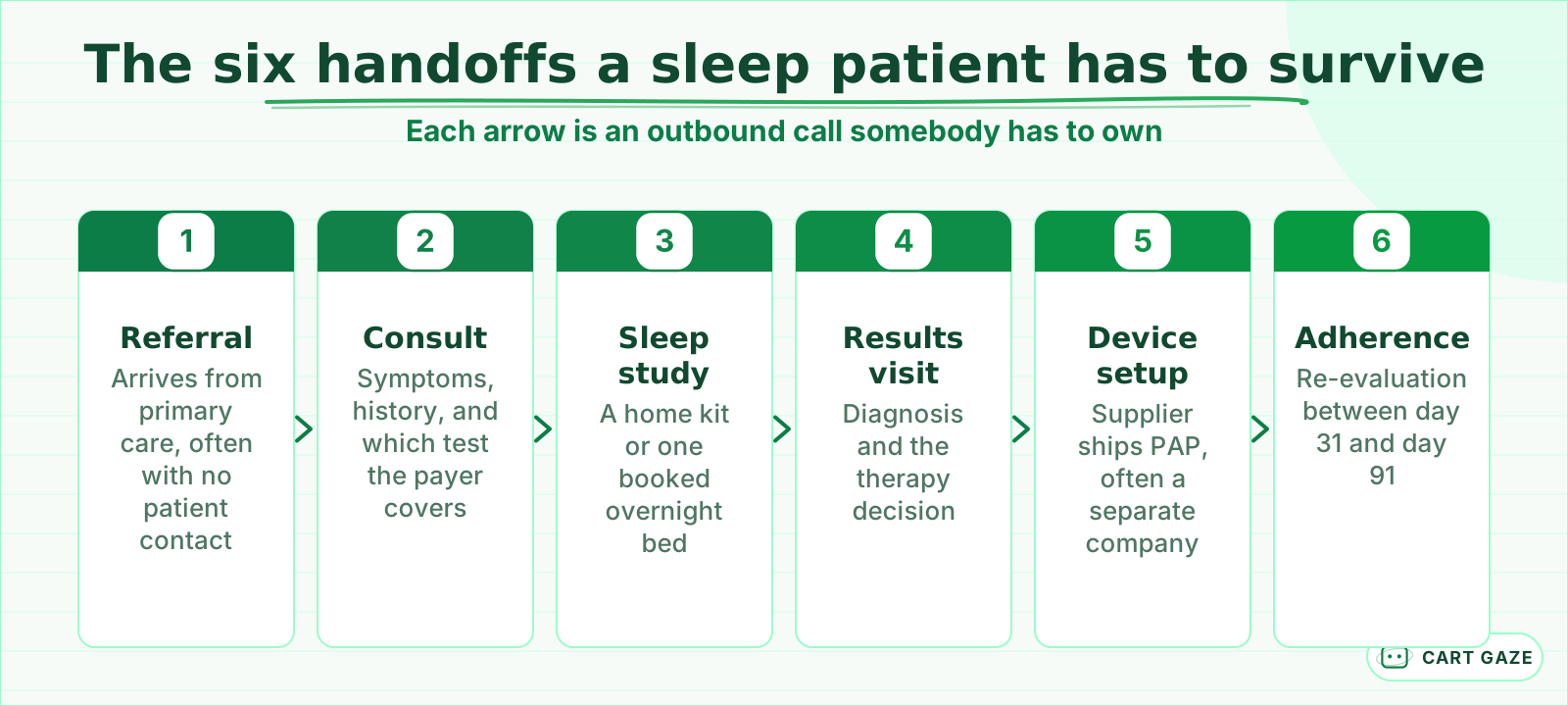 Each pass between stages is a phone call. The patient stops at the first one nobody makes.
Demand is not the constraint. A Frost and Sullivan analysis commissioned by the American Academy of Sleep Medicine in 2016 estimated that obstructive sleep apnea affects 29.4 million American adults, about 12% of the adult population, and put the annual economic burden of the undiagnosed share at $149.6 billion. That figure is a decade old now, but nobody argues the pipeline is thin.
Completion is the constraint. Most sleep referrals arrive from a primary care office as a fax or an EHR message with no patient contact attached, which means the first call is outbound and often never happens. The upstream half of that handoff is its own problem, covered in what a primary care front desk is juggling.
Every stage after that has the same shape: a document changes hands, and a human is supposed to call somebody. When the front desk is holding four inbound lines, the outbound call loses.
The two testing paths your front desk has to keep straight
Home testing and in-lab polysomnography are not a patient preference. The AASM says both are options for an uncomplicated adult at high risk of moderate to severe apnea, but in-lab testing is the one indicated when there is significant cardiorespiratory disease, neuromuscular weakness, opioid use, or stroke history.
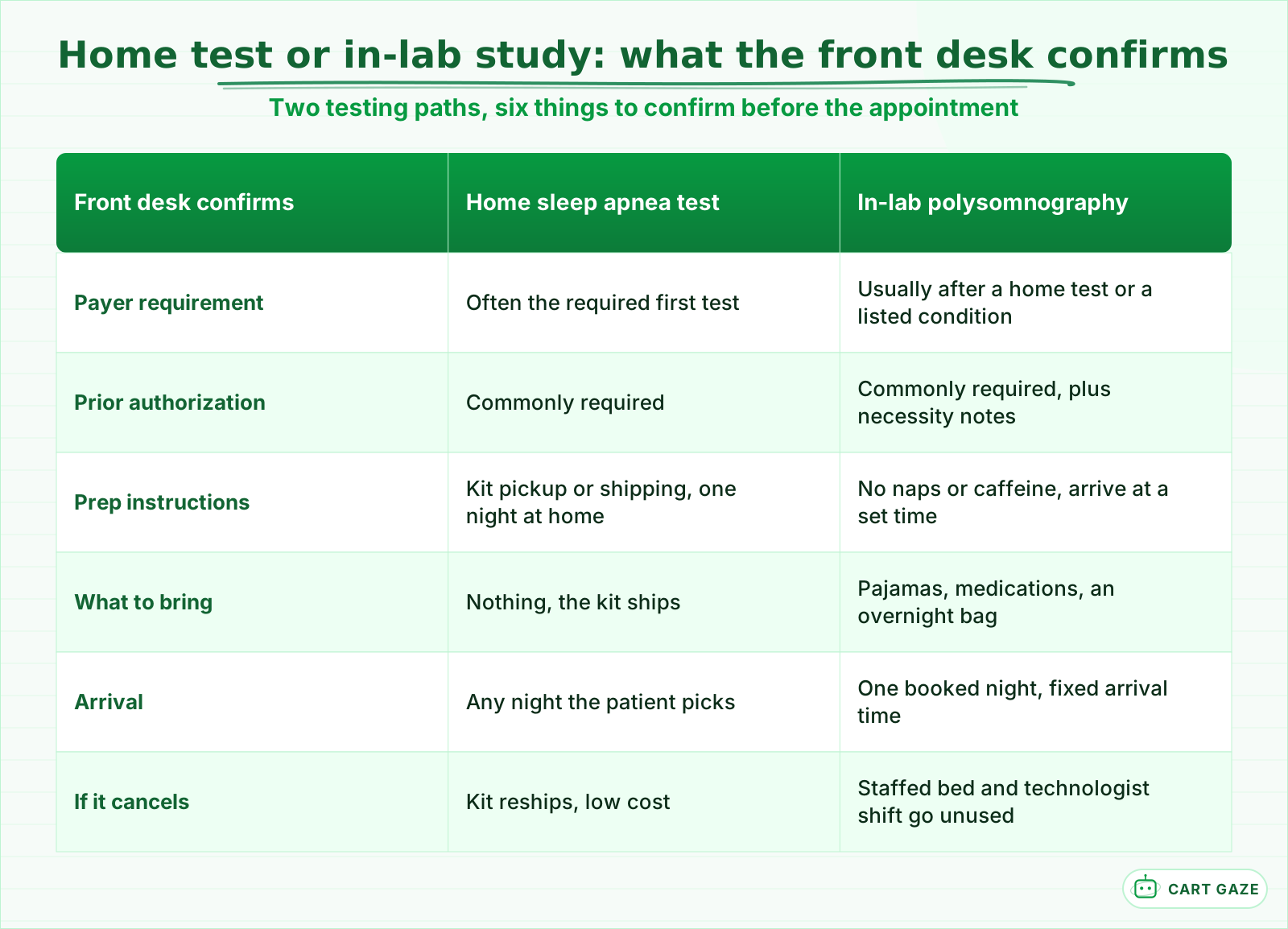 The fork is eligibility and logistics, not preference. Confirm each line before you book.
The 2017 AASM guideline also names awake or suspected sleep-related hypoventilation and severe insomnia as reasons to keep a patient in the lab. Your payer adds a second filter on top: prior authorization is common, and many plans want a technically adequate home test attempted before they will authorize a bed. Two different rules decide the same booking, and the front desk has to check both.
Cost sharpens the point. The Sleep Foundation puts a home sleep apnea test at roughly $100 to over $1,000 in total charges and an in-lab study at an average of about $3,000. The expensive path is also the one with the tightest logistics.
Tip
Prep is where scripted automation earns its place. A kit arrives by mail; a bed needs an arrival time, an overnight bag, and instructions about naps and caffeine. Have the system read back your written prep sheet word for word rather than paraphrasing it.
An empty overnight bed is your most expensive no-show
An in-lab study consumes a room, a technologist shift, and a night that cannot be resold. When the patient does not arrive, you do not lose a 20-minute slot, you lose the whole night. A peer-reviewed review of one sleep clinic put overall no-shows at 21.2% across 2,532 appointments.
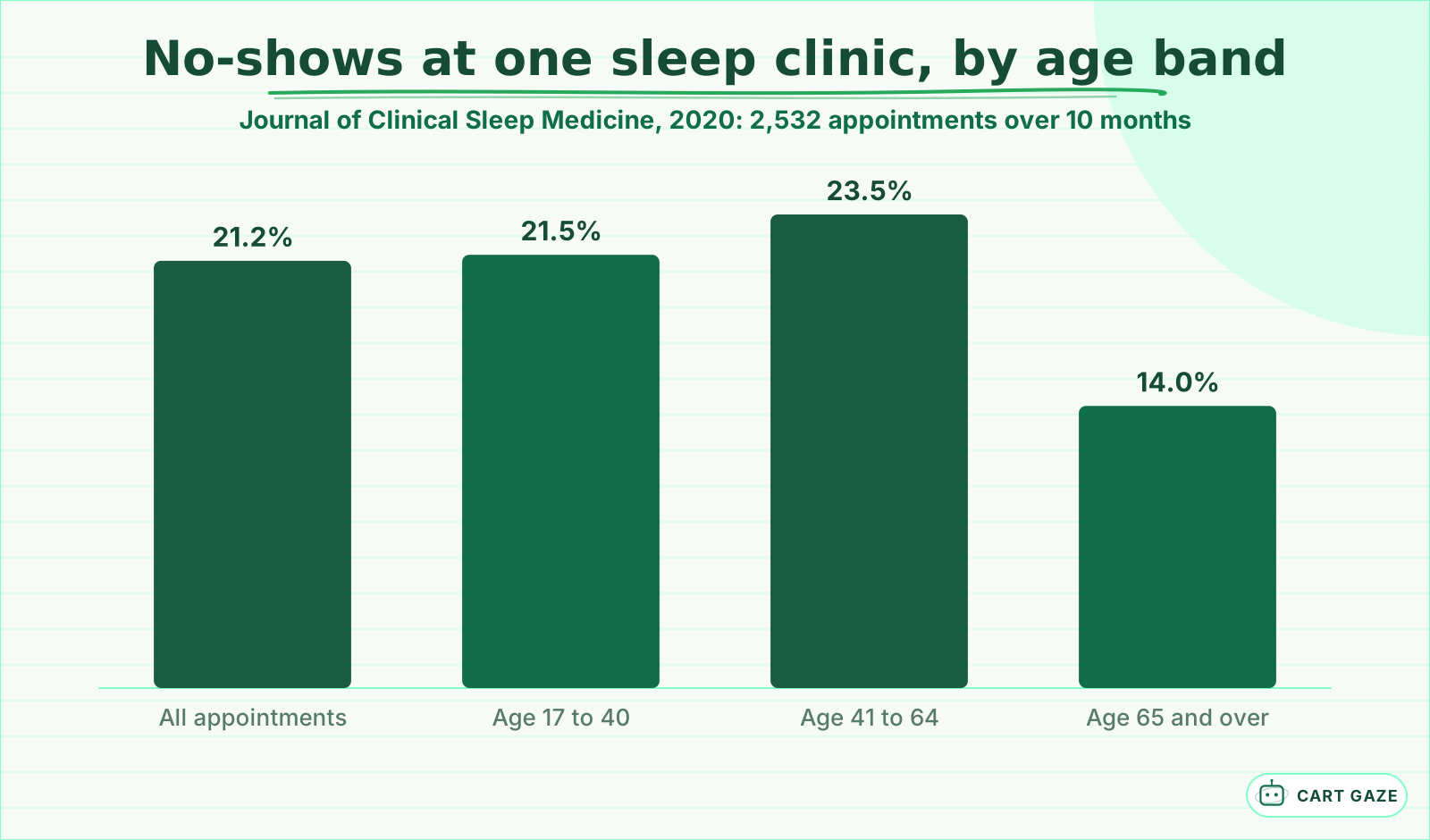 One clinic, 2,532 appointments over 10 months. Measure your own before you copy it.
That review, published in the Journal of Clinical Sleep Medicine in 2020, looked at 10 months of visits at the Saint Louis University sleep disorders center. No-shows ran 21.5% for patients aged 17 to 40, 23.5% for 41 to 64, and 14.0% for 65 and over. The independent predictors were age 40 or under, with an adjusted odds ratio of 1.72, new patient status, and having no health insurance.
Read that as a reason to measure, not as your number. Those are clinic visits at one academic center, not overnight bed no-shows, and your mix of new patients and payers is different. The useful part is the shape: the people most likely to miss are new, younger, and least connected to the practice, which is exactly the profile of a fresh referral waiting for a bed.
Confirmation is the cheap intervention here. A booked overnight study that gets confirmed 7 days out, then 24 hours out, with a live way to move the date, is a very different asset from one that sits in the schedule untouched for a month. The general playbook is in the reminder sequence that actually reduces no-shows; the sleep-specific twist is that a cancellation 3 days early can still be refilled, and one at 8 p.m. cannot.
The 90-day adherence clock, and what automation can do about it
Medicare keeps paying for a PAP device only when the record shows the patient used it at least 4 hours a night on 70% of nights across a 30-day window inside the first 3 months, plus a face-to-face re-evaluation between day 31 and day 91 after therapy starts. Both halves are calls.
The coverage thresholds sit upstream of that: an AHI or RDI at or above 15 events per hour with a minimum of 30 events, or between 5 and 14 with a minimum of 10 events plus documented sleepiness, cognitive or mood symptoms, insomnia, hypertension, ischemic heart disease, or stroke history. Those come from the CMS local coverage determination for PAP devices, and commercial plans widely mirror them. Confirm your own payer's language rather than assuming.
The window is tighter than it sounds. Research presented at the ATS 2026 International Conference, covering more than 132,000 patients at Kaiser Permanente Southern California, found 51% did not meet the 90-day Medicare use criteria, while more than a third of that group were still using CPAP a year later. The clock measures coverage, not whether the patient gave up.
That gap is the automation case. Booking the day 31 to 91 re-evaluation at the moment of setup, checking in during the first 2 weeks when usage patterns form, and flagging anyone trending under 4 hours for a human call are all scheduling and messaging tasks.
Warning
Adherence automation stops at the appointment. It must never change a pressure setting, interpret a machine download, tell a patient their therapy is working, or promise that coverage will continue. Those are clinical and billing determinations that belong to your staff.
The calls a sleep clinic must hand to a person
A caller who says they stopped breathing, woke choking, or nearly fell asleep at the wheel is describing a clinical problem, not a scheduling one. An AI receptionist should capture what they said, route it to clinical staff, and never rank how serious it is. Sleepiness at the wheel counts.
Where a call goes matters more than how smoothly it is answered. A routing map you can hand to a new hire is also the specification you hand a vendor.
| Call type | Where it must land | What an AI receptionist may do |
|---|---|---|
| Booking, reschedule, hours, directions | Front desk queue | Handle it and book |
| Study prep question | Front desk or sleep technologist | Read back the written prep, no improvising |
| Stopped breathing, choking, new symptoms | Clinical staff | Take details, route, never assess |
| Sleepiness while driving | Clinical staff, same day | Flag as urgent, route to a person |
| What did my study show | Ordering provider | Book the results visit, never interpret |
| Mask leak, pressure, machine alarm | Clinic or supplier, per your rule | Route by ownership, never adjust therapy |
| Resupply or reorder | Equipment supplier | Confirm and transfer, no automatic shipment |
If you have never set one of these boundaries before, what an AI receptionist does and where it stops is the place to start. One more thing to check while you are reading vendor pages: any system touching patient details is a business associate and needs a signed Business Associate Agreement. Compliance is a configuration plus that contract. There is no such thing as a "HIPAA certified" product, so treat that phrase as a warning sign.
Who owns the machine: routing between your clinic and the supplier
Most patients get the device from a separate durable medical equipment supplier, so a mask leak at 2 a.m. becomes a call to your clinic about a product you did not ship. Without a written ownership rule, those calls bounce between two phone systems and the patient gives up.
Write the rule before you automate the routing. Decide who owns mask fit, who owns pressure complaints, who owns filters and tubing, and who owns the compliance download, then encode exactly that. A transfer with a reason attached beats a warm-sounding dead end.
Important
Resupply is not an auto-ship workflow. CMS requires the supplier to contact the patient to verify the need within 30 calendar days of the expected end of the current supply, prohibits delivery sooner than 10 calendar days before that supply runs out, and does not allow automatic shipment on a pre-determined basis even when the patient authorizes it.
That rule is a feature, not an obstacle. A remind-and-confirm sequence that captures a documented patient response is exactly what the refill record needs, and it is the kind of repetitive outbound contact a front desk never gets to.
Before a sleep clinic line goes live
- A signed Business Associate Agreement covers every vendor touching patient details.
- Symptom calls and sleepiness-at-the-wheel calls have a named human owner and a tested path.
- Your prep instructions and supplier-ownership rules exist in writing, not in one person's head.
- Someone reads the first week of transcripts end to end before the scope widens.
Where to start in your own clinic
Start with the handoff that leaks most, not the whole path. Pull last month's calls, count how many were prep questions, results questions, or device questions, and pick the single stage where patients stall. One call type, one stage, measured against your own log for 30 to 60 days.
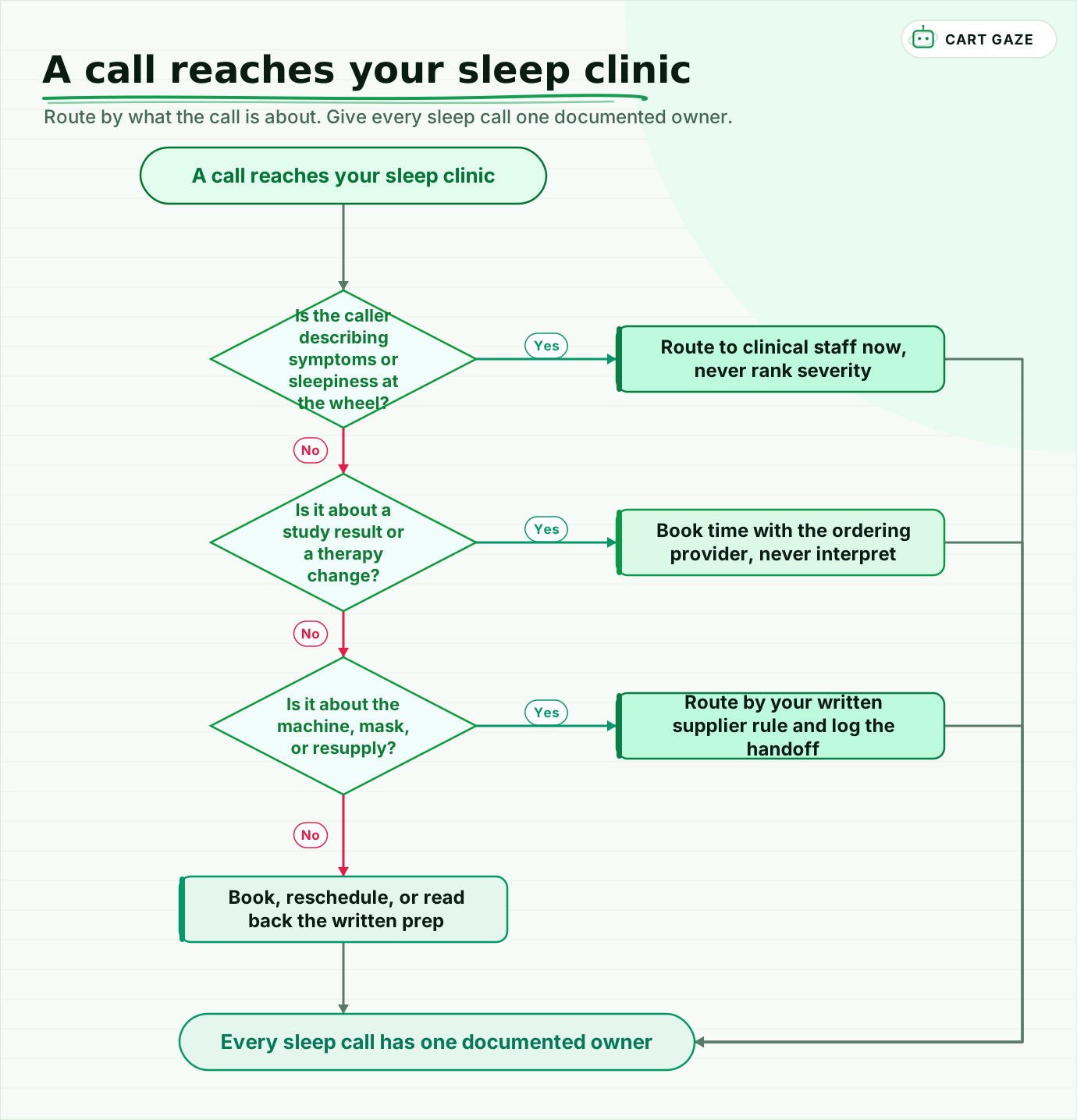 Route by what the call is about. Give every sleep call one documented owner.
Walk the flow once. Anything clinical goes to a person immediately. Anything about a result or a therapy change goes to the ordering provider. Anything about the machine follows your written supplier rule. What is left is booking, rescheduling, and reading back prep, which is a large share of your volume and the safest place to begin.
Then check the number that matters for your clinic rather than the one in a demo: recovered overnight bed nights, completed results visits, or re-evaluations booked inside the day 31 to 91 window. If you would rather see which handoff is costing you most before anyone talks tools, the free Growth Leak Audit sizes it from your own numbers.
Fair questions.
What can an AI receptionist actually do for a sleep medicine clinic?
It can answer and book routine calls around the clock, confirm overnight study appointments, read back your written prep instructions, take structured messages, and route everything clinical to staff. It cannot assess symptoms, interpret a sleep study, or adjust therapy. In sleep medicine the highest-value work is outbound: confirming beds and booking the follow-up visits that keep coverage intact.
What is the Medicare PAP adherence requirement?
Medicare coverage determination defines adherence as use of the device at least 4 hours a night on 70% of nights during a consecutive 30-day period, anytime within the first 3 months. The treating practitioner also has to document a face-to-face re-evaluation no sooner than the 31st day and no later than the 91st day after therapy begins.
Should a patient get a home sleep apnea test or an in-lab study?
That is a clinical and payer decision, never a front-desk one. The AASM guideline says both are options for an uncomplicated adult at high risk of moderate to severe apnea, but calls for in-lab testing with significant cardiorespiratory disease, neuromuscular weakness, suspected hypoventilation, chronic opioid use, stroke history, or severe insomnia. Many plans also require a home test first.
Can automation handle PAP resupply reminders?
It can remind and confirm, but it cannot ship on a schedule. CMS requires the supplier to contact the patient to verify the need within 30 calendar days of the expected end of the current supply, bars delivery sooner than 10 calendar days before that supply runs out, and prohibits automatic shipment on a pre-determined basis even with patient authorization.
Is an AI receptionist for a sleep clinic HIPAA compliant?
Compliance is a configuration plus a signed Business Associate Agreement, not a product badge, and no "HIPAA certified" credential exists. Any vendor that hears a patient name, date of birth, or symptoms is a business associate. Ask what the system records, what it reads back on a call, how long it keeps audio, and get the agreement signed before go-live.
Sources.
- [1]LCD L33718: Positive Airway Pressure Devices for the Treatment of Obstructive Sleep Apnea (CMS)
- [2]AASM clinical practice guideline for diagnostic testing for adult obstructive sleep apnea
- [3]Early CPAP struggles do not predict treatment failure (ATS 2026, Kaiser Permanente Southern California)
- [4]No-show rates to a sleep clinic: drivers and determinants (Journal of Clinical Sleep Medicine, 2020)
- [5]Are sleep studies covered by insurance? Home test and in-lab study costs
- [6]Economic burden of undiagnosed sleep apnea in the US (AASM and Frost & Sullivan, 2016)
- [7]DMEPOS refill requirements (CMS)
Written by

Muhammad Qasim Hammad
Founder, Cart Gaze
Qasim builds AI receptionists and front-office automation for medical and dental practices at Cart Gaze. Posts here start from published sources and real call data, not vendor claims, and every number links back to where it came from.
Keep reading.
 By Practice TypeAI Receptionist for a Gastroenterology Practice: Prep Calls10 min read
 By Practice TypeAI Receptionist for an ENT Practice: The 14-Day Clock10 min read
 By Practice TypeAI Receptionist for Orthopedics: What It Fixes, What It Cannot10 min read
 By Practice TypeAI Receptionist for a Cardiology Practice: Safe Call Routing10 min read
 By Practice TypeAI Receptionist for Audiology Practices: Why Text Comes First11 min read
 By Practice TypeAI Receptionist for Behavioral Health: Crisis and Part 210 min read