
Provider Schedule Template Optimization Before You Automate
An automated booking agent fills the grid you hand it, including blocks held for a referrer who stopped calling and slot lengths chosen by a provider who left. Audit the template before you automate it.
Key takeaways.
- A schedule template is a stack of decisions nobody revisits, so blocks outlive the referrer they were held for and slot lengths outlive the provider who chose them.
- One published single-provider cardiology series reported roughly 67% utilization and nearly 8 surplus slots per clinic session, which is a reason to query your own schedule rather than a benchmark.
- Read four leak points in 90 days of slot data: unfilled slots by day and hour, visit types that overrun, the post-cancellation gap, and the last appointment of the day.
- Advanced-access guidance from 2000 held 65 to 75% of slots open; current vendor operations guidance caps same-day at 20 to 25%, with carve-out utilization under 70% meaning you are holding too much.
- Automated booking exposes a bad template faster because software books exactly what the grid says is free, so subtract dead blocks and re-time slots before you point an agent at it.
Table of Contents8 sections
- Why schedule templates ossify
- Read your own data: four places a schedule leaks
- Rigid slots or flexible slots
- A template audit for a 2-provider practice
- How much same-day capacity to hold, and how to release it
- Why an AI booking agent makes the template matter more
- Where to start on your own schedule
- Fair questions
Most practices shopping for automated booking are about to hand a machine the authority to fill a grid nobody has inspected in years. The template is the only thing the software knows about your day. Every block, every slot length, every hold is an instruction it will follow perfectly.
That matters because templates rot quietly. A Tuesday morning block still sits reserved for a specialist who stopped referring in 2022. New-patient slots are 30 minutes because a physician who left in 2023 wanted them that way. One published analysis of a single cardiology clinic found a usage rate near 80% and an appearance rate near 80%, which multiplied out to a utilization rate of roughly two thirds and left nearly 8 surplus slots per session.
This post covers how templates ossify, the four places to read your own slot data for leaks, the tradeoff between rigid and flexible slot lengths, how much same-day capacity to hold back, and a worked audit for a 2-provider practice. Provider schedule template optimization comes before booking automation, not after it.
Why schedule templates ossify
A schedule template is a stack of decisions nobody scheduled a date to revisit. Each one made sense the week it was made. Nothing in the software expires them, no report flags them, and the front desk learns to work around them, so the grid quietly stops describing today's practice.
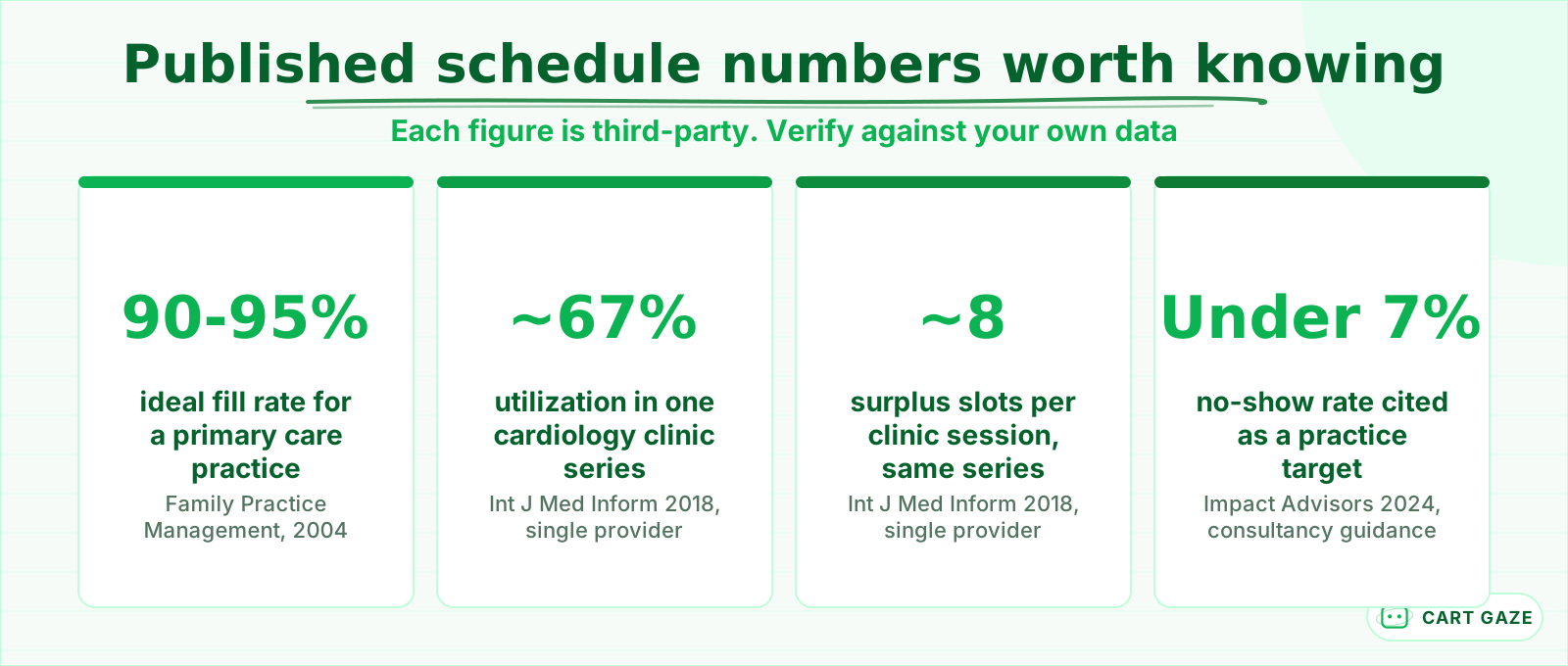 Published figures, each sourced. Reasons to measure your own template, not your result.
The consultancy Impact Advisors put the uncomfortable part plainly in a March 2024 piece on provider templates: providers often are not fully aware of how their own template is structured or how it fills. Their recommendation is that operational leadership review and revise templates with each provider at least quarterly. Most small practices review them approximately never.
AHRQ describes the same rot in clinical terms. Its advanced-access guidance tells practices to hunt down demand created by outdated clinical protocols, and names routine follow-up visits for urinary tract infections and annual Pap smears as examples of recurring visits that a template keeps generating after the underlying guidance has moved on.
Staff turnover is the other engine. In a 2008 case series of 6 Boston-area primary care practices, one of the named barriers that undid an access improvement was a drop in appointment supply from provider leaves of absence and departures. A departing provider takes their clinical judgment with them and leaves their slot lengths behind.
Read your own data: four places a schedule leaks
Averages hide leaks. A practice running at 88% fill looks healthy until you split that number by day and hour and find Thursday afternoons at 61%. Before changing any slot length, pull 90 days of slot-level data and read four specific things, because each one leaks for its own reason.
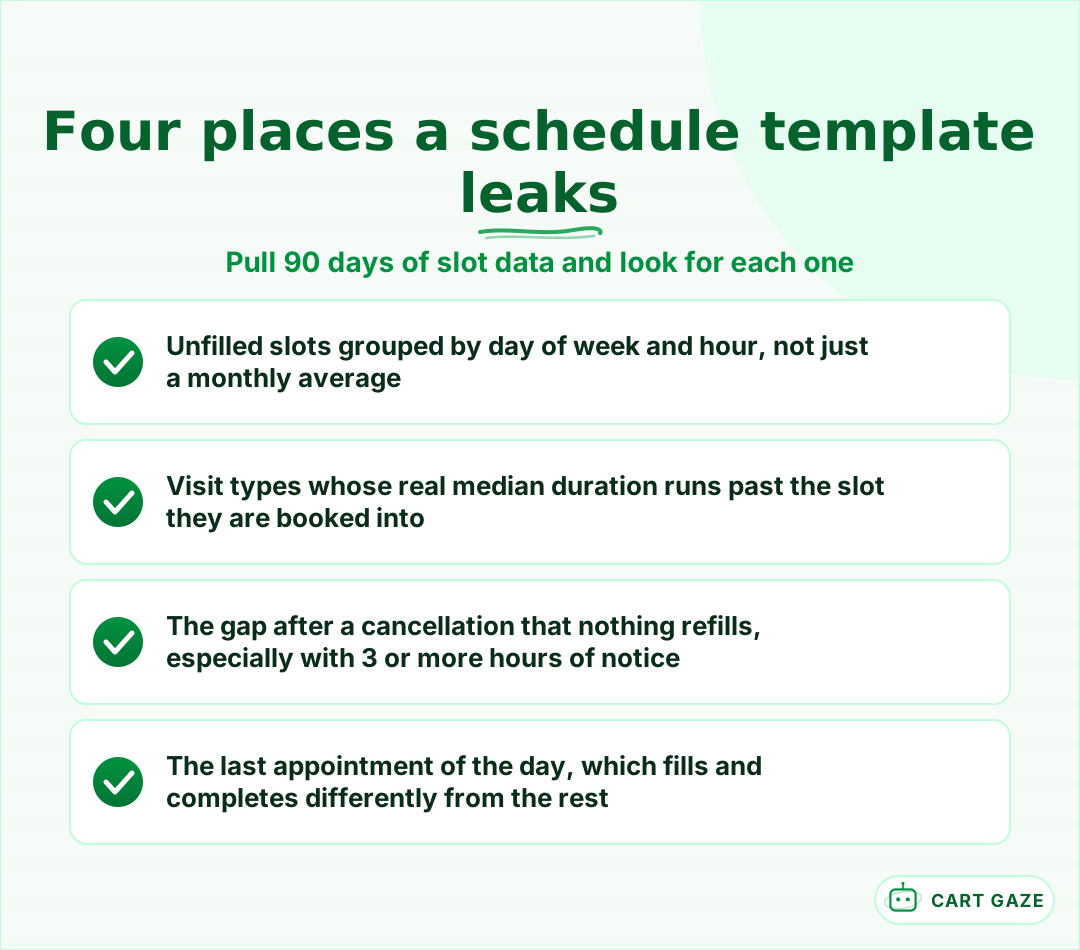 Read these four in your own data before you change a single slot length.
Unfilled slots by day and hour. Group them, do not average them. Family Practice Management has long put the ideal fill rate for a primary care practice at about 90 to 95%, with sustained readings above 95% hinting at access strain and readings under 90% pointing at lost revenue. That guidance dates to 2004, so treat it as a long-standing rule of thumb rather than a current benchmark.
Visit types that run long. Pull the real median duration of each visit type and compare it to the slot it is booked into. A type that reliably needs 22 minutes in a 15-minute slot is not a provider problem, it is a template that lies.
The gap after a cancellation. In that same single-provider cardiology analysis, roughly 30% of cancellations arrived with real advance notice, and nearly half of those came more than 3 hours ahead. That is genuinely refillable time, and most of it went unused.
The last appointment of the day. Track its fill rate and its completion rate separately from the rest of the day. It behaves differently, and a template that treats 4:30 p.m. like 10:30 a.m. is guessing.
Important
One caveat on all four numbers above: they come from one cardiologist's 67 weekly clinics over 18 months at a single academic medical center, about 900 visits in total. Use them as a reason to run the same query on your own schedule, never as a benchmark you have already met.
Rigid slots or flexible slots
Rigid templates use one or two uniform slot lengths and are trivial to automate, because software reasons about one number. Flexible templates assign a duration per visit type and fit real appointments better, at the cost of a grid that drifts in more places. Most practices land in a narrow middle.
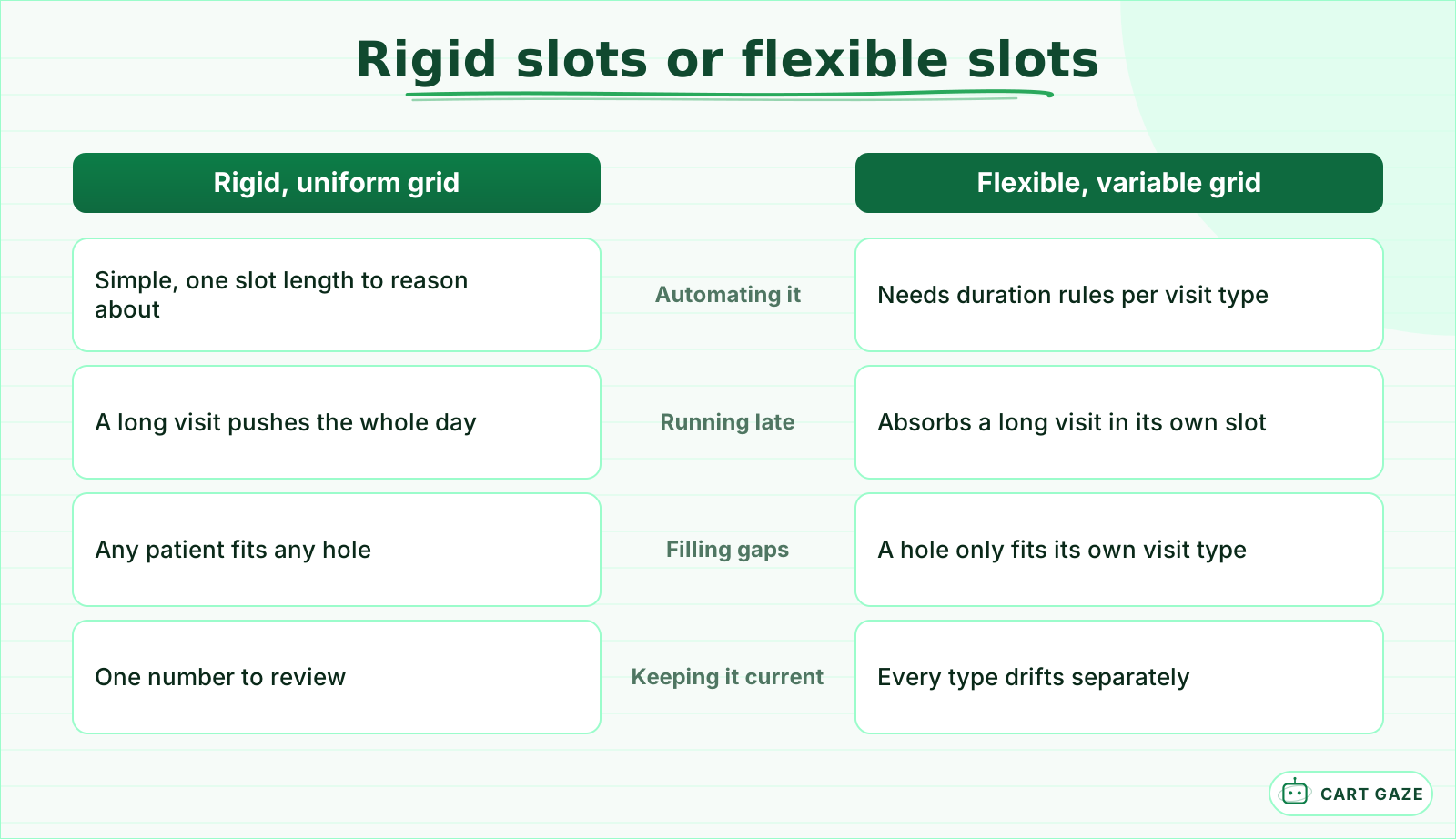 Rigid is easy to automate. Flexible fits real visits. Most practices need a narrow middle.
AHRQ's guidance sits firmly on the rigid side: simplify appointment types, make them roughly the same length, and hold the practice to about three types, treating a long appointment as roughly two short ones. Murray and Tantau, writing in Family Practice Management back in 2000, recommended standardizing at about 15 to 20 minutes or whatever the practice's own average happened to be.
Slot length is not only an operations decision. A 2024 study in Family Practice looked at 222 primary care physicians at one academic health system and found 38.3% working a 15/30 minute template and 61.7% on 20/40. In an adjusted analysis covering 238,806 patients, patients of the 15/30 physicians had about 9% more primary care visits and about 8% fewer specialty visits. That is an association at one health system, not proof that shorter slots cause referrals to fall, but it does mean the number in your template reaches further than your day.
Tip
If you are moving toward automated booking, cut the number of distinct visit types before you cut anything else. Every additional type is another duration rule, another set of eligibility conditions, and another way for a phone booking and a web booking to disagree about what is free.
A template audit for a 2-provider practice
Here is what the exercise looks like end to end for a modeled 2-provider family practice running 8-hour days. The numbers below are illustrative rather than measured, so swap in your own. The pattern is the point: most of what an audit produces is subtraction, not new features.
| Template block | Originally reserved for | What 90 days of slot data showed | The change |
|---|---|---|---|
| Tue 9 to 11 a.m. Provider A | Specialist referral intake | 4 of 26 slots used, none by that referrer | Release to general booking |
| New patient, 30 minutes | A physician who left in 2023 | Median visit 21 minutes | Re-time to 20 minutes |
| Fri 4 p.m. both providers | End-of-day overflow | Fill 44%, completion below the daily rate | Close Fri at 3:30 p.m. |
| Same-day hold, 4 slots daily | Urgent walk-ins | Used 2.4 of 4 on average | Hold 3, auto-release at noon |
| Wed 1 to 2 p.m. admin block | Paperwork and callbacks | Kept, no booking demand shown | Keep as is |
Four of those five rows remove an instruction. The audit reclaimed roughly 22 provider-hours a month in this model, and not one of them required new software. That is the honest sequencing argument: a booking agent added on top of the original grid would have spent a year faithfully protecting a referral block for a practice that stopped calling.
How much same-day capacity to hold, and how to release it
Held capacity only pays if it gets used or released. The classic advanced-access answer is aggressive and the vendor-operations answer is modest, and the gap is wide enough that copying either blindly hurts. What settles it is your own carve-out utilization, measured over a quarter rather than argued in a meeting.
Murray and Tantau argued in 2000 for keeping 65 to 75% of a physician's slots completely open, and AHRQ's summary of open access describes leaving about half the day free. Both come from health-system-scale primary care work. Current vendor operations guidance is far more conservative: hold same-day capacity at no more than 20 to 25% of scheduled capacity.
Utilization tells you whether your hold is the right size. That same vendor guidance treats carve-out utilization above 85% as correctly sized, below 70% as holding more than same-day demand justifies, and consistently above 95% as holding too little and turning requests away.
Warning
Capacity you hold and never release is worse than capacity you never held. If nothing automatically opens an unclaimed slot, a same-day carve-out is just a scheduled empty chair. Impact Advisors suggests opening any slot that has not filled 48 hours out to any patient type; vendor guidance releases unclaimed same-day holds around mid-morning or noon depending on when your calls land.
Be honest about the ceiling here. In that 2008 case series, 5 of 6 practices cut the wait for the third next available appointment from 21 to 8 days for 15-minute visits and from 39 to 14 days for 30-minute visits within 4 months. None of them reached same-day access, waits crept back up over 2 years of follow-up, and no consistent change appeared in no-show rates or in patient and staff satisfaction. Template work moves real numbers and it does not move all of them.
Before you point automated booking at your template
- Pull 90 days of slot data and split fill rate by day of week and hour.
- Confirm every standing block still has a live reason and a named owner.
- Compare each visit type's median real duration against its slot length.
- Write down what happens when a booking write to the calendar does not go through.
Why an AI booking agent makes the template matter more
An automated booking agent both exposes a bad template faster and raises the payoff for fixing one. It removes the human filter. Your staff quietly work around a wrong slot length, steering patients into the right hole. Software books exactly what the grid says is free, around the clock.
That cuts both ways, and the upside is real. A template fix that used to improve one channel now improves every booking path at once, including the 8 p.m. request that previously became a voicemail. If you have not evaluated one of these systems before, start with what an AI receptionist actually does and where it stops, because the boundaries matter more than the feature list.
Three limits belong in the same breath. Clinical and urgent calls route to a human, always: a booking agent recognizes and redirects, it never diagnoses or judges how sick someone is. A write to a live calendar can fail, so decide now whether a failed booking gets retried, confirmed by text, or handed to a person, because silently dropping it is the one option that loses the patient. And any system touching patient details needs a signed Business Associate Agreement. "HIPAA certified" is not a real credential, so treat any page claiming it as a warning about the vendor.
Two neighboring problems are worth solving in the same pass. Slots you release need somewhere to send the offer, which is what waitlist management handles, and the appearance-rate half of your utilization gap is covered in no-show prediction and smart overbooking. For scale there, MGMA's single-specialty aggregate no-show rate was 6.81% in 2023, up from 5% in 2022.
Where to start on your own schedule
Work in this order: measure, subtract, re-time, automate the release, then automate the booking. Reversing those last two is the common and expensive mistake, because an agent pointed at an unaudited grid will book against dead blocks and stale durations at machine speed and produce a schedule nobody can defend.
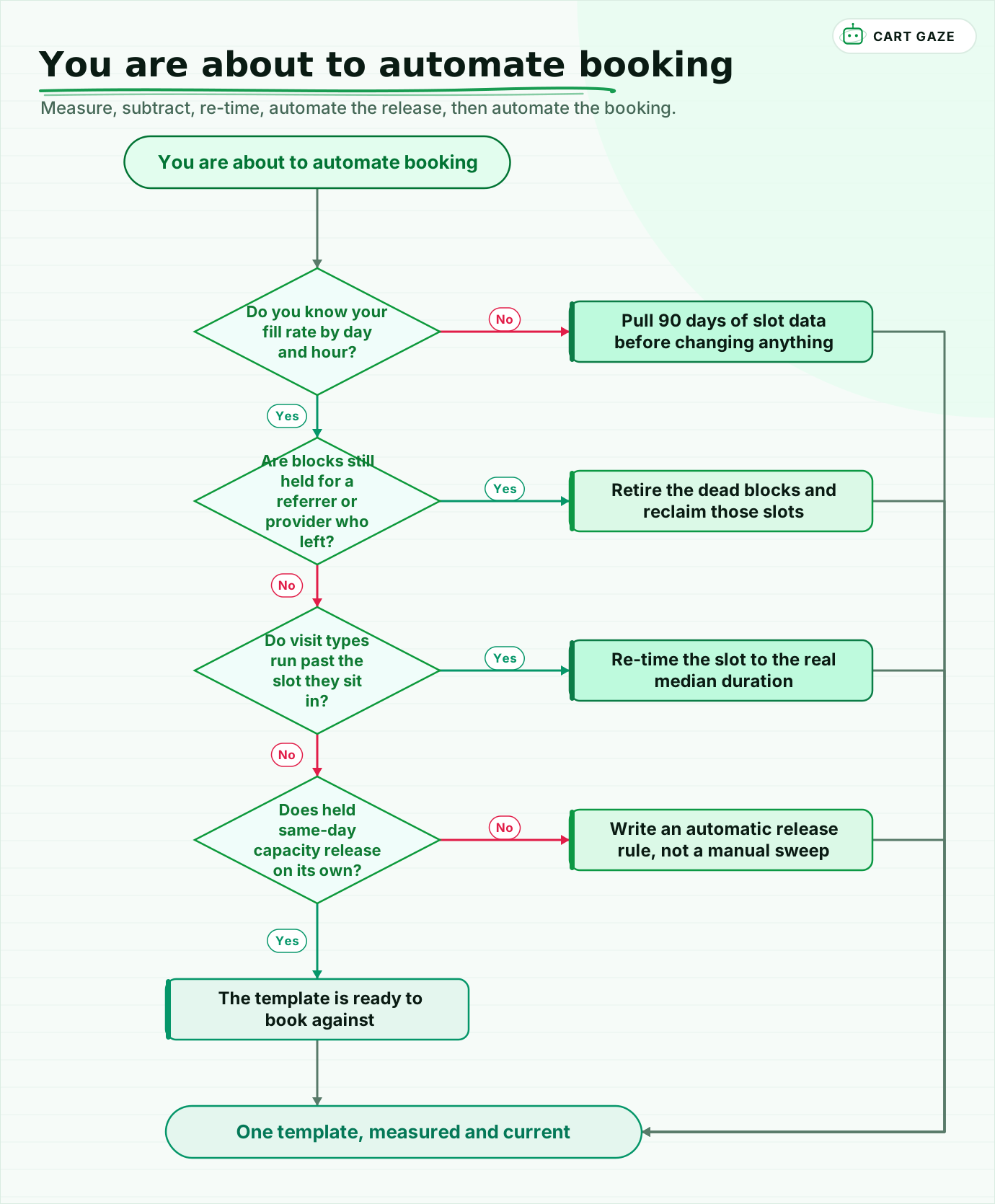 Measure, subtract, re-time, automate the release, then automate the booking.
Walk it once. Without fill data by day and hour you are guessing, so pull it. Blocks held for a referrer or a provider who is gone get retired. Visit types that overrun get re-timed to their real median. Held capacity that only a person can release gets an automatic rule instead.
Then re-measure the same four leak points 60 to 90 days later, in your own data, and expect a partial win rather than a clean one. If you would rather see the size of the gap before touching anything, the free Growth Leak Audit sizes it from your own numbers first.
Fair questions.
What is provider schedule template optimization?
It is the practice of auditing the appointment grid a provider works to, then removing or re-timing the parts that no longer match demand. That means retiring blocks held for referral sources that stopped referring, resetting slot lengths to the real median duration of each visit type, and sizing same-day holds against measured carve-out utilization rather than habit.
How often should a practice review its schedule template?
Consultancy guidance published in 2024 recommends that operational leadership review and revise provider templates at least quarterly, because providers are often not aware of how their own template is structured or how it fills. A practical cadence for a small practice is a full audit twice a year against 90 days of slot data, with fill rate watched monthly.
What is a good appointment fill rate?
Family Practice Management has long put the ideal at about 90 to 95% for a primary care practice, with sustained readings above 95% suggesting access strain and readings below 90% suggesting lost revenue. That guidance dates to 2004, so treat it as a rule of thumb and split your own fill rate by day and hour rather than trusting a monthly average.
How many same-day slots should we hold open?
There is no single answer, and published positions differ widely. Advanced-access work from 2000 argued for keeping 65 to 75% of slots open, while current vendor operations guidance caps same-day at 20 to 25% of scheduled capacity. Let your carve-out utilization decide: above 85% is sized right, below 70% means you are holding more than demand justifies.
Will an AI booking agent fix a bad schedule template?
No. It executes the template faster and more literally, so a dead block stays protected and a wrong slot length gets booked around the clock instead of quietly worked around by staff. Fix the grid first. Also confirm the agent routes clinical and urgent calls to a human, never diagnoses, and operates under a signed Business Associate Agreement.
Sources.
- [1]How to Use Scheduling Data to Improve Efficiency (Family Practice Management, 2004)
- [2]Schedule-based metrics for clinic performance and recovery of cancelled appointments (Int J Med Inform 2018)
- [3]Improving Patient Access: Four Steps to Optimizing Provider Templates (Impact Advisors, 2024)
- [4]Strategy 6A: Open Access Scheduling for Routine and Urgent Appointments (AHRQ CAHPS Improvement Guide)
- [5]Same-Day Appointments: Exploding the Access Paradigm (Family Practice Management, 2000)
- [6]Implementing open-access scheduling in primary care practices: a cautionary tale (Ann Intern Med 2008)
- [7]Association of primary care visit length with outpatient utilization and care processes (Fam Pract 2024)
- [8]Same-Day Access: Making It Actually Work (clinIQ, vendor operations guidance)
- [9]No-show fees in medical practices on the rise (MGMA Stat, January 2025)
Written by

Muhammad Qasim Hammad
Founder, Cart Gaze
Qasim builds AI receptionists and front-office automation for medical and dental practices at Cart Gaze. Posts here start from published sources and real call data, not vendor claims, and every number links back to where it came from.
Keep reading.
 Practice Automation PlaybooksAI Receptionist Implementation: A Realistic Week-by-Week Guide10 min read
 Practice Automation PlaybooksFront Desk AI Training: The Conversation Practices Skip10 min read
 Practice Automation PlaybooksWhat to Automate First: A 90-Day Practice Sequencing Plan10 min read
 Practice Automation PlaybooksThe Front Office Automation Stack for Medical Practices10 min read
 Practice Automation PlaybooksHuman in the Loop AI Approvals: What to Gate and What to Let Run11 min read
 Practice Automation PlaybooksAI Agent Orchestration Rules That Stop Automations Colliding12 min read