
Appointment Type Triage: Deciding What an AI Should Book
The hardest part of AI booking is not writing to the schedule, it is deciding what to book. Here is the service catalog an agent books against, how it handles an ambiguous request, and the urgency line it never crosses.
Key takeaways.
- An AI agent books against a visit type, not a reason for visit, and that record has to carry duration, eligible providers, room or chair, prep, and pre-conditions.
- Duration is looked up, never estimated: an established-patient 99213 runs 20 to 29 minutes, a new-patient 99204 runs 45 to 59, and a dental hygiene visit can budget 58 minutes with turnover.
- An ambiguous request gets one bounded question and a read-back, or a handoff to staff; a silent default is how the wrong slot gets booked.
- The agent may recognize that a call sounds urgent and route it to a human, but it never rates severity, because unlicensed telephone triage is off limits for people and for software.
- In one published clinic study, 36% of appointment blocks were scheduled at the wrong exam length, and wait time fell 3.7 minutes for every 10% improvement in correctly matched blocks.
Table of Contents8 sections
- Build the service catalog your agent books against
- Duration, provider eligibility, and the new-patient question
- Handle the ambiguous request without guessing
- The line an AI never crosses: it does not assess urgency
- When you do not offer what the caller is asking for
- Why booking the wrong length costs more than not booking
- Start with the three visit types that carry your volume
- Fair questions
Writing an appointment into your calendar is the easy half. The hard half happens two seconds earlier, when a caller says "my tooth hurts" or "I need a check-up" and something has to turn that sentence into a visit type, a length, an eligible provider, and a chair. Get that wrong and the booking still lands, which is exactly what makes it expensive.
There is published evidence for how often it goes wrong. In an academic pediatric ophthalmology clinic studied at OHSU, 36% of appointment blocks were scheduled at the wrong exam length, and wait time fell 3.7 minutes for every 10% improvement in correctly matched blocks. That is one clinic in one specialty, not a benchmark for yours, but the failure mode travels: the schedule looked full and the day still ran late.
This post covers the service catalog an AI agent books against, how it should handle a request that is genuinely ambiguous, the line it never crosses on clinical urgency, what it should say when you do not offer what the caller wants, and why an appointment booked at the wrong length costs more than one never booked.
Build the service catalog your agent books against
An AI agent cannot book against a reason for visit. It books against a visit type: a named record that carries a duration, the providers allowed to deliver it, the room or chair it consumes, the prep the patient owes, and the conditions that must be true before the date.
"Knee pain" produces no rules. "20-minute established-patient review, consulting room, no prep" produces all of them. That gap is the configuration job, and it is almost all of the work.
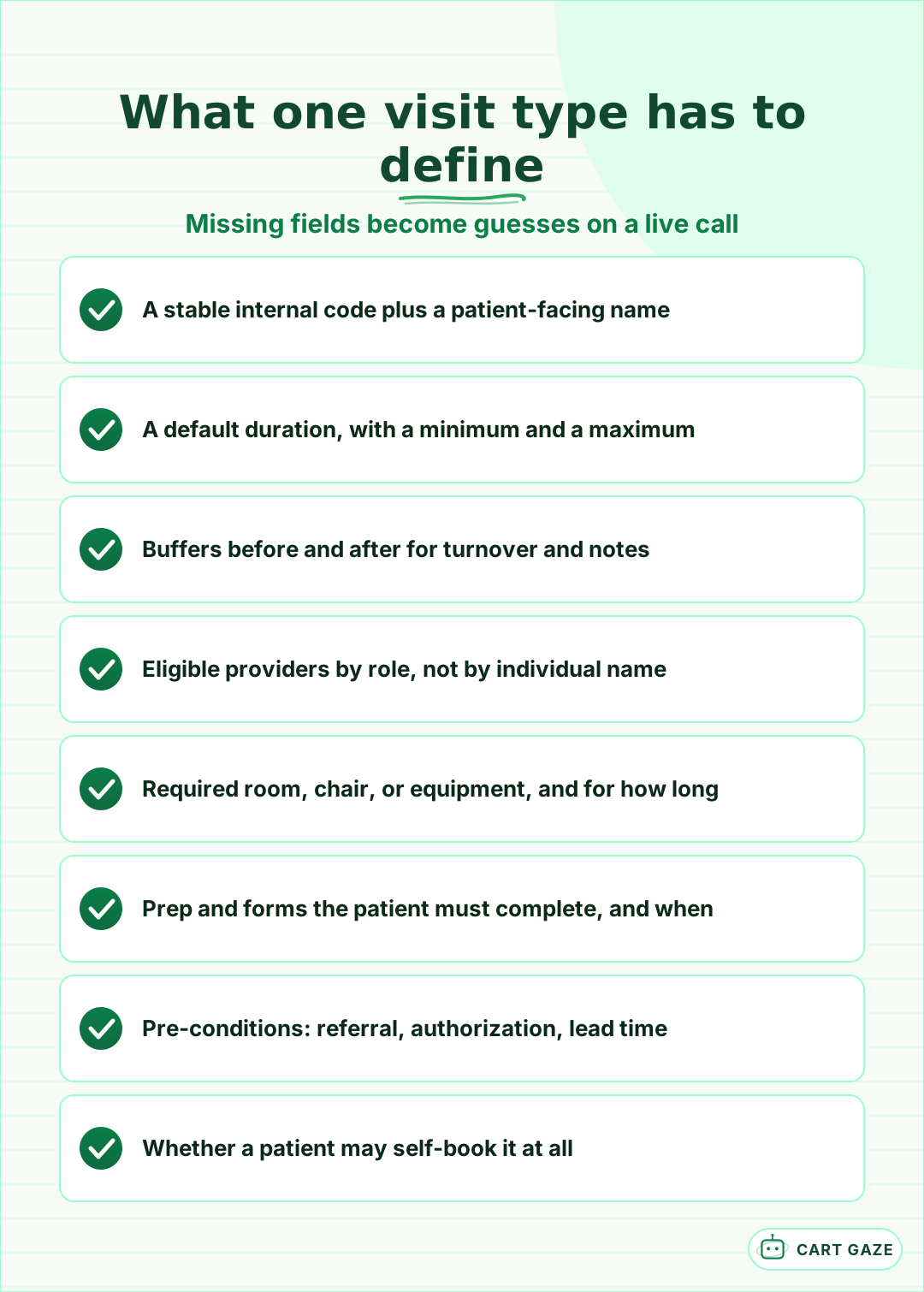 Any field missing here is a field the agent will improvise on a live call.
Two of those fields save the most maintenance later. List eligible providers by role rather than by name, so a new hygienist inherits eligibility instead of needing 30 individual edits. And keep a stable internal code separate from the patient-facing name, so the website can be reworded without breaking the booking rules underneath it.
Whatever you leave out of the catalog, the agent improvises on a live call. That is the unglamorous reason this step cannot be skipped, and it is the same reason a real knowledge base beats a clever prompt.
Duration, provider eligibility, and the new-patient question
Duration is a clinical and financial decision somebody already made, and the agent's job is to look it up rather than estimate it. The same holds for who may perform the visit and whether the caller counts as new, which changes both the length and the money attached to it.
Published total-time ranges make the point concrete. An established-patient 99213 office visit runs 20 to 29 minutes, a 99214 runs 30 to 39, and a new-patient 99204 runs 45 to 59. A 15-minute slot for a visit that needs 45 is not a booking, it is a promise the practice cannot keep.
Dental runs the same arithmetic in chair time. One published hygiene budget puts 7 minutes on data collection, 7 on treatment planning, 30 on treatment, 7 on the exam, and 7 on dismissal and turnover, which is 58 minutes rather than "a cleaning". Two quadrants of scaling and root planing fit one 90-minute appointment or two 60-minute ones, and those are different days off work for the patient.
New versus established is a duration input before it is a billing input. The standard rule is no face-to-face professional service from the same physician, or one of the exact same specialty and subspecialty in the same group, within the past 3 years. Caller ID does not know that, so the agent has to ask.
| Caller says | Books as | Typical minutes | Who may perform it | Must be true first |
|---|---|---|---|---|
| "I need a cleaning" | Adult hygiene recall | 50 to 60 | Hygienist | Existing patient, recall due |
| "I'm new, I want a check-up" | New patient office visit | 45 to 59 | Physician or NP | No visit in the past 36 months |
| "My tooth hurts" | Limited problem-focused exam | 30 | Dentist, chair with imaging | A same-day slot is held open |
| "I need a refill" | Established follow-up | 20 to 29 | Any eligible provider | Seen within the recall interval |
| "Can someone look at this mole" | Focused skin check | 15 to 20 | Dermatology provider | Not billed as a full-body exam |
Important
Provider eligibility is not a preference list. It is scope of practice, credentialing, and payer enrollment stacked on top of each other. If the catalog opens a visit type to a provider who cannot bill for it, the agent will book it and the claim will not pay.
Handle the ambiguous request without guessing
Most requests are not ambiguous, and the few that are should never be settled by a silent default. A good agent is allowed to do three things with an unclear request: narrow it with one bounded question, read the answer back before it books, or hand the call to a person.
Vendor setup guidance puts 15 to 30 appointment types in a typical clinic master schedule, with roughly 80% of call volume landing in three or four. Treat that as a shape, not a measurement of your practice: build the common types properly and route the long tail to staff.
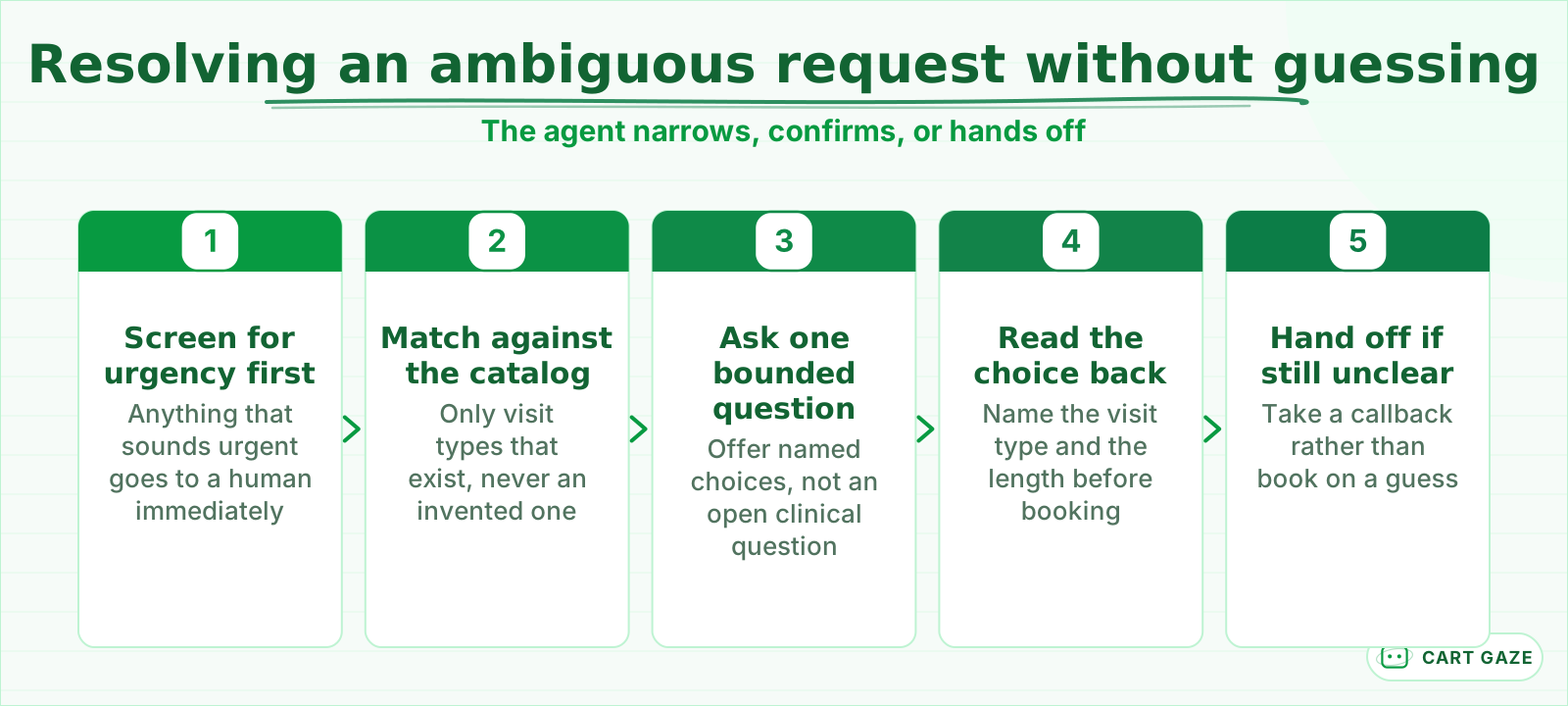 Bounded questions, then a read-back, then a handoff. Never a silent default.
A bounded question offers named choices that already exist in your catalog. "Is this the cleaning that comes round about every six months, or is there something specific you want looked at?" is safe, because both answers are visit types you defined. "How bad is the pain?" is not, for reasons the next section makes plain.
Then read it back. Saying the visit type and the length out loud, as in a 30-minute problem-focused visit on Thursday at 2, catches the misheard word before it becomes a wasted chair. Set a hard retry limit as well: one vendor's published baseline transfers to a human after 3 failed clarification attempts, and any number you can defend beats an agent that keeps trying.
The line an AI never crosses: it does not assess urgency
An AI receptionist may recognize that a call sounds urgent and move it to a human. It may not decide how urgent it is. Rating severity, choosing between the emergency room and a next-day slot, or shortening a visit because a symptom sounded mild is clinical judgment, not a booking rule.
That boundary is not a marketing position. The Doctors Company, writing about human staff, states that unlicensed personnel should never be allowed to triage by telephone or provide telephone advice, and that unlicensed staff may only receive and convey information verbatim, without exercising independent clinical judgment. Applied to software, that sentence is the entire permission set.
MedPro Group adds the liability half: any medical advice given to a patient on the phone is legally deemed the practice of medicine, and the supervising provider carries it. Which staff may triage at all varies by state nurse practice act, and no version of that answer is "the phone system".
Warning
Red-flag phrases route to a human immediately, with no qualifying questions in between: chest pain, trouble breathing, severe bleeding, unconsciousness, suicidal ideation, seizure activity, stroke symptoms. An agent that asks 3 clarifying questions first has already failed the call.
The regulatory backdrop points the same way. The FDA's revised clinical decision support guidance, issued 6 January 2026, still addresses only software aimed at healthcare professionals, and patient-facing decision aids get no comparable carve-out. A patient-facing acuity rater is not a scheduling feature.
What a safe agent does instead is book conservatively and flag: take the soonest slot of a longer, problem-focused type and mark it for clinical review. We work through that boundary call by call in the emergency versus routine triage protocol, and cover where these systems stop altogether in the practice owner's overview.
When you do not offer what the caller is asking for
Three different situations hide behind "we do not do that": the practice does not offer the service, the practice offers it but this provider does not perform it, or the practice offers it but not to this caller. Each needs a different sentence, and not one of them is a booking.
The third case is the one that quietly costs money. The caller is younger than the practice treats, the referral has not arrived, the plan is not accepted, or the visit needs a prior authorization nobody has started. The visit happens, the claim does not pay, and everybody finds out 3 weeks later.
Put those conditions in the catalog as pre-conditions on the visit type instead of leaving them to a judgment call on the phone. The refusal then comes out the same way every time, which is also what makes it reviewable afterwards.
Tip
Build the do-not-offer list from last quarter's real calls rather than from your services page. A procedure you stopped doing, a plan you dropped, an age group you refer out: those are the requests the agent meets in week 1.
The behavior you want is short. Name the limit, offer the genuinely adjacent option if one exists, and hand off a referral or a callback. What you do not want is an agent that negotiates, improvises a price, or books a placeholder so the call ends pleasantly.
Why booking the wrong length costs more than not booking
A missed booking costs you one appointment. A mis-slotted booking costs that appointment plus every appointment behind it that day, the staff time to unpick it, and sometimes the claim. That is why the wrong length is the more expensive error, even though it shows up as a success in the report.
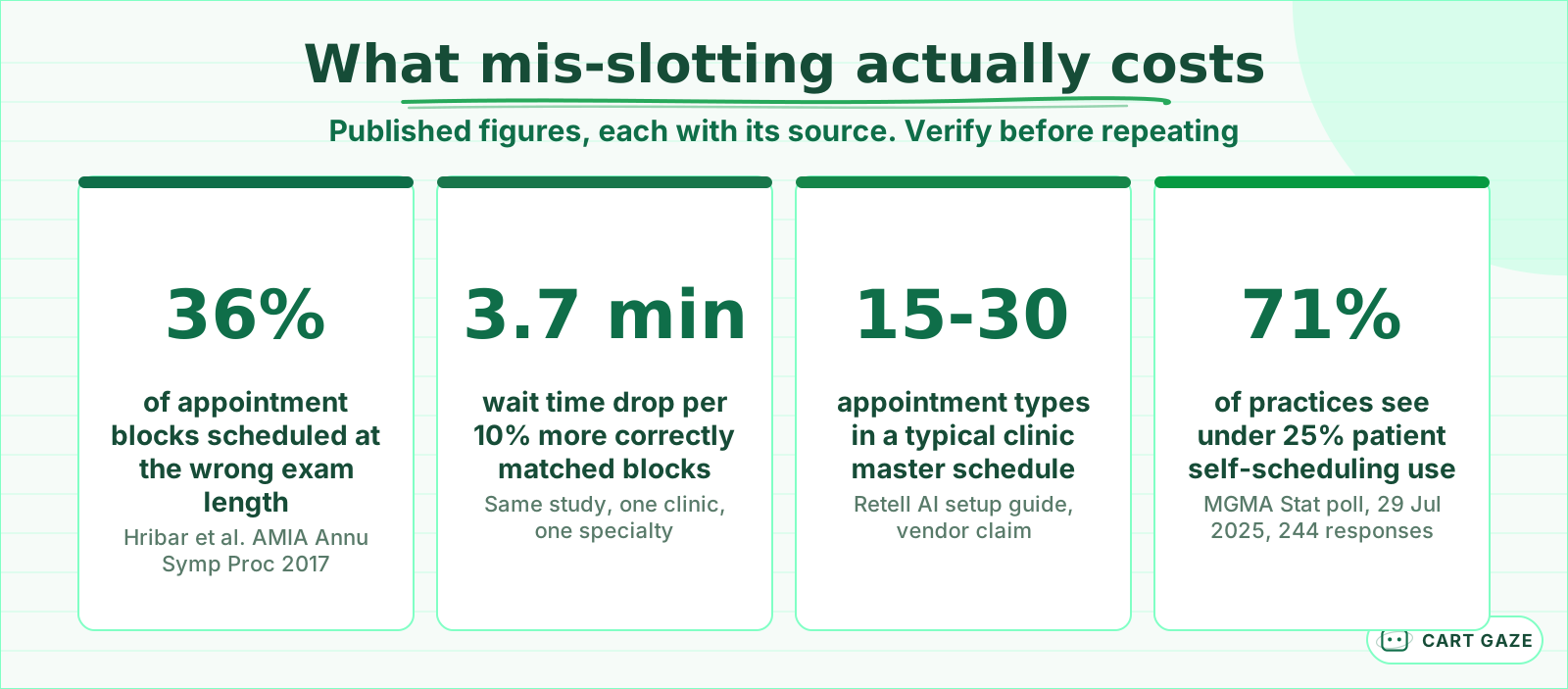 Published figures, each sourced. Reasons to audit your own template, not your result.
The published evidence is narrow but clean. In that OHSU pediatric ophthalmology clinic, 36% of appointment blocks were scheduled at the wrong exam length and 58% of blocks deliberately left blank were filled anyway. Direction mattered: for every 10% increase in long exams placed into short blocks, wait time rose 1.5 minutes, while correctly matched blocks cut wait time 3.7 minutes and session length 7.7 minutes per 10% improvement.
One clinic, one specialty, one template. Do not repeat it as your number. Repeat it as the reason to audit your own template, because this failure is invisible from the front desk: the schedule looks full and the day starts slipping mid-morning with nobody able to name the cause.
The revenue-cycle tail is what practices notice last. A booking made under the wrong visit type can carry the wrong authorization requirement, the wrong eligibility check, and the wrong block of provider time. An agent answering 24/7 multiplies whichever of those you have not fixed yet.
Before an agent books its first live slot
- Every visit type it can book has a duration, an eligible provider list, and any pre-conditions written down.
- A test appointment has been booked through the agent, seen in the practice management system, cancelled, and the slot confirmed reopened.
- Red-flag phrases route to a human with no qualifying questions in between.
- A signed BAA covers every vendor that will touch patient details.
Start with the three visit types that carry your volume
Pick the two or three visit types that carry most of your call volume, configure those completely, and leave the rest with your team until you have read a week of transcripts. Narrow and correct beats broad and approximate, because every visit type you half-define is a guess waiting to happen.
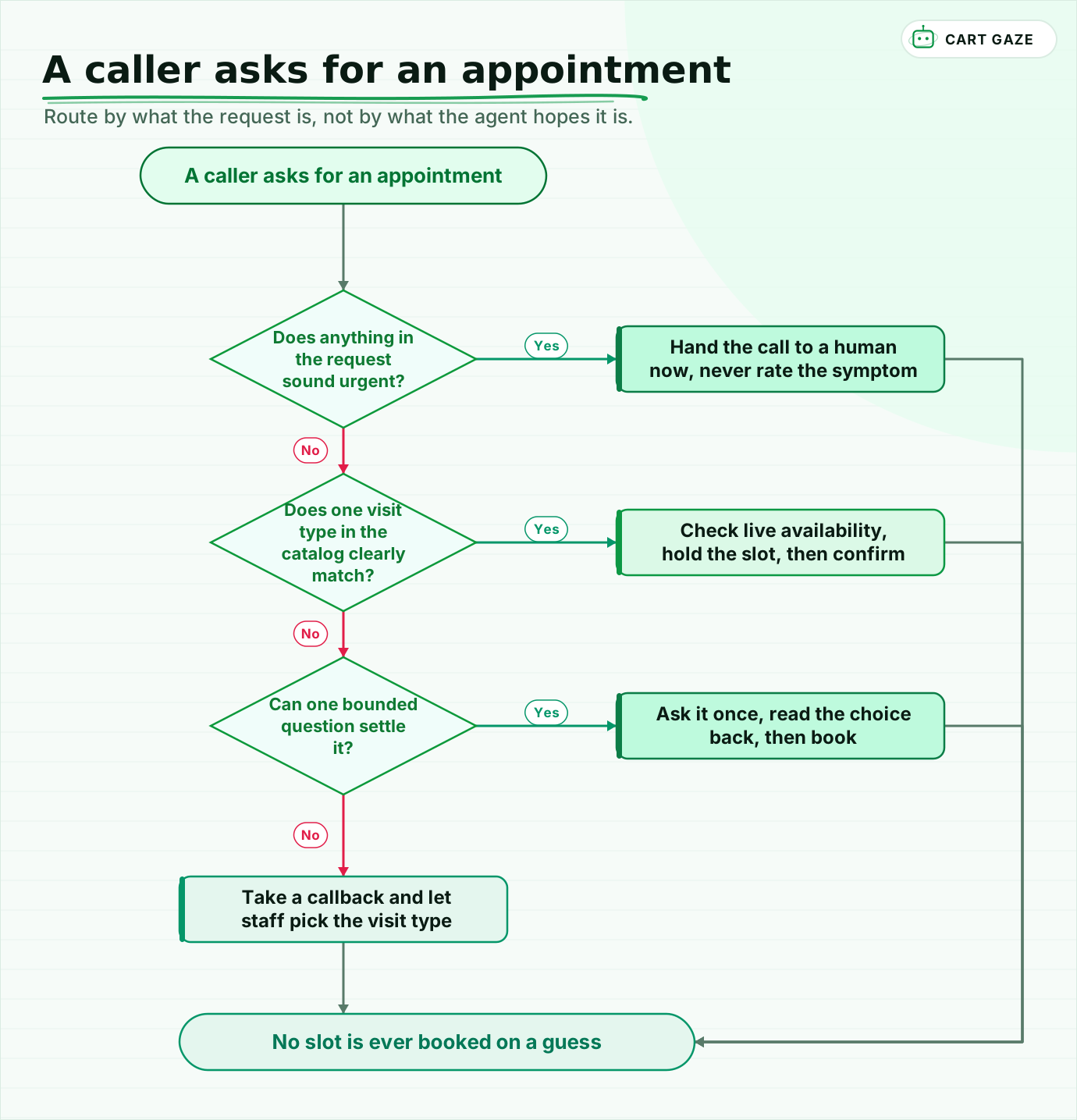 Route by what the request is, not by what the agent hopes it is.
Insist on the shape of the write as well. Availability and every change should be a live round trip to one source of truth: check what is free, hold the slot, then confirm it. A single combined "just book it" call is faster and hands the agent a private copy of your schedule, which is how the phone line and the website end up disagreeing about Thursday at 2.
Booking can fail, so decide now what happens when it does. If a hold expires or the write is rejected, the caller should get a person or a callback commitment, never a confirmation your calendar never received. The most common integration failure vendors describe is a booking that shows on the agent's side and never posts to your system.
Test it the way those same vendors say to test it: book a real appointment through the agent, watch it appear in your system, cancel it, and confirm the slot reopens. Then read the first week of transcripts end to end. If you would rather size the leak before configuring anything, the free Growth Leak Audit works from your own call numbers.
Fair questions.
What is appointment type triage in AI booking?
Appointment type triage is the step where an AI agent turns a caller's words into one specific visit type before it books anything. That visit type carries the duration, the providers allowed to deliver it, the room or chair it uses, the prep the patient owes, and the conditions that must be true first. Without it, the agent writes to your schedule with no rules attached.
How does an AI agent decide how long to book an appointment for?
It looks the duration up in your service catalog rather than estimating it on the call. Published total-time ranges show why that matters: an established-patient 99213 runs 20 to 29 minutes, a 99214 runs 30 to 39, and a new-patient 99204 runs 45 to 59. A dental hygiene visit can budget 58 minutes once turnover is counted.
What should an AI receptionist do when a booking request is ambiguous?
Narrow, confirm, or hand off, and never default silently. One bounded question offering named choices from your own catalog is safe. Reading the visit type and the length back before writing catches the misheard word. If a couple of attempts do not resolve it, the call goes to staff with a callback rather than a booked guess.
Can an AI receptionist decide whether a patient's problem is urgent?
No. It may recognize that a call sounds urgent and route it straight to a human, but it may not rate severity or choose a level of care. The Doctors Company states that unlicensed personnel should never triage by telephone or provide telephone advice, and that boundary applies to software at least as strictly as it does to staff.
What happens when a patient asks for a service the practice does not offer?
The agent names the limit plainly, offers a genuinely adjacent service if one exists, and hands off a referral or a callback. Write those limits into the catalog as pre-conditions so the answer comes out the same way every time. What you want to avoid is a placeholder booking that becomes a wasted visit and a denied claim.
Sources.
- [1]Evaluating and Improving an Outpatient Clinic Scheduling Template Using Secondary EHR Data (AMIA 2017)
- [2]MGMA Stat: meeting the competitive pressure on patient digital self-scheduling
- [3]Telephone Triage and Advice: Patient Safety Strategies (The Doctors Company)
- [4]Telephone Triage in Healthcare Practices (MedPro Group)
- [5]Coding Level 4 Office Visits Using the New E/M Guidelines (AAFP, FPM)
- [6]CPT code 99213: established patient office visit, 20-29 minutes (AMA)
- [7]New vs established patient billing and the 3-year rule
- [8]Hygienist appointment time management formula (Colgate Professional)
- [9]Visit type: the field that decides duration, room, provider and prep
- [10]How to set up AI patient appointment scheduling (Retell AI)
- [11]athenahealth AI voice agent integration guide (Assort Health)
- [12]Common mistakes clinics make deploying AI receptionists
- [13]Five key takeaways from FDA's revised Clinical Decision Support software guidance
- [14]How to train your AI receptionist with a knowledge base
Written by

Muhammad Qasim Hammad
Founder, Cart Gaze
Qasim builds AI receptionists and front-office automation for medical and dental practices at Cart Gaze. Posts here start from published sources and real call data, not vendor claims, and every number links back to where it came from.
Keep reading.
 AI ReceptionistsThe Call Triage Protocol Your AI Receptionist Actually Needs9 min read
 AI ReceptionistsAI Receptionist Maintenance: What Decays and Who Fixes It11 min read
 AI ReceptionistsCaller Frustration Detection: Escalate Before They Hang Up12 min read
 AI ReceptionistsAI Booking Failure Fallback: What a Good Agent Does Next10 min read
 AI ReceptionistsVoice AI Patient Identity Capture: Names, Dates, and Digits10 min read
 AI ReceptionistsAI Booking vs Online Scheduling: Why Most Practices Need Both11 min read