
Voice AI Patient Identity Capture: Names, Dates, and Digits
A voice agent that books appointments has to get a name, a birth date, and a callback number exactly right, and speech recognition is worst at all three. Here are the read-back rules that catch an error on the call.
Key takeaways.
- One 2026 study measured a 32.3% word error rate on named entities while ordinary words in the same audio sat at 7.0%, so headline accuracy hides the fields a booking depends on.
- Confirm the number the call arrived on instead of asking the caller to recite one, because signaling data skips the audio path where 10 spoken digits go wrong.
- Each identity field breaks differently: spell a surname phonetically, say a date of birth as one whole date, and chunk a phone number before confirming it once.
- Search on the confirmed surname, date of birth, and number before creating a chart; Black Book Research put the average duplicate rate inside healthcare organizations at 18%.
- Stop after 2 failed attempts on the same field and route the call to a person, because an identity the agent guessed at is harder to find than a missed booking.
Table of Contents8 sections
- Why voice AI patient identity capture fails on the fields that matter
- Confirm the number the call arrived on, do not ask the caller to recite one
- Read back a name, a date, and a number the way each one breaks
- Check for a duplicate chart before you write a new one
- Decide what the agent says out loud and what it never repeats
- Know where the agent stops guessing and hands the call to a person
- Set your confirmation rules before the line goes live
- Fair questions
A voice agent books an appointment and gets one digit of the callback number wrong. The confirmation text goes to a stranger, carrying a patient's name and an appointment time. That is not a booking error you clean up on Monday. Telephone numbers and birth dates are both named identifiers under HIPAA, so a text to the wrong number is a disclosure.
Speech recognition is at its worst on exactly the fields a booking needs. A 2026 study measured a 32.3% word error rate on named entities using Whisper-large-v3, while ordinary words in the same audio sat at 7.0%. Phone lines widen the gap again: published accuracy runs 80% to 88% on phone conversations against 95% to 98% on clean studio audio.
This post covers the confirmation moves that actually work on a live call, why you should confirm the number you already have instead of asking for one, how a duplicate check before the write beats a merge afterwards, and where the agent should stop guessing and hand the call to a person.
Why voice AI patient identity capture fails on the fields that matter
Voice AI patient identity capture breaks on proper nouns, spelled letters, digit strings, and dates, because those carry no surrounding context for a model to lean on. The same audio that transcribes ordinary conversation at a 7.0% word error rate can miss named entities at 32.3%, and phone lines make both worse.
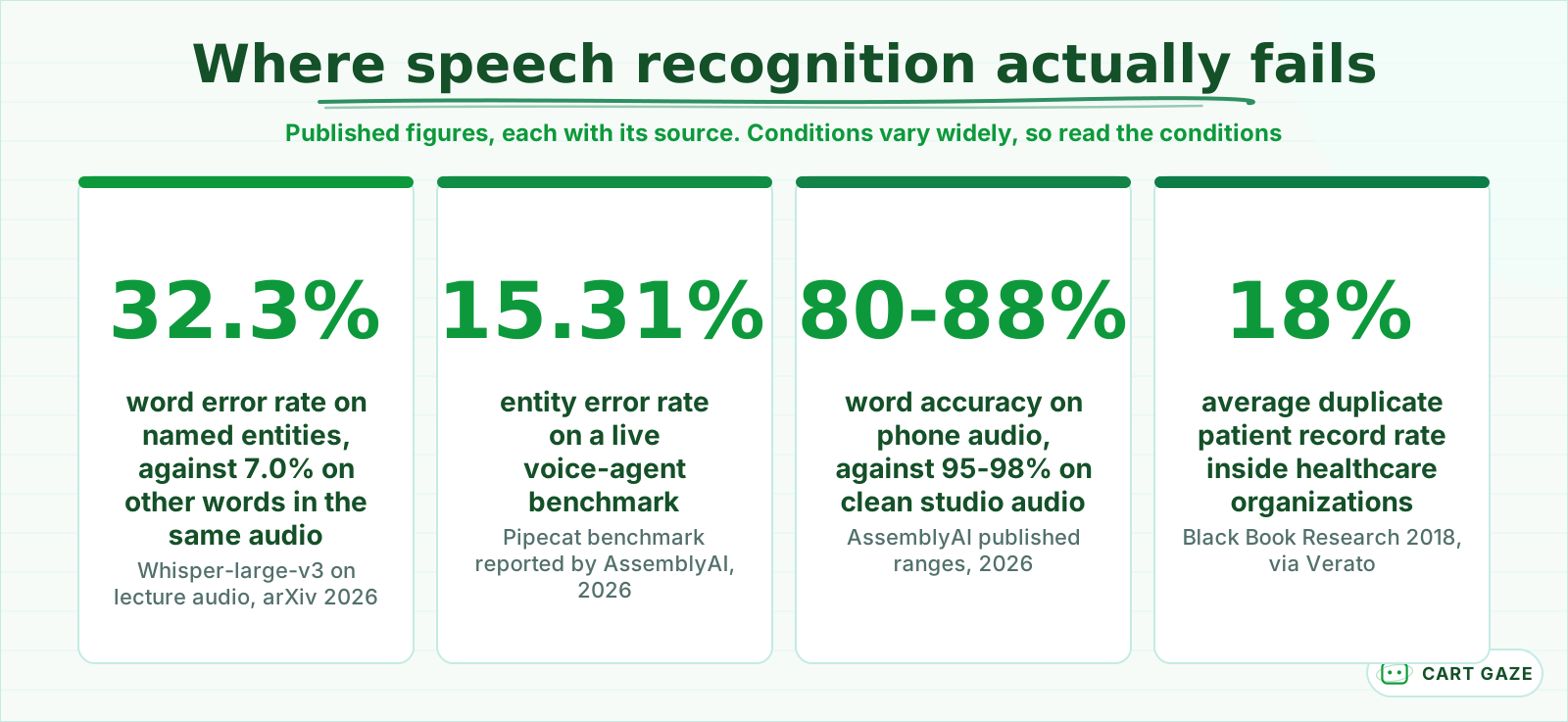 Published figures, each sourced. Headline accuracy is measured on the words that matter least.
The reason is prediction. A model transcribing "I need to reschedule my" has strong odds on the next word. A surname gives it nothing. That study ran on lecture recordings rather than phone audio, so treat the exact figures as a shape rather than a benchmark for your line, but the shape holds across models: Whisper-small landed at 39.3% on named entities, Whisper-medium at 36.0%, and Canary-1B at 36.6%.
The same pattern survives in a production voice stack. On a 2026 voice-agent benchmark reported by AssemblyAI, overall word error rate was 6.99% while the entity error rate was 15.31%. Phone numbers did better at 3.55%, which tells you digits are more tractable than names, not that they are safe.
Conditions swing these numbers hard, so quote them as ranges. Published accuracy sits at 95% to 98% on clean studio audio, 80% to 88% on phone conversations, 75% to 90% on heavily accented speech, and 70% to 85% in noise. A patient calling from a car park is in the bottom band, not the headline one.
Every fix below costs a conversational turn, and turns cost time. That trade is worth understanding before you tune anything, and we cover the response-time side in voice quality and latency.
Confirm the number the call arrived on, do not ask the caller to recite one
The number your phone system received is more accurate than one a caller reads aloud, because it arrived as data rather than as audio. Read it back and ask the caller to confirm or correct it. Fall back to spoken or keypad entry only when the caller wants a different number.
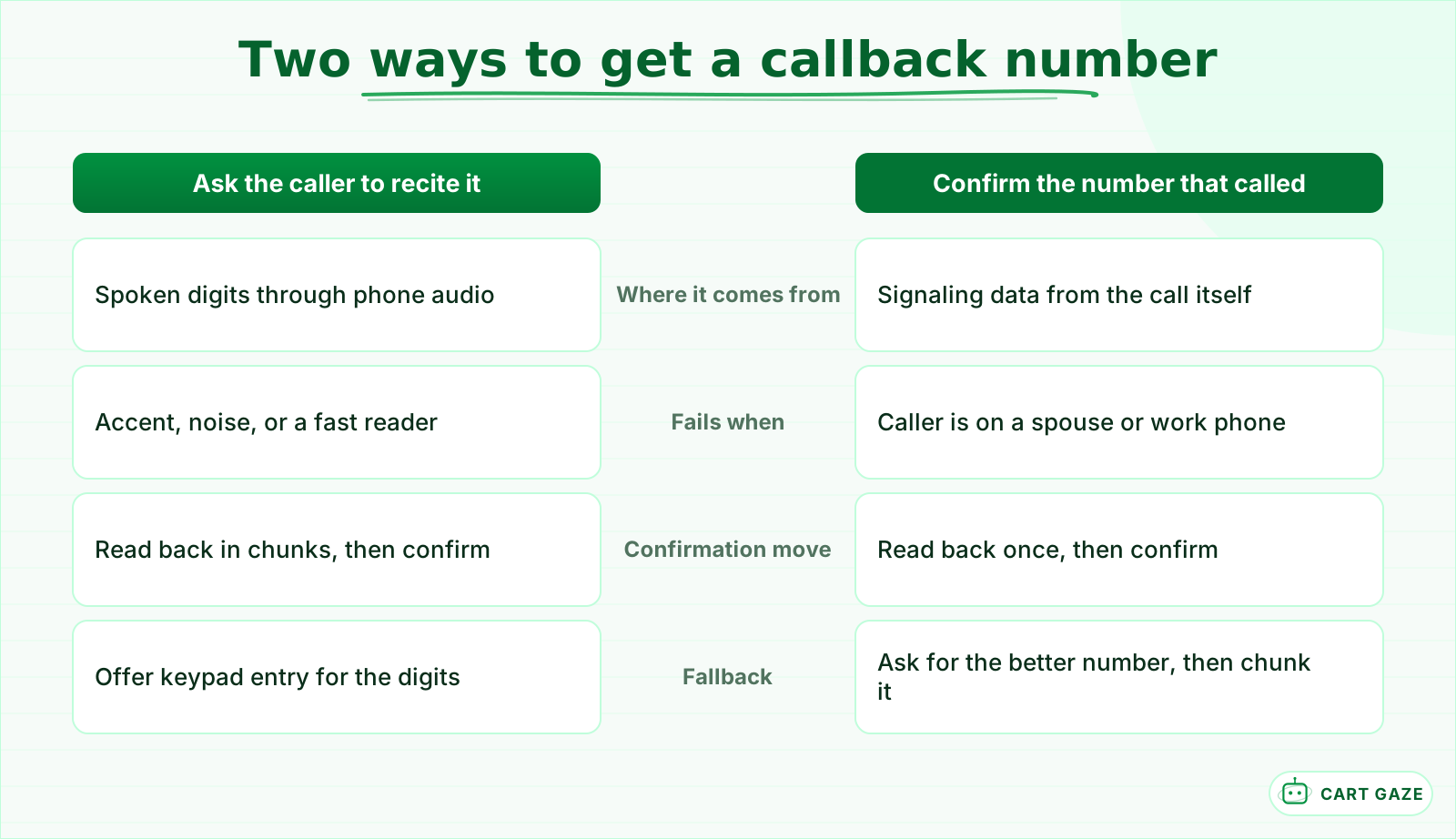 One arrives as audio and can be misheard. The other arrives as data and only needs confirming.
This removes the single most expensive failure on the call. Ten spoken digits through a compressed phone line is the worst case for recognition. The same ten digits delivered as signaling data skip the audio path entirely.
Caller ID is a number, not an identity. A patient may be on a spouse's phone, a work line, or a number the practice has never seen. So confirming is not optional politeness. Under 45 CFR 164.514(h), a covered entity has to verify the identity and authority of a person requesting protected health information when it does not already know them, and a read-back is the phone version of that.
Tip
When a caller does want a different number, offer the keypad. Retell's own guidance puts keypad entry ahead of speech for long digit strings, for noisy lines, and for callers who would rather not say a number out loud in a waiting room.
Read back a name, a date, and a number the way each one breaks
Each field fails differently, so one generic read-back catches less than three targeted ones. Spell a surname phonetically instead of letter by letter. Say a date of birth as one whole date, not three separate fields. Group a phone number into chunks and confirm the whole string once.
| Field | Why it breaks on a call | The confirmation move | Hand off when |
|---|---|---|---|
| First name | Nicknames and rare spellings, nothing to predict from | Ask for the spelling, then read the spelling back | The caller corrects it twice |
| Surname | Similar-sounding letters collapse over the line | Spell it phonetically, one familiar word per letter | Two attempts still disagree |
| Date of birth | Month names and digits blur together | Say the whole date once, not three fields | It matches no chart on file |
| Callback number | 10 digits with no meaning to lean on | Read back in chunks, offer the keypad | The caller changes it mid-call |
Phonetic spelling is the highest-value move on the list. Call centre practice has long grouped the letters that collapse over a phone line: B, C, D, E, G, P, T and V together, then M and N, then F, S and X, then Y and I, and G and J when the speaker is not a native English speaker. Reading a surname back letter by letter walks straight into those groups. A familiar word per letter walks around them.
Confirm the date of birth as one spoken date rather than three questions. Three fields means three chances to mishear and three extra turns, and it is also how a caller ends up giving you a month and a day that belong to their child.
This concentrates on accented and non-English names, where published accuracy drops to the 75% to 90% band. If a meaningful share of your patients are Spanish-speaking, the language handling and the name handling are the same problem, and a bilingual line is where that gets solved.
Check for a duplicate chart before you write a new one
A duplicate chart is far cheaper to prevent than to merge. Before creating a patient, search on the confirmed surname, date of birth, and number, and treat a near match as a stop rather than a green light. Black Book Research put the average duplicate rate inside healthcare organizations at 18%.
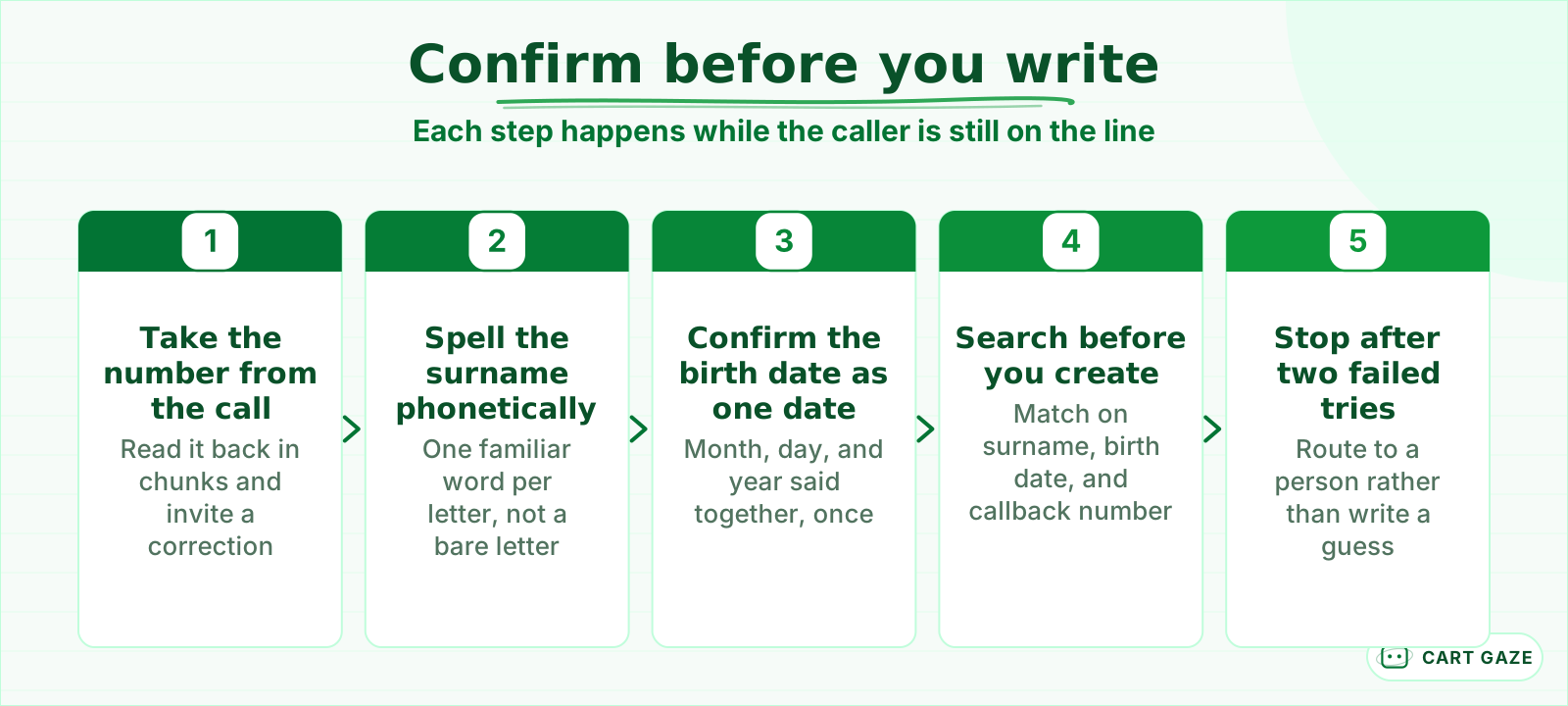 Order matters. Every one of these happens while the caller can still correct you.
That 18% figure is from 2018, against a national average of 8% to 12% reported a decade earlier, so read it as a direction of travel rather than your number. The downstream cost is the part worth internalizing: the same research put repeated tests and procedures at over $800 per emergency department visit and over $1,950 per inpatient stay, and traced 33% of denied claims to poor patient matching.
A duplicate created by a voice agent is worse than one created at the front desk, because nobody watched it happen. Staff catch their own misspelling when the chart looks empty. An agent writing at 9 p.m. does not.
Important
A near match is not a match. If the surname and date of birth line up but the phone number does not, that is exactly the pattern that produces two charts for one patient. Send it to a person instead of resolving it automatically.
Decide what the agent says out loud and what it never repeats
A read-back is a disclosure, so decide field by field what the agent repeats. Confirming a callback number and a date of birth is normal front-desk practice and is hard to avoid. Repeating a diagnosis, a medication, or a reason for the visit adds risk without improving identity accuracy.
Draw the line by asking what the read-back is for. Identity fields need confirming because you cannot verify what you do not repeat. Clinical detail does not get more accurate by being said aloud, and it raises the cost of every wrong number.
Warning
A confirmation text to a wrong number is a disclosure of protected health information, not a typo. Telephone numbers and birth dates are both listed identifiers under 45 CFR 164.514, so the wrong recipient is a breach question, not a scheduling one.
Where a patient asks you to text them, HIPAA Journal notes the practice should verify both the identity of the patient making the request and the identity of the recipient of the message. That is the same read-back, doing double duty. And every vendor in the call path, including the speech provider, needs a signed Business Associate Agreement. There is no such thing as a "HIPAA certified" voice agent, so treat that phrase on a vendor page as a signal to read the contract harder. If you are still mapping what one of these systems should and should not do, start with what an AI receptionist does and where it stops.
Know where the agent stops guessing and hands the call to a person
Two failed attempts on the same field is the natural stopping point. After that, more retries annoy the caller and rarely recover the field. Route the call to a person, or take the booking as a request a human confirms, and never write an identity the agent could not verify.
Three hard stops are worth writing into the configuration. The caller has corrected the same field twice. The search returns a near match rather than an exact one. The caller changes the callback number partway through the call. Each of those means the agent is now guessing, and a guess written to a chart is harder to find than a missed booking.
Before the agent writes to a chart
- A signed BAA covers every vendor in the call path, including the speech provider.
- Each identity field has a written read-back rule and a retry limit.
- A near match on surname and date of birth routes to a person rather than creating a chart.
- Confirmation texts go only to a number the caller confirmed during the call.
Set your confirmation rules before the line goes live
Write the rules down before launch: which fields get read back, how many retries each one gets, what happens on a near match, and who receives a call the agent could not resolve. Then test them against real names from your own schedule rather than a scripted demo.
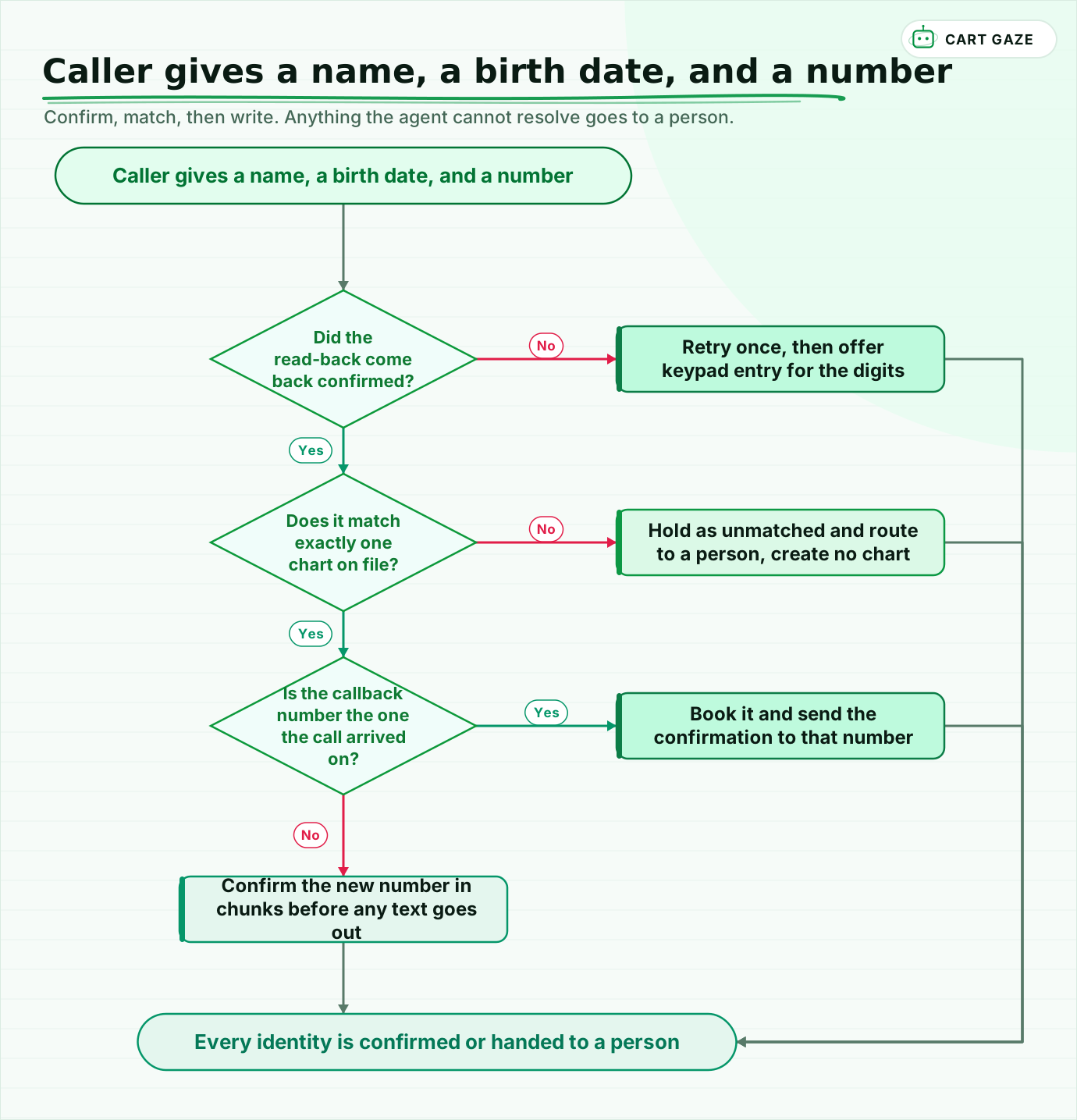 Confirm, match, then write. Anything the agent cannot resolve goes to a person.
Walk the flow once. A read-back that comes back confirmed moves forward. One that does not gets a single retry and then the keypad. A search that returns anything other than one exact chart goes to a person with no chart created. A callback number that differs from the number the call arrived on gets confirmed in chunks before any text leaves the system.
Then read the first week of transcripts for the identity fields specifically, not for whether the conversation sounded natural. Pull the calls where a name was spelled twice and the ones where a booking was made without a confirmed number. If you would rather see what your phone line is losing before you change anything on it, the free Growth Leak Audit sizes that from your own numbers.
Fair questions.
Why do AI receptionists get patient names wrong?
Names carry no surrounding context for a speech model to predict from, so they fail far more often than ordinary conversation does. One 2026 study measured a 32.3% word error rate on named entities against 7.0% on other words in the same audio. Phone lines widen the gap, with published accuracy of 80% to 88% on phone conversations.
Should a voice agent ask for a phone number or use the caller ID?
Use the number the call arrived on and read it back for confirmation, because it reaches your system as signaling data rather than as audio. Ask the caller to recite a number only when they want a different one, and offer keypad entry for those digits rather than relying on speech recognition alone.
How should an AI booking call confirm a date of birth?
Say the whole date back once, as a single date, rather than asking for month, day, and year as three separate fields. Three fields means three chances to mishear and three extra conversational turns. It is also how a caller ends up giving you the month and day of a child instead of their own.
How do you stop an AI receptionist creating duplicate patient charts?
Search before you write. Match on the confirmed surname, date of birth, and callback number, and treat a near match as a reason to route the call to a person rather than create a record. Black Book Research put the average duplicate rate inside healthcare organizations at 18%, and a merge costs more than prevention.
Is reading a phone number back aloud a HIPAA problem?
Confirming a callback number or a date of birth is ordinary front-desk practice, and both are listed identifiers under 45 CFR 164.514. The risk sits in the wrong recipient, not the read-back itself. Keep clinical detail out of confirmations, verify identity before disclosing, and make sure every vendor in the call path has signed a BAA.
Sources.
- [1]How accurate is speech-to-text in 2026?
- [2]Why your word error rate benchmark might be lying to you
- [3]Improving speech recognition of named entities with LLM revision and phonetic-semantic context
- [4]Three hidden costs of duplicate patient records
- [5]45 CFR 164.514: verification requirements and the HIPAA identifier list
- [6]Is texting in violation of HIPAA? 2026 update
- [7]DTMF vs voice recognition: when to use keypad entry on a voice agent
- [8]NATO phonetic alphabet for spelling names over the phone
Written by

Muhammad Qasim Hammad
Founder, Cart Gaze
Qasim builds AI receptionists and front-office automation for medical and dental practices at Cart Gaze. Posts here start from published sources and real call data, not vendor claims, and every number links back to where it came from.
Keep reading.
 AI ReceptionistsAI Booking vs Online Scheduling: Why Most Practices Need Both11 min read
 AI ReceptionistsAI Receptionist vs an Offshore Virtual Assistant for Practices10 min read
 AI ReceptionistsAI Receptionist for Medical & Dental Practices: What It Really Does13 min read
 AI ReceptionistsHow to Choose an AI Receptionist for Your Medical Practice10 min read
 AI ReceptionistsAI Receptionist vs Answering Service: Which Fits Your Practice?11 min read
 AI ReceptionistsAI Receptionist for Multi-Location Practices: One Rule10 min read