
AI Booking vs Online Scheduling: Why Most Practices Need Both
A booking widget and a conversational AI lose different patients. Here is what each one is genuinely good at, what running both costs, and the one calendar rule that stops two channels selling the same slot twice.
Key takeaways.
- A booking widget and a conversational AI lose different patients, so for most practices the honest answer is both rather than a replacement.
- The widget wins on cost and speed: published light-tier plans run about $16 to $49 a month, and a self-served booking takes under 1 minute against more than 8 minutes on the phone.
- The widget loses five nameable patients: unclear visit type, hands-busy callers, older patients, anyone who needs a question answered first, and every inbound phone call.
- Voice booking is priced from around $0.07 a minute, so a 5,000-minute month models to roughly $350 and the widget should absorb the routine volume.
- Neither channel may hold a private view of what is free: check availability, hold the slot, then confirm the booking, all against one calendar.
Table of Contents7 sections
You already have an online booking link on your website, and a vendor is now telling you a conversational AI should replace it. That is the wrong question. A booking widget and an AI that books lose completely different patients, and the overlap between the two loss sets is small.
The widget is cheaper, more predictable, and better at the one job it was built for. Published light-tier plans run about $16 to $49 a month, and Phreesia's network data puts more than 30% of self-scheduled visits between 6 p.m. and 8 a.m. when nobody is at the desk. It also loses five specific patients you can name, and every one of them still has your phone number.
This post covers what each channel is genuinely good at, who each one drops, what running both actually costs, and the one integration rule that makes running both safe: neither channel may hold a private view of what is free.
What an online scheduling widget is genuinely good at
A booking widget is the cheapest correct answer for a patient who already knows what they want. It costs little, behaves the same every time, and works at midnight without staffing. For a returning patient booking a cleaning or a follow-up, it beats any phone call on speed and on price.
Speed is the honest advantage. Phreesia contrasts a phone booking at more than 8 minutes including hold time with a self-served booking at under 1 minute. Nothing a conversational AI does closes that gap for a patient who was never going to need the conversation in the first place.
It also fills dead calendar space. In a German two-center study covering 98,067 appointments between September 2022 and April 2024, unused appointments at the private practice fell from 22.7% to 10.3% after online booking went live, and slots that were never booked at all fell from 8.6% to 1.6%.
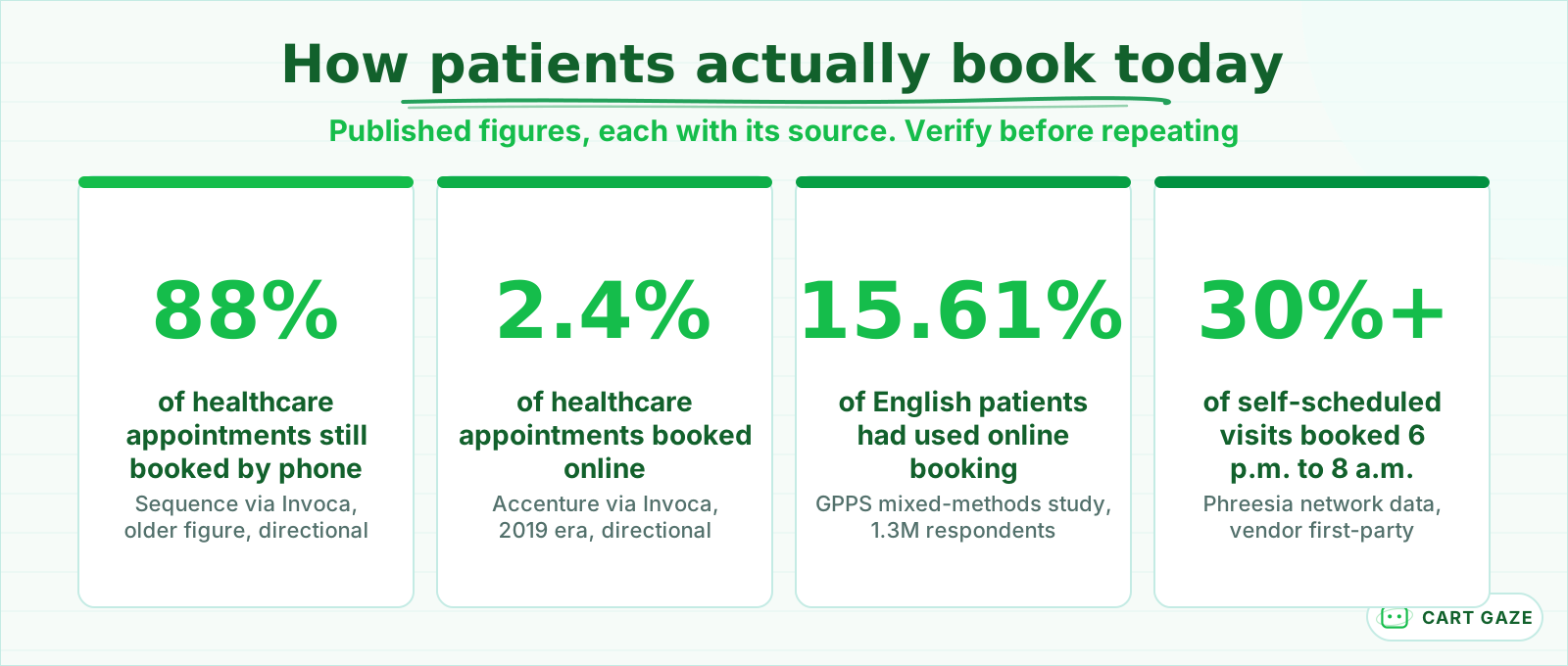 Published figures, each sourced. Measure your own channel split before you buy either box.
The same study is the reason to be careful with no-show claims. Online-booked visits at that private practice no-showed at 1.8% against 5.9% for offline bookings, but at the university hospital in the same paper the direction reversed: 14.3% for online-scheduled against 11.2% for offline. Online booking is not automatically a no-show fix. It is one specialty, in one country, at two sites that behaved differently.
The five patients a booking widget loses
Every self-service booking flow assumes the patient can answer one question before they start: which appointment is this. Five groups cannot, or will not, and they do not fail quietly. They call, or they leave. Naming them is how you decide whether a second channel is worth paying for.
| The patient | What the widget asks of them | What they do instead |
|---|---|---|
| Does not know the visit type | Pick from a short list of visit reasons | Guesses wrong, or gives up and calls |
| Is driving or holding a child | Read a screen and tap through a form | Calls, because their hands are busy |
| Is older or rarely online | Log in and remember a password | Calls the number they have used for years |
| Needs a question answered first | Commit before anyone has answered it | Calls to ask, then books on that same call |
| Is already on the phone | Hang up and go to the website | Waits on hold, or hangs up for good |
The visit-type problem is the one practices underestimate. Keona Health, a scheduling vendor, reports that portals typically expose only 3 to 7 visit reasons and that patients put themselves in the wrong appointment routinely. That lands at your front desk as rework rather than as a lost booking, so it never appears in the widget's own numbers.
Age shows up in the research. An English mixed-methods study of 1,327,693 patient survey respondents found that 45.11% knew online booking was available at their practice, while only 15.61% had actually used it, with a substantial decline in both above age 75. Interviewees over 65 said they preferred the telephone because it was familiar. That work is English and pre-pandemic, so treat the shape as transferable and the exact figures as not.
Tip
Before you buy a second channel, pull one month of your own call log and count how many callers were trying to book something the widget already offers. That number, not a vendor benchmark, tells you what a voice channel is worth to you.
The largest group is simply people who are already on the phone. Third-party figures still put roughly 88% of healthcare appointments on the phone against 2.4% booked online. Both numbers are old, and both reach you second-hand through vendor pages, so use them as a prompt to check your own split rather than as a current benchmark.
Where a conversational AI books, and where it stalls
A conversational AI books by asking first. It can establish the visit type, the provider, whether the caller is new, and what the real question is, then offer an actual slot. That is the widget's blind spot. Its own blind spots are noise, ambiguity, and anything clinical, which must reach a person.
The failure modes are real and worth naming out loud. Background noise, heavy accents, and callers who change their mind mid-sentence all degrade a voice agent, and the correct behavior is to hand off rather than guess. A booking made from a misheard visit type is worse than no booking, because it burns a slot and a staff correction.
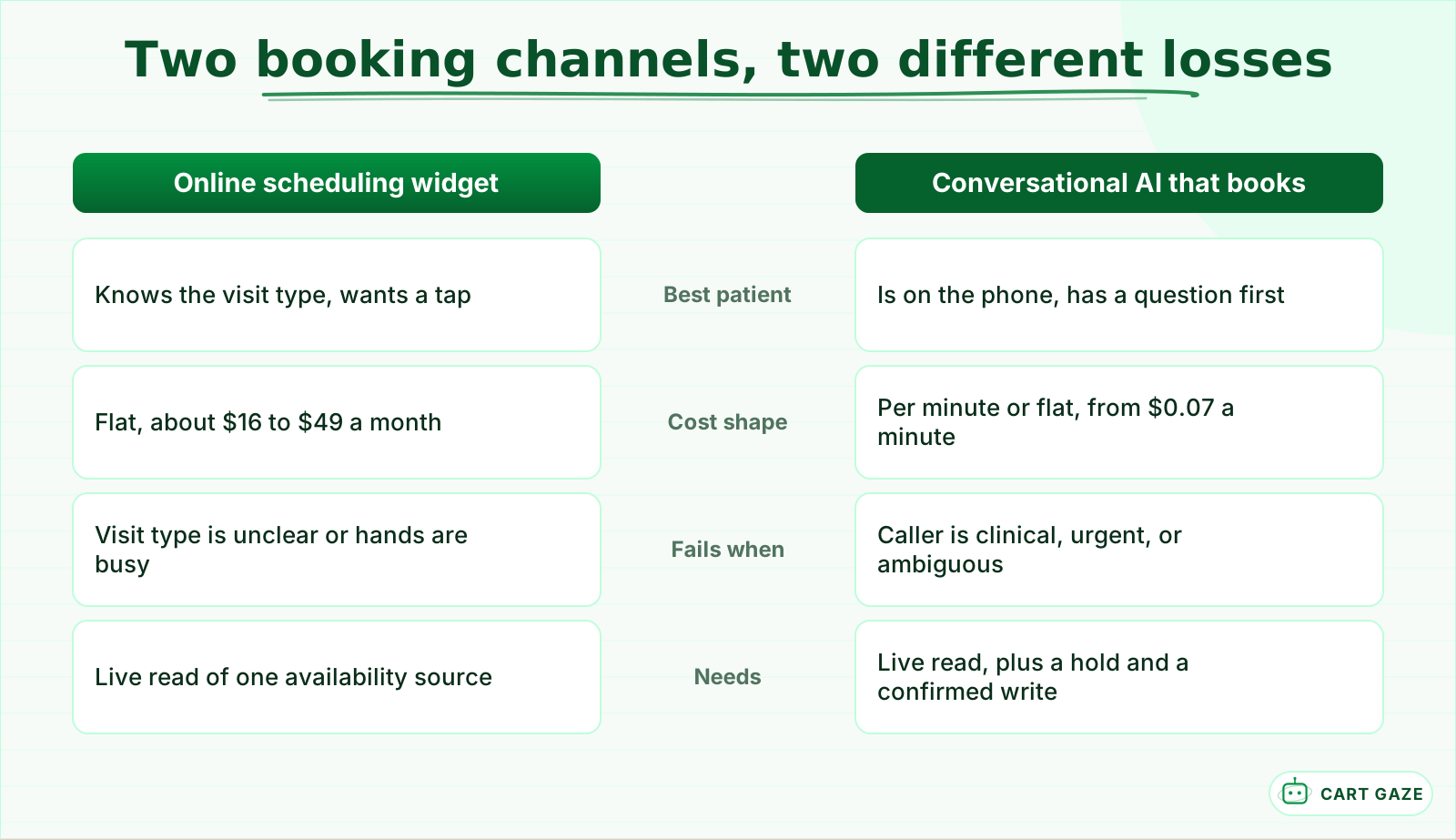 Neither is better. They lose different patients, which is why the overlap is small.
The hard boundary is clinical. An AI receptionist routes clinical and urgent calls to a human and never diagnoses or offers medical advice.
Warning
A booking agent that will cheerfully schedule a caller describing chest pain into next Thursday is a safety problem, not a scheduling feature. Symptom descriptions, distress, and anything ambiguous belong with a person, immediately.
Compliance is the other thing to settle before the demo ends. If the call touches patient details you need a signed Business Associate Agreement, and you should know what the system records, reads back, and deletes. "HIPAA compliant" describes a configuration plus that contract. "HIPAA certified" does not exist as a status, so a page claiming it is telling you something about the vendor. For the full boundary, start with what an AI receptionist does and where it stops.
What running both actually costs
Running both is cheaper than most owners assume, because the widget absorbs the volume that would have self-served anyway. The AI then bills only on the calls a person would otherwise have answered. That is the whole financial argument for keeping two channels instead of picking the more capable one.
Published light-tier booking plans run about $16 to $49 a month. Check which tier carries the BAA before you sign, because on at least one widely used tool it sits only on the top plan, which makes the cheap tier a non-option for a healthcare practice no matter how the feature list reads.
On the voice side, published per-minute rates start around $0.07 a minute. A 5,000-minute month models to roughly $350, and third-party roundups put a realistic all-in figure at $400 to $1,200 a month once add-ons are counted. Flat AI receptionist tiers sit near $39 to $99 at the budget end, $199 to $499 for a single location, and $400 to $1,000 or more per location for multi-site groups, with setup anywhere from $0 to $5,000.
Important
Per-minute voice pricing bills you most on your busiest weeks. If a large share of your inbound volume is routine, push it to the widget deliberately, with the link in your on-hold message and every reminder text, and let the voice channel carry the calls that genuinely need a conversation.
Model your own pair rather than trusting a range. A widget at $49 a month plus 900 AI minutes at $0.07 a minute is about $112 a month before integration and messaging fees. That figure is modeled, not measured, so run your own call volume through it before you quote it to a partner. If you are still comparing categories rather than vendors, how to choose an AI receptionist covers the questions worth asking on a demo call.
One source of truth, or you will sell the same slot twice
Two booking channels are safe only when neither holds a private view of what is free. Availability and every write has to be a live round trip to the same calendar. The moment one channel caches a copy of open slots, the two will eventually sell the same appointment to two people.
The technically honest shape is three round trips, not one: check availability, hold the slot, confirm the booking. A single combined "book it" call is faster to build, and it hands the voice agent a private shortcut, which is exactly how a phone booking and a website booking end up disagreeing about what was open.
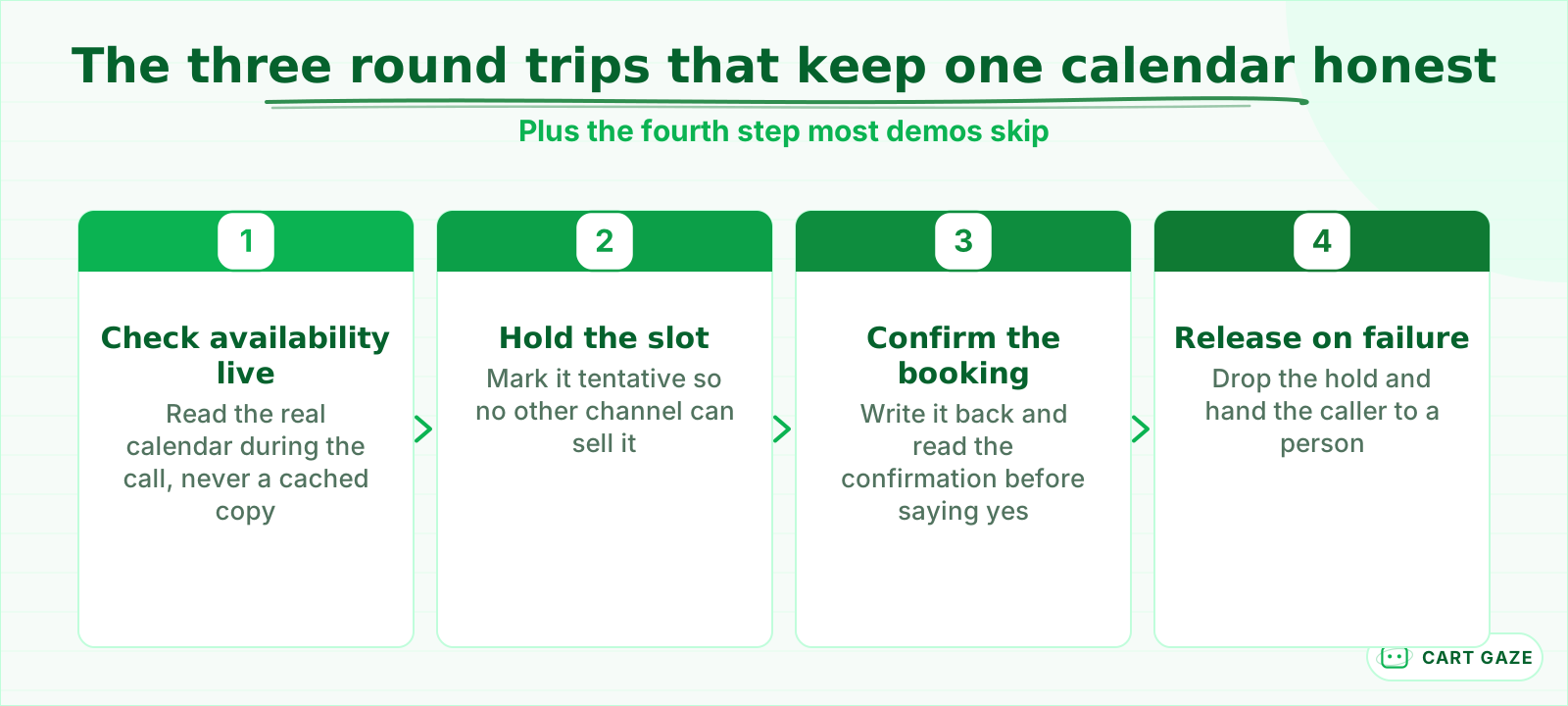 One combined book-it call is faster, and is exactly how two channels start disagreeing.
This is not a vendor invention. The HL7 FHIR standard models it directly. A slot carries a status of free, busy, busy-tentative, or busy-unavailable, and an appointment points back at the slot it consumed, so the tentative hold is a first-class state in the specification rather than a workaround. A vendor who cannot hold a slot is skipping a step the standard already defined.
Failure is normal, and it is the part demos skip. If the confirming write fails, the hold has to be released and the caller handed to a person with the time named out loud, instead of being left believing they are booked. Ask two questions on any demo: is availability read live at the moment of the call, and what happens when the write fails. A vendor who answers the second one crisply has thought about it. The same rule applies to a chat window that books, which is why website chat to a booked appointment is the same integration problem wearing a different channel.
Before you switch a second booking channel on
- Availability is read live from one calendar at the moment of booking, by both channels.
- A tentative hold exists, and it expires on its own when confirmation never lands.
- A failed write hands the patient to a person, with the slot and time stated out loud.
- A signed BAA covers every vendor that touches patient details.
Decide which channel gets which patient
The choice is not which channel is better. It is which patient each one gets. Send the people who already know what they want to self-service, put the ones who need to ask on a voice channel, and make sure both of them are reading the same calendar at the same moment.
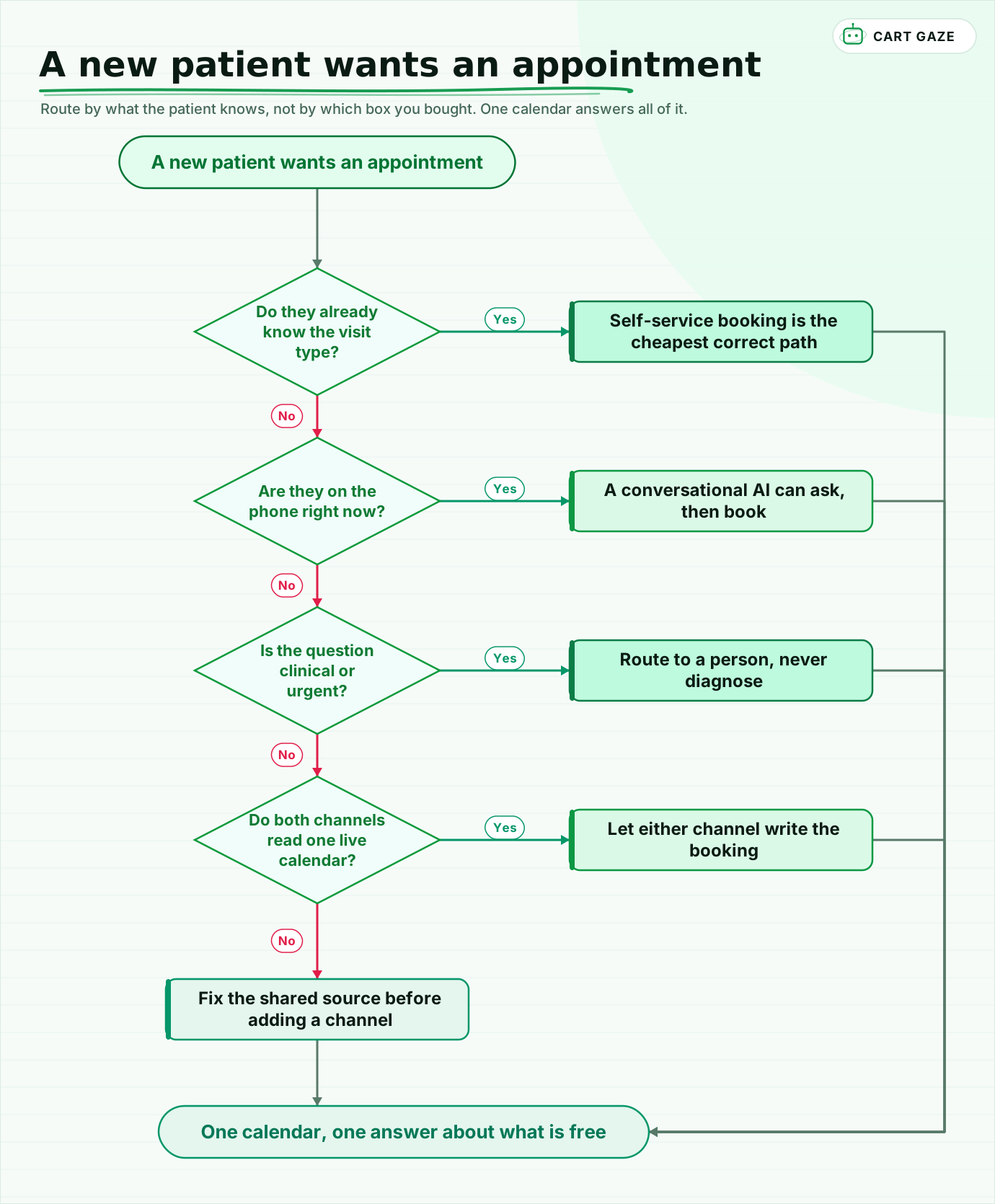 Route by what the patient knows, not by which box you bought. One calendar answers all of it.
Walk the flow once. A patient who already knows the visit type should be self-serving, because it is the cheapest correct path. A patient on the phone who does not know gets the conversation. Anything clinical or urgent goes to a person. And if the two channels are not reading one live calendar, that is the thing to sort out before you add anything else to the phone line.
Pilot narrow: one visit type, one location, one month. Read the first week of transcripts end to end, then count bookings by channel in your own log after 30 to 60 days. Someone else's conversion slide is not your practice, and the German study above is a fair reminder that the same tool ran in opposite directions at two different sites.
If you would rather see the size of the phone leak before you shop for either box, the free Growth Leak Audit puts your own numbers through it first.
Fair questions.
Should an AI receptionist replace my online booking widget?
Usually not. The widget is the cheapest correct path for a patient who already knows the visit type, and published light-tier plans start near $16 a month. A conversational AI earns its keep on the calls the widget cannot serve: unclear visit types, hands-busy callers, and anyone who needs a question answered before they will commit.
What does AI booking cost compared with an online scheduling widget?
Light-tier booking plans publish around $16 to $49 a month. Voice pricing usually starts near $0.07 a minute, so a 5,000-minute month models to roughly $350, and roundups put a realistic all-in at $400 to $1,200 once add-ons are counted. Flat AI receptionist tiers run about $199 to $499 for a single location.
Can both channels book into the same calendar without double-booking?
Yes, but only if neither channel keeps its own copy of what is free. Availability and every write has to be a live round trip to one source. The safe sequence is three steps: check availability, hold the slot as tentative, then confirm. A single combined booking call is what causes the two channels to disagree.
Do older patients actually use online scheduling?
Less than younger patients. An English study of 1,327,693 survey respondents found 45.11% knew online booking existed at their practice while only 15.61% had used it, with a substantial decline above age 75. Interviewees over 65 preferred the telephone because it was familiar. That research is English and pre-pandemic, so check your own patient mix.
Is an AI that books appointments HIPAA compliant?
HIPAA compliance is a configuration plus a signed Business Associate Agreement, not a product badge, and "HIPAA certified" does not exist. Any vendor touching patient details is a business associate. Ask what the system records, reads back, and deletes, and confirm the BAA covers the booking path before a single patient detail reaches it.
Sources.
- [1]Healthcare marketing statistics: phone vs online booking share
- [2]MGMA Stat: putting the power of scheduling into patients hands
- [3]Investigating patient use and experience of online appointment booking in primary care
- [4]Impact of online appointment scheduling on the no-show rate: a two-center study
- [5]Seven reasons to offer patient self-scheduling (Phreesia network data)
- [6]Why healthcare has a self-scheduling problem: visit reasons and wrong appointment types
- [7]HL7 FHIR Slot resource: free, busy-tentative and busy statuses
- [8]AI voice agent pricing: full cost breakdown and per-minute rates
- [9]AI receptionist pricing 2026: monthly tiers and setup fees
- [10]Acuity Scheduling published plan pricing and BAA availability
- [11]AI voice scheduling and EHR integration: live vs cached availability
Written by

Muhammad Qasim Hammad
Founder, Cart Gaze
Qasim builds AI receptionists and front-office automation for medical and dental practices at Cart Gaze. Posts here start from published sources and real call data, not vendor claims, and every number links back to where it came from.
Keep reading.
 AI ReceptionistsAI Receptionist for Medical & Dental Practices: What It Really Does13 min read
 AI ReceptionistsAI Receptionist Maintenance: What Decays and Who Fixes It11 min read
 AI ReceptionistsAI Booking Failure Fallback: What a Good Agent Does Next10 min read
 AI ReceptionistsVoice AI Patient Identity Capture: Names, Dates, and Digits10 min read
 AI ReceptionistsAI Receptionist Knowledge Base: What Your Practice Must Load10 min read
 AI ReceptionistsHow to Choose an AI Receptionist for Your Medical Practice10 min read