
AI Booking Failure Fallback: What a Good Agent Does Next
Every booking demo shows the appointment that works. Here are the 6 ways a booking actually fails, the correct response to each, and the idempotency key that stops a retry from creating two appointments.
Key takeaways.
- A booking is 3 round trips, not 1: check live availability, hold the slot, then confirm the write, which is why FHIR has a separate busy-tentative slot status.
- A successful HTTP status code is not a successful booking, and one integrator guide reports Epic returning a SLOT_TAKEN error inside an HTTP 200 response body.
- An agent may honestly say only 3 things at the end of a booking attempt: confirmed, pending, or not booked, and demos only ever show the first.
- An idempotency key on the appointment write is what stops a timed-out retry from creating a duplicate, and Stripe documents the standard contract including a 24 hour key life.
- Every failure should still capture a name, a callback number, a reason, and the requested window, because Patient Prism found only 36% of identified lost opportunities got any follow-up in 2025.
Table of Contents8 sections
- Every booking demo skips the same step
- The 6 ways a booking actually fails
- Never say confirmed unless the write came back confirmed
- Idempotency decides whether a retry books one appointment or two
- Degrade to lead capture, never to silence
- Make a repeated failure visible the same day
- Decide what your agent does when booking breaks
- Fair questions
Every AI booking demo you have watched ended the same way. The caller asked for Tuesday at 2, the agent found Tuesday at 2, and the appointment appeared on the schedule. Nobody showed you the second try, and the second try is where these systems either hold up or quietly cost you patients.
Booking is a write to a live system, and live systems fail. A survey summarized by HHS ASPR TRACIE found 96% of institutions had unplanned electronic record downtime in the prior 3 years, and 70% had an outage lasting more than 8 hours. That survey is from 2014 and hospital-weighted, so read it as a reason to plan rather than a forecast for your office. The scheduling system your agent writes to will be slow, busy, or unreachable at some point this year.
This post names the 6 ways a booking actually fails, states the correct response to each, and covers the one mechanic that stops a retry from creating two appointments. None of it is a Cart Gaze result. It is ordinary engineering practice applied to a phone line that patients use.
Every booking demo skips the same step
A demo shows one booking that works. What it hides is the shape of the transaction underneath, which is three round trips and not one: check what is actually free, hold the slot while the caller decides, then confirm the write. Collapsing those into a single call is where trouble starts.
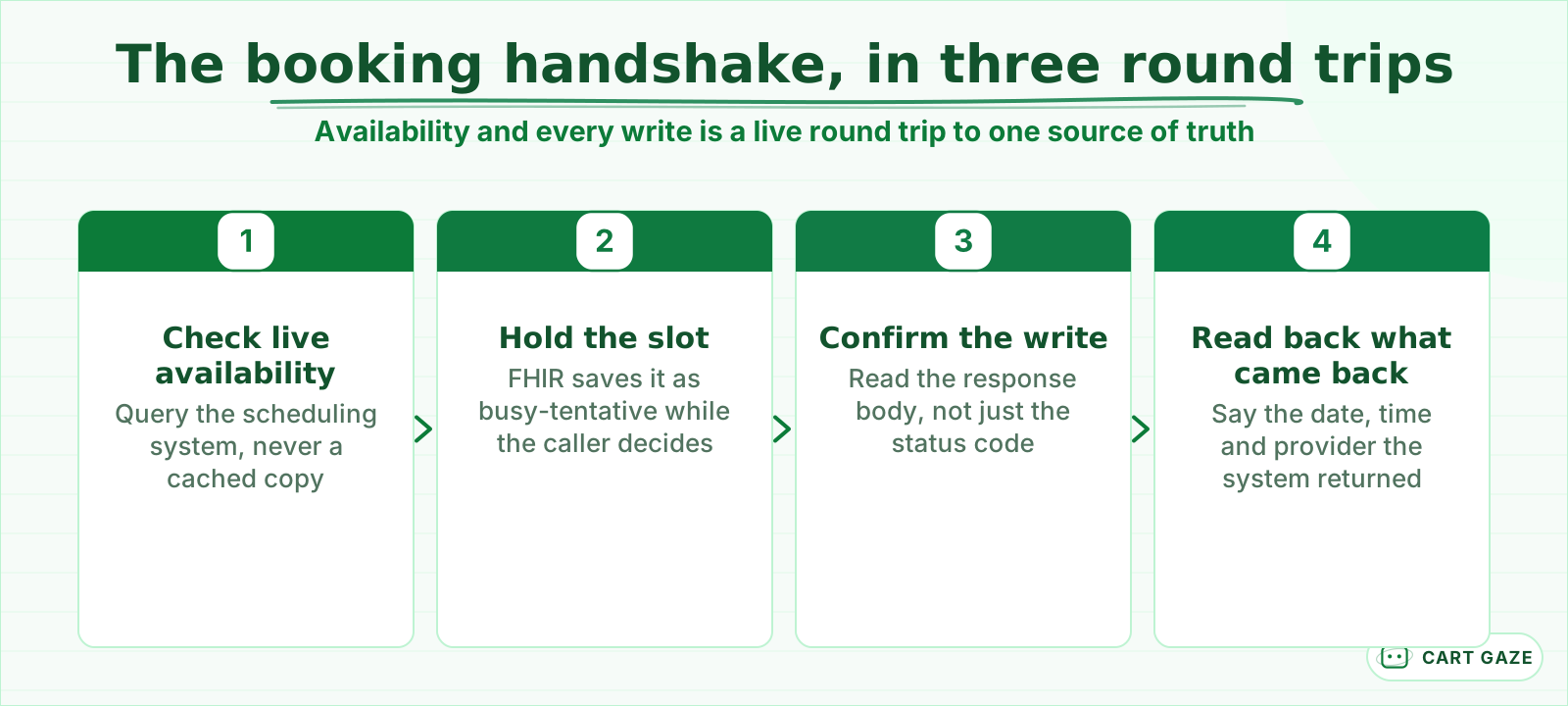 One combined book call is faster and gives the agent a private shortcut. Three round trips do not.
This is not a Cart Gaze invention. The FHIR scheduling workflow encodes it directly. In Medplum's implementation, a hold "places a hold on one or more schedules by atomically creating an Appointment and Slot resources," the appointment is saved with status pending, and the slot is saved as busy-tentative. FHIR has a distinct slot status for the held-but-not-booked state precisely because holding and booking are different things.
The shortcut version, one combined "book it" call, is faster and gives the agent a private view of your availability. That private view is exactly how a phone booking and a website booking end up disagreeing about what is free. Availability and every write have to be a live round trip to one source of truth, not a cached copy refreshed every 10 minutes. Linear Health names this failure mode plainly: cached schedules and copied provider rules create preventable booking errors.
If you have already watched two systems disagree about the same appointment, you know the pattern from the seams between practice tools. Booking is that same seam, running live, while a patient waits on the phone.
The 6 ways a booking actually fails
Six failure modes cover almost everything you will see in production. The scheduling system is down or slow. The held slot gets taken mid-conversation. The write returns nothing you can trust. The provider has no opening in the caller's window. The agent cannot understand the caller. The call drops.
Each of these is documented somewhere public, not hypothetical. The booking platform JRNI returns a 409 Conflict for a "race condition for the same time slot between 2 or more customers." An open Cal.com issue reports the booking endpoint rejecting a slot that its own availability endpoint had just returned. And transcription is the weakest link on any phone line: one 2026 review of speech recognition benchmarks puts word error rate at 19.7% across a corpus of 40-plus English accents, against 2.7% on clean US English read speech.
| What failed | What the caller should hear | What lands in the practice queue |
|---|---|---|
| Scheduling system down or slow | "I cannot reach the schedule right now, so let me take your details" | Callback task with name, number, and the window they wanted |
| Held slot taken mid-call | "That time just went. The next opening is Thursday at 9" | Nothing, if the caller takes the alternative |
| Write returned an unknown result | "Your request is pending. You will get a text once it is confirmed" | Verification task, flagged urgent, carrying the retry key |
| No opening in the caller's window | "Nothing is free before the 14th. Want a later date or the waitlist?" | Waitlist entry with the constraint that blocked it |
| Caller not understood after 2 attempts | "Let me get someone to help you with this" | Transfer, or a callback task with the recording attached |
| Call dropped mid-booking | Nothing. The line is gone | Outbound callback task with everything captured so far |
Notice that only one row ends with nothing for staff to do, and that is the row where the patient already got what they wanted. Every other failure produces work, because the alternative is that it produces a lost patient nobody can name.
Never say confirmed unless the write came back confirmed
A successful status code is not a successful booking. One integrator guide reports that Epic sometimes returns HTTP 200 with an error inside the body, such as a SLOT_TAKEN code reading that the selected slot is no longer available. Your agent has to read the body, then say only what came back.
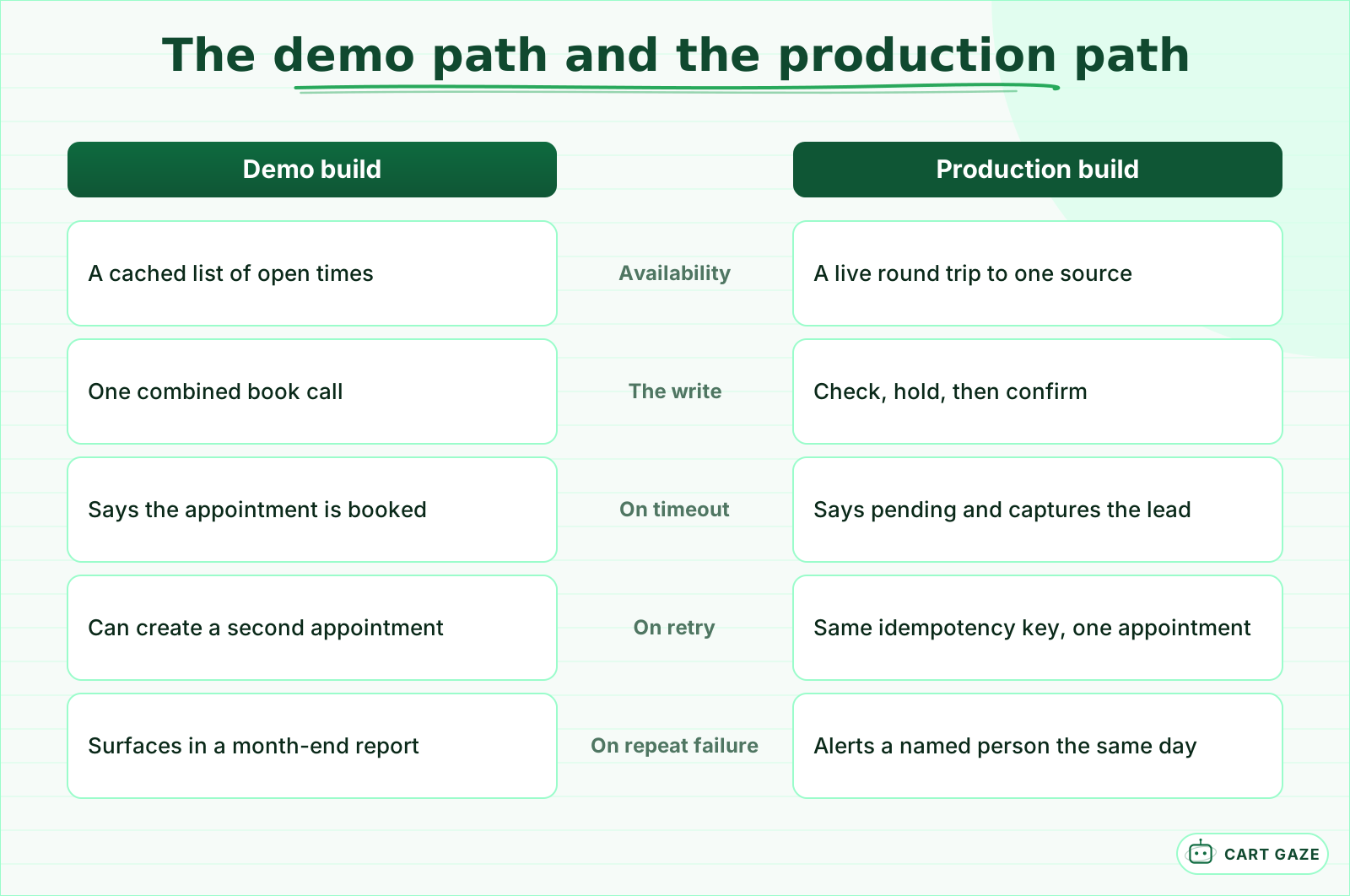 Both look identical when the booking succeeds. They differ only on the calls that fail.
Warning
If your agent treats an HTTP 200 as proof of a booking, it will confidently confirm appointments that do not exist. The patient arrives, the schedule is empty, and the front desk finds out from a person standing at the counter.
There are only three honest things an agent can say at the end of a booking attempt: confirmed, pending, or not booked. Demos only ever show the first. Pending is the one that keeps a practice out of trouble, and it needs a matching promise: the patient gets a text once a human has verified it.
The read-back rule follows from the same logic. The agent repeats the date, time, and provider that the scheduling system returned, not the ones the caller asked for. When those differ, the system is right and the conversation was wrong. This is the boundary the cornerstone guide to what an AI receptionist does draws around every other capability too: the agent reports what the record says, and it never fills a gap with something plausible.
Idempotency decides whether a retry books one appointment or two
When a booking request times out, nobody knows whether the appointment exists. Retrying blind can create a duplicate, and not retrying can lose a real booking. An idempotency key resolves it: the same key returns the same stored result instead of running the write a second time against your schedule.
Stripe's implementation is the clearest public description of the contract. The first request's status code and response body are saved for a given key regardless of whether it succeeded or failed, retries with that key replay the stored result rather than executing again, keys can be pruned after 24 hours, and the system rejects a retry whose parameters differ from the original request. Swap "charge" for "appointment" and the design is unchanged.
Retries also need shape, not just safety. The standard is capped exponential backoff with jitter, which spreads retries out instead of stacking them. AWS documented the reason years ago: without jitter, total work across contending clients grows with the square of the number of clients, and adding jitter cut call counts by more than half in their 100-client test.
Important
Ask any booking vendor two questions: what is the idempotency key on an appointment write, and how long does it live. A vendor who cannot answer has a system that can double-book, and a duplicate appointment is a no-show plus an angry phone call.
Degrade to lead capture, never to silence
The worst result of a failed booking is not a failed booking. It is a caller who hangs up leaving no trace, so nobody at the practice knows they existed. Any failure should still end with a name, a callback number, a reason, and the window they wanted.
That is the floor, and it is a low one. Four fields is enough for a staff member to finish the job in about 90 seconds. Silence, by contrast, converts a recoverable problem into an invisible one, and an invisible problem never gets fixed because nobody can see it happening.
Capture alone is not enough either. The record has to become a task with an owner, or it becomes a row in a report nobody opens. Patient Prism, a call-tracking vendor, reported identifying 1.5 million lost opportunities across 12.5 million monitored calls in 2025, with only 36% receiving any follow-up. Treat that as vendor data rather than a benchmark, but the direction is not surprising: captured leads without an assigned owner mostly sit there.
The handoff itself has to carry context. A caller who has already spent 4 minutes spelling their name should not start over with a human. What has to travel with them, and how to test that it does, is covered in designing the escalation handoff.
Make a repeated failure visible the same day
A booking integration that quietly stops writing looks exactly like a slow week, which is why silent degradation is the expensive failure. Three numbers catch it: how often the schedule actually recorded the intended action, how often staff had to correct or reverse one, and whether escalations got resolved.
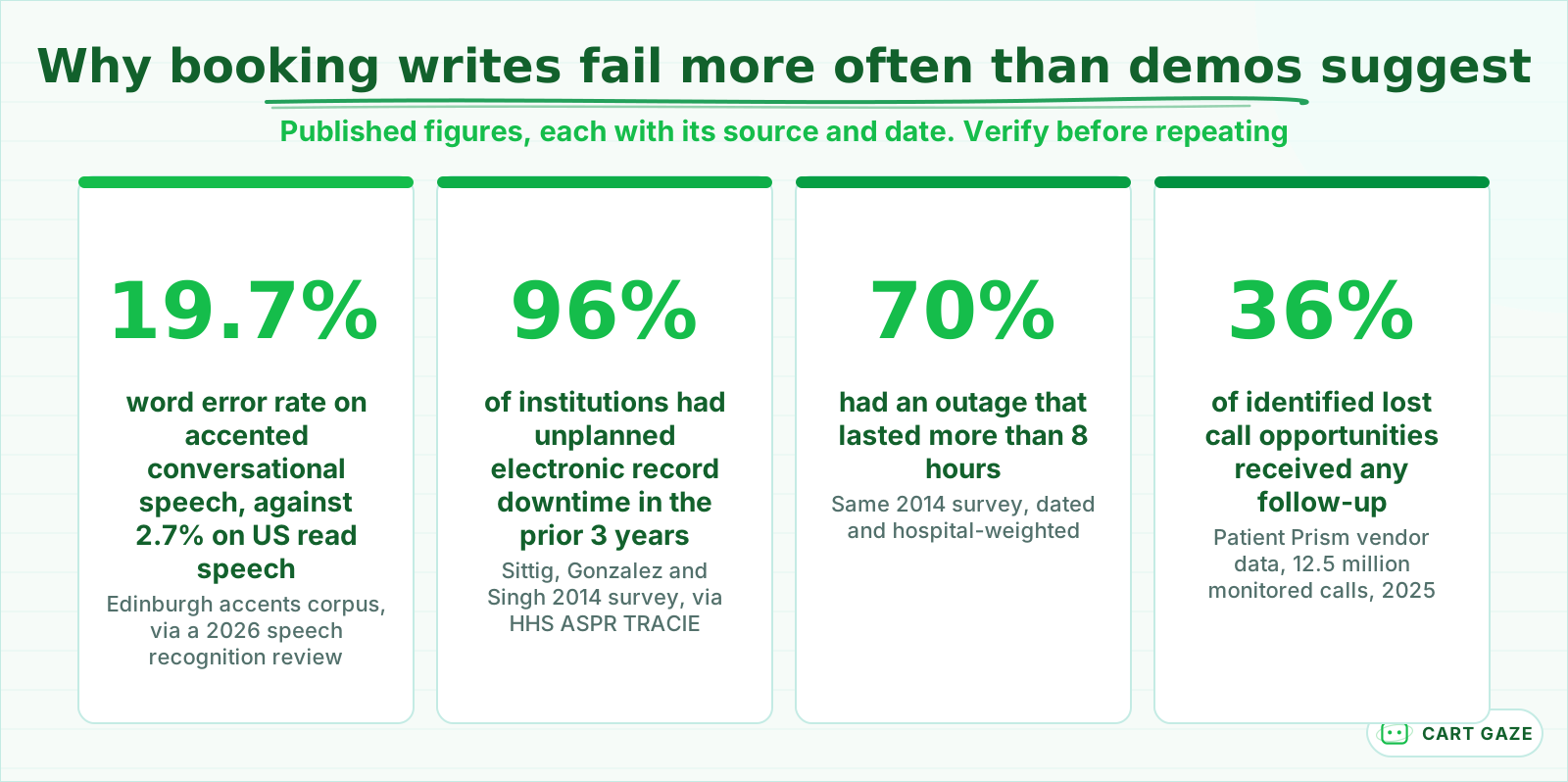 Published figures, each sourced and dated. Reasons to plan for failure, not predictions of your rate.
Call volume and automation rate will not catch it. Those measure workload, not whether the work was correct. A system can answer 100% of calls, report a high automation rate, and still be failing every third write, because the two metrics never touch the schedule.
Tip
Set one alerting rule before go-live: 3 consecutive write failures, or any single write that returned an unknown result, notifies a named person the same day. Monthly reporting is where booking failures go to hide.
Before you switch on live booking
- Availability comes from a live query to the scheduling system, not a cached copy.
- Appointment writes carry an idempotency key, and you know how long that key lives.
- Every failure path ends in a captured name, a callback number, and an owned task.
- Someone is named to receive the same-day alert when writes start failing.
Decide what your agent does when booking breaks
Pick the behavior for each failure mode before you go live, and write it down where staff can see it. Then ask the vendor for the failure demo instead of the success demo: have them turn the scheduling connection off mid-call while you listen to what the agent says.
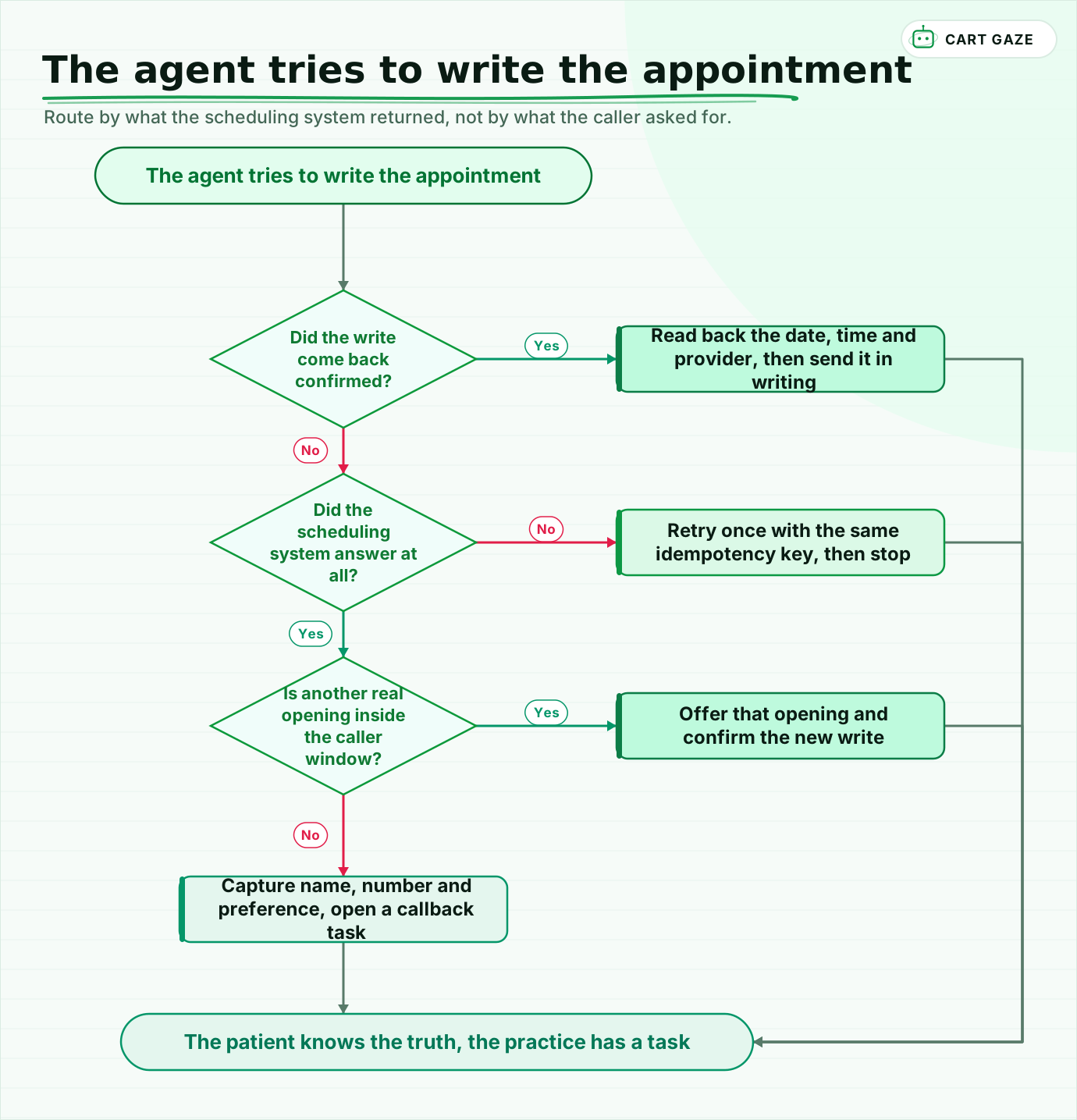 Route by what the scheduling system returned, not by what the caller asked for.
Walk that once. A write that comes back confirmed gets read back and sent in writing. A write that gets no answer at all is retried once with the same key and then stopped, never repeated blindly. A write that fails cleanly because the slot went means offering a real alternative inside the caller's window. And when there is no alternative, the agent takes the details and opens a callback task rather than apologizing into a hangup.
Test all 6 modes against your own system before a patient hears any of them, and read the transcripts of every call that ended in pending for the first two weeks. If you would rather see what unanswered and unbooked calls are already costing you before evaluating any of this, the free Growth Leak Audit sizes it from your own numbers.
Fair questions.
What should an AI receptionist say when a booking fails?
It should say what actually happened, using one of 3 honest outcomes: confirmed, pending, or not booked. If the scheduling system did not return a confirmation, the agent says the request is pending and a human will verify it. It should never announce a booking it cannot prove exists in the schedule.
How does an AI booking failure fallback avoid double-booking a patient?
With an idempotency key attached to the appointment write. The key means a retry returns the stored result of the first attempt instead of running the write again. Stripe documents the standard contract: the first response is saved whether it succeeded or failed, and keys can be pruned after 24 hours.
What happens if the slot is taken while the patient is still on the phone?
A well-built agent holds the slot before it starts collecting details, so this is rarer than it sounds. When it does happen, the booking system returns a conflict, and the correct response is to offer the next real opening inside the caller stated window rather than retrying the slot that is gone.
What should happen if the AI cannot understand the caller?
After 2 failed attempts it should stop trying and hand off. Transcription is the weakest link on a phone line, with one 2026 review reporting 19.7% word error rate on accented conversational speech against 2.7% on clean read speech. A third attempt annoys the caller and rarely fixes anything.
How will I know if the booking integration quietly stopped working?
Only if you measure the right things. Call volume and automation rate show workload, not correctness. Track how often the schedule actually recorded the intended action and how often staff had to reverse one, then alert a named person the same day after 3 consecutive write failures.
Sources.
- [1]Appointment $hold: the FHIR scheduling workflow and busy-tentative slots (Medplum)
- [2]Slot resource and status value set (HL7 FHIR R5)
- [3]Epic scheduling APIs: booking, canceling, rescheduling and the HTTP 200 error trap
- [4]409 Conflict error: fully booked slots and same-slot race conditions (JRNI)
- [5]Cal.com issue 24260: the booking API rejecting a slot the slots API returned
- [6]Idempotent requests: keys, stored responses and 24 hour pruning (Stripe API)
- [7]Exponential backoff and jitter (AWS Architecture Blog)
- [8]Speech recognition word error rate: benchmarks and failure modes, 2026
- [9]Voice AI in healthcare: where it works and where it breaks (Linear Health)
- [10]Healthcare call center metrics that predict revenue, 2026 (Patient Prism)
- [11]Electronic health records and downtime procedures (HHS ASPR TRACIE)
Written by

Muhammad Qasim Hammad
Founder, Cart Gaze
Qasim builds AI receptionists and front-office automation for medical and dental practices at Cart Gaze. Posts here start from published sources and real call data, not vendor claims, and every number links back to where it came from.
Keep reading.
 AI ReceptionistsAI Booking vs Online Scheduling: Why Most Practices Need Both11 min read
 AI ReceptionistsMulti-Provider Call Routing: Get the Right Doctor on Every Call10 min read
 AI ReceptionistsAI Receptionist Maintenance: What Decays and Who Fixes It11 min read
 AI ReceptionistsCaller Frustration Detection: Escalate Before They Hang Up12 min read
 AI ReceptionistsVoice AI Patient Identity Capture: Names, Dates, and Digits10 min read
 AI ReceptionistsBilingual AI Receptionist for Spanish-Speaking Patients10 min read