
Caller Frustration Detection: Escalate Before They Hang Up
A deployed keyword frustration detector caught 1% of frustrated conversations. Here are the signals worth counting instead, where to set the threshold, and the three calls that escalate with no score at all.
Key takeaways.
- A deployed keyword-based frustration detector scored 100% precision but only 1% recall, so it was almost never wrong and almost never fired.
- Countable conversation signals beat inferred emotion: repetition, task retries, turn count and call duration predict a hangup earlier than a voice does.
- Set the threshold by what a miss costs, escalating on 1 repeat when a new patient is on the line and waiting for a second failure when the call is routine.
- Off-the-shelf sentiment models scored 0.34 to 0.65 Macro-F1 against 0.71 for a plain repetition-and-turns feature set in the same 2025 benchmark.
- Clinical content, a named symptom and any request for a person escalate on the turn they appear, ahead of every counter and with no score attached.
Table of Contents9 sections
- Most systems escalate on the wrong signal
- The signals that actually predict a caller giving up
- When to escalate on a weak signal
- Sentiment analysis is oversold
- A speech-feature model does not fail evenly across your patients
- The calls that escalate with no score at all
- Check what your trigger missed, then move it
- Set the trigger, then let the calls move it
- Fair questions
The patient has already decided to give up. Your AI receptionist has not noticed, because it is still waiting for a word she is too polite to use. In a peer-reviewed benchmark of a deployed receptionist and booking system, the keyword-based frustration detector was right every single time it fired, 100% precision, and it fired on 1% of the conversations that were actually frustrated.
That gap is the whole problem. Frustration shows up in the shape of a conversation long before it shows up in a voice: the same request asked twice, a task attempted and failed again, a call for a 30-second job running past 3 minutes. Those things are countable. Anger in a voice is not, at least not reliably, and not across every patient who calls you.
This post is about the trigger, not the handoff. It covers which signals are worth counting, where to set the threshold and why it moves, why acoustic sentiment loses to boring alternatives, how a speech-feature model fails some patients more than others, and the three cases that skip scoring entirely.
Most systems escalate on the wrong signal
Most deployments fire on one of two triggers: a magic word like agent or representative, or a low recognition confidence score. Both arrive late. A frustrated patient who never swears and speaks clearly trips neither, so the call runs on until she hangs up and books somewhere else.
A 2025 industry-track study measured this on a production system whose two evaluation domains were a receptionist transferring calls and a booking agent negotiating appointment slots. Its deployed detector matched profanity and negative words. Precision came out at 100%, recall at 1%, and the overall score at 0.41 Macro-F1. The authors' explanation is the line worth pinning up: poor conversation handling does not always show up as overtly negative language.
Confidence scores fail in the other direction. A low score means the system did not catch the words, which happens constantly with surnames and dates of birth. It says nothing about whether the caller minds. Plenty of calls recover from 3 bad transcriptions, and plenty of clean ones go badly because the answer was wrong.
Tip
Before you wire any signal to a transfer, log all of them for 2 weeks and change nothing. You find out which ones actually precede your hangups, and how noisy each is on your own line.
The signals that actually predict a caller giving up
Frustration is a property of the conversation before it is a property of the voice. The signals that predict it are things you can count in a transcript: the same request asked twice, a task attempted twice, a rising turn count, a call running past the time its task should take.
| Signal | What you count | A starting trigger | What a miss costs |
|---|---|---|---|
| Repetition | Same request in 2 consecutive turns | 2nd repeat | The caller decides nobody is listening |
| Task retry | Same task failed, then re-attempted | 2nd failure | The task will not complete on this call |
| Turn count | Turns since the current task started | 6 to 8 turns | Effort spent with nothing to show |
| Call duration | Elapsed time against that task | 2x your median for the task | A 30-second job became a 3-minute one |
| Silence | No reply after a prompt | 2nd unanswered prompt | Confusion, a bad line, or a caller who walked away |
| Explicit request | Caller asks for a person | 1st request | Trust, permanently |
Repetition earns the top spot. In that study's real deployment data, repeated utterances ran about 8% by fuzzy match and 9.6% by cosine similarity, against 2.1% and 4% in a public reference corpus of ordinary task dialogues. Repeating yourself is not normal conversation. It is what people do when the last answer did not land.
The feature set that beat every off-the-shelf sentiment and emotion model in the same benchmark was deliberately dull: semantic and syntactic repetition, how long each turn ran, how long the whole conversation ran, and how many turns it took. No emotion model, no acoustic features, and a Macro-F1 of 0.71 against 0.65 for the best sentiment model.
Interruptions and barge-ins belong in the log, but not in the trigger on their own. Natural turn-taking gaps run under 300 ms in ordinary speech, so a system listening for interruptions also hears every "mm-hm" as one. Track your false stop rate before you treat a barge-in as evidence of anything.
When to escalate on a weak signal
There is no single correct threshold, because the right one depends on what a miss costs. When missing a frustrated caller means losing a new patient or overlooking a clinical concern dressed up as annoyance, escalate on thin evidence. When the cost is 2 minutes of staff time, wait for something solid.
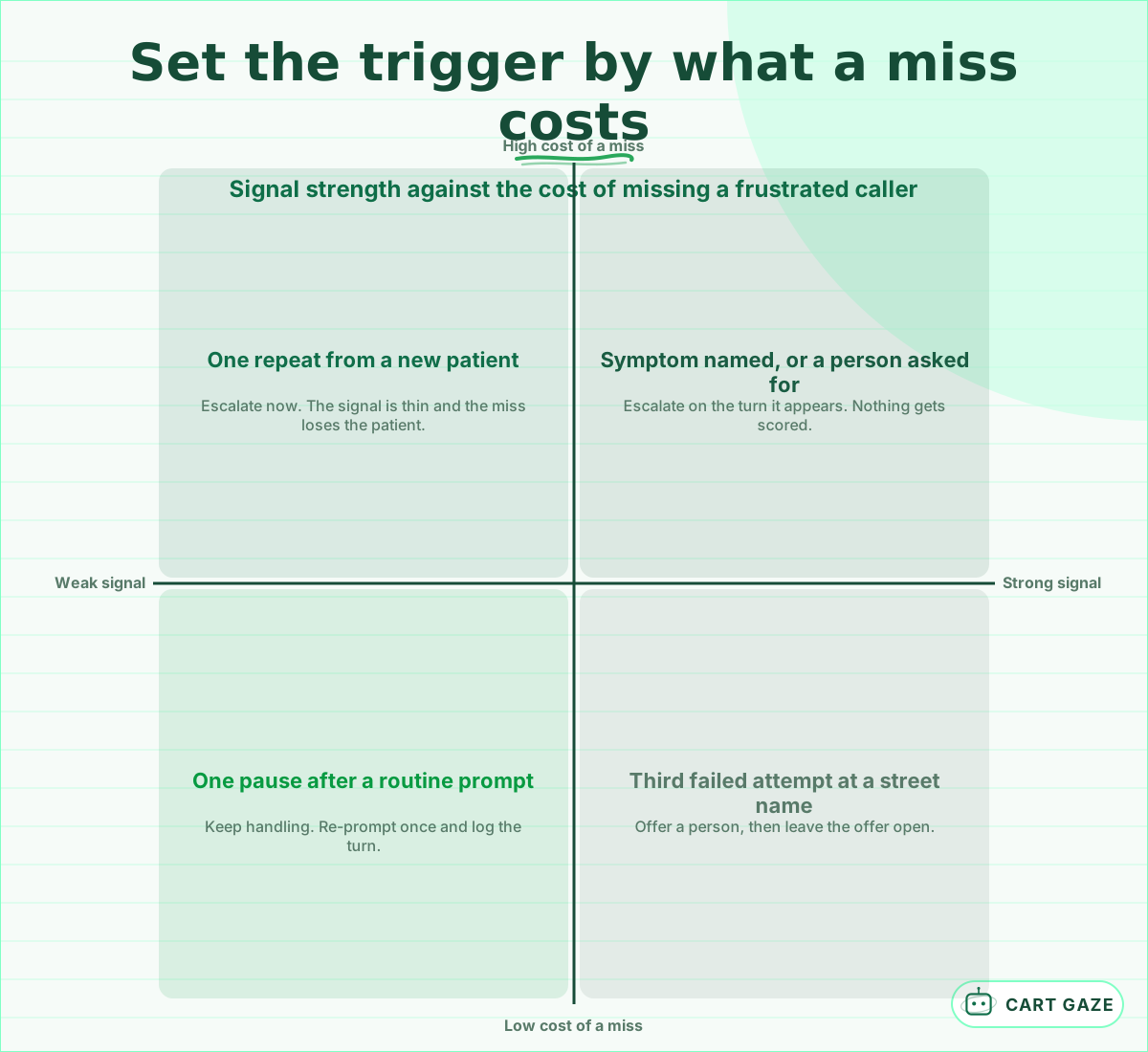 When a miss is expensive, a weak signal is enough. When it is cheap, wait for something solid.
The high-cost side covers more calls than most practices assume: anyone who has not booked yet, anyone calling a second time the same day, anyone whose reason for calling touches how they feel, and anyone raising a complaint. On those calls, 1 repeat is enough. You are not deciding whether the patient is angry. You are deciding whether a person should take it from here.
The low-cost side is the routine end: a known patient confirming a known appointment, an hours-and-parking question, a refill message. There, an unnecessary transfer costs a staff interruption and gains nothing, so wait for a second failed attempt or an explicit request.
Price both errors before you set a number. A false positive costs a few minutes at the front desk. A false negative costs you the patient, and no report shows it, because the call simply ended. If you have not decided which mistake you would rather make, you have accepted a vendor default rather than set a threshold.
Sentiment analysis is oversold
Vendors sell acoustic sentiment as though hearing emotion in a voice were a solved problem. It is not. In a published benchmark that pits these approaches against each other on real deployed traffic, off-the-shelf sentiment and emotion models lost to a feature set that counted repetition and turn structure alone.
The numbers: sentiment models scored 0.34 and 0.65 Macro-F1, emotion-detection models landed between 0.40 and 0.60, and the plain dialog-breakdown features scored 0.71. Large language models reading the conversation history did best at 0.83 to 0.87, which the authors report as a 33% relative improvement over the sentiment and emotion models and 22% over dialog breakdown.
The reason is not that emotion models are badly built. It is that they do not travel. Cross-corpus evaluations of speech emotion recognition report significant drops when a model trained on one corpus meets another, and one study concludes that the transfer of information across corpora is simply not successful without extra adaptation. Your phone line is another corpus: different handsets, different rooms, different people.
Warning
If a vendor's differentiator is real-time sentiment, ask them to score 100 of your own recordings against labels your own staff assigned, before you sign anything. A demo runs on clean audio from people who were asked to sound annoyed.
A speech-feature model does not fail evenly across your patients
Any trigger built on speech features inherits the accuracy gaps of the speech stack under it, and those gaps are documented and large. A model that mishears a patient more often will also read her turns as noisier, escalate her later, and leave no trace that it happened.
The clearest evidence is still Koenecke and colleagues in PNAS. Across 5 commercial systems from Amazon, Apple, Google, IBM and Microsoft, the systems misunderstood 35% of words spoken by Black speakers against 19% of words spoken by white speakers, and over 20% of Black speakers' samples were effectively unusable against under 2% of white speakers' samples. Same phrases, matched for age and gender.
Age moves it too. A speech model tested on interview audio from long-term care started at 48.3% word error rate and reached 24.3% after fine-tuning on that population, with residents the worst-served group at 22.7%. The authors name age, gender and accent as factors that change speech features and raise error rates. An 82-year-old speaking slowly is not a frustrated caller, and a trigger built on speech rate will read her as one. The wider set of design choices for those callers sits in what an AI receptionist does and where it stops.
Accent adds another layer. A 2025 study of synthetic voice services found technical performance disparities across 5 regional English accents and framed the result as a digital-exclusion risk.
Important
Report your escalation rate split by language, interpreter use, and relay calls. If one group escalates half as often as another, the model is not calmer with those patients, it is deafer to them.
The calls that escalate with no score at all
Three cases end the automated part of a call the moment they appear, and none of them is scored. Any clinical or urgent content. Any named symptom. Any request for a person. Your counters run after these, never before, so no frustration threshold can ever delay one of them.
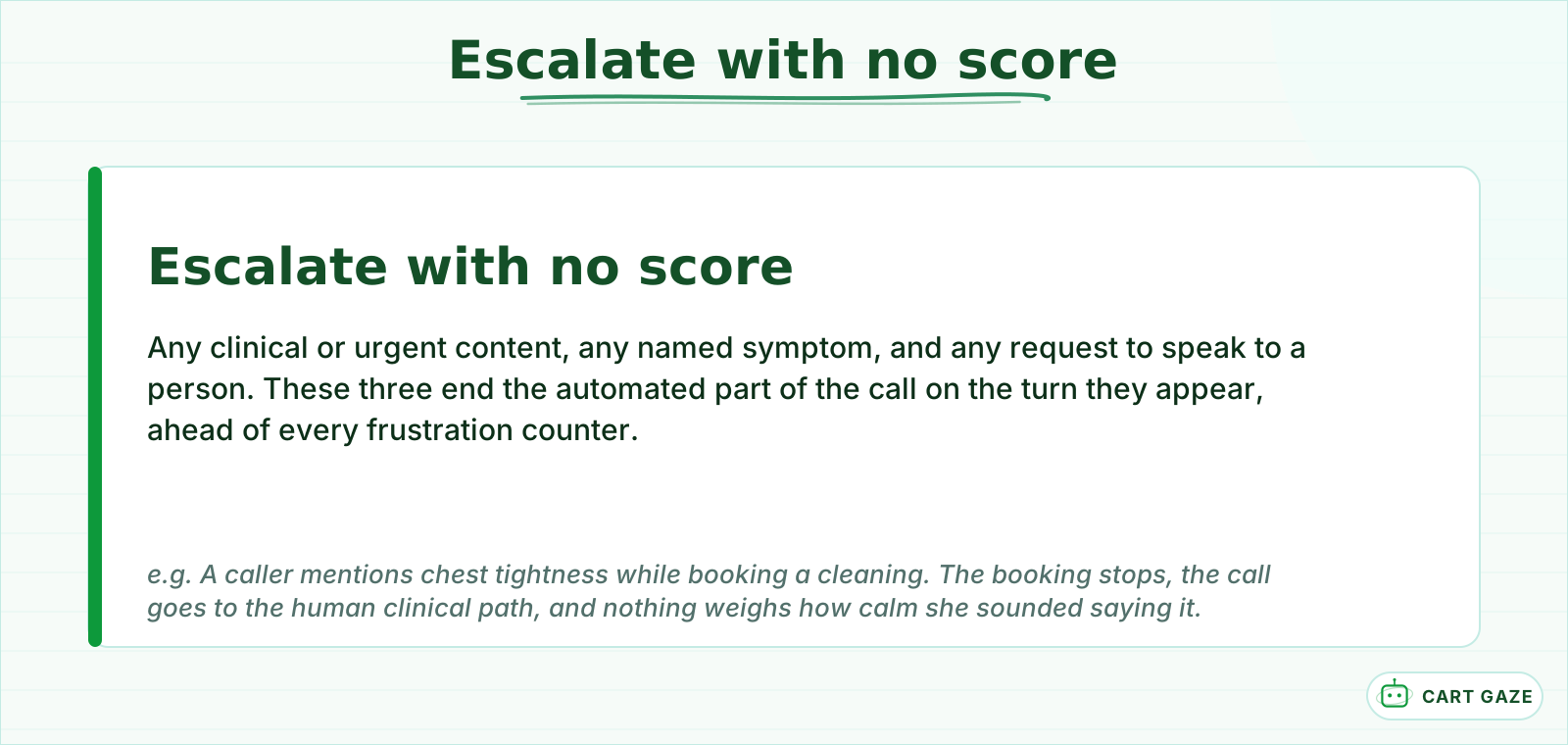 Three cases end the automated call on the turn they appear. Nothing weighs them.
The symptom rule is the one people try to soften, usually by asking the system to judge whether a symptom sounds urgent enough. That judgement is triage, and an AI receptionist routes calls, it does not diagnose. A caller who mentions chest tightness while booking a cleaning gets a person, and nothing weighs how calm she sounded saying it.
A request for a person is a decision the caller already made. The mechanics of what happens next, warm or cold transfer, what data travels with her, what happens when nobody picks up, are covered in designing the handoff to a human. This post only sets the moment it fires.
Order these ahead of your counters in the configuration, not alongside them. If the no-score class is one branch among several, a scoring bug can swallow it. If it runs first and exits, it cannot.
Check what your trigger missed, then move it
A threshold you never audit is a guess with a timestamp on it. Once a month, sample calls from both sides: the ones where escalation fired, and the ones where it did not. The second sample is the one nobody pulls, and it is exactly where the expensive mistakes live.
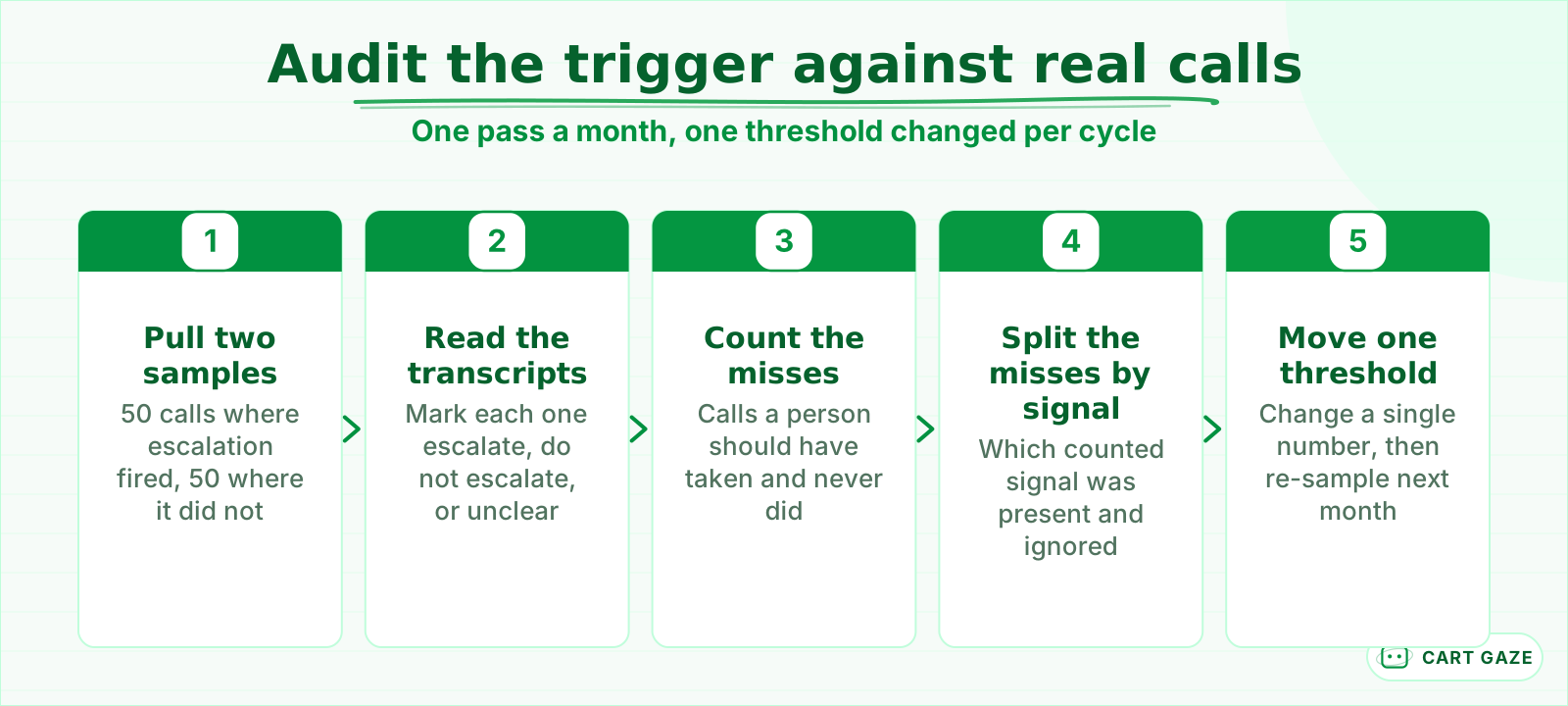 Sample both sides. A trigger you never audit is a guess with a timestamp.
50 calls on each side is enough to see a pattern. Read them and mark each one 3 ways: a person should have taken this, a person should not have, or it is genuinely unclear. The unclear pile earns its keep, because it shows where your staff disagree about the rule.
The number that matters is the false negative: calls that ended without a human where one was needed. No report surfaces it, because a call that quietly ended looks identical to a call that went fine. You find these by reading them, or you do not find them.
Change one threshold per cycle. If you move the repeat count and the duration cap in the same month, you have learned nothing about either. Tolerance for this is not unlimited on the patient's side either, and the surveys behind whether patients accept an AI receptionist point the same way: acceptance tracks whether the task went well, not the technology behind it.
Before the trigger goes live
- The no-score cases run ahead of every counter: clinical content, a named symptom, a request for a person.
- Each counted signal is written to the call record, whether or not it fired.
- One named person owns the monthly sample of calls where escalation did not fire.
- A signed BAA covers the vendor storing your transcripts and recordings.
Set the trigger, then let the calls move it
Start narrow. Two counted signals, a second repeat and a second failed attempt at the same task, plus a duration cap for that task, with the no-score class sitting above all of them. That configuration is defensible on day 1, and it gives you something specific to argue with next month.
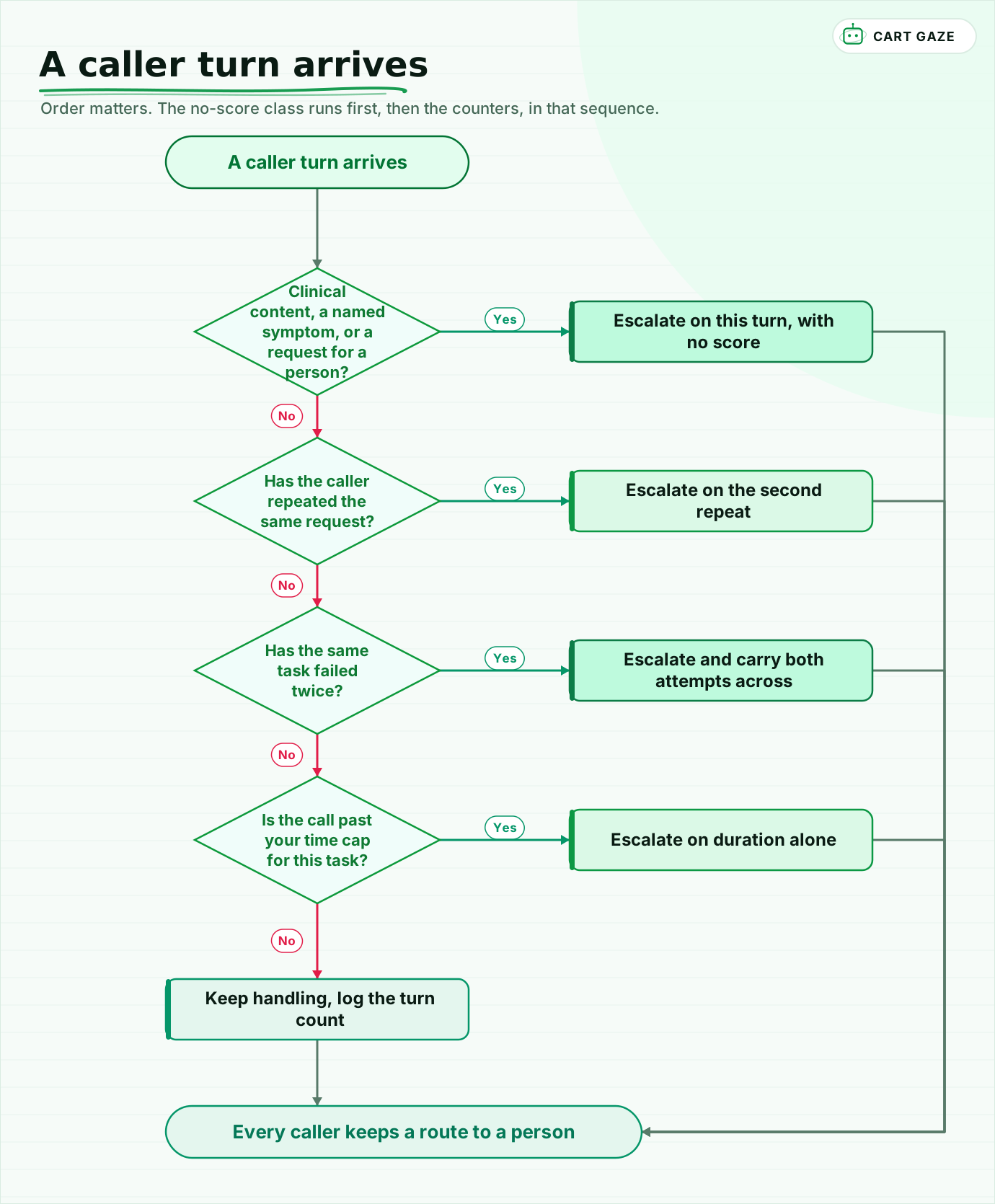 Order matters. The no-score class runs first, then the counters, in that sequence.
Walk the ladder once. Clinical content, a named symptom or a request for a person leaves on the turn it appears. A repeated request leaves on the second repeat. A task that has failed twice leaves with both attempts attached. A call past its time cap leaves on duration alone. Everything else keeps going, with the turn count written down.
Leave acoustic sentiment out of the trigger for now. Log its score beside your counted signals, compare the two against calls your staff labelled by hand, and promote it only if it beats counting on your own recordings. On the published evidence, it does not.
If you would rather size the problem before touching any configuration, the free Growth Leak Audit works out what your phone line is losing from your own numbers.
Fair questions.
How does an AI receptionist detect a frustrated caller?
The reliable signals are counted, not inferred: the same request repeated, a task attempted and failed twice, a rising turn count, and a call running past the time its task should take. Acoustic sentiment is sold as the answer but underperforms these in published benchmarks. Log every signal first, then wire the two that best predict your own hangups.
Is sentiment analysis accurate enough to trigger a transfer?
Not on its own. In a 2025 benchmark on a deployed receptionist and booking system, sentiment models scored 0.34 and 0.65 Macro-F1 and emotion detection 0.40 to 0.60, while a plain feature set counting repetition and turns scored 0.71. Speech emotion models also generalize poorly across recording conditions, so demo accuracy rarely survives contact with your phone line.
What should always escalate without any frustration score?
Three things: any clinical or urgent content, any named symptom, and any request to speak to a person. These end the automated part of the call on the turn they appear, ahead of every counter. An AI receptionist routes clinical calls to a human and never diagnoses, so it must not judge whether a symptom sounds urgent enough to pass on.
Can a frustration model treat some patients unfairly?
Yes, and it is documented. Five commercial speech systems misunderstood 35% of words from Black speakers against 19% from white speakers in a PNAS study, and error rates rise with age and accent. A trigger reading speech features will escalate the patients it hears worst less often. Report escalation rates by language, interpreter use and relay calls.
How do I know whether my escalation threshold is set right?
Sample both sides every month. Pull 50 calls where escalation fired and 50 where it did not, read them, and mark whether a person should have taken each one. The number nobody measures is the false negative, a call that ended without a human when one was needed. Move one threshold per cycle so you can attribute the change.
Sources.
- [1]User Frustration Detection in Task-Oriented Dialog Systems (COLING 2025, industry track)
- [2]User Frustration Detection in Task-Oriented Dialog Systems (ACL Anthology)
- [3]Racial disparities in automated speech recognition (Koenecke et al. PNAS 2020)
- [4]Automated speech recognition systems often misinterpret black speakers (Stanford Engineering)
- [5]An automatic speech recognition model built on long-term care interview data (JAMIA 2023)
- [6]Examining accent bias and digital exclusion in synthetic AI voice services
- [7]A cross-corpus study on speech emotion recognition
- [8]Barge-in, interruptions and turn-taking in voice agents
- [9]Duplex Conversation: user state detection, backchannel selection and barge-in detection
Written by

Muhammad Qasim Hammad
Founder, Cart Gaze
Qasim builds AI receptionists and front-office automation for medical and dental practices at Cart Gaze. Posts here start from published sources and real call data, not vendor claims, and every number links back to where it came from.
Keep reading.
 AI ReceptionistsWill Patients Accept an AI Receptionist? What Surveys Show10 min read
 AI ReceptionistsDouble Booking Prevention for AI Scheduling: Hold, Then Confirm11 min read
 AI ReceptionistsAI Appointment Booking: The 3-Step Architecture That Works12 min read
 AI ReceptionistsAI Receptionist vs an Offshore Virtual Assistant for Practices10 min read
 AI ReceptionistsAI Receptionist Accessibility: Older Callers and Relay Calls10 min read
 AI ReceptionistsWaitlist Management: Stop Losing Revenue to Cancelled Slots9 min read