
Double Booking Prevention for AI Scheduling: Hold, Then Confirm
Two patients booked the 9:40 slot 22 seconds apart and nobody made a mistake. Here is the race that creates double bookings when you add an AI booking channel, and the hold-then-confirm fix.
Key takeaways.
- Accidental double booking is a concurrency bug, not an overbooking strategy, and adding an AI booking channel makes it more likely because it puts a second writer on one schedule.
- The race window is the length of the call, not the agent response time: a patient can spend 40 seconds on details while the front desk books the same slot.
- Availability answered from a nightly export or a 15-minute mirror guarantees conflicts, because any copy of the schedule describes the past rather than the present.
- The safe shape is 3 calls instead of 1: read live, place a short expiring hold, then confirm with a write that revalidates and is rejected if the slot moved.
- Log the channel, hold id, and read and write timestamps on every booking so a conflict becomes a number you can count per channel instead of a staff argument.
Table of Contents8 sections
- Why adding an AI booking channel makes double booking more likely
- The 40-second race that puts two patients in one slot
- Cached availability is what guarantees the bug
- Hold the slot, then confirm with a write that revalidates
- Hold windows, abandoned holds, and what happens when the call drops
- Two calendars, one truth, and which channel actually won
- What to check before you let anything book into your schedule
- Fair questions
Two people show up for the 9:40 a.m. slot. One booked it with your AI receptionist at 6:12 the evening before. The other booked it at the counter, 22 seconds later, with a front desk person who was looking at the same schedule and saw it free.
Nobody made a mistake. That is what makes this failure so hard to argue about, and why "be more careful" never fixes it. It is a timing bug, and it gets more likely the moment you add a booking channel, not less. US practices average roughly 53 calls per physician per day by one aggregated 2025 estimate, and a phone scheduling call runs over 8 minutes against under 60 seconds for self-scheduling, according to Accenture data cited by Phreesia. Long conversations mean long windows where two writers can both be wrong.
This post walks the race second by second, shows why a cached view of availability guarantees the bug, and lays out the fix the scheduling standards already describe: read live, hold the slot, then confirm with a write that re-checks instead of trusting what it read a minute ago.
Why adding an AI booking channel makes double booking more likely
Double booking prevention gets harder the moment a second system can write to your schedule. Your front desk cannot race itself. Add a voice agent, a website booker, and a portal, and four writers now claim the same slots, each acting on a reading that was true a minute ago.
First, clear up a naming collision. In outpatient operations, "double-booking" often means the deliberate practice of putting two patients in one slot to absorb no-shows. A March 2026 arXiv paper models exactly that as a policy choice, weighing overbooking against idle time. That version is a strategy you choose.
This post is about the other one: the accidental kind, where two channels each believe a slot is free and both write to it. That is not a scheduling strategy. It is a concurrency bug, and concurrency bugs scale with the number of things allowed to write.
The uncomfortable framing is that the AI did not create the problem. It exposed one that was already latent in a schedule with a single busy writer and no coordination. If you have not evaluated one of these systems before, start with what an AI receptionist does and where it stops, because the booking write is the part vendors demo least and get wrong most.
The 40-second race that puts two patients in one slot
The bug lives in the gap between reading availability and writing the booking. An agent checks the schedule, the patient then spends 40 seconds giving a name and a reason, and somewhere inside that window the front desk books the same slot for a walk-in standing at the counter.
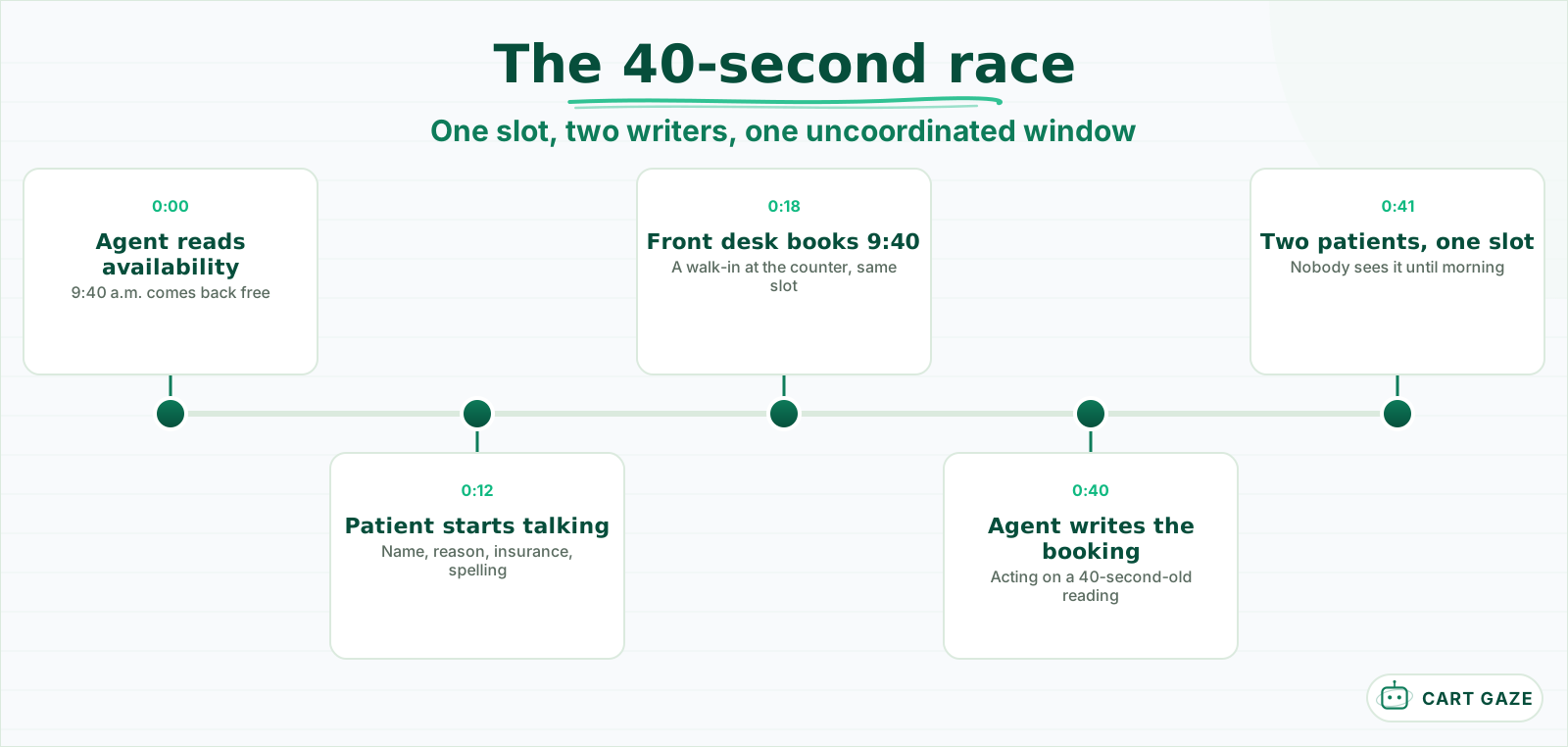 Nothing malfunctions here. Both writers acted on a reading that was true when it was taken.
Read the sequence and notice what is missing: a malfunction. The agent's read was accurate at 0:00. The front desk's read was accurate at 0:18. The agent's write at 0:40 was based on information that had quietly stopped being true 22 seconds earlier, and nothing in the system was watching for that.
This is why faster voice models do not help. The window is not the agent's response latency, which is measured in hundreds of milliseconds. The window is the length of the conversation, and you cannot shorten a patient spelling a surname or checking which insurance card is in their wallet.
It also explains the reporting delay. Nobody notices at 0:41. Somebody notices at 8:55 the next morning, with two people in the waiting room and a schedule that agrees with both of them.
Cached availability is what guarantees the bug
If your booking channel answers from a copy of the schedule rather than the schedule itself, conflicts are not a risk, they are a certainty. A nightly export, a 15-minute mirror, or a vendor-side database all describe the past. Only a live read can be wrong in a way you catch.
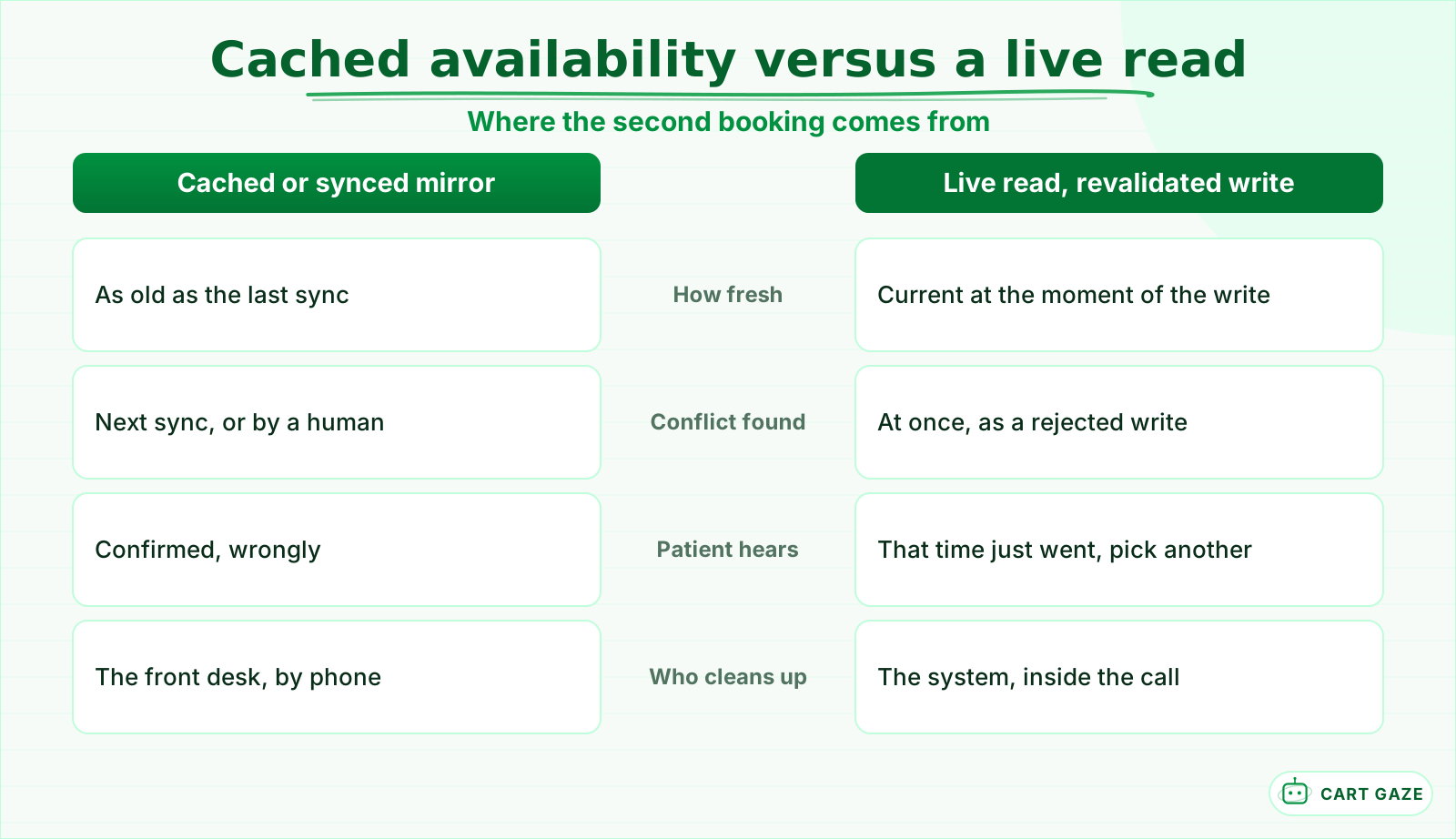 A mirror is a snapshot. Only a live round trip can be wrong in a way you find out about.
Google's own calendar sync guidance shows the failure mode plainly. A client keeps a local copy and refreshes it with a sync token, and the server can invalidate that token at any time by answering with HTTP 410, at which point the client has to clear its storage and resynchronize from scratch. Any mirror is a guess about the present that is occasionally, silently wrong.
Published integration guides show how common the read-then-write shape is. NexHealth's own getting-started walkthrough for scheduling lists the slot query and then the appointment creation call, with no hold step and no documented behavior for a slot taken in between. That is normal engineering practice, not negligence, but it means the safety has to be designed on top of the integration rather than assumed from it.
Warning
"Real-time sync" in a vendor deck usually means "a fast mirror", not a live round trip. Ask one question instead: at the moment a patient asks for Tuesday at 9:40, does the system query the source of truth, or does it answer from a copy? The gap between those two answers is where your double bookings live.
How your booker connects decides how honest its answers can be, which is the whole subject of connecting an AI receptionist to your practice management software.
Hold the slot, then confirm with a write that revalidates
The fix is three network calls instead of one. Read live availability, place a short expiring hold the moment the patient shows interest, then confirm with a write that re-checks the slot before committing and fails loudly rather than overwriting whatever moved. The extra call is the entire defense.
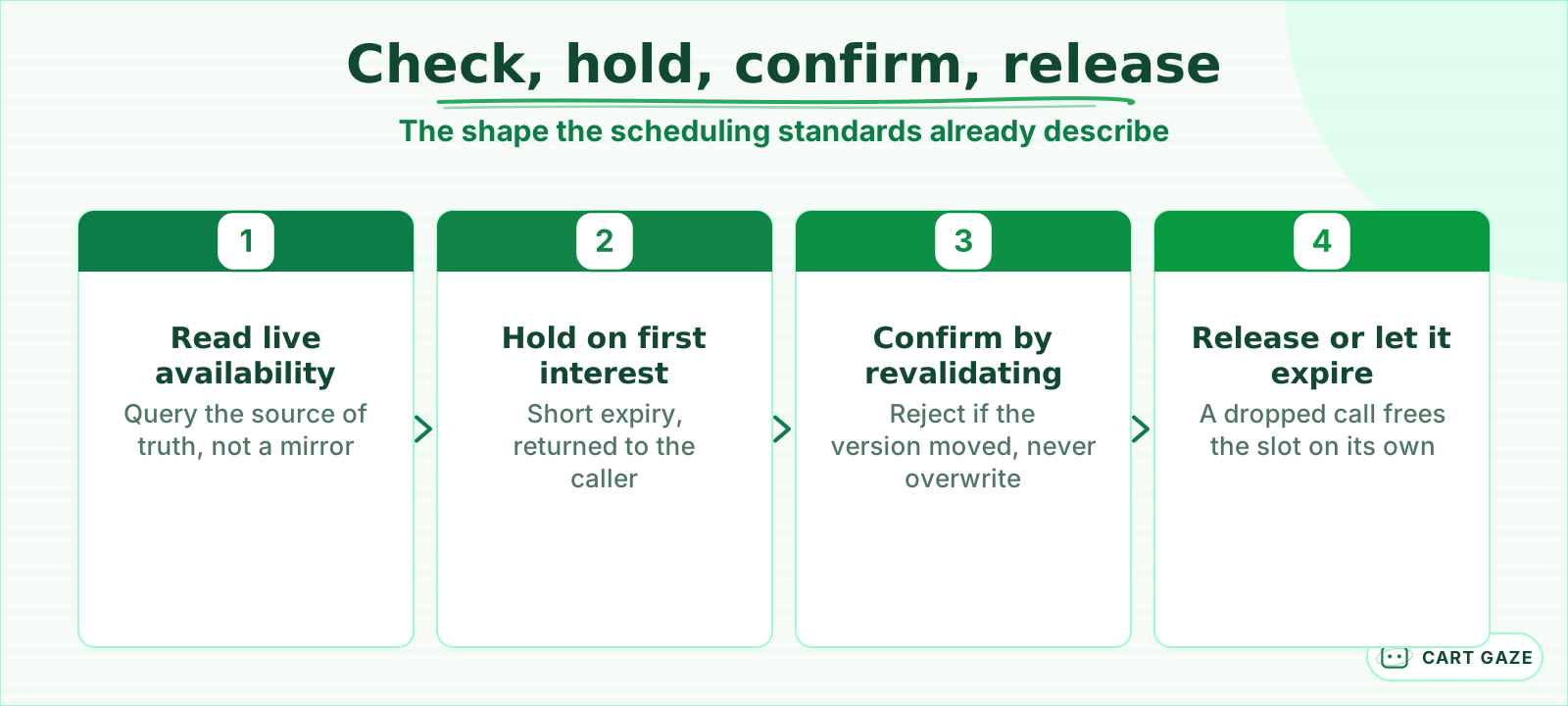 Three network calls instead of one. The extra call is the whole defense.
This shape is not something an agency invented. The Argonaut Scheduling Implementation Guide, a healthcare interoperability specification, defines three separate operations for exactly this: find availability, hold, then book. It describes the hold as a request made so the user can finish entering booking details, with the server deciding whether the appointment is still available and either accepting or rejecting the request.
The guide is specific about the parts that matter operationally. An accepted hold moves the appointment to a pending status, a rejected one to cancelled, and the response should carry an expiry so the client knows how long it has. The matching slot vocabulary exists too: a tentatively scheduled interval is marked busy-tentative rather than plainly busy.
The confirm step then has to distrust its own earlier read. The HTTP layer of the same standard family specifies version-aware updates, where the client sends the version it last saw and the server answers 412 Precondition Failed if that version has moved on, with 409 Conflict used where the server locks instead. In product terms, a scheduling API that does this rejects the second claim on a window, and the correct client behavior is to catch the rejection, refresh the list, and ask the patient to choose again inside the same call.
Important
A hold on its own is not the fix. Cal.com, an open-source scheduler, shipped slot reservations and still had a bug filed in September 2025 because the booking handler did not check reserved slots, so a booking could succeed on a slot that was already held. Two features that do not talk to each other are still one bug.
Hold windows, abandoned holds, and what happens when the call drops
A hold needs an expiry, and the length is a real tradeoff. Too short and it lapses while a patient spells a surname. Too long and your availability looks thinner than it is, so the next caller hears that Tuesday is full when it is open. Size it to the call.
| Hold window | Fits | Too short means | Too long means |
|---|---|---|---|
| 60 to 90 seconds | A quick confirm from a known patient | Expires mid-sentence on a new patient | Rarely a problem |
| 2 to 5 minutes | A voice booking with intake questions | Tight if insurance is discussed | Small, self-clearing loss |
| 10 to 20 minutes | A web booking page, not a phone call | Almost never | Real slots look unavailable |
| No expiry at all | Nothing | Not applicable | A permanent leak of availability |
Cal.com's booking page holds a selected slot for 20 minutes by default, which one user asked to shorten in April 2025. That is a sensible length for someone filling in a web form on their own time. It is the wrong shape for a phone conversation, where the whole interaction is often over in under 3 minutes.
Every hold needs a defined death. It should release on confirmation, release on an explicit no, release when the call drops, and expire on its own if none of those fire. The dropped-call case is the one most setups forget, and it is the most common: a patient loses signal at the exact moment they were about to say yes.
Tip
Treat released holds as inventory rather than cleanup. A slot freed by an abandoned hold at 6:15 p.m. is a real opening you can offer to someone else, which is precisely the job of an AI receptionist running a waitlist.
Two calendars, one truth, and which channel actually won
Exactly one system holds the truth about your schedule, and every other surface reads from it and writes through it. The second the practice management system and a stray booking page both accept appointments, there is no correct answer when they disagree, only a staff member reconciling by phone.
Most practices do not choose a second calendar, they inherit one. A provider's personal calendar that never got migrated. A med spa booking page a marketing agency set up. An acquired location still running its old system. Each one is a second writer with its own idea of what is free.
The workable pattern is a one-way projection out of the source of truth for anything that only needs to display availability, plus a single write path back in for anything that books. If a genuine second writer is unavoidable, you need a scheduled reconciliation sweep, a written tiebreak such as earliest confirmed write wins, and a named person who works the exception queue.
Then there is the question that surfaces the morning after: which channel actually won the slot. You should be able to answer it without a meeting. For every booking, log the channel, the hold id, the hold expiry, the timestamp of the availability read, and the timestamp of the write. Standard scheduling resources already carry a version id and a pending state for this reason.
That log turns a conflict from an argument into a number. Count conflicts per channel per week, and you find out whether the racing writer is the voice agent, the web form, or the front desk, instead of blaming the newest system by default.
Before a second channel writes to your schedule
- One system is named in writing as the source of truth for availability.
- Availability is read live at the moment of the request, not from a nightly copy.
- Every booking records its channel, hold id, and read and write timestamps.
- One named person owns the conflict queue and reviews it weekly.
What to check before you let anything book into your schedule
Five questions separate a booker that writes safely from one that writes hopefully: is availability read live, is a hold placed, does the confirm re-check, what does the patient hear when a write is rejected, and what gets logged for every booking. Ask them before the integration goes live, not after.
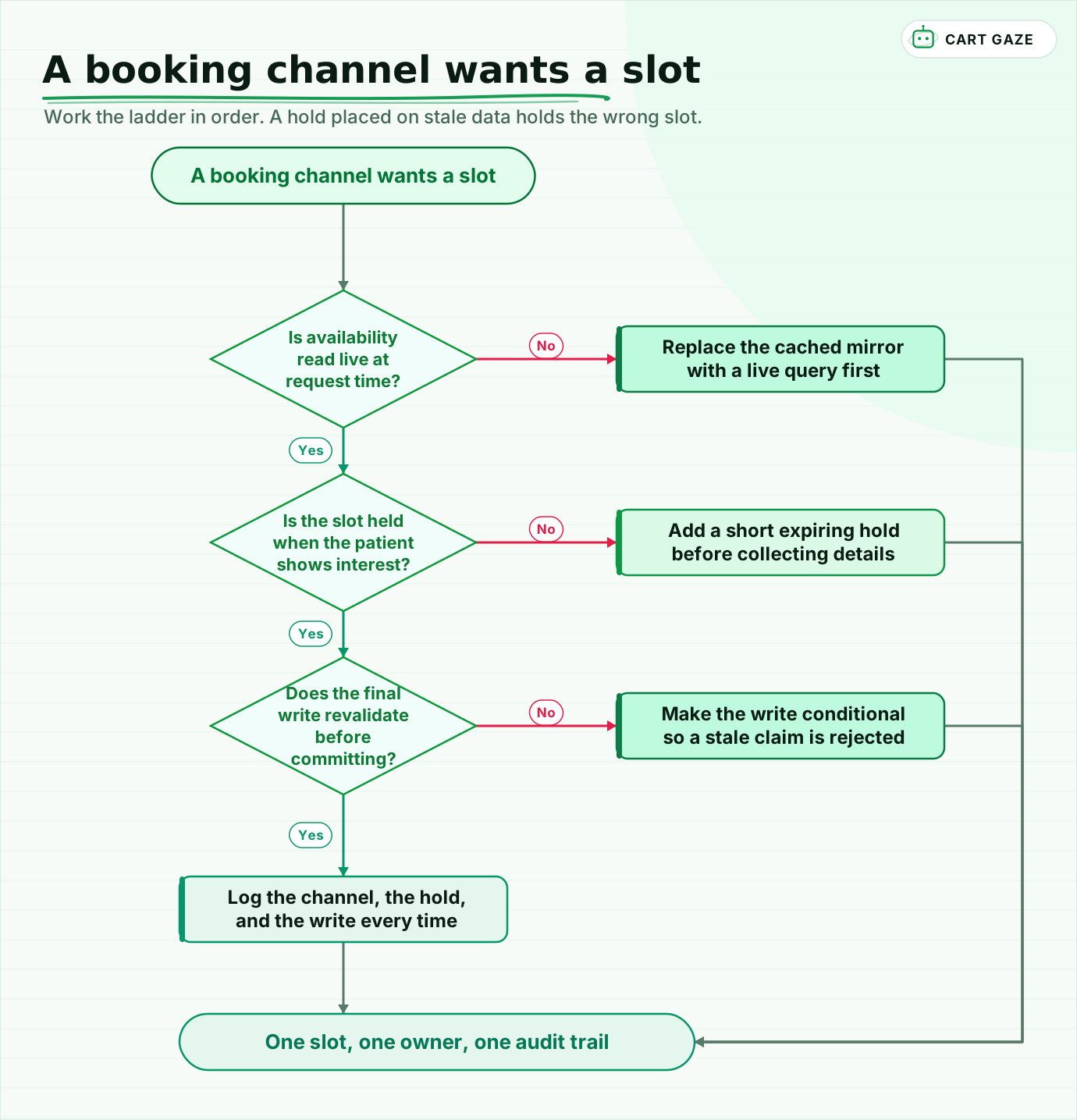 Work the ladder in order. A hold placed on stale data holds the wrong slot.
Walk the flow once and you will see it is a ladder, not a menu. A cached read has to be replaced first, because a hold on stale data holds the wrong slot. Then the hold, then the revalidating write, then the log that lets you attribute a conflict after the fact.
Set expectations honestly with whoever you buy from. No configuration makes conflicts impossible, and a vendor promising zero is selling rather than engineering. The realistic target is that conflicts are rare, caught inside the call so the patient picks another time on the spot, and attributable afterward. A patient told "that time just went, I can do 10:20" has had a fine experience. A patient told nothing until they arrive has not.
Start narrow. One appointment type, one provider, one location, and someone reading the first week of AI-booked appointments against the real schedule by hand. If you would rather size the booking gap before you touch the integration, the free Growth Leak Audit works from your own numbers.
Fair questions.
What causes double booking when a practice adds AI scheduling?
A gap in time. The AI reads availability, the patient spends 40 seconds giving details, and the front desk books the same slot inside that window. Both readings were accurate when taken. Adding a booking channel adds a writer, and every extra writer widens the odds that two of them claim one slot.
How long should an appointment hold last?
Match it to the conversation. A voice booking usually needs 2 to 5 minutes, long enough for intake questions but short enough that an abandoned call frees the slot quickly. Web booking pages often hold for 10 to 20 minutes. Any hold without an expiry is a permanent leak of availability.
Does real-time sync prevent double booking?
Not by itself. Most real-time sync is a fast mirror, and a mirror still describes the past. Google calendar sync lets the server invalidate a client sync token with an HTTP 410, forcing a full resync. Ask whether availability is queried live at request time, not how fast the copy refreshes.
What should happen when a booking write is rejected?
The patient should hear it inside the same call. A good setup catches the rejection, refreshes availability, and offers the next real opening: that time just went, I can do 10:20. A rejected write is a working safety mechanism. Silence until the patient arrives is the actual failure.
Can any system guarantee zero double bookings?
No, and a vendor promising zero is selling rather than engineering. Even products that ship slot reservations have logged bugs where the booking step skipped the reservation check. The realistic target is that conflicts are rare, detected during the call so the patient picks another time, and attributable afterward.
Sources.
- [1]Argonaut Scheduling: Appointment $hold operation definition
- [2]Argonaut Scheduling: Appointment $book operation definition
- [3]HL7 FHIR: Slot status value set, including busy-tentative
- [4]HL7 FHIR RESTful API: managing resource contention with If-Match
- [5]Nylas: healthcare appointment booking and double-booking prevention
- [6]NexHealth: getting started with scheduling and booking an appointment
- [7]Cal.com issue 23974: reservation-to-booking flow allows double-booking reserved slots
- [8]Cal.com issue 20961: custom setting for lock duration of a selected slot
- [9]Google Calendar API: synchronize resources efficiently
- [10]Adaptive double-booking strategy for outpatient scheduling
- [11]Phreesia: patient scheduling best practices, phone versus self-scheduling time
- [12]Medical practice phone statistics: call volume per physician per day
Written by

Muhammad Qasim Hammad
Founder, Cart Gaze
Qasim builds AI receptionists and front-office automation for medical and dental practices at Cart Gaze. Posts here start from published sources and real call data, not vendor claims, and every number links back to where it came from.
Keep reading.
 AI ReceptionistsAI Appointment Booking: The 3-Step Architecture That Works12 min read
 AI ReceptionistsCaller Frustration Detection: Escalate Before They Hang Up12 min read
 AI ReceptionistsAI Receptionist vs an Offshore Virtual Assistant for Practices10 min read
 AI ReceptionistsMulti-Provider Call Routing: Get the Right Doctor on Every Call10 min read
 AI ReceptionistsAI Receptionist Escalation: Designing the Handoff to a Human10 min read
 AI ReceptionistsAI Receptionist Knowledge Base: What Your Practice Must Load10 min read