
Patient Communication Preferences: Capture Once, Honor Everywhere
The practice knew the patient wanted calls only on her mobile. The reminder system did not. Here is how to capture communication preferences once and make every automation honor them.
Key takeaways.
- A preference record needs 6 structured fields: channel by purpose, verified contacts, language, quiet times, confidential instructions, and opt-outs.
- Under 45 CFR 164.522(b), providers must accommodate reasonable confidential-communication requests and may not ask the patient why.
- Section 1557 requires meaningful language access, qualified interpreters and translators, and human review of machine translation for critical text.
- Automations read structured fields only, so any preference kept in a free-text note will be ignored by reminders, recalls and billing.
- Record opt-outs by channel and purpose on one shared list; the FCC cross-category revocation date is January 31, 2027, as of September 2026.
Table of Contents8 sections
- What a communication preference record should hold
- Law versus expectation
- Confidential communications: the preference you must honor
- Language: record it, then actually use it
- Where preferences live, and how automations read them
- Opt-outs are per channel, and per purpose
- Build preferences into every workflow
- Fair questions
A patient tells your front desk not to call her home number, only her mobile. It goes into a note field. Three weeks later an automated reminder calls the home number anyway, because the reminder system reads the phone field and nobody told it about the note. That is how most communication preference failures happen: the practice knew, and the automation did not.
Patient communication preferences are the rules each patient sets for how you contact them: which channel for which purpose, which number or address, which language, and what not to do. Some are courtesy. Some are law: HIPAA requires providers to accommodate reasonable requests for confidential communications, and Section 1557 requires meaningful language access. This post covers what the record should hold, which preferences are legal duties, where preferences usually live, how automations should read them, and how opt-outs differ by channel.
What a communication preference record should hold
A usable preference record holds six things: the preferred channel for each purpose, the verified number or address for each channel, the patient's language, times not to contact, any confidential-communication instruction, and opt-outs by channel and purpose. If any of these lives only in a free-text note, no automation will honor it.
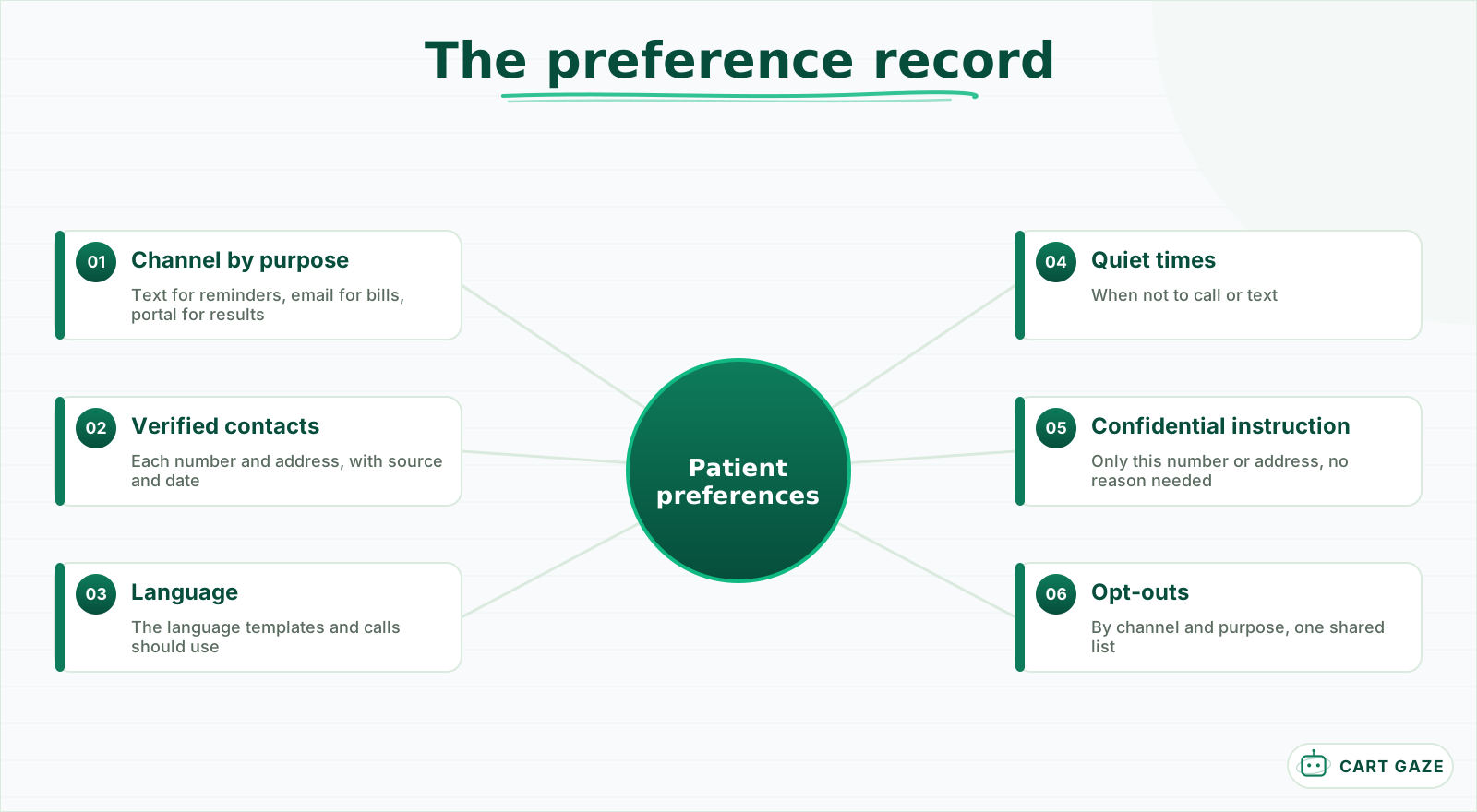 Six structured fields. Anything left in a note field is invisible to automation.
"Preferred channel" needs a purpose attached. Many patients want appointment reminders by text, statements by email, and anything about results by portal message. A single "preferred contact method" field forces one answer to three different questions, and every automation then guesses.
Numbers and addresses need a source and a date. A mobile number the patient gave at intake last month is not the same as one copied from a referral fax two years ago, and the difference matters both for reaching them and, for automated texts, for consent.
Ask for preferences the same way every time, on the intake form and again on the first call. Three questions cover most of it: "How would you like reminders, and how would you like bills?" "Is there any number or address we should not use?" "What language do you prefer for your care?" The second question is the one most forms leave out, and it is the one that carries legal weight.
Keep the record short enough that the front desk will fill it in. Six fields, captured at intake and confirmed once a year, beats a twenty-field form that is half empty.
Law versus expectation
Some preferences are legal obligations and some are service expectations, and the record should mark which is which. A confidential-communication request, a language need, and a text opt-out carry legal weight. A preferred time of day or a preference for email over text is courtesy you should still honor, but differently.
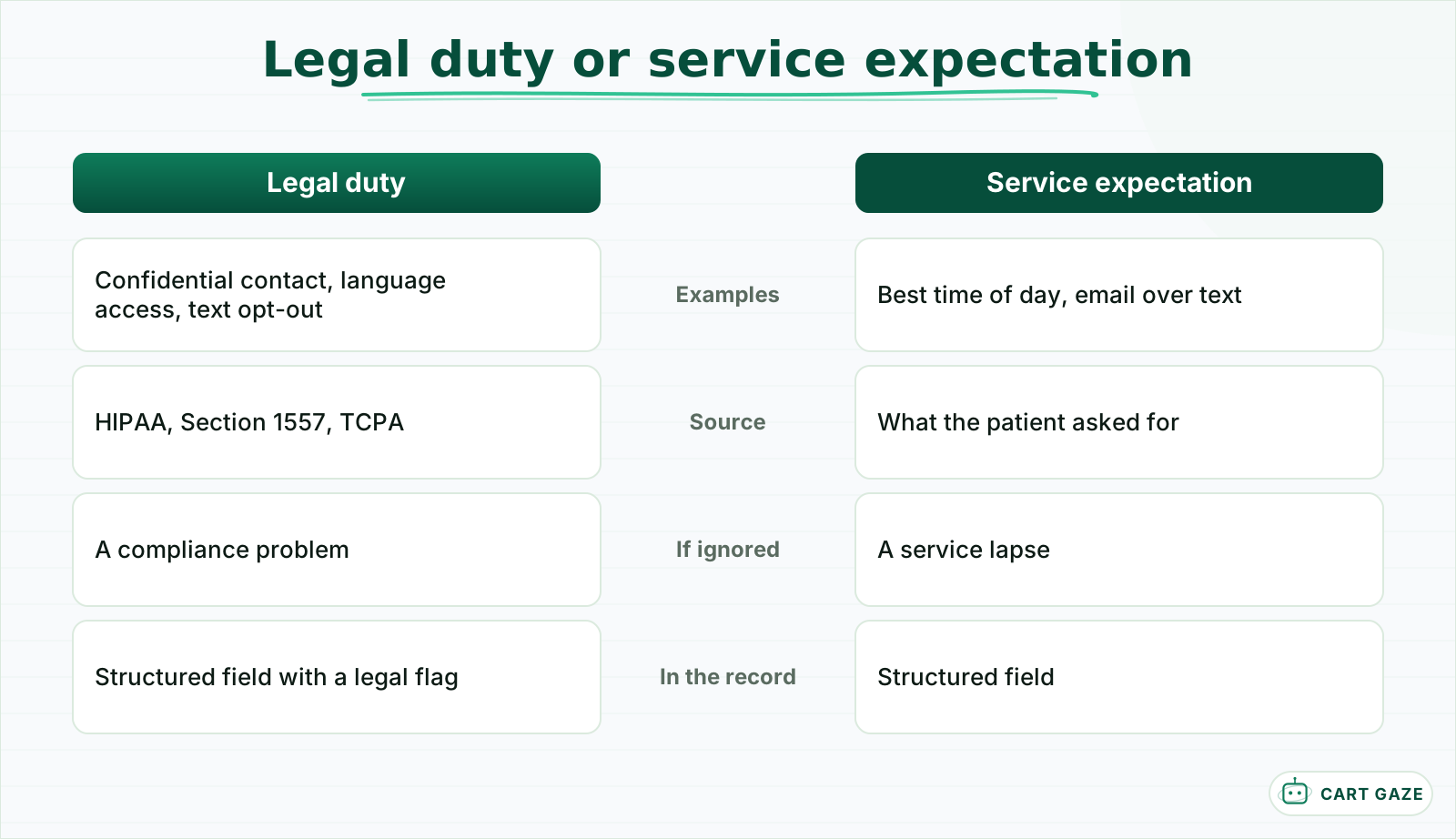 Automation treats both kinds alike unless the record says which is which.
The difference matters when something goes wrong. Calling at 6:45 p.m. when a patient asked for mornings is a service lapse. Calling a home number the patient asked you not to use, after they requested confidential communications, is a HIPAA problem. Texting after a STOP reply is a TCPA problem. Automation treats all three as the same kind of data unless you tell it otherwise, so the record should carry a flag for the legally binding ones.
This is also why preferences belong to the patient, not the workflow. The billing team, the recall campaign, and the reminder system should all read one record, not keep their own copies that drift apart.
Confidential communications: the preference you must honor
Under HIPAA, a provider must accommodate reasonable requests to receive communications by alternative means or at alternative locations, and may not require the patient to explain why. A patient who asks for calls only on her mobile, or mail only to a work address, is exercising that right.
The rule is 45 CFR 164.522(b). A covered health care provider must permit patients to make the request and must accommodate reasonable ones. The provider may require the request in writing and may ask for the alternative address or method of contact, and, where appropriate, how payment will be handled. It may not ask for a reason.
The reasons are often serious: a patient keeping care private from a partner, a teenager's confidential visit, a patient whose household is not safe. That is exactly why the instruction has to reach every automated system, including billing statements and reminder calls, not only the front desk's memory.
Two situations need extra care. Adolescents who receive confidential services under state law may need communications routed away from a parent's phone or portal, and the rules vary by state. And the health plan is a separate covered entity: the same regulation lets a plan require the patient to say that disclosure could endanger them, so a patient who asks you for confidential contact may also need to ask their plan about where statements go.
Warning
A confidential-communication instruction recorded only in a note field will be ignored by every automated reminder, recall, and billing message. Record it in a structured field that each system checks before sending anything.
Consent to be contacted at all is a separate record, and how to capture it so it holds up is covered in consent management automation.
Language: record it, then actually use it
Recording a patient's language is the easy part. Section 1557 requires practices it covers to take reasonable steps to give patients with limited English proficiency meaningful access, with qualified interpreters, qualified translators, and human review of machine translation for critical text. A language field that nothing reads does not meet that.
The rule is 45 CFR 92.201. Language assistance must be free, accurate, and timely, and must protect the patient's privacy and independent decision-making. When interpretation is required, the practice must offer a qualified interpreter. When translation is required, it must use a qualified translator, and if it uses machine translation for text that is critical to the patient's rights, benefits, or access, or where accuracy is essential, a qualified human translator must review it.
A separate rule, 45 CFR 92.11, requires covered entities to post a notice that language assistance is available free of charge, in English and in at least the 15 languages most commonly spoken by people with limited English proficiency in their state, on their website and in physical locations.
Ask the question in a way that captures both spoken and written needs. Some patients are comfortable reading English reminders but want an interpreter for a clinical conversation; others read their own language better than they speak English. Two fields, spoken and written, avoid the wrong guess.
For automation, this means templates, not live translation. Have each patient-facing template, such as a reminder, a recall, or pre-visit instructions, translated once by a qualified translator into the languages your patients actually speak, and have the system choose the template from the language field.
The phone works the same way. An AI receptionist that handles a patient's language can answer routine calls in it; one that does not must route the caller to staff with an interpreter, not push on in English. What it does and where it hands off is set out in what an AI receptionist does and where it stops. It never assesses symptoms or gives medical advice in any language.
Where preferences live, and how automations read them
In most practices, preferences are scattered: a phone type field, a language field that may or may not be filled, a portal setting, and free-text notes. Automations read structured fields only. Map where each preference lives, move the legally binding ones into fields, and make every sending system check them first.
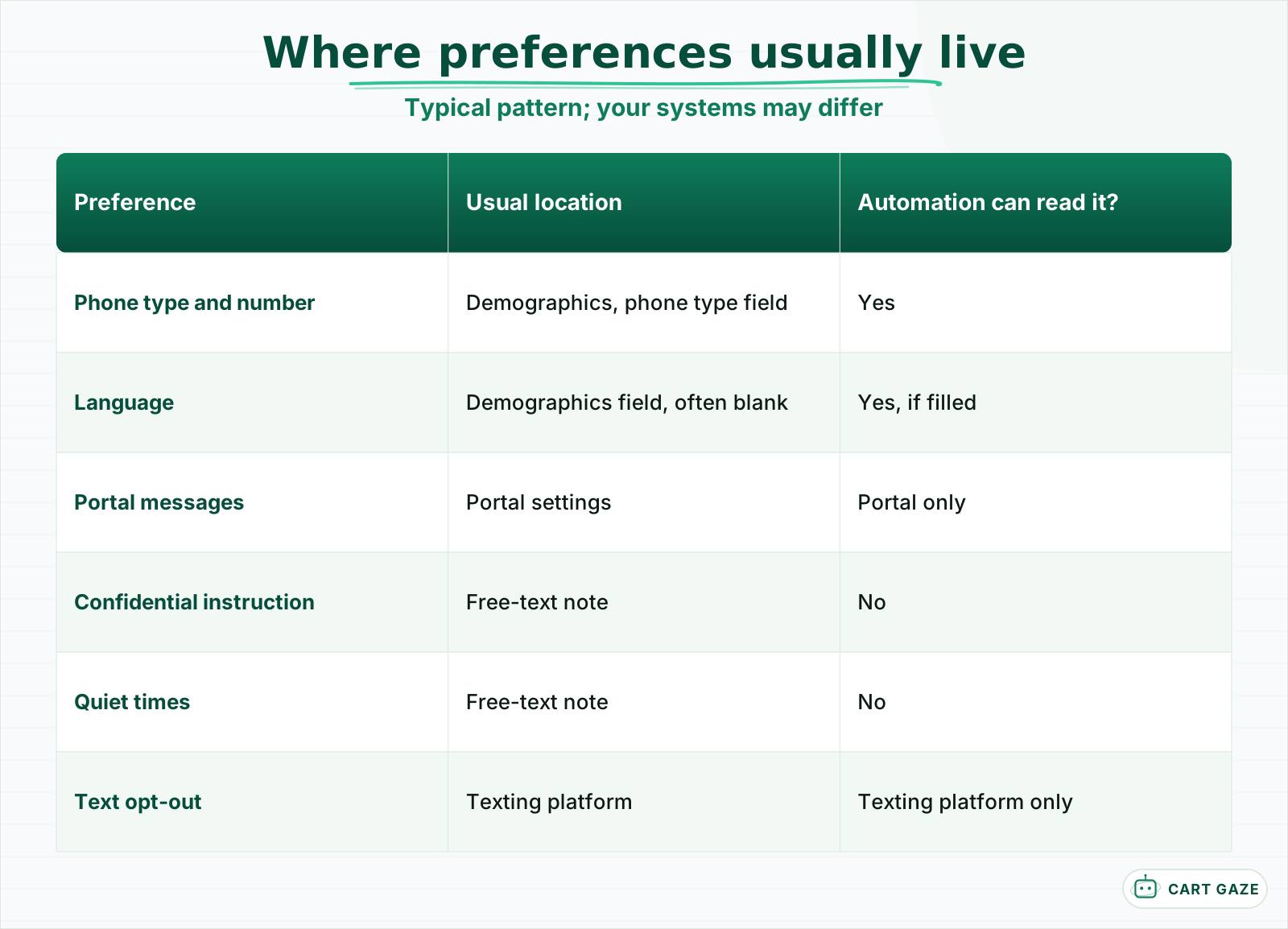 Most failures start in the last column: preferences that live where automation cannot look.
Practice management systems differ, but the pattern repeats. Phone numbers usually have a type (home, mobile, work) and sometimes a "do not use" flag. Language often exists as a demographic field. Portal message preferences live in the portal. Confidential-communication instructions, time-of-day preferences, and "text me, don't call" usually end up in notes, which is where automations cannot see them.
Pick one system as the source of truth, usually the practice management system, and sync everything else to it. If the texting platform records a STOP reply, that opt-out should flow back to the patient record the same day, so the recall campaign run from a different tool sees it. Where two systems disagree, the more restrictive preference wins until someone confirms it with the patient.
The fix is a short list of structured fields and one rule: no automated message goes out without checking them. Here is what each common automation has to read before it sends.
| Automation | Must check before sending |
|---|---|
| Appointment reminders | Channel for reminders, confidential instruction, text opt-out, language |
| Recall and reactivation | Channel for outreach, marketing opt-out, language |
| Billing statements | Confidential address, channel for billing, language |
| Results-ready notices | Channel for clinical notices, confidential instruction |
| Surveys | Text opt-out, channel for surveys, language |
| AI receptionist callbacks | Number to use, confidential instruction, language |
Tip
Test each automation with a dummy patient whose record carries every restriction at once: a confidential instruction, a text opt-out, and a non-English language. Anything that reaches that test patient in the wrong way is a real bug.
Opt-outs are per channel, and per purpose
An opt-out applies to the channel and purpose the patient used it for, unless your policy is stricter. A STOP reply to a reminder text ends automated texts under that consent; it does not, by itself, cancel email statements. Record opt-outs by channel and purpose, and let every system read the same list.
Federal rules are moving toward broader revocation. The FCC's rule that would make one revocation apply to all of a sender's message categories has had its effective date pushed back twice and is now set for January 31, 2027, as of September 2026, with an open FCC proceeding that could move it again. Re-check the date before relying on it.
Many practices choose a simpler, stricter rule now: one opt-out on a channel stops everything on that channel. It costs a few reminders and removes a class of mistakes. What counts as a valid revocation, and how the TCPA and HIPAA overlap, is covered in TCPA compliance for automated patient texting.
Before any automation contacts a patient
- It reads a structured confidential-communication field.
- It reads opt-outs by channel and purpose from one shared list.
- It picks a reviewed template from the language field.
- It never reads preferences from free-text notes.
Build preferences into every workflow
Capture six structured fields at intake, confirm them yearly, and make every automated message check confidential instructions, opt-outs, and language before it sends. Mark which preferences are legal duties. Then test every workflow with a patient record that carries every restriction at once, and fix whatever gets through.
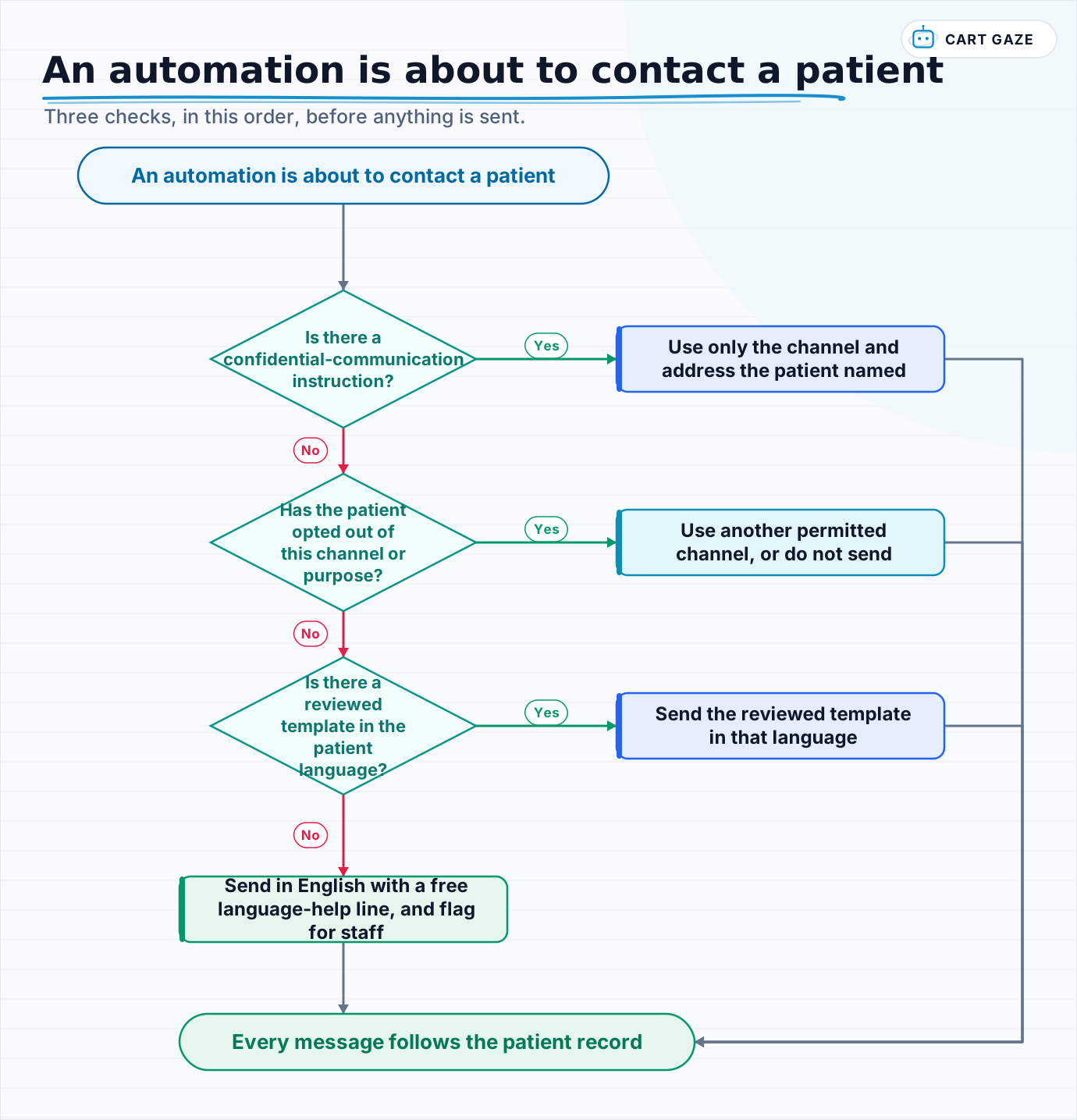 Three checks, in this order, before anything is sent.
Walk each automated message through the flow once. Most practices find at least one system, often billing, that reads its own copy of the patient's contact details and ignores the rest.
For the compliance questions this raises, including which vendors need a BAA and what gets logged, see the compliance answers, including BAAs and what gets logged.
Fair questions.
What should a patient communication preference record include?
Six structured fields: the preferred channel for each purpose, a verified number or address for each channel, the patient language, times not to contact, any confidential-communication instruction, and opt-outs by channel and purpose. Capture them at intake and confirm them yearly. Anything kept only in a free-text note will not be honored by automated systems.
Do practices have to honor a request not to call a home number?
Generally yes. Under HIPAA, 45 CFR 164.522(b), a covered health care provider must accommodate reasonable requests to receive communications by alternative means or at alternative locations. It may require the request in writing and ask for the alternative contact, but it may not require the patient to explain why. Every automated system must honor it.
What does Section 1557 require for patient language preferences?
Covered practices must take reasonable steps to give patients with limited English proficiency meaningful access, free of charge, using qualified interpreters and translators. Machine translation of critical text must be reviewed by a qualified human translator. A notice of free language help must be posted in English and at least the 15 most common languages in the state.
Does a STOP reply to a text cancel email and phone contact too?
Not automatically. A STOP reply revokes consent for the texts it covers. The FCC rule that would extend one revocation across message categories is set for January 31, 2027 as of September 2026, and it has moved before. Many practices choose a stricter rule now: one opt-out on a channel stops everything on that channel.
How do automations know a patient communication preferences?
Only if the preferences sit in structured fields that each system checks before sending. Reminders, recalls, billing statements, surveys and AI receptionist callbacks should all read the same record. Test each one with a dummy patient carrying a confidential instruction, a text opt-out and a non-English language, and fix anything that gets through.
Sources.
Written by

Muhammad Qasim Hammad
Founder, Cart Gaze
Qasim builds AI receptionists and front-office automation for medical and dental practices at Cart Gaze. Posts here start from published sources and real call data, not vendor claims, and every number links back to where it came from.
Keep reading.
 Trust & CompliancePatient Consent Management Automation You Can Prove, Not Promise11 min read
 Trust & ComplianceTCPA Compliance for Patient Texting: The Rule HIPAA Misses10 min read
 Trust & ComplianceMinor Consent and Guardian Verification: Who Can Book a Visit12 min read
 Trust & ComplianceAI Agent Audit Trail in Healthcare: What You Must Log and Keep11 min read
 Trust & ComplianceSection 1557 Language Access: What Practices Must Provide10 min read
 Trust & ComplianceGood Faith Estimate Rules: What Your Front Desk Owes Patients10 min read