
Google Local Services Ads for Medical Practices in 2026
Google Local Services Ads work differently in health care: 15 listed categories, phone leads only, no lead credits, and a ranking that weighs whether you answer. Here is what Google's own pages say.
Key takeaways.
- As of October 3, 2026, Google's US help center lists 15 health care categories; pediatrics, OB-GYN, cardiology and behavioral health are not among them.
- Health care leads are phone calls only: Google says message leads, booking leads, call recordings and lead credits are unavailable for health care verticals.
- Verification covers background checks, state licenses, NPI, general liability and malpractice insurance, and Google says it averages 3 to 4 weeks.
- Google publishes no fixed lead price; the monthly cap is your weekly budget times 30.4 divided by 7, so a $500 weekly budget caps a month at $2,171.43.
- Google names responsiveness as a ranking factor and says missed calls may hurt it, so schedule the ad for hours someone answers and log every Google call.
Table of Contents8 sections
- Which health care practices can run Local Services Ads?
- What is different about a health care lead?
- How does verification work, and what happened to Google Screened?
- What do you pay for, and what does a lead cost?
- Can you dispute a bad lead in a health care category?
- How does answering the phone affect your ranking?
- Who should answer a pay-per-lead call?
- Fair questions
Search "dentist near me" on Google and the page may open with a short row of ads showing star ratings and a Google Verified badge. Each practice in that row pays only when a patient gets in touch, not when someone clicks. That is Google Local Services Ads, and in health care it runs under narrower rules than in most other categories.
As of October 3, 2026, Google's US help center lists 15 health care categories for the program. Every one of them receives phone leads only: Google's pages say message leads, booking leads, call recordings and automatic lead credits are all unavailable for health care. Google puts verification at 3 to 4 weeks on average, and the program is moving into Google Ads in phases through 2027.
This post works from Google's own help pages, read on that date: which practices qualify, what the checks involve, what counts as a chargeable lead, what you cannot dispute, how answering feeds your ranking, and who should pick up. Google changes this program often, so treat every list here as a snapshot.
Which health care practices can run Local Services Ads?
Google's US help center lists 15 health care categories as of October 3, 2026, from dentist and primary care physician to podiatrist and plastic surgeon. Many specialties are missing, availability depends on your area, and the list changes, so run Google's eligibility check before you plan a budget.
Google keeps two lists, and they do not match. The help center's screening requirements page groups 15 categories under health care. Google's Local Services Ads product page lists 11 health services as eligible for the Google Verified badge. The 4 that appear only on the help center list are audiologist, occupational therapist, orthopedic surgeon and plastic surgeon. This post follows the help center, the more detailed of the two.
| Group | Categories on Google's US help center list | Also on Google's product page? |
|---|---|---|
| Dental | Dentist, orthodontist | Yes, both |
| Physician | Primary care physician, allergist, dermatologist, ophthalmologist | Yes, all four |
| Surgical | Orthopedic surgeon, plastic surgeon | No |
| Eye and foot | Optometrist, podiatrist | Yes, both |
| Therapy and rehab | Physical therapist, chiropractor, occupational therapist | Physical therapist and chiropractor only |
| Other | Audiologist, dietitian | Dietitian only |
What is missing matters as much as what is listed. Neither list includes pediatrics, OB-GYN, cardiology, behavioral health, urgent care or oral surgery. There is no med spa category; the nearest listing, hair removal, sits under beauty. Acupuncturist, massage therapist and weight loss service appear under wellness, with their own checks and no NPI requirement.
If your specialty is missing, the routes to the same results page are your Google Business Profile and standard Search ads. The profile matters to Local Services Ads anyway, because Google verifies you through it and pulls your reviews from it. What can safely run on a schedule there, and what a person should still handle, is covered in how to keep a Google Business Profile accurate without risking patient privacy.
What is different about a health care lead?
Health care gets a narrower product. Google's pages say message leads, booking leads, call recordings, automatic lead credits and pre-badge ads are unavailable for health care verticals. A health care lead is a phone call to a Google forwarding number, and what happens on that call is the whole lead.
For most other categories, Google promotes message and booking leads as a way to collect leads at night and on weekends, when nobody can answer the phone. Its ranking page says enabling them can increase the likelihood of receiving a lead. A health care advertiser cannot pull that lever, which leaves the phone as the only door.
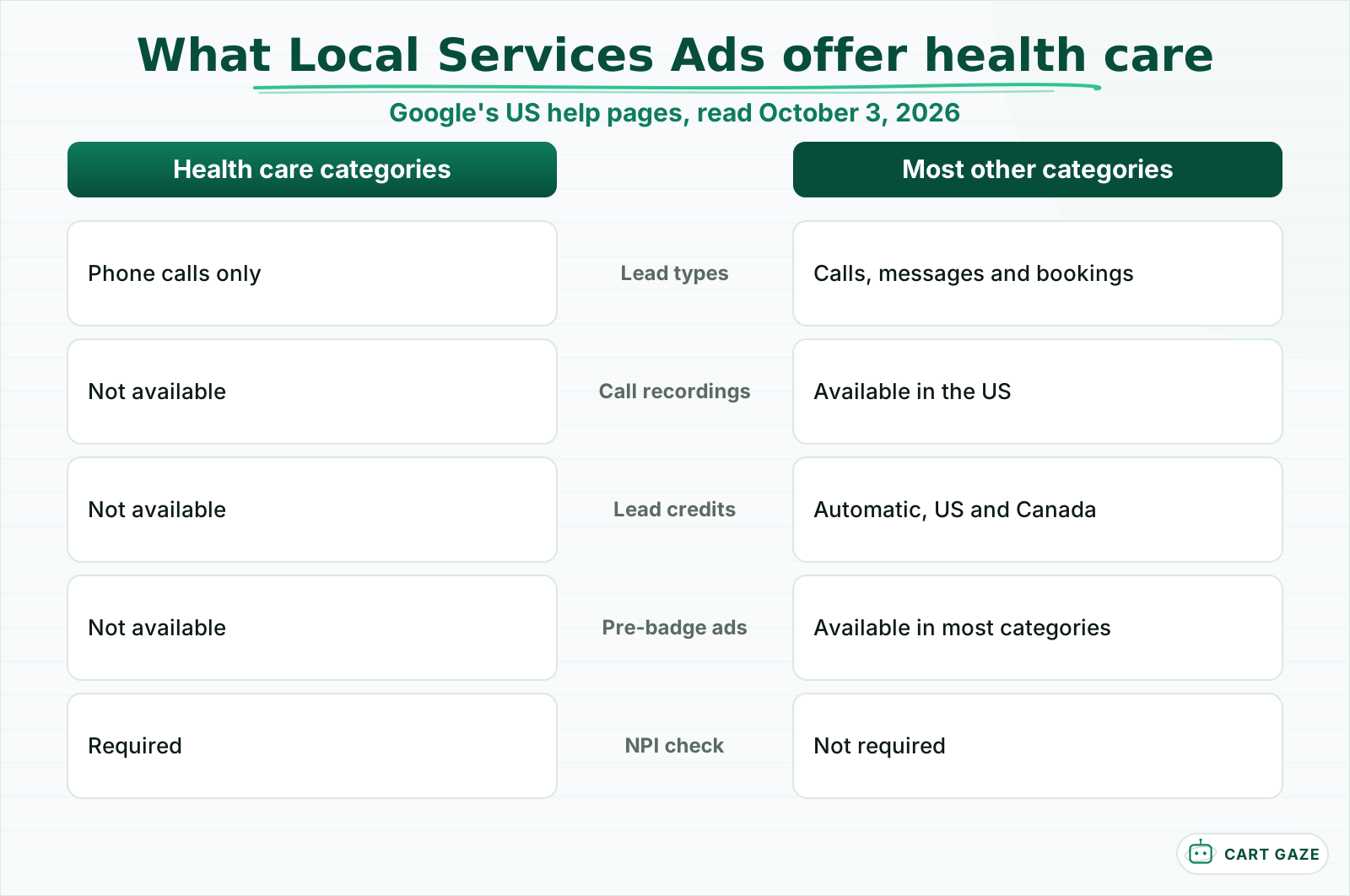 Health care gets phone leads only. Every other route to a patient runs outside the ad.
The number on your ad is not your number. Google shows a dynamic forwarding number that changes as different people search, and you cannot choose it. Calls to it ring through to your business line, and you hear "Call from Google" when you pick up. Google notes that you may not hear that announcement if your line uses call forwarding or VoIP, so test how your own system handles it. If staff cannot tell an ad call from any other, nobody can count them later.
There is also no recording to go back to. Google's lead inbox lets other categories replay a phone lead, but its pages say recordings aren't available for health care verticals. When a caller says they were never offered an appointment, your own notes are the only record.
The missing pre-badge option affects your start date. Some categories can start receiving leads, ranked below verified providers, while their remaining checks finish. Health care cannot, so the ad does not run until verification is complete.
Warning
We found an agency setup guide for health care advertisers that still promises message leads, the Google Screened badge and credits for disputed leads. Google's current pages say none of those applies to health care, so budget as if every charged call is final.
How does verification work, and what happened to Google Screened?
Every health care advertiser passes Google's screening before the ad runs: background checks on provider and practice, state licenses where local law requires them, NPI verification, general liability and malpractice insurance, and a verified Business Profile. Google says the process averages 3 to 4 weeks after you submit your documents.
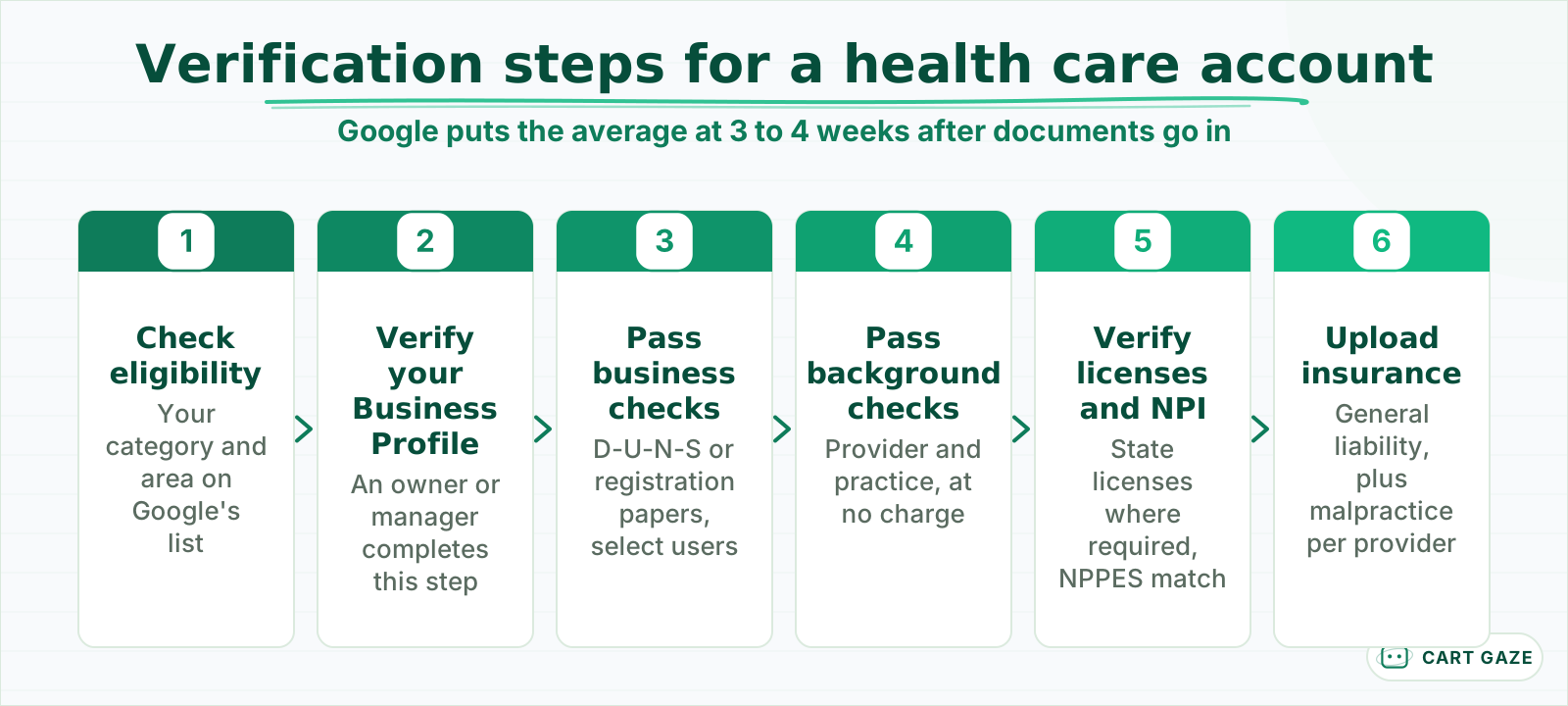 Google says screening averages 3 to 4 weeks after documents go in. The ad waits until it finishes.
The NPI check is specific to health care. Google says it verifies the National Provider Identifier through the NPPES registry, and if it finds no NPI or more than 1, the provider has to call Local Services support. A business can hold several NPIs; an individual holds 1.
Insurance comes in two parts. The practice uploads its general liability certificate on the main verification page, and each provider's professional liability or malpractice certificate goes in with that provider's license details. Google asks for a document that is valid for at least 14 days after you submit it, shows a policy number, and carries the name you advertise under, or a Doing Business As document that ties the two together.
Background checks are run by Google's partners at no charge to the practice, and they do not involve a credit check. If a check fails and the final decision stands, Google says the business waits 30 days to reapply, and 180 days after a second denial.
Some US advertisers also face a business registration check. Google uses a D-U-N-S number from Dun & Bradstreet, which can take up to 30 days to obtain, or accepts a state business registration, an IRS EIN or a Department of Revenue registration instead. Start this early if the name on file does not match your Business Profile exactly.
Checks are not one-time. Google re-evaluates advertisers and says a business that skips a requested review can lose its badge, have its ads paused or have its account suspended.
Now the badge. Many guides still tell practices to earn the Google Screened badge, but health care never carried it. Archived copies of Google's help pages show Google Screened covered professional services, home, wellness and similar categories, while health care carried a separate License Verified by Google badge. In an August 20, 2025 announcement, Google said a single Google Verified badge would replace Google Guaranteed, Google Screened and License Verified by Google from October. Profiles now show that badge alongside the specific checks a business has passed.
What do you pay for, and what does a lead cost?
You pay per valid lead, not per click, and Google does not publish a fixed price. Its help pages say lead prices vary by location, job type, lead type and bidding mode, and Google offers a budget estimate tool instead. Your spending is set by a weekly budget and a monthly cap.
For a health care category, Google's list of valid leads comes down to four situations:
- You answer the call and speak with the caller.
- The caller leaves a voicemail.
- The caller meaningfully engages with an automated system, for example by requesting a callback or scheduling an appointment.
- You miss a call with no voicemail, then return it by call, text or email and either reach the caller or leave a voicemail.
Google says it assesses each lead at first contact and does not charge for leads it judges invalid or low quality. One more free case: with direct business search on, your ad can appear when a patient searches your practice name, Google asks the caller whether they are a returning customer, and you are not charged when they say yes.
The budget math is Google's own. Your monthly maximum is your average weekly budget times 30.4, divided by 7. Take a hypothetical $500 weekly budget: the month is capped at $2,171.43. Some weeks may run over $500 when demand is high, but the month will not pass the cap, and once it is reached the ad stops until the next month.
There are three bid modes. Maximize leads lets Google set the bid, and Google recommends a budget of at least 10 leads a week for it. Target cost per lead aims for an average. Max per lead is a hard ceiling. Google says results take about 2 weeks to settle.
Important
Never ask a caller from the ad to hang up and dial your main number. Google's Local Services policy names diverting customers to a different phone number to avoid paying for a lead as monetization abuse.
Agency guides publish average per-lead prices for dental Local Services Ads, and they do not agree with each other. None is a Google figure, so we have left them out. What paid Search and Meta leads cost practices, and how to work them, is covered in how to score and work paid-ad leads before they go cold.
The move into Google Ads
Google is moving Local Services Ads into Google Ads as Performance Max campaigns with pay-per-lead goals. Its timeline starts with home and storefront services in August 2026, widens in late 2026, and moves the remaining categories in 2027. Health care is not named, so watch for the email Google sends 14 days before your date.
The pay-per-lead model and the ad positions stay the same. Manual Max per lead bidding goes away, weekly budgets become daily ones, and the monthly cap becomes the daily budget times 30.4. Past performance reports do not carry over, so download or screenshot them before your migration date.
Can you dispute a bad lead in a health care category?
Not for money back. Google's lead credit page says lead credits aren't available for health care verticals, and its "How to dispute charges" link opens the same page. You can rate a lead in the feedback survey, which Google says shapes the leads it sends, but a charged lead stays charged.
In other categories, Google reassesses charged leads and can credit low-quality ones automatically, usually within 30 days. Health care is excluded from that system. A call that Google's first-contact screening judges invalid or low quality is still not charged, but once a call is charged, there is no route back.
That moves your controls upstream. Google's advice for unwanted leads is to revisit your service areas, job types and categories, and each of those is yours to set. List only the services you want new patients to call about, draw the service area around where your patients actually travel from, and schedule the ad for hours when someone answers.
The other control is your own record. Without recordings or credits, a simple lead log is the only evidence you have. For each Google call, note the date and time, whether it was answered or missed, whether the caller was new or existing, and whether a visit was booked.
Divide a month's spend by the booked visits in the log for a cost per booked visit, the number worth comparing across channels. As a hypothetical, $2,171.43 spent and 25 visits booked is $86.86 per booked visit.
How does answering the phone affect your ranking?
Google ranks Local Services ads in an auction that weighs your bid, how likely your ad is to produce a lead, and your profile quality. It names responsiveness as a factor and says missed calls may hurt it, but it publishes no answer-rate threshold, so the cost of each miss is unknown.
Your bid sets the most you will pay. Likelihood of a lead covers your responsiveness, the context of the search and how relevant your services are to it. Profile quality covers your rating, number of reviews, average response time, high-quality images and the verification checks you have completed. Elsewhere, Google is blunter: if you regularly fail to answer calls, your ad ranking may be affected, and a consistently fast response time could improve it.
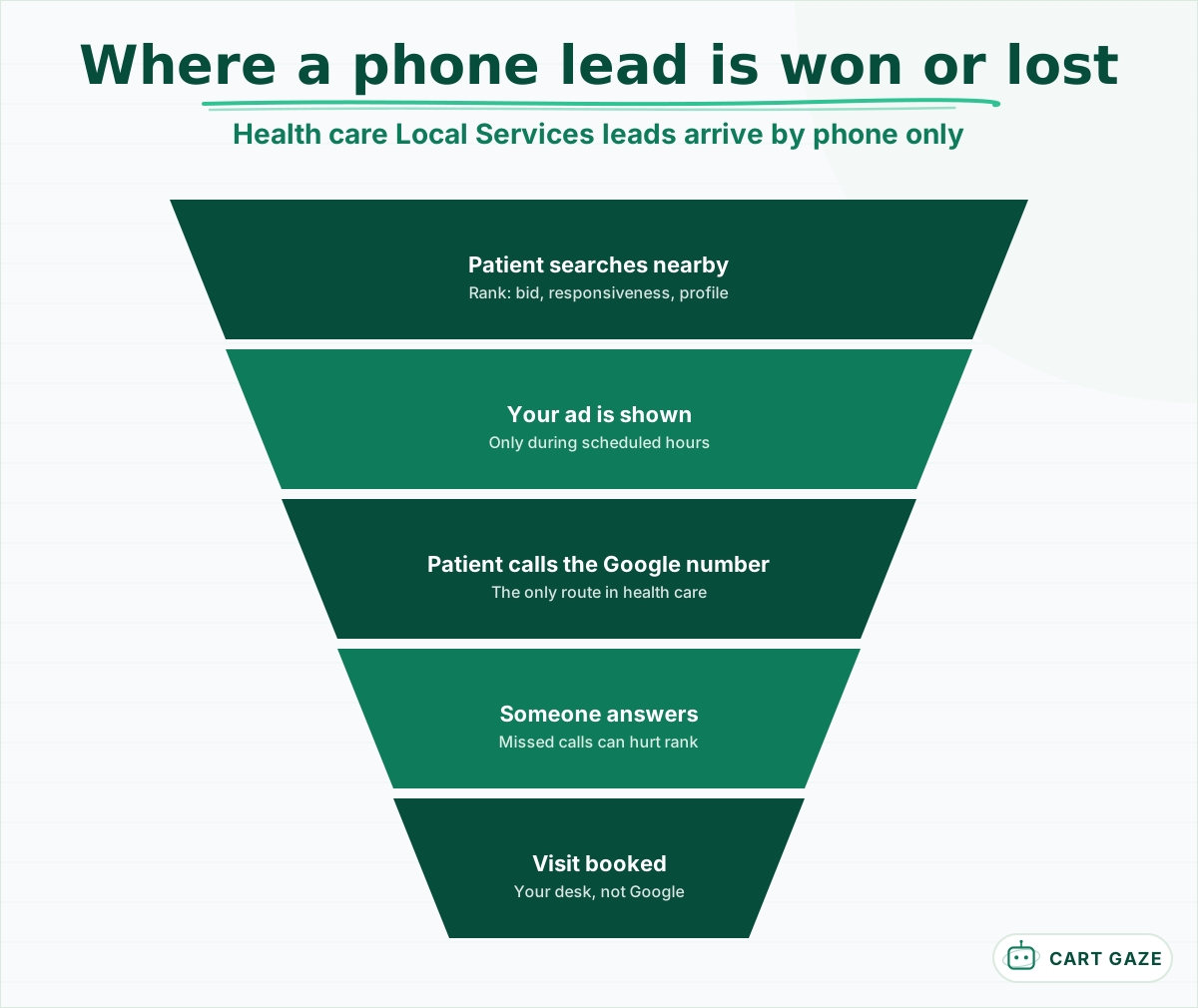 Google decides who appears. Your phone decides who books.
Reviews feed the same auction. Google says star ratings and review counts affect how your business ranks, that the reviews come from your Business Profile, and that some business types need 5 reviews before the ad shows.
Because health care has no message or booking leads, a patient who cannot get through has no other way to reach you through the ad. Google's ad schedule offers three settings: all day, which is the default, your business hours, or custom hours. Google's own example is to run the ad when you can respond to customer calls in a timely manner.
Tip
Set the ad schedule to the hours someone actually answers, not the hours the office is open. Outside your scheduled hours, Google says a free version of your listing may still appear.
Groups have one more rule to plan around. If several of your locations serve the same area, Google shows only the highest-ranking ad for a search, so your locations compete with each other before they compete with anyone else.
The missed call has a twist. A missed call with no voicemail becomes a valid, chargeable lead once you call back, and Google's list does not count one you never return. Skipping the callback is no saving: Google says missed calls may hurt your responsiveness, and the patient is calling someone else. The best-value Google call is the one answered the first time.
Who should answer a pay-per-lead call?
Whoever answers must pick up during the ad's hours, use the practice name on the ad, and book the visit or capture a callback. That can be the front desk, a live answering service, an AI receptionist or a mix, as long as every Google call has an owner and an outcome.
Google's policy sets two limits. Your communications with callers should use the same name and branding as your ad, and advertising for a call center that re-routes requests to other businesses is not allowed.
Google also counts an automated answer as a real lead when the caller meaningfully engages, such as by requesting a callback or scheduling. An automated answer is charged like any other, so it should end with something the patient can act on, not a dead-end menu.
The options trade off differently. The front desk knows your schedule but is busiest when the phone rings most. A live answering service puts a person on the line but may only take a message. An AI receptionist can answer several calls at once and should hand clinical questions to a person, never assess symptoms. Where that handoff sits is laid out in what an AI receptionist does and where it stops.
Lead details, from a caller's name and number to the reason they give for calling, can include health information, so keep your call log and notes under your HIPAA policies and confirm the setup with your privacy officer or counsel.
Before you switch the ad on
- Your category is on Google's US health care list for your area.
- Every provider's license, NPI and malpractice certificate is current.
- The ad schedule matches the hours someone can answer the phone.
- A log records each Google call as answered or missed, and booked or not.
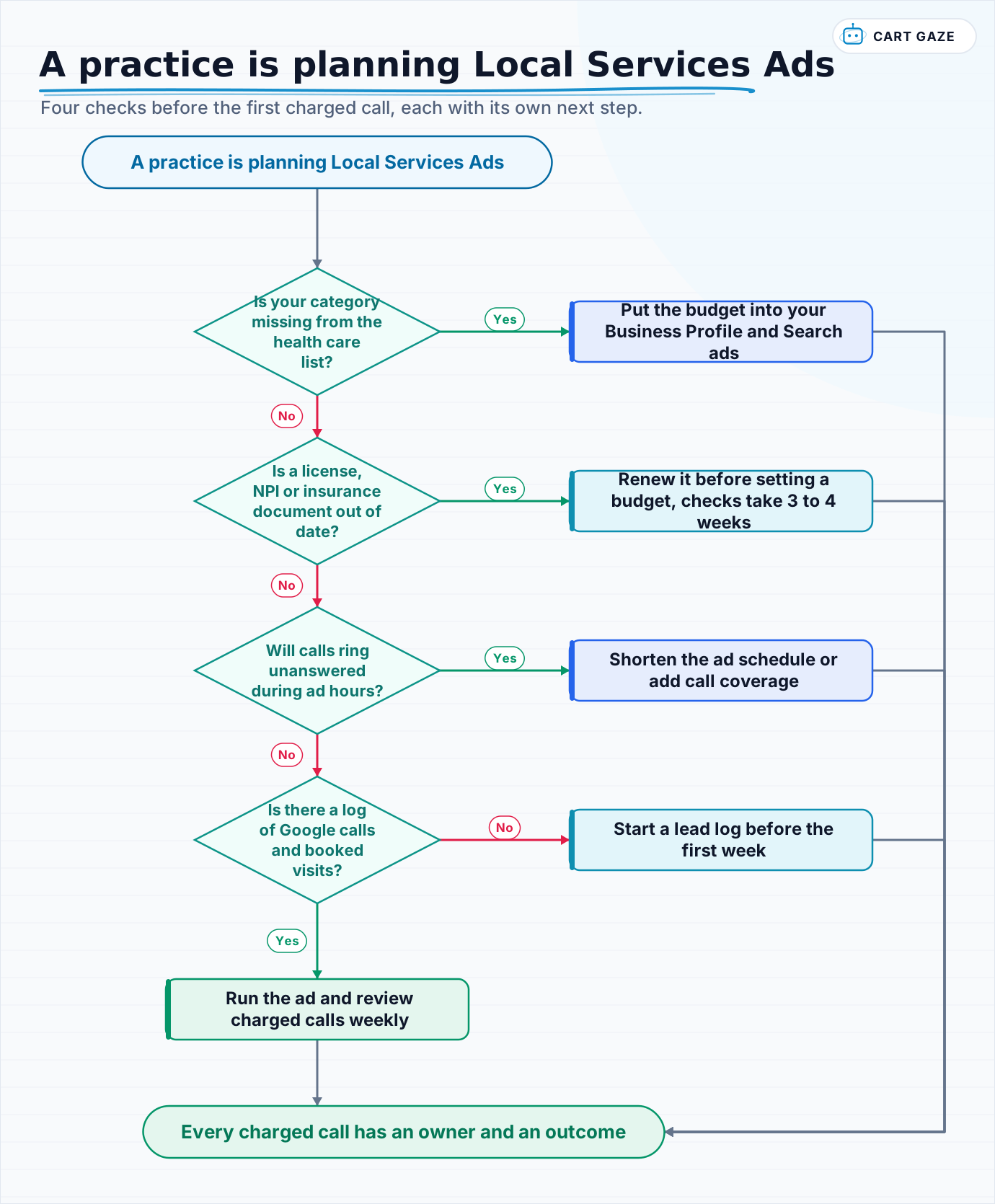 Four checks before the first charged call, each with its own next step.
Walk the ladder once for your practice. A missing category means the budget belongs elsewhere. A lapsed document means a delay. Unanswered hours mean a shorter schedule or more coverage. A missing log means nobody can say what the spend bought.
When the gap is pay-per-lead calls ringing out while the ad is live, a side-by-side of an AI receptionist and a live answering service compares who answers, the cost model and where each hands off to staff.
Fair questions.
Can dentists and doctors use Google Local Services Ads?
Yes, in the categories Google lists. As of October 3, 2026, Google's US help center lists 15 health care categories, including dentist, orthodontist, primary care physician, dermatologist, optometrist, chiropractor and physical therapist. Pediatrics, OB-GYN, cardiology, behavioral health and urgent care are not on it. Availability also depends on your area, and Google changes the list, so run its eligibility check first.
Do health care Local Services Ads get message or booking leads?
No. Google's help pages say message leads, booking leads and call recordings aren't available for health care verticals. A health care lead arrives as a phone call to a Google forwarding number, which rings through to your practice line. That makes answering the phone, during every hour the ad runs, the part of the program a practice controls most.
How much does a Local Services lead cost for a medical practice?
Google does not publish a fixed price. Its pages say lead prices vary by location, job type, lead type and bidding mode, and it offers a budget estimate tool. You set an average weekly budget, and the monthly maximum is that budget times 30.4 divided by 7, so a $500 weekly budget caps the month at $2,171.43.
Can a practice get credit for a bad Local Services lead?
Not in a health care category. Google states that lead credits are not available for health care verticals. Google does assess each lead at first contact and does not charge for leads it judges invalid or low quality, and you can rate a lead in the feedback survey to shape future leads, but a charged health care lead stays charged.
What happened to the Google Screened badge?
Google replaced it. In an August 20, 2025 announcement, Google said a single Google Verified badge would replace Google Guaranteed, Google Screened and License Verified by Google from October 2025. Health care listings had carried License Verified by Google rather than Google Screened. New advertisers now earn Google Verified by completing screening and verification.
Sources.
- [1]Getting started with Local Services Ads, United States (Google Local Services Help)
- [2]Business screening and verification requirements (Google Local Services Help)
- [3]Understand the screening and verification process (Google Local Services Help)
- [4]Uploading license or insurance documents (Google Local Services Help)
- [5]About Google Verified badge (Google Local Services Help)
- [6]Google Verified makes it easier to find trusted local businesses (Google blog, Aug 20, 2025)
- [7]About License Verified by Google (Google help page, archived May 8, 2025)
- [8]About Google Screened (Google help page, archived Aug 5, 2025)
- [9]How leads work (Google Local Services Help)
- [10]About Automated Local Services Ads lead credits (Google Local Services Help)
- [11]How bidding works for Local Services Ads (Google Local Services Help)
- [12]How to edit your budget (Google Local Services Help)
- [13]About ad rankings (Google Local Services Help)
- [14]Manage leads and jobs (Google Local Services Help)
- [15]About ad scheduling (Google Local Services Help)
- [16]About direct business search (Google Local Services Help)
- [17]Reviews and ratings on Local Services Ads (Google Local Services Help)
- [18]Improve your Local Services Ads performance (Google Local Services Help)
- [19]Local Services Ads requirements (Google Advertising Policies Help)
- [20]Local Services Ads transition to Performance Max campaigns with pay-per-lead goals (Google Ads Help)
- [21]Local Services Ads product page with eligible health services (Google)
Written by

Muhammad Qasim Hammad
Founder, Cart Gaze
Qasim builds AI receptionists and front-office automation for medical and dental practices at Cart Gaze. Posts here start from published sources and real call data, not vendor claims, and every number links back to where it came from.
Keep reading.
 Patient Acquisition & GrowthPatient Referral Programs: Ask More People, Reward Carefully10 min read
 Patient Acquisition & GrowthGoogle Business Profile Automation Without a HIPAA Slip10 min read
 Patient Acquisition & GrowthLead Scoring for Paid Ads: Stop Wasting Spend on Cold Leads10 min read
 Patient Acquisition & GrowthTurn Website Chat Into Booked Appointments the Compliant Way11 min read
 Patient Acquisition & GrowthCall Tracking Numbers for Medical Practice Marketing, Done Safely10 min read
 Patient Acquisition & GrowthConsultation Follow Up That Converts Without Pressure9 min read